JKSCI
A Study on the Effect of Basic Life Support Training on the First Responsive Police Officers
1)
Byung-Tae Jo*, Seon-Rye Kim**
*Student, Dept. of Administration, Daejeon University, Daejeon, Korea
**Adjunct Instructor, Dept. of Pharmacy, Kangwon National University, Chuncheon, Korea [Abstract]
The study was conducted to verify the effect of basic life support training on the skill ability of police officers. The subjects of this study were 10 experimental group and 10 comparative group with voluntary consent after explaining the theory and significance of the training experiment at the police station located in K. The education program used in this study consists of theoretical education and practical training, and the theoretical education is 60 minutes and the practical training is 30 minutes. The measurement tool for basic resuscitation performance was measured based on the ‘CPR and ECG Guidelines for Cardiopulmonary Resuscitation and Emergency Cardiovascular Care’ presented by the American Heart Association. The results are as follows. The experimental group showed higher performance skills than the traditional control group in field confirmation performance skills, primary evaluation performance skills (A, B, C, medical evaluation), and BLS performance skills (heart compression, artificial respiration, medical evaluation) which are the basic resuscitation performance skills. In conclusion, this study confirmed that the theory and practice education program is more effective in improving the clinical performance of police officers than the traditional lectures and practice education, so it is possible to apply this simulation education program to the cardiac arrest patient emergency treatment.
▸Key words:
Basic Life Support(BLS), Police Officers, Cardiopulmonary Resuscitation, First Responser[요 약]
이 연구는 경찰관에게 실시한 기본인명소생술 훈련의 효과를 증명하기 위해 실시되었고 , 연구
대상자는 K 경찰관 중 10명의 실험군과 10명의 대조군으로, 교육프로그램은 60분 이론과 30분 실 습을 포함하였다. 기본인명소생술 술기 측정은 미국심장협회에서 제시한 응급 심혈관 치료의 가 이드라인을 따랐다 . 결과는 다음과 같다. 실험군에서 현장확인기술, 1차 평가수행기술 및 기본인 명소생술 능력(심장압박, 인공호흡, 의학적 평가)이 대조군에 비하여 높게 나타났다. 결론적으로, 이 연구결과는 시뮬레이션 교육프로그램이 전통적인 이론실습강의보다 경찰관의 임상술기능력을
향상시키는데 효과적이라는 것을 증명하였다 . 그러므로 시뮬레이션 교육프로그램을 심정지 응급
치료에 대한 교육프로그램으로 적용하는 것을 제안한다.
▸주제어: 기본인명소생술, 경찰관, 심폐소생술, 최초반응자
∙First Author: Byung-Tae Jo, Corresponding Author: Seon-Rye Kim
*Byung-Tae Jo ([email protected]), Dept. of Administration, Daejeon University **Seon-Rye Kim ([email protected]), Dept. of Pharmacy, Kangwon National University
∙Received: 2019. 08. 06, Revised: 2019. 09. 17, Accepted: 2019. 09. 17.
Copyright ⓒ 2019 The Korea Society of Computer and Information http://www.ksci.re.kr pISSN:1598-849X | eISSN:2383-9945
I. Introduction
CPR education should be designed to be universally conducted in a consistent form and the results can be shown as performance of the general public or medical personnel. The concept of survival chain for cardiac arrest patients was revised in 2015 to five chains: prevention and early detection of cardiac arrest, rapid call, rapid cardiopulmonary resuscitation, rapid defibrillation, effective professional resuscitation and post-cardiopulmonary treatment. Therefore, the educational goal of CPR is to allow cardiac arrest patients to receive the treatment based on the most recent medical knowledge that is constantly present, with the concept of chain of survival.
Early CPR, which is performed on the spot until professional CPR is performed by contacting the emergency medical system, plays a very important role in the prognosis of the patient and is usually done by non-medical personnel[1].
It is known that the survival rate of cardiac arrest patients is improved when CPR is performed rapidly by witnesses in the event of cardiac arrest.
However, if the basic lifesaving is provided at the sighting site after 8 minutes or more, the success rate of CPR will fall to 0%. The person who performed CPR at the sighting site is called the 'first responder', and since it is usually done by non-medical personnel, CPR education is spreading to the general public[1, 2].
The first responder is a police officer, firefighter, security officer, and security guard who are likely to be frequently contacted with these emergency patients or to be asked for help first in case of emergency patients. In developed countries, the education system for the first responders is well prepared, but the domestic emergency medical law does not define the concept of the first responder.
However, Article 14 of the Emergency Medical Care Act (Act on Rescue and First Aid), among the subjects of education, there are police officers who are engaged in road traffic safety work and are
prescribed in Article 5 of the Road Traffic Act. The Minister of Health and Welfare or the City and Governor of the Provincial Office can order the person who comes under one of the following arcs among the person who is not the emergency medical worker to receive the education about rescue and first aid [5,6].
The survival rate of cardiac arrest patients is 8.7% in Korea, and the survival rate of cardiac arrest patients outside the hospital in Korea is increasing recently, but it is still low compared to advanced countries such as the US, Europe and Japan. Cardiopulmonary Resuscitation (CPR) and Automated External Defibrillator (AED) are the most difficult causes of cardiac arrest in the three major causes of deaths every year due to emergency situations. However, various studies have shown that if appropriate first aid is performed in the field in a short period of time, the survival rate can be increased, which means that the benefits of following the resuscitation guidelines are greater than the potential risks [7, 8].
More than 80% of patients with acute cardiac
arrest are known to have heart disease, and the
cause of cardiovascular change is quickly identified
at the same time as CPR because it becomes
unconscious within one hour of the change of
cardiovascular state. If the blood flow to the tissue
is not smooth due to cardiac arrest, the oxygen in
the tissue is depleted, especially the oxygen in the
cerebral brain is depleted within 10 seconds, and
irreversible brain damage begins after 5 minutes. If
the cycle stop is not corrected after 4-10 minutes,
the heart rate will recover, but serious brain
damage will remain. In the case of a cardiac
rhythm requiring defibrillation in a cardiac arrest
situation, the survival rate decrease by 7-10% per
minute as defibrillating is delayed as the
defibrillating is the only treatment. Therefore,
cardiopulmonary resuscitation for the patient
treatment of police officers is very important and
should be performed effectively.
This study aims to compare and analyze the job performance before and after the rescue and first aid training for the first responder police officers.
II. Methods
1. Subjects of this study Related works
The subjects of this study were 20 new police officers who were assigned to K police station.
To secure the homogeneity between the experimental group and the comparison group, the score of the basic life resuscitation knowledge and performance skills before the experiment was added up and grouped at 5 point intervals, and the subjects within the same range were mated between the experimental group and the comparison group.
The experimental group consisted of 10 people and the comparative group consisted of 10 people. After explaining the teaching method to the subjects, the study was conducted only for those who recognized the purpose of the study and agreed through written documents.
After the questionnaire was prepared before the start of the education, simulation education was prepared based on the questionnaire after the questionnaire was prepared for general characteristics, and the training was conducted for 60 minutes of theory and 30 minutes of practice.
2. Research design
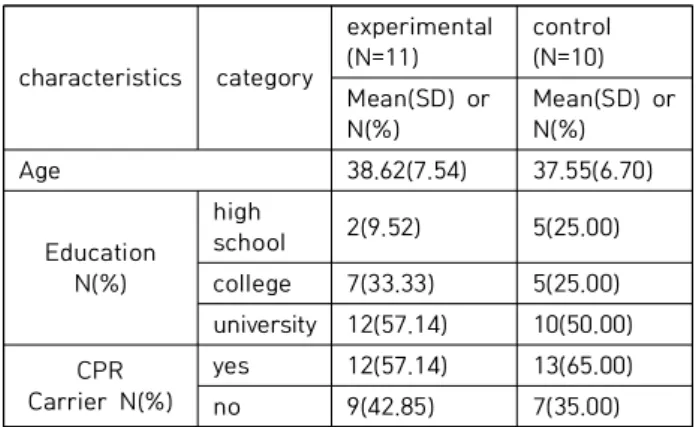
This study is a similar experimental design before and after the non-equivalence comparison group to verify the effect of basic lifesaving education on the educational effect. The general characteristics of age, education level, and experience of CPR education in the experimental group and the comparison group are as follows in Table 1.
The development process of the basic life support intervention program is as follows. The development process of this program is primarily
composed by the researcher reviewing, modifying, and supplementing the draft to two basic life resuscitation instructors for the basic life resuscitation program. The training time of this program is 60 minutes for theoretical education and
characteristics category
experimental
(N=11) control
(N=10) Mean(SD) or
N(%) Mean(SD) or
N(%)
Age 38.62(7.54) 37.55(6.70)
Education N(%)
high
school 2(9.52) 5(25.00)
college 7(33.33) 5(25.00) university 12(57.14) 10(50.00) CPR
Carrier N(%)
yes 12(57.14) 13(65.00)
no 9(42.85) 7(35.00)
Table 1. The subject of general characteristics
1 group of 4 people for basic resuscitation(BLS) for 3 minutes, 30 minutes for each person, and 90 minutes for debriefing.
The team consists of two people as a leader, and the first two people get off the ambulance, and two more people appear after 5 cycles of basic resuscitation chest compression. The educational materials were prepared as audiovisual materials and educational contents handouts for theoretical education, and the practical training was prepared as a Laerdal mannequin used for practical training.
The instructors possessed the BLS certificate and were in charge of the professional instructors who had trained the contents of the program before the program was performed.
The evaluation sheet was modified and modified by BLS and AHA and the evaluation items using simulation equipment for objective evaluation were developed. The evaluation sheet was composed of two professional instructors after reviewing the draft.
The detailed evaluation items were composed of
field confirmation, primary evaluation (A, B, C),
BLS (breast compression, artificial respiration,
medical evaluation), and transfer evaluation.
The score of prehospital specialist resuscitation evaluation was 5 points, which is "very excellent", "4 points excellent", "3 points normal", "2 points insufficient" and "1 point very insufficient".
3. Data analysis method
The collected data of this study were analyzed at the significance level p<.05 using SPSS/WIN 22.0 program, and the analysis method is as follows.
The general characteristics and clinical characteristics of the subjects were calculated by real number, percentage, average and standard deviation. The homogeneity test of the pre-test BLS of the experimental group and the control group was verified by t-test. The difference of BLS between the experimental group and the control group was verified by t-test. The pre-test and post-tests of the bbls of the experimental group and the control group were analyzed by paired t-test.
Ⅲ. Results
1. Difference verification of field verification performance skill
The total number of field confirmation after the training was 4.70±0.89 in the experimental group and 3.84±0.73 in the comparative group, which showed that the field confirmation performance skill of the experimental group was high (p=0.007).
In the detailed items, the infection prevention was not significantly different (p=0.086) with 4.52±0.93 points in the experimental group and 3.89±0.97 points in the control group. The field evaluation was 4.89±0.35 points for the experimental group and 3.96±0.34 points for the comparison group, which showed significant difference (p=0.000). Medical evaluation was significantly different with the experimental group at 4.50±0.53 and the control group at 3.50±0.53.
Patient evaluation was 4.67±0.76 points for the experimental group and 4.35±0.66 points for the comparison group, which showed higher scores in performance skill than the comparison group, but there was a significant difference (p=0.000) <Table 2>.
skill
experim ental (N=11)
control
(N=10) t
pMean±SD Mean±SD
Safe
total 4.70±0.89 3.84±0.73 3.736 0.007
BSI 4.52±0.93 3.89±0.97 2.247 0.086 Scene
Safe 4.89±0.35 3.96±0.34 9.882 0.000 patient
evaluation 4.67±0.76 4.35±0.66 4.687 0.000 medical
evaluation 4.81±0.29 3.77±0.27 9.751 0.000 Table 2. The verification of the difference on Safe
2. The Difference of the Primary Evaluation Performance skill
The total score of the first evaluation after the education was 4.71±0.26 in the experimental group and 3.69±0.34 in the comparative group, which showed that the first evaluation performance skill of the experimental group was high (p=0.001).
In detail, airway open was 4.68±0.864.68±0.86 in
the experimental group and 3.89±0.67 in the
control group, which showed a statistically
significant difference (p=0.007). Breathing was
4.88±0.50 in the experimental group and 3.49±0.94
in the control group, which showed a statistically
significant difference (p=0.000). The Circualation
was 4.75±0.81 in the experimental group and
3.68±0.63 in the control group, which showed a
statistically significant difference (p=0.000). Medical
evaluation was 4.82±0.36 in the experimental group
and 3.73±0.82 in the comparison group, which
showed a statistically significant difference
(p=0.003) <Table 3>.
skill
experim ental (N=10)
control
(N=10) t
pMean±SD Mean±SD
prim ary evalu ation
total 4.71±0.26 3.69±0.34 8.973 0.001
Airway 4.68±0.86 3.89±0.67 3.876 0.007
Breathi
ng 4.88±0.50 3.49±0.94 7.237 0.000
Circulati
on 4.75±0.81 3.68±0.63 3.743 0.000 medical
evaluati
on 4.82±0.36 3.73±0.82 3.61 0.002 Table 3. The verification of the difference on primary evaluation
3. Verification of Differences in BLS Performance skill