• 검색 결과가 없습니다.

A Study on the Categories and Contents of Fashion and Technology Trend: Focused on Design Field

N/A
N/A
Protected

Academic year: 2021

Share "A Study on the Categories and Contents of Fashion and Technology Trend: Focused on Design Field"

Copied!
16
0
0

로드 중.... (전체 텍스트 보기)

전체 글

(1)

A Study on the Categories and Contents of Fashion and Technology Trend: Focused on Design Field

Park Hyewon

+

Yang Junghee

Dept. of Clothing & Textiles, Changwon National University

+

Dept. of Clothing & Textiles, Changwon National University

Abstract

This study examined the categories and contents of technology that is recently influencing the fashion design. For this, the cases of global companies integrating fashion design and technology were examined, and the types of technology integration studies within the field of fashion design were analyzed through the trend of fashion-technology integration in domestic academic circles released since 2000.

According to the case of global companies integrating fashion design and technology, various companies and fashion brands have released fashion products that are integrated with technology, and such integrations are developing up to the field of fashion shows and displays in addition to fashion products.

The analysis of studies related with fashion and technology in the design field showed that domestic studies on fashion-technology integration were manifested as the types that applied various technologies to the fashion design. Such types were categorized into the studies that applied light-emitting technology, studies that focused on the integration of interaction and textile design, studies that applied response-perception, studies that used attached electronic devices, and studies that used autogenic bacteria.

The fashion has less negative impact on body and environment compared with other areas, and therefore, is the best area for the experiments in IT, bio, and electronics areas and for the integration of fashion and technology. Moreover, studies on fashion that suggest the capability in developing and industrializing cases through the collaboration with other fields such as IT, bio, and electronics shall continue.

Key words : electronic device fashion, fashion technology, interaction-textile, light-emitting fashion, response-perception fashion

Corresponding author: Park Hyewon, Tel.+82-55-213-2724, Fax.+82-55-213-2724 E-mail: [email protected]

This paper was supported by research funds of Changwon National University in 2013.

(2)

. Introduction

The technological development of the modern society is having great impact on fashion and also brought many changes. Recent fashion trend is that a number of technology related fashion products are released in the market and innovative technologies are integrated into fashion to create new idea products. Moreover, new materials are integrated with fashion to create new fashion and technology is not limited to fashion products but also applied to fashion show and display to give great influence on the development of fashion.

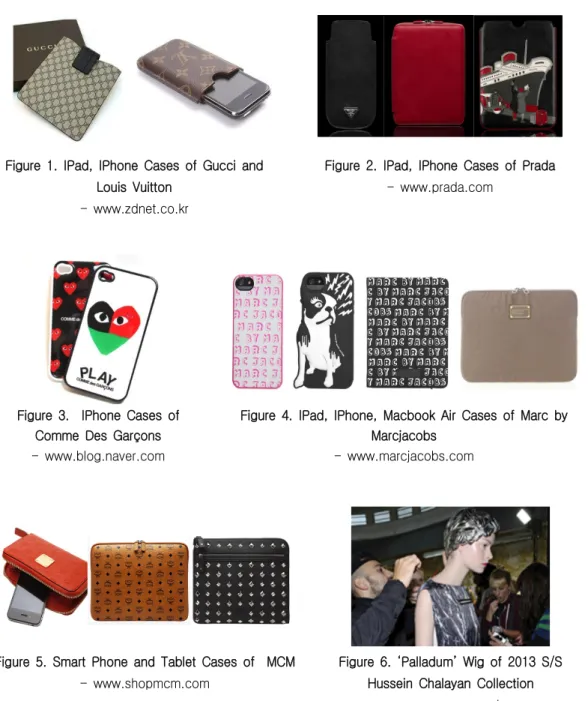
Technology is deeply ingrained into our life and now it achieves great synergy effect with the fashion beyond expectation. Various designers including Louis Vuitton, Gucci, Prada, Armani, and Comme Des Garçons as well as domestic and foreign fashion brands such as Marc Jacobs, DKNY (Donna Karan New York), Michel Chores, and MCM are releasing cases for iPhone, iPad, and MacBook when new iPhone, iPad, and MacBook are released, and fashion shops are displaying a number of accessories related with the technology (Figure 1, 2, 3, 4, 5).

Moreover, Hussein Chalayan, the leading designer who presented variable fashion using the materials that react to heat or light in his collection, decorated the last evening dress with the toupee made of palladium which is considered as the new metal fashion material in his S/S collection for 2013. Palladium is quite light compared with other metals and it also has the advantages such as rustless and unvanishing luster that it is also popular as jewel material, and CHANEL also used palladium for pearl decoration (Figure 6).

As suggested, this study dealt with the

categories and contents of technology in the field of fashion showing great impact in fashion recently. For this, the cases of global companies integrating fashion design and technology were examined, and the types of technology integration studies within the field of fashion design were analyzed through the trend of fashion-technology integration in domestic academic circles. Also, the types of technology integration studies in the fashion design field were analyzed to examine possible directions for fashion and technology in the future.

For study, the newspaper articles and internet sources on the integration of fashion and technology were examined to examine the integration between fashion design and technology that recently appeared in fashion.

Moreover, fashion related journals were selected as the research subjects to collect research studies conducted in Korea on fashion and technology integration and academic journals were selected among the journals of fashion related academic societies in Korea registered to Korea Research Foundation through continuous evaluations conducted by the foundation. The scope of fashion-technology integration studies were determined based on design related theses released after 2000. Furthermore, research theses on fashion-technology integration were searched and collected through the National Assembly Library, academic research information service (www.riss4u.net), and KSI KISS academic database search portal. Domestic academic journals and specialized magazines were used as the reference for the cases of fashion-technology integration.

For there were not many recent domestic

studies on technology in fashion, the quantitative

research could not be conducted and the

contents analysis was conducted instead.

(3)

Studies were categorized through contents analysis based on preceding studies and

Figure 1. IPad, IPhone Cases of Gucci and Louis Vuitton

- www.zdnet.co.kr

Figure 2. IPad, IPhone Cases of Prada - www.prada.com

Figure 3. IPhone Cases of Comme Des Garçons - www.blog.naver.com

Figure 4. IPad, IPhone, Macbook Air Cases of Marc by Marcjacobs

- www.marcjacobs.com

Figure 5. Smart Phone and Tablet Cases of MCM - www.shopmcm.com

Figure 6. ‘Palladum’ Wig of 2013 S/S Hussein Chalayan Collection

- www.vogue.co.kr

specialized books and summarized by the author

of this study.

(4)

. Concept of Fashion-Technology

Integration

Fashion technology uses new technologies such as IT, NT, BT, and ET to create a futuristic clothing based on a new concept which breaks from the traditional concept of textile or clothing. This is a completely new type of clothing that combines the functionality of the materials that detect external stimulations and automatically react to them and the digital features that textile or clothing does not innately have (E. Kim, Kim, Na, Oh, & Shin, 2013). The past fashion-technology integration studies used various terms to express the concept of fashion and technology. The terms such as wearable computer, smart clothing, interaction fashion, hybrid fashion, and digital fashion are not standardized into a single term but used as a combination of various terms related with fashion and technology.

This study collected various theses that used terms that are related with fashion and technology and examined the definition of wearable computer, smart clothing, interaction fashion, hybrid fashion, and digital fashion that were used in past studies, and the following shows details.

Wearable computer is the computer that is included in the personal space that the user can directly control and it operates continuously and interacts with the user. It has the advantage that it can be used any time for it is always on and it is often called by other names such as ‘digital fashion’ and ‘smart clothing’ (Joohyeon Lee &

Park, 2001).

Smart clothing is the textile product with smart function created through the fusion technology which uses the textile fashion technology as the major technology and the digital hardware technology and software application technology

as the minor technology. It also refers to the commercialization technologies including the planning which designs a high-tech functional smart textile products by combining textile fashion technology and related digital technologies, design, production, process, and marketing. Smart clothing is the device which integrates clothing and computing technologies centering on the user (Y . Kim & Lee, 2009).

Interaction fashion is a compound word made of “interaction” meaning the actions of different parties toward each other and "fashion" and it indicates the causal relationship that has impact on both sides. The fashion design with interaction function use materials that have various names such as e-textile, smart fabric, and technical textile. This is the science and technology that applies academic system to product development, and it not only involves data transmission and communication features but also detects dangerous chemical substances, sterilizes, warms, and cools itself, and capable of notifying its location (“Interaction,” 2013).

Hybrid fashion integrates two or more functions or roles into the fashion as the name suggests, and in dictionary term ‘hybrid’ means

‘a mutant born of two different races or nations, or the entity generated through the crossbreeding of two different species.’

Wearable hybrid fashion sometimes concentrates on future-oriented styles with various functionalities using artificial intelligence or technologies or on the combination of new functions and high sensibility such as the artificial ceramics and synthetic resin or high-tech fabric or bio-fiber rather than focusing on technologies (Kang & Yoon, 2010).

Digital fashion was defined with the concept

of wearable computer in the beginning and later,

(5)

with smart clothing, as the aspect of fashion was brought to relief. The 21st digital fashion can mount various sensors without difficulty and also forms a great platform for sharing sensors that it is considered as the ideal type of next generation PC (Heo & Lee, 2013).

The said definition of terms shows that the concepts were expressed in various terms, however, univocally indicates the application of technology to fashion, in other words, the integration of technology and fashion. Therefore, this study amalgamated these terms into the single term ‘fashion technology’ and used the term accordingly (Figure 7).

. Cases of Global Corporations

Integrating Fashion Design and Technology

Recently, various companies and fashion brands are achieving synergy effect through the combination of fashion and advanced technology.

Figure 7. Concept of Fashion-Technology Integration

Samsung Electronics exhibited the watch-type cellular phone, ‘Galaxy Gear’ at IFA 2013 on September 5, 2013. Samsung Electronics announced that they will release Galaxy Gear with Galaxy Note III in 140 countries as the new trend products that support telephone call, SMS, e-mail, and camera features (Figure 8).

In 2013, the outdoor brand, Wild Rose, with Korea Research Institute for Fashion Industry released new products developed with IT and other advanced technologies using the funds provided through 2011 Global Technology Development Project of the Ministry of Trade, Industry and Energy. Products released include the outdoor products such as backpack and windbreaker that applied LED and optical fiber (Figure 9).

In 2012, NIKE announced “NIKE+ FuelBand”

that helps the user to enjoy exercise more

scientifically. NIKE+ FuelBand is an innovative

wristband that traces and measures the motion

at each moment to encourage people to engage

in more activities and inspire them, and it

provides 4 values: time, calorie consumption,

step, and NikeFuel (Figure 10).

(6)

The automobile brand, Lexus, successfully held the ‘Mase Fashion Week’ during the New York Fashion Week which started from September 5, 2013 to celebrate the release of the new IS. They created scenes that break the conventional ideas by adding the story expressed in choreographs to 3D holographic technology to combine technology, fashion, and performance art through the collaboration with LEGS, the famous multimedia studio in New York (Figure 11).

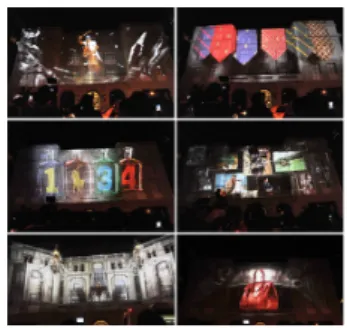
American fashion brand, Ralph Lauren, held 4D Light Show in New York and London on November 10, 2010. The show presented 4D

Figure 8. Galaxy Gear - www.samsungmobilepress.com

Figure 9. New Product of WildRose uses LED and Optical Fiber

- www.etoday.co.kr

Figure 10. NIKE+ FuelBand - www. sports.news.naver.com

Figure 11. Holographic Fashion Show of Lexus - www.eto.co.kr

moments by integrating fashion art, music, and perfume, and they presented a more realistic and exciting show with the installation art of lights completed by significantly enhancing the video mapping using buildings and making the best use of audio visual effects including music, sound effects, and the sound of the wind alongside the images projected (Figure 12).

The use of helio display is increasing recently

in fashion shows and musicals, and it is the

hologram using vapor presented by shooting the

jet steam into the air similarly to a ultrasonic

humidifier and projecting images on the steam

(Figure 13).

(7)

Figure 12. 4D Show of Ralph Lauren - www.bntnews.hankyung.com

Figure 13. Display Hologram - www.it.co.kr

. Types of Studies on the

Integration of Fashion and Technology in Korea

Regarding the design related theses announced in Korea after 2000, the analysis of studies that focused on fashion-technology integration showed that most studies were related with the overall flow using keywords such as ‘wearable computer’, ‘smart clothes’,

‘interaction fashion’, ‘hybrid fashion’, and ‘digital fashion’ except the studies that clearly experimented with technological materials such as the studies on light-emitting design and textile design. In other words, most studies did not categorize types nor made detailed analysis based on clear criteria.

This study categorized the studies on light-emitting design and textile design by summarizing the contents of past studies and summarized and categorized the studies on the general trend on fashion technology through the analysis of their contents.

The analysis of studies related with fashion and technology in the design field showed that domestic studies on fashion-technology

integration were manifested as the types that applied various technologies to the fashion design. Such types were categorized into the studies that used attached electronic devices, studies that applied light-emitting technology, studies that focused on the integration of interaction and textile design, studies that applied response-perception, and studies that used autogenous bacteria. The contents of each type of integration studies are as follows.

1. Attachment of Electronic Device

The fashion that uses attached electronic devices is divided into the integration of technological and mechanical system into the fashion, the clothing with the attachment of mechanical device or the sensor, and the fabric was produced with electro-conductive threads and is used for fashion design.

Cases analyzed in preceeding studies (kang &

Yoon, 2010; Y. Kim & Lee, 2009; W. Lee, 2006)

include the one that automatically changes the

form by pushing out the air cushion from the

skirt hem in response to the remote controller

signal and various works of Hussein Chalayan

that change the form through the wireless

communication device attached (Figure 14).

(8)

Malden Mills of America developed ‘Polatech’, the stainless conductive fiber, and the military supplies maker, Poster Miller, developed the electronic fiber that can send information wirelessly with the antenna function. Using this electronic fiber, the industry is manufacturing jackets to which various information devices such as MP3 player can be connected (Figure 15).

The “Musical Jacket” developed by MIT has the MID synthesizer on one side of the chest area for the wearer to enjoy music and the

Figure 14. Hussein Chalayan One Hundred and One

- www.style.com

Figure 15. Smart Clothing with MP3 Attached - Fashion textile, p.205.

Figure 16. Musical Jacket - New Clothing Textile Study, p.316.

Figure 17. M-Dress of Cute Circuit - www.cutecircuit.com

Figure 18.

U-Healthwear - www.imaeil.com fabric keypad on the other side (Jo, Jung, Song, Kwon, & Yoo, 2007)(Figure 16). There are also the "Toy Piano Shirt" that play different notes depending on the parts that the user touches and the “Electronic Drum Kit Shirt.”

The “M-Dress” by Cute Circuit includes SIM

card in the dress to let the user make and

receive calls through the clothing without

additional devices near a mobile device (Figure

17), and the “U-Healthwear” has a built-in

textile sensor to monitor heart beat, breath, and

momentum (Figure 18).

(9)

2. Application of Light-Emitting Technology

In the study by Heo and Lee (2013), the interaction in digital fashion design is divided into total 31 types by interaction factors including 11 current input types, 10 body-recognition types, and 10 environment- recognition types.

The interactions manifested in the light-emitting digital fashion design which recognizes electric current through manual operation were divided into 11 types based on the reaction response. The interactions in digital fashion design which emits light through body recognition were manifested as 10 types including the reaction to body movement, static, heart beat, hand touch, breath, voice, choreography, body temperature, and sweat according to direct and indirect stimulations to the body. The interactions in digital fashion design which reacts to environmental changes were divided into 10 types according to stimulations in the surrounding environment such as solar radiation, CO2, ambient brightness, wind, atmospheric contamination, humidity,

Figure 19. Light Emitting Fashion Cases of Current Input Type, Biometric Type, Environmental

Awareness Type

- The Interaction Expressed in 21st Century's Digital Fashion, pp.22-26.

Figure 20. Light Emitting Handbag using EL Wire

- A Research and Development on Light Emitting Handbag using Double Cloth with EL

Wire, p.108.

Wi-Fi, camera flash, street, and music (Figure 19).

J. Choi and Moon (2013) inserted EL wire into the weft thread with other thread materials to design a double-weaved fabric to develop light-emitting fabric and they also developed an interactive light-emitting handbag design which changes the display of light according to the sound waves that change in the user's environment by connecting a device with built-in sound sensor to the light-emitting fabric (Figure 20).

Technologies used in the studies applying light-emitting technology were EL, EL wire, optical fiber, LED, OLED, flexible display, and laser.

3. Interaction-Textile Integration

Ree and Wang (2009) developed an interactive

textile with the fabric processor that sends

information to the processor using new

electro-conductive fabric material, the fabric

input device such as microcomputer or chip set,

and the output device such as LED, speaker,

and screen so that users can communicate with

(10)

each other.

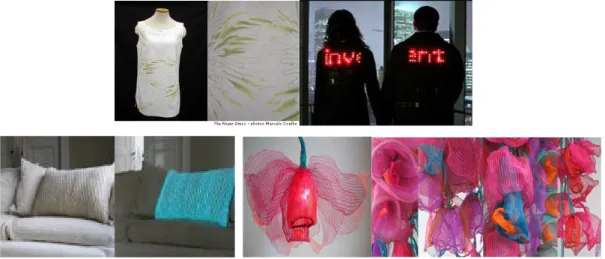
The cases of interactive textile apparel were mainly the cases that used the output device, LED, and the material that notifies the user's body information in the medical field. For interior items, the functional aspect is combined with emotion and sensibility such as the cushion reacting to touching or hugging and the lighting fixture that blooms a flower to a stimulation.

Other parts of fashion accessory items were used in a variety of areas including hat, bag, shoes, and fans (Figure 21).

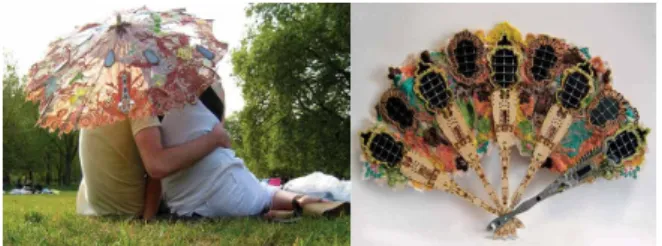
The trend of interaction expressed in the textile design in the study by S. Choi and kang (2011) is combined with high-tech materials and is advancing in a practical manner through the advancement of science, technology, and design, and it is combined with aesthetic elements for special purposes. Examples include the “Intimacy” by Studio Roosegaarde which is made of electrically-sensitive foil that turns opaque or transparent when someone comes close (Figure 22) and the “Solar Vintage”

Figure 21. Apparel and Interior Case of Interaction Textile

- A study in Textile Utilizing Sensibility-Oriented Interactive Concept, pp.295-297

by Elena Cochero made with fan and oxallic acid using solar cell panels and flexible conductive threads as materials and the traditional embroidery as the technique. “Solar Vintage” fan opens automatically and lights LED by using the energy accumulated in the solar cell, and the umbrella can be used as parasol during the day and also as the lighting fixture or the ornament at home in the evening (Figure 23).

Moreover, the interaction expressed in the textile design has been developed in various aspects as a comprehensive technology to satisfy the emotional demand of consumers and used for the continuous application of ideas, and it is showing new attempts and outcomes in relation to environmental elements beyond existing concept of composition and production methods.

Technologies used in the studies on

interaction and textile integration were LED,

electrically-sensitive foil, solar heat, flexible

conductive thread, and shape memory alloy.

(11)

Figure 22. High-Tech Textile added Interaction Case : Electically-Sensitive Foil

made Studio Roosegaarde - www.studioroosegaarde.net

Figure 23. Interaction Case with added Aesthetic Elements for Special Purposes : Solar Vintage of Elena

Cochero - www.greenmuze.com

4. Response-Perception Application

The fashion that applies response-perception uses the technology that responds with the environmental and human behaviors or chemical phenomena such as light, temperature, color, and dye.

Cases analyzed in past studies (Kang & Yoon, 2010; Y. Kim & Lee, 2009) include the “Lumalive Light-emitting T-shirts” by Phillips which replaced printing or subsidiary materials with LED, OLED, or optical fiber (Figure 24), the

"Video Dress" and costumes that applied optical fiber tape-type LED by Hussein Chalayan, and the "Skin Dress" by Phillips which changes the form of the clothing and emits light according to the skin emotion (Figure 25). The aforementioned fashion that uses light-emitting technology also belongs to response-perception fashion in a broader term for it involves the perception based on photo-reaction.

On the other hand, there are clothes that changed the entire form of the clothes by sewing a thin wire like shape memory material inside the fabric or expressed the details by using the material in some parts. The “Oricalco Smart Shirt” by Corpo Nove was developed with the shape memory alloy fabric which was

produced by weaving nitinol (nickel-titanium), the shape memory alloy, and nylon by the ratio of 1:5. The long-sleeved shirt quickly becomes short-sleeved when the indoor temperature increases and is quite light (Jo et al., 2007) (Figure 26).

The response-perception fashion has been mainly used for health care purposes, and the examples include health care belt and brassiere by Phillips which includes a built-in sensor for detecting body signals and the “Smart Shirt” by Georgia Institute of Technology and Sensatex.

The Smart Shirt was made with plastic optical fiber, and it can measure various body signals such as breath and heart beat. The smart shirt for children is used to prevent sudden death by monitoring the body signal of the child (E. Kim et al., 2013) (Figure 27).

Other cases include the application of

“Thermo Chromatic Ink” which changes color according to temperature.

5. Use of Autogenic Bacteria

The fashion that uses autogenic bacteria uses

the bio technology to cultivate bacteria to form

the cellulose layer and use the layer to make

(12)

Figure 24. Lumalive Light Emitting T-Shirts of Philips

- Fashion Image-up, p.203.

Figure 25. Skin Dress of Philips - www.design.philips.com

Figure 26. (Left) Smart Fashion made shape memory alloy fabric -Fashion textile, p.209.

(Right) Smart Shirt of Corpo Nove - New Clothing Textile Study, p.318.

Figure 27. (Left) Smart Shirt, (Right) Smart Shirt for the Prevention of Sudden Infant Death - New Clothing Textile Study, p.315.

clothing. The bacteria cellulose can be applied to the diaphragm of the special headphones and also the carrier for cell culture or artificial skin (E. Kim et al., 2013). The typical cases of the fashion that applied autogenic bacteria are the wine dress and bio-couture.

In 2007, the University of Western Australia developed future fashion material using the bacteria that grow in the sediments inside the wine barrel. The cellulose layer in which the bacteria live grows by itself when it is placed on human body or other forms as large as it would cover the shape, and it does not require the conventional process of producing a form such as sewing, gluing, and heating. However, the cellulose material becomes as thin as a paper

and tears easily when it dries; it has the technical limit that it has to be kept wet at all times (Kang & Yoon, 2010) (Figure 28).

In bio-couture research project, Suzanne Lee,

the author of “Fashioning The Future: Tomorrow’s

Wardrobe”, conducted a study with Dr. David, a

biologist from Imperial College London, to combine

design, the advanced electric and nano-technology

(Park, 2012). When the cultivator mixed with

bacteria cellulose, yeast, and microorganisms are

added to and cultivated in the sugared green tea

solution, the bacteria feed on the sugar and

produces thread, and this can be applied to a

frame and into a shape to obtain a fashion

material (E. Kim et al., 2013). The vegetable bio

material does not produce any waste and the

(13)

Figure 28. Wine Dress - www.gizmodo.com.au

Figure 29. Bio Couture

- Eco-Fashion Industry Trend and Creative Fashion Design Technic for Zero-Waste, p.41.

remaining pieces are bio-degraded as they are that it is considered as the experimental fashion for waste reduction without environmental burden (Park, 2012) (Figure 29).

The summary of the characteristics and details of the studies on fashion-technology integration by types are shown in (Table 1).

. Conclusion

This study examined the categories and contents of technology that is recently influencing the fashion design. For this, the cases of global companies integrating fashion design and technology were examined, and the types of technology integration studies within the field of fashion design were analyzed through the trend of fashion-technology integration in domestic academic circles.

According to the case of global companies integrating fashion design and technology, various companies and fashion brands such as Samsung Electronics, Wild Rose, NIKE, Lexus, and Ralph Lauren have released fashion products that are integrated with technology, and such integrations are developing up to the field of fashion show and display in addition to fashion products.

The analysis of studies related with fashion and technology in the design field showed that domestic studies on fashion-technology integration were manifested as the types that applied various technologies to the fashion design. Such types were categorized into the studies that studies that used attached electronic devices, applied light-emitting technology, studies that focused on the integration of interaction and textile design, studies that applied response-perception, and studies that used autogenous bacteria.

First, The fashion that uses attached electronic devices is divided into the integration of technological and mechanical system into the fashion, the clothing with the attachment of mechanical device or the sensor, and the fabric was produced with electro-conductive threads and is used for fashion design. Technologies used for the electronic device attachment type were remote controller, wireless communication device, SIM card, sensor, and MP3.

Second, Based on preceding studies, the

studies that dealt with light-emitting technology

were divided into 31 types including 11 current

input types, 10 body-recognition types, and 10

environment-recognition types according to

relevant factors. Furthermore, there was a study

that developed an interactive light-emitting

(14)

Table 1. Summary of Characteristics and Details of Studies on Fashion-Technology Integration by Types

No Type Characteristics Technology Used Typical Example

1

Attachment of Electronic

Device

Mechanical system integration

Attachment of mechanical

device to clothing Production of fabric using

electro-conductive threads

Remote Controller

Wireless

Communication Device SIM Card

․ Sensor

․ MP3

․ Clothing of MP3

Attached

2

Application of Light- Emitting

Technology

11 current input types, 10

body-recognition types, and 10 environment-recognition types

Development of E.L. wire +

double weaved light-emitting fiber -> Development of light-emitting handbag which connects light-emitting fabric with

the sound sensor

EL, EL Wire

Optical Fiber

LED

OLED, Flexible

Display Laser

paparazzi lover

3

Interaction- Textile Integration

Connect fabric processor with

fabric input device, and output device by using new electro-conductive fiber material to enable mutual communication

between users.

Combined with high-tech

material or combined with aesthetic elements for special

purposes

LED

․ Electrically

-sensitive Foil Solar Heat

Flexible Conductive

Thread Shape Memory

Alloy

Finger Dress

4

Response- Perception Application

Response to the behaviors

and chemical phenomena of environment and people: light,

temperature, color, dye, etc.

Use for health management

Temperature and

Light-Reactive Color-Shifting Ink

Shape Memory

Alloy LED, Optical Fiber

Conductive Ink

Body Detection

Sensor

Smart Shirt

5

Use of Autogenic

Bacteria

Wine Dress: Form the

cellulose layer by using the bacteria growing in the sediments

inside the barrel for maturing wine

Bio Couture: Add green tea,

sugar, and microorganisms in the container and keep consistent temperature to form a number of

membranes

Bio-technology

Wine Dress

(15)

handbag design. Technologies such as EL, EL wire, optical fiber, LED, OLED, flexible display, and laser were used in the studies that dealt with light-emitting technology.

Third, The interaction trend manifested in textile design is that it is advancing in a practical manner through the integration with high-tech materials along with the advancement of science and technology as well as design and is integrated with aesthetic elements for special purposes. Technologies used in the studies on interaction and textile integration were LED, electrically-sensitive foil, solar heat, flexible conductive thread, and shape memory alloy.

Fourth, The fashion that applies response-perception uses the technology that responds with the environmental and human behaviors or chemical phenomena such as light, temperature, color, and dye, and the technologies used are temperature and light sensitive color-shifting ink, shape memory material, LED, optical fiber, conductive ink, and body detection sensor.

Fifth, The fashion that uses autogenous bacteria applies the bio technology to cultivate bacteria to form the cellulose layer and use the layer to create a clothing. The typical cases of the fashion that applied autogenic bacteria are the wine dress and bio-couture.

Fashion is the best area for integrating applicable technologies. It includes all endophilic components and is the area that can most perfectly combine environment-friendly and human-centered advanced technologies and bring about the best outcomes compared with other areas.

Furthermore, the fashion has less negative impact on body and environment compared with other areas, and therefore, is the best area for the experiments in IT, bio, and electronics areas

and for the integration of fashion and technology. Moreover, studies on fashion that suggest the capability in developing and industrializing cases through the collaboration with other fields such as IT, bio, and electronics shall continue.

The fashion studies would advance and the overall development of the future of design and industries in Korea can be expected only when such studies on integration persist, and the fashion would have actual influence on the industry through in-depth studies in each technological area rather than trend-based approaches and will become the media for better development.

References

Choi, J., & Moon, B. (2013). A research and development on light emitting handbag using double cloth with EL wire. Journal of Society of Basic Design & Art, 14(3), 101-109.

Choi, S., & Kang, H. (2011). Applicability of interaction noted in textile design. Journal of Society of Basic Design & Art, 12(6), 429-437.

Comme des Garçons iPhone case. (2013).

Retrieved from http://blog.naver.com/guidecat?

Redirect=Log&logNo=80191629712

Galaxy gear’ to change the world once again.

(2013, September 6). Herald Economics.

Retrieved September 24, 2013, from http://www.heraldcorp.com

Gu, M., Kim, J., Kim, S., Oh, K., & Sung, Y.

(2007), 패션 이미지 업 [Fashion image up].

Seoul: Gyomunsa.

Heo, S., & Lee, Y. (2013). The interaction expressed in 21st century’s digital fashion:

Focused on the luminescence digital fashion

(16)

designs. The Journal of the Korean Society of Costumes, 63(4), 17-29.

Interaction. (2013). In Dong-a's prime english-korean dictionary (6th ed.). Retrieved from http://endic .naver.com/enkrEntry.nhn?sLn

=kr&entryId=67e2d7a70b9746eeaafa726b366a809a Jeong, H. (2013, April 18). [E-fashion] wild

rose, releasing new products made with LED optical fiber. e-Today. Retrieved from http://www.etoday.co.kr

Jo, G., Jung, H., Song, K., Kwon, Y., & Yoo, S.

(2007), 새로운 의류소재학 [Studies on new clothing materials]. Seoul: East West Institute.

Kang, H., & Yoon, S. (2010). Analysis of wearable hybrid clothing from amalgamation of fashion and technology. Journal of Korean Society of Design Science, 23(3), 5-15.

Kim, E., Kim, H., Na, Y., Oh, K., & Shin, Y.

(2013). 패션 텍스타일 [Fashion textile]. Seoul:

Gyomunsa

Kim, Y., & Lee, H. (2009). Research reports:

Development of a Design Prototype for Winter Outdoor Smart Clothing. The Korean Society of Design Culture, 15(3), 339-355.

Lee, J. [Janghyuk]. (2010, December 20).

Brand-name products' filling smartphone · tablet accessories market. ZDNETKOREA.

Retrieved from http://www.zdnet.co.kr

Lee, J. [Joohyeon], & Park, S. (2001). An exploratory research for design of digital fashion product based on the concept of

"wearable computer" 1. Journal of Fashion Business, 5(3), 111-128.

Lee, S. (2013, August 25). Next generation display hologram Media It. Retrieved from http://www.it.co.kr

Lee, W. (2006). Research reports: Study on research trend of wearable computer. The Korean Society of Design Culture, 12(2), 232-241.

Marc by Marc Jacobs iPhone, iPad, and MacBook case. (2013). Retrieved from http://www. marcjacobs.com

MCM smartphone, tablet case. (2013). Retrieved from http://www.shopmcm.com

Park, H. (2012). Eco-fashion industry trend and creative fashion design technic for zero-waste.

Jounal of Fashion Business, 16(4), 29-45.

Prada iPad and iPhone case. (2013). Retrieved from http://store.prada.com/en/AP/woman/

small-accessories/technology

Ree, S., & Wang, K. (2009). Research reports:

A study on textile utilizing sensibility-oriented interactive concept. The Korean Society of Design Culture, 15(3), 289-299.

Sohn, B. (2012, January 20). NIKE, releasing

‘NIKE+ FuelBand’. Best Eleven. Retrieved from http://sports.news.naver.com

Sohn, G. (2013, February). When fashion met advanced technology. vogue. Retrieved from http://www.vogue.co.kr

Sohn, M. (2010, November 22). Ralph Lauren, 4D show ‘fashion+art+technology.’ The Korea Economic Daily. Retrieved from http://bntnews.hankyung.com

Wine dress of micro be. (2013). Retrieved fromhttp://www.gizmodo.com.au/2012/06/unive rsity-in-western-australia-grows-dresses-from -bacteria/

Yim, E. (2013, September 13). Lexus, holographic fashion show in New York. Economic Today.

Retrieved from http://www. eto.co.kr

Yim, S. (2010, October 11). U-healthwear, fiber wearing 'IT clothes.' Getting Smarter.

Retrieved from http://www.imaeil.com

Received(Nov. 12, 2013)

Revised(Dec. 2, 2013)

Accepted(Dec. 6, 2013)

수치

Figure 3. IPhone Cases of Comme Des Garçons - www.blog.naver.com
Figure 7. Concept of Fashion-Technology Integration
Figure 9. New Product of WildRose uses LED and Optical Fiber
Figure 13. Display Hologram - www.it.co.kr
+7

참조

관련 문서

After analyzing the influence of design award indicators(technology, concept, visual expression, communication and benefits) on future design technologies,

Fourth, as the information technology is developed due to the fourth industrial revolution and the proportion of information technology in the commercial

To this end, prior studies of the type of value, design paradigm and design value were considered, and three types of design value (practical value,

• Select one of the elemental technologies of Smart City and describe the current level of this technology, the direction of future technology development, and the urban space to

First, it was found that some factors of internet fashion shopping mall design quality had significant positive influences on the qualities of relationship to users such

The purpose of this study is to establish and design the characteristics of summer resorts according to the design manual, develop cultural products using

In terms of the mould design, the effects of runner system design and the mould temperature on filling characteristics, the weldline formation, the

This study derives the attributes of 'product design identity' from the consumer's point of view, and verified whether the 'product design identity'