1. Introduction
Volatile organic compounds (VOCs) refer to organic compounds with saturated vapor pressure greater than 133.32 Pa at room temperature, boiling point between 50 and 260
℃ at atmospheric pressure, or any organic solid or liquid that can volatilize at room temperature and atmospheric pressure. VOCs come from a variety of sources. The sources of VOCs are mainly man-made and natural sources. On a global scale, the emissions of natural sources of VOCs exceed those of man-made sources. Natural sources include plant release, volcanic eruption, forest and grassland fires, among which the most important sources are forests and shrubs. The artificial sources can be roughly divided into three categories: fixed sources, mobile sources and unorganized emission sources. Fixed sources include fossil fuel combustion, use of solvents (coatings, paints), waste combustion, petroleum storage and transportation, and emissions from petrochemical, iron and steel industry and metal smelting; mobile sources include emissions from vehicles, aircraft and ships, as well as non-road sources. Unorganized sources include biomass combustion and volatilization of solvents such as gasoline and paint. Transportation is the largest artificial VOCs emission source in the world,
and solvent use is the second largest source
[1-5].
As a new type of pollutant treatment technology, which will become the main research direction of VOCs in the future[6], low temperature plasma treatment technology is a comprehensive cross-cutting technology integrating physical, chemical and environmental engineering. NTP has high VOCs removal efficiency at room temperature. But in the process of treatment, the uncertainties of external factors, such as the composition and temperature of the exhaust gas from pollution sources, the variability of air humidity, and the unstable power supply in the process of treatment, will affect the efficiency of plasma treatment of exhaust gas, especially the composition of the treated exhaust gas, so it is necessary to combine other technologies with them to optimize the exhaust gas treatment.
2. Materials and Methods 2.1 Reagents and Instruments
Reagents like ethyl acetate, carbon disulfide are analytical pure; activated carbon sampling tubes, sealants, etc. are purchased online.
Instruments such as low temperature plasma equipment, mass flowmeter, flowmeter display, portable sampler, electronic balance, thermometer,
* School of Biology, Food and Environment, Hefei University, Hefei 230601, China.
** School of Biology, Food and Environment, Hefei University, Hefei 230601, China. Correspondent Author
Effect of dielectric barrier discharge parameters on degradation efficiency of ethyl acetate
Xu Deng*·SiHeng Lu*·Kun Zheng*·ZhiMin Yu**
Abstract: Using self-made coil dielectric barrier discharge reactor, the removal efficiency of ethyl acetate under simulated experimental parameters such as initial concentration of waste gas, total flow rate, relative humidity and voltage was investigated. The results show that the degradation rate of ethyl acetate increases with the increase of output voltage. When other conditions remain unchanged, the degradation rate decreases with the increase of initial concentration of ethyl acetate; with the increase of total flow rate, the degradation rate of ethyl acetate decreases; with the increase of relative humidity, the degradation rate first increases and then decreases, and when the relative humidity is 64%, the degradation efficiency is the highest.
Key Words: Dielectric barrier discharge; Degradation efficiency; Ethyl acetate
dielectric barrier reactor, gas chromatography, and gas chromatography mass spectrometer are used.
2.2 Experimental Device
1 2
3 7
4 5
6 8
9
10
11
12
Fig. 1 Experimental device diagram
Note: 1. Simulated air cylinder; 2. Cylinder valve;
3. Mass flowmeter; 4. Constant temperature water bath pot; 5. Montessori bottle washing; 6. Blower; 7.
Buffer bottle; 8. Rotor flowmeter; 9. Medium barrier reactor; 10. Power supply; 11. Adsorption catalytic fixed bed; 12 convenient samplers.
The target substance (ethyl acetate) is stored in two containers connected in series with branch tubes. At room temperature, gas (air, etc.) bubbles are introduced. The saturated vapor of the target substance at that temperature is carried out by gas (airflow 1) and mixed with another gas (air, etc.) (airflow 2). The flow rate of airflow 1 and airflow 2 (airflow 3 closure) is adjusted to form a mixture of certain flow rate and concentration of the target substance. The gas is fed into the quartz reactor with a certain flow rate. When the flow rate reaches a stable level, the plasma power supply is turned on, and the voltage of the power supply is adjusted to a certain value, respectively. The plasma is produced and treated by dielectric barrier discharge (DBD) low temperature plasma degradation.
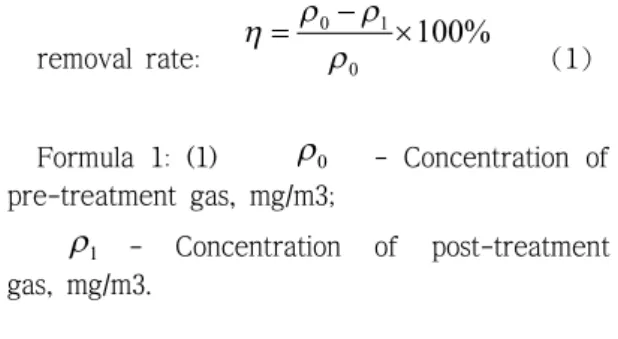
In this study, a method is used to evaluate the removal rate of pollutants by dielectric barrier discharge (DBD)[7]. The removal rate formula is as follows:(1):
The removal efficiency of the treated gas was used to evaluate the experimental results.
removal rate: 100%
0 1
0- ´
= r r h r
(1)
Formula 1: (1) r0 - Concentration of pre-treatment gas, mg/m3;
r1 - Concentration of post-treatment gas, mg/m3.
3. Results and discussions
The effects of output voltage, initial concentration of ethyl acetate, total flow rate and air humidity on the degradation rate of ethyl acetate are investigated by control variable method.
3.1 Effect of Output Voltage on Degradation Rate
In the case of empty tower of plasma reactor, the total flow rate is unchanged at 0.3 m3/h, the initial concentration of ethyl acetate is adjusted at about 300 mg/m3, the relative humidity of intake air is adjusted at 60% and remains unchanged. The discharge experiments are carried out with the changing voltage of 5 kV, 6 kV, 7 kV, 8 kV, 9 kV and 10 kV, respectively. The experimental results are shown in Fig.2.
Fig.2 Effect of Output Voltage on Degradation Rate
The figure shows that the degradation rate of ethyl acetate increases with the increase of
output voltage. When the output voltage was 5 kV, the degradation rate of ethyl acetate was 24.6%. When the output voltage increased to 9 kV, the degradation rate of ethyl acetate increased to 49.2%. When the output voltage increased to 10 kV, the degradation rate of ethyl acetate increased to 50.1%. This is because the increase of the output voltage will increase the number of high-energy active particles, increase the probability of bond breaking dissociation of ethyl acetate molecules, thereby improving the degradation rate and the degradation effect. The final price reduction rate slowly increased because of the high energy density[8].
3.2 Effect of Total Flow Rate on Degradation Rate
In the case of empty tower of the plasma reactor, the voltage was set at 9kV, the total flow rate was controlled unchanged at 0.3m3/h, the relative humidity of the inlet was adjusted to 60% and remained unchanged, and the initial concentration of ethyl acetate was adjusted to 100mg/m3, 200mg/m3, 300mg/m3, 400mg/m3 and 500mg/m3, respectively, for discharge experiments. Experimental results are shown in Fig.3.
Fig.3Effect of Initial Concentration on Degradation Rate
The figure shows that when the output voltage is 9 kV, the degradation rate decreases from 54.6% to 41.9% with the initial concentration of ethyl acetate increasing from 100 mg/m3 to 500 mg/m3. The reason for this is that when the initial concentration of ethyl
acetate is low, the ethyl acetate molecule is more likely to be destroyed by high-energy electrons in the discharge reaction and dissociated more fully. On the contrary, when the initial concentration of ethyl acetate is high, the corresponding high-energy electrons decrease and the probability of bond breaking dissociation decreases [9-10].
3.3 Effect of Total Flow Rate on Degradation Rate
In the case of empty tower of plasma reactor, the initial concentration of ethyl acetate was controlled to be 300 mg/m3 at a voltage of 9 kV, and the relative humidity of intake air was adjusted to be 60% and unchanged. The total flow rates were 0.06 m3/h, 0.18m3/h, 0.3 m3/h, 0.42 m3/h and 0.54m3/h, respectively. The experimental results are shown in Fig.4.
Fig.4 Effect of Total Flow Rate on Degradation Rate
As a whole, the degradation rate of ethyl acetate decreases with the increase of total flow rate. When the output voltage is 9 kV, the total flow rate is 0.06 m3/h, 0.18 m3/h, 0.30 m3/h, 0.42 m3/h and 0.54 m3/h, the degradation rate is 65.4%, 60.6%, 50.2%, 50.8% and 38.1%, respectively. This is because the total flow rate determines the residence time, which is an important factor affecting the catalytic degradation of ethyl acetate. With the decrease of residence time and the increase of gas flow rate, the contact probability of ethyl acetate
molecule with energetic active particles decreases, and it is blown out without sufficient reaction, and the degradation effect becomes worse naturally [11-12].The degradation rate was very close under the total flow rate of 0.30 m3/h and 0.42 m3/h, and the degradation rate at the total flow rate of 0.42 m3/h was slightly higher than that at the total flow rate of 0.30 m3/h.
3.4 Effect of Relative Humidity on Degradation Rate
When the plasma reactor is empty, the initial concentration of ethyl acetate is adjusted to 300mg/m3 with a voltage of 9 kV, and the total flow rate is adjusted to 0.3 m3/h, and the relative humidity is changed to 73% RH, 64%
RH, 56% RH, 48% RH and 34% RH, respectively. The experimental results are shown in Fig.5.
Fig.5 Effect of Intake Humidity on Degradation Rate
The figure shows that the degradation rate increases with the increase of relative humidity when the relative humidity changes from 34%
to 64%. When the relative humidity changes from 64% to 73%, the degradation rate decreases with the increase of relative humidity. When the relative humidity is 64%, the degradation rate is the highest, that is, at 9kV, the degradation rate of 64% relative humidity is 52.3%, higher than that of 34%, 48%, 56% and 73% relative humidity. The reason for this is that with the increase of
relative humidity, the number of free radicals formed by water action increases, which promotes the degradation of ethyl acetate. But when the relative humidity increases to a certain value, that is 64%, the high-energy active particles will collide with water molecules more and quench, and the degradation rate will decrease with the decrease of high-energy active particles. Therefore, with the increase of relative humidity, the trend of degradation rate first increases and then decreases [13-15].
4.Conclusions and Prospects 4.1 Summary
In this paper, the origin, hazard, pollution status, countermeasures and control technology of VOCs are introduced. The research status and progress of low temperature plasma technology to solve VOCs pollution problem are described. The degradation of ethyl acetate by low temperature plasma technology is discussed.
The effects of output voltage, initial concentration of ethyl acetate, total flow rate and air humidity on the degradation rate of ethyl acetate are also discussed. According to the experimental results, the following conclusions are drawn:
With the increase of output voltage, the degradation rate of ethyl acetate also increases.
The increase of the output voltage will increase the number of high-energy active particles, increase the probability of bond breaking dissociation of ethyl acetate molecules, thus improve the degradation rate and improve the degradation effect.
When the output voltage is 9 kV, the degradation rate decreases with the increase of the initial concentration of ethyl acetate from 100 mg/m3 to 500 mg/m3.
When the output voltage is 9kV, the degradation rate of ethyl acetate decreases with the increase of total flow rate. The residence time, an important factor affecting the catalytic degradation of ethyl acetate, is determined by the total flow rate. With the decrease of residence time and the increase of gas flow rate, the possibility of contact between ethyl acetate and high-energy active particles
decreases, and the degradation effect becomes worse without sufficient reaction.
When the relative humidity changes in the range of 34%-64%, the degradation rate increases with the increase of relative humidity.
When the relative humidity changes in the range of 64%-73%, the degradation rate decreases with the increase of relative humidity. With the increase of relative humidity, the increase of the number of free radicals formed by water interaction will promote the degradation of ethyl acetate molecules. But when the relative humidity increases to a certain value, which is 64%, the high-energy active particles will collide with water molecules more and quench, and the reduction of high-energy active particles will reduce the degradation rate. Therefore, with the increase of relative humidity, the trend of degradation rate will first increase, then decline.
4.2 Prospects
In this paper, the treatment of ethyl acetate by low temperature plasma dielectric barrier discharge is still at the laboratory level. The degradation of single gas pollutant molecule is mainly studied. Because of the limited simulation experimental parameters, the treatment effect of industrial gas with large flow and complex composition is not clear. The control of tail gas composition after discharge is closely related to the experimental conditions and the selection of catalyst. The effect of intermediate products on catalytic degradation needs further exploration and demonstration, and the degradation effect of high concentration pollutants should be studied in conjunction with other treatment technologies.
Acknowledgement
This work was supported by major research project of natural science in higher schools of Anhui education department (KJ2017ZD46);
Research and Development of Integrated Technology and Equipment for Low Temperature Plasma/Fixed Bed Catalytic Cooperative Treatment of Industrial VOCs(1804a09020096);Innovation
Team for Manucipal Solid Waste Treatment of Anhui; graduate innovation research project CX101808; undergraduate innovation project 201711059268
Reference
[1] Yu Li,(2018), “Low temperature plasma treatment VOCs technology and future development”, Resource saving and environmental protection, No. 06, P. 17.
[2] The definition relates to indoor air quality, World Health Organization, 1989.
[3] Qi Xiao, ZeYi Jiang, XinXin Zhang,(2010),
“Volatile Organic Compounds Air Pollution Problems and Solutions”, Energy Conservation and Environmental Protection, No.1.
[4] HengTao Zhou,(2007),“Study on the effect of indoor volatile organic compounds on air quality”, Henan Agricultural University.
[5] LeiYan Su, Yan Li, Ming Zhao,(2013),
“Progress in source analysis of volatile organic compounds (VOCs) in ambient air”, Green Science and Technology, No. 5, P.
168-171.
[6] ChangMing Du, YanNi Huang, XiangJie Gong,(2018),“Purification of Benzenes by Plasma”, China Environmental Science.
[7] Qi Zhang, Ru Li, Qiu Li, Fan Yi, FeiYang Li,(2018),“Dielectric barrier discharge plasma degradation of toluene waste gas”, Journal of xi 'an engineering university.
[8] YunXia Li,(2016),“Combined treatment of carbon disulfide and toluene in gases by low temperature plasma-manganese oxide”.
[9] XiaoXiao Cao,(2016),“Experimental study on removal of NO_x and VOCs from flue gas by dielectric barrier discharge low temperature plasma”, Shandong University.
[10] ZhouBin Zhu,(2018),“Study on the degradation of xylene by dielectric barrier discharge combined with Mn catalyst”, Zhejiang University of Industry and Commerce.
[11] DongNi Li, XiaoHui Army Wang, Qin Huang, ChengZhu Zhu,(2012),“Study on degradation of odor substance CS2 by dielectric barrier discharge”, Environmental Science and Technology,Vol. 35,No. 12, P.
56-60.
[12] Jie Pan,(2016),“A numerical study on the mechanism and characteristics of pulsed dielectric barrier discharge plasma of Ar, N2a n d A r / O2a t a t m o s p h e r i c p r e s s u r e ” , Shandong University.
[13] LiYing Jiang, ShuLing Cao, RunYe Zhu, JianMeng Chen, Fei Su,(2015),“Degradation characteristics and product analysis of Chlorobenzene by dielectric barrier discharge”, Environmental Science, Vol. 36, No. 3, P.
831-838.
[14] Delagrange S, Pinard L, Tatibouet M,(2006),
“Combination of a non-thermal plasma and a catalyst for toluene removal from air:
manganese based oxide catalysts, Applied Catalysis B:Environmental”,Vol. 68, No. 3-4, P. 92-98.
[15] Kun Liu, Hua Liao, PeiChao Zheng, ChenYing Wang, HongDi Liu, Danil Dobrynin, (2015),“Study on OH radical formation in water induced by argon plasma jet”, Spectroscopy and spectral analysis, Vol. 35, No. 7, P. 1791-1796.
논문투고일 2019년 11월 30일 논문심사일 2019년 12월 10일 논문게재일 2019년 12월 30일