Evaluation of Chlorophyll Content, Antioxidant Activity and Phenolic Compounds in the Seedlings of Rice-type Tartary Buckwheat
Pankaja Sharma, Kooyeon Lee and Cheol Ho Park*
Department of Bio-Health Technology, Kangwon National University, Chuncheon 200-701, Korea
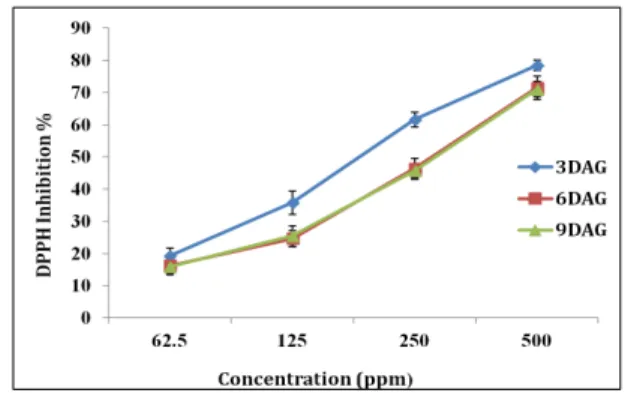
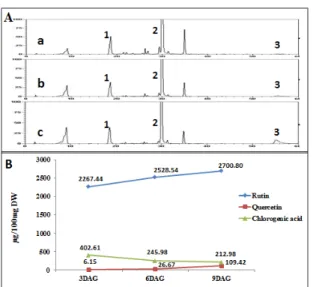
Abstract - Rice type tartary buckwheat is used as a substitute for rice in many Asian countries due to its easy dehulling character. The objective of the present study was to determine the chlorophyll, total polyphenol (TP), total flavonoid (TF), antioxidant activity and to quantify the bioactive compounds rutin, quercetin and chlorogenic acid in the seedlings of rice-type tartary buckwheat (RTTB). Young seedlings exhibited higher antioxidant (DPPH radical inhibition) activity in dose dependent manner. TP and TF content were highest (3017.46 ± 201.84 ㎍ TAE /100 ㎎ dw and 1916.0 ± 102.95 ㎍ QE / 100 ㎎ dw respectively) in 3 days after germination (DAG) seedlings compare to 6 and 9 DAG. The contents of rutin and quercetin increased with growing stage of seedlings. However, the chlorogenic acid decreased with increasing growth.
Overall, RTTB seedlings can be regarded as a strong source of phenolics and have high possibility for food and nutraceutical application due to their efficient antioxidant properties, higher chlorophyll and phytochemical content.
Key words - Antioxidant, Chlorophyll, Seedlings, Rice-type tartary buckwheat
*Corresponding author. E-mail : [email protected]
Introduction
Buckwheat is an annual plant belonging to the family Polygonaceae and is cosmopolitan in nature. This plant is considered as a functional food as it is rich in phenolic compounds including rutin, quercetin, orientin, vitexin, isovitexein and isoorientin (Hagels et al., 1995, Li and Zhang, 2001). Among these compounds, rutin has been recognized as a major antioxidant component that accounts for about 85-90% of the total antioxidant activity (Morishita et al., 2007). Rutin is also known to have anti-inflammatory, anti- carcinogenic effects (Liu et al., 2008) and is effective for preventing hemorrhagic disease and arteriosclerosis (Fabjan et al., 2003). Other bioactive compounds like quercetin and chlorogenic acid present in buckwheat have been identified as strong antioxidants, antimicrobial, antifungal (Bowels and Miller, 1994), anti-angiogenesis and anticancer (Jackson and Venema, 2006) agent.
Apart from phenolic compounds, chlorophylls are also a major component in green plants. Commonly two types of chlorophyll, a and b, are found in terrestrial plant. These
chlorophylls absorb the light in the process of photosynthesis that converts light energy to chemical energy. These days, chlorophylls are used for the supplementary food because of its important health benefit role to human body. Researches have shown that the chlorophylls can be used for the treatment of different acute and chronic suppurative diseases (Benjamin, 1940). Chlorophyll derivatives have been considered as an antiproliferative effect (Chiu et al., 2003; Gomaa et al., 2012).
Therefore, in this study it is worthy to analyze the chlorophyll content in the seedlings of the rice type tartary buckwheat.
Nowadays, buckwheat seedlings and sprout have gained popularity due to the functional compounds present in them and are considered as a new vegetable (Kim et al., 2001). So far, several researches have been reported regarding the phenolic content, antioxidant activities, and biological effects of the buckwheat sprouts (Kim et al., 2008, 2006; Liu et al., 2008; Chang et al., 2010). Compared to common buckwheat, tartary buckwheat is known to have higher flavonoid content, mainly rutin. Recently, another type of tartary buckwheat known as rice-type tartary buckwheat (RTTB) has gained much attention due to its unique character of being readily dehulled. This RTTB is used as a substitute for rice in some parts of Nepal, Bhutan, Inner Mongolia and southwest China
Original Research Article
Fig. 1. Seedlings of rice-type tartary buckwheat cultivated in greenhouse (A). B, C and D represent seedlings harvested in 3, 6 and 9 days after germination, respectively.
(Wang et al., 2007). In previous study, Li et al. (2012) quanti- fied rutin and quercetin in mature flower, seed, leaf and stem of RTTB. However, to the best of our knowledge, there is no literature regarding the phenolic compounds (rutin, quercetin and chlorogenic acid), chlorophyll content and the antioxidant activity of seedlings of RTTB. Therefore, in this research, we made an effort to assess the chlorophyll content, antioxidant activity, as well as the content of phytochemicals, particularly rutin, quercetin and chlorogenic acid in the different growth stages of seedlings of RTTB.
Materials and Methods
Chemicals
Analytical grade organic solvent (methanol and acetonitrile) used for the extraction of rice-type tartary buckwheat and detection in HPLC were purchased from Merck KGaA Darmstadt, Germany. Tannic acid, Quercitin and 1, 1-diphenyl- 2-picrylhydrazyl (DPPH) purchased from Sigma Chemical Co. (St. Louis, Mo). Folin-Ciocalteu’s reagent was purchased from Wako Pure Chemicals, Japan. The pure compounds rutin, quercetin and chlorogenic acid were purchased from Sigma Chemical Co. (St. Louis, MO). All other chemicals and reagents used were of analytical grade.
Cultivation and sampling of plant materials
The seeds of RTTB were sown in a greenhouse at 24 ± 3℃
and watered one time in a day. The young seedlings (Fig. 1) were harvested in 3, 6, and 9 days after germination (DAG).
The harvested samples were washed and dried in an oven at a temperature of 45 ± 1℃. To estimate the fresh weight and
moisture content of seedlings another batch of 10 seedlings each in 3 replications were also harvested and dried in the oven.
Preparation of plant extracts
The dried powdered samples (2 g) of seedlings were taken and 100 ㎖ of 100% ethanol was added to each and incubated overnight in a shaker followed by filtration using Advantech 5B filter paper (Tokyo Roshi Kaisha, Japan). The extract was dried using a rotatory evaporator (Eyela digital water bath SB-1000, Tokyo, Rikakikai Co., Ltd. Japan) at a temperature of 40℃. The extracts were vacuum freeze dried and the yield was measured and stored in the refrigerator for further experiment.
Extraction of chlorophylls
The freshly harvested and pre-weighed seedlings were homogenized with 20 ㎖ of 100% ethanol in an extraction tube for 10 min. The extract obtained was centrifuged at 5000 rpm for about 10 min. The supernatant was separated and the maximum absorbance of chlorophyll a and b were determined spectrophotometrically at 666 and 654 ㎚ respectively by means of equations proposed by Lichtenthaler and Wellburn (1983):
Chlorophyll a = 15.65 A
666- 7.340 A
654Chlorophyll b = 27.05 A
654- 11.21 A
666Estimation of total polyphenol and total flavonoid content
Total polyphenol (TP) content of samples was estimated
using the Folin-Ciocalteu colorimetric method (Ghimeray et
al., 2009). The appropriate dilutions of the extracts were oxidized with 0.2N Folin-Ciocalteu’s reagent and then the reaction was neutralized with 10% sodium carbonate. The absorbance of the resulting blue color was measured at 725 ㎚ using spectrophotometer after incubation for 1 hr at room temperature. Quantification was done on the basis of the standard curve of Tannic acid. Results were expressed as ㎍ of Tannic acid equivalent (TAE) per 100 ㎎ of dry weight (dw).
Total flavonoid (TF) content was determined using the protocol of Eom et al. (2008). Briefly, an aliquot of 1 ㎖ of the sample (1 ㎎/㎖) was mixed with 0.1 ㎖ of aluminum nitrate (10%) and 0.1 ㎖ of potassium acetate (1 M). To the mixture, 3.8 ㎖ of ethanol was added to make the total volume 5 ㎖.
The mixture was vortexed and the absorbance was measured after 40 min at 415 ㎚ using a spectrophotometer (UV, 1800 Shimadzu, Japan). The TF was calculated from a calibration curve (R
2= 0.999) using quercetin equivalents (QE) in ㎍ per 100 ㎎ dry weight.
Measurement of antioxidant activity by DPPH free radical scavenging assay
DPPH radical scavenging activity of rice-type tartary buckwheat extracts were determined by using the method of Sharma et al. (2012). Briefly, 1 ㎖ of each of extract at different concentration (500, 250, 125 and 62.5 ppm) was added to 3 ㎖ of DPPH (0.15 mM) solution. The mixtures were shaken vigorously and left to stand at room temperature in the dark for 30 min. The absorbance was measured at 517 ㎚ in a spectrophotometer and the percent inhibition activities of the extracts were calculated against a blank using the following expression: Inhibition (%) = (1-B/A) × 100, where, A is the absorbance of the mixture without extract and B is the absorbance with extracts.
Quantitation of Rutin, Quercetin and Chlorogenic acid by HPLC
The quantitative estimation of different compounds (rutin, quercetin, and chlorogenic acid) was performed by HPLC.
The HPLC system (CBM-20A, Shimadzu Co, Ltd., Japan) with two gradient pumps (LC-20AT, Shimadzu), an auto sample injector (SIL-20A, Shimadzu), a UV-detector (SPD-
10A, Shimadzu) and a column oven (35℃ CTO-20A, Shimadzu) were used for analysis. The separation was performed on a C18 column (Synergi 4 μ MAX-RY, 150 × 4.6 ㎜, 4 micron Phenomenex). Flow rate of mobile phage solution was 1.0
㎖/min, and detection was at 355 ㎚. 10 ㎕ of each sample was injected in to the HPLC machine. HPLC conditions were as follows: Solvent A (water in 0.1% Trifloroacetic acid) and solvent B (acetonitrile). Gradient elution used was 0-10 min, 5-6% B; 10-15 min, 6-10% B; 15-45 min, 10-19% B; 45-65 min, 19-20% B. The compounds were identified in solvents by matching their retention times and spectra with that of the standards and the data were calculated on the basis of the peak area obtained.
Data analysis
All data were expressed as the mean value ± standard deviation (SD) of each experimental group (n = 3). The results were processed using Excel 2010 (Microsoft, Redmond, WA, USA).
Results and Discussion
Estimation of fresh weight (FW), moisture and chlorophyll content in seedlings
Table 1 lists the FW, moisture and chlorophyll contents of seedlings harvested in different days after germination. The FW of seedlings increased with the growth of the seedlings which measured 760.6 ± 18.2, 1951.7 ± 29.6 and 4426.4 ± 17.1 ㎎ at 3, 6 and 9 DAG, respectively. The data of moisture content remain almost consistent (ranging from 91.83 - 92.58%) in all the seedlings harvested in different days. This moisture content of seedlings resembles with the previous report of common and tartary buckwheat seedlings shown by Kim et al. (2008).
The chlorophyll pigments are a major source applied in
food and neutraceutical products (Mortensen, 2006). Accor-
ding to other findings the ethanol molecules penetrate lipid-
protein bilayers more efficiently than methanol due to higher
hydrophobicity (Patra et al., 2006). Therefore, we also used
ethanol to extract the chlorophyll from the seedlings. According
to our data, the 3, 6 and 9 DAG seedlings showed higher chl-
b content ranging from 46.20-47.82 ㎍/㎖compared to chl-a,
Fig. 2. Total polyphenol (TP) and total flavonoid (TF) content in rice-type tartary buckwheat seedlings at 3, 6 and 9 days after germination (DAG). TP content is expressed in ㎍ TAE/100 ㎎dw and TF content is expressed in ㎍ QE/100 ㎎ dw. Bar means standard deviation.
Fig. 3. DPPH free radical scavenging activity (%) of rice-type tartary buckwheat seedlings at 3, 6 and 9 days after germination (DAG).
Table 1. Fresh weight (FW), moisture content (%) and chlorophyll content (㎍/㎖) in rice-type tartary buckwheat seedlings at different stages of germination
zDays after
germination FW (㎎) Moisture (%)
Chl-a (㎍/㎖)
yChl-b (㎍㎖)
y3 760.6 ±
18.2
91.83 ± 0.53
23.93 ± 2.61
47.82 ± 2.71
6 1951.7 ±
29.6
92.58 ± 0.46
24.34 ± 1.96
47.75 ± 2.54
9 4426.4 ±
17.1
92.39 ± 0.75
23.76 ± 2.14
46.20 ± 3.04
z
Values are means ± standard error of 3 replications containing 10 seedlings in each replica.
y