Environmental Science
Vol. 32, No. 3, pp. 302-310, August, 2016 http://dx.doi.org/10.7747/JFES.2016.32.3.302
Assessment of Carbon Stock in Chronosequence Rehabilitated Tropical Forest Stands in Malaysia
Roland Jui Heng Kueh1,*, Nik Muhamad Majid2, Osumanu Haruna Ahmed1 and Seca Gandaseca3
1Faculty of Agriculture and Food Sciences, Universiti Putra Malaysia Bintulu Sarawak Campus, Jalan Nyabau 97008 Bintulu, Sarawak, Malaysia
2Institute of Tropical Forestry and Forest Products, Universiti Putra Malaysia, 43400 UPM Serdang, Selangor Darul Ehsan, Malaysia
3Faculty of Forestry, Universiti Putra Malaysia, 43400 UPM Serdang, Selangor Darul Ehsan, Malaysia
Abstract
The loss and degradation in tropical forest region are some of the current global concern. Hence, these issues elevated the role of rehabilitated forests in providing ecological products and services. The information on the carbon stock is important in relation to global carbon and biomass use, but lacking from the tropical region. This paper reports the assessment of tree and soil carbon stock in a chronosequence rehabilitated tropical forest stands in Malaysia. The study site was at the UPM-Mitsubishi Forest Rehabilitation Project, UPMKB. 20×20 m plot was established each and assessed in 2009 at 1-, 10- and 19-year-old sites while an adjacent ±23-year-old natural regenerating secondary forest plot was established for comparison. The overall total carbon stock was in the order of 19-year-old>±23-year-old>
10-year-old>1-year-old. When forest carbon stock is low, the soil component plays an important role in the carbon storage. The forest carbon recovery is crucial to increase soil carbon stock. The variations in the carbon stock showed the different stages of the forest recovery. Species survived after 19-years of planting are potential species for carbon sequestration activities in rehabilitated forest. Human intervention in rehabilitating degraded forest areas through tree planting initiatives is crucial towards recovering the forest ecological role especially in forest carbon stock capacity.
Key Words: biomass, carbon, rehabilitated tropical forest, natural regenerating secondary forest
Received: July 29, 2014. Revised: March 28, 2016. Accepted: April 19, 2016.
Corresponding author: Roland Jui Heng Kueh
Faculty of Agriculture and Food Sciences, Universiti Putra Malaysia Bintulu Sarawak Campus, Jalan Nyabau, 97008 Bintulu, Sarawak, Malaysia Tel: 6086855722, Fax: 6086855416, E-mail: [email protected]
Introduction
Currently, the clearing and degradation of tropical forest are occurring at unprecedented rate. The United Nation Food and Agriculture Organization (FAO) reported that between 2000 and 2005, the global forest loss was 13 mil- lion ha per year. Most of these losses are occurring in the tropical region (FAO 2011). These issues would have sig- nificant impact on the global carbon cycle. This is because forest ecosystem store more carbon than other terrestrial ecosystems (Waring and Running 1998) where tropical for- est stores about 56% and 32% in biomass and soil carbon,
respectively (Pan et al. 2011). The impacts to the carbon cy- cle are higher carbon emission rates to the atmosphere through reduce storage capacity of the above- and below- ground components of the forest ecosystem (Silver et al.
2000). This has prompted many scientists to carry out stud- ies related to biomass and carbon storage (Bohre et al.
2014).
Forest rehabilitation is man-facilitated or intervention on the recovery process according to the natural regeneration and succession. Hence, it is a process of restoring or replac- ing some form of vegetative cover to an area of land so as to improve its natural productivity and its natural environ-
mental and aesthetic values (Lim 1992). The use of in- digenous tree species of which is the potential natural vege- tation in forest rehabilitation initiatives has also become an important aspect of forest conservation (Miyawaki 1999;
2011). A joint research project was initiated 25 years ago on a 47.5 hectare research site in the Universiti Putra Malaysia Bintulu Sarawak Campus (UPMKB) with the objectives to conduct experimental planting of indigenous tree spe- cies, preferably the canopy species on degraded sites (Azani et al. 1995; Azani 2011; Akita 2011).
Forest rehabilitation has the potential in enhancing car- bon storage through biomass and soil carbon accumulation (Ritcher et al. 1999; Silver et al. 2000; Silver et al. 2004).
Forest with tree species of high growth rates as in forest plantation and natural succession could be a good option for mitigating CO2 emissions through carbon sequestration (Montagnini and Porras 1998; Silver et al. 2000). On sec- ondary forest succession, significant amount of carbon can accumulate in plants and soil within 20 years and some studies recorded 100 t/ha after 50 years of regeneration (Brown and Lugo 1992). As for the belowground compo- nent, carbon accumulation only occur significantly during the 20-100 years after forest rehabilitation (Silver et al.
2000). However, the capacity of carbon sequestration on the rehabilitated forest through plantation and natural re- generating forest remain unclear (Sang et al. 2013).
Generally, it is thought that the aboveground biomass and carbon accumulates faster than the belowground while the slower turn-over rate in the belowground component has the potential as long-term storage capability (Silver et al.
2000).
Such information provides the platform to develop man- agement strategies and in setting national policy. However, carbon stock capacity of the rehabilitated forest remains un- clear due to the lack of information especially from the trop- ical forest region. The uncertainty about how much carbon is stored in tropical forest is an important limitation for re- gional scale estimation of carbon fluxes and its improve- ment requires extensive field studies of both above- and be- lowground stocks (Lu et al. 2010). To understand the car- bon stock, this paper attempts an initiative to assess the tree and soil carbon stock in a chronosequence rehabilitated tropical forest stands. This would be of great interest due to the significant impact on the global carbon cycle.
Materials and Methods
Study Site
The study was conducted at the UPM-Mitsubishi Corporation Forest Rehabilitation Project in UPM Bintulu Sarawak Campus, Sarawak, Malaysia. It is located about 600 kilometers northeast of Kuching (latitude 03o12’N and longitude 113o02’E). Assessments were conducted in 2009.
20×20 m research plot was established each at stand of 19-year-old (Plot 1991), 10-year-old (Plot 1999) and 1-year-old (Plot 2008). In a natural regenerating secondary forest (Plot NF), a plot was established adjacent to study site. The forest is regenerating naturally since 1987 (±23-year-old). The relative small plot size and limited number of plot (one in each planting year) was due to the small annual planting area where it is not more than 0.04 ha annually.
The Miyawaki’s method applied in this project is based on the concept of vegetation association and accelerating natural regeneration (Miyawaki 1999). In this technique, indigenous species mainly from the Dipterocarpaceae and Non-Dipterocarpaceae (126 species) were planted at a high density (3 seedlings/m2). Plots 1991 and 1999 were pre- viously an ex-shifting cultivation area. Before the com- mencement of the project, the area was dominated by Ischaemum magnum, Miscanthus floridulus and Trema orientalis. Plot 2008 was a regenerating forest which was do- minated by grassland species and Macaranga spp. and T.
orientalis (Yusuf and Abas 1992). The Plot NF was a log- ging area and the timber harvesting ceased with the open- ing of the university campus in 1987.
Forest enumeration was also conducted in 2009. Data analysed showed that most of the trees were small and falls within <10 cm diameter size class (>75%). This is a typi- cal inverse-J pattern with high tree density (3 seedlings/m2) at the smaller diameter class. The structural characteristics performance of trees in the 19-year-old rehabilitated forest stand were better compared to the adjacent natural re- generating secondary forest (Kueh et al. 2011). The mean dbh of 10- and 19-year-old rehabilitated forests were 35%
and 56%, higher, respectively compared to the natural re- generating secondary forest, despite natural regenerating secondary forest having the biggest diameter tree (59.8 cm). The mean height of 10- and 19-year-old rehabilitated
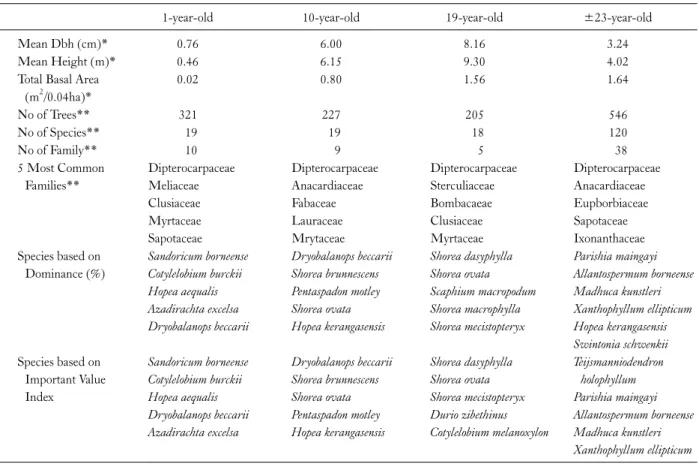
Table 1. Selected forest structural features of the study sites
1-year-old 10-year-old 19-year-old ±23-year-old
Mean Dbh (cm)* 0.76 6.00 8.16 3.24
Mean Height (m)* 0.46 6.15 9.30 4.02
Total Basal Area (m2/0.04ha)*
0.02 0.80 1.56 1.64
No of Trees** 321 227 205 546
No of Species** 19 19 18 120
No of Family** 10 9 5 38
5 Most Common Families**
Dipterocarpaceae Meliaceae Clusiaceae Myrtaceae Sapotaceae
Dipterocarpaceae Anacardiaceae Fabaceae Lauraceae Mrytaceae
Dipterocarpaceae Sterculiaceae Bombacaeae Clusiaceae Myrtaceae
Dipterocarpaceae Anacardiaceae Eupborbiaceae Sapotaceae Ixonanthaceae Species based on
Dominance (%)
Sandoricum borneense Cotylelobium burckii Hopea aequalis Azadirachta excelsa Dryobalanops beccarii
Dryobalanops beccarii Shorea brunnescens Pentaspadon motley Shorea ovata Hopea kerangasensis
Shorea dasyphylla Shorea ovata Scaphium macropodum Shorea macrophylla Shorea mecistopteryx
Parishia maingayi Allantospermum borneense Madhuca kunstleri Xanthophyllum ellipticum Hopea kerangasensis Swintonia schwenkii Species based on
Important Value Index
Sandoricum borneense Cotylelobium burckii Hopea aequalis Dryobalanops beccarii Azadirachta excelsa
Dryobalanops beccarii Shorea brunnescens Shorea ovata Pentaspadon motley Hopea kerangasensis
Shorea dasyphylla Shorea ovata Shorea mecistopteryx Durio zibethinus Cotylelobium melanoxylon
Teijsmanniodendron holophyllum Parishia maingayi Allantospermum borneense Madhuca kunstleri Xanthophyllum ellipticum
*Indicate that data was adapted from Kueh et al. (2011), **Indicate that data was adapted from Kueh et al. (2012).
forests were 46% and 60%, higher compared to the natural regenerating secondary forest, despite natural regenerating secondary forest having the tallest tree (26.8 m) in the study area. In addition, the mean basal area of 19-year-old re- habilitated forest was 61% higher than natural regenerating secondary forest. In terms of forest stand development, these forest stands are at early stage of development with smaller size (0.8-8.2 cm), lower height (0.5-9.3 m) and lower species diversity (18-19 species) compared to a ma- ture forest. Information on the key forest structural features is as in Table 1.
Forest Carbon Estimation
The forest carbon was estimated using the information on biomass. The carbon content in the tree samples (n=4) was determined by dry-combustion method in a LECO CHNS TruSpec 600 Analyser. The average tree carbon value was 45% and this is consistent with other reported
studies that reported 45-50% of biomass is carbon (Chan 1982; Brown 1997; Basuki et al. 2009). The biomass was estimated using a modified allometric biomass equation 1 by Kueh (2014):
Aboveground biomass (kg)=0.074*(dbh)2.48··· (1)
Where, dbh=diameter breast height (1.3 m). The equa- tion was derived from the average values between Kueh et al. (2012) [Y=0.041*(Dbh*H)1.335] and Kenzo et al.
(2009) [Y=0.0829*(Dbh)2.43] models. The former model was developed in the similar study site, and subsequent model in Niah Forest Reserve and Sungai Liku, Miri, Sarawak, Malaysia. From the analysis, Kenzo’s model was chosen because of the low mean relative error (MRE) and the overall wood density in the study plots are close to this model. The forest carbon stock was estimated by multi- plying the biomass estimates and carbon content.
Table 2. Relationship between age of stand with the forest carbon, standing crop litter carbon and soil carbon [Ln Y=Ln a+bLn (x)]
Ln (Y) Ln (X) n a (±S.E.) b (±S.E.) Adjusted r2 MSE CF
Total Carbon Age 4 3.35**±0.07 0.39**±0.03 0.978 0.01 1.00
Tree Carbon Age 4 −2.02*±0.31 2.04**±0.13 0.989 0.10 1.05
Standing Crop Litter Carbon Age 4 0.69ns±0.53 0.28ns±0.22 0.172 0.30 1.16
Soil Carbon Age 4 3.34 **±0.18 0.08ns±0.07 0.071 0.03 1.02
r2means coefficient of determination; * and ** indicate significant differences at levels of p≤0.05 and p≤0.01, respectively; n.s., no sig- nificant differences; S.E., standard error; MSE, mean square error; CF, correction factor.
Soil Carbon Estimation
Ten sampling points were randomly selected which cov- ers each corner and centre in each of the research plot (20×20 m). Samples were taken at depths of 0-25 and 25-50 cm. These depth was chosen as study done in similar area (for 1-7-year-old rehabilitated forest) found that there are not significant differences in soil total carbon between 0-20 cm and 20-40 cm except 40-60 cm (Ch’ng et al. 2011).
The 50 cm depth was considered in the study as reports by Paramanthan (2000) showed that the carbon content in the Nyalau Series stabilize at 0.1-0.3% after 35 cm depth while Bekenu Series stabilize at 0.1-0.2% after 36 cm depth. Each sample was a bulk of three subsamples. The soil samples were air-dried, crushed manually and sieved to pass a 2 mm size sieve. The soil carbon content (%) was determined by dry-combustion method in a LECO CHNS TruSpec 600 Analyser. By using the information of the soil carbon content (C), bulk density (ρb) and soil depth (D), it was possible to estimate the amount of soil carbon. The total soil carbon stock for the 50-cm depth was calculated by adding the val- ue obtained from 0-25 cm and 25-50 cm depth.
Soil C=C%×ρb×D ··· (2) Data Analysis
In the regression analysis, age was independent variable while carbon was dependent variable using the model LN (y)=LN (a)+b[LN (x)]. All the data were analyzed us- ing SPSS 16.0 for Windows. The back-transformed forest and soil carbon estimates were multiplied by the Correction Factor (CF)=e0.5*MSE where MSE is the mean squared er- ror of the regression model (Sprugel 1983).
Results and Discussion
The rehabilitated forests have tree carbon ranging from 0.1-54.0 tC/ha. In contrast to the natural regenerating sec- ondary forest, tree carbon was 61.0 tC/ha. Regression anal- ysis showed that the tree carbon increase significantly with age (p≤0.01) (Table 2). These values are comparable to those reported for natural regenerating secondary forest in this region which ranges from 4.0-59.4 tC/ha (Hashimotio et al. 2000; Kenzo et al. 2010) but lower compared to those reported for lowland and hill dipterocarps in Asia (Laumonier et al. 2010; Lu et al. 2010; Ngo et al. 2013).
The total soil carbon (at 50-cm depth) was 27.0-42.0 tC/ha in rehabilitated forests and 32.0 tC/ha in natural re- generating secondary forest. Regression analysis show insig- nificant relationships between ages of stand and soil carbon (Table 2). These results are comparable to 8-year-old plan- tation in Vietnam and less than 7 year-old rehabilitated for- est in Sarawak which ranged from 18.7-56.6 tC/ha (Ch’ng et al. 2011; Sang et al. 2013) but fall slightly lower that the value range (55.9-102.0 tC/ha) of the carbon stock as re- ported for secondary forest such as in young secondary for- est in tropical regions (FAO 2010; Lu et al. 2010; Fonseca et al. 2011; Toriyama et al. 2011; Ngo et al. 2013).
Carbon is stored in the vegetation and soil, where the loss of biomass as litter acts as one of the soil carbon input.
Information on the litter was obtained from study conducted by Ku (2012). Standing litter crop biomass ranged from 4.5-18.3 t/ha or standing litter crop carbon of 2.1-8.3 tC/ha in the rehabilitated forest while 7.5 t/ha (3.4 tC/ha) in the natural regenerating secondary forest (Ku 2012). The low decomposition rate (k=0.21-0.22) and low concentration of nitrogen were the contributing factors towards high stand- ing litter crop. This could explain the weak relationship be-
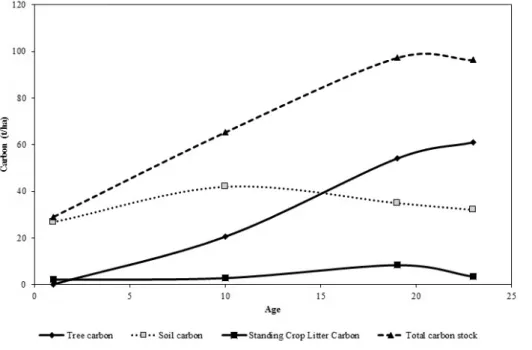
Fig. 1. Carbon stock at the study plots.
tween age and the standing crop litter (Table 2). The results were consistent with values reported in previous studies lo- cated in tropical lowland forests that recorded a range of 1.6-3.9 tC/ha (Ogawa 1978; Gong and Ong 1983).
Overall, the total tree and soil carbon stock was in the or- der of 19-year-old>±23-year-old>10-year-old>1-year- old where tree carbon stock increased significantly with age of the forest (Table 2). Similar trends have been reported for tropical forest rehabilitation where the first 20 years showed a high rate of aboveground biomass accumulation and storage (Silver et al. 2000). Based on Fig. 1, the above- ground carbon stock component (tree carbon and standing crop litter carbon) significantly affects soil carbon storage in 19-year-old rehabilitated and natural regenerating secon- dary forests. The aboveground carbon stock component contributed about 64-67% of total carbon stock in the 19-year-old rehabilitated and natural regenerating secon- dary forests. The younger rehabilitated forest (10- and 1-year-old) recorded low aboveground carbon stock 36%
and 8% of the total carbon stock, respectively.
The rehabilitated forests had stands with smaller mean dbh (0.8-8.2 cm), lower total basal area (0.5-39.0 m2/ha) and shorter mean height (0.5-9.3 m). This explains the low- er forest carbon recorded in this study. Physical structural characteristics of forest can affect total aboveground bio- mass and carbon stored. These were consistent with other
studies who reported that 55-year-old secondary forest with mean basal area of 6.4 m2/0.25 ha and mean height of 19.0 m stored 264.0 t/ha of biomass while in a primary forest with basal area of 7.8 m2/0.25 ha and mean height of 22.1 m stored 358.4 t/ha of biomass (Brearley et al. 2004). In addi- tion, the low forest carbon stock at 1-year-old rehabilitated forest also indicates an early stage of succession in the plot.
Early succession areas dominated by Imperata cylindrical and Pteridium spp. had low biomass of 6.2 t/ha in compar- ison to 21.0 t/ha of upland with high number of larger sized trees (Lim and Basri 1985).
The accelerated forest structural development in 19- year-old rehabilitated forest had comparable forest carbon stock with the natural regenerating secondary forest (Fig.
1). Such similar trend was also reported where higher num- ber of large trees over 30 cm dbh will contribute to the higher aboveground biomass and carbon for primary forest when compared to the secondary forest in Singapore (Ngo et al. 2013). Furthermore, this could be due to the effect of higher site fertility index at similar site as reported by Akbar et al. (2010) compared to other study plots.
With these findings, the rehabilitated forests are at dif- ferent stages of forest carbon recovery. This also reflects the different stages of forest growth. The 1-year-old re- habilitated forest is still at the gap phase or early stage of succession. The 10-year-old rehabilitated forest is at the
building phase or between early and mid stage of succession. The 19-year-old rehabilitated and natural re- generating secondary forests are between building and young mature phase or between mid to young late stage of succession. After 19 years, the rehabilitated forest is yet to recover from the aspect of the total aboveground carbon.
The soil carbon (which is first top 50 cm) was about 33-36% of the total carbon stock in the 19-year-old re- habilitated and natural regenerating secondary forests. As for younger rehabilitated forests of 10- and 1-year-old, soil carbon contributed 64% and 92% of total carbon stock, respectively. The presence of forest as in the older re- habilitated forest restored the soil organic matter as this for- est provides organic matter inputs in the form of above- and belowground litter. Studies conducted in primary forest, Singapore found that the soil carbon contributed 33% in contrast to 52% in secondary forest (Ngo et al. 2013). As for the soil carbon stock, there was a weak relationship with age (Table 2). Similar trend has been reported by Sang et al.
(2013) where 17-year-old Acacia mangium plantation showed higher aboveground biomass but similar soil carbon stock in comparison to secondary forest in Vietnam. This is because belowground carbon accumulates more slowly than aboveground carbon. Studies found that carbon accumu- lation would increase significantly during the 20-100 years of forest rehabilitation (Silver et al. 2000). This could due to the slower rate of root biomass accumulation.
Lower tree carbon stock was recorded in the young re- habilitated forest particularly the 1- and 10-year-old re- habilitated forests but had soil carbon stock of 27.0 tC/ha and 42.0 tC/ha, respectively. This could be due to the pre- vious vegetation which contributed to the soil organic mat- ter and soil carbon prior to the tree planting. This suggests the importance of soil component as carbon storage. The aboveground wood component has a high long term storage capacity. However, they also found that carbon movement is very slow for the belowground component but it has high storage capacity (Chambers et al. 2001).
As the forest grows older, the forest biomass and carbon also recovers. In the 10- and 19-year-old rehabilitated for- ests, the amount of carbon increased from 32 to 56% of the overall total carbon stock. When forest carbon stock is low as in the young rehabilitated forest, the soil component plays an important role in the carbon storage. Over 90% of
the total carbon stock was stored in the younger re- habilitated forest. The comparable soil carbon stock could be associated with the increase in fine root biomass which was due to the vegetation clearing prior planting. This is where the fine root turnover contributes to the increase in soil carbon stocks in a secondary forest in Singapore (Ngo et al. 2013). The aboveground biomass and carbon recov- ery is crucial for the increase in soil carbon storage.
Therefore, their synergic and symbiotic role between aboveground forest development and belowground carbon stock should be considered in any forest rehabilitation man- agement activities.
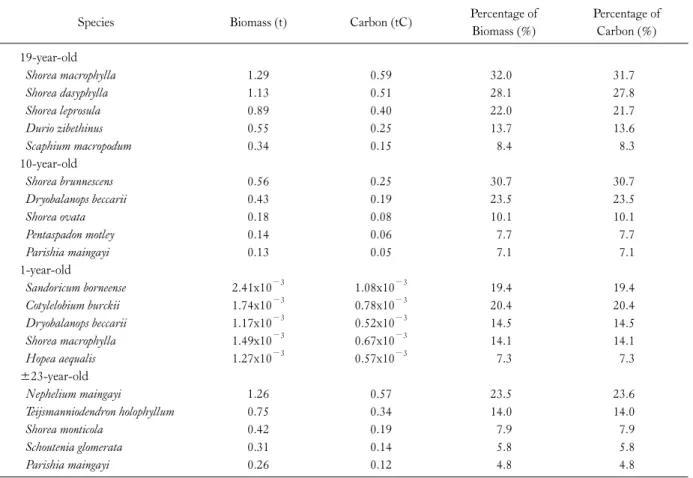
The major contributors of the tree biomass and carbon in the 19-year-old rehabilitated forest were Shorea macrophylla and S. dasyphylla (Table 3).They contributed about 60% of total biomass and carbon. The contribution of these species are supported by the fact that they ranked top five dominant species. As for the 10-year-old rehabilitated forest, both emergent species namely S. brunnescens and Dryobalanops beccarii contributed about 54% of the total biomass and carbon. Both species were found to be the most common species in the study plot. In the one-year-old rehabilitated forest, Sandoricum borneense and Cotylelobium burckii con- tributed almost 40% of the total biomass and carbon. Both species are commonly found in the study plot where both contributed 21.2% and 15.3%, respectively, of the total species. In the natural regenerating secondary forest, Nephelium maingayi and Teijsmanniodendron holophyllum con- tributed almost 38% of the total biomass and carbon. T. hol- ophyllum had the highest Importance Value (IV) index (115.3) suggesting the importance of the species in the study plot. However, as for N. maingayi only had IV index value of 42.3. The highest biomass recorded by this species as it has the biggest dbh (59.80 cm) size recorded in the plot. The species recorded in the 19-year old rehabilitated forest are the fittest tree species which survived 19 years of competition within the forest stand. These are potential spe- cies which can play important role in carbon sequestration in rehabilitated forest.
The intervention by rehabilitating degraded forest areas through tree planting activities had enhanced their capa- bility to store soil carbon rather than relying on natural recovery. This finding suggested the importance of forest rehabilitation activities which is a part of an effective carbon
Table 3. Top five species’ biomass and carbon contribution
Species Biomass (t) Carbon (tC) Percentage of
Biomass (%)
Percentage of Carbon (%) 19-year-old
Shorea macrophylla 1.29 0.59 32.0 31.7
Shorea dasyphylla 1.13 0.51 28.1 27.8
Shorea leprosula 0.89 0.40 22.0 21.7
Durio zibethinus 0.55 0.25 13.7 13.6
Scaphium macropodum 0.34 0.15 8.4 8.3
10-year-old
Shorea brunnescens 0.56 0.25 30.7 30.7
Dryobalanops beccarii 0.43 0.19 23.5 23.5
Shorea ovata 0.18 0.08 10.1 10.1
Pentaspadon motley 0.14 0.06 7.7 7.7
Parishia maingayi 0.13 0.05 7.1 7.1
1-year-old
Sandoricum borneense 2.41x10⁻³ 1.08x10⁻³ 19.4 19.4
Cotylelobium burckii 1.74x10⁻³ 0.78x10⁻³ 20.4 20.4
Dryobalanops beccarii 1.17x10⁻³ 0.52x10⁻³ 14.5 14.5
Shorea macrophylla 1.49x10⁻³ 0.67x10⁻³ 14.1 14.1
Hopea aequalis 1.27x10⁻³ 0.57x10⁻³ 7.3 7.3
±23-year-old
Nephelium maingayi 1.26 0.57 23.5 23.6
Teijsmanniodendron holophyllum 0.75 0.34 14.0 14.0
Shorea monticola 0.42 0.19 7.9 7.9
Schoutenia glomerata 0.31 0.14 5.8 5.8
Parishia maingayi 0.26 0.12 4.8 4.8
recovery. This active management were suggested to accel- erate regeneration and carbon accumulation in secondary forest (Ngo et al. 2013). Hence, rehabilitation forest can play a significant role as carbon sink in mitigating green- house gases and climate change. The choice of species is im- portant in rehabilitating degraded forest while the remnant important species in regenerating secondary forest will play their role in carbon sequestration. Long-term monitoring of the soil carbon recovery is still required as the rate of recov- ery for the belowground carbon stock is slow. These could provide a better understanding on the trend of the carbon recovery and the stock capacity of a rehabilitated forest.
Conclusions
This quantification of carbon stock in Sarawak’s re- habilitated forest revealed that the oldest rehabilitated forest stand recovery in terms of carbon stock was comparable to
the natural regenerating secondary forest. In general, the carbon stock in rehabilitated forests is lower than other sites reported for Southeast Asia forests. This information may provide an indication on forest recovery where the amount carbon stock is used as means of comparison to the primary forest. These forests were different in terms of carbon stock among different age stands of rehabilitated forest that re- flected the different stages of forest recovery. The above- ground component (forest carbon and standing litter crop carbon) of the rehabilitated forest showed faster carbon re- covery than the belowground component (soil carbon).
This information also indicates that the soil component is essential to soil carbon stock in a rehabilitated forest espe- cially when forest carbon stock capacity is low.
Long-term monitoring is still required to provide better understanding on the carbon dynamics especially the se- questration capacity, sink capability and sources in the re- habilitated forest. The Miyawaki’s method applied has
prompted the 19-year-old rehabilitated forest to store more carbon. Species that survived in high density forest are the fittest species which are potential species in tree planting programme. Forest rehabilitation activities also showed the potential in promoting carbon recovery. In conclusion, hu- man intervention in rehabilitating degraded forest areas through tree planting initiatives is crucial towards recover- ing the forest ecological roles especially in carbon storage capacity.
Acknowledgements
This work was supported by the research grant from Mitsubishi Corporation, Japan.
References
Akbar MH, Ahmed OH, Jamaluddin AS, Nik Ab. Majid NM, Abdul-Hamid H, Jusop S, Hassan A, Yusof KH, Abdu A.
2010. Differences in soil physical and chemical properties of re- habilitated and secondary forests. American J Applied Sci 7:
1200-1209.
Akita M. 2011. Mitsubishi Corporation’s tropical forest re- generation experimental projects. In: Proceedings of International Symposium on Rehabilitation of Tropical Rainforest Ecosys- tems, Kuala Lumpur, 24-25 October, 2011. (Majid NM, Ahmed OH, Sajap AS, Islam MM, eds). Faculty of Forestry, Universiti Putra Malaysia, Selangor, pp 1-6.
Azani MA, Fujiwara K, Miyawaki A. 1995. The rehabilitation of the tropical rainforest ecosystems in Sarawak, Malaysia-four year results of a scientific study by Universiti Pertanian Malaysia and Yokohama National University Japan. Bulletin Inst Enviro Sci Tech 21: 59-87.
Azani MA. 2011. An overview of UPM-Mitsubishi Corporation Forest Rehabilitation Project. In: Proceedings of International Symposium on Rehabilitation of Tropical Rainforest Ecosystems, Kuala Lumpur, 24-25 October, 2011 (Majid NM, Ahmed OH, Sajap AS, Islam MM, eds). Faculty of Forestry, Universiti Putra Malaysia, Selangor, pp 293-298.
Basuki TM, Van Laake PE, Skidmore AK, Hussin YA. 2009.
Allometric equations for estimating the above-ground biomass in tropical lowland dipterocarp forests. Forest Eco Manage 257:
1684-1694.
Bohre P, Chaubey OP, Singhal PK. 2014. Biomass production and carbon sequestration by Pongamia pinnata (Linn) Pierre in trop- ical environment. International J Bio-Sci Bio-Tech 6: 129-140.
Brearley FQ, Prajadinata S, Kidd PS, Proctor J, Suriantata. 2004.
Structure and floristics of an old secondary rain forest in Central Kalimantan, Indonesia and a comparison with adjacent primary
forest. Forest Eco Manage 195: 385-397.
Brown S, Lugo AE. 1992. Tropical forests as sinks of atmospheric carbon. Forest Eco Manage 54: 239-255.
Brown S. 1997. Estimating biomass and biomass change of tropical forests: A primer. FAO Forestry Paper 134. Rome, Food and Agriculture Organization of the United Nations.
Ch’ng HY, Ahmed OS, Majid NMA. 2011. Assessment of soil carbon storage in a tropical rehabilitated forest. International J Phy Sci 6: 6210-6219.
Chamber JQ, Higuchi N, Tribuzy ES, Trumbore SE. 2001.
Carbon sink for a century: intact rainforests have a long-term storage capacity. Nature 410: 429.
Chan YH. 1982. Storage and release of organic carbon in Peninsular Malaysia. International J Enviro Studies 18:
211-222.
FAO (Food and Agriculture Organization of the United Nations).
2010. Global forest resources assessment 2010. FAO Forestry Paper 163. Rome, Food and Agriculture Organization of the United Nations.
FAO (Food and Agriculture Organization of the United Nations).
2011. State of the world’s forests. Rome, Food and Agriculture Organization of the United Nations.
Fonseca W, Benayas JMR, Alice FE. 2011. Carbon accumulation in the biomass and soil of different aged secondary forests in the humid tropics of Costa Rica. Forest Eco Manage 262: 1400- 1408.
Gong WK, Ong JE. 1983. Litter production and decomposition in a coastal hill dipterocarp forest. In: Tropical Rain Forest Ecology and Management (Sutton SL, Whitmore TC, Chadwick AC, eds). Palo Alto, Blackwell Scientific Publication, pp 275-285.
Hashimotio T, Kojima K, Tange T, Sasaki S. 2000. Changes in car- bon storage in fallow forests in the tropical lowlands of Borneo.
Forest Eco Manage 126: 331-337.
Kenzo T, Ichie T, Hattori D, Itioka T, Handa C, Ohkubo T, Kendawang JJ, Nakamura M, Sakaguchi M, Takahashi N, Okamoto M, Tanaka-Oda A, Sakurai K, Ninomiya I. 2009.
Development of allometric relationships for accurate estimation of above- and below-ground biomass in tropical secondary for- ests in Sarawak, Malaysia. J Tropical Eco 25: 371-386.
Kenzo T, Ichie T, Hattori D, Kendawang JJ, Sakurai K, Ninomiya I. 2010. Changes in above- and belowground biomass in early successional tropical secondary forests after shifting cultivation in Sarawak, Malaysia. Forest Eco Manage 260: 875-882.
Ku MKK. 2012. Forest Litter Assessment in Different Age Stands of a Rehabilitated Forest at Bintulu, Sarawak. MS thesis.
Universiti Putra Malaysia, Bintulu.
Kueh RJH, Ab. Majid NM, Gandaseca S, Ahmed OH. 2012.
Estimation of total above ground biomass at selected age stands of a rehabilitated forest. J Tropical Bio Conserv 9: 164-175.
Kueh RJH, Abd. Majid NM, Gandaseca S, Ahmed OH, Jemat S, Ku MKK. 2011. Forest structure assessment of a rehabilitated
forest. American J Agri Biol Sci 6: 256-260.
Kueh RJH. 2014. Structure, biomass and carbon assessment of chronosequence rehabilitated tropical forest stands. MS thesis.
Universiti Putra Malaysia.
Laumonier Y, Edin A, Kanninen M, Munandar AW. 2010.
Landscape-scale variation in the structure and biomass of the hill dipterocarp forest of Sumatra: Implications for carbon stock assessments. Forest Eco Manage 259: 505-513.
Lim MT. 1992. Some ecological considerations in rehabilitating tropical forest ecosystems. In: Proceedings of International Symposium on Rehabilitation of Tropical Rainforest Ecosystems:
Research and Development Priorities, Kuching, 2-4 September, 1992 (Nik MM, Ismail AAM, Mohd Zaki H, Kamaruzaman J, eds). Faculty of Forestry, Universiti Pertanian Malaysia, Serdang, pp 20-25.
Lim MT, Basri MH. 1985. Biomass accumulation in a naturally regenerating lowland secondary forest and an Acacia mangium stand in Sarawak. Pertanika 8: 237-242.
Lu XT, Yin J-X, Jepsen MR, Tang J-W. 2010. Ecosystem carbon storage and partitioning in a tropical seasonal forest in South- western China. Forest Eco Manage 260: 1798-1803.
Miyawaki A. 1999. Creative ecology: restoration of native forests by native trees. Plant Biotech 16: 15-25.
Miyawaki A. 2011. Restoration of tropical rainforests based on vegetation ecology: its significance, results and vision for the future. In: Proceedings of International Symposium on Rehabi- litation of Tropical Rainforest Ecosystems, Kuala Lumpur, 24-25 October, 2011, (Majid NM, Ahmed OH, Sajap AS and Islam MM, eds). Faculty of Forestry, Universiti Putra Malaysia, Selangor, pp 1-6.
Montagnini F, Porras C. 1998. Evaluating the role of plantations as carbon sinks: an example of an integrative approach from the humid tropics. Environ Manage 22: 459-470.
Ngo KM, Turner BL, Muller-Landau HC, Davies SJ, Larjavaara M, Nik Hassan NF, Lum S. 2013. Carbon stocks in primary and secondary tropical forests in Singapore. Forest Eco Manage 296: 81-89.
Ogawa H. 1978. Litter production and carbon cycling in Pasoh
forest. Malayan Nat J 30: 367-373.
Pan Y, Birdsey RA, Fang J, Houghton R, Kauppi PE, Kurz WA, Phillips OL, Shvidenko A, Lewis SL, Canadell JG, Ciais P, Jackson RB, Pacala SW, McGuire AD, Piao S, Rautiainen A, Sitch S, Hayes D. 2011. A large and persistent carbon sink in the world's forests. Science 333: 988-993.
Paramanthan S. 2000. Soils of Malaysia: their characteristics and identification. Kuala Lumpur, Academy of Sciences Malaysia.
Ritcher DD, Markewitz D, Trumbore SE, Wells CG. 1999. Rapid accumulation and turnover of soil carbon in a re-establishing forest. Nature 400: 56-58.
Sang PM, Lamb D, Bonner M, Schmidt S. 2013. Carbon seques- tration and soil fertility of tropical tree plantations and secondary forest established on degraded land. Plant Soil 362: 187-200.
Silver WL, Kueppers LM, Lugo AE, Ostertag R, Matzek V.
2004. Carbon sequestration and plant community dynamics fol- lowing reforestation of tropical pasture. Eco App 14: 1115- 1127.
Silver WL, Osterlag R, Lugo AE. 2000. The potential for tropical forest restoration and reforestation for carbon accumulation and offset. Restoration Bio 8: 394-407.
Sprugel DG. 1983. Correcting for bias in log-transformed allo- metric equations. Ecology 64: 209-210.
Toriyama J, Kato T, Siregar CA, Siringoringo HH, Ohta S, Kiyono Y. 2011. Comparison of depth- and mass-based approaches for estimating changes in forest soil carbon stocks: a case study in young plantations and secondary forests in West Java, Indonesia.
Forest Eco Manage 262: 1659-1667.
Waring RH, Running SW. 1998. Forest Ecosystems: Analysis at multiple scales. California, Academic Press.
Yusuf H, Abas S. 1992. Planting indigenous tree species to re- habilitate degraded forest lands: the Bintulu project. In:
Proceedings of a National Seminar on Indigenous Species for Forest Plantation, Selangor, 23-24 April, 1992 (Ahmad SS, Razali AK, Mohd Shahwahid O, Aminuddin M, Faridah HI, Mohd Hamami S, eds). Universiti Putra Malaysia, Selangor, pp 36-44.
![Table 2. Relationship between age of stand with the forest carbon, standing crop litter carbon and soil carbon [Ln Y=Ln a+bLn (x)]](https://thumb-ap.123doks.com/thumbv2/123dokinfo/5498846.673523/4.892.95.803.961.1065/table-relationship-forest-carbon-standing-litter-carbon-carbon.webp)