Clinical Experience with the Bentall Procedure: 28 Years
Hyun-Chel Joo, Byung-Chul Chang, Young-Nam Youn, Kyung-Jong Yoo, and Sak Lee
Department of Thoracic and Cardiovascular Surgery, Yonsei Cardiovascular Center, Yonsei University College of Medicine, Seoul, Korea.
Received: February 29, 2012 Revised: April 9, 2012 Accepted: April 23, 2012 Corresponding author: Dr. Sak Lee, Department of Thoracic and Cardiovascular Surgery, Yonsei University College of Medicine, 50 Yonsei-ro, Seodaemun-gu,
Seoul 120-752, Korea.
Tel: 82-2-2228-8488, Fax: 82-2-313-2992 E-mail: [email protected]
∙ The authors have no financial conflicts of interest.
© Copyright:
Yonsei University College of Medicine 2012 This is an Open Access article distributed under the terms of the Creative Commons Attribution Non- Commercial License (http://creativecommons.org/
licenses/by-nc/3.0) which permits unrestricted non- commercial use, distribution, and reproduction in any medium, provided the original work is properly cited.
Purpose: We retrospectively analyzed 28 years of experience with the Bentall pro- cedure in patients with aortic valve, aortic root, and ascending aortic disease. Ma- terials and Methods: Between March 1982 and December 2010, a total of 218 patients underwent the Bentall procedure using a composite valved conduit. The
“inclusion technique” was used in 30 patients (13.8%), the “open-button tech- nique” in 181 patients (83.0%), and the Cabrol technique in 7 patients (3.2%). Re- sults: The early mortality rate was 5.5% (12/218). The mean follow-up duration was 108.0±81.0 months (range: 1-329 months). Seven patients required re-opera- tion, and 1 patient required stent graft insertion at the descending thoracic aorta for progression of aortic arch or descending thoracic aortic dissection or aneurysm af- ter the first operation, and 5 of them had Marfan syndrome. Kaplan-Meier estimat- ed survival rates at 1, 5, 10, 20, and 25 years were 90.4%, 82.7%, 77.6%, 65.3%, and 60.3%, respectively. Freedom from reoperation rates at 1, 5, 10, 20, and 25 years were 99.0%, 98.3%, 95.5%, 90.8%, and 90.8%, respectively. Conclusion: In our experience, the Bentall procedure provided optimal survival with improved functional status. The disease of the aorta may progress, especially in patients with Marfan syndrome. Therefore, careful follow-up with regular computed tomogra- phy angiograms should be performed in these patients.
Key Words: Annuloaortic ectasia, marfan syndrome, bentall procedure
INTRODUCTION
Since Bentall and De Bono
1first described composite valve graft implantation in 1968, this well documented technique of aortic root replacement has been used for a large spectrum of various pathologic conditions involving the aortic valve, aortic root, and ascending aorta.
2-4In this study, we retrospectively reviewed and evaluat- ed the early and long-term results of our 28-year clinical experience with the Ben- tall procedure for various aortic diseases in 218 patients.
MATERIALS AND METHODS
Patients’ characteristics
From March 1982 to December 2010, a total of 218 patients underwent the Ben-
type II: 18), and annular endocarditis (9). The causes of aor- tic disease included Marfan syndrome in 102 patients (46.8%), atherosclerosis in 64 patients (29.4%), congenital bicuspid aortic valve in 39 patients (17.9%), bacterial endo- carditis in 9 patients (4.1%), syphilitic aortitis in 3 patients (1.4%), and Takayasu arteritis in one patient (0.5%). Twenty patients (9.8%) had previously undergone surgical interven- tion on the aortic valve or ascending aorta, or both. Nine pa- tients (4.1%) were in New York Heart Association (NYHA) functional class I, 92 patients (42.2%) in class II, 89 pa- tients (40.8%) in class III, and 28 patients (12.8%) in class IV (Table 1).
Surgical techniques
The operation was performed through a standard median sternotomy, and cardiopulmonary bypass was instituted by cannulation of the ascending aorta, aortic arch, femoral ar- tery, or subclavian artery, and the right atrium. Myocardial protection was achieved by antegrade, retrograde, or simul- taneously antegrade and retrograde intermittent cold hyper- kalemic blood cardioplegia. The “inclusion technique” was performed in 30 patients (13.8%), the “open-button tech- nique” in 181 patients (83.0%), and the Cabrol technique in 7 patients (3.2%). In patients treated with “open-button tech- nique”, coronary reimplantation suture lines were reinforced with an autologous pericardial strip or removed aortic wall.
The Cabrol technique was used only in cases of reoperation because of difficulty with mobilizing and approximating coronary arteries to the vascular graft.
The concomitant procedures included graft replacement of the ascending aorta (9); hemi arch (11), total arch (7), or mitral valve replacement (4); mitral annuloplasty (14), cor- onary artery bypass grafting (21); repair of a ventricular septal defect (4); tricuspid valve repair (10); myectomy (2);
and the Dor procedure (1). In cases of arch or hemi arch re- placement, cerebral protection was obtained with deep hy- pothermic circulatory arrest (DHCA) in 3 patients, DHCA and retrograde cerebral perfusion in 8 patients, and ante- grade cerebral perfusion through the right subclavian artery with moderate systemic hypothermia in 7 patients.
A Bjork-Shiley composite graft prosthesis (Shiley, Inc., Irvine, CA, USA) was used in 11 patients; a St. Jude com- posite graft (St. Jude Medical, Inc., St. Paul, MN, USA) in 146 patients; a Carbomedics composite graft (Carbomed- ics, Inc., Austin, TX, USA) in 52 patients; ATS (ATS Medi- cal, Inc., Minneapolis, MN, USA) in 1 patient; freestyle stentless valve (Medtronic, Inc., Minneapolis, MN, USA) tall procedure using a composite valved conduit in Yonsei
Cardiovascular Center, Yonsei University Health System.
Our study was conducted with the approval of the Institu- tional Review Board of Yonsei University College of Medi- cine (Yonsei Institutional Review Board No. 4-2011-0062).
Individual patient consent was waived. The mean patient age at the time of the operation was 44.4±13.9 years (range, 13-76 years). Of these patients, 151 (69%) were male and 67 were female (31%). The preoperative diagnoses included annuloaortic ectasia (144), acute aortic dissection (DeBakey type I: 29, type II: 9), chronic aortic dissection (type I: 12, Table 1. Baseline Patient Characteristics
Characteristics n (%)
Age (yrs)±SD 44.35±13.9
Male/Female 151/67 (69.3/30.7)
Hypertension 64 (31.2)
Diabetes mellitus 9 (4.4)
CAOD 10 (4.9)
COPD 21 (10.2)
Old CVA 11 (5.4)
Previous cardiac operation 20 (9.8)
Chronic renal failure 5 (2.5)
NYHA class
I 9 (4.1)
II 92 (42.2)
III 89 (40.8)
IV 28 (12.8)
Aortic pathology
Annuloaortic ectasia 144 (66.0) Dissection
Acute 35 (16.3)
Chronic 30 (13.8)
Marfan syndrome 102 (46.8)
Bicuspid aortic valve 39 (18.1)
Maximum diameter of ascending
aorta, mm±SD 56.68±19
Combined mitral valve disease 46 (21.1) AR grade
I 11 (5.0)
II 25 (11.5)
III 85 (38.9)
IV 97 (44.5)
LVEF (%) 54.3±13.1
LVESD, mm±SD 50.9±12.4
LVEDD, mm±SD 69.2±12.4
Emergency 21 (9.6)
n, number; CAOD, coronary artery occlusive disease; COPD, chronic obstructive pulmonary disease; CVA, cerebrovascular accident; NYHA, New York Heart Association; AR, aortic regurgitation; LVEF, left ventricular ejection fraction; LVESD, left ventricular end systolic diameter; LVEDD, left ventricular end diastolic diameter; SD, standard deviation.
RESULTS
Hospital mortality and morbidity
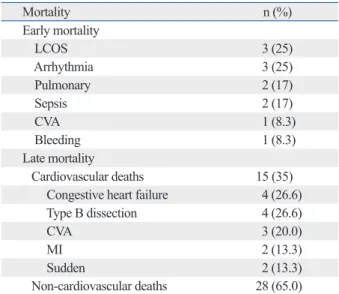
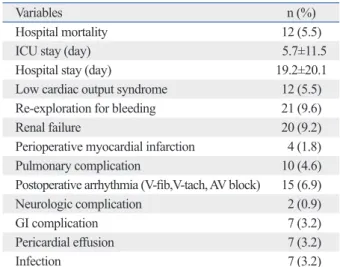
The overall early mortality rate, defined as death within 30 days of initial hospitalization, was 5.5% (12/218). Causes of death were low cardiac output syndrome in 3, ventricular arrhythmia in 3, pneumonia or acute respiratory distress syndrome in 2, sepsis in 2, cerebrovascular accident in 1, and bleeding in 1 patient (Table 3). Early complications in- cluded re-exploration for bleeding in 21, acute renal failure in 20, low cardiac output syndrome in 12, upper gastroin- testinal bleeding in 7, myocardial infarction in 4, prolonged mechanical ventilation in 10, pericardial effusion in 7, tran- sient ischemic attack in 1, cerebral infarction in 1, and su- perficial wound infection in 7 patients (Table 4A).
Postoperative left ventricular end-systolic dimension signif- icantly decreased from 50.9±12.4 to 43.1±11.4 mm (p<
0.001), and left ventricular end-diastolic dimension signifi- cantly decreased from 69.2±12.4 to 57.3±11.1 mm (p<
0.001). The postoperative NYHA functional class also im- proved significantly (2.59±0.76 to 1.14±0.39, p<0.001), and ascending aortic size measured with pre and postopera- tive chest computed tomography (CT) decreased from 70.0±19.9 to 32.4±4.4 mm (p<0.001).
In hospital mortality was significantly affected by preop- erative diabetes mellitus [odds ratio (OR) 16.62; 95% con- fidence interval (CI) 2.58 to 106.91; p=0.003] and NYHA class of 3 or greater (OR 5.28; 95% CI, 1.06 to 26.10;
p=0.041) (Table 5).
in 5 patients; and aortic homograft in 3 patients (Table 2).
Follow-up and statistical analysis
All patients were followed in the outpatient department with clinical examination, computed tomography scans and transthoracic echocardiography. When necessary, patients were interviewed via the telephone to obtain actualized in- formation. Among 206 hospital survivors, 196 (95.1%) pa- tients were available for follow-up (mean: 108 months). Sta- tistical analysis was performed with the SPSS 11.0 statistical software package (SPSS, Chicago, IL, USA). Continuous variables were expressed as the mean±standard deviation, and compared with unpaired two-tailed t-test. Categorical variables were analyzed with the χ
2test or Fisher’s exact test, where appropriate. Univariate and multivariate analy- sis of predictors for early and late mortality were performed using a logistic regression model. A p-value of <0.05 was considered statistically significant. Survival curves were constructed using the Kaplan-Meier method and compared with the log-rank test.
Table 2. Operative Data
Variables n (%)
Coronary transfer technique
Inclusion technique 30 (13.8)
Open-button technique 181 (83.0)
Cabrol technique 7 (3.2)
OP time (min) 412±130
CPB time (min) 210±78
ACC time (min) 146±51
Total circulatory arrest 22 (10)
Total circulatory arrest time (min) 44±36 Valve type
Mechanical 213 (97.7)
Tissue 5 (2.3)
Composite valve size (mm) 25.7±2.6
Concomitant procedure
CABG 21 (9.6)
Ascending aorta replacement 9 (4.1)
Hemiarch replacement 11 (5.0)
Total arch replacement 7 (3.2)
Mitral valve repair 14 (6.4)
Mitral valve replacement 4 (1.8) Tricuspid valve repair 10 (4.6)
Myectomy 2 (0.9)
VSD patch repair 4 (1.8)
Dor procedure 1 (0.5)
n, number; OP, operation; CPB, cardiopulmonary bypass; ACC, aortic cross clamp; CABG, coronary artery bypass surgery; VSD, ventricular septal de- fect.
Table 3. Cause of Early and Late Mortality
Mortality n (%)
Early mortality
LCOS 3 (25)
Arrhythmia 3 (25)
Pulmonary 2 (17)
Sepsis 2 (17)
CVA 1 (8.3)
Bleeding 1 (8.3)
Late mortality
Cardiovascular deaths 15 (35)
Congestive heart failure 4 (26.6) Type B dissection 4 (26.6)
CVA 3 (20.0)
MI 2 (13.3)
Sudden 2 (13.3)
Non-cardiovascular deaths 28 (65.0) n, number; LCOS, low cardiac output syndrome; CVA, cerebrovascular ac- cident; MI, myocardial infarction.
deaths occurred. The most common causes of cardiac-relat- ed death were congestive heart failure (n=4) and type B dis- section progression (n=4). The causes of cardiac-related late death are listed in Table 3.
Kaplan-Meier estimated overall survival rates for the 218 patients (including hospital deaths) were 90.4±2.0%, 82.7
±2.7%, 77.6±3.1%, 65.3±4.6%, and 60.3±6.4% at 1, 5, 10, 20, and 25 years, respectively (Fig. 1A). Among the patients with Marfan syndrome, the overall survival rate tended to de- cline compared to the group without Marfan syndrome, but did not reach statistical significance (log rank p=0.586) (Fig.
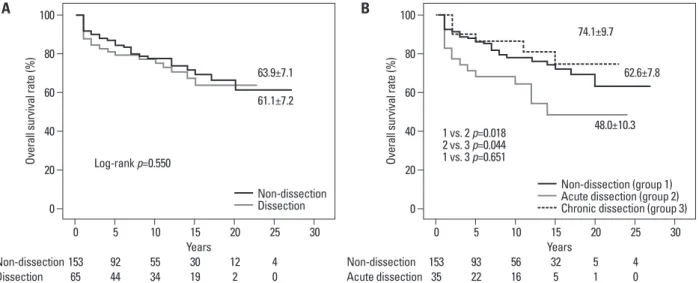
1B). Among the patients with dissection, the overall surviv- al rate was not different compared to the group without dis- section (log rank p=0.550) (Fig. 2A). However, among pa- tients with acute dissection, the overall survival rate was significantly lower than that of the group with chronic dis- section (Fig. 2B). Overall survival rates between the non- dissection group and the chronic dissection group were sim- ilar. Among patients treated with the open-button technique, the overall survival rate was better than that for those treated with the inclusion technique or Cabrol technique (Fig. 3).
Univariate analyses revealed that hypertension, chronic re- nal failure, NYHA class of 3 or greater, and coronary trans- fer technique were risk factors for late death. Multivariate logistic analysis identified hypertension as the only inde- pendent risk factor for late death (OR 2.51, 95% CI, 1.14 to 5.53; p=0.022) (Table 5).
Late morbidity
Late complications included new onset aneurysm or dissec- tion in 13, intracranial hemorrhage in 3, cerebral infarction Late mortality and survival
The mean follow-up duration was 108.0±81.0 months (range: 1-329 months). During the follow-up period, 15 cardiac-related (6.9%) and 28 non-cardiac-related (12.8%) Table 4A. Early Result
Variables n (%)
Hospital mortality 12 (5.5)
ICU stay (day) 5.7±11.5
Hospital stay (day) 19.2±20.1
Low cardiac output syndrome 12 (5.5)
Re-exploration for bleeding 21 (9.6)
Renal failure 20 (9.2)
Perioperative myocardial infarction 4 (1.8)
Pulmonary complication 10 (4.6)
Postoperative arrhythmia (V-fib,V-tach, AV block) 15 (6.9)
Neurologic complication 2 (0.9)
GI complication 7 (3.2)
Pericardial effusion 7 (3.2)
Infection 7 (3.2)
n, number; ICU, intensive care unit; V-fib, ventricular fibrillation; V-tach, ventricular tachycardia; AV, atrioventricular; GI, gastrointestinal.
Table 4B. Late Mortality and Morbidity
Variables n (%)
Mortality 43 (19.7)
Reoperation 7 (3.2)
New onset aneurysm or dissection 13 (6.0)
Neurologic complication 9 (4.1)
Pericardial effusion 5 (2.3)
Postop arrhythmia (V-fib,V-tach, AV block) 4 (1.8)
GI bleeding 3 (1.4)
Endocarditis 3 (1.4)
n, number; V-fib, ventricular fibrillation; V-tach, ventricular tachycardia; AV, atrioventricular; GI, gastrointestinal.
Fig. 1. Kaplan-Meier estimated survival curves. Actual survival of all patients, at a mean follow-up time of 108.0±81.0 months, following the Bentall procedure (A). Actual survival of Marfan and non-Marfan syndrome patients (B).
0 0
20 20
40 40
60 60
80 80
100 100
Overall survival rate (%) Overall survival rate (%)
0 5 10 15 20 25 30 0 5 10 15 20 25 30
60.3±6.4
63.5±5.7
55.3±12.1
Log-rank p=0.586
218 116
137 102 76
90 59 47
50 42 31
12 18 5
4 5 2
Number at risk 1
Number at risk
Years Years
Non-Marfan Marfan
Non-Marfan Marfan
A B
graft dehiscence and residual moderate aortic regurgitation.
One patient required reoperation for development of a coro- nary pseudoaneurysm 20 years after a Bentall procedure had been performed using the inclusion technique. Seven patients required re-operation for progression of aortic arch, descending thoracic aortic dissection or aneurysm within a mean of 100 months (range: 1-204 months) after the first in 6, gastrointestinal bleeding in 3, pericardial effusion re-
quiring pericardiocentesis in 5, arrhythmia in 4, and bacteri- al endocarditis in 3 patients (Table 4B).
Reoperation
One patient who underwent the Bentall operation with a homograft required a redo Bentall operation due to homo-
Fig. 2. Kaplan-Meier estimated survival curves. Actual survival rate for non-dissection and dissection patients (A). Actual survival of non-dissection (group 1), acute dissection (group 2) and chronic dissection (group 3) patients (B).
0 0
20 20
40 40
60 60
80 80
100 100
Overall survival rate (%) Overall survival rate (%)
0 5 10 15 20 25 30 0 5 10 15 20 25 30
63.9±7.1 61.1±7.2
62.6±7.8 74.1±9.7
48.0±10.3 1 vs. 2 p=0.018
2 vs. 3 p=0.044 1 vs. 3 p=0.651 Log-rank p=0.550
153
65 153
35 92
44 93
22 55
34 56
16 30
19 32
5 12
2 5
1 4
0 4
0
Non-dissection Non-dissection
Dissection Acute dissection
Years Years
Non-dissection (group 1) Acute dissection (group 2) Chronic dissection (group 3) Non-dissection
Dissection
A B
Table 5. Risk Factor Analysis for Operative Death and Late Death
Variables Operative death Late death
Univariate Multivariate Univariate Multivariate
Age 0.202 0.219
Sex (male) 0.352 0.821
Hypertension 0.346 0.010* 0.020*
Diabetes mellitus 0.019* 0.003* 0.697
CAOD 0.463 0.422
COPD 0.979 0.145
Old CVA 0.440 0.463
Previous cardiac operation 0.253 1.000
Chronic renal failure 0.223 0.024* 0.162
NYHA class ≥3 0.019* 0.041* 0.036* 0.052
Emergency 0.180 0.334
Dissection 0.348 0.550
Marfan syndrome 0.703 0.107
Bicuspid aortic valve 0.558 0.295
Combined mitral valve disease 0.755 0.140
Maximum diameter of ascending aorta 0.895 0.467
LVEF (%) 0.362 0.472
LVESD 0.372 0.719
LVEDD 0.106 0.739
Coronary transfer method 0.433 0.033 0.116
CAOD, coronary artery occlusive disease; COPD, chronic obstructive pulmonary disease; CVA, cerebrovascular accident; NYHA, New York Heart Associa- tion; LVEF, left ventricular ejection fraction; LVESD, left ventricular end systolic diameter; LVEDD, left ventricular end diastolic diameter.
*Statistically significant.
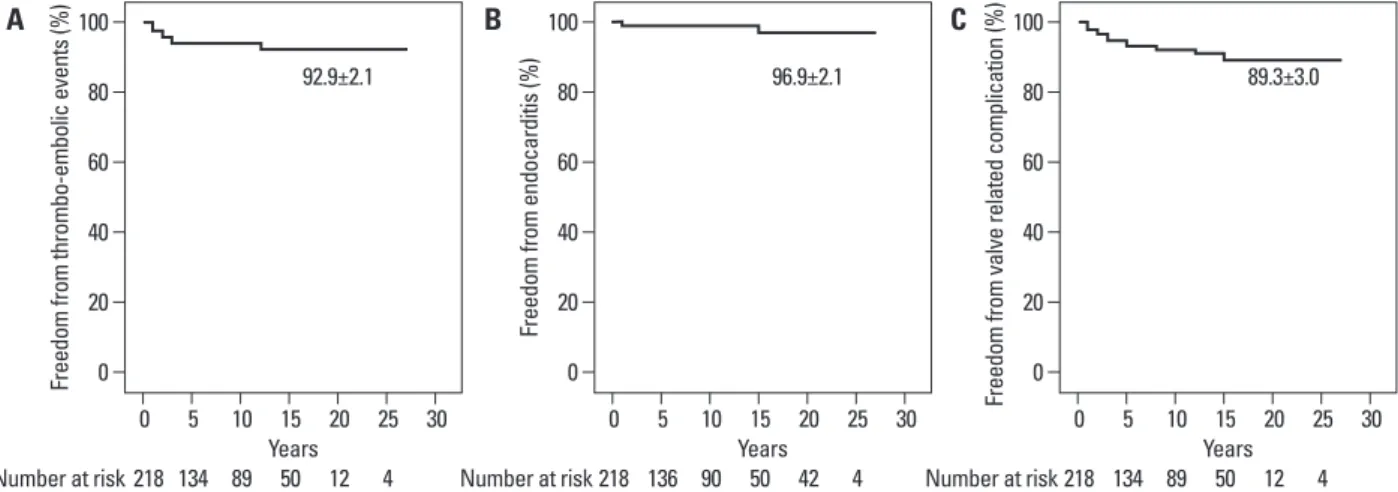
complications occurred. Cerebral hemorrhage occurred in 4 patients, two of which died from cerebral hemorrhage. Gas- trointestinal bleeding occurred in 4 patients and coumadin toxicity occurred in 1 patient. All of these patients were treated with medical therapy and recovered. Freedom from anticoagulant-related complications was 95.9±1.1%, 94.2±
1.7% and 92.9±0.2% at 5, 10 and 25 years, respectively (Fig. 5A). After discharge, 3 patients experienced prosthetic valve endocarditis. Two of these patients healed after medi- cal therapy, while the other patient died from rupture of an intracranial mycotic aneurysm. Freedom from prosthetic valve endocarditis rate was 99.0±0.7%, 97.1±2.0% and 97.1±2.0% at 5, 10, and 25 years, respectively (Fig. 5B).
Freedom from prosthetic valve related complications was 98.1±1.0%, 93.3±1.9%, 92.4±2.1% and 89.3±3.0% at 1, 5, 10, and 25 years, respectively (Fig. 5C).
DISCUSSION
The original Bentall procedure has been widely used since 1968 when Bentall and De Bono
1first described the tech- nique. Over the past decades, several modifications of the originally described technique have been introduced, and have helped to improve clinical outcomes.
2-5Although results, following introduction of the Bentall procedure, have steadily improved, over the last decade, vari- ous kinds of valve-sparing operations have become an attrac- tive alternative to replacement of the aortic root, improving survival with fewer complications and better quality of life, even in patients with Marfan syndrome.
6-9However, due to operation. Four of these patients had Marfan syndrome. One
patient required stent graft insertion for descending thoracic aortic dissection, and he also had Marfan syndrome. The Kaplan-Meier analysis for freedom from reoperation is shown in Fig. 2. Freedom from re-operation rates for all pa- tients at 1, 5, 10, 20, and 25 years were 99.0±0.7%, 98.3±
1.0%, 95.5±1.7%, 90.8±3.9%, and 90.8±3.9%, respectively (Fig. 4A). In patients with Marfan syndrome, survival with- out reoperation tended to decline compared to the group without Marfan syndrome, but this observation did not reach statistical significance (log rank p=0.089) (Fig. 4B).
Freedom from prosthetic valve-related complications During the follow-up period, nine anticoagulant-related
Fig. 4. Kaplan-Meier estimated freedom from reoperation. Freedom from reoperation for all patients, at a mean follow-up time of 100 months, following the Bentall procedure (A). Freedom from reoperation for Marfan versus non-Marfan syndrome patients (B).
Fig. 3. Kaplan-Meier estimated survival curves. Actual survival rate ac- cording to coronary transfer technique. Inclusion (group 1), open-button (group 2), Cabrol (group 3).
0 0
20 20
40 40
60 60
80 80
100 100
Freedom from reoperation (%) Freedom from reoperation (%)
0 5 10 15 20 25 30 0 5 10 15 20 25 30
91.6±3.6 97.1±1.6
79.4±10.1
218 116
102
132 74
59
88 45
42
47 29
17
11 5
4
3 2
1
Number at risk Non-MarfanNumber at risk
Marfan
Years Years
A B
Log-rank p=0.089
Non-Marfan Marfan 0
20 40 60 80 100
Overall survival rate (%)
0 5 10 15 20 25 30
57.1±18.7 73.2±4.5
43.5±9.8 1 vs. 2 p=0.025
2 vs. 3 p=0.114 1 vs. 3 p=0.751
30 181 7
23 109 4
20 66 2
15 31 1
8 4 0
5 1 0 Inclusion
Open-button Cabrol
Years
Inclusion (group 1) Open-button (group 2) Cabrol (group 3)
aneurysm, especially in patients with Marfan syndrome.
11-14The incidence of pseudoaneurysms with this technique ranged from 7% to 25%.
15-17However, since aortography or aorta CT is not performed on all patients after the Bentall procedure, the true frequency may have been higher. Our experience also showed that the open-button technique was better than the inclusion technique in regards to long-term survival (Fig. 3). Although we have not experienced pseudo- aneurysm during the earlier period, we had one patient who was re-operated for coronary pseudoaneurysm 20 years af- ter undergoing the Bentall procedure using the inclusion technique. Since a long interval between the operation and the development of pseudoaneurysm is not unusual, contin- uous careful follow-up of patients with imaging studies is suggested. We abandoned performing the inclusion tech- nique in 1994, and the open button technique in its stead, which includes direct implantation of coronary buttons and a distal anastomosis to the completely divided ascending aorta, has remained the current policy for aortic root replace- ment at our institute. We also adopted a technique of pre- clotting the prosthesis with albumin plus autoclaving in 1994, which further contributed to reoperation rate decline.
The Cabrol technique was used only in cases of re-opera- tion because of difficulties with mobilization and approxi- mation of coronary arteries to the vascular graft or upon ex- tensive calcification of the aneurismal aorta.
Numerous studies have shown different independent risk factors for death after the Bentall procedure.
18,19Advanced age, dissection, Marfan syndrome, severe ventricular dys- function, endocarditis, previous cardiac surgery, emergency status, coronary artery disease, poor preoperative New York Heart Association functional class and left ventricle ejec- tion fraction <35% were known as predictors of early and the complexity of the procedure it is still regarded as a chal-
lenging procedure, especially in emergency settings, e.g.
cases of acute aortic dissection, and if the damaged aortic valve is combined with dilatation of the aortic root or a dis- section, the Bentall procedure is required. It is also remains questionable as to whether a valve-sparing procedure is suitable only for specific patients or is more widely applica- ble, and whether the long-term durability is better than that of replacement. Therefore, the modified Bentall procedure is likely to remain the standard approach for various aortic root diseases.
When Bentall and De Bono
1first performed this proce- dure, a star valve was sutured into a tube graft to form a com- posite graft. Since then, mechanical vales have been generally used. The grafts often used for the Bentall procedure are com- posite grafts, cryo-preserved homografts, autologous pulmo- nary valves, and stentless valves. Since the availability of cryo-preserved homografts is limited, we use homografts only in patients with active infective endocarditis. The decision whether to use a mechanical or biologic valve was made on an individual basis by the surgeon and the patient. Even though mechanical valves were used in most patients, the rates of valve-related complications seemed to be similar to that of sole aortic valve replacement, as previously de- scribed by other authors.
10One of the most important portions of the Bentall proce- dure is the coronary anastomosis technique. Three different anastomotic techniques have been developed over the past few decades: the inclusion, button, and Cabrol techniques.
The inclusion technique, as originally described by Bentall and De Bono
1was until 1993 our preferred method. Many authors had reported a relationship between the inclusion/
wrapping technique, and the formation of coronary pseudo-
Fig. 5. Kaplan-Meier estimated freedom from prosthetic valve related complications. Kaplan-Meier estimated freedom from anti-coagulation-related compli- cations (A), endocarditis-related complications (B), and valve-related complications (C).
0 0 0
20 20 20
40 40 40
60 60 60
80 80 80
100 100 100
Freedom from thrombo-embolic events (%) Freedom from endocarditis (%) Freedom from valve related complication (%)
0 5 10 15 20 25 30 0 5 10 15 20 25 30 0 5 10 15 20 25 30
218 134 89 50 12 4 218 136 90 50 42 4 218 134 89 50 12 4
Number at risk Years Number at risk Years Number at risk Years
92.9±2.1 96.9±2.1 89.3±3.0
A B C
going the operation (percentage of acute aortic dissection, or Marfan patients, for instance), most authors report low hospi- tal mortality, as well as a significant difference between pa- tients receiving emergency surgery versus receiving elective surgery.
23In our study, the operative mortality rate was 5.5%
which was comparable to other studies. Functional status im- proved in most patients with good long-term outcomes.
Prosthetic valve-related complications in our study were also comparable to other reports. Freedom from anticoagula- tion-related complications at 25 years was 93%. Prosthetic endocarditis occurred only in 3 (1.3%) of the followed pa- tients, which was significantly lower than previously report- ed incidences.
In summary, we have found that, in our experience, oper- ative mortality and long-term survival after the Bentall pro- cedure were comparable to that in other studies, and open- button Bentall operation can be performed with excellent short-term and long-term results. However, re-operation of the remaining aorta is not rare especially in the Marfan pop- ulation; therefore, continuous follow-up and proper medical management is recommended.
ACKNOWLEDGEMENTS
This study was supported by a faculty research grant from the Yonsei University College of Medicine for 2007.
REFERENCES
1. Bentall H, De Bono A. A technique for complete replacement of the ascending aorta. Thorax 1968;23:338-9.
2. Kouchoukos NT, Wareing TH, Murphy SF, Perrillo JB. Sixteen- year experience with aortic root replacement. Results of 172 oper- ations. Ann Surg 1991;214:308-18.
3. Svensson LG, Crawford ES, Hess KR, Coselli JS, Safi HJ. Com- posite valve graft replacement of the proximal aorta: comparison of techniques in 348 patients. Ann Thorac Surg 1992;54:427-37.
4. Pacini D, Ranocchi F, Angeli E, Settepani F, Pagliaro M, Martin- Suarez S, et al. Aortic root replacement with composite valve graft. Ann Thorac Surg 2003;76:90-8.
5. Hagl C, Strauch JT, Spielvogel D, Galla JD, Lansman SL, Squit- ieri R, et al. Is the Bentall procedure for ascending aorta or aortic valve replacement the best approach for long-term event-free sur- vival? Ann Thorac Surg 2003;76:698-703.
6. Sarsam MA, Yacoub M. Remodeling of the aortic valve anulus. J Thorac Cardiovasc Surg 1993;105:435-8.
7. David TE, Feindel CM, Bos J. Repair of the aortic valve in pa- tients with aortic insufficiency and aortic root aneurysm. J Thorac Cardiovasc Surg 1995;109:345-51.
8. David TE, Armstrong S, Ivanov J, Feindel CM, Omran A, Webb
late death. We observed that hospital mortality was strongly correlated with diabetes mellitus and NYHA class (≥3), and late death was strongly correlated with hypertension. We believe that diabetes mellitus and a NYHA functional class associated with early morbidity seem to be correlated with hospital mortality. Hypertension seems to be an indepen- dent risk factor of late death in regard that common reasons of late death included congestive heart failure, type B dis- section progression, and cerebral vascular accident, which are all associated with hypertension. With improvements in operative technique and postoperative management, ad- vanced age, dissection, Marfan syndrome, endocarditis, and previous cardiac surgery did not prove to be independent risk factors for early mortality in this study. We did experience different results, however, between acute dissection and chronic dissection (Fig. 2B). This showed that acute dissec- tion was still risk factor of after Bentall procedure.
There are many debates as to whether Marfan syndrome is associated with long-term survival or not, after the Ben- tall procedure. Yousif and colleagues reported that Marfan was an independent risk factor of long-term mortality.
20However, Hagl, et al.
5demonstrated that Marfan syndrome was not associated with lower long-term survival. In our study, although there was a trend for decreased survival of patients with Marfan syndrome in the course of time com- pared to that of non-Marfan patients (Fig. 1B), we could not find a significant association for Marfan syndrome with long-term survival (p=0.586). However, we found that Marfan syndrome was strongly associated with the incidence of reoperation during follow-up. Many authors have reported a high incidence of subsequent operations on the remaining aorta in patients with Marfan syndrome. Kouchoukos, et al.
2reported that at 12 years, the actual probability of freedom from re-operation was significantly lower in patients with Marfan syndrome (85%), compared to patients without Mar- fan syndrome (96%). A similarly high incidence rate of re- operation on the remaining aorta in Marfan patients was re- ported by Crawford.
21In our study, among seven patients who required re-operation, 4 patients had Marfan syndrome.
One patient who required stent graft insertion for descend- ing thoracic dissection also had Marfan syndrome. These facts imply that these patients require careful medication to strictly control blood pressure and heart rate, as well as pe- riodic evaluation of the entire aorta throughout their life.
Early mortality after the Bentall procedure was reported to
range from 1.9% to 7.3%.
22,23Although there may be some
differences therefore according to the type of patient under-
16. Mayer JE Jr, Lindsay WG, Wang Y, Jorgensen CR, Nicoloff DM.
Composite replacement of the aortic valve and ascending aorta. J Thorac Cardiovasc Surg 1978;76:816-23.
17. McCready RA, Pluth JR. Surgical treatment of ascending aortic aneurysms associated with aortic valve insufficiency. Ann Thorac Surg 1979;28:307-16.
18. Sioris T, David TE, Ivanov J, Armstrong S, Feindel CM. Clinical outcomes after separate and composite replacement of the aortic valve and ascending aorta. J Thorac Cardiovasc Surg 2004;128:
260-5.
19. Prifti E, Bonacchi M, Frati G, Proietti P, Giunti G, Babatasi G, et al. Early and long-term outcome in patients undergoing aortic root replacement with composite graft according to the Bentall’s tech- nique. Eur J Cardiothorac Surg 2002;21:15-21.
20. Sheick-Yousif B, Sheinfield A, Tager S, Ghosh P, Priesman S, Smolinsky AK, et al. Aortic root surgery in Marfan syndrome. Isr Med Assoc J 2008;10:189-93.
21. Crawford ES. Marfan’s syndrome. Broad spectral surgical treat- ment cardiovascular manifestations. Ann Surg 1983;198:487-505.
22. Kindo M, Billaud P, Gerelli S, Levy F, Mazzucotelli JP, Eisen- mann B. Twenty-seven-year experience with composite valve graft replacement of the aortic root. J Heart Valve Dis 2007;16:
370-7.
23. Bachet J, Termignon JL, Goudot B, Dreyfus G, Piquois A, Bro- daty D, et al. Aortic root replacement with a composite graft. Fac- tors influencing immediate and long-term results. Eur J Cardiotho- rac Surg 1996;10:207-13.
G. Results of aortic valve-sparing operations. J Thorac Cardiovasc Surg 2001;122:39-46.
9. Kazui T, Tsuboi J, Izumoto H, Nakajima T, Ishihara K, Kawazoe K. Aortic root remodeling with aortic annuloplasty: mid-term re- sults. Circ J 2007;71:207-10.
10. Kouchoukos NT, Marshall WG Jr, Wedige-Stecher TA. Eleven- year experience with composite graft replacement of the ascend- ing aorta and aortic valve. J Thorac Cardiovasc Surg 1986;92:691- 11. Milano AD, Pratali S, Mecozzi G, Boraschi P, Braccini G, Magag-705.
nini E, et al. Fate of coronary ostial anastomoses after the modi- fied Bentall procedure. Ann Thorac Surg 2003;75:1797-801.
12. Mautner SL, Mautner GC, Curry CL, Roberts WC. Massive peri- graft aortic aneurysm late after composite graft replacement of the ascending aorta and aortic valve in the Marfan syndrome. Am J Cardiol 1993;71:624-7.
13. Kazui T, Yamashita K, Terada H, Washiyama N, Suzuki T, Ohkura K, et al. Late reoperation for proximal aortic and arch complica- tions after previous composite graft replacement in Marfan pa- tients. Ann Thorac Surg 2003;76:1203-7.
14. Shiono M, Hata M, Sezai A, Iida M, Negishi N, Sezai Y. Reopera- tion for ascending aortic aneurysm, coronary ostial aneurysm and patent Cabrol trick after bentall operation for aortitis syndrome.
Circ J 2005;69:861-4.
15. Donaldson RM, Ross DN. Composite graft replacement for the treatment of aneurysms of the ascending aorta associated with aortic valvular disease. Circulation 1982;66(2 Pt 2):I116-21.