External Validation of the Acute Physiology and Chronic Health Evaluation II in Korean Intensive Care Units
Jae Yeol Kim,1* So Yeon Lim,2* Kyeongman Jeon,2 Younsuck Koh,3 Chae-Man Lim,3 Shin Ok Koh,4 Sungwon Na,4 Kyoung Min Lee,5 Byung Ho Lee,6 Jae-Young Kwon,7 Kook Hyun Lee,8
Seok-Hwa Yoon,9 Jisook Park,10 and Gee Young Suh2
1Division of Pulmonary and Critical Care Medicine, Department of Medicine, Chung-Ang University College of Medicine, Seoul;
2Division of Pulmonary and Critical Care Medicine, Department of Medicine, Samsung Medical Center, Sungkyunkwan University School of Medicine, Seoul;
3Division of Pulmonary and Critical Care Medicine, Department of Medicine, Asan Medical Center, University of Ulsan College of Medicine, Seoul;
4Department of Anesthesiology and Pain Medicine, Severance Hospital, Yonsei University College of Medicine, Seoul; 5Anesthesiology and Critical Care Medicine, Konkuk University Hospital, Seoul; 6Department of Anesthesiology and Pain Medicine, The Catholic University of Korea, St. Paul’s Hospital, Seoul;
7Department of Anesthesiology and Pain Medicine, Pusan National University Medical School, Busan; 8Department of Anesthesiology and Pain Medicine, Seoul National University Hospital, Seoul; 9Department of Anesthesiology and Pain Medicine, Chungnam National University Hospital, Gwangju;
10School of Media, Seoul Women’s University, Seoul, Korea.
Received: December 13, 2011 Revised: March 30, 2012 Accepted: April 8, 2012
Corresponding author: Dr. Gee Young Suh, Division of Pulmonary and Critical Care Medicine, Department of Medicine, Samsung Medical Center, Sungkyunkwan University School of Medicine,
81 Irwon-ro, Gangnam-gu, Seoul 135-710, Korea.
Tel: 82-2-3410-3426, Fax: 82-2-3410-6956 E-mail: [email protected]
*Jae Yeol Kim and So Yeon Lim contributed equally to this work.
∙ The authors have no financial conflicts of interest.
© Copyright:
Yonsei University College of Medicine 2013 This is an Open Access article distributed under the terms of the Creative Commons Attribution Non- Commercial License (http://creativecommons.org/
licenses/by-nc/3.0) which permits unrestricted non- commercial use, distribution, and reproduction in any medium, provided the original work is properly cited.
Purpose: This study was designed to validate the usefulness of the Acute Physiolo- gy and Chronic Health Evaluation (APACHE) II for predicting hospital mortality of critically ill Korean patients. Materials and Methods: We analyzed data on 826 pa- tients who had been admitted to nine intensive care units and were included in the Fever and Antipyretics in Critical Illness Evaluation study cohort. Results: Among the patients enrolled, 62% (512/826) were medical and 38% (314/826) were surgical patients. The median APACHE II score was 17 (11 to 23 interquartile range), and the hospital mortality rate was 19.5%. Age, underlying diseases, medical patients, me- chanical ventilation, and renal replacement therapy were independently associated with hospital mortality. The calibration of APACHE II was poor (H=57.54, p<0.0001; C=55.99, p<0.0001), and the discrimination was modest [area under the receiver operating characteristic (aROC)=0.729]. Calibration was poor for both med- ical and surgical patients (H=63.56, p<0.0001; C=73.83, p<0.0001, and H=33.92, p<0.0001; C=33.34, p=0.0001, respectively), while discrimination was poor for medical patients (aROC=0.651) and modest for surgical patients (aROC=0.704). At the predicted risk of 50%, APACHE II had a sensitivity of 36.6% and a specificity of 87.4% for hospital mortality. Conclusion: For Koreans, the APACHE II exhibits poor calibration and modest discrimination for hospital mortality. Therefore, a new model is needed to accurately predict mortality in critically ill Korean patients.
Key Words: APACHE II, calibration, discrimination, intensive care units, illness severity
INTRODUCTION
Over the last three decades, severity-of-illness scoring systems, such as the Acute
by the APACHE II score; and 3) interventions including need for mechanical ventilation and continuous renal re- placement therapy (CRRT). The worst data from the first 24 hours after admission to the ICU was used to calculate the APACHE II score. Hospital mortality was adjusted for the principal diagnostic category which led to ICU admis- sion. The equation used to predict the risk (R) of hospital death was: ln (R/1-R)=-3.517+(APACHE II score×0.146)+
(0.603, if only post-emergency surgery)+(diagnostic cate- gory weight).1
Statistical analysis
For statistical analysis, PASW 17.0 (SPSS Inc., Chicago, IL, USA) and STATA 11.0 (StataCorp LP, TX, USA) were used. Data are shown as medians and interquartile ranges or numbers with percentages. A univariate logistic regres- sion analysis was performed to examine any associations between various risk factors and hospital mortality. Among the variables used in this model, the risk factors with a p- value less than 0.25, including age and gender, were select- ed for multivariate logistic regression analysis. Validation of the scoring system was performed using standard tests to measure calibration and discrimination. Calibration was de- fined as agreement between individual probabilities and ac- tual outcomes. The Hosmer-Lemeshow goodness-of-fit (GOF) H statistic and GOF C statistic were used to evalu- ate agreement between observed and predicted mortality rates.8 In the Hosmer-Lemeshow GOF test, a p-value great- er than 0.05 was interpreted as being well calibrated.8 The standardized mortality ratio (SMR) was calculated by di- viding the number of observed deaths per group by the number of expected deaths per group. To test for statistical significance, we calculated 95% confidence intervals (CI) according to the method described by Hosmer and Leme- show. Discrimination was defined as the power to distin- guish between non-survivors and survivors, and was as- sessed by calculating the area under the receiver operating characteristic (aROC) curve as described by Hanley and McNeil.6,9 The level of discrimination was defined by the level of aROC. An aROC greater than 0.9 was defined as excellent discrimination, 0.8≤aROC<0.9 as good discrimi- nation, and 0.7≤aROC<0.8 as modest discrimination.6,9 A predicted mortality of 50% was used to calculate the sensi- tivity and specificity of the APACHE II in predicting hospi- tal mortality.10
Two-tailed p<0.05 was considered statistically signifi- cant.
Physiology and Chronic Health Evaluation (APACHE) Score and the Simplified Acute Physiology Score, have been developed to predict hospital mortality of intensive care unit (ICU) patients.1-5 As with other types of prediction scores, these scores must be externally validated when there is a reason to believe that the intended population may constitute a patient mix different from the derivation cohort. In addition, to accurately predict mortality over pro- longed periods, such scores should periodically be updated to reflect changes in medical practice and patient mix over time.6
Although APACHE II is one of the most widely used pre- diction models in Korea, the performance of the APACHE II model has not yet been validated in a Korean ICU sam- ple, and has not been updated for Korean patients since its development in 1985.1 Therefore, the aim of this study was to perform an external validation of the APACHE II by eval- uating its performance in a large representative database of Korean ICU patients.
MATERIALS AND METHODS
Patients
This study is an analysis of prospectively collected data- base for The Fever and Antipyretics in Critical Illness Eval- uation (FACE) cohort.7 The FACE study was a prospective observational study of the influence of fever and antipyretic treatment on the outcomes of ICU patients in 25 hospi- tals-15 in Japan and 10 in Korea-that was conducted by the Japan-Korea Intensive Care Study group between Septem- ber 1 and November 30, 2009. The current study used only data from the Korean centers. Inclusion criteria for the FACE study were all patients who were admitted to the participating ICUs for more than 24 hrs. Exclusion criteria for the FACE study were patients less than 18 years of age and with brain damage. For this study, data from one center that recruited only two patients were excluded to reduce se- lection bias. The study was approved by the Institutional Review Board, and the requirement for informed consent was waived.
Data collection
The following variables were recorded: 1) general charac- teristics including age, gender, pre-existing underlying dis- ease, reason for ICU admission, and admission status (med- ical or surgical patients); 2) severity of illness as assessed
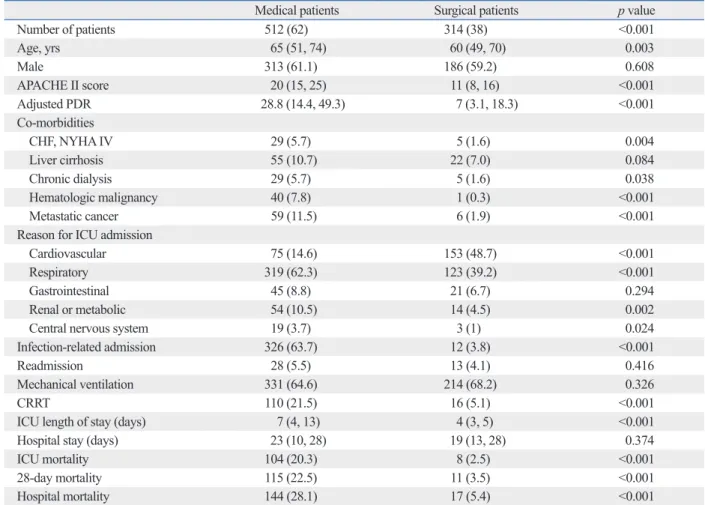
APACHE II scores, and more co-morbidities. Furthermore, they were more likely to have admissions related to major organ system failures, and had more patients on CRRT (Ta- ble 2). Hospital mortality of medical patients was 28.1%, which was significantly higher than 5.4% of surgical pa- tients (p<0.001).
Risk factors for hospital mortality of Korean ICU patients
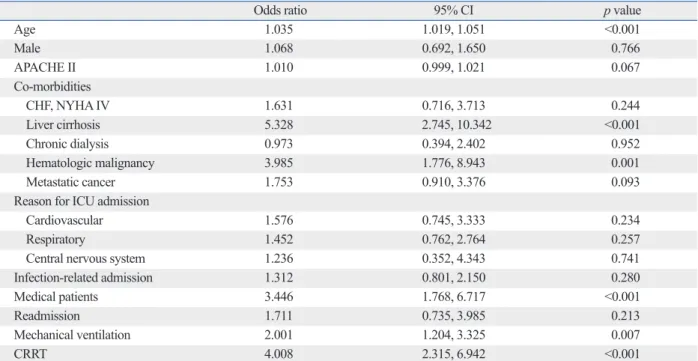
The multivariate logistic regression model was used to de- termine independent risk factors of hospital mortality by using all variables with a p-value <0.25 in the univariate model. Among the variables used in the model, age (OR=
1.035, p<0.001, 95% CI=1.019-1.051), liver cirrhosis (OR=
5.328, p<0.001, CI=2.745-10.342), hematologic malignan- cy (OR=3.985, p=0.001, CI=1.776-8.943), medical patients
RESULTS
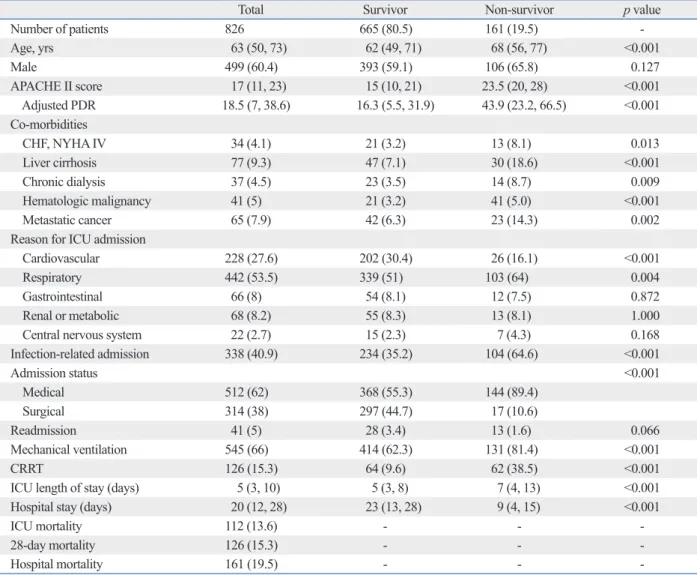
Baseline characteristics and outcomes of patients Of 1426 patients enrolled in the FACE study, 600 patients were excluded, therefore, data of 826 patients were used in the analysis. The baseline characteristics and outcomes of the patients are shown in Table 1. Overall hospital mortality was 19.5% (161 out of 826 patients). The patients who died were significantly older, and had higher APACHE II scores, and greater numbers of co-morbidities. They had ICU ad- missions related to either cardiovascular and respiratory problems, and were more likely to be medical patients and to have more interventions such as mechanical ventilation or CRRT (Table 1).
Medical patients were significantly older, and had higher
Table 1. Baseline Characteristics and Outcomes of Korean ICU Patients
Total Survivor Non-survivor p value
Number of patients 826 665 (80.5) 161 (19.5) -
Age, yrs 63 (50, 73) 62 (49, 71) 68 (56, 77) <0.001
Male 499 (60.4) 393 (59.1) 106 (65.8) 0.127
APACHE II score 17 (11, 23) 15 (10, 21) 23.5 (20, 28) <0.001
Adjusted PDR 18.5 (7, 38.6) 16.3 (5.5, 31.9) 43.9 (23.2, 66.5) <0.001
Co-morbidities
CHF, NYHA IV 34 (4.1) 21 (3.2) 13 (8.1) 0.013
Liver cirrhosis 77 (9.3) 47 (7.1) 30 (18.6) <0.001
Chronic dialysis 37 (4.5) 23 (3.5) 14 (8.7) 0.009
Hematologic malignancy 41 (5) 21 (3.2) 41 (5.0) <0.001
Metastatic cancer 65 (7.9) 42 (6.3) 23 (14.3) 0.002
Reason for ICU admission
Cardiovascular 228 (27.6) 202 (30.4) 26 (16.1) <0.001
Respiratory 442 (53.5) 339 (51) 103 (64) 0.004
Gastrointestinal 66 (8) 54 (8.1) 12 (7.5) 0.872
Renal or metabolic 68 (8.2) 55 (8.3) 13 (8.1) 1.000
Central nervous system 22 (2.7) 15 (2.3) 7 (4.3) 0.168
Infection-related admission 338 (40.9) 234 (35.2) 104 (64.6) <0.001
Admission status <0.001
Medical 512 (62) 368 (55.3) 144 (89.4)
Surgical 314 (38) 297 (44.7) 17 (10.6)
Readmission 41 (5) 28 (3.4) 13 (1.6) 0.066
Mechanical ventilation 545 (66) 414 (62.3) 131 (81.4) <0.001
CRRT 126 (15.3) 64 (9.6) 62 (38.5) <0.001
ICU length of stay (days) 5 (3, 10) 5 (3, 8) 7 (4, 13) <0.001
Hospital stay (days) 20 (12, 28) 23 (13, 28) 9 (4, 15) <0.001
ICU mortality 112 (13.6) - - -
28-day mortality 126 (15.3) - - -
Hospital mortality 161 (19.5) - - -
APACHE, Acute Physiology and Chronic Health Evaluation; PDR, predicted death rate; CHF, congestive heart failure; NYHA, New York Heart Association;
ICU, intensive care unit; CRRT, continuous renal replacement therapy.
An outline of patient characteristics and primary reasons for ICU admission. Data are expressed by n (%) or median (interquartile range).
Table 4. Calibrations of the APACHE II were poor among both medical and surgical patients (H=63.56, p<0.0001, C=
73.83, p<0.0001, and H=33.92, p<0.0001, C=33.34, p=
0.0001, respectively). The discrimination of APACHE II of the medical patients was poor (aROC=0.651, 95% CI=
0.69-0.97), whereas the discrimination of the surgical pa- tients was modest (aROC=0.704, 95% CI=0.2-0.59).
DISCUSSION
The present study demonstrated that APACHE II had poor calibration and modest discrimination among critically ill Ko- rean patients. The APACHE II also exhibited poor calibration and poor to modest discrimination in groups divided accord- ing to surgical status at ICU admission. At the predicted risk of 50%, the APACHE II had a sensitivity and specificity of 36.6% and 87.4% for hospital mortality, respectively.
Developed in 1985 using a database of North American (OR=3.446, p<0.001, CI=1.768-6.717), mechanical venti-
lation (OR=2.001, p=0.007, CI=1.204-3.325) and CRRT (OR=4.008, p<0.001, CI=2.315-6.942) were associated in- dependently with hospital mortality (Table 3).
Performance assessment of APACHE II in Korean ICUs
Calibration and discrimination data are presented in Table 4. Overall, discrepancy between observed and expected mortalities across all of the strata was demonstrated as a Hosmer-Lemeshow GOF H of 57.54 (p<0.0001) and a Hosmer-Lemeshow GOF C of 55.99 (p<0.0001). The SMR of the APACHE II model was 0.76 (95% CI 0.62-0.85).
The overall discriminatory capability of the APACHE II model was modest (aROC=0.729). Using 50% of predicted mortality as the cut-off, the sensitivity and specificity of the APACHE II for hospital mortality were found to be 36.6%
and 87.4%, respectively.
The GOF values according to surgical status are listed in
Table 2. Baseline Characteristics and Outcomes of Medical and Surgical Patients (n=826)
Medical patients Surgical patients p value
Number of patients 512 (62) 314 (38) <0.001
Age, yrs 65 (51, 74) 60 (49, 70) 0.003
Male 313 (61.1) 186 (59.2) 0.608
APACHE II score 20 (15, 25) 11 (8, 16) <0.001
Adjusted PDR 28.8 (14.4, 49.3) 7 (3.1, 18.3) <0.001
Co-morbidities
CHF, NYHA IV 29 (5.7) 5 (1.6) 0.004
Liver cirrhosis 55 (10.7) 22 (7.0) 0.084
Chronic dialysis 29 (5.7) 5 (1.6) 0.038
Hematologic malignancy 40 (7.8) 1 (0.3) <0.001
Metastatic cancer 59 (11.5) 6 (1.9) <0.001
Reason for ICU admission
Cardiovascular 75 (14.6) 153 (48.7) <0.001
Respiratory 319 (62.3) 123 (39.2) <0.001
Gastrointestinal 45 (8.8) 21 (6.7) 0.294
Renal or metabolic 54 (10.5) 14 (4.5) 0.002
Central nervous system 19 (3.7) 3 (1) 0.024
Infection-related admission 326 (63.7) 12 (3.8) <0.001
Readmission 28 (5.5) 13 (4.1) 0.416
Mechanical ventilation 331 (64.6) 214 (68.2) 0.326
CRRT 110 (21.5) 16 (5.1) <0.001
ICU length of stay (days) 7 (4, 13) 4 (3, 5) <0.001
Hospital stay (days) 23 (10, 28) 19 (13, 28) 0.374
ICU mortality 104 (20.3) 8 (2.5) <0.001
28-day mortality 115 (22.5) 11 (3.5) <0.001
Hospital mortality 144 (28.1) 17 (5.4) <0.001
APACHE, Acute Physiology and Chronic Health Evaluation; PDR, predicted death rate; CHF, congestive heart failure; NYHA, New York Heart Association;
ICU, intensive care unit; CRRT, continuous renal replacement therapy.
An outline of patient characteristics and outcomes according to surgical status. Data are expressed by n (%) or median (interquartile range).
Korean ICU patients.
To our knowledge, this is the first study which attempted to validate the APACHE II score in a large, multicenter, prospectively collected database in East Asia. In this study, the performance of the APACHE II was poor not only in general ICU patients, but also in patients group divided ac- cording to surgical status. The results of this study are con- sistent with studies conducted in other regions of the world that have attempted to validate the APACHE II at various times. Most of the studies published since 1996 showed that the APACHE II had modest to good discrimination and poor calibration in general ICUs.12-14 The only exception was found in a study conducted prospectively at a single center in Italy from 1994 to 1997.15 The study sample con- sisted mainly of surgical patients, and patients with ICU length of stays <24 hr were excluded. Furthermore, studies performed with both medical and surgical patients, using ICU patients, the APACHE II uses the most extreme values
of 12 physiological variables 24 hours after admission to ICU, chronic health status, age, and the Glasgow coma scale to calculate a score.1 Hospital mortality is predicted using the APACHE II score, principal diagnostic category which had to ICU admission, and also depending on whether or not the patient required emergency surgery.1 In the original arti- cle, no goodness-of-fit testing was reported for calibration, and the aROC for the APACHE II was 0.863.1
External validation is essential before routine application of any model to a group of subjects that is different from the group originally used for model development.11 Al- though the APACHE II has extensively been validated in different regions of the world, it has never been validated in critically ill East Asian patients. It is popular in Korea be- cause of its ease of use and availability, and is often used as a tool to assess severity of illness and to predict mortality of
Table 3. Multivariate Logistic Regression Analysis of the Effects of Various Clinical Parameters on the Odds Ratio for Hospital Mortality
Odds ratio 95% CI p value
Age 1.035 1.019, 1.051 <0.001
Male 1.068 0.692, 1.650 0.766
APACHE II 1.010 0.999, 1.021 0.067
Co-morbidities
CHF, NYHA IV 1.631 0.716, 3.713 0.244
Liver cirrhosis 5.328 2.745, 10.342 <0.001
Chronic dialysis 0.973 0.394, 2.402 0.952
Hematologic malignancy 3.985 1.776, 8.943 0.001
Metastatic cancer 1.753 0.910, 3.376 0.093
Reason for ICU admission
Cardiovascular 1.576 0.745, 3.333 0.234
Respiratory 1.452 0.762, 2.764 0.257
Central nervous system 1.236 0.352, 4.343 0.741
Infection-related admission 1.312 0.801, 2.150 0.280
Medical patients 3.446 1.768, 6.717 <0.001
Readmission 1.711 0.735, 3.985 0.213
Mechanical ventilation 2.001 1.204, 3.325 0.007
CRRT 4.008 2.315, 6.942 <0.001
APACHE, Acute Physiology and Chronic Health Evaluation; CHF, congestive heart failure; NYHA, New York Heart Association; CRRT, continuous renal re- placement therapy; ICU, intensive care unit; CI, confidence interval.
Table 4. Performance Assessment of the APACHE II in Korean ICU Patients
Group n APACHE II
score Adjusted
APACHE II (%) GOF H test GOF C test SMR 95% CI aROC
H p value C p value
All 826 17 (11, 23) 18.5 (7, 38.6) 57.54 <0.0001 55.99 <0.0001 0.76 0.62-0.85 0.729 Medical patients 512 20 (15, 25) 28.8 (14.4, 49.3) 63.56 <0.0001 73.83 <0.0001 0.85 0.69-0.97 0.651 Surgical patients 314 11 (8, 16) 7 (3.1, 18.2) 33.92 <0.0001 33.34 0.0001 0.40 0.2-0.59 0.704 APACHE, Acute Physiology and Chronic Health Evaluation; GOF, goodness of fitness; SMR, standardized mortality ratio; CI, confidence interval; aROC, area under the receiver operating characteristic; ICU, intensive care unit.
The APACHE II model exhibited poor calibration (H=57.54, p<0.0001, C=55.99, p<0.0001) and modest discriminative power (aROC=0.729).
lower than that reported by Capuzzo, et al.15 If we treat the APACHE II as a diagnostic test, the cut-off point of the APACHE II for hospital mortality in our study can be cal- culated by using the Youden index, giving a predicted mor- tality of 22%.20 At this cut-off point, sensitivity, specificity, positive predictive value and negative predictive value were 73.9%, 63.8%, 33.1% and 91%, respectively.
In this study, although the APACHE II score was found to be associated with hospital mortality in the univariate model, it only showed borderline statistical significance in the multivariate model (p=0.067). This may be due to the fact that components of the APACHE II score include many of the strong outcome predictors of our model, such as age, gender, and comorbidities, although the test for co-linearity did not show significant co-linearity with predicted mortali- ty of the APACHE II for each variable. Another possible reason might be that the APACHE II score is not an accu- rate predictor of hospital mortality in these days and age in Korean ICU patients, as described above.
One of the limitations of this study is that the data used were drawn from large university hospitals, therefore, the conclusions may not be applicable to patients treated at smaller hospitals in Korea. Also, certain populations that use the ICU (for example, neurosurgery patients or coro- nary care unit patients), were not represented in this study, thus limiting the applicability of our findings among these patient populations. However, this is the first study that pro- spectively collected data from nine university-affiliated hos- pitals and provided a good case-mix of both medical and surgical ICU patients, thus increasing the generalizability of our findings.
In conclusion, the APACHE II prognostic model has poor calibration and modest discriminative power when ap- plied to ICU patients in Korea. Therefore, a new prognostic model that is customized to Korean patients or an updated model is needed.
REFERENCES
1. Knaus WA, Draper EA, Wagner DP, Zimmerman JE. APACHE II:
a severity of disease classification system. Crit Care Med 1985;13:
818-29.
2. Knaus WA, Wagner DP, Draper EA, Zimmerman JE, Bergner M, Bastos PG, et al. The APACHE III prognostic system. Risk pre- diction of hospital mortality for critically ill hospitalized adults.
Chest 1991;100:1619-36.
3. Le Gall JR, Lemeshow S, Saulnier F. A new Simplified Acute Physiology Score (SAPS II) based on a European/North American
the APACHE II, show poor predictive power for predicting hospital mortality.16,17
There are several reasons for the limited usefulness of the APACHE II score in predicting mortality for critically ill Korean patients today. First, the differences may represent differences between the population from which the original APACHE II sample was derived and current Korean pa- tients. As stated, the APACHE II was developed mainly us- ing patients from North American ICUs who descended from different populations, and have different underlying diseases and different ICU organizational structures from Korean patients. Second, even if the APACHE II had good performance for Koreans in the 1980s when it was devel- oped, it may not be accurate now. Since its development in the 1980s, there have been significant changes in the preva- lences of major diseases, diagnostic approaches and thera- peutic modalities. For example, therapeutic modalities, such as liver transplantation, CRRT, early goal-directed therapy and low tidal volume ventilation to reduce ventilator-in- duced lung injury, were not available at that time.1 Predic- tion models should periodically be updated to reflect the changes in medical practice and case-mix over time.6 Third, the diagnostic category used to adjust for mortality in the APACHE II is vague.1 More and more patients have sever- al concurrent, complex problems, and selecting only one principal diagnostic category may be very difficult. In addi- tion, some patients (e.g., liver transplant recipients) may be grouped with patients with very different prognoses (e.g., elective abdominal surgery) because these kinds of patients were not seen in the ICU at the time when the APACHE II was developed. Fourth, APACHE II includes a lead-time bias. The physiological variables included in any scoring system are all dynamic and can be influenced by multiple factors, including recent and ongoing resuscitation and thera- py.18 The interpretation of outcome prediction scores needs to take this potential bias into account, especially with recent in- creased emphasis on the importance of early resuscitation.
The APACHE II is vulnerable to the Boyd and Grounds ef- fect,1,19 which increases the risk of overestimation of pre- dicted mortality. A recently developed scoring system tried to eliminate this effect by using only data collected during the first hour of ICU stay.
In this study, a commonly used cut-off of 50% was used to evaluate the prediction value of the APACHE II for hos- pital mortality.10 At this cut-off point, the sensitivity and specificity were 36.6% and 87.4%, respectively. Specificity of the APACHE II for hospital mortality in this cohort was
12. Harrison DA, Brady AR, Parry GJ, Carpenter JR, Rowan K. Re- calibration of risk prediction models in a large multicenter cohort of admissions to adult, general critical care units in the United Kingdom. Crit Care Med 2006;34:1378-88.
13. Timsit JF, Fosse JP, Troché G, De Lassence A, Alberti C, Gar- rouste-Orgeas M, et al. Accuracy of a composite score using daily SAPS II and LOD scores for predicting hospital mortality in ICU patients hospitalized for more than 72 h. Intensive Care Med 2001;27:1012-21.
14. Strand K, Flaatten H. Severity scoring in the ICU: a review. Acta Anaesthesiol Scand 2008;52:467-78.
15. Capuzzo M, Valpondi V, Sgarbi A, Bortolazzi S, Pavoni V, Gilli G, et al. Validation of severity scoring systems SAPS II and APACHE II in a single-center population. Intensive Care Med 2000;26:
1779-85.
16. Fedullo AJ, Swinburne AJ, Wahl GW, Bixby KR. APACHE II score and mortality in respiratory failure due to cardiogenic pul- monary edema. Crit Care Med 1988;16:1218-21.
17. Cerra FB, Negro F, Abrams J. APACHE II score does not predict multiple organ failure or mortality in postoperative surgical pa- tients. Arch Surg 1990;125:519-22.
18. Vincent JL, Bruzzi de Carvalho F. Severity of illness. Semin Respir Crit Care Med 2010;31:31-8.
19. Lim SY, Ham CR, Park SY, Kim S, Park MR, Jeon K, et al. Vali- dation of the Simplified Acute Physiology Score 3 scoring system in a Korean intensive care unit. Yonsei Med J 2011;52:59-64.
20. Greiner M, Pfeiffer D, Smith RD. Principles and practical applica- tion of the receiver-operating characteristic analysis for diagnostic tests. Prev Vet Med 2000;45:23-41.
multicenter study. JAMA 1993;270:2957-63.
4. Metnitz PG, Moreno RP, Almeida E, Jordan B, Bauer P, Campos RA, et al. SAPS 3--from evaluation of the patient to evaluation of the intensive care unit. Part 1: objectives, methods and cohort de- scription. Intensive Care Med 2005;31:1336-44.
5. Moreno RP, Metnitz PG, Almeida E, Jordan B, Bauer P, Campos RA, et al. SAPS 3--from evaluation of the patient to evaluation of the intensive care unit. Part 2: development of a prognostic model for hospital mortality at ICU admission. Intensive Care Med 2005;31:1345-55.
6. Afessa B, Gajic O, Keegan MT. Severity of illness and organ fail- ure assessment in adult intensive care units. Crit Care Clin 2007;23:639-58.
7. Lee BH, Inui D, Suh GY, Kim JY, Kwon JY, Park J, et al. Associa- tion of body temperature and antipyretic treatments with mortality of critically ill patients with and without sepsis: multi-centered prospective observational study. Crit Care 2012;16:R33.
8. Hosmer DW, Lemeshow S. Confidence interval estimates of an index of quality performance based on logistic regression models.
Stat Med 1995;14:2161-72.
9. Hanley JA, McNeil BJ. The meaning and use of the area under a receiver operating characteristic (ROC) curve. Radiology 1982;
143:29-36.
10. Steyerberg EW. Clinical prediction models: a practical approach to development, validation, and updating (statistics for biology and health). New York: Springer; 2010.
11. Glance LG, Osler T, Shinozaki T. Effect of varying the case mix on the standardized mortality ratio and W statistic: a simulation study. Chest 2000;117:1112-7.