Household dietary practices and family nutritional status in rural Ghana
Christina A. Nti
§Department of Home Science, University of Ghana, Legon, Ghana
Received February 13, 2008; Revised March 7, 2008; Accepted March 21, 2008
Abstract
A cross-sectional study involving 400 mothers was conducted in the Manya Krobo district of Ghana with the objective of studying household dietary practices, quality of diets and family nutritional status of rural Ghana. A combination of methods, including structured interviews using questionnaire, dietary assessments and anthropometry was used to collect data for the study. The data obtained was analyzed using Statistical Package for Social Sciences (SPSS) Version 10 in Windows. Means and standard deviations were generated for continuous variables and frequency distribution for categorical variables. Most women consumed meals three times a day but only a few (12.5%) cooked all three meals at home. Breakfast and lunch were the two main meals purchased from food vendors. The most frequently consumed food items on daily basis were the starchy staples, maize, fish, pepper, onion, tomato and palm fruits. The nutritional qualities of diets were poor in terms of calcium and the B-vitamins. A significant proportion of the women were nutritionally at risk of being either underweight (12%), overweight (17%) or obese (5%). For adequate nutrition in this population, nutrition education intervention programs aimed at improving nutrient intake through improved diet diversity and increased use of local foods rich in calcium and the B-vitamins needs to be undertaken. There is also the need to intensify education on excessive weight gain and its attendant health problems in the area.
Key Words: Dietary practices, consumption, nutritional composition, dietary quality
Introduction
7)Sound nutrition throughout life ensures good nutrition and long life. This is because there is a relationship between what people eat and their health. Nonetheless, most people choose foods for reasons other than their nourishing values. Because food choices become an integral part of people’s lifestyles, they sometimes find it difficult to change eating habits. Some factors influencing food choices include preferences, ethnicity, values, habits, avai- lability, health and nutrition. Dietary patterns, which are affected by a number of reasons, some of which are enumerated above, determine the nutritional and health status of people (Krause and Mahan, 1984). Regardless of the factors influencing dietary patterns, adequate food intake is essential as nutritional well- being plays an important role in health promotion and main- tenance. Diet may influence the risk of developing certain chronic diseases and plays a role in preventing morbidity and mortality.
Besides, the health and nutritional status of the mother, who is mostly the primary caregiver, has been found to affect her ability to care for her children effectively (Engel et al., 1997).
According to Torun et al., (1989), chronic energy deficiency affects productivity negatively by modifying physical activity patterns. They observed that marginally malnourished indivi- duals tended to become more sedimentary at the expense of social interactions and discretionary activities such as child care.
A direct linkage between caregiver nutritional status and caring capacity has been reported in Egypt and Kenya. In Egypt, poor dietary intake, low hemoglobin levels, and low vitamin B-6 status of mothers were found to be associated with less responsive patterns of caregiver-child interaction at three to six months (McCullough et al., 1990). These included less time spent on childcare, less response to infants’ vocalization, less vocalization to infants, and greater utilization of older siblings as caregivers.
Similarly, in Kenya, lower maternal caloric intake was associated with less physical contact with their toddlers (Neumann et al., 1992). In view of the important role dietary practices play on health and nutrition of the individual, especially the mother, a study was conducted to assess household dietary practices, dietary quality and nutrition situation in rural Ghana, using the mother as unit of analysis.
Subjects and Methods
Survey area and sample
The study was conducted in the Manya Krobo District in the Eastern Region of Ghana. The district is situated about 85 km Northeast of the capital city, Accra, on Longitude 0° and Latitude 6º 15´ north of the equator. The inhabitants belong predominantly
§Corresponding Author: Christina A. Nti, Tel. 233-21-500300, Email. [email protected]; [email protected]
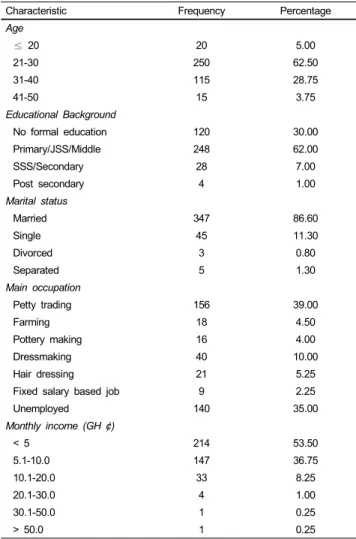
Table 1. Background characteristics of respondents
Characteristic Frequency Percentage
Age
≤ 20 20 5.00
21-30 250 62.50
31-40 115 28.75
41-50 15 3.75
Educational Background
No formal education 120 30.00
Primary/JSS/Middle 248 62.00
SSS/Secondary 28 7.00
Post secondary 4 1.00
Marital status
Married 347 86.60
Single 45 11.30
Divorced 3 0.80
Separated 5 1.30
Main occupation
Petty trading 156 39.00
Farming 18 4.50
Pottery making 16 4.00
Dressmaking 40 10.00
Hair dressing 21 5.25
Fixed salary based job 9 2.25
Unemployed 140 35.00
Monthly income (GH ¢)
< 5 214 53.50
5.1-10.0 147 36.75
10.1-20.0 33 8.25
20.1-30.0 4 1.00
30.1-50.0 1 0.25
> 50.0 1 0.25
to the Dangme ethnic group with some few migrant fishermen and farmers from other tribes. The study population consisted of mothers of child bearing age who had young children between the ages of 0 and 18 months. Sample size calculations were made on the basis of an estimate of 50% of mothers with children between the ages of 0 and 18 months, a 5% level of precision and a confidence level of 95%. Based on this, a sample size of 400 was obtained.
Data collection methods
House to house visits were made to identify mothers with infants and young children. The objectives of the study were explained to them and after giving their verbal consent, the mothers were interviewed on general household dietary practices in terms of meal patterns, types of meals consumed and meal procurement practices using a structured questionnaire. Frequ- ency of consumption of food items was assessed using the food frequency questionnaire whilst the nutritional quality of diets consumed was assessed using the 24-hr recall method. Anthro- pometric measurements, weights and heights, of the women were also taken using standard procedures.
Data analysis
Information collected from the 24-hr recall was converted into quantitative data of nutrients using Ghana Food Composition Tables (CSIR-FRI, 1975) and Food Processor Plus Software (ESHA Research, Salem, OR). The recommended nutrient intakes (RNI) were used to assess the nutritional adequacy of the diets consumed. Data from the food frequency questionnaire were used to describe the food consumption patterns of the women. Body mass index (BMI) was used to assess adult nutritional status.
Using the BMI classification (WHO, 1995), mothers were classified as underweight (<18.5 kg/m
2), normal (18.5-24.9 kg/
m
2), overweight (25-29.9 kg/m
2) and obese (≥ 30 kg/m
2). All data generated were analyzed using the Statistical Package for Social Sciences (SPSS), Version 10 in Windows.
Results and Discussion
Background characteristics
The mothers were relatively young in terms of age. Their ages ranged between 16 and 46 years, with a mean age of 28.3 years.
The majority were within the age range of 21 to 40 years (Table 1). The high correlation between levels of education and positive health and social indicators makes education a very important variable in any study of households. Higher education, especially of women, has been reported to be associated with greater knowledge as well as good health and care practices (Guldan, et al., 1993). From the results of the study, a third of the mothers
had no formal education. Of those who had formal education, a majority had basic school education, with a few having secondary and post secondary education. The mean number of years of education of the mothers was 5.69 (± 4.4) and most of them were married.
Petty trading was the main occupation of the women inter- viewed, with 39% being petty traders. The rest were mainly engaged in dressmaking, hairdressing, farming and pottery. A few were employed in fixed salary-based jobs. The average monthly income of the women was GH ¢7.9 (One GH¢ is equi- valent to One US Dollar). Over half earned less than GH ¢5.0 a month, with a third earning between GH ¢5.0 and GH ¢10.0.
Only a few of the mothers had monthly income above GH ¢10.0.
Meal patterns
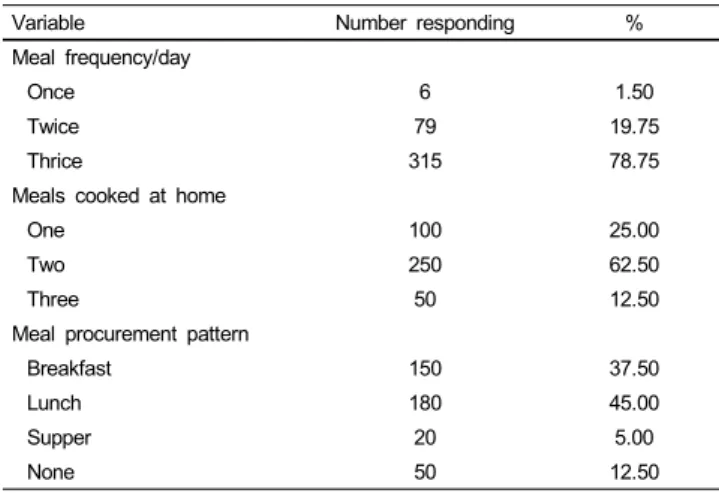
Information on dietary practices in terms of meal frequency,
type of meals consumed, and meal procurement patterns are
presented in Table 2. On the whole, the majority of women
consumed three meals a day, with a few having two meals a
day. In terms of meals cooked at home for consumption, about
Table 2. Meal frequency and sources of meals
Variable Number responding %
Meal frequency/day
Once 6 1.50
Twice 79 19.75
Thrice 315 78.75
Meals cooked at home
One 100 25.00
Two 250 62.50
Three 50 12.50
Meal procurement pattern
Breakfast 150 37.50
Lunch 180 45.00
Supper 20 5.00
None 50 12.50
Table 3a. Frequency of consumption of staples, animal products and legumes
Commodity % Response
Daily Weekly Monthly Occasionally Never Starchy roots and Plantain
Cassava 91.0 7.5 1.5 0.0 0.0
Yam 11.0 64.8 17.0 7.3 0.0
Cocoyam 2.3 18.5 20.0 54.7 4.5
Sweet potato 0.0 16.8 23.8 55.1 4.3
Plantain 12.3 53.6 24.3 9.0 0.8
Cereals and Cereal Products
Maize 96.8 1.8 0.3 1.3 0.0
Rice 28.8 65.5 5.0 0.7 0.0
Millet 12.5 26.5 20.0 17.3 19.7
Bread 61.8 21.3 3.5 5.5 8.0
Biscuits 8.8 14.8 8.8 64.4 3.2
Animal Products
Meat 13.3 37.8 29.3 18.0 1.6
Fish 95.3 2.5 1.5 0.7 0.0
Poultry 0.5 0.5 2.5 96.0 0.0
Egg 0.0 3.3 13.5 83.2 0.0
Milk 18.8 53.0 19.8 7.0 1.4
Snail 0.0 3.3 4.3 31.0 61.4
Legumes
Cowpea 29.0 45.8 14.3 8.4 2.5
Soybean 4.8 10.0 14.8 49.1 21.3
Groundnut 28.5 55.0 8.7 5.3 2.5
Bambara 0.0 0.0 6.8 20.0 71.4
Agushie 6.8 18.0 33.3 36.6 5.3
Neri 0.0 0.0 4.3 4.8 90.9
Table 3b. Frequency of consumption of fruits and vegetables, and fats and oils
Commodity % Response
Daily Weekly Monthly Occasionally Never Fruits and Vegetables
Orange 7.5 7.5 11.5 71.5 2.0
Mango 11.8 6.3 4.0 74.8 2.3
Pineapple 5.8 8.0 18.0 74.3 3.0
Pawpaw 1.5 3.0 6.0 80.5 0.0
Banana 7.5 7.5 13.0 72.0 0.0
Watermelon 2.5 2.3 6.8 80.5 7.5
Tomato 98.0 1.5 0.5 0.0 0.0
Onion 98.0 1.0 1.0 0.0 0.0
Leafy vegetables 17.5 60.8 16.3 4.3 1.3
Okro 59.0 34.3 3.3 1.5 2.0
Garden eggs 70.8 25.3 2.5 0.5 0.8
Pepper 98.0 1.0 1.0 0.0 0.0
Fats and Oils
Refined vegetable oil 19.3 26.0 28.8 24.0 2.0
Palm oil 66.5 31.3 2.0 0.3 0.0
Palm kernel oil 2.8 17.8 24.5 28.0 26.9
Groundnut oil 5.5 25.8 32.8 22.3 13.6
Coconut oil 3.8 3.8 5.5 6.5 80.4
Margarine 9.8 39.5 25.0 20.4 5.3
Sheabutter 1.5 2.0 2.8 1.5 92.2
Palm fruits 27.0 61.8 5.0 0.8 1.5
two-thirds of the respondents cooked two meals a day at home, only a few cooked all three meals at home. Breakfast and lunch were the two main cooked meals usually purchased from food vendors, with supper being the least purchased outside the home.
About 13% of the households however cooked their meals at home and never purchased food from food vendors. A similar trend of household dietary patterns has also been observed and reported by Plahar et al. (1999). In their studies on household food availability and consumption behaviors in Ghana, they
reported that in most households in Southern Ghana, supper is the main meal prepared at home, with breakfast and lunch mostly bought from food vendors. Usually, food intake is twice daily with variations especially during the hunger period.
Consumption of foods from the six food groups
The main foods that are available in the area and which dictate consumption patterns are presented in Tables 3a and 3b under the six food groups of Ghana namely, starchy roots and plantain, grains and cereals, animal products, beans, nuts and oilseeds, fruits and vegetables, fats and oils.
1) Starchy roots and plantain
The main starchy staples consumed are cassava, plantain, yam and cocoyam, with cassava being the most frequently consumed.
Almost all the respondents indicated that they consumed cassava
on daily basis, while 11% and 12% respectively, were consuming
yam and plantain. The root and tuber crops as well as plantain
were eaten mainly in the form of fufu (a pounded mash of cooked
cassava with plantain or cocoyam) and ampesi (boiled root, tuber
or plantain). Cassava was also eaten in the form of kokonte
(cooked meal of dried cassava flour), gari (roasted fermented
maize meal) or agbelima (a fermented dough) mixed with
fermented maize meal and cooked into a soft meal, banku. Sweet
potato does not form a major part of the normal diet of most
people in the area.
Table 4a. Mean energy and nutrient intakes of respondents Energy/nutrients Daily intake
(24-hour recall)1 Expected intake (RNI)3
Energy (kcal) 1,966.0 ± 399.7 2,200
Protein (g) 43.9 ± 17.3 50
Calcium (mg) 595.3 ± 477.0 800
Iron (mg) 26.3 ± 7.8 15
Vitamin A (mg) 1,608 (100-4017)2 800
Vitamin B1 (mg) 0.8 ± 0.3 1.1
Vitamin B2 (mg) 0.6 ± 0.3 1.3
Niacin (mg) 10.8 ± 2.5 15
1 Mean ± standard deviation
2 Median (Range)
3 Recommended Nutrient Intake, National Research Council, 1989.
Table 4b. Percent of RNI1met by respondents’ diets
Energy/Nutrient % Respondents
< 50% RNI1 51-75% RNI1 > 75% RNI1
Energy 0.0 20.0 80.0
Protein 6.0 32.0 62.0
Calcium 36.0 35.0 29.0
Iron 2.0 32.0 66.0
Vitamin A 9.0 4.0 87.0
Vitamin B1 12.0 52.0 36.0
Vitamin B2 69.0 29.0 2.0
Niacin 9.0 53.9 38.0
1 Recommended Nutrient Intakes, National Research Council, 1989.
2) Grains and cereals
With regards to the consumption of cereals, maize was found to be the most frequently consumed, with almost all the respon- dents consuming maize daily. Maize was consumed primarily in the form of kenkey (cooked balls of fermented maize dough), banku (cooked meal of fermented maize and cassava dough) and porridge. The second most important cereal consumed was rice, which was consumed at least once a week by 66% of the respondents (Table 3a). Rice was consumed, mainly boiled, and served with stew. To a lesser extent, it was consumed in the form of waakye (rice and beans boiled together), omotuo (rice balls) and rice water. Although wheat as a whole cereal plays very little role in the diet of the people, about 62% of the respondents took wheat in the form of bread daily while 21%
consumed it weekly.
3) Animal products
Fish was found to be the main source of animal protein for the respondents and consumed daily in almost all households.
It was consumed mainly in soups and stews, as well as in hot pepper sauce as an accompaniment to the major staples. Other sources of animal protein include meat, eggs, milk, poultry and snails. Meat and milk were less frequently consumed with poultry and eggs being consumed occasionally. Snails were not con- sumed at all by 61% of the respondents for cultural reasons.
4) Beans, nuts and oilseeds
Legume consumption in the area was rather low. The most frequently consumed legumes were cowpeas and groundnuts.
Cowpeas were consumed mainly in stews and as waakye, whereas groundnuts were consumed as soups and also in the roasted form as a snack. Agushie (melon seeds) and soybeans were occa- sionally consumed whereas bambara and neri were never con- sumed by 71% and 91% respectively.
5) Fruits and vegetables
The major tropical fruits found in the area include oranges, mangoes, pineapples, pawpaw, watermelon, and banana. Altho- ugh some of these are grown locally, others such as oranges and bananas are imported from the forest areas of the country.
Because most fruits are seasonal, consumption is high only when in season. This is evidenced by the high percentage distribution of 72%-81% of the respondents for occasional consumption (Table 3b). With respect to vegetables, pepper, onion and tomato were found to be consumed on a daily basis by almost all respondents, mainly in soups and stews or as hot pepper sauce accompaniment to kenkey, banku or kokonte. Similarly, garden eggs and okro were important vegetables used in the preparation of some stews and soups. Green leafy vegetables were consumed by 61% on a weekly basis in soups and stews.
6) Fats and oils
Among the fats and oils, palm oil and palm fruits were the
most frequently consumed, used mainly in soups/stews and also as an accompaniment to cooked beans and gari. About 67% of the respondents used palm oil on daily basis whiles 62% con- sumed palm fruits weekly. Being a very good source of Vitamin A, the respondents would most likely meet their requirements for the vitamin. Refined cooking oil and margarine were con- sumed less frequently because they are expensive. Shea butter and coconut oil were not popular among the people probably because they were not easily available. Shea butter is produced mainly in the northern parts of the country and constitutes a major part of the food consumption patterns of the people in northern Ghana more than in the southern parts of the country.
Nutritional composition and quality of diets
Mean energy and nutrient intake as well as percent of RNI met by respondents’ diets are presented in Tables 4a and 4b.
The results revealed that recommended intakes of some nutrients were not being met. On the average, meeting energy requirements was not difficult, as most of the diets consumed were carbo- hydrate based. Eighty percent (80%) of the women had adequate intakes of energy. The mean energy intake was 1966 kcal/day, corresponding to a mean RNI of 89%.
In terms of protein intake, two-thirds of the respondents met over 75% of the requirements, with a third meeting between 51 and 75%. Only a few of the respondents had intakes below 50%.
The mean intake and percent RNI for protein were 43.9mg/day
Table 5. Anthropometric characteristics of respondents
Characteristic Mean SD
Age (yr) 28.3 6.4
Weight (kg) 58.1 10.5
Height (m) 1.6 0.1
BMI 22.6 3.7
BMI Categorization (%)
Normal (18.5-24.9) 66%
Underweight (< 18.5) 12%
Overweight (25.0-29.9) 17%
Obese (> 30) 5%
and 88% respectively. The high fishing activity in the area may account for the high protein intake (Table 4b). Calcium intake on the average was quite low. Only 29% of caregivers met over 75% of RNI for calcium, with as many as 36% receiving below 50% of the recommended intake. The mean calcium intake was 594 mg/day corresponding to 74% RNI. The low dietary levels of calcium could be attributed to the low consumption of milk and milk products in the area as reflected in the consumption patterns. Dietary intake of iron appears to be quite high among respondents, with 66% and 32% of the caregivers meeting over 75% and 51-75% of requirements respectively. The mean iron intake was 26.3 mg/day. Most of the iron was from plant food sources. The actual percentages therefore may be lower due to poor bioavailability of non-heme iron.
Intakes of the B-vitamins were generally low, with the intake of riboflavin being the poorest. The mean intake was 0.59 mg/
day, about 45% of the recommended intake. Only 2% were able to meet over 75% of the RNI, with 29% of the women meeting between 51% and 75%. Compared to riboflavin, intakes of thia- min and niacin were fairly good, with mean intakes of 0.81 mg/
day and 10.8 mg/day respectively. About 36% and 52% of the respondents respectively, met between 50% and 100% of the recommended intake of thiamin and niacin. In terms of vitamin A intake, majority of the respondents (87%) met their RDA for the vitamin. This could be explained by the frequent consumption of palm soups and palm oil in the area as reflected in the consumption patterns.
Nutritional status of women
The results on anthropometric characteristics of the women are presented in Table 5. The ages of the mothers ranged between 16 and 46 years, with a mean age of 28.3 years. Maternal average height and weight were 1.60 m and 58.1 kg respectively. Similar values of maternal height and weight have been reported in Ghana (GDHS, 1998; Maxwell et al., 2000). Of all the women interviewed only 3.5% were shorter than 1.49 m, a cut-off point often used to define obstetric risk or complications with child- birth. Short maternal stature has been reported notto be a severe problem in Africa (ACC/SCN, 1992).
Maternal BMI ranged between 15.6 kg/m
2and 33.0 kg/m
2, with a mean value of 22.6 kg/m
2. This value compares well with a
national average of 22.1 kg/m
2for women (GDHS, 1998). Based on BMI categorization, 12% of the women were underweight, that is, they had BMI below 18.5 kg/m
2, a cut-off point often used to define under-nutrition in adults (Gibson, 1990). Seven- teen percent (17%) and 5% were overweight and obese respec- tively. These results also compare well with that reported for the GDHS (1998). Nationally, 11.2%, 16.2% and 4.9% respec- tively, of Ghanaian women are underweight, overweight or obese.
The high levels of overweight/obese (22%) observed are not surprising given the fact that obesity has been described as an emerging problem among many adults in the developing world, especially those living in large towns and cities (Maxwell et al., 2000). There is therefore the need to intensify education on excessive weight gain and its attendant health problems in the area.
Based on the results of the study, it is concluded that the diets of the respondents are inadequate in the B-vitamins, namely thiamin, riboflavin, niacin and in calcium. A significant propor- tion of the women were nutritionally at risk of being either underweight, overweight or obese. Nutrition education interven- tion programs aimed at improving nutrient intake through impro- ved diet diversity and increased use of local foods rich in iron, calcium and the B-vitamins needs to be undertaken. There is also the need to intensify education on excessive weight gain and its attendant health problems in the area.
Acknowledgement
The field studies were undertaken with financial assistance in part by Benson Institute of Food and Agriculture, Brigham Young University, Utah, USA, through their Thesis Grant Project in Ghana and A.G. LEVENTIS Fellowship Programme of the University of Ghana. The authors are extremely grateful for the support. We are also grateful to Mr. and Mrs. Adjei, local Benson Institute administrators, for their support during the fieldwork.
Literature cited
ACC/SCN (2000). Fourth Report of the World Nutrition Situation.
Geneva. Switzerland
Engle PL, Menon P & Haddad L (1997). Care and nutrition: Con- cepts and measurements. FCND Discussion Paper No. 18, IFPRI, Washington, D.C. USA
Eyeson KK & Ankrah EK (1970). Composition of foods commonly used in Ghana. Food Research Institute, C.S.I.R., Accra, Ghana.
Gibson RS (1990). Principles of Nutritional Assessment, New York and Oxford. Oxford University Press.
GSS (1998). Ghana Demographic and Health Survey, Accra. Ghana Guldan GS, Zeitlin MF, Beiser AS, Super CM, Gershoff SN & Dhatta
S (1993). Maternal education and child feeding practices in Bangladesh. Soci Sci Med 36:925-935.
Krause MV & Mahan KL (1984). Food, nutrition and diet therapy.
7th Ed. W.B. Saunders & Co. Philadelphia, USA
Maxwell D, Levin C, Amar-Klemesu M, Ruel M, Morris SS &
Ahiadeke L (2000). Urban livelihoods, food and nutrition security in Greater Accra. Research Report 112. International Food Policy Research Institute, Washington, D.C. USA
McCullough AL, Kirksey A, Wachs TD, McCabe GP, Bassily NS, Bishry OM, Galal G, Harrison GG & Jerome NG (1990). Vitamin B6 status of Egyptian mothers: Relation to infant behaviour and maternal - infant interactions. Am J Clin Nutr 51:1067-1074.
National Academy of Sciences (1989). Recommended dietary allo- wances. 9th Ed. National Academy Press, Washington, D.C. USA Neumann CG, Bwibo M, Marquardt M, Trostle M & Wienbug G
(1992). Food intake during acute illness and convalescence in
Kenyan toddlers. FASEB Journal 8:A 2550.
Plahar WA, Nti, CA, Quaye W & Nyako PM (1999). Household food availability and consumption behaviour in the coastal savanna zone of Ghana. A project report, Food Research Institute, C.S.I.R., Accra, Ghana
Torun B, Flores R, Viteri F, Immink M & Diaz E (1989). Energy Supplementation and work performance. Summary of INCAP Stu- dies. Proceeedings of the XIV International Congress of Nutrition (ICN), Seoul and Tokyo.
WHO (1995). Physical Status: The use and interpretation of anth- ropometry. Report of a WHO Expert Committee. WHO Technical series 854. WHO, Geneva. Switzerland