Low Compliance with National Guidelines for Preventing Transmission of Group 1 Nationally Notifiable Infectious
Diseases in Korea
Eu Suk Kim,
1Kyoung-Ho Song,
1Baek-Nam Kim,
2Yee Gyung Kwak,
2Chang-Seop Lee,
3Sang Won Park,
4Chisook Moon,
2Kyung Hwa Park,
5Hee-Chang Jang,
5Joon-Sup Yeom,
6Won Sup Oh,
7Chung-Jong Kim,
1Hong Bin Kim,
1and Hyun-Sul Lim
81Department of Internal Medicine, Seoul National University Bundang Hospital, Seongnam; 2Department of Internal Medicine, Inje University College of Medicine, Busan; 3Department of Internal Medicine, Chonbuk National University Medical College, Jeonju; 4Department of Internal Medicine, Boramae Medical Center, Seoul National University College of Medicine, Seoul; 5Department of Internal Medicine, Chonnam National University Medical
School, Gwangju; 6Departemt of Internal Medicine, Kangbuk Samsung Hospital, Sungkyunkwan University School of Medicine, Seoul;
7Department of Internal Medicine, Kangwon National University School of Medicine, Chuncheon;
8Department of Preventive Medicine, Dongguk University College of Medicine, Gyeongju, Korea.
Received: April 9, 2013 Revised: June 19, 2013 Accepted: June 19, 2013
Co-corresponding authors: Dr. Hong Bin Kim, Department of Internal Medicine, Seoul National University Bundang Hospital, 82 Gumi-ro 173beon-gil, Bundang-gu, Seongnam 463-707, Korea.
Tel: 82-31-787-7021, Fax: 82-31-787-4052 E-mail: [email protected] and Dr. Hyun-Sul Lim,
Department of Preventive Medicine, Dongguk Univeristy College of Medicine, 123 Dongdae-ro, Gyeongju 780-714, Korea.
Tel: 82-54-770-2401, Fax: 82-54-770-2438 E-mail: [email protected]
This work was presented in part at the International Conference on Prevention and Infection Control (ICPIC) 2011; Geneva, Switzerland; July 2011 (Abstract P324).
∙ The authors have no financial conflicts of interest.
© Copyright:
Yonsei University College of Medicine 2014 This is an Open Access article distributed under the terms of the Creative Commons Attribution Non- Commercial License (http://creativecommons.org/
licenses/by-nc/3.0) which permits unrestricted non- commercial use, distribution, and reproduction in any medium, provided the original work is properly cited.
Purpose: This study was performed to evaluate the compliance with, and adequacy of, the Korean national guidelines which had been recommended until 2011 for iso- lation of patients with group 1 nationally notifiable infectious diseases (NNIDs), namely cholera, typhoid fever, paratyphoid fever, shigellosis, and enterohemor- rhagic Escherichia coli (EHEC) infection. Materials and Methods: We evaluated the clinical and microbiological characteristics of confirmed cases of group 1 NNIDs and compliance with the guidelines in 20 Korean hospitals nationwide in 2000-2010. We also compared the Korean guidelines with international guidelines.
Results: Among 528 confirmed cases (8 cases of cholera, 232 of typhoid fever, 81 of paratyphoid fever, 175 of shigellosis, and 32 EHEC infections), strict compliance with the Korean guideline was achieved in only 2.6% to 50.0%, depending on the disease. While the Korean guidelines recommend isolation of all patients with group 1 NNIDs, international guidelines recommend selective patient isolation and screening for fecal shedding, depending on the type of disease and patient status.
Conclusion: Compliance with the previous national guidelines for group 1 NNIDs in Korea was generally very low. Further studies are needed to evaluate whether compliance was improved after implementation of the new guideline in 2012.
Key Words: Communicable disease control, guideline adherence, patient isola- tion, cholera, typhoid fever, shigellosis
INTRODUCTION
Food-borne diseases are mostly acquired by ingestion of water and food contami-
nated with pathogenic microorganisms. However, infections also occur through
with group 1 NNIDs and asymptomatic carrier in hospitals using enteric precautions; 2) regular screening for fecal shedding; and 3) maintaining patient and carrier isolation until microbiological confirmation of negative conversion after finishing antibiotic treatment. Isolation methods for patients and carriers were considered adequate when they occupied single rooms or were admitted in cohorts. Based on the 2011 Korean national guidelines,
5microbiological confirmation of negative conversion involved two consecu- tive negative cultures of stool specimens taken 24 hours apart and at least 48 hours after finishing antibiotic therapy for cholera, shigellosis, and EHEC infections.
5For typhoid fever and paratyphoid fever, three consecutive negative stool cultures were required.
We compared the Korean guidelines with two major inter- national guidelines for control and isolation of patients with group 1 NNIDs: the guidelines of the American Public Health Association in the United States
6and of the Public Health Laboratory Service in the United Kingdom.
7This study was approved by the Institutional Review Board of Seoul Na- tional University Bundang Hospital.
RESULTS
Of the 20 participating hospitals, 15 were tertiary care teach- ing hospitals and 5 community-based secondary care gener- al hospitals. All had their own microbiology laboratories, and the etiologic microorganisms were identified in each in- stitute. The locations of participating hospitals were: 5 in Seoul, 1 in Busan, 1 in Daegu, 2 in Incheon, 1 in Gwangju, 5 in Gyeonggi, 2 in Gangwon, 1 in Chonbuk, 1 in Gyeongbuk, and 1 in Gyeongnam.
During the study period, 528 cases of group 1 NNIDs were microbiologically confirmed in the 20 hospitals; 8 cas- es of cholera, 232 of typhoid fever, 81 of paratyphoid fever, 175 of shigellosis, and 32 of EHEC infections (Table 1). Of the 175 cases of shigellosis, 98 were caused by Shigella flexneri, 58 by S. sonnei, 6 by S. dysenteriae, 5 by S. boydii, and 8 by unidentified Shigella species. 75.0% and 43.2% of the cases of cholera and paratyphoid fever were imported from Southeast Asian countries and the Indian subcontinent respectively, and 15.9%, 20.6% and 0% of the typhoid fever, shigellosis, and EHEC infection, respectively, developed in travelers returning from abroad. EHEC infections mainly de- veloped in children under 10 years of age whereas the other group 1 NNIDs developed in diverse age groups. Fever, ab- person-to-person transmission, especially among members
of the same household or in crowded places where hygiene is often compromised, such as day care centers and nursing homes. In these conditions, transmission can sometimes cause large outbreaks in the community and even in hospital settings.
1-3Successful prevention of spreading of infectious diarrhea in the community depends largely on adequate con- trol measures such as rapid and accurate microbiological di- agnosis among the populations at risk, reporting of specific communicable diseases to the appropriate public health au- thorities, adequate follow-up strategies to monitor fecal shedding after treatment in groups at risk, patient isolation and preventative education.
4Cholera, typhoid fever, paratyphoid fever, shigellosis, and enterohemorrhagic Escherichia coli (EHEC) infections have been classified as group 1 nationally notifiable infectious diseases (NNIDs) in Korea. To prevent spreading of group 1 NNIDs in the community and in hospitals, the national guidelines have recommended that all patients with these diseases should be hospitalized under enteric precautions until screening for fecal shedding becomes negative 2 or 3 times consecutively after finishing antibiotic therapy until 2011.
5International guidelines for these communicable dis- eases also recommend adequate patient isolation, adopting enteric precautions and regular screening for fecal shedding in some situations.
6,7This study was performed to charac- terize the clinical and microbiological features of group 1 NNIDs in Korea and evaluate compliance with the Korean guideline for control and isolation of patients with group 1 NNIDs. A more realistic isolation policy for Korea was sug- gested by comparing the Korean national guidelines with international guidelines.
MATERIALS AND METHODS
Infectious disease specialists retrospectively reviewed the medical records of confirmed cases of group 1 NNIDs, diag- nosed in 20 Korean hospitals nationwide, from 2000 to 2010.
Cases of cholera were limited only to instances in which Vib- rio cholerae O1 or O139 was isolated in clinical specimens.
Data on demographic characteristics, clinical information, and microbiological and epidemiological findings were col- lected. Clinically or serologically diagnosed cases were ex- cluded as were cases of non-typhoid salmonellosis.
Three aspects of compliance with the 2011 Korean na-
tional guidelines were assessed:
51) isolation of patients
Table 1. Clinical and Microbiological Characteristics of Group 1 Nationally Notifiable Infectious Diseases Developed during 2000 through 2010 in 20 Korean Hospitals
Cholera (n=8) Typhoid fever
(n=232) Paratyphoid
fever (n=81) Shigellosis
(n=175) EHEC
(n=32)
Female, n (%) 4 (50.0) 107 (46.1) 33 (40.7) 102 (58.3) 14 (43.8)
Age, median (range), yrs 42 (10-70) 39 (0-94) 34 (0-76) 45 (1-87) 3 (0-72)
0-9 (n) 0 23 12 28 24
10-19 (n) 1 31 4 16 5
20-29 (n) 1 33 15 21 0
30-39 (n) 1 30 14 17 0
40-49 (n) 1 48 17 12 0
50-59 (n) 1 28 9 15 2
60-69 (n) 2 30 8 35 0
≥70 (n) 1 9 2 31 1
Imported cases, n (%) 6 (75.0) 37 (15.9) 35 (43.2) 36 (20.6) 0
Major symptoms, n (%)
Abdominal pain 6 (75.0) 84 (36.2) 19 (23.5) 90 (51.4) 15 (46.9)
Chill 0 107 (46.1) 43 (53.1) 32 (18.3) 0
Diarrhea 7 (87.5) 107 (46.1) 47 (58.0) 159 (90.9) 26 (81.3)
Fever 2 (25.0) 208 (89.7) 71 (87.7) 106 (60.6) 15 (46.9)
Headache 1 (12.5) 79 (34.1) 23 (28.4) 22 (12.6) 23 (71.9)
Nausea 0 43 (18.5) 43 (53.1) 27 (15.4) 2 (6.3)
Vomiting 1 (12.5) 37 (15.9) 11 (13.6) 39 (22.3) 13 (40.6)
Weakness 0 41 (50.6) 11 (13.6) 25 (14.3) 3 (9.4)
Specimen yielding initial positive cultures, n (%)
Stool 8 (100.0) 11 (4.7) 14 (17.3) 162 (92.6) 32 (100.0)
Blood 0 203 (87.5) 65 (80.2) 3 (1.7) 0
Urine 0 2 (0.8) 0 5 (2.9) 0
Others 0 7 (3.0) 1 (1.2) 3 (1.7) 0
Stool and blood 0 7 (3.0) 1 (1.2) 2 (1.1) 0
Stool and urine 0 2 (0.8) 0 0 0
Antibiotic treatment, n (%)
Yes 7 (87.5) 216 (93.1) 76 (93.8) 157 (89.7) 19 (59.4)
No 1 (12.5) 0 3 (3.7) 11 (6.3) 13 (40.6)
Unknown 0 16 (6.9) 2 (2.5) 7 (4.0) 0
Follow up of stool cultures after initial positive culture, n (%)
Done 7 (87.5) 175 (75.4) 63 (77.8) 133 (76.0) 28 (87.5)
Not done 1 (12.5) 57 (24.6) 18 (22.2) 42 (24.0) 4 (12.5)
Duration of fecal shedding after initial positive culture, n
<3 d 1 8 2 5 1
3-5 d 0 3 4 5 2
6-7 d 0 2 1 4 2
8-14 d 1 8 2
15-21 d 1 2
22-28 d 1
In-hospital mortality, n (%) 0 3 (1.3) 0 2 (1.1) 1 (3.1)
EHEC, enterohemorrhagic Escherichia coli.
DISCUSSION
The Korean government has designated several communi- cable diseases, including five major food-borne or water- borne diseases - cholera, typhoid fever, paratyphoid fever, shigellosis, and EHEC infections - as NNIDs since 1957.
5The government also strictly controls by law the handling of infected patients and carriers, because these communicable diseases can spread rapidly in the community and cause large outbreaks that have a substantial social impact. We ret- rospectively collected clinical and microbiological data on 528 cases of group 1 NNIDs for over 10 years. A total of 8396 cases including clinically suspicious cases were report- ed to the public health authority during that period.
8The cas- es enrolled in this study were only 6.3% of all the cases de- veloped nationwide. However, our data reflect general situation in Korea because we collected only microbiologi- cally confirmed cases and excluded suspected cases. The medical records were also reviewed carefully by infectious diseases specialists in each hospital, and we did not depend only on data reported to the public health authorities, which can easily lack information on compliance with guidelines on isolation of patients and follow-up microbiological tests.
While a considerable proportion of cholera and paraty- phoid fever cases in this study were imported from abroad, most of the cases of typhoid fever, shigellosis, and EHEC infections originated domestically as sporadic cases or epi- dominal pain, and diarrhea were the most frequently ob-
served symptoms of these diseases. Follow-up stool cul- tures were made at least once in 75.4-87.5% of the confirmed cases of group 1 NNIDs. While the period of fecal shed- ding is relatively short in most of cases of cholera, typhoid fever, and paratyphoid fever, cases with longer periods of fecal shedding was more frequent in shigellosis and EHEC infections. In-hospital deaths involving Group 1 NNIDs were rare.
Compliance with the Korean national guidelines for pa- tients with group 1 NNIDs was generally low (2.6-50.0%), especially in cases of typhoid fever and paratyphoid fever (Fig. 1). The most common type of non-compliance was fail- ure to maintain patient isolation until microbiological confir- mation of negative conversion. Moreover, substantial num- bers (12.5-43.8%) of patients were not hospitalized in single rooms or in cohorts.
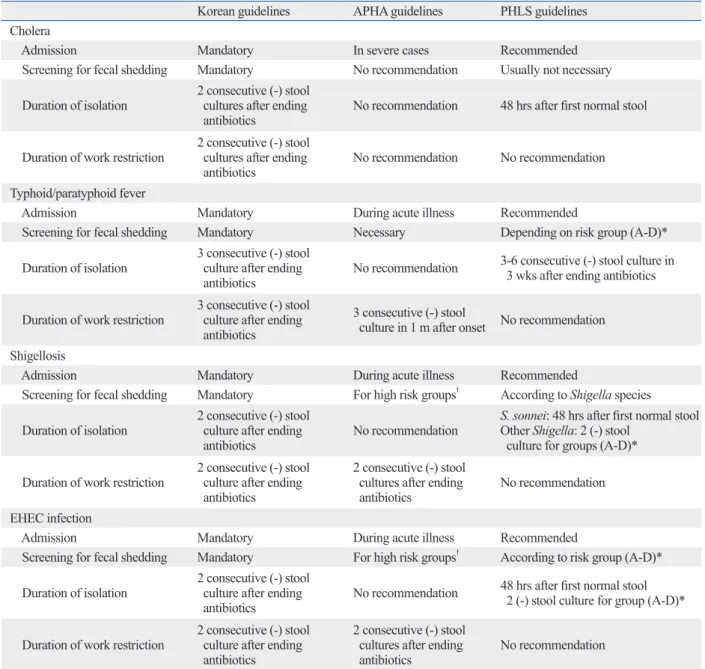
Several differences were observed between the Korean guidelines and the two major international guidelines for control and prevention of these communicable diseases (Table 2).
5-7The most distinctive feature of the international guidelines was that patient isolation and screening for fecal shedding were applied selectively depending on the type of disease, severity of illness, and patient characteristics such as age, ability to maintain general hygiene, and occupation.
The Korean guidelines were much stricter in that all group 1 NNID patients were to be hospitalized until confirmation of negative conversion of fecal shedding.
Fig. 1. Compliance and types of non-compliance with the Korean national guidelines for preventing transmission of group 1 nationally notifiable infectious diseases (NNIDs) in Korea. The Korean national guidelines had recommended until 2011 that all patients with group 1 NNIDs be admitted to hospital under enteric precautions until fecal shedding was negative 2 or 3 times consecutively after ending antibiotic therapy. EHEC, enterohemorrhagic Escherichia coli.
0 20 40 60 80 100
(%)
Cholera (n=8) Typhoid fever (n=232) Paratyphoid fever (n=81) Shigellosis (n=175) EHEC infections (n=32) Unknown Insufficient isolation period No regular screening No patient isolation Compliant
ease and patient status. Bacteria are excreted for 3 days or less in cases of cholera receiving adequate antibiotic treat- ment.
9In typhoid fever and paratyphoid fever, there is con- cern about long term fecal excretion and carriers of Salmo- nella,
6but secondary transmission through contact with patients is not likely to occur frequently.
10-12On the other hand, the period of fecal shedding is longer in shigellosis and EHEC infections, and secondary attack rates are rela- tively high, especially in children.
13-16Therefore, measures to prevent the spreading of gastrointestinal communicable demics. Because the main route of transmission is the fecal
to oral route, prolonged fecal shedding of infectious organ- isms has a significant impact on public health. It is difficult to compare the durations of fecal shedding in the various NNID because our study was retrospective and most of the patients received antibiotic therapy. However, there was a tendency for a longer duration of fecal shedding in cases of shigellosis and EHEC infections than in cases of cholera, typhoid and paratyphoid fever (Table 1). The duration of fe- cal shedding is known to differ according to the type of dis-
Table 2. Comparison of the Korean Guidelines for Preventing Transmission of Group 1 Nationally Notifiable Infectious Dis- eases with International Guidelines
Korean guidelines APHA guidelines PHLS guidelines
Cholera
Admission Mandatory In severe cases Recommended
Screening for fecal shedding Mandatory No recommendation Usually not necessary Duration of isolation 2 consecutive (-) stool
cultures after ending
antibiotics No recommendation 48 hrs after first normal stool Duration of work restriction 2 consecutive (-) stool
cultures after ending
antibiotics No recommendation No recommendation
Typhoid/paratyphoid fever
Admission Mandatory During acute illness Recommended
Screening for fecal shedding Mandatory Necessary Depending on risk group (A-D)*
Duration of isolation 3 consecutive (-) stool culture after ending
antibiotics No recommendation 3-6 consecutive (-) stool culture in 3 wks after ending antibiotics Duration of work restriction 3 consecutive (-) stool
culture after ending antibiotics
3 consecutive (-) stool
culture in 1 m after onset No recommendation Shigellosis
Admission Mandatory During acute illness Recommended
Screening for fecal shedding Mandatory For high risk groups† According to Shigella species Duration of isolation 2 consecutive (-) stool
culture after ending
antibiotics No recommendation S. sonnei: 48 hrs after first normal stool Other Shigella: 2 (-) stool
culture for groups (A-D)*
Duration of work restriction 2 consecutive (-) stool culture after ending antibiotics
2 consecutive (-) stool cultures after ending
antibiotics No recommendation
EHEC infection
Admission Mandatory During acute illness Recommended
Screening for fecal shedding Mandatory For high risk groups† According to risk group (A-D)*
Duration of isolation 2 consecutive (-) stool culture after ending
antibiotics No recommendation 48 hrs after first normal stool 2 (-) stool culture for group (A-D)*
Duration of work restriction 2 consecutive (-) stool culture after ending antibiotics
2 consecutive (-) stool cultures after ending
antibiotics No recommendation
APHA, American Public Health Association; PHLS, Public Health Laboratory Service; EHEC, enterohemorrhagic Escherichia coli.
*A, any person of doubtful personal hygiene; B, children attending pre-school or nursery; C, food handlers; D, clinical and social care staff.
†Food handlers, healthcare workers, and social staff caring for vulnerable persons.
otic treatment (Fig. 1). We think that it is not necessary for all patients and carriers to be followed up for fecal shedding after adequate antibiotic treatment, provided that they can maintain good personal hygiene and present no risk of be- coming a source of outbreak; for example, food handlers do. In 2012, the Korean Government changed its recom- mendations for control and isolation of patients with group 1 NNIDs to more targeted measures, based on the type of disease and patient.
18This change was made partly because hepatitis A, the incidence of which increased rapidly in the young-adult population in the 2000s,
19had been classified as a group 1 NNID in 2010, and it was not realistic to apply the same quarantine policy to all patients with hepatitis A.
Further studies and changes of strategy based on scientific grounds are warranted to improve patient convenience and healthcare workers’ compliance.
This study has some limitations. First, it was retrospec- tive, and we did not collect data from small community- based hospitals. These factors can be sources of selection bias. Small community-based hospitals have limited resourc- es for microbiological diagnosis of group 1 NNIDs and also more difficulty in adhering to infection control measures.
Therefore, the real level of compliance with the Korean na- tional guidelines is probably much lower than indicated by the results of this study. Second, the study was performed in a country where the prevalence of infectious diarrhea and food-borne illness is relatively low. Therefore, our sug- gestions may not be validly extrapolated to other countries, especially where the prevalence of gastrointestinal commu- nicable diseases is high and resources for infection control are limited. Third, the results should be interpreted with cau- tions because low compliance with the national guidelines might have resulted not only from the rigidity of the nation- al guidelines, but also a lack of knowledge about quarantine or isolation among Korean healthcare workers. Fourth, we did not evaluate the changes of compliance with the new national guidelines which were implemented in 2012. Fur- ther studies are needed to evaluate the knowledge level of healthcare workers about the national guidelines and whether compliance was improved after implementation of the new guidelines.
In conclusion, compliance with the previous national guidelines for preventing transmission of group 1 NNIDs was very low in Korea. Future guidelines should be selec- tively applied to highly communicable diseases such as shigellosis and EHEC infections and to patient groups with a high risk of transmission.
diseases in the community should differ depending on the etiologic agent. The main targets of infection control should be shigellosis and EHEC infections.
Compliance with the Korean guidelines was found to be generally very low in this study (2.6-50.0% depending on the disease). Compared with international guidelines, the Kore- an national guidelines were very rigid and intended to be uni- versally applied in all clinical settings, regardless of the type of NNID (Table 2). Adherence to these guidelines was fre- quently unrealistic, mainly because the guidelines recom- mended that all the patients should be hospitalized under contact precautions until microbiological clearance was con- firmed. The duration of hospitalization to meet the minimal criteria for relief from quarantine usually exceeded one week, and in cases of typhoid fever and paratyphoid fever, patients were required to be hospitalized for at least two weeks for antibiotic therapy and microbiological follow-up.
This was resource-intensive and could substantially limit individual freedom and rights in the name of public benefit.
Thomas, et al.
12have also reported considerable difficulties in following strictly national guidelines for typhoid and para- typhoid fever in the United Kingdom. Therefore, it seemed desirable to reevaluate the scientific background of the 2011 Korean national guidelines to make them more realistic. In a survey regarding measures used for isolation of patients with group 1 NNIDs in 2011, the majority of infectious dis- eases specialists in Korea believed that the current national guidelines should be changed.
17Based on the results of this study, we suggest following rational measures to prevent spreading of group 1 NNIDs in the community. First, the decision whether the patient is hospitalized should not be based on law but depend on the clinical judgment of the physician. Also, the duration of quarantine should be individualized according to the type of disease, severity of acute illness, and patient characteris- tics, not based on the results of follow-up stool cultures af- ter treatment. Strict isolation should be limited to cases of shigellosis and EHEC infection, which have longer periods of fecal shedding of etiologic agents and higher rates of sec- ondary attack.
13-16International guidelines also recommend hospitalization and isolation of patients in selected cases (Table 2). Second, follow-up for fecal shedding after antibiot- ic treatment should be targeted only to the risk groups. While follow-up tests were performed at least once in 75.4-87.5%
of the cases in this study, substantial numbers of cases were
not screened according to the guidelines which recommend-
ed two or three tests at least 48 hours after the end of antibi-
6. Heymann DL, American Public Health Association. Control of communicable diseases manual. 19th ed. Washington, DC: Ameri- can Public Health Association; 2008.
7. PHLS Advisory Committee on Gastrointestinal Infections. Pre- venting person-to-person spread following gastrointestinal infec- tions: guidelines for public health physicians and environmental health officers. Commun Dis Public Health 2004;7:362-84.
8. Korea Centers for Disease Control and Prevention. Web statistics of infectious diseases in Korea. [assessed on 2013 January 26].
Available at: http://stat.cdc.go.kr/.
9. Wallace CK, Anderson PN, Brown TC, Khanra SR, Lewis GW, Pierce NF, et al. Optimal antibiotic therapy in cholera. Bull World Health Organ 1968;39:239-45.
10. Morris JG Jr, Ferreccio C, Garcia J, Lobos H, Black RE, Rodri- guez H, et al. Typhoid fever in Santiago, Chile: a study of house- hold contacts of pediatric patients. Am J Trop Med Hyg 1984;33:
1198-202.
11. Braddick MR, Crump BJ, Yee ML. How long should patients with Salmonella typhi or Salmonella paratyphi be followed-up? A com- parison of published guidelines. J Public Health Med 1991;13:
101-7.
12. Thomas HL, Addiman S, Mellanby A. Evaluation of the effective- ness and efficiency of the public health management of cases of infection due to Salmonella typhi/paratyphi in North East London.
Public Health 2006;120:1188-93.
13. DuPont HL, Hornick RB, Dawkins AT, Snyder MJ, Formal SB.
The response of man to virulent Shigella flexneri 2a. J Infect Dis 1969;119:296-9.
14. Arias C, Sala MR, Domínguez A, Bartolomé R, Benavente A, Ve- ciana P, et al. Waterborne epidemic outbreak of Shigella sonnei gastroenteritis in Santa Maria de Palautordera, Catalonia, Spain.
Epidemiol Infect 2006;134:598-604.
15. Shah S, Hoffman R, Shillam P, Wilson B. Prolonged fecal shed- ding of Escherichia coli O157:H7 during an outbreak at a day care center. Clin Infect Dis 1996;23:835-6.
16. Belongia EA, Osterholm MT, Soler JT, Ammend DA, Braun JE, MacDonald KL. Transmission of Escherichia coli O157:H7 infec- tion in Minnesota child day-care facilities. JAMA 1993;269:883-8.
17. Lee MS, Kim ES, Kim HB, Hong JY, Lee JY. Opinions of infec- tious disease specialists on the current method for isolation of group 1 nationally notifiable infectious diseases in Korea. fect Chemother 2012;44:185-7.
18. Korea Centers for Disease Control and Prevention. Guidelines for control of infectious diseases, 2012. [assessed on 2013 January 26]. Available at: http://www.cdc.go.kr.
19. Seo JY, Seo JH, Kim MH, Ki M, Park HS, Choi BY. Pattern of hepatitis a incidence according to area characteristics using na- tional health insurance data. J Prev Med Public Health 2012;45:
164-73.
ACKNOWLEDGEMENTS
This work was supported by a grant from Korea Centers for Disease Control and Prevention. We are grateful to the fol- lowing for collecting clinical data in the various hospitals:
Kyong Ran Peck (Sungkyunkwan University School of Medicine), Yong Kyun Cho (Gachon University Gil Hospi- tal), Hyun-Ha Chang (Kyungpook National University School of Medicine), In-Gyu Bae (Gyeongsang National University School of Medicine), Hyo Youl Kim, Young Keun Kim (Yonsei University Wonju College of Medicine), Jin-Soo Lee (Inha University School of Medicine), Ae-Jung Huh, Yoon Seon Park (National Health Insurance Corpora- tion Ilsan Hospital), Kkot Sil Lee (Kwandong University College of Medicine), Sung-Han Kim (University of Ulsan College of Medicine), and Su Jin Jung (Dongguk Universi- ty Ilsan Hospital). We also thank Joong Sik Eom (Hallym University College of Medicine), Byung Chul Chun, Kyung Ho Roh (Korea University College of Medicine), and Ji Whan Bang (Seoul National University College of Medi- cine) for sharing their expert opinions.
REFERENCES
1. Lynch M, Painter J, Woodruff R, Braden C; Centers for Disease Control and Prevention. Surveillance for foodborne-disease out- breaks--United States, 1998-2002. MMWR Surveill Summ 2006;
55:1-42.
2. Lee JH, Lee JH, Kim MS, Park SG. Analysis of foodborne disease outbreaks for improvement of food safety programs in Seoul, Re- public of Korea, from 2002 to 2006. J Environ Health 2009;71:51-5.
3. Wikswo ME, Hall AJ; Centers for Disease Control and Prevention.
Outbreaks of acute gastroenteritis transmitted by person-to-person contact--United States, 2009-2010. MMWR Surveill Summ 2012;61:1-12.
4. Guerrant RL, Van Gilder T, Steiner TS, Thielman NM, Slutsker L, Tauxe RV, et al. Practice guidelines for the management of infec- tious diarrhea. Clin Infect Dis 2001;32:331-51.
5. Korea Centers for Disease Control and Prevention. Guidelines for control of infectious diseases, 2011. [assessed on 2013 January 26]. Available at: http://www.cdc.go.kr.