* Corresponding author : Young-Jin Oh, National Institute of Crop Science, RDA, Wanju-gun, 565-851, Korea,. Tel: +82-63-283-5224, E-mail: [email protected]
Research Article
청보리 신품종 ‘미호’의 생육특성과 수량성
오영진
1* ․박태일
1․박형호
1․한옥규
2․송태화
1․박종철
1․김양길
1․박종호
1․강현중
1․강천식
1․정영근
1․ 김경호
1․김보경
1․윤건식
3․홍기흥
4․배정숙
5․이성태
61
국립식량과학원,
2국립식량과학원 중부작물부,
3충청북도 농업기술원,
4충청남도 농업기술원,
5
경상북도 농업기술원,
6경상남도 농업기술원
Growth Characteristics and Forage Productivity of New Forage Barley Variety, ‘Miho’
Young-Jin Oh
1*, Tae-Il Park
1, Hyoung-Ho Park
1, Ouk-Kyu Han
2, Tae-Hwa Song
1, Jong-Chul Park
1, Yang-Kil Kim
1, Jong-Ho Park
1, Hyeon-Jung Kang
1, Chon-Sik Kang
1, Young-Keun Cheong
1, Kyong-Ho Kim
1, Bo-Kyeong Kim
1,
Geon-Sig Yun
3, Gi-Heung Hong
4, Jeong-Suk Bae
5and Seong-Tae Lee
61
National Institute of Crop Science, RDA, Wanju-gun, 565-851, Korea,
2Dept. of Central Area, National Institute of Crop Science, RDA, Suwon, 441-100, Korea,
3Chungbuk Agricultural Research & Extension Service, Cheongwon 363-880, Korea,
4Chungnam Agricultural Research & Extension Service, Yesan 340-861, Korea,
5Gyeongbuk Agricultural Research &
Extension Service, Daegu 702-320, Korea,
6Gyeongnam Agricultural Research & Extension Service, Jinju 660-985, Korea
ABSTRACT
The purpose of development new variety ‘Miho’ (Hordeum vulgare L.) is a favorite with livestock feed and develop varieties resistant to disease and lodging. ‘Miho’ was carrying out the growth habit of group Ⅲ with green and mid-wide leaf. Awn that is related to preference of livestock is a semi-smooth awn. This cultivar had 96 cm of culm length, 650 of spikes per m2. Heading date of ‘Miho’ was April 27, and maturing date on May 30, which were later than cultivar ‘Youngyang’. It also showed strong winter hardiness, and similar resistance to shattering and bariy yellow mosaic virus (BaYMV) compared with those of check one. The best thing among the traits of a good quality with the plant green at the latter growing period. The average forage dry matter yield in the regional yield trial was about 13.1, 12.1 MT per ha in upland and paddy field, respectively, which were 9%, 2% higher than that of the check cultivar. It’s also showed 6.8% crude protein, 27.1% ADF (acid detergent fiber), and 67.5% TDN (total digestible nutrients), including higher silage quality for whole crop barley. This cultivar would be suitable for the area whose average minimum temperature was above -8℃ January in Korean peninsula.
(Key words : Miho, Farage barely, Semi-smooth awn, High yielding)
Ⅰ. 서 론
청보리는 기존의 알곡만 사용하던 식량작물 보리에서 줄 기와 잎을 포함해 전체를 조사료로 이용 할 목적으로 만들 었다. 청보리는 종실이 포함되어 있어 티머시, 톨페스큐어 등 수입조사료에 비하여 사료가치가 우수하면서 가격이 저 렴하여 대외경쟁력이 높고 (Kim et al., 2007b; Kim and Seo, 2006; Seo et al., 2007), 조사료와 농후사료의 기능을 모두 가지고 있어 배합사료 대체효과도 크다는 장점을 가
지고 있다 (Choi et al., 2008). 또한 매년 체감하는 국제곡 물가 폭등과 불안정한 국제 수급환경에 따른 국내 축산물 의 경쟁력 향상을 위하여 정부 주도의 겨울철 논을 활용한 양질 조사료 생산 정책에 의해 청보리 품종개발이 적극적 으로 이루어지고 있다.
2002년부터 사료맥류 육종팀은 곡실용 보리에 비해 총체
수량이 평균 30% 이상 높은 청보리 전용품종인 영양 (2002),
선우 (2002), 상원 (2004), 소만 (2006)을 육성하여 왔다. 또
한 가축의 기호성 증진을 위하여 망의 특성을 매끄럽게 개
Year ’01 ’02 ’03 ’04 ’05 ’06 ’07 ’08 ’09 ’10 ’11 ’12 ’13 ’14 Generation - F
1F
2F
3F
4F
5F
6F
7F
8F
9F
10F
11F
12F
13SB00T2040
SB01T2027 B B B B 178 2 O PYT AYT RYT
SB941003
Miho (Iksan473)
Process Artificial cross Bulk and Pedigree selection PYT
zand AYT
yRYT
xzPYT : Preliminary yield trial, yAYT : Advanced yield trial, xRYT : Regional yield trial.
Fig. 1. Pedigree diagram of a new cultivar ‘Miho’.
선한 우호 (2004), 망이 퇴화된 삼차망 유연 (2006)을 개발 하였고, 2007년에는 줄기에 엽이가 없어 부드럽고 밀식에 강한 ‘다미’를 육성하였다 (Choi et al., 2007a, 2007b, Kim et al., 2007a, Park et al., 2008, Park et al., 2009). 2008 년 에는 도복, 한해 및 보리호위축병에 강한 ‘영한’과 삼차망 이면서 내탈립성인 ‘유호’를 육성하였다 (Park et al., 2011).
2010년에는 줄기에 엽이가 없어 부드럽고 잎의 비율이 높 으며, 다얼성으로 밀식에 강하고 사료가치가 우수한 ‘조미’
를 육성하였고 (Oh et al., 2014), 2012년에는 내한성, 도복 및 보리호위축병 등의 내병, 내재해성이면서 후기까지 녹 색이 유지되고 잎 비율이 높아 사료가치가 우수한 청보리 신품종 ‘녹양’과 초기생육이 빠르고 도복에 강하며 보리호 위축병에 저항성인 ‘유한’을 육성하였다 (Park et al., 2015a, Park et al., 2015b). 그리고 2014년에는 까락에 거치가 적 어 부드럽고 엽신의 비율이 높으며, 내한성이 강하고 경수 가 많은 청보리 신품종 ‘미호’를 육성하기 위하여 본 연구 를 수행하였다.
Ⅱ. 재료 및 방법
1. 육성경위
청보리 신품종 ‘미호’는 2001년에 ‘SB00T2040’을 모본,
‘SB941003’을 부본으로 인공교배하여 ‘SB01T2027’을 육성 한 후에 집단 및 계통선발에 의해 육성된 품종이다. 여기 서 선발된 ‘SB01T2027-B-B-B-B-178-2’ 계통을 2010~2011 년까지 생산력검정 예비시험 및 본시험을 수행한 결과, 총
체적성 및 농업적 특성이 우수하여 ‘익산473호’로 계통명 을 부여하고 2012년부터 2014년까지 3개년간 6개소에서 지역적응시험을 수행하였다. 그 결과 ‘익산473호’는 까락에 거치가 적은 반매끈망으로 부드럽고 엽신비율이 높으며, 내한성에 강하고 경수가 많은 다얼성으로 총체 건물수량이 높고 조사료 품질이 좋아 그 우수성이 인정되어 2014년 10 월 농작물 직무육성 신품종선정심의회에서 신품종으로 선 정되어 ‘미호’로 명명되었다.
2. 시험방법
지역적응시험은 경기 수원 전작 1개소, 충북 청원, 충남 예산, 전북 익산, 경북 대구, 경남 진주 등 답리작 5개소에 서 실시되었다. 파종기는 수원이 10월 10일, 청원, 예산이 10월 18일, 대구는 10월 23일, 익산 10월 24일, 진주는 10 월 31일이었다. 파종방법 (휴폭×파폭×휴장×열수)은 전작이 25 cm × 5 cm × 6 m × 6열 세조파, 답리작은 150 cm × 120 cm
× 6 m × 1열 휴립광산파로 파종하였고, 파종량은 전작이 18
kg/10a, 답리작이 22 kg/10a으로 하였다. 시비량은 진단시비
로 식용보리 표준시비량에서 질소질비료를 30% 증비하였
다. 질소질비료의 밑거름과 웃거름 비율은 수원이 60 :
40%, 청원, 예산, 대구가 50 : 50%, 그리고 익산과 진주가
40 : 60% 로 나누어 시용하였으며, 인산과 가리는 전량 밑거
름으로만 시용하였다. 수확은 황숙기 초기에 실시하였는데
지역별로는 청원, 예산이 5월 28일, 진주 5월 29일, 익산,
수원이 5월 30일, 대구는 6월 1일이었다. 생초수량은 전체
구를 예취하여 ha당 수량으로 환산하였으며, 건물수량은
Table 1. Inherent characteristics of a new barley cultivar ‘Miho’
(NICS, ’12∼’14)
Cultivar Growth
habit Plant type
Leaf Culm
Awn
Kernel Color Width Length Diameter 1000 grain
wt (g) color
Miho Ⅲ Erect Green Mid Long Mid Semi-
smooth 30.2 Yellow Youngyang Ⅱ Erect Green Mid Lomg Thick Normal 31.1 Yellow Table 2. Agronomic characteristics of the cultivar ‘Miho’
(RYT
z, ’12 ∼’14) Cultivar Plant height
(cm)
No. of tillers per m
2Lamina / Stem + Leaf (% DW)
Spike / whole plant (% DW)
Miho 96 650 19.4 51.5
Youngyang 91 593 18.9 54.6
zRYT : Regional yield trial.
각 품종별로 생초수량을 칭량 후 1 kg을 취하여 70℃에서 60 시간 건조 후 건물률을 산출, 생초수량에 곱하여 ha당 수량으로 환산하였다. 기타 생육관리는 국립식량과학원 표 준재배법 (NICS, 2010)에 준하였고, 생육, 수량특성, 내한성 및 병충해 저항성 등 특성검정은 농진청 신품종개발 공동 연구사업 수행계획서 조사기준에 준하여 실시하였다. 조사 료 품질평가를 위하여 조단백질은 AOAC법 (1995)으로 하 였고, neutral detergent fiber (NDF)와 acid detergent fiber (ADF)는 Goering & Van Soest (1970)의 방법으로 분석하였 다. Total digestible nutrients (TDN)는 ADF와 NDF의 건물 소화율 및 섭취량과 높은 상관관계를 가진다는 점에 근거 하여 TDN(%) = 88.9-(0.79 × %ADF)의 계산식을 이용하여 산출하였다 (Holland, 1990).
3. 통계분석
이 실험에서 얻어낸 데이터는 SAS Ver. 9.1 program (SAS, 2002)을 이용하여 분산분석을 실시하였으며, Duncan’s multiple range test 에 의하여 5% 유의수준에서 처리구간의 통계적인 차이를 구명하였다.
Ⅲ. 결과 및 고찰
1. 고유특성
청보리 신품종 ‘미호’의 고유특성은 Table 1과 같다. ‘미 호’는 초형이 직립이고 파성은 Ⅲ으로 추파에 적합하며, 잎
은 녹색이고 엽폭은 중간 정도이다. 엽이에는 색소 침착이 없고, 까락특성이 대비품종인 영양보리의 일반망과 달리 거치가 적은 반매끈망인 품종이다.
2. 가변특성
‘미호’의 농업적 특성은 Table 2와 같다. 초장은 96 cm로
‘ 영양’보다 5 cm 큰 장간 품종에 속하고, m
2당 경수는 650 개로 ‘영양’의 593개 보다 57개가 많은 다얼성이었다. 엽신 비율은 ‘미호’가 19.4%로 18.9%인 ‘영양’ 보다 높은 풍엽 성이며, 이삭비율은 51.5%로 ‘영양’ 보다 3.1% 낮았다.
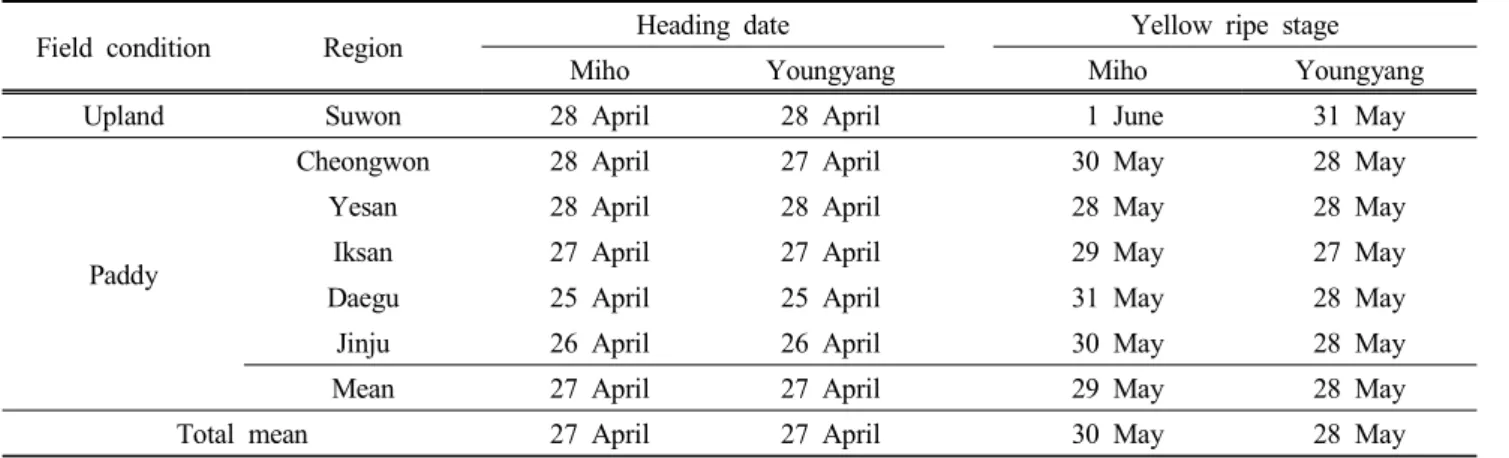
‘미호’의 출수기는 전작에서 4월 28일, 답리작에서는 4월 27일로 표준품종인 ‘영양’ 보리와 같았다. 지역별로는 수 원, 청원, 예산 등 경기 및 충청지역이 남부지역인 익산, 대구, 진주에 비해 출수기가 약 2∼3일 늦은 경향이었다.
청보리 수확기인 황숙기는 전작에서 6월 1일로 ‘영양’보다 1일 늦었고, 답리작에서도 5월 29일로 1일 늦었다. 지역별 로는 예산이 5월 28일로 가장 빨랐다 (Table 3).
3. 내재해성 및 내병성
‘미호’의 내재해성과 내병성은 Table 4와 같다. ‘미호’의
내한성은 고휴재배 시 고사주율이 33.3%로 ‘영양’(67.4%)
에 비해 강하였으며, 도복정도는 1로 강하였다. 보리호위
축병은 익산(Ⅲ)에서 중도저항성, 나주(Ⅰ), 진주(Ⅳ)에서는
저항성을 보였다. 그러나 흰가루병은 감수성을 나타내어
향후 개선이 필요한 특성으로 판단되었다.
Table 5. Forage dry matter yield of ‘Miho’ in the advanced yield trial
(AYT
z, ’10 ∼’11) Cultivar Dry matter yield
(MT ha
-1)
Index (a/b×100)
Miho (a) 10.8 108
Youngyang (b) 10.0 100
zAYT : Advanced yield trial.
Table 3. Heading and maturing dates of the cultivar ‘Miho’
(RYT
z, ’12∼’14) Field condition Region Heading date Yellow ripe stage
Miho Youngyang Miho Youngyang
Upland Suwon 28 April 28 April 1 June 31 May
Paddy
Cheongwon 28 April 27 April 30 May 28 May Yesan 28 April 28 April 28 May 28 May Iksan 27 April 27 April 29 May 27 May Daegu 25 April 25 April 31 May 28 May Jinju 26 April 26 April 30 May 28 May Mean 27 April 27 April 29 May 28 May Total mean 27 April 27 April 30 May 28 May
zRYT : Regional yield trial.
Table 4. Winter hardiness, lodging and disease resistance of the cultivar ‘Miho’
(RYT
z, ’12∼14)
Cultivar
Winter killing rate
y(%)
Degree of lodging
(0-9)
XPowdery mildew BaYMV
v(0-9) Infection
type
Infection degree
(0∼9) Iksan
(Ⅲ) Naju
(Ⅰ) Jinju (Ⅳ)
Miho 33.3 1 Susceptible 6 2 0 0
Youngyang 67.4 1 Susceptible 5 2 0 1
zRYT : Regional yield trial.
xRating score: 0 = excellent or strong, 9 = worst or weak.
yData tested at Yeoncheon.
vBarley yellow mosaic virus.
4. 조사료 생산성
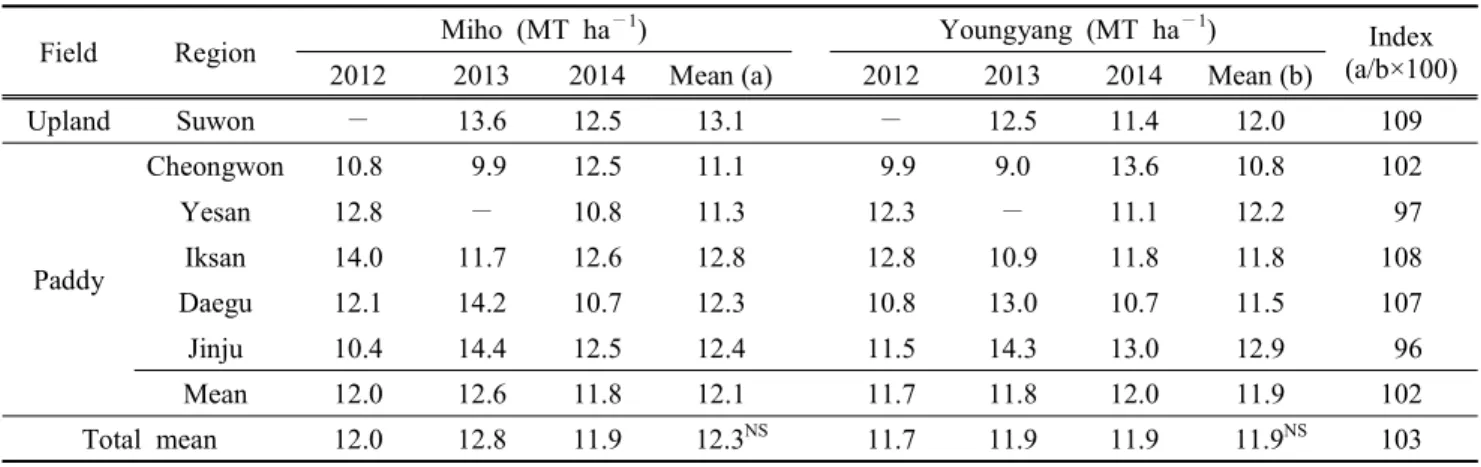
생산력 검정시험에서 ‘미호’의 건물수량은 Table 5에서 보는 바와 같이 10.8 톤/ha으로 대비품종인 ‘영양’ (10.0톤 /ha) 에 비하여 8% 증수하였다. 3년간 실시한 지역적응시 험에서는 수원 전작 1개소와 답리작인 청원, 예산, 익산, 대구, 진주 등 5개소의 평균 건물수량은 Table 6과 같이 전작에서는 평균 13.1톤/ha로 표준품종인 ‘영양’ (12.0톤 /ha) 에 비해 9%, 답리작에서는 평균 12.1톤/ha로 ‘영양’
(11.9톤/ha)에 비해 2% 정도 많았으나 통계적인 유의성은 없었다.
5. 사료가치
‘ 미호’의 조사료 품질특성은 Table 7과 같다. 조단백질 함량은 6.8%로서 표준품종인 ‘영양’에 비해 낮았고, ADF 와 NDF 함량은 각각 27.1%, 49.4%로 ‘영양’에 비해 다소 높았다. TDN 함량은 67.5%로 두 품종간 통계적인 유의성 은 없었다. TDN 수량은 8.3톤/ha로 ‘영양’보리와 대등하였 다. 사일리지 품질은 2등급으로 양호한 발효양상을 보였다.
6. 적응지역 및 재배상의 유의점
‘미호’의 적응지역은 1월 최저 평균기온 -8℃ 이상인 지
Table 6. Forage yield of the cultivar ‘Miho’ in the regional yield trials (RYT) tested in the six locations
(RYT
z, ’12 ∼’14) Field Region Miho (MT ha
-1) Youngyang (MT ha
-1) Index
(a/b×100) 2012 2013 2014 Mean (a) 2012 2013 2014 Mean (b)
Upland Suwon - 13.6 12.5 13.1 - 12.5 11.4 12.0 109
Paddy
Cheongwon 10.8 9.9 12.5 11.1 9.9 9.0 13.6 10.8 102
Yesan 12.8 - 10.8 11.3 12.3 - 11.1 12.2 97
Iksan 14.0 11.7 12.6 12.8 12.8 10.9 11.8 11.8 108 Daegu 12.1 14.2 10.7 12.3 10.8 13.0 10.7 11.5 107 Jinju 10.4 14.4 12.5 12.4 11.5 14.3 13.0 12.9 96 Mean 12.0 12.6 11.8 12.1 11.7 11.8 12.0 11.9 102 Total mean 12.0 12.8 11.9 12.3
NS11.7 11.9 11.9 11.9
NS103
zRYT : Regional yield trial.
- No data.
* Dry metter yield is significantly not different between cultivar ‘Miho’ and ‘Youngyang’ by t-test.
Table 7. Forage quality of the cultivar ‘Miho’ at early yellow ripe stage
(RYT
z, ’12 ∼’14) Cultivar Crude protein
(%)
ADF
y(%)
NDF
x(%)
TDN
w(%)
TDN Yield (MT ha
-1)
Silage Quality
v(1 ∼5)
Mihoi 6.8 27.1 49.4 67.5 8.3 2
Youngyang 7.4 24.6 47.0 69.5 8.3 2
zRYT : Regional yield trial.
yADF : acid detergent fiber, xNDF : neutral detergent fiber, wTDN : total digestible nutrients
vTested by Flieg’s score : 1(superior, above 81), 2(good, 61∼80), 3(common, 41∼60), 4(no good, 21∼40), 5(very bad, under 20).
역으로 중북부 산간내륙지방을 제외한 남한 전국이다. 비 교적 흰가루병에 약하므로 상습발병지에서는 재배를 피하 고 만파 시에는 파종량을 늘려서 파종하는 것이 유리하다.
Ⅳ. 요 약
청보리 신품종 ‘미호’는 까락에 거치가 적은 반매끈망으 로 부드럽고 엽신비율이 높으며, 내한성에 강하고 경수가 많은 다얼성으로 총체 건물수량이 높은 품종이다. 이 품종 은 2001년에 ‘SB00T2040’을 모본으로 하고, ‘SB941003’을 부본으로 인공교배하여 육성선발된 ‘익산 473호’를 2012년 부터 2014년까지 전국 6개소에서 지역적응시험을 거쳐 2014 년에 육성되었다. ‘미호’는 직립초형이고 파성이 Ⅲ 정 도이며, 잎은 녹색이고 옆폭은 중간 정도이다. 엽이에는 색 소 침착이 없고, 까락특성은 거치가 적은 반매끈망이다. 초 장은 96 cm로 장간 품종에 속하고, ㎡당 경수는 650개로서
‘ 영양’의 593개 보다 57개가 많은 다얼성이다. 출수기는 전 작에서 4월 28일, 답리작에서는 4월 27일로 표준품종인
‘ 영양’보리와 같았고, 황숙기는 전작에서 6월 1일로 ‘영양’
보다 1일 늦었고, 답리작에서도 5월 29일로 1일 늦었다.
‘ 미호’는 영양보다 내한성이 강하였고, 흰가루병에는 감수 성을 나타내었지만 보리호위축병은 익산(Ⅲ)에서 중도저항 성, 나주(Ⅰ), 진주(Ⅳ)에서는 저항성을 보였다. 건물수량은 전작에서 평균 13.1톤/ha, 답리작에서 평균 12.1톤/ha으로
‘영양’에 비하여 각각 9%, 2% 증수하였다. 조사료 품질은 조단백질 함량은 6.8%로 ‘영양’에 비해 낮았고, ADF와 NDF 함량은 각각 27.1%, 49.4%로 ‘영양’에 비해 다소 높 았으나, TDN 수량은 8.3톤/ha로 ‘영양’보리와 대등하였다.
사일리지 품질은 2등급으로 양호한 발효양상을 보였다.
Ⅴ. 사 사
본 논문은 농촌진흥청 연구사업 (세부과제명: 양질 다수
성 청보리 신품종 개발, 세부과제번호 : PJ00919601)의 지
원에 의하여 수행되었으며, 본 품종 육성에 협력하여 주신
농촌진흥청 연구정책국 및 각도 농업기술원 관계관께 깊은
감사를 드립니다.
Ⅵ. REFERENCES
AOAC. 1995. Official method of analysis (15th ed.) Association &
Official Analytical Chemists, Washington DC.
Choi, G.J., Kim, W.H. and Seo, S. 2008. Production and utilization of winter forage crops in Korea. 2008. Proceedings of the Korean Society of Grassland Science Conference, The Korean Society of Grassland and Forage Science. pp. 19-48.
Choi, J.S., Kim, J.G., Baek, S.B., Park, K.H., Kwon, Y.U., Park, H.H., Kang, M.S., Park, T.I., Heo, H.Y., Seo, J.H., Cheong, Y.K., Sung, B.R., Kim, J.G., Lee, J.J., Kim, S.J., Ryu, I.M., Ju, J.I. Kim, D.H., Jung, K.Y. and Lee, S.H. 2007a. A new early maturing and high yielding barley cultivar “Soman” for whole crop barley. Korean Journal of Breeding Science. 39(2):240-241.
Choi, J.S., Kim, J.G., Baek, S.B., Park, K.H., Kwon, Y.U., Park, H.H., Kang, M.S., Park, T.I., Heo, H.Y., Seo, J.H., Cheong, Y.K., Sung, B.R., Kim, J.G., Lee, J.J., Kim, S.J., Ryu, I.M., Ju, J.I., Kim, D.H., Jung, K.Y. and Lee, S.H. 2007b. A ruminant palatable hood type barley cultivar “Yuyeon” for whole- cropforage use. Korean Journal of Breeding Science. 39(2):242- 243.
Goering, H.K. and Van Soest. P.J. 1970. Forage fiber analysis. Agic.
Handbook 379, U.S. Gov. Print. Office Washington, DC.
Holland, C., Kezar, W., Kautz, W.P., Lazowski, E.J., Mahanna, W.C.
and Reinhart, R. 1990. Pioneer Hi-Bred International, Inc., Des moines, IA.
Kim, J.G., Choi, J.S., Park, H.H., Baek, S.B., Kang, M.S., Park, K.H., Kwon, Y.U. Heo, H.Y., Seo, S.J., Nam, J.H., Lee, J.J., Cheong, Y.K., Sung, B.R., Kim, J.G., Ryu, I.M., Ju, J.I., Kim, D.H., Jung, K.Y. and Lee, S.H. 2007. A new smooth awn barley cultivar, “Wooho” suitable for whole crop forage use. Korean Journal of Breeding Science. 39(2):238-239.
Kim, W.H. and Seo, S. 2006. Cultivation and utilization of barley as the main winter crop in paddy field. Proceedings of the Korean Society of Grassland Science Conference, The Korean Society of Grassland and Forage Science. pp. 37-57.
Kim. W.H., Seo, S., Lim, Y.C., Shine, J.S., Sung, B.R., Ji, H.C., Lee, S.J. and Park, T.I. 2007. Selection of promising barley cultivar for silage at paddy field of Honam region. Journal of the Korean Society of Grassland and Forage Science. 27(3):161- 166.
National Institute of Crop Science, Rural Development Administration (RDA). 2010. Task performance plan for test research business.
pp. 45-54.
Oh, Y.J., Park, T.I., Han, O.K., Pakr, H.H., Cho, S.K., Park, J.C., Choi, J.S., Kim, Y.K., Song, T.H., Kim K.H., Choi, I.B., Kang, H.J., Noh, J.H., Kim, W.H., Jeung, J.H., Hong, K.H., Bae, J.S., Heo, J.Y., Jang, Y.W., Park, K.G. and Pakr, K.H. 2014. A new auricleless barley (Hordeum vulgare L.) cultivar ‘Jomi’ for whole crop forage. Korean Journal of Breeding Science. 46(4):470-475.
Park T.I., Seo J.H., Han O.K., Kim K.Y., Park K.H., Oh Y.J., Choi J.S., Park J.C., Park H.H., Kim H.S., Kim J.G., Song T.H., Kim W.H., Park N.G., Jung J.H., Ju J.I., Kim S.Y. and Kim D.H.
2011. “Youho” A new forage barley cultivar with ruminant- palatable hood spike and non-scatteredness. Korean Journal of Breeding Science. 43(3):190-195.
Park, T.I., Han, O.K., Seo, J.H., Choi, J.S. Park, K.H. and Kim, J.G.
2008. New barley cultivars with improved morphological characteristics for whole crop in Korea. Journal of the Korean Society of Grassland and Forage Science. 28(3):193-202.
Park, T.I., Oh, Y.J., Park, H.H., Park J.C., Cho, S.K., Noh, J.H., Kim, D.W., Song, T.H., Chae, H.S., Jeung, J.H., Hong, K.H., Bae, J.S., Huh, J.Y., Ku, J.H., Park, K.H. and Han, O.K. 2015a.
‘Nokyang’, whole crop forage barley cultivar with the stay-green character, resistance to viral disease and high-yielding. Journal of the Korean Society of Grassland and Forage Science. 35(1):57- 62.
Park, T.I., Oh, Y.J., Park, H.H., Park J.C., Cho, S.K., Noh, J.H., Kim, D.W., Song, T.H., Chae, H.S., Jeung, J.H., Hong, K.H., Bae, J.S., Huh, J.Y., Jang, Y.W., Kim, K.J., Park, K.H. and Han, O.K. 2015b. “Youhan”, new whole crop barley cultivar of hooded spike and fine growth ability in spring. Journal of the Korean Society of Grassland and Forage Science. 35(2):81-86.
Park, T.I., Seo, J.H., Han, O.K., Choi, J.S., Kim, J.G., Park, J.C., Kim, H.S., Heo, H.Y., Baek, S.B., Kwon, Y.U., Park, H.H., Kang, M.S., Park, K.G. and Suh, S.J. 2009. A new auricleless barley cultivar “Dami” for whole crop forage. Korean Journal of Breeding Science. 41(3):349-353.
SAS. 2002. SAS system Releas 9.1, SAS Institute Inc., Cary, NC.
Seo, S., Kim, W.H., Kim, J.G., Choi, G.J., Ko, J.M. and Lim, S.G.
2007. Selection of promising forage crops and variety for forage production in paddy field. 3. Yeongnam region. Journal of the Korean Society of Grassland and Forage Science. 27(2):85-92.
(Received October 6, 2016 / Revised October 17, 2016 / Accepted October 17, 2016)