559
The Effect of Alpha Lipoic Acid(Thioctacid HR
®) on
Endothelial Function in Diabetic and Hypertensive Patients
Sang Rok Lee, MD, Myung Ho Jeong, MD, Sang Yup Lim, MD, Seo Na Hong, MD, Kye Hun Kim, MD, Il Suk Sohn, MD, Young Joon Hong, MD, Hyung Wook Park, MD, Ju Han Kim, MD, Weon Kim, MD, Young Keun Ahn, MD,
Jeong Gwan Cho, MD, Jong Chun Park, MD and Jung Chaee Kang, MD
The Heart Center of Chonnam National University Hospital, Chonnam National University Research Institute of Medical Sciences, Gwangju, Korea
ABSTRACT
Background and Objectives:α-Lipoic acid (ALA) is known to improve endothelial function in patients with diabetes. However, the effect of ALA on endothelial function in hypertensive patients is unknown. The aim of this study was to investigate whether ALA improves endothelial function in diabetic and hypertensive patients.
Subjects and Methods:This study included 40 patients who were treated with ALA (Group I: 20 diabetic patients, 54.9±10.2 years, Group II: 20 hypertensive patients, 56.5±9.0 years). ALA was administered in 600 mg/day doses during the first four weeks, and 1,200 mg/day doses during the second four weeks. Clinical char- acteristics and endothelial function were assessed at baseline, 4 weeks and 8 weeks after ALA administration.
Evaluation of patients included: assessment of the brachial artery for flow mediated vasodilation (FMD) and the inflammatory marker (high sensitive CRP: hsCRP). Results:Clinical characteristics (body mass index, total cholesterol/HDL-cholesterol and hsCRP) were unchanged in each group. However, FMD was significantly improved at 8 weeks after ALA therapy in both groups. Group I-baseline:4 weeks:8 weeks=4.1±3.3:6.5±2.2:8.0±
2.7, Group II-baseline:4 weeks:8 weeks=5.5±3.7:7.4±3.3:9.3±2.7, p<0.05. The level of fibrinogen was observed to have an inverse correlation with FMD at 8 weeks after ALA therapy in Group I (p<0.05). Conclusion:
ALA improves endothelial function in both diabetic and hypertensive patients. (Korean Circulation J 2006;
36:559-564)
KEY WORDS:Alpha lipoic acid;Hypertension.
Introduction
There is growing evidence that oxidative stress plays an important role in the development and progression of cardiovascular disease.1)2) Moreover oxidative stress has been thought to contribute to the development of complications in both diabetes and hypertension.3) Co- mmon conditions predisposing to atherosclerosis such as hyperlipidemia, hypertension, diabetes and smoking are closely related to the development of endothelial dysfunction.4-8) Endothelial function has been evaluated
by endothelium-dependent vasomotion, partially based on the assumption that endothelium-derived nitric ox- ide(NO) has a pivotal role in anti-inflammatory and antithrombotic activity. A common mechanism under- lying endothelial dysfunction has been associated with increased vascular production of reactive oxygen species (ROS), and indirectly associated with inflammation.
Alpha-lipoic acid(ALA) is a thiol antioxidant com- pound that has direct free- radical scavenging properties, and has been shown to benefit vascular and endothelial function.9-12) In many studies, ALA treatment has been shown to improve diabetic-induced endothelial dysfun- ction, probably due to the antioxidant effect of ALA.13)14) However, the effect of ALA treatment in patients with hypertension associated endothelial dysfunction is unk- nown.
The purpose of this study was to investigate whether ALA can improve endothelial vasomotor function and
Received:September 6, 2005 Revision Received:November 7, 2005 Accepted:November 11, 2005
Correspondence:Myung Ho Jeong, MD.The Heart Center of Chonnam National University Hospital, Chonnam National University Research Institute of Medical Sciences, 8 Hak-dong, Dong-gu, Gwangju 501-757, Korea Tel: 82-62-220-6243, Fax: 82-62-228-7174
E-mail: [email protected]
inflammation in hypertensive patients, as it does in di- abetic patients.
Subjects and Methods
SubjectsThe study population included men and postmeno- pausal women who had been diagnosed with type 2 diabetes(group I, n=20) and newly diagnosed with hypertension(group II, n=20). Patients who had a pr- ior history of coronary artery disease, significant valvular heart disease, congestive heart failure, severe hepatic or renal disease, malignancy, nutritional deficiency, mood disorder and psychosis, stage III hypertension, and overt proteinuria were excluded. All patients gave their writ- ten informed consent to participate, and the protocol was approved by the Chonnam National University Hos- pital Institutional Review Board.
Experiment protocol
Although discussion continues about the therapeutic dosage, doses of ALA range from 200 to 1,800 mg/day15); all subjects were prospectively studied at baseline, and after the first 4-weeks of ALA oral administration (qd thioctacid HR® 600 mg/day, Bukwang, Korea), and after the second 4-weeks oral ALA administration(qd thioctacid HR® 1,200 mg/day, Bukwang, Korea). Pat- ients were educated to fast overnight, to abstain from smoking, alcohol and caffeine and to hold vasoactive medication(angiotensin converting enzyme inhibitor, angiotensin receptor blocker, and other antioxidant) at least 1 week. During the study period, the oral hypogly- cemic agent(glibenclamide) was maintained in patients in group I and thiazide was maintained in group II patients. Simvastatin was continued in some patients during the study period as well[group I: 8(40%), group II: 2(10%)]. The presence or absence of the following cardiovascular risk factors were assessed in each subject:
hypertension(systolic blood pressure >140 mmHg/dia- stolic blood pressure >90 mmHg), hypercholestero- lemia(total serum cholesterol >240 mg/dL), diabetes mellitus(treated with an oral hypoglycemic agent, or having a fasting glucose level >126 mg/dL), family his- tory of coronary artery disease(first- or second-degree relatives with premature cardiovascular disease), and a history of smoking(having smoked >5 cigarettes per day within the last month). The baseline clinical parameters (such as body mass index and waist circumference) and laboratory parameters(such as lipid profiles, highly sen- sitive C-reactive protein, and microalbuminuria), which represents inflammation were also examined.
Endothelial function test
Brachial artery ultrasound testing, for evaluation of peripheral endothelium function, was performed fol-
lowing a protocol similar to that described by Celer- majer at al.16) Longitudinal brachial artery images were obtained with a high-resolution(10 MHz) linear-array vascular transducer(Phillips, ATL Ultramark HDI 5000®, Netherlands). Subjects were studied during the morning hours, after more than 8 hours fasting, under quiet con- ditions while they were in the supine position. After a 10 minute resting period, baseline two-dimensional images of the right brachial artery were analyzed ap- proximately 2 cm above the antecubital fossa. A blood pressure cuff placed proximal to the imaging transducer on the upper arm was inflated to at least 50 mmHg above systolic pressure for 5 minutes. The vessel was monitored continuously for 1 minute after deflation of the cuff, and reactive hyperemia was confirmed by a pulse-wave Doppler study. After an additional 10 mi- nutes of resting, subjects were given sublingual nitro- glycerin(600-μg tablet).
Endothelium-dependent vasomotion(EDV) was ex- pressed as percent flow mediated dilation(FMD) which was defined as the maximal brachial artery diameter after 60 sec of reactive hyperemia compared with the baseline vessel diameter. Endothelium-independent vasodilation was expressed as percent nitroglycerin-mediated dilation (NMD) which was defined as the maximal brachial ar- tery diameter 5 minutes after administration of nitro- glycerin compared with the baseline vessel diameter.
Brachial artery measurements were performed with ultra- sonic calipers by independent observers.
According to our hospital data, the interobserver and intraobserver variability were 1.5±0.3% and 1.3±0.5%, respectively.
Statistical analysis
Statistical analysis was performed using SPSS for win- dows, version 12.0(Chicago, Illinois, USA). Data are expressed as mean±SEM. Independent t test and Pea- rson correlation were performed to demonstrate asso- ciation with FMD. Clinical characteristics, laboratory finding and endothelial function were studied(baseline, 4 weeks and 8 weeks). We compared baseline variables with 4 and 8 week data , respectively. For all analyses, a p<0.05 was considered statistically significant.
Results
Baseline characteristicsTwenty patients in Group I: 16 men, 4 women, 54.9±
10.2 years and twenty patients in Group II: 15 men, 5 women, 56.5±9.0 years were enrolled, and completed the 8-week study. Characteristics of the study population are listed in Table 1. There were no significant differe- nces in the baseline characteristics of group I and group II, except for the blood glucose level.
Changes in clinical and laboratory variables after ALA administration
There were no significant interval changes after ALA administration in either group I or group II(Table 2, 3) except for the fibrinogen level. The fibrinogen level decreased in group 1 after the second 4-week 1200 mg ALA therapy(p=0.005).
Endothelial function test
In group I, there were no significant differences in
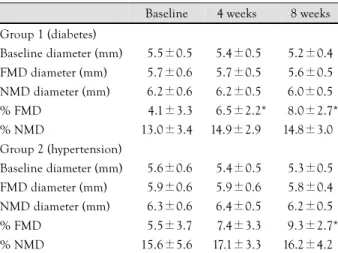
baseline, FMD and NMD diameters. However, when comparing the baseline percent FMD, there were sta- tistical differences in both the 4-week(p=0.01) and the 8-week percent FMD(p=0.001). In group II, there were no differences in the baseline, FMD and NMD diameters.
However, when comparing the baseline percent FMD, there were statistical differences in the 8-week percent FMD(p=0.001) without differences in the 4-week pe- rcent FMD(p= 0.09)(Table 4).
Relationship between fibrinogen and FMD
There was no correlation between fibrinogen and FMD in group II. However, there was negative correl- ation between fibrinogen and FMD in group I. Dec- reased fibrinogen levels were associated with an increased percent of FMD(Fig. 1).
Table 1. Baseline clinical characteristics of both diabetic patients (gr- oup I) and hypertensive patients (group II)
Group I (n=20) Group II (n=20)
Age (years) .54.9±10.2 56.5±9.00.
Male (%) 16 (80) 15 (75)
Hyperlipidemia (%) 13 (15) 15 (25) Premature CAD (%) 13 (15) 15 (25)
Smoking (%) 15 (25) 16 (30)
Blood sugar (mg/dL) 150.5±30.5. 100.4±13.4*.
Body weight (kg) 69.1±8.7. 67.0±9.00
BMI (kg/m2) 24.9±2.5. 25.5±3.70
WC (cm) 91.0±6.0. 89.7±8.50
TC (mg/dL) 184.6±47.31 188.0±37.80
HDL (mg/dL) .38.8±12.7 41.1±10.8.
LDL (mg/dL) 121.4±34.5. 135.1±27.50
TG (mg/dL) 204.0±147.4 186.9±125.8.
TC/HDL .5.1±1.5 4.9±1.51
Fibrinogen (mg/dL) 349.6±74.7. 313.1±63.60
hsCRP (mg/dL) .1.3±1.9 1.8±1.6.
Microalbuminuria (μg/mL) .42.8±44.8 25.8±20.4.
*: p<0.05. There were no statistical differences between group I and group II. BMI: body mass index, WC: waist circumference, TC: total cholesterol, HDL: high density lipoprotein, LDL: low density lipo- protein, TG: triglyceride, hsCRP: high sensitivity C-reactive protein, CAD: coronary artery disease
Table 2. Changes in clinical and laboratory variables of diabetic pat- ients afterα-lipoic acid administration
Baseline 4 weeks 8 weeks
Blood sugar (mg/dL)
150.5±30.5. 140.0±40.01 138.5±47.90 Body weight (kg) 69.1±8.71. 68.4±9.40 67.9±9.80.
BMI (kg/m2) 24.9±2.5. 24.7±2.71 24.5±2.80 WC (cm) 91.0±6.0. 90.1±5.81 89.1±6.20 TC (mg/dL) 184.6±47.31 199.3±55.41 196.6±52.60 HDL (mg/dL) .38.8±12.7 38.6±11.3. 35.8±9.20 LDL (mg/dL) 121.4±34.5. 130.2±52.01 131.5±48.70 TG (mg/dL) 204.0±147.4 228.3±124.8. 174.0±103.9
TC/HDL .5.1±1.5 5.5±1.7 5.7±1.7.
Fibrinogen (mg/dL) 349.6±74.71 330.9±118.5. 285.3±60.7*.
hsCRP (mg/dL) .1.3±1.9 .1.6±3.0 .1.3±2.2 Microalbuminuria
(μg/ml)
.42.8±44.8 48.1±41.8 41.6±37.2.
*: p<0.05. BMI: body mass index, WC: waist circumference, TC:
total cholesterol, HDL: high density lipoprotein, LDL: low density lip- oprotein, TG: triglyceride, hsCRP: high sensitivity C-reactive protein
Table 3. Changes in clinical and laboratory variables of hypertensive patients afterα-lipoic acid administration
Baseline 4 weeks 8 weeks Blood sugar
(mg/dL)
100.4±13.40 98.4±12.1. 108.2±15.1 Body weight (kg) 67.0±9.00 67.3±9.51 066.7±9.5 BMI (kg/m2) 25.5±3.70 25.6±3.81 025.5±3.8 WC (cm) 89.7±8.50 89.0±9.00 188.5±8.9 TC (mg/dL) 188.0±37.80 204.7±23.01 195.3±31.5 HDL (mg/dL) .41.1±10.8 40.5±8.20 038.4±9.5 LDL (mg/dL) 135.1±27.51 135.4±27.30 135.8±35.4 TG (mg/dL) 186.9±125.8 195.3±207.9 .147.1±104.3
TC/HDL 4.9±1.5. 5.2±1.0 005.3±1.2.
Fibrinogen (mg/dl) 313.1±63.6. 301.8±58.51 288.5±73.2 hsCRP (mg/dL) 1.8±1.6 .1.1±1.0 001.3±1.5 Microalbuminuria
(μg/ml)
25.8±20.4 23.7±22.8 028.2±26.2 There were no statistical differences in both the 4 and 8 week groups.
BMI: body mass index, WC: waist circumference, TC: total chole- sterol, HDL: high density lipoprotein, LDL: low density lipoprotein, TG: triglyceride, hsCRP: high sensitivity C-reactive protein
Table 4. Effect ofα-lipoic acid on both flow-mediated vasodilation and nitroglycerin-mediated vasodilation
Baseline 4 weeks 8 weeks Group 1 (diabetes)
Baseline diameter (mm) 15.5±0.5 .5.4±0.5 15.2±0.4 FMD diameter (mm) 15.7±0.6 .5.7±0.5 15.6±0.5 NMD diameter (mm) 16.2±0.6 .6.2±0.5 16.0±0.5
% FMD 14.1±3.3 06.5±2.2* 18.0±2.7*
% NMD 13.0±3.4 14.9±2.9. 14.8±3.0
Group 2 (hypertension)
Baseline diameter (mm) 15.6±0.6 .5.4±0.5 05.3±0.5 FMD diameter (mm) 15.9±0.6 .5.9±0.6 15.8±0.4 NMD diameter (mm) 16.3±0.6 16.4±0.5 16.2±0.5
% FMD 15.5±3.7 17.4±3.3 19.3±2.7*
% NMD 15.6±5.6 17.1±3.3 16.2±4.2
*: p<0.05. FMD: flow-mediated vasodilation, NMD: nitroglycerin- mediated vasodilation
Discussion
Healthy endothelium plays a crucial role in regulating vascular tone and structure. An additional role of endo- thelium is not only mediation of endothelium dependent vasodilation, but also active suppression of thrombosis and vascular inflammation. Nitric oxide is a particul- arly important mediator of both endothelium-dependent vasodilation and anti-inflammatory and antithrombotic effects of endothelium. Endothelium dependent vaso- motion is therefore thought to represent other impor- tant functions of endothelium.17)
Common conditions predisposing to atherosclerosis have endothelial dysfunction; also considered a marker for atherosclerotic disease even in patients with cardi- ovascular disease.
The fact that many cardiovascular risk factors are present long before the development of diabetes has led to increasing support for the ‘common ground’
hypothesis in which type 2 diabetes and cardiovascular disease share common genetic and environmental ant- ecedents.18) The available data suggest that the decreased nitric oxide bioactivity in type 2 diabetic patients may be the result of nitric oxide breakdown associated with increased generation of ROS(reactive oxygen species) by a variety of causes.19-21) In addition, hyperglycemia itself directly promotes endothelial dysfunction by over- production of superoxide, depleting NAD+, decreasing glycolysis and ATP formation. These products produce acute endothelial dysfunction in diabetic blood vessels, and contribute to the development of diabetic compli- cations.
Recently, efforts to improve endothelial dysfunction associated with hypertension have been pursued inclu- ding both pharmacological and non-pharmacological therapies.3)22-25) In some experiments, ALA prevents deve- lopment of hypertension and hyperglycemia.26) Physical exercise, calcium channel blockers such as a dihydro- pyridine like agents, ACE inhibitors and angiotensin II receptor blockers have been found to be effective.
However, to date clinical studies evaluating efficacy of ALA in hypertensive patients are limited.
Lipoic acid has been used as a therapy for many clinical disorders, especially diabetes.13) There are many reports demonstrating the improvement of endothelial dysfunction in diabetic patients in a dose-dependent manner. Lipoic acid supplementation has been reported to increase the unbound lipoic acid level, which can act as a potent antioxidant and reduce oxidative stress;27) it is commonly marketed as an adjunct for the treatment of diabetic neuropathy. Lipoic acid is readily converted to its reduced form in various tissues, which increases intracellular levels of coenzyme NADPH, and NADH via increased glutathione availability. Lipoic acid also acts as a scavenger of several free radicals, including hydroxyl radicals and singlet oxygen and increases nitric oxide bioactivity.28)
Because endothelial dysfunction is not specific to either diabetes or hypertension, but is rather a common marker of all major cardiovascular risk factors, we th- ought that improvement of endothelial function after ALA therapy in hypertension patients would be likely.
We found that there was an improvement of endothelial function after both a regular dosage(ALA 600 mg/day for first 4-week) and after high dosage(ALA 1,200 mg/
day for second 4-week) in diabetic patients. However, improvement of endothelial dysfunction in hyperten- sive patients was different. Significant improvement of endothelial function occurred not after a regular dosage (ALA 600 mg for first 4 weeks) but only after high dosage(ALA 1,200 mg for second 4 weeks). There are two possible explanations for this difference in response to ALA therapy in diabetic and hypertensive patients.
First, although both diabetes and hypertension are con- ditions with increased oxidative stress, the direct effect of hyperglycemia on the vascular endothelium was do- minant in diabetics. This effect might produce a more severe endothelial dysfunction at baseline in diabetic patients; therefore, the endothelial dysfunction was im- proved via the hypoglycemic effect of regular dose ALA.
20.00 15.00 10.00 5.00 0.00
FMD
500.00 400.00 300.00 200.00
Fibrinogen R=-0.038, p>0.05
A
20.00 15.00
5.00 0.00
FMD
500.00 400.00 300.00 200.00
Fibrinogen R=- 0.141, p=0.02
10.00
B
Fig. 1. Relationship between fibrinogen and flow-mediated vasodilation (FMD) in both diabetes (A) and hypertensives (B). There was a negative correlation between fibrinogen and FMD in diabetic patients (p=0.02). There was no correlation between fibrinogen and FMD in hypertensive patients (p=NS).
We can explain the cause of the improvement of endo- thelial function, at lower dosage of ALA in diabetics, as a result of the hypoglycemic effect of ALA therapy.
Second, the level of fibrinogen was decreased signifi- cantly by high dose ALA in diabetic patients. In another report, ALA was associated with a significant decrease of fibrinogen, factor VII, vWF, and triglycerides in dia- betes.29) An inverse correlation between fibrinogen and endothelial function, after ALA therapy in our study, was related to the possible antithromotic effects of ALA in diabetic patients rather than anti-inflammatory effects.
Our results showed no change of hsCRP after ALA administration in either diabetic or hypertensive patients, as previously reported;30) therefore, this suggested a pos- sible antithrombotic effect of ALA.
There are several limitations in our study. First, our study had a small study population(n=40), and the study period was short(8 weeks) to determine the po- tential mechanisms by which ALA may be effective. It is possible that further differences might have been noted if the study had been extended for a longer duration or, conversely, that some of the effects may have been attenuated over time. Second, it is important to note that we could not discontinue the administration of some medications such as simvastatin, glibenclamide, and thiazide. The concomitant use of these agents might alter the effects of ALA on our study outcomes. Third, our study had no placebo group for comparison to the diabetes and hypertension groups. Fourth, in terms of other confounding vasoactive medications(angiotensin converting enzyme inhibitor, angiotensin receptor bloc- ker and other antioxidant), the washout period in our study was relatively short.
Conclusion
This study demonstrated that ALA improves endo- thelial function in diabetic and hypertensive patients.
Even though the percent FMD, in the hypertensive pa- tients, improved significantly at a high dose but not at a regular dose of ALA, this study showed the possi- bility of improvement of endothelial function in hyper- tension after treatment with ALA. The mechanism by which this is achieved remains to be further clarified.
Additional studies with a prospective, random, placebo controlled study design are now needed to determine the therapeutic parameters for ALA treatment of hyper- tensive patients.
This study was supported by grants from the Cardiovascular Res- earch Foundation Asia and from the Clinical Research Institute of Chonnam National University Hospital.
REFERENCES
1) Schachinger V, Britten MB, Zeiher AM. Prognostic impact of coronary vasodilator dysfunction on adverse long-term outcome
of coronary heart disease. Circulation 2000;101:1899-906.
2) Suwaidi JA, Hamasaki S, Higano ST, Nishimura RA, Holmes DR Jr, Lerman A. Long-term follow-up of patients with mild coronary artery disease and endothelial dysfunction. Circulation 2000;101:948-54.
3) Brunner H, Cockcroft JR, Deanfield J, et al. Endothelial fun- ction and dysfunction: part II. association with cardiovascular risk factors and diseases. J Hypertens 2005;23:233-46.
4) Landmesser U, Hornig B, Drexler H. Endothelial function: a critical determinant in atherosclerosis? Circulation 2004;109 (Supple 1):II27-33.
5) Yoon HJ, Bae JH, Kim JK, et al. Age, gender, and number of atherosclerotic risk factors are the independent factor of end- othelial dysfunction in patients with coronary atherosclerosis.
Korean Circ J 2005;35:302-8.
6) Park CS, Youn HJ, Ihm SH, et al. Relation between peripheral vascular endothelial function and coronary flow reserve in pat- ients with chest pain and normal coronary angiogram. Korean Circ J 2004;34:485-91.
7) Park TJ, Seo BG, Choi DJ, et al. Effect of hypercholesterolemia and age on endothelial function in women. Korean Circ J 2002;
32:549-55.
8) Park KR, Bae JH. Comparison of the endothelial function between healthy subjects and patients with coronary artery disease or risk factors of atherosclerosis. Korean Circ J 2001;31:544-50.
9) Packer L, Witt EH, Tritschler HJ. Alpha-lipoic acid as a bio- logical antioxidant. Free Radic Biol Med 1995;19:227-50.
10) Packer L, Roy S, Sen CK. Alpha-lipoic acid: a metabolic anti- oxidant and potential redox modulator of transcription. Adv Pharmacol 1997;38:79-101.
11) Evans JL, Goldfine ID, Maddux BA, Grodsky GM. Oxidative stress and stress-activated signaling pathways: a unifying hyp- othesis of type 2 diabetes. Endocr Rev 2002;23:599-622.
12) Visioli F, Smith A, Zhang W, Keaney JF Jr, Hagen T, Frei B.
Lipoic acid and vitamin C potentiate nitric oxide synthesis in human aortic endothelial cells independently of cellular glut- athione status. Redox Rep 2002;7:223-7.
13) Ziegler D, Hanefeld M, Ruhnau KJ, et al. Treatment of sympto- matic diabetic peripheral neuropathy with the anti-oxidant alpha- lipoic acid: a 3-week multicentre randomized controlled trial (ALADIN study). Diabetologia 1995;38:1425-33.
14) Ziegler D, Schatz H, Conrad F, Gries FA, Ulrich H, Reichel G.
Effects of treatment with the antioxidant alpha-lipoic acid on cardiac autonomic neuropathy in NIDDM patients: a 4-month randomized controlled multicenter trial(DEKAN Study). Dia- betes Care 1997;20:369-73.
15) Wollin SD, Jones PJ. Alpha lipoic acid and cardiovascular disease. J Nutr 2003;133:3327-30.
16) Celermajer DS, Sorensen KE, Gooch VM et al. Non-invasive detection of endothelial dysfunction in children and adults at risk of atherosclerosis. Lancet 1992;340:1111-5.
17) Libby P. Inflammation in atherosclerosis. Nature 2002;420:
868-74.
18) Hu FB, Stampfer MJ. Is type 2 diabetes mellitus a vascular condition? Arterioscler Thromb Vasc Biol 2003;23:1715-6.
19) Williams SB, Cusco JA, Roddy MA, Johnstone MT, Creager MA.
Impaired nitric oxide-mediated vasodilation in patients with non-insulin-dependent diabetes mellitus. J Am Coll Cardiol 1996;
27:567-74.
20) Ting HH, Timimi FK, Boles KS, Creager SJ, Ganz P, Creager MA. Vitamin C improves endothelium-dependent vasodilation in patients with non-insulin-dependent diabetes mellitus. J Clin Invest 1996;97:22-8.
21) van der Ree MA, Huisman MV, de Man FH, van der Vijver JC,
Meinders AE, Blauw GJ. Impaired endothelium-dependent va- sodilation in type 2 diabetes mellitus and the lack of effect of simvastatin. Cardiovasc Res 2001;52:299-305.
22) Kim CH, Zo JH, Kim HS, et al. Endothelium-dependent vas- odilation responses in the patients with essential hypertension.
Korean Circ J 1997;27:958-64.
23) Synn YC, Bae JH, Kim KY. Correlation between endothelial function and the extent of coronary atherosclerosis. Korean Circ J 2004;34:752-60.
24) Doo YC, Rim CY, Lee JM, et al. Endothelial dysfunction in pat- ients with essential hypertension. Korean Circ J 1996;26:483-9.
25) Son JW, Koh KK, You SM, et al. Effects of simvastatin alone or combined with ramipril on nitric oxide bioactivity and inflam- mation markers in hypercholesterolemic patients. Korean Circ J 2003;33:1053-9.
26) Midaoui AE, Elimadi A, Wu L, Haddad PS, de Champlain J. Li- poic acid prevents hypertension, hyperglycemia, and the increase
in heart mitochondrial superoxide production. Am J Hypertens 2003;16:173-9.
27) Suzuki YJ, Tsuchiya M, Packer L. Thioctic acid and dihydro- lipoic acid are novel antioxidants which interact with reactive oxygen species. Free Radic Res Commun 1991;15:255-63.
28) Biewenga GP, Haenen GR, Bast A. The pharmacology of the antioxidant lipoic acid. Gen Pharmacol 1997;29:315-31.
29) Ford I, Cotter MA, Cameron NE, Greaves M. The effects of tre- atment with alpha-lipoic acid or evening primrose oil on vascular hemostatic and lipid risk factors, blood flow, and peripheral nerve conduction in the streptozotocin-diabetic rat. Metabolism 2001;50:868-75.
30) Block G, Jensen C, Dietrich M, Norkus EP, Hudes M, Packer L.
Plasma C-reactive protein concentrations in active and passive smokers: influence of antioxidant supplementation. J Am Coll Nutr 2004;23:141-7.