Case Report
Obstet Gynecol Sci 2016;59(1):75-78 http://dx.doi.org/10.5468/ogs.2016.59.1.75 pISSN 2287-8572 · eISSN 2287-8580
www.ogscience.org 75
Introduction
Iatrogenic parasitic myomas may develop after seeding by small fibroid masses when morcellation is performed dur- ing uterine surgery. This condition is the most common late complication after laparoscopic myomectomy; the reported incidence is 0.2% to 1.2% [1,2]. Several cases have described parasitic myomas that develop after abdominal myomectomy [3]. The myomas sometimes parasitize the greater omentum.
Such cases are usually found only incidentally during surgery;
some patients exhibit nonspecific symptoms. Acute abdominal pain attributable to torsion of the pedicle of a fibroid that has parasitized the greater omentum is extremely rare as an initial presentation [4]. However, such an event may occasionally cause acute abdominal pain.
Case report
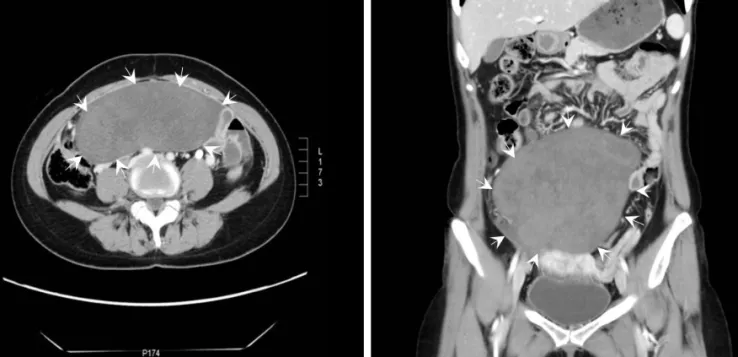
A 38-year-old woman was admitted to our emergency de- partment complaining of a 2-hour history of sudden, severe right lower abdominal pain. She appeared to be acutely ill.
The pain was both severe and progressive. Her medical history was unremarkable. She had undergone a cesarean section 17 years prior, followed by abdominal myomectomy to remove uterine fibroids 7 months prior. During myomectomy, two in- tramural myomas and one subserosal myoma were removed.
Uterine myomas were removed entirely without morcellation;
we minimized myoma tissue disruption. The abdominal cavity contained no visible tissue remnants.
Physical examination revealed lower abdominal rigidity and
Torsion of a parasitic myoma that developed after abdominal myomectomy
In Ae Cho
1, Jong Chul Baek
1, Ji Kwon Park
1,2, Dae Hyun Song
3, Wan Ju Kim
1, Yoon Kyoung Lee
1, Ji Eun Park
1, Jeong Kyu Shin
1,2, Won Jun Choi
1,2, Soon Ae Lee
1,2, Jong Hak Lee
1,2, Won Young Paik
1,21