• 검색 결과가 없습니다.

Myocardial Ischemia Caused by Paroxysmal Supraventricular Tachycardia in a Patient with Anomalous Origin of Right Coronary Artery Arising from Left Sinus of Valsalva

N/A
N/A
Protected

Academic year: 2022

Share "Myocardial Ischemia Caused by Paroxysmal Supraventricular Tachycardia in a Patient with Anomalous Origin of Right Coronary Artery Arising from Left Sinus of Valsalva"

Copied!
4
0
0

로드 중.... (전체 텍스트 보기)

전체 글

(1)

123 Copyright © 2013 The Korean Society of Cardiology

Korean Circulation Journal

Introduction

Most coronary artery anomalies are incidentally detected during coronary angiography. The prevalence varies between 0.6% and 1.3%

in various series.

1)2)

Anomalous origin of a coronary artery from the opposite sinus of Valsalva represents small fraction of these an- omalies.

3)

Although most instances of anomalous origin of the co- ronary artery are unlikely to have any clinical sequelae, a few are po- tentially significant and trigger sudden death and myocardial ische- mia

4)5)

because position or orientation may lead to coronary flow compromise.

5)

We report an uncommon case of anomalous origin of

Case Report

http://dx.doi.org/10.4070/kcj.2013.43.2.123 Print ISSN 1738-5520 • On-line ISSN 1738-5555

Myocardial Ischemia Caused by Paroxysmal Supraventricular Tachycardia in a Patient with Anomalous Origin of Right Coronary Artery Arising from Left Sinus of Valsalva

Sang Hee Song, MD 1 , Seong Eun Suh, MD 1 , Sun Mi Jin, MD 1 , Jie Hye Moon, MD 1 , Yun Kyung Cho, MD 2 , and Sang Wook Lim, MD 3

1

Department of Internal Medicine, College of Medicine, CHA University, CHA Bundang Medical Center, Seongnam,

2

Cardiology Division, Department of Internal Medicine, College of Medicine, CHA University, Gangnam CHA Hospital, Seoul,

3
Cardiology Division, Department of Internal Medicine, College of Medicine, CHA University, CHA Bundang Medical Center, Seongnam, Korea

Anomalous origin of a coronary artery is rare and does not generally lead to myocardial infarction and paroxysmal supraventricular tachy- cardia (PSVT). We report an uncommon case of anomalous origin of the right coronary artery (RCA) originating from the left sinus of Val- salva with PSVT and myocardial ischemia. A 58-year-old man presented with PSVT. After arrhythmia subsided, electrocardiogram showed ST and T wave abnormalities, and transient cardiac enzymes were found to be elevated. Coronary CT angiography confirmed that there was anomalous origin of the RCA originating from the left sinus of Valsalva and no intracoronary stenotic lesion. He was managed with con- servative treatment, having no symptoms on clinical follow-up for 4 years. (Korean Circ J 2013;43:123-126)

KEY WORDS: Coronary vessel anomalies; Tachycardia, paroxysmal; Myocardial ischemia; Multidetector computed tomography.

Received: April 15, 2012 Revision Received: June 20, 2012 Accepted: June 25, 2012

Correspondence: Yun Kyung Cho, MD, Cardiology Division, Department of Internal Medicine, College of Medicine, CHA University, Gangnam CHA Hos- pital, 566 Nonhyeon-ro, Gangnam-gu, Seoul 135-913, Korea

Tel: 82-2-3468-3282, Fax: 82-2-558-1119 E-mail: [email protected]

• The authors have no financial conflicts of interest.

This is an Open Access article distributed under the terms of the Creative Commons Attribution Non-Commercial License (http://creativecommons.

org/licenses/by-nc/3.0) which permits unrestricted non-commercial use, distribution, and reproduction in any medium, provided the original work is properly cited.

the right coronary artery (RCA) originating from the left sinus of Valsalva with paroxysmal supraventricular tachycardia (PSVT) and myocardial ischemia.

Case

A 58-year-old man presented with chest pain and palpitation for 2 hours at rest. He had no previous chest pain or palpitation. He had 40-pack-year smoking and daily alcoholic drink. On admission his blood pressure was 130/90 mm Hg, pulse rate 196 beats per minute, respiratory rate 20 per minute and body temperature 36.6°C. The electrocardiogram showed PSVT with pulse rate 190 bpm (Fig. 1A).

The patient was treated with adenosine 6 mg twice and his symp-

toms subsided. Follow-up electrocardiography displayed ST change

and T inversion in leads II, III, aVF and V 4-6 (Fig. 1B and C). Blood

pressure was 150/100 mm Hg with heart rate of 80 bpm. Cardiac

enzyme showed transient increase; creatine kinase-MB 5.8 ng/mL

(normal <5 ng/mL), myoglobin 154 ng/mL (normal <110 ng/mL), tro-

ponin T 0.3 ng/mL (normal <0.1 ng/mL). He had no other abnormal

laboratory findings. Echocardiogram exhibited preserved left ven-

tricle (LV) systolic function and concentric LV hypertrophy. But mild

hypokinesia in septum and anterior wall of LV was noted. He was

diagnosed with PSVT and temporary acute myocardial injury. After

(2)

124 Coronary Artery Anomaly and Coronary CT Angiography

http://dx.doi.org/10.4070/kcj.2013.43.2.123 www.e-kcj.org

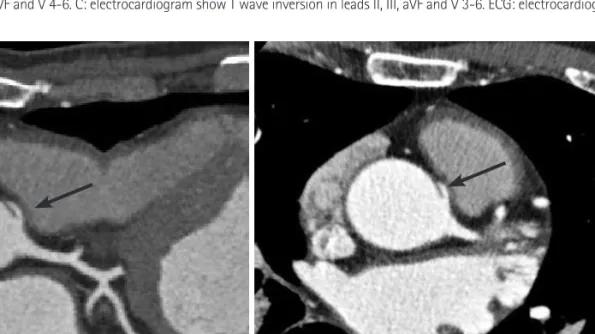
the acute episode terminated, he was treated with aspirin, lipid lo- wering agent, angiotension II receptor blocker and intravenous he- parin. We performed multidetector computed tomography. Coro- nary CT angiography revealed that the RCA arose from the left sinus of Valsalva with acute angle of the ostium and course between the

right ventricular outflow tract and the aorta (Figs. 2 and 3). Other intracoronary atherosclerotic lesion was not observed. The treadmill test was done with good exercise performance and the result sh- owed ST depression in leads III, aVF. 24 hours holter monitoring showed one episode of non-sustained ventricular tachycardia for

Fig. 2. Anomalous orgin of the right coronary artery with CT coronary angiography. A: multiplanar reformatted image from a multi-detector CT coronary angiogram confirms that the right coronary artery was arising from the left sinus Valsalva with acute angle of the ostium (arrow). B: axial reconstruction anomaly coronary artery takes a course between the right ventricular outflow tract and the aorta (arrow) on axial image.

A   B  

Fig. 1. Variable changes of ECG. A: ECG show paroxysmal supraventricular tachycardia with pulse rate 190. B: ECG show ST elevation in leads V 1-3 and T inversion in leads II, III, aVF and V 4-6. C: electrocardiogram show T wave inversion in leads II, III, aVF and V 3-6. ECG: electrocardiogram.

A  

C  

B  

(3)

125 Sang Hee Song, et al.

http://dx.doi.org/10.4070/kcj.2013.43.2.123 www.e-kcj.org

0.8 seconds. We continued medical treatment including ATII recep- tor blocker, bisoprolol and aspirin and recommended life style mo- dification.

Discussion

Coronary artery anomalies, after hypertrophic cardiomyopathy, are the second most common cause of exercise-related sudden car- diac deaths. These anomalies have been associated with myocardial ischemia, arrhythmia and sudden death during exercise.

6)7)

The pre- valence of coronary artery anomalies has been reported between 0.6 to 1.3% in angiographic series and 0.3% in autopsy series.

1-4)7)

Anomalous origin of the RCA from the left sinus of Valsalva repre- sents a small fraction less than 3% of total coronary anomalies.

5)

Me- chanisms of the restricted coronary blood flow suggest that the acute angle of ostium, slit-like orifice limit the flow of coronary ar- tery.

5)8)

Also, possible mechanisms are compression of the intramu- ral segment by the aortic valve commissure and compression between the aorta and pulmonary artery.

8)

In case of interarterial course be- tween aorta and pulmonary artery, luminal compression of the cor- onary artery is related to the pressure of the aorta because the pres- sure of the pulmonary artery was much lower than that of the aor- ta.

8)

On that account, anomalous coronary artery stemming from opposite sinus of Valsalva can trigger syncope, myocardial isch- emia and sudden death in the absence of critically fixed stenosis.

5)

The methods for evaluation of anomalous origin of coronary ar- tery include angiography, intravascular ultrasound, transthoracic and transesophageal echocardiogram, coronary CT angiography, and MRI.

8)

Coronary angiography is limited for evaluation of coronary

anomalies since it is sometimes difficult to cannulate the orifice and the complex three dimensional structure of the arteries is displayed in a two dimensional plane.

8)

Coronary CT angiography is a non-in- vasive diagnostic modality which provides much higher spatial re- solution and three dimensional images.

8)9)

Understanding ischemic mechanisms in anomalous origin of the RCA is attributed to excel- lent information about the origin and the course of the anomalous coronary artery from multidetector CT images.

10)

In the case of our patient, the axial image showed an acute-angled take off of the RCA from the ascending aorta and a small orifice of the RCA which was thought to be one of the mechanisms for the ischemia.

Recent recommendations have favored surgical management of all symptomatic patients.

11-13)

Nevertheless, there is concern about risk of surgical procedure.

12)

We believed that sudden arrhythmias such as PSVT are brought about by hemodynamic changes, widening of aortic root and coro- nary artery luminal compression between the aorta and the pulmo- nary artery limiting the coronary artery flow. Our patient performed a treadmill test and the result showed ischemic changes. ST change in EKG and elevated troponin T could be explained as a response to pacing induced stress as well as a response to myocardial ishemia.

14)

In our patient, myocardial ischemia induced by the coronary an- omaly is more likely because of mild hypokinesia of septum and an- terior wall of LV, and ischemic change of treadmill test was con- firmed. It is a limitation of this case report that the cause of PSVT, whether atrio-ventricular nodal reentry or accessory pathway, was not evaluated by cardiac electrophysiologic study. The electrophys- iologic study could help to clarify the relation between coronary an- omaly and PSVT.

In our patient, coronary CT angiography showed that the anom- alous RCA with inter-arterial pathway and the whole coronary tree was free of any stenotic lesion. We managed him with medications and recommended he avoid intense physical activities. The patient remains clinically well.

References

1. Kimbiris D, Iskandrian AS, Segal BL, Bemis CE. Anomalous aortic origin of coronary arteries. Circulation 1978;58:606-15.

2. Yamanaka O, Hobbs RE. Coronary artery anomalies in 126,595 patients undergoing coronary arteriography. Cathet Cardiovasc Diagn 1990;

21:28-40.

3. Angelini P, Velasco JA, Flamm S. Coronary anomalies: incidence, patho- physiology, and clinical relevance. Circulation 2002;105:2449-54.

4. Kim JS, Lee JM, Yoon HJ, et al. A case of coronary vessel anomaly of the left circumflex artery originating from the right coronary artery with variant angina. Korean Circ J 2004;34:711-4.

5. Vincelj J, Todorovic´ N, Marusic´ P, Puksic´ S. Anomalous origin of the left coronary artery from the right sinus of Valsalva in a 62-year-old wom- Fig. 3. 3D volume rendered multi-detector CT image of the coronary arter-

ies show that there is no stenosis of any coronary artery.

(4)

126 Coronary Artery Anomaly and Coronary CT Angiography

http://dx.doi.org/10.4070/kcj.2013.43.2.123 www.e-kcj.org

an with unstable angina pectoris: a case report. Int J Cardiol 2010;142:

e35-7.

6. Basso C, Maron BJ, Corrado D, Thiene G. Clinical profile of congenital coronary artery anomalies with origin from the wrong aortic sinus leading to sudden death in young competitive athletes. J Am Coll Car- diol 2000;35:1493-501.

7. Dogan SM, Gursurer M, Aydin M, Gocer H, Cabuk M, Dursun A. Myo- cardial ischemia caused by a coronary anomaly left anterior descending coronary artery arising from right sinus of Valsalva. Int J Cardiol 2006;

112:e57-9.

8. Lee BY. Anomalous right coronary artery from the left coronary sinus with an interarterial course: is it really dangerous? Korean Circ J 2009;

39:175-9.

9. Park CS, Kim W, Hong SB, Hwang SH, Kim W, An BH. Anomalous origin of the right coronary artery from the main pulmonary artery present-

ing as angina pectoris in an adult. Korean Circ J 2008;38:627-9.

10. Tariq R, Kureshi SB, Siddiqui UT, Ahmed R. Congenital anomalies of coronary arteries: diagnosis with 64 slice multidetector CT. Eur J Ra- diol 2012;81:1790-7.

11. Earls JP. Coronary artery anomalies. Tech Vasc Interv Radiol 2006;9:

210-7.

12. Mirchandani S, Phoon CK. Management of anomalous coronary arter- ies from the contralateral sinus. Int J Cardiol 2005;102:383-9.

13. Reul RM, Cooley DA, Hallman GL, Reul GJ. Surgical treatment of coro- nary artery anomalies: report of a 37 1/2-year experience at the Texas Heart Institute. Tex Heart Inst J 2002;29:299-307.

14. Turer AT, Addo TA, Martin JL, et al. Myocardial ischemia induced by

rapid atrial pacing causes troponin T release detectable by a highly

sensitive assay: insights from a coronary sinus sampling study. J Am

Coll Cardiol 2011;57:2398-405.

수치

Fig. 1. Variable changes of ECG. A: ECG show paroxysmal supraventricular tachycardia with pulse rate 190

참조

관련 문서

Objective: To examine the fractional flow reserve derived from computed tomographic angiography (CT-FFR) in patients with anomalous origin of the right coronary artery from the