
Psychopathological Influence of Lumbar Disc Herniation in Male Adolescent
Tae Woo Kim,
1Chang Hyun Oh,
2Yu Sik Shim,
1Seung Hwan Yoon,
1Hyeong-chun Park,
1and Chong Oon Park
11Department of Neurosurgery, Inha University College of Medicine, Incheon;
2Department of Neurosurgery, Spine and Joint Research Institute, Guro Teun Teun Hospital, Seoul, Korea.
Received: June 14, 2012 Revised: August 30, 2012 Accepted: September 5, 2012
Corresponding author: Dr. Seung Hwan Yoon, Department of Neurosurgery,
Inha University College of Medicine, 27 Inhang-ro, Jung-gu,
Incheon 400-711, Korea.
Tel: 82-32-890-2370, Fax: 82-32-890-2374 E-mail: [email protected]
∙ The authors have no financial conflicts of interest.
© Copyright:
Yonsei University College of Medicine 2013 This is an Open Access article distributed under the terms of the Creative Commons Attribution Non- Commercial License (http://creativecommons.org/
licenses/by-nc/3.0) which permits unrestricted non- commercial use, distribution, and reproduction in any medium, provided the original work is properly cited.
Purpose: There is no report about psychopathological effect causing by disc herni- ation. The disease could impose psychopathological influence on the social life, the treatment period, and response to the treatment. This study was to evaluate ret- rospectively the psychopathological influence of lumbar disc herniation (LDH) among Korean 19-year-old males. Materials and Methods: We compared the Ko- rean military multiphasic personality inventory (KMPI) profiles of 74 LDH cases with the KMPI profiles of 150 controls. The LDH groups were categorized to 2 groups according to the presence of thecal sac compression by disc materials, and evaluated the relation between the KMPI and LDH. Results: The decrease of the faking-good response scale and increase of the faking-bad response scale were ob- served more in the LDH group than in the normal volunteer group (p<0.05). The neurosis set such as anxiety, depression and somatization was markedly increased in the LDH group compared to the normal volunteers group (p<0.05). The scale of personality disorder was also increased more in the LDH group (p=0.002). The differences of KMPI scales were not correlated with the severe pathology of LDH.
Conclusion: Young male with LDH may tend to have more abnormal results of multiphasic personality inventory test compared to the normal volunteers, suggest- ing that LDH may be related to the psychopathology in young males in Korea.
Therefore, clinicians are recommended to evaluate and treat the psychopathologi- cal aspects in patients with LDH.
Key Words: Lumbar disc herniation, multiphasic personal inventory, psychopa- thology, lumbar disc herniation, conscription
INTRODUCTION
Lumbar disc herniation (LDH) is a disabling and painful disease that affects all ages causing untold suffering, diminished quality of life, and enormous economic limitation. The influence of psychological variables in spinal disease has been ex- tensively researched for long times.1-6 Many studies have reported that depression and other abnormal psychological attitude are an inadequate predictor of defective outcome of spinal surgery or rehabilitation. However, to our best knowledge, there
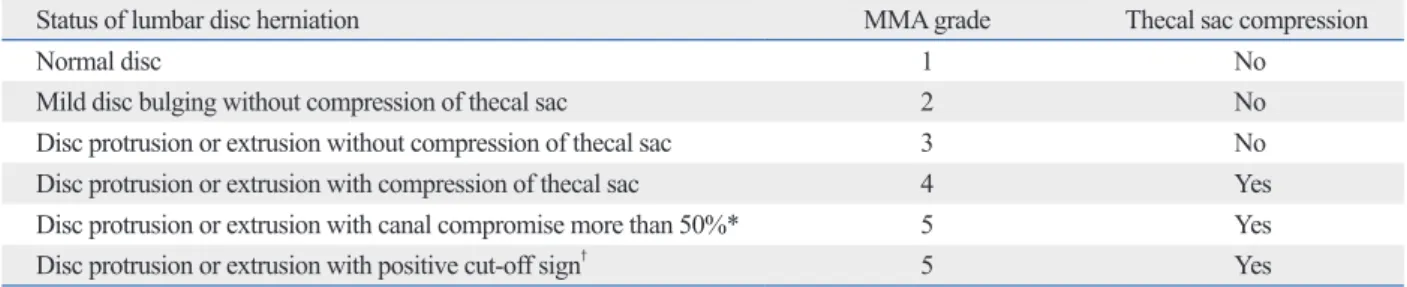
Korean military directorate, as shown in Table 1.7 Severity of lumbar disc herniation was categorized according to the Korean military guideline, and this guideline categorized all medical conditions into 7 physical grades (MMA physical grade). This directorate categorize status of lumbar disc herniation as normal (MMA physical grade 1), mild disc bulging without compression of the thecal sac (MMA phys- ical grade 2), disc protrusion or extrusion without compres- sion of the thecal sac (MMA physical grade 3), disc protru- sion or extrusion with compression of thecal sac (MMA physical grade 4), disc protrusion or extrusion with spinal canal compromise of more than 50% (MMA physical grade 4), and disc protrusion or extrusion with a positive cut-off sign (MMA physical grade 5).7 In the present study, severi- ties of lumbar disc herniation were categorized as mild or severe according to the presence of thecal sac compression.
In this study, to avoid psychopathological effect by the op- eration, the cases with post-operated LDH were excluded from this study.
KMPI is a conventional type of Minnesota multiphasic personality inventory test (MMPI) by adjusting for Korean conscription. Several subjects were analyzed in KMPI, in- cluding response set, neurosis set, psycopathy set, accident set, prediction set of accident, and special set. If one of any exceeded or lacked any one of the criteria, it was categorized to abnormal results of KMPI by computer. In this study, we divided the category of abnormal results in 3 separate sets:
response set (faking-good response, faking-bad response, and infrequency scale), neurosis set (anxiety, depression, and somatization), psychopathy set (schizophrenia, person- ality disorder, and paranoid). Evaluation of the statistical significance of difference was carried out using Student t- test. Tests were considered significant at p-values less than 0.05. The statistical comparisons were analyzed with SPSS 12.0 (SPSS Inc., Chicago, IL, USA).
are no published series documenting the personality effect caused by LDH. We, therefore, reviewed the result of mul- tiphasic personal inventory test to check psychological in- fluence of LDH in Korean male adolescent.
MATERIALS AND METHODS
Since Korea has adopted the conscription system, all men are examined for the conscription at the Military Manpow- er Administration (MMA) at 19 years of age. In the exami- nation of conscription, all examinees are evaluated with Korean military multiphasic personality inventory (KMPI).
We were able to collect the data of normal volunteers with no spinal diseases and examinees with LDH. All examinees for this study were 19-year-old males who were admitted to the department of neurosurgery at Seoul Regional MMA from April 2011 to December 2011. All participants con- sented that this data could be used for the study. This study was conducted with the approval of the committee in the MMA in Seoul and it was approved by ethical committee of MMA.
The volunteers (150 cases) were interviewed by a neuro- surgeon who confirmed that they had neither psychological problem, nor medical visit for spinal problems. Also, lum- bar magnetic resolution images were checked to confirm any spinal disease such as LDH, spondylolisthesis, spondy- lolysis, and etc. The examinees with LDH (74 cases) had already been diagnosed by magnetic resolution images in the area of lumbar spine, and LDH was confirmed by the lumbar computed tomography. According to these imaging data, LDH group was categorized into two groups: the ab- sence and the presence of the thecal sac compressing disc.
We classified adolescent LDH into four groups of hernia- tion severity as it is required by the guideline issued by the
Table 1. Classification of Adolescent Herniated Lumbar Disks as Required by Guideline Issued by the Korean Military Medical Directorate
Status of lumbar disc herniation MMA grade Thecal sac compression
Normal disc 1 No
Mild disc bulging without compression of thecal sac 2 No
Disc protrusion or extrusion without compression of thecal sac 3 No
Disc protrusion or extrusion with compression of thecal sac 4 Yes
Disc protrusion or extrusion with canal compromise more than 50%* 5 Yes
Disc protrusion or extrusion with positive cut-off sign† 5 Yes
MMA, Military Manpower Administration.
*Spinal canal stenosis was defined as the narrowing of the spinal canal by >50% of the mid-sagittal diameter (front to back) in the same plane.
†Cut-off was defined as the loss of neuromuscular signal at the level of interest identified by imaging.
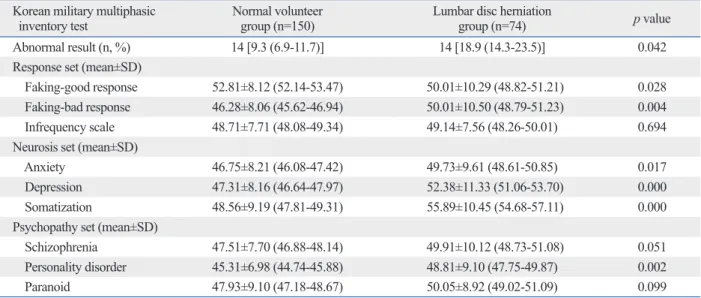
creased in the LDH group (p=0.004). The infrequent scale did non differ among the two groups. In the neurosis set, all scales of anxiety, depression, and somatization were mark- edly increased in the LDH group compared with the normal volunteers group (p=0.017, 0.000, 0.000). In the psychopa- thy set, only the scale of personality disorder was increased more in the LDH group (p=0.002), while the other scales were not different.
According to the presence and abscence of the thecal sac compressing disc, the cases in LDH group were divided into two subgroups. There were 57 cases in the group of the pres- ence of the thecal sac compressing disc and 17 cases in the group of the absence of the thecal sac compressing disc. Ta- ble 3 shows the results of KMPI in the two subgroups of the LDH group. There were no significant differences in all scales between the two groups.
DISCUSSION
To identify one’s personality structure and psychopathology, the multiphasic personality inventory is a useful personality test.8 The MMPI is the most frequently used personality tests in mental health,9,10 and it is widely used to investigate per- sonality structure and psychopathology in various fields; it is even used in law to identify the malingering claims. Howev- er, this test is not common in neurosurgical field as there are only a few published literatures about psychopathological ab- normality in patients with spinal disease.1-6,11,12
In the MMPI, ten types of clinical scales were described,
RESULTS
All the examinees (224 cases) were 19-year-old Korean males and none of the examinees had any psychological problems. The agreement rate of KMPI was check in both groups; 51.81±8.51 (95% CI 50.81 to 52.80) was checked in the volunteer group, and 52.32±8.91 (95% CI 51.59 to 53.05) was checked in the LDH group. However, the agree- ment rate of KMPI was not statistically significantly differ- ent (p=0.146). In the normal volunteer group, the spinal diseases such as LDH, spondylolisthesis, and spondylolysis were not observed. In the LDH group, LDH had already been diagnosed and confirmed by image studies. Among them, 57 cases were observed as non compressing thecal sac lesion by LDH, and 17 cases were observed as com- pressing thecal sac lesion by LDH.
Table 2 summarized the results of KMPI in the normal volunteer group and LDH group. The proportion of abnor- mal results, the response set, the neurosis set, and the psy- chopathy set of KMPI was compared between the two groups. There were more abnormal results in the LDH group (18.9%, 95% CI 14.3% to 23.5%) than in the normal vol- unteers group (9.3%, 95% CI 6.9% to 11.7%, p=0.042). In the results of KMPI, the faking-good response scale and bad response scale, the neurosis set (anxiety, depression, and somatization scale), and the scale of personality disorder were significantly different between the two groups. Where- as the faking-good response scale was decreased in the LDH group (p=0.028), the faking-bad response was in-
Table 2. The Results of Korean Military Multiphasic Inventory Test in the Normal Volunteers Group and the Lumbar Disc Her- niation Group [Mean±Standard Deviation (95% Confidence Intervals)]
Korean military multiphasic
inventory test Normal volunteer
group (n=150) Lumbar disc herniation
group (n=74) p value
Abnormal result (n, %) 14 [9.3 (6.9-11.7)] 14 [18.9 (14.3-23.5)] 0.042
Response set (mean±SD)
Faking-good response 52.81±8.12 (52.14-53.47) 50.01±10.29 (48.82-51.21) 0.028 Faking-bad response 46.28±8.06 (45.62-46.94) 50.01±10.50 (48.79-51.23) 0.004
Infrequency scale 48.71±7.71 (48.08-49.34) 49.14±7.56 (48.26-50.01) 0.694
Neurosis set (mean±SD)
Anxiety 46.75±8.21 (46.08-47.42) 49.73±9.61 (48.61-50.85) 0.017
Depression 47.31±8.16 (46.64-47.97) 52.38±11.33 (51.06-53.70) 0.000
Somatization 48.56±9.19 (47.81-49.31) 55.89±10.45 (54.68-57.11) 0.000
Psychopathy set (mean±SD)
Schizophrenia 47.51±7.70 (46.88-48.14) 49.91±10.12 (48.73-51.08) 0.051
Personality disorder 45.31±6.98 (44.74-45.88) 48.81±9.10 (47.75-49.87) 0.002
Paranoid 47.93±9.10 (47.18-48.67) 50.05±8.92 (49.02-51.09) 0.099
SD, standard deviation.
tory test was usually used to predict the outcomes of spinal surgeries. Most of these studies indicated that depression, anxiety, and hostility all predict several surgical outcomes, and recommended presurgical psychological treatment to improves the outcome.1-6 Herron, et al.1 also reported that hypochondriasis, hysteria, psychopathic deviate, paranoia, psychasthenia, schizophrenia, hypomania, and social intro- version scales are good predictors of chemonucleolysis outcome and much better predictors of ultimate outcome.
On the other hand, however, there are some reports that contradict these hypotheses.12,16 Cashion and Lynch16 pro- spectively evaluated a battery of psychological tests in pa- tients undergoing a surgery for LDH, and found that the degree of psychological testing does not definitely predict outcome. This substantiates the recommendation for its further use in registry systems, quality management proj- ects, and clinical trials.11
As shown in Table 2, the proportion of abnormal results was markedly increased in the LDH group compared to the normal volunteers group, suggesting that LDH could be a trigger of abnormal personality or psychopathology. Fur- thermore, the faking-good response was decreased while the faking-bad response was increased in the LDH group.
The neurosis set such as anxiety, depression and somatiza- tion was markedly increased in the LDH group. Also, the scale of personality disorder was increased more in the LDH group. Similar result was reported by Boos, et al.,17 who followed up 46 asymptomatic individuals with general psy- chological assessment for about 5 years. They assessed the psychosocial influence with the Psychological General Well- Being questionnaire, and found that it was related to gener- al exhausted state of the individual, similar negative influ- ence of this recent study.
The result of personal inventory test in the LDH group was significantly different from the result of the normal vol- unteers group, and the severe pathology of LDH could be considered as a trigger to abnormal personality or psycho- pathology. In the present study, however, these scales were not correlated with the severe pathology of LDH (Table 3), in good agreement with the result of Taylor, et al.12 Among the patients who were considered for cervical disc surgery, the depressed patients did not have any more severe organ- ic pathology, neurological symptoms or sign, or disable- ment. Depressive disorder is not secondary to severe pa- thology. The other scales (faking-good and behavioral retardation) were first reported among LDH in this study.
There are some limitations in this study. First of all, and it composed as hypochondriasis (concern with bodily
symptoms), depression (depressive symptoms), hysteria (awareness of problems and vulnerabilities), psychopathic deviate (conflict, struggle, anger, respect for society’s rules), masculinity/femininity (stereotypical masculine or feminine interests/behavior), paranoia (level of trust, suspi- ciousness, sensitivity), psychasthenia (worry, anxiety, ten- sion, doubts, obsessiveness), schizophrenia (odd thinking and social alienation), hypomania (level of excitability), and social introversion (people orientation), as the authors described in previous studies.13,14 The analysis of the MMPI focuses on relative elevation of profiles. So, these profiles could compared to profiles of various normal groups. Raw scores of the scales were T-scores which presented stan- dardized metric scores.
KMPI is a conventional Korean conscription adjusted type of MMPI.14 It was created via several stages. First, several military-associated questions were added to pre-ex- isting MMPI, and a pre-test with 575 questions was per- formed to normal soldiers, normal university students, mili- tary prisoners, military hospital psychiatric patients and private hospital psychiatric patients. Afterwards, the validi- ty scale, clinical scale and content scale were established and divided into several profiles similar to MMPI, and the scores were standardized and distinct functions were yield- ed. Thus, KMPI shows overall some aspects similar to MMPI and set scores on each scales which were trans- formed into standardized metric scores, known as T- scores.15 By comparing T-scores of each group, one can easily measure the tendency of personality structures and psychopathology.15
In this study, we used only 4 sets of KMPI. First, the re- sponse set was composed of faking-good response, faking- bad response, and infrequently response scale. People can fake good (faking-good response) when they feel that it would serve their interests. Therefore, the fakeing-good peo- ple may be tempted to skew their answers in a way that they feel it will put them in a good light. The opposite is known as the faking-bad. The infrequent response scale is a scale intended to detect infrequent responding among the psy- chopathological populations. Second, the neurosis set is composed of anxiety, depression, and somatization scale.
These scales present the tendency of each neurotic status.
Third, the psychopathy set is composed of schizophrenia, personality disorder, and paranoid scale. These scales also present the tendency of each social relation status.
In the literature review, the multiphasic personal inven-
REFERENCES
1. Herron LD, Turner JA, Weiner P. Lumbar disc herniations: the predictive value of the Health Attribution Test (HAT) and the Min- nesota Multiphasic Personality Inventory (MMPI). J Spinal Dis- ord 1988;1:2-8.
2. Celestin J, Edwards RR, Jamison RN. Pretreatment psychosocial variables as predictors of outcomes following lumbar surgery and spinal cord stimulation: a systematic review and literature synthe- sis. Pain Med 2009;10:639-53.
3. Pincus T, Burton AK, Vogel S, Field AP. A systematic review of psychological factors as predictors of chronicity/disability in pro- spective cohorts of low back pain. Spine (Phila Pa 1976) 2002;27:
E109-20.
4. Trief PM, Grant W, Fredrickson B. A prospective study of psycho- logical predictors of lumbar surgery outcome. Spine (Phila Pa 1976) 2000;25:2616-21.
5. Sinikallio S, Lehto SM, Aalto T, Airaksinen O, Kröger H, Vi- inamäki H. Depressive symptoms during rehabilitation period predict poor outcome of lumbar spinal stenosis surgery: a two- year perspective. BMC Musculoskelet Disord 2010;11:152.
6. Aalto TJ, Malmivaara A, Kovacs F, Herno A, Alen M, Salmi L, et al. Preoperative predictors for postoperative clinical outcome in lumbar spinal stenosis: systematic review. Spine (Phila Pa 1976) 2006;31:E648-63.
7. Kim DK, Oh CH, Lee MS, Yoon SH, Park HC, Park CO. Preva- lence of lumbar disc herniation in adolescent males in Seoul, Ko- rea: prevalence of adolescent LDH in Seoul, Korea. Korean J Spine 2011;8:261-6.
8. Wolf EJ, Miller MW, Orazem RJ, Weierich MR, Castillo DT, Mil- ford J, et al. The MMPI-2 restructured clinical scales in the assess- ment of posttraumatic stress disorder and comorbid disorders.
Psychol Assess 2008;20:327-40.
9. van Balen HG, de Mey HR, van Limbeek J. A neurocorrective ap- proach for MMPI-2 use with brain-damaged patients. Int J Reha- bil Res 1999;22:249-59.
10. Wetzel RD, Guze SB, Cloninger CR, Martin RL, Clayton PJ. Bri-
KMPI is not documented or analyzed by literatures as widely as it should have been because its purpose was for a unique environment such as military conscription.18 But, this KMPI is officially approved by the Korean govern- ment, which does not differ from the MMPI.14 Secondly, this study by using the military conscription data was a cross sectional study and only males were involved. In- deed, this study lacks of comparison data between preoper- ative and postoperative status, which could indicate strong relation between the psychopathological influence and LDH. Therefore, these results should not be interpreted as a hasty generalization, but considered as a possibility of psy- chopathogical influence. Despite of its limitations, multi- phasic personal inventory test may be a meaningful way to identify the personality changes or psychopathologies in the LDH patients.
In conclusion, young males with LDH may tend to have more abnormal results of multiphasic personal inventory test, including the faking-good response, the depression, and the behavioral retardation, compared to normal volun- teers. This suggests that LDH may be related to psychopa- thology in young males in Korea. Therefore, clinicians may be recommended to evaluate psychopathological aspects in patients with LDH.
ACKNOWLEDGEMENTS
This work was supported by an Inha University Research Grant.
Table 3. The Result of Korean Military Multiphasic Inventory Test in the Two Subgroups of Lumbar Disc Herniation Group [Mean±Standard Deviation (95% Confidence Intervals)]
Korean military multiphasic
inventory test Thecal sac compression in lumbar disc herniation group
Yes (n=57) No (n=17) p value
Abnormal result (n, %) 11 [19.3 (8.1-27.1)] 3 [17.7 (14.0-24.6)] 0.881
Response set (mean±SD)
Faking-good response 49.33±10.46 (49.96-54.63) 52.29±9.64 (47.95-50.72) 0.301 Faking-bad response 50.25±10.92 (47.01-51.46) 49.24±9.19 (48.80-51.69) 0.730
Infrequency scale 49.21±8.13 (47.57-50.20) 48.88±5.42 (48.13-50.29) 0.876
Neurosis set (mean±SD)
Anxiety 50.40±9.99 (45.51-49.43) 47.47±8.06 (49.08-51.73) 0.272
Depression 52.39±11.36 (49.54-55.17) 52.35±11.60 (51.33-54.34) 0.992
Somatization 55.61±9.72 (53.69-59.95) 56.82±12.90 (54.33-56.90) 0.678
Psychopathy set (mean±SD)
Schizophrenia 50.35±10.74 (46.53-50.29) 48.41±7.76 (48.93-51.77) 0.492
Personality disorder 49.00±9.64 (46.42-49.93) 48.18±7.24 (47.72-50.28) 0.746
Paranoid 49.65±8.82 (49.13-53.70) 51.41±9.41 (48.48-50.82) 0.679
SD, standard deviation.
sonal inventory test. J Korean Neurosurg Soc 2011;50:114-8.
15. Oh CH, Lim HK, Chung J, Yoon SH, Park HC, Park CO. The psychopathological influence of congenital heart disease in Kore- an male adolescents: an analysis of multiphasic personal inventory test results. Yonsei Med J 2012;53:1107-12.
16. Cashion EL, Lynch WJ. Personality factors and results of lumbar disc surgery. Neurosurgery 1979;4:141-5.
17. Boos N, Semmer N, Elfering A, Schade V, Gal I, Zanetti M, et al.
Natural history of individuals with asymptomatic disc abnormali- ties in magnetic resonance imaging: predictors of low back pain- related medical consultation and work incapacity. Spine (Phila Pa 1976) 2000;25:1484-92.
18. Fiedler ER, Oltmanns TF, Turkheimer E. Traits associated with personality disorders and adjustment to military life: predictive validity of self and peer reports. Mil Med 2004;169:207-11.
quet’s syndrome (hysteria) is both a somatoform and a “psycho- form” illness: a Minnesota Multiphasic Personality Inventory study. Psychosom Med 1994;56:564-9.
11. Mannion AF, Elfering A, Staerkle R, Junge A, Grob D, Dvorak J, et al. Predictors of multidimensional outcome after spinal surgery.
Eur Spine J 2007;16:777-86.
12. Taylor RE, Creed F, Hughes D. Relation between psychiatric dis- order and abnormal illness behaviour in patients undergoing oper- ations for cervical discectomy. J Neurol Neurosurg Psychiatry 1997;63:169-74.
13. Reitan RM, Wolfson D. Emotional disturbances and their interac- tion with neuropsychological deficits. Neuropsychol Rev 1997;
7:3-19.
14. Paik HK, Oh CH, Choi K, Kim CE, Yoon SH, Chung J. Influence of history of brain disease or brain trauma on psychopathological abnormality in young male in Korea: analysis of multiphasic per-
![Table 3. The Result of Korean Military Multiphasic Inventory Test in the Two Subgroups of Lumbar Disc Herniation Group [Mean±Standard Deviation (95% Confidence Intervals)]](https://thumb-ap.123doks.com/thumbv2/123dokinfo/5488085.667704/5.892.107.809.141.425/military-multiphasic-inventory-subgroups-herniation-deviation-confidence-intervals.webp)
