Health Related Quality of Life in Common Variable Immunodeficiency
Isabella Quinti,
1Cristina Di Pietro,
2Helene Martini,
1Anna Maria Pesce,
3Francesca Lombardi,
3Maddalena Baumghartner,
3Stefania Colantuono,
3Cinzia Milito,
1and Stefano Tabolli
21Department of Molecular Medicine, Sapienza University of Rome and Fondazione Eleonora Lorillard Spencer Cenci, Rome;
2Health Services Research Unit, Istituto Dermopatico Dell’Immacolata IDI-IRCCS, Rome;
3Department of Clinical Immunology, Sapienza University of Rome, Rome, Italy.
Received: May 24, 2011 Revised: July 19, 2011 Accepted: July 21, 2011
Corresponding author: Dr. Stefano Tabolli, Health Services Research Unit, Istituto Dermopatico Dell’Immacolata IDI- IRCCS, Via Monti di Creta 104, 00167 Rome, Italy.
Tel: 39-0666464324, Fax: 39-0666464329 E-mail: [email protected]
∙ The authors have no financial conflicts of interest.
© Copyright:
Yonsei University College of Medicine 2012 This is an Open Access article distributed under the terms of the Creative Commons Attribution Non- Commercial License (http://creativecommons.org/
licenses/by-nc/3.0) which permits unrestricted non- commercial use, distribution, and reproduction in any medium, provided the original work is properly cited.
Purpose: To quantify the health related quality of life in primary immunodeficien- cy patients. Materials and Methods: We used generic health status and general psychological health questionnaires to determine the range of issues that needed to be considered in examining the burden of common variable immunodeficiency (CVID). Results: The health status of patients with CVID was lower than that ob- served in normal subjects. Overall, Role-Physical and General Health scales corre- lated with a poorer clinical status. Surprisingly, the duration of disease did not influ- ence health status. Being female, older, General Health Questionnaire-positive and alexithymic proved to be major risk factors associated with a poor health status. Pa- tients with chronic lung disease and chronic diarrhea had the lowest values on the Medical Outcome Study, Short Form SF-36 (SF-36) scales. Disease severity per- ception was associated with the General Health Questionnaire and alexithymia sta- tus. Limitations in daily activities as a result of lower physical health were the ma- jor problems facing common variable immunodeficiency patients. Conclusion:
Our data underlined the importance of conducting a periodical health related quality of life assessment on patients with primary antibody deficiencies and, moreover, stressed the necessity of providing psychological support to at risk patients.
Key Words: Common Variable Immunodeficiency, Health Related Quality of Life, SF-36, General Health Questionnaire-12, GHQ-12
INTRODUCTION
Common variable immunodeficiency (CVID) is the most frequent symptomatic
antibody deficiency, characterized by low levels of serum immunoglobulins and
impaired antibody response.
1-3CVID may occur at any age, demonstrating pre-
dominance in the adult age group. The clinical spectrum includes respiratory in-
fections, gastrointestinal diseases, autoimmune diseases, granulomatous manifes-
tations, and cancers.
4,5Long-term administration of immunoglobulins reduces the
incidence of infections. However, despite IgG replacement, CVID patients may
plete blood counts, lymphocyte subsets, chemistries, serum immunoglobulin levels, and culture tests were performed four times per year. Chest and sinus computerized tomogra- phy (CT) scans were performed every four years, and gas- trointestinal endoscopy with biopsy was performed every two years. All data were processed in a database and sent to the Interuniversity Computing Centre responsible for pro- cessing and analyzing the data. All 112 adult CVID patients referred to our center were recruited, and 16 refused to par- ticipate. Data were analyzed on the same day of their peri- odical clinical assessment. The ninety-six patients (50 males and 46 females) who agreed to participate to our study had a mean age of 48.2±17 years. Fifty-two patients were less than 50 years of age (group 1) and 44 were older than 50 years (group 2). The mean age at diagnosis was 36±17.5 years. The mean duration of disease since diagno- sis was 10.7 years (range 5-36). The majority of patients (87.5%) were receiving intravenous gammaglobulin every 2 or 3 weeks in a day hospital setting. Twelve patients self-in- fused subcutaneous immunoglobulins at home with a monthly clinical follow-up at our out-patient service. Be- fore clinical examination and immunoglobulin therapy, pa- tients were asked to fill in the four questionnaires concern- ing their HRQoL, general health status, and the possible presence of depression/anxiety and alexithymia.
Outcome measures SF-36
Although designed as a generic health status indicator for use in population surveys and health policy evaluation studies, the SF-36 (8) can also be used as an outcome measure. The SF-36 includes 36 items in a Likert-type or forced-choice format, intended to measure the following eight dimensions:
physical functioning (PF, limitations in performing physical activities such as bathing or dressing), role-physical (RP, lim- itations in work and other daily activities as a result of physi- cal health), bodily pain (BP, how severe and limiting is pain), general health (GH, how general personal health is perceived by the patient), vitality (VT, feeling tired and worn out vs.
feeling energetic), social functioning (SF, interference with normal social activities due to physical or emotional prob- lems), role-emotional (RE, limitations in work and other dai- ly activities as a result of emotional problems), and mental health (MH, feeling nervous and depressed vs. peaceful, hap- py and calm). Scores for each domain range from 0 to 100, with higher scores indicating better health status. Two addi- still suffer from respiratory infections, caused by encapsulat-
ed bacteria, leading to permanent lung damage.
6,7Quantify- ing the health related quality of life (HRQoL) in primary im- munodeficiency conditions has relatively recently began as an effort to document the outcomes of therapeutic interven- tion, and in order to do so, investigators have begun to use generic measures such as the Medical Outcome Study, Short Form SF-36
8/SF-12
9or Life Quality Index.
10The aims of our study were to determine the range of issues that need to be considered in examining the burden of CVID and to evaluate HRQoL and psychological status of patients attending our day-hospital Unit, using a generic health status questionnaire and general psychological health questionnaires. Moreover, we intended to compare the evaluations of disease severity from both the patient and the physician perspectives. The un- derlying hypothesis was that CVID patients have a low HRQoL and, according to the global severity assessment of his/her own disease, mental and psychological aspects, which contribute to the burden of the disease, should be con- sidered. Moreover, we investigated if risks of depression/
anxiety and alexithymia could be associated with different perceptions of disease severity and health status.
MATERIALS AND METHODS
Study subjects
For this observational, short-term longitudinal cohort study, performed in a day hospital setting, patients’ participation was obtained via signed informed consent. The project was approved by our Institute Ethical Committee. The study was conducted during the period of January-October 2010.
HRQoL was tested twice in a six month period. The entry
criteria for this study were: 1) a diagnosis of CVID and 2) a
clinical follow-up of at least five years at our center for pri-
mary immunodeficiencies. CVID diagnosis was made in
patients over two years of age by approved criteria;
2includ-
ing low levels of serum IgG, IgA, and/or IgM; antibody de-
ficiency with impaired response to tetanus and pneumococ-
cal antigen immunization; peripheral B cell numbers of less
than 2%; and exclusion of hypogammaglobulinemia due to
other primary or secondary immunodeficiencies. Detailed
information on personal data, date of diagnosis, immuno-
logical data and clinical manifestations, as well as route and
dosage of immunoglobulin replacement were collected on a
yearly basis from the initial diagnosis via a questionnaire
filled in by a physician of our center. For each patient, com-
tions, “In your opinion, compared to other patients with the same condition, how severe is the disease of patient X?” and
“In your experience, how severe is your disease?”, respec- tively. Answers were given on a 5-point scale: “very mild”,
“mild”, “moderate”, “severe”, and “very severe”. The physi- cian recorded the evaluation at the end of the visit, and the patients recorded their evaluations after completing the oth- er questionnaires.
Statistical analysis
In order to compare PtGA and PhGA, we created three cat- egories: “Agreement”, PtGA was equal to PhGA; “Patient underestimates”, PtGA was lower than PhGA; “Patient overestimates”, PtGA was higher than PhGA. Cohen’s kap- pa was calculated to measure the agreement between the evaluations of severity by both patients and physicians. A value of 1 indicated perfect agreement, while a value of 0 indicated that agreement was no better than chance. After univariate analyses, two logistic regression models were tested in order to investigate the possible determinants of underestimation or overestimation of severity by the patient.
The dependent variables were, respectively, “patient under- estimates” and “patient overestimates” vs. others. Indepen- dent variables were: gender, age (dichotomised cut-off of 50 years), GHQ-12 (case/non-case), TAS-20 (alexithymia/
no-alexithymia). For all subjects, sex, age, duration of dis- ease, presence of chronic lung disease, chronic sinusitis and chronic diarrhea, were compared using Wilcoxon-Mann- Whitney tests. Quality of life scores eight areas, and the overall physical and mental scores were calculated based on the SF-36 manual. Then, one-sample z-test was used to compare our study group with the general Italian popula- tion. To internally compare the overall physical and mental quality of life scores in various subgroups in our CVID study group, the Wilcoxon-Mann-Whitney test was used.
Statistical analyses included the t-test for independent sam- ples and the chi-square test as well as a logistic regression analysis to assess the independent role of factors of interest in determining poor HRQoL. All analyses were performed using the Stata version 11 software.
RESULTS
Chronic infections were the major cause of morbidity in CVID
Forty-two percent of patients were affected by chronic si- tional summary measures, the physical (PCS) and mental
component scores (MCS), cross-culturally validated in the framework of the International Quality of Life Assessment project for the Italian version of the SF-36,
11were also ob- tained. As controls for general health status, we used the Ital- ian Normative Values.
11GHQ-12
The General Health Questionnaire-12
12is a self-adminis- tered 12-item questionnaire designed to measure psycho- logical distress and to detect current non-psychotic psychiat- ric disorders, such as depression and anxiety. The reliability and validity of the Italian version have been tested in sever- al diseases, including dermatological conditions.
13Answers are given on a four-point scale; for instance, the item “in the last weeks, did you feel under strain?” invites the following answers: “no”, “not more than usual”, “more than usual”, and “much more than usual”. When scored with the binary method (0-0-1-1), the GHQ-12 can be used as a screening tool to detect minor non-psychotic psychiatric disorders, yielding final scores that range from 0 to 12. Operationally, patients scoring 4 or more were considered as “GHQ-posi- tive” (GHQ+): at risk of anxiety/depression.
TAS-20
The 20-item Toronto Alexithymia Scale (TAS-20) ques- tionnaire
14,15was used to evaluate alexithymia, i.e., the diffi- culty in identifying and describing feelings. It gives three subscale scores, measuring, respectively, the difficulty in identifying feelings, the difficulty in describing and com- municating feelings, and the tendency to focus on the con- crete details of external events rather than on feelings, fan- tasies, and other aspects of one’s own inner experience (“externally oriented thinking”). There is evidence of inter- nal consistency, test-retest reliability and factorial validity for the Italian version of the TAS-20.
16The item ratings un- der each TAS-20 scale were added together to give sub- scale scores. Then, these scores were summed to give the total score. The classical cut-offs are: below 52, people are classified as non-alexithymic; between 52 and 60, border- line alexithymic; and more than 60, alexithymic.
PGA
For each patient, an overall clinical severity evaluation of
the disease was given by the physician and by the patient
him/herself. The Physician Global Assessment (PhGA) and
the Patient Global Assessment (PtGA) comprised the ques-
apy (data not shown).
In our study, trough IgG levels did not correlate with fre- quency of respiratory infections, which agrees with the data of a recently published multicenter prospective study.
17For the multivariate analysis performed in order to determine independent predictors of CVID-associated clinical condi- tions, we did not find an increased risk of pneumonia, bron- chiectasis, or acute and chronic sinusitis in patients who had different IgG trough levels, except for those who had IgG trough levels below 400 mg/dL.
17Being female, older, General Health Questionnaire- positive and alexithymic proved to be major risk factors associated with a poor health status
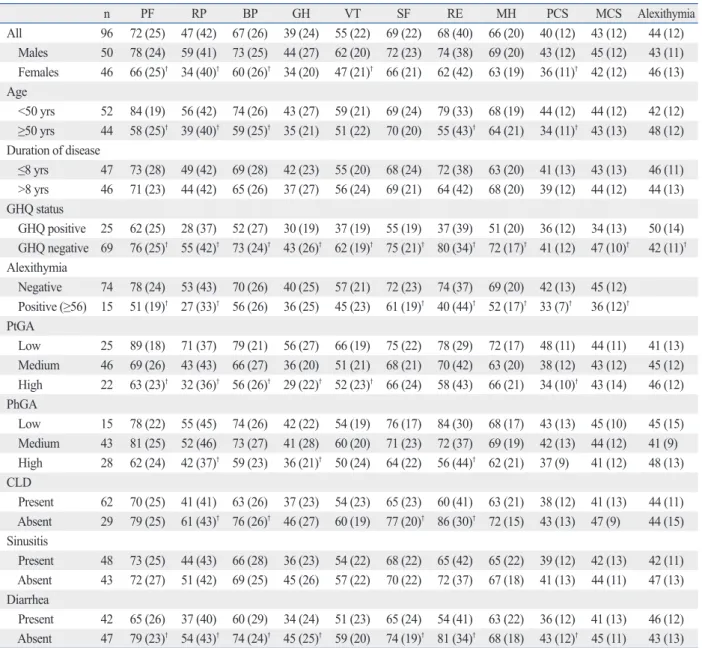
Female, older, GHQ-positive and alexithymic individuals had statistically significant lower mean SF-36 scale values (p<0.05) compared to male, younger, GHQ-negative, non- alexithymic individuals (Table 1). GHQ-positive patients (at risk of minor psychiatric non psychotic diseases such as depression/anxiety) or alexithymic individuals (who have difficulty in identifying and describing feelings) showed the worst values for evaluating QoL. SF-36 summary measures for physical and mental scales (PCS-MCS) demonstrated that GHQ-positive patients had lower mean values for MCS (34±13) in comparison with GHQ-negative patients (47±10) (p<0.05), while alexithymic individuals had lower values for PCS (33±7) in comparison to non-alexithymic individuals (42±13) (p<0.05) and lower values for MCS (36±12) in comparison to non-alexithymic individuals (45±12) (p<0.05).
Disease severity perception was associated with GHQ and alexithymia status
Cohen’s kappa was calculated to measure the agreement be- tween severity evaluations by the patients and by physicians (0.16). PhGA was greater in alexithymic CVID patients and GHQ-positive CVID patients (57% and 48%, respectively) (Table 1). Only 15% of alexithymic individuals and only 25% of GHQ-positive patients considered their disease se- verity as “high”. With a logistic regression analysis, consid- ering “underestimation” of the disease severity by the pa- tient as the dependent variable and gender, age, GHQ- positive status, and presence of alexithymia as independent variables, a statistically significant result was only observed for those less than 50 years of age (p=0.045). For “overesti- mation”, no variables were statistically significant; however, GHQ-positive patients had an OR of 2 (95% CI 0.6-6.9) . nusitis at the time of the study. A high prevalence (65.6%)
of patients with chronic lung disease (CLD) and bronchiec- tasis, confirmed by chest CT scanning, was present at the time of the survey. The prevalence was higher than 50% for both age groups. The 63 individuals with CLD were slight- ly older (mean age 49.8±17) than those without CLD (mean age 43.8±15.6); 76% of the subjects with CLD had one or more episodes of acute bronchitis or acute sinusitis during the study period. One of the subjects with CLD was using oxygen. Two patients died during the study period, one for non-Hodgkin B cell lymphoma and one for post- splenectomy sepsis. Twenty-two percent of the patients with chronic lung disease were taking daily prophylactic antibiotics (20). Chronic diarrhea was observed in 22.4% of patients. The percentage of affected patients was higher in the older age group (>50 years of age). Twenty-one patients (22.6%) had CLD, chronic diarrhea and sinusitis at the same time. We found no difference in the prevalence of chronic diseases between males and females. Other medical problems commonly seen in adults including hypertension and type II diabetes were observed in 18% and 9% of pa- tients, respectively.
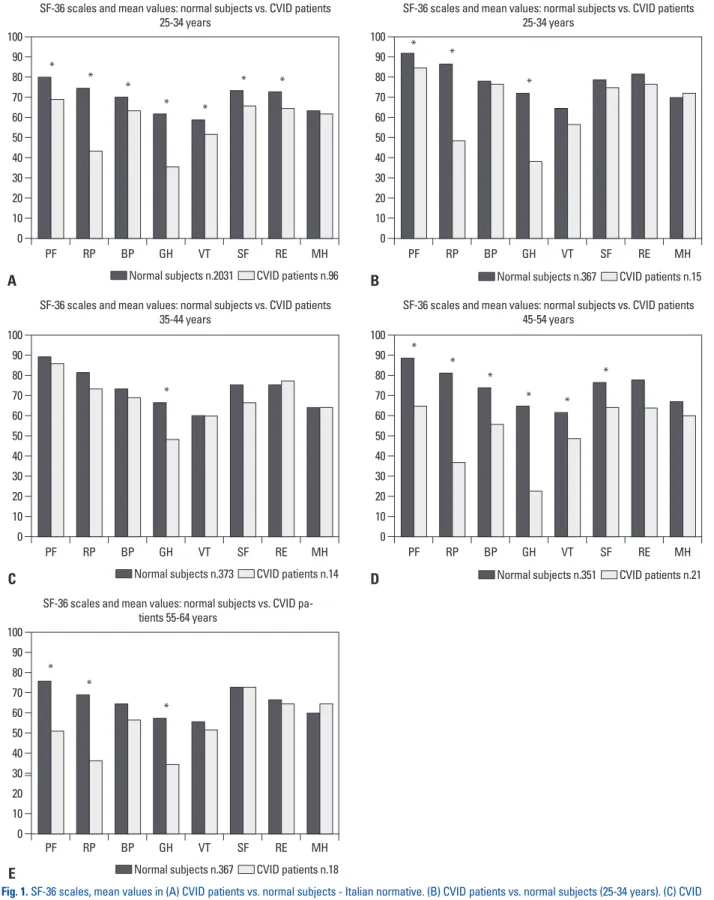
The health related quality of life was low; mental health scales are less affected than physical scales
The SF-36 mean values of all CVID patients and of differ-
ent age groups (25-34 years; 35-44 years; 45-54 years; 55-
64 years) were compared to the normative data of the Ital-
ian population (Fig. 1). Health status in CVID patients was
statistically significant lower than that observed in normal
subjects. The mental domain scales (Vitality, Social Func-
tioning, Role-Emotional, Mental Health) had values close
to those reported in normal subjects in all age groups,
whereas the physical mean value scales (Physical Function-
ing, Role-Physical, Bodily Pain, General Health) were low-
er than the normative data (p<0.05). Role-Physical and
General Health scales showed the lowest values among
CVID patients, overall. Patients with CLD (p<0.05) and
chronic diarrhea (p<0.05) had lower values on SF-36 scales
with respect to patients with no chronic diseases, while
chronic sinusitis had no effect on HRQoL (Table 1). No
correlations were found for IgG serum levels and health
status assessed by PCS and MCS or by GHQ-12 (comput-
ed using the classical Likert score). We found no differenc-
es in HRQoL between patients on intravenous immuno-
globulin therapy (IVIG) and patients who self-administered
subcutaneous immunoglobulins (SCIG) as an in-home ther-
Fig. 1. SF-36 scales, mean values in (A) CVID patients vs. normal subjects - Italian normative. (B) CVID patients vs. normal subjects (25-34 years). (C) CVID patients vs. normal subjects (35-44 years). (D) CVID patients vs. normal subjects (45-54 years). (E) CVID patients vs. normal subjects (55-64 years). Higher scores denote better health SF-36 scales. PF, physical functioning (limitations in performing physical activities such as bathing or dressing); RP, role-physi- cal (limitations with work and other daily activities as a result of physical health); BP, bodily pain (how severe and limiting is pain); GH, general health (how general personal health is evaluated by the patient); VT, vitality (feeling tired and worn out vs. feeling full of energy); SF, social functioning (interference with normal social activities due to physical or emotional problems); RE, role-emotional (limitations with work and other daily activities as a result of emo- tional problems); MH, mental health (feeling nervous and depressed vs. peaceful, happy and calm). CVID, common variable immunodeficiency; SF-36, Shot From-36. Normal subjects, Italian Normative11). *p<0.05 t-test.
Normal subjects n.2031 CVID patients n.96
Normal subjects n.373 CVID patients n.14
Normal subjects n.367 CVID patients n.18
Normal subjects n.367 CVID patients n.15
Normal subjects n.351 CVID patients n.21 0
0
0
0
0 10
10
10
10
10 20
20
20
20
20 30
30
30
30
30 40
40
40
40
40 50
50
50
50
50 60
60
60
60
60 70
70
70
70
70 80
80
80
80
80 90
90
90
90
90 100
100
100
100
100 PF
PF
PF
PF
PF RP
RP
RP
RP
RP BP
BP
BP
BP
BP GH
GH
GH
GH
GH VT
VT
VT
VT
VT SF
SF
SF
SF
SF RE
RE
RE
RE
RE MH
MH
MH
MH
MH
A
C
E
B
D
SF-36 scales and mean values: normal subjects vs. CVID patients 25-34 years
SF-36 scales and mean values: normal subjects vs. CVID patients 35-44 years
SF-36 scales and mean values: normal subjects vs. CVID pa- tients 55-64 years
SF-36 scales and mean values: normal subjects vs. CVID patients 25-34 years
SF-36 scales and mean values: normal subjects vs. CVID patients 45-54 years
*
*
*
*
*
*
*
*
*
* *
* *
*
* *
*
*
*
*
DISCUSSION
HRQoL is a subjective perception of health status (includ- ing disease and treatment) concerning physical, psychologi- cal, and social functioning and wellbeing. When consider- ing the burden of a disease, the health domain is the most pertinent aspect of quality of life and on which this study focused. Self-completed measures, acceptable to patients, are available for use in clinical settings with adequate sensi- tivity and specificity in their ability to identify problems A second patient assessment was performed over a six-
month period using the same questionnaires in order to confirm the results obtained at the first assessment. The re- sults observed in the first and second assessment of the mean values of SF-36 summary measures allowed for iden- tification of patients who reported a change in their GHQ status. The percentage of GHQ-positive patients was 27%
at the first observation and 29% at the second observation.
As expected, in subjects who had an increase in GHQ score, we observed a reduction in MCS values as a result of wors- ening mental health.
Table 1. SF-36 and Alexithymia Mean Values and Standard Deviation for Clinical Characteristics of CVID Patients*
n PF RP BP GH VT SF RE MH PCS MCS Alexithymia
All 96 72 (25) 47 (42) 67 (26) 39 (24) 55 (22) 69 (22) 68 (40) 66 (20) 40 (12) 43 (12) 44 (12) Males 50 78 (24) 59 (41) 73 (25) 44 (27) 62 (20) 72 (23) 74 (38) 69 (20) 43 (12) 45 (12) 43 (11) Females 46 66 (25)† 34 (40)† 60 (26)† 34 (20) 47 (21)† 66 (21) 62 (42) 63 (19) 36 (11)† 42 (12) 46 (13) Age
<50 yrs 52 84 (19) 56 (42) 74 (26) 43 (27) 59 (21) 69 (24) 79 (33) 68 (19) 44 (12) 44 (12) 42 (12) ≥50 yrs 44 58 (25)† 39 (40)† 59 (25)† 35 (21) 51 (22) 70 (20) 55 (43)† 64 (21) 34 (11)† 43 (13) 48 (12) Duration of disease
≤8 yrs 47 73 (28) 49 (42) 69 (28) 42 (23) 55 (20) 68 (24) 72 (38) 63 (20) 41 (13) 43 (13) 46 (11) >8 yrs 46 71 (23) 44 (42) 65 (26) 37 (27) 56 (24) 69 (21) 64 (42) 68 (20) 39 (12) 44 (12) 44 (13) GHQ status
GHQ positive 25 62 (25) 28 (37) 52 (27) 30 (19) 37 (19) 55 (19) 37 (39) 51 (20) 36 (12) 34 (13) 50 (14) GHQ negative 69 76 (25)† 55 (42)† 73 (24)† 43 (26)† 62 (19)† 75 (21)† 80 (34)† 72 (17)† 41 (12) 47 (10)† 42 (11)† Alexithymia
Negative 74 78 (24) 53 (43) 70 (26) 40 (25) 57 (21) 72 (23) 74 (37) 69 (20) 42 (13) 45 (12) Positive (≥56) 15 51 (19)† 27 (33)† 56 (26) 36 (25) 45 (23) 61 (19)† 40 (44)† 52 (17)† 33 (7)† 36 (12)† PtGA
Low 25 89 (18) 71 (37) 79 (21) 56 (27) 66 (19) 75 (22) 78 (29) 72 (17) 48 (11) 44 (11) 41 (13) Medium 46 69 (26) 43 (43) 66 (27) 36 (20) 51 (21) 68 (21) 70 (42) 63 (20) 38 (12) 43 (12) 45 (12) High 22 63 (23)† 32 (36)† 56 (26)† 29 (22)† 52 (23)† 66 (24) 58 (43) 66 (21) 34 (10)† 43 (14) 46 (12) PhGA
Low 15 78 (22) 55 (45) 74 (26) 42 (22) 54 (19) 76 (17) 84 (30) 68 (17) 43 (13) 45 (10) 45 (15) Medium 43 81 (25) 52 (46) 73 (27) 41 (28) 60 (20) 71 (23) 72 (37) 69 (19) 42 (13) 44 (12) 41 (9) High 28 62 (24) 42 (37)† 59 (23) 36 (21)† 50 (24) 64 (22) 56 (44)† 62 (21) 37 (9) 41 (12) 48 (13) CLD
Present 62 70 (25) 41 (41) 63 (26) 37 (23) 54 (23) 65 (23) 60 (41) 63 (21) 38 (12) 41 (13) 44 (11) Absent 29 79 (25) 61 (43)† 76 (26)† 46 (27) 60 (19) 77 (20)† 86 (30)† 72 (15) 43 (13) 47 (9) 44 (15) Sinusitis
Present 48 73 (25) 44 (43) 66 (28) 36 (23) 54 (22) 68 (22) 65 (42) 65 (22) 39 (12) 42 (13) 42 (11) Absent 43 72 (27) 51 (42) 69 (25) 45 (26) 57 (22) 70 (22) 72 (37) 67 (18) 41 (13) 44 (11) 47 (13) Diarrhea
Present 42 65 (26) 37 (40) 60 (29) 34 (24) 51 (23) 65 (24) 54 (41) 63 (22) 36 (12) 41 (13) 46 (12) Absent 47 79 (23)† 54 (43)† 74 (24)† 45 (25)† 59 (20) 74 (19)† 81 (34)† 68 (18) 43 (12)† 45 (11) 43 (13) SF-36: PF, physical functioning; RP, role-physical; BP, bodily pain; GH, general health; VT, vitality; SF, social functioning; RE, role-emotional; MH, mental health; PCS, physical component summary; MCS, mental component summary; CLD, chronic lung disease; PhGA, physician global assessment; PtGA, patient global assessment; CVID, common variable immunodeficiency; GHQ, General Health Questionnaire.
*p<0.05.
†Totals may vary because of missing values.
were judged by the physician (PhGA) as seriously affected reported a lower health status than the others.
Our data underlined the importance of conducting a peri- odical Health related quality of life assessment on patients with primary antibody deficiencies and other chronic ill- nesses. In fact, as expected, patients with chronic lung dis- ease and chronic diarrhea had the lowest health related quality of life values; however, being female, older, General Health Questionnaire-positive and alexithymic also proved to be major risk factors associated with a poor health status.
Finally, we suggest that in a comprehensive evaluation of HRQoL assessment should be performed in each patient in order to document the outcomes of clinical management and therapeutic intervention. Moreover, we confirmed that it is necessary to care for at risk patients with psychological support throughout their lifetime.
ACKNOWLEDGEMENTS
This study has been funded by the EU Commission, EU- RO-PADnet Health-F2-2008-201549 and supported by Jef- frey Modell Fondation and Fondazione Eleonora Lorillard Spencer Cenci. We would like to thank our patients, nurses (Anna Rita Ligia, Anna Petroni, Francesca Iasi, Michele Tucci, Assunta Iannucci) for their continuous and precious collaboration. We would also like to thank the Italian pa- tient’s association AIP (Associazione Immunodeficienze Primitive).
REFERENCES
1. Primary immunodeficiency diseases. Report of an IUIS Scientific Committee. International Union of Immunological Societies. Clin Exp Immunol 1999;118 Suppl 1:1-28.
2. Conley ME, Notarangelo LD, Etzioni A. Diagnostic criteria for primary immunodeficiencies. Representing PAGID (Pan-Ameri- can Group for Immunodeficiency) and ESID (European Society for Immunodeficiencies). Clin Immunol 1999;93:190-7.
3. Park MA, Li JT, Hagan JB, Maddox DE, Abraham RS. Common variable immunodeficiency: a new look at an old disease. Lancet 2008;372:489-502.
4. Conley ME, Park CL, Douglas SD. Childhood common variable immunodeficiency with autoimmune disease. J Pediatr 1986;108:
915-22.
5. Cunningham-Rundles C, Bodian C. Common variable immuno- deficiency: clinical and immunological features of 248 patients.
Clin Immunol 1999;92:34-48.
6. Kainulainen L, Varpula M, Liippo K, Svedström E, Nikoskelainen J, Ruuskanen O. Pulmonary abnormalities in patients with prima-
and changes. Moreover, patient-reported outcome measures in clinical practice have been proposed as a means of facili- tating doctor-patient communication, uncovering patients’
problems, monitoring disease or treatment, and screening for functional problems.
18-21However, while HRQoL mea- sures are now quite commonly included in the protocols of randomized controlled clinical trials and other clinical stud- ies, their use in routine clinical practice is still quite limited.
Only a few studies have analyzed the HRQoL of life in pa- tients with primary immunodeficiencies.
22-25A detailed anal- ysis of the burden of CVID, besides the problems of immu- noglobulin treatment, is lacking. We examined the possibility that the quality of life may be influenced by the ages of the patients; the length of CVID disease; the presence or absence of chronic sinusitis, chronic lung disease, or chronic diarrhea;
and whether the subject received gammaglobulin therapy at
home or in a hospital setting. The duration of disease did not
influence health status, while the most seriously affected
HRQoL measures were due to the presence of chronic clini-
cal conditions. Respiratory tract infections were the most
prominent clinical problem observed in our patients, in
agreement with all published data on CVID patients (re-
viewed in 3). The strong impact of CLD on HRQoL was in
line with what has been reported in patients with chronic
obstructive pulmonary disease
26-28and in patients with in-
flammatory bowel diseases
29where a relationship between
the number of symptoms and impaired levels on both phys-
ical and mental scales has been observed. Due to their
chronic clinical condition, CVID patients are faced with the
prospect of lifelong IgG replacement treatment adminis-
tered intravenously or subcutaneously at the hospital or at
home. We found no differences in HRQoL between pa-
tients on IVIG and patients who self-administered SCIG at
home. This was in contrast with the observation that adults
on IVIG therapy showed improvements in HRQoL (Vitali-
ty, Mental Health, and Social Functioning) after switching
to SCIG home therapy.
24This discrepancy might be ex-
plained by the low number of patients who decided to shift
from IVIG to SCIG and to the different measures used in
our study to investigate the burden of CVID. In fact, ac-
cording to our observation, other important aspects, besides
those measured by SF-36, might have influenced the com-
prehensive evaluation of patients’ status, such as their psy-
chological condition. Disorders such as anxiety and depres-
sion are particularly prevalent in hospital settings and still
often go unrecognized.
30,31Moreover, patients with a more
severe perception of the disease (PtGA) and patients who
21. Sweinberg SK, Wodell RA, Grodofsky MP, Greene JM, Conley ME. Retrospective analysis of the incidence of pulmonary disease in hypogammaglobulinemia. J Allergy Clin Immunol 1991;88:96- 104.
22. Nicolay U, Kiessling P, Berger M, Gupta S, Yel L, Roifman CM, et al. Health-related quality of life and treatment satisfaction in North American patients with primary immunedeficiency diseases receiving subcutaneous IgG self-infusions at home. J Clin Immu- nol 2006;26:65-72.
23. Tcheurekdjian H, Palermo T, Hostoffer R. Quality of life in com- mon variable immunodeficiency requiring intravenous immuno- globulin therapy. Ann Allergy Asthma Immunol 2004;93:160-5.
24. Gardulf A, Borte M, Ochs HD, Nicolay U; Vivaglobin Clinical Study Group. Prognostic factors for health-related quality of life in adults and children with primary antibody deficiencies receiv- ing SCIG home therapy. Clin Immunol 2008;126:81-8.
25. Winkelstein JA, Conley ME, James C, Howard V, Boyle J. Adults with X-linked agammaglobulinemia: impact of disease on daily lives, quality of life, educational and socioeconomic status, knowl- edge of inheritance, and reproductive attitudes. Medicine (Balti- more) 2008;87:253-8.
26. Carrasco Garrido P, de Miguel Díez J, Rejas Gutiérrez J, Centeno AM, Gobartt Vázquez E, Gil de Miguel A, et al. Negative impact of chronic obstructive pulmonary disease on the health-related quality of life of patients. Results of the EPIDEPOC study. Health Qual Life Outcomes 2006;4:31.
27. Bridevaux PO, Gerbase MW, Probst-Hensch NM, Schindler C, Gaspoz JM, Rochat T. Long-term decline in lung function, utilisa- tion of care and quality of life in modified GOLD stage 1 COPD.
Thorax 2008;63:768-74.
28. Voll-Aanerud M, Eagan TM, Wentzel-Larsen T, Gulsvik A, Bakke PS. Respiratory symptoms, COPD severity, and health related quality of life in a general population sample. Respir Med 2008;
102:399-406.
29. Reilly MC, Gerlier L, Brabant Y, Brown M. Validity, reliability, and responsiveness of the work productivity and activity impair- ment questionnaire in Crohn’s disease. Clin Ther 2008;30:393- 404.
30. Gilbody SM, House AO, Sheldon TA. Routinely administered questionnaires for depression and anxiety: systematic review. BMJ 2001;322:406-9.
31. van Hemert AM, Hengeveld MW, Bolk JH, Rooijmans HG, Van- denbroucke JP. Psychiatric disorders in relation to medical illness among patients of a general medical out-patient clinic. Psychol Med 1993;23:167-73.
ry hypogammaglobulinemia. J Allergy Clin Immunol 1999;104:
1031-6.
7. Quinti I, Soresina A, Spadaro G, Martino S, Donnanno S, Agostini C, et al. Long-term follow-up and outcome of a large cohort of patients with common variable immunodeficiency. J Clin Immu- nol 2007;27:308-16.
8. Ware JE Jr, Sherbourne CD. The MOS 36-item short-form health survey (SF-36). I. Conceptual framework and item selection. Med Care 1992;30:473-83.
9. Howard V, Greene JM, Pahwa S, Winkelstein JA, Boyle JM, Ko- cak M, et al. The health status and quality of life of adults with X- linked agammaglobulinemia. Clin Immunol 2006;118:201-8.
10. Daly PB, Evans JH, Kobayashi RH, Kobayashi AL, Ochs HD, Fischer SH, et al. Home-based immunoglobulin infusion therapy:
quality of life and patient health perceptions. Ann Allergy 1991;
67:504-10.
11. Apolone G, Mosconi P. The Italian SF-36 Health Survey: transla- tion, validation and norming. J Clin Epidemiol 1998;51:1025-36.
12. Goldberg D. The detection of psychiatric illness by questionnaire.
London: Oxford University Press; 1972.
13. Picardi A, Abeni D, Pasquini P. Assessing psychological distress in patients with skin diseases: reliability, validity and factor structure of the GHQ-12. J Eur Acad Dermatol Venereol 2001;15:410-7.
14. Bagby RM, Parker JD, Taylor GJ. The twenty-item Toronto Alexi- thymia Scale--I. Item selection and cross-validation of the factor structure. J Psychosom Res 1994;38:23-32.
15. Bagby RM, Taylor GJ, Parker JD. The Twenty-item Toronto Alexithymia Scale--II. Convergent, discriminant, and concurrent validity. J Psychosom Res 1994;38:33-40.
16. Bressi C, Taylor G, Parker J, Bressi S, Brambilla V, Aguglia E, et al. Cross validation of the factor structure of the 20-item Toronto Alexithymia Scale: an Italian multicenter study. J Psychosom Res 1996;41:551-9.
17. Quinti I, Soresina A, Guerra A, Rondelli R, Spadaro G, Agostini C, et al. Effectiveness of immunoglobulin replacement therapy on clinical outcome in patients with primary antibody deficiencies:
results from a multicenter prospective cohort study. J Clin Immu- nol 2011;31:315-22.
18. Higginson IJ, Carr AJ. Measuring quality of life: using quality of life measures in the clinical setting. BMJ 2001;322:1297-300.
19. Lohr KN. Advances in health status assessment. Overview of the conference. Med Care 1989;27(3 Suppl):S1-11.
20. Lohr KN. Applications of health status assessment measures in clinical practice. Overview of the third conference on advances in health status assessment. Med Care 1992;30(5 Suppl):MS1-14.