
Standardized rice bran extract improves hepatic steatosis in HepG2 cells and ovariectomized rats
12
0
0
전체 글
(2) Rice bran extract ameliorates hepatic steatosis. Sangoh Kwon https://orcid.org/0000-0001-9558-3429 Suengmok Cho https://orcid.org/0000-0001-5951-5832 Min Young Um https://orcid.org/0000-0002-8448-8837 Funding This research was supported by the Korea Institute of Planning and Evaluation for Technology in Food, Agriculture, Forestry and Fisheries (IPET) through the High Value-added Food Technology Development Program, funded by the Ministry of Agriculture, Food and Rural Affairs (MAFRA) (116036-03) and by the Main Research Program (E0164501-05) of the Korea Food Research Institute funded by the Ministry of Science and ICT. Conflict of Interest The authors declare no potential conflicts of interests. Author Contributions Conceptualization: Cho S, Um MY; Formal analysis: Lim DW, Cho S, Um MY; Funding acquisition: Um MY; Investigation: Jeon H, Kim M, Yoon M, Jung J, Kwon S; Methodology: Cho S, Um MY; Writing - original draft: Lim DW, Um MY; Writing - review & editing: Lim DW, Cho S, Um MY.. which is the primary target organ of estrogen, has attracted attention [5]. There is increasing evidence that estrogen regulates lipid metabolism, and its deficiency following menopause is associated with the occurrence of hepatic steatosis [6]. In fact, estrogen replacement therapy reduces the risk of fatty liver [7]. In menopause, a loss of the liver's capacity to oxidize fatty acids occurs, along with an increase in lipogenesis, resulting in excessive fat accumulation in the liver [8]. Therefore, menopausal women should be considered targets for clinical interventions for further investigations of hepatic steatosis. Rice (Oryza sativa L.) is an important cereal crop consumed by more than half of the world's population as a staple food [9]. Rice bran, the byproduct of rice milling, contains an array of phytochemicals, such as phenolics, flavonoids, vitamins, amino acids, and phytosterols. Various studies have indicated that rice bran has diverse health effects, including antioxidant, antiinflammatory, cholesterol-lowering, anti-hyperlipidemic, and anti-diabetic activities [10-13]. In addition, several clinical studies reported that the consumption of stabilized rice bran, which is rice bran inactivated by the lipase enzyme through heating, decreases fasting glucose, total cholesterol (TC), low-density lipoprotein cholesterol, apolipoprotein B, and triglyceride (TG) levels, and increases insulin in the sera of patients with diabetes [14,15]. In particular, γ-oryzanol, which is a major compound in rice bran, reduced the bone mineral density loss associated with ovariectomized (OVX)-induced estrogen deficiency in rats via γ-amino butyric acid B receptors [16]. Moreover, it ameliorates lipopolysaccharide-induced cognitive and memory impairments in mice by promoting hippocampal antioxidant and anti-inflammatory molecular responses [17]. Despite the diverse pharmacological activities of rice bran, its effects and underlying molecular mechanisms in protecting against hepatic steatosis induced by estrogen deficiency are unclear. In the present study, we hypothesized that a standardized rice bran extract (RBS) impacts hepatic steatosis induced by estrogen deficiency by altering lipogenesis-related genes. Therefore, the protective effects of RBS on the liver were investigated in the livers of OVX rats, animal models of human menopause, as well as in oleic acid-treated HepG2 cells [18].. MATERIALS AND METHODS Preparation of RBS The RBS (Lot No. SD-RB-002) standardized with 0.45% γ-oryzanol was obtained from S&D Co., Ltd. (Cheongju, Korea) as previously described [19-21]. Briefly, rice bran (O. sativa L.) was extracted in an ethanol/water solution at 40°C for 8 h. The ethanol extract was filtered, concentrated, and spray-dried for storage. The yield of RBS was 29.3%. HPLC analysis was performed using a LiChrospher 100 Diol column (250 × 4.0 mm, 5 µm; Merck Millipore, Billerica, MA, USA). The solvent systems used for separation were an isocratic elution (A: 0.1% acetic acid in cyclohexane, and B: 0.1% acetic acid in ethyl acetate) in a ratio of 85:15 (v/v). The injection volume was 10 µL and the column eluent was monitored at UV 315 nm; chromatography was performed at 30°C with a flow rate of 0.5 mL/min. The HPLC quantitative analysis was replicated three times. A representative chromatogram of the γ-oryzanol reference and its corresponding peak in the RBS is presented in Fig. 1.. Cell culture and oil red O (ORO) staining HepG2 cells were obtained from ATCC (Manassas, VA, USA). The cells were maintained in DMEM supplemented with antibiotics (100 U/mL penicillin A and 100 U/mL streptomycin) and 10% fetal bovine serum. The cells were treated with or without samples in oleic acid (200 µM) for 24 h. Lipid droplets were visualized and subsequently quantified by ORO staining. https://e-nrp.org. https://doi.org/10.4162/nrp.2020.14.6.568. 569.
(3) Rice bran extract ameliorates hepatic steatosis. (B) 90 80 70 60 50 40 30 20 10 0. γ-oryzanol. Standard. 120. Rice bran extract. 100 80. mAU. mAU. (A). 60 40 20 0. 0. 5. 10. 15. 20. 0. Min. 5. 10. 15. 20. Min. Fig. 1. HPLC chromatograms of RBS detected at ultraviolet 315 nm. A standard chromatogram of γ-oryzanol (A) was compared with the chromatogram of RBS (B) and contents of the compounds were calculated based on the standard. RBS, rice bran extract.. The cells were fixed in 10% formaldehyde for 1 h, washed with 60% isopropanol, and mixed with ORO solution. Red-stained lipid droplets were observed with a light microscope. To quantify lipid accumulation, ORO was eluted with 100% isopropanol, and then, the optical densities of the eluates were measured using a spectrophotometer at 500 nm.. Animal studies Female sham-operated and OVX rats (Sprague-Dawley, 6 weeks of age) were purchased from SLC (Shizouka, Japan). The rats were maintained at a temperature and humidity of 21–25°C and 50–60%, respectively, and under a 12-h:12-h light:dark cycle with free access to water and food. Thirty rats were subjected to the removal of the bilateral ovaries (OVX), and 10 rats were subjected to incision and suturing without ovary removal (SHAM group). After a 2-week recovery period, the OVX rats were randomly divided into 3 groups (n = 10 per group) as follows: OVX rats fed a normal diet (ND; OVX group), OVX rats fed an ND containing 17β-estradiol (E2, 10 µg/kg body weight; OVX+E2 group), and OVX rats fed an ND containing RBS (500 mg/kg body weight; OVX+RBS group) for 16 weeks. The dosage of RBS and E2 were chosen based on our preliminary study and previous reports [20,22,23]. This dosage was converted from dose per kg body weight to % of diet considering daily intake and body weight of rats. Finally, rats were fed an ND containing 0.00002% E2 or ND containing 1% RBS. The ND was prepared by supplementing the basal American Institute of Nutrition-93G diet (Research Diets, New Brunswick, NJ, USA). The experimental diets were prepared by mixing RBS or E2 into the AIN-93G diet, shown in Supplementary Table 1. Body weight was measured once per week, and food intake was measured 3 times per week. After feeding the rats with the experimental diets for 16 weeks, we collected blood from the retro-orbital sinus in the fasted state. The sera were separated and stored at −80°C until analysis. The liver and adipose tissues were removed, weighed, and stored at −80°C. All animal experiments were approved by the Korea Food Research Institutional Animal Care and Use Committee (permission number: KFRI-M-16056).. Serum biochemical analysis Serum TC, TG, high-density lipoprotein-cholesterol (HDL-C), free fatty acid (FFA), and glucose levels were measured using commercial enzyme kits (Shinyang Chemical Co., Ltd., Seoul, Korea). Alanine aminotransferase (ALT) and aspartate aminotransferase (AST) activities were measured using commercial reagent kits (Young-Dong Diagnostics, Yongin, Korea). https://e-nrp.org. https://doi.org/10.4162/nrp.2020.14.6.568. 570.
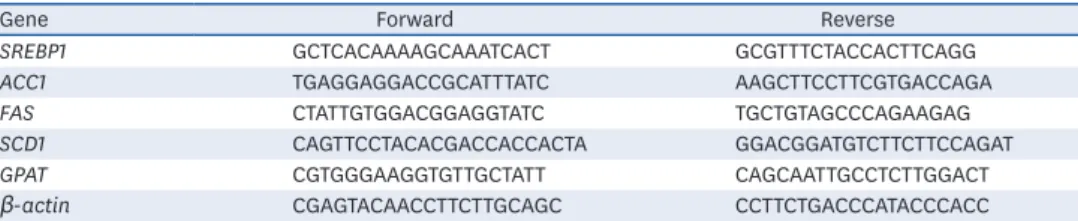
(4) Rice bran extract ameliorates hepatic steatosis. Hepatic lipid analysis Hepatic total lipids were extracted as described by Folch et al. [24]. Hepatic TG and TC were measured using a commercial enzyme kit (Shinyang Chemical Co., Ltd.).. Histological analysis Liver tissue was removed from the same part of the left lobe of each rat and fixed with 4% formaldehyde in phosphate-buffered solution. The paraffin-embedded liver samples were sliced into 5-µm-thick sections and stained with hematoxylin and eosin (H&E). Stained sections were analyzed by light microscopy (BX50, Olympus, Tokyo, Japan), and digital images were captured.. Quantitative reverse transcription polymerase chain reaction (qRT-PCR) The expression of the sterol regulatory element-binding protein 1 (SREBP1), acetyl-CoA carboxylase 1 (ACC1), fatty-acid synthase (FAS), stearoyl-CoA desaturase 1 (SCD1), and glycerol-3-phosphate acyltransferase 1 (GPAT) genes was analyzed by qRT-PCR. The primers used in this study are shown in Table 1. Total RNA was extracted from the liver tissue using a total RNA isolation kit (Macherey-Nagel, Düren, Germany) according to the manufacturer's protocol. The cDNA was synthesized using ReverTra Ace qPCR RT Master Mix (Toyobo, Osaka, Japan). qRT-PCR was performed with SYBR Green Master Mix (Toyobo) and forward/ reverse primers using a QuantStudio 6 Flex RT PCR System (Applied Biosystems, Foster City, CA, USA). The relative gene expression levels were normalized to that of β-actin.. Statistical analysis The results are expressed as the mean ± SD. Differences were assessed by analysis of variance and Tukey's multiple comparis[INSERT FIGURE 001]on test using the SPSS 18.0 statistical package (SPSS, Inc., Chicago, IL, USA); P < 0.05 was considered significant.. RESULTS Identification of γ-oryzanol in RBS. γ-oryzanol, which is a unique component of rice bran, is widely known as the marker compound in rice bran extracts or products [25]. To confirm its existence in RBS, HPLC analysis was performed (Fig. 1). As a result, γ-oryzanol in RBS was detected at 4.50 ± 0.01 mg/g extract.. Effect of RBS on lipid accumulation in oleic acid-induced HepG2 cells To investigate the effect of RBS on oleic acid-induced intracellular lipid accumulation, HepG2 cells were treated with 200 µM oleic acid and RBS (100 and 250 µg/mL) or γ-oryzanol (1 and 10 µM). As shown in Fig. 2, oleic acid-treated HepG2 cells showed a significant increase in lipid droplets, whereas untreated control cells did not. However, the development of lipid droplets induced by oleic acid was significantly decreased by RBS or γ-oryzanol treatment. Table 1. Primer sequences Gene Forward Reverse SREBP1 GCTCACAAAAGCAAATCACT GCGTTTCTACCACTTCAGG ACC1 TGAGGAGGACCGCATTTATC AAGCTTCCTTCGTGACCAGA FAS CTATTGTGGACGGAGGTATC TGCTGTAGCCCAGAAGAG SCD1 CAGTTCCTACACGACCACCACTA GGACGGATGTCTTCTTCCAGAT GPAT CGTGGGAAGGTGTTGCTATT CAGCAATTGCCTCTTGGACT β-actin CGAGTACAACCTTCTTGCAGC CCTTCTGACCCATACCCACC ACC1, acetyl-CoA carboxylase 1; FAS, fatty acid synthase; GPAT, glycerol-3-phosphate acyltransferase; SCD1, stearoyl-CoA desaturase 1; SREBP1, sterol regulatory element-binding protein 1.. https://e-nrp.org. https://doi.org/10.4162/nrp.2020.14.6.568. 571.
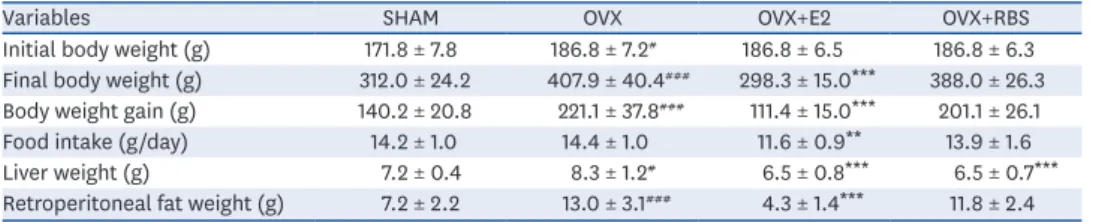
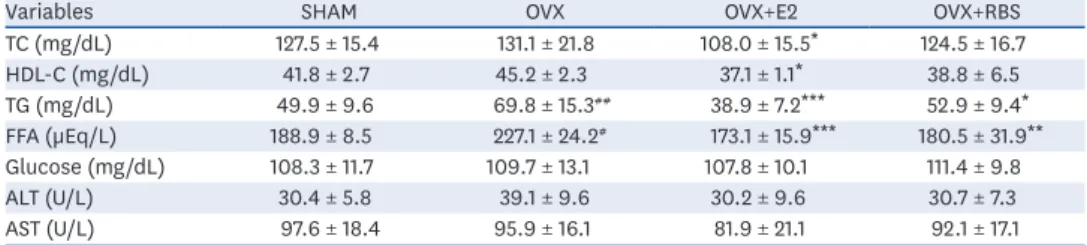
(5) Rice bran extract ameliorates hepatic steatosis. CONT. OA+RBS 100 µg/mL. OA+ORY 1 µM 3. OA+vehicle. OA+RBS 250 µg/mL. OA+ORY 10 µM. Oil O Red (relative to CONT). ###. *. 2. **. ***. 1. OA +. C OA ON T + ve RB OA S 10 hicl +R 0 µ e BS g 25 /mL 0 OA µg/ +O mL OA RY +O 1 µM RY 10 µM. 0. Fig. 2. Effects of RBS and γ-oryzanol on intracellular lipid accumulation in OA-stimulated HepG2 cells. After treatment with 200 µM OA with or without RBS and γ-oryzanol for 24 h, the cells were stained with ORO solution and intracellular lipid accumulation was visually observed under a light microscope (magnification, ×200). Data are expressed as mean ± SD. RBS, rice bran extract; ORO, oil red O; CONT, not-treated cells; OA, oleic acid; ORY, γ-oryzanol; RBS, rice bran extract. ### P < 0.001 compared to untreated cells. *P < 0.05, **P < 0.01, and ***P < 0.001 compared to OA only treated cells.. Effect of RBS on body and organ weights Compared to those in the SHAM group, the OVX group showed significant increases in the final body weight, body weight gain, and fat pad weight. However, the final body weight, body weight gain, and fat pad weight in the RBS group were lower than those in the OVX group, although the differences were not significant. We also found that liver weight was significantly higher in OVX rats than in SHAM rats, and this increase was significantly attenuated by RBS supplementation (Table 2).. Effect of RBS on blood parameters As shown in Table 3, OVX rats exhibited significantly higher serum TG and FFA levels than the SHAM group. In contrast, RBS supplementation restored serum TGs and FFAs to levels similar to those of the SHAM group. However, TC, HDL-C, ALT, and AST levels did not differ significantly among the experimental groups.. RBS attenuates hepatic lipid accumulation Next, we investigated whether RBS protects against OVX-induced hepatic steatosis. As shown Fig. 3, histological analysis showed that OVX rats developed hepatocellular microand macrovesicular vacuolation, but these alterations were ameliorated by RBS (Fig. 3). Furthermore, increases in hepatic total lipids, TG, and TC levels induced by OVX were Table 2. Effects of RBS on body weight and organ weights in OVX rats fed an experimental diet for 16 weeks Variables SHAM OVX OVX+E2 OVX+RBS Initial body weight (g) 171.8 ± 7.8 186.8 ± 7.2# 186.8 ± 6.5 186.8 ± 6.3 Final body weight (g) 312.0 ± 24.2 407.9 ± 40.4### 298.3 ± 15.0*** 388.0 ± 26.3 Body weight gain (g) 140.2 ± 20.8 221.1 ± 37.8### 111.4 ± 15.0*** 201.1 ± 26.1 Food intake (g/day) 14.2 ± 1.0 14.4 ± 1.0 11.6 ± 0.9** 13.9 ± 1.6 Liver weight (g) 7.2 ± 0.4 8.3 ± 1.2# 6.5 ± 0.8*** 6.5 ± 0.7*** Retroperitoneal fat weight (g) 7.2 ± 2.2 13.0 ± 3.1### 4.3 ± 1.4*** 11.8 ± 2.4 Data are expressed as mean ±SD. SHAM, sham-operated controls; E2, 17β-estradiol; OVX, ovariectomized; RBS, rice bran extract. # P < 0.05, ###P < 0.001 compared to the SHAM group. **P < 0.01, ***P < 0.001 compared to the OVX group.. https://e-nrp.org. https://doi.org/10.4162/nrp.2020.14.6.568. 572.
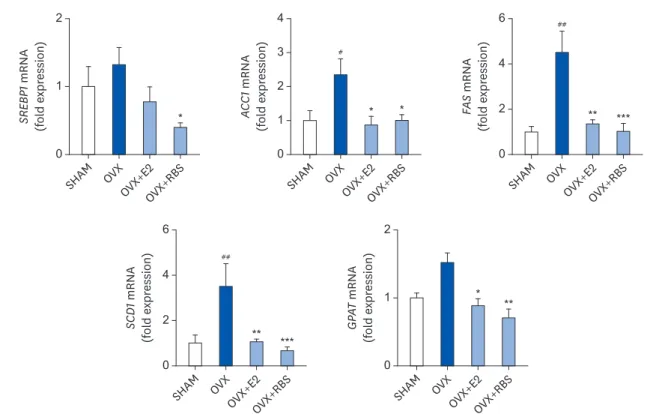
(6) Rice bran extract ameliorates hepatic steatosis. Table 3. Effect of RBS on fasting serum lipids levels in OVX rats fed an experimental diet for 16 weeks Variables SHAM OVX OVX+E2 OVX+RBS TC (mg/dL) 127.5 ± 15.4 131.1 ± 21.8 108.0 ± 15.5* 124.5 ± 16.7 HDL-C (mg/dL) 41.8 ± 2.7 45.2 ± 2.3 37.1 ± 1.1* 38.8 ± 6.5 TG (mg/dL) 49.9 ± 9.6 69.8 ± 15.3## 38.9 ± 7.2*** 52.9 ± 9.4* FFA (µEq/L) 188.9 ± 8.5 227.1 ± 24.2# 173.1 ± 15.9*** 180.5 ± 31.9** Glucose (mg/dL) 108.3 ± 11.7 109.7 ± 13.1 107.8 ± 10.1 111.4 ± 9.8 ALT (U/L) 30.4 ± 5.8 39.1 ± 9.6 30.2 ± 9.6 30.7 ± 7.3 AST (U/L) 97.6 ± 18.4 95.9 ± 16.1 81.9 ± 21.1 92.1 ± 17.1 Data are expressed as mean ±SD. RBS, rice bran extract; OVX, ovariectomized; SHAM, sham-operated controls; E2, 17β-estradiol; TC, total cholesterol; HDL-C, high-density lipoprotein cholesterol; TG, triglyceride; FFA, free fatty acids; ALT, alanine aminotransferase; AST, aspartate aminotransferase. # P < 0.05, ##P < 0.01 compared with SHAM group. *P < 0.05, **P < 0.01, and ***P < 0.001 compared with OVX group.. significantly attenuated by RBS (45.5%, 49.3%, and 22.3% reductions compared to levels in the OVX group, respectively), similar to those in the OVX+E2 group (Table 3). These data indicate that RBS exerts inhibitory effects on hepatic steatosis.. RBS ameliorates expression of lipogenic genes It is possible that RBS reduces fat accumulation in hepatocytes by regulating the expression of genes involved in lipogenesis. To test this hypothesis, we analyzed the hepatic expression of genes associated with lipogenesis by qRT-PCR. As shown in Fig. 3, the mRNA expression levels of lipogenic genes, including SREBP1, ACC1, FAS, SCD1, and GPAT, were increased in the livers of OVX rats compared to those in the SHAM group. In contrast, RBS supplementation decreased the expression levels of these genes (Fig. 4). These data suggest that RBS suppresses OVX-induced fatty liver by downregulating the expression of lipogenesis genes.. (A). 90 60. **. **. 30. 30 20. ***. ***. 10. OV OV X X+ OV E2 X+ RB S. AM SH. SH. OV OV X X+ OV E2 X+ RB S. 0. AM. 0. ###. 3 #. **. 2. *. 1 0. OV OV X X+ OV E2 X+ RB S. 40 #. OVX+RBS. AM. 120. Hepatic triglycerides (mg/g tissue). Hepatic total lipids (mg/g tissue). (B). OVX+E2. SH. OVX. Hepatic total cholesterol (mg/g tissue). SHAM. Fig. 3. Effect of RBS on hepatic lipid levels in OVX rats. (A) Histological changes (original magnification, ×200) and (B) hepatic lipid, triglyceride, and total cholesterol levels in rats. Data are expressed as mean ± SD. RBS, rice bran extract; OVX, ovariectomized; E2, 17β-estradiol; SHAM, sham-operated controls. # P < 0.05 and ###P < 0.001 compared to the SHAM group. *P < 0.05, **P < 0.01, and ***P < 0.001 compared to the OVX group.. https://e-nrp.org. https://doi.org/10.4162/nrp.2020.14.6.568. 573.
(7) Rice bran extract ameliorates hepatic steatosis. *. #. 2 *. *. 1. **. ***. M. 2 ##. 4 2. **. ***. *. 1. **. OV OV X X+ OV E2 X+ RB S. AM SH. SH. OV OV X X+ OV E2 X+ RB S. 0. AM. 0. GPAT mRNA (fold expression). 6. SCD1 mRNA (fold expression). 2. SH A. OV OV X X+ OV E2 X+ RB S. SH A. OV OV X X+ OV E2 X+ RB S. SH A. 4. 0. M. 0. M. 0. 3. ##. OV OV X X+ OV E2 X+ RB S. 1. 6. FAS mRNA (fold expression). 4. ACC1 mRNA (fold expression). SREBP1 mRNA (fold expression). 2. Fig. 4. RBS suppresses the mRNA expression of lipogenic genes. Relative mRNA levels were measured by qRT-PCR and normalized against that of β-actin. Data from three independent experiments are presented as the mean ± SD. RBS, rice bran extract; qRT-PCR, quantitative reverse transcription polymerase chain reaction; SHAM, sham-operated controls; OVX, ovariectomized; E2, 17β-estradiol; SREBP1, sterol regulatory element-binding protein 1; ACC1, acetyl-CoA carboxylase 1; FAS, fatty acid synthase; SCD1, stearoyl-CoA desaturase 1; GPAT, glycerol-3-phosphate acyltransferase. # P < 0.05, ##P < 0.01 compared to the SHAM group. *P < 0.05, **P < 0.01, and ***P < 0.001 compared to the OVX group.. DISCUSSION Postmenopausal women exhibit more frequent development of hepatic steatosis than premenopausal women. For example, aromatase-knockout mice, a useful model for examining the role of estrogen, exhibit hyperlipidemia and hepatic steatosis [26]. In addition, OVX-induced estrogen decreases significantly increase serum lipoprotein levels and hepatic fat accumulation, whereas E2 treatment completely restores normal levels [27]. Heine et al. [28] reported that estrogen receptor-knockout mice exhibit greater fat masses and lower energy expenditures than wild-type mice. Estrogen has been reported to play a role in liver fat accumulation; thus, estrogen deficiency leads to a disturbance of lipid regulatory mechanisms in the liver [29]. As estrogen levels decrease, this lipid accumulation might be the result of several factors, including alterations in the uptake or export of fatty acids, changes in the mitochondrial oxidation of fatty acids, and reduced export of TGs [30]. Thus, fat accumulation in the liver is of critical concern in postmenopausal women. Therefore, we investigated the protective effects of RBS on HepG2 cells and OVX-induced hepatic steatosis in rats. In the present study, we found that lipid accumulation was significantly increased in oleic acid-treated HepG2 cells. RBS and γ-oryzanol, a major component of RBS, exerted an inhibitory effect on oleic acid-induced lipid accumulation in HepG2 cells. In agreement with the in vitro data obtained using HepG2 cells, we found that OVX caused hepatic fat accumulation, whereas RBS supplementation suppressed OVX-induced increases in hepatic lipid accumulation and lipid levels. Moreover, RBS reduced serum TG and FFA levels. RBS supplementation could have induced this reduction in circulating lipid levels by decreasing https://e-nrp.org. https://doi.org/10.4162/nrp.2020.14.6.568. 574.
(8) Rice bran extract ameliorates hepatic steatosis. lipid transport to the liver, thereby preventing hepatic lipid accumulation. Surprisingly, in our study, the serum AST and ALT levels, used as indicators of hepatic damage [31], did not differ among the experimental groups. Charatcharoenwitthaya et al. [32] reported that the level of hepatic enzymes is an insensitive tool to follow histological changes in the liver among patients with nonalcoholic fatty liver disease. Moreover, in animal studies comparing OVX and SHAM mice, serum markers of liver function, ALT or AST, showed no significant differences between both groups, although fat accumulation was observed in the OVX animals [33,34]. Thus, our results suggest that the effects of RBS on circulating lipid profiles in serum can be attributed to improved hepatic lipid accumulation. In the present study, RBS altered hepatic lipid metabolism and the expression of genes involved in these processes. Liver fatty acid synthesis might result in hepatic steatosis and is mostly regulated by well-known transcription factors, such as SREBP1. SREBP1 is the key regulator of hepatic fatty acid and TG synthesis [35], and reducing its expression is thought to improve hepatic steatosis. SREBP-1c activates ACC1, FAS, SCD1, and GPAT, which are responsible for lipogenesis in the liver. ACC1, the enzyme that carboxylates acetyl-CoA to malonyl-CoA, is utilized by FAS in the synthesis of fatty acids [36]. A previous study showed that SCD1, a central lipogenic enzyme catalyzing the synthesis of monounsaturated fatty acids, -deficient mice display reduced lipid synthesis and enhanced lipid oxidation and insulin sensitivity in the liver [37]. Moreover, the human fatty liver is characterized by increased hepatic SCD1 levels and lipogenic activity [38]. GPAT catalyzes the first step in the synthesis of TGs and is recognized as contributing to lipogenesis in the liver [39]. Interestingly, GPAT has been suggested as a potential therapeutic target for dyslipidemia and obesity [40]. As expected, our results showed that the expression levels of the hepatic lipogenic genes SREBP1, ACC1, and FAS were increased in the livers of OVX rats, which is supported by previous studies showing that lipogenesis-related protein expression in the liver is dramatically increased in OVX animal models [41,42]. Based on our results, SREBP1induced expression of FAS and ACC1 mRNA might have affected the production of fatty acids. These fatty acids are used as a source for TG synthesis by SCD1 and GPAT, thereby triggering lipid accumulation in hepatocytes. However, in the present study, RBS supplementation notably inhibited the mRNA expression of these lipogenic genes. Our findings suggest that RBS ameliorates OVX-induced hepatic lipid accumulation by regulating genes involved in lipogenesis. Hao et al. [43] reported that a pre-germinated brown rice extract decreases the protein expression of SREBP1, SCD1, and FAS in the livers of high-fat diet (HFD)-fed mice. Moreover, the typical hepatic steatosis observed in the livers of ApoE−/− mice fed an HFD was reduced by rice bran enzymatic extract [44]. These effects could have been the result of various bioactive compounds (phytic acid, γ-oryzanol, GABA, phenolics, and anthocyanins) present in the rice bran [45]. Among them, γ-oryzanol, which consists of a mixture of ferulic acid esters of sterols, has been suggested to reduce circulating levels of liver lipoproteins in obese rats [46]. Furthermore, γ-oryzanol alleviates high-fat and high-fructose diet-induced hepatic steatosis through the inhibition of intracellular TG and TC accumulation in male SD rats and downregulates the expression of the lipogenic genes FAS, SCD1, ACCα, and ACCβ in HepG2 cells [47]. In the study by Wang et al. [48], γ-oryzanol was found to ameliorate HFD-induced obesity in mice and also reduced obesity-induced chronic inflammation in the hepatic tissues of mice. The authors indicated that γ-oryzanol-mediated inhibition of nuclear factor-κB activation might have participated in both anti-inflammation and lipid-lowering effects. Song et al. [49] reported that phytosterol esters attenuate hepatic steatosis in rats fed a HFD. Although not all components of RBS have been identified, we measured the content of γ-oryzanol in the RBS as 4.5 mg/g extract. Additionally, γ-oryzanol significantly inhibited https://e-nrp.org. https://doi.org/10.4162/nrp.2020.14.6.568. 575.
(9) Rice bran extract ameliorates hepatic steatosis. lipid accumulation in oleic acid-treated HepG2 cells. Thus, various components of RBS likely contributed to its hepatoprotective effects. Collectively, our results indicate that RBS inhibits increases in serum TG and FFA levels and hepatic lipid accumulation by downregulating SREBP1-mediated activation of lipogenic genes. This study provides a basis for the use of RBS as a supplement for the treatment or prevention of fatty liver in postmenopausal women.. SUPPLEMENTARY MATERIAL Supplementary Table 1 Composition of experimental diets (g/kg of diet) Click here to view. REFERENCES 1. Farrell GC, Larter CZ. Nonalcoholic fatty liver disease: from steatosis to cirrhosis. Hepatology 2006;43:S99-112. PUBMED | CROSSREF. 2. Singh A, Le P, Lopez R, Alkhouri N. The utility of noninvasive scores in assessing the prevalence of nonalcoholic fatty liver disease and advanced fibrosis in type 1 diabetic patients. Hepatol Int 2018;12:37-43. PUBMED | CROSSREF. 3. Fan JG, Kim SU, Wong VW. New trends on obesity and NAFLD in Asia. J Hepatol 2017;67:862-73. PUBMED | CROSSREF. 4. Summart U, Thinkhamrop B, Chamadol N, Khuntikeo N, Songthamwat M, Kim CS. Gender differences in the prevalence of nonalcoholic fatty liver disease in the Northeast of Thailand: a population-based crosssectional study. F1000 Res 2017;6:1630. PUBMED | CROSSREF. 5. Fu X, Xing L, Xu W, Shu J. Treatment with estrogen protects against ovariectomy-induced hepatic steatosis by increasing AQP7 expression. Mol Med Rep 2016;14:425-31. PUBMED | CROSSREF. 6. Gualtieri M, Cahoon SS, Paulson RJ, Shoupe D, Muderspach LI, Roman LD, Matsuo K. Surgical menopause and the increased risk of non-alcoholic fatty liver disease in patients with endometrial hyperplasia and cancer. Fertil Steril 2015;103:e23. CROSSREF. 7. Walsh BW, Schiff I, Rosner B, Greenberg L, Ravnikar V, Sacks FM. Effects of postmenopausal estrogen replacement on the concentrations and metabolism of plasma lipoproteins. N Engl J Med 1991;325:1196-204. PUBMED | CROSSREF. 8. Mabunga DF, Gonzales EL, Kim HJ, Choung SY. Treatment of GABA from fermented rice germ ameliorates caffeine-induced sleep disturbance in mice. Biomol Ther (Seoul) 2015;23:268-74. PUBMED | CROSSREF. 9. Wani AA, Singh P, Shah MA, Schweiggert-Weisz U, Gul K, Wani IA. Rice starch diversity: effects on structural, morphological, thermal, and physicochemical properties-a review. Compr Rev Food Sci Food Saf 2012;11:417-36. CROSSREF. 10. Laokuldilok T, Shoemaker CF, Jongkaewwattana S, Tulyathan V. Antioxidants and antioxidant activity of several pigmented rice brans. J Agric Food Chem 2011;59:193-9. PUBMED | CROSSREF. 11. Kahlon TS, Chow FI, Sayre RN, Betschart AA. Cholesterol-lowering in hamsters fed rice bran at various levels, defatted rice bran and rice bran oil. J Nutr 1992;122:513-9. PUBMED | CROSSREF. 12. Rhee YH, Rhee CH, Chung PS, Ahn JC. Anti-oxidant and anti-inflammatory effects of rice bran and green tea fermentation mixture on lipopolysaccharide-induced RAW 264.7 macrophages. Trop J Pharm Res 2017;16:2943-51. CROSSREF. https://e-nrp.org. https://doi.org/10.4162/nrp.2020.14.6.568. 576.
(10) Rice bran extract ameliorates hepatic steatosis. 13. Nie Y, Luo F, Wang L, Yang T, Shi L, Li X, Shen J, Xu W, Guo T, Lin Q. Anti-hyperlipidemic effect of rice bran polysaccharide and its potential mechanism in high-fat diet mice. Food Funct 2017;8:4028-41. PUBMED | CROSSREF. 14. Qureshi AA, Sami SA, Khan FA. Effects of stabilized rice bran, its soluble and fiber fractions on blood glucose levels and serum lipid parameters in humans with diabetes mellitus types I and II. J Nutr Biochem 2002;13:175-87. PUBMED | CROSSREF. 15. Cheng HH, Huang HY, Chen YY, Huang CL, Chang CJ, Chen HL, Lai MH. Ameliorative effects of stabilized rice bran on type 2 diabetes patients. Ann Nutr Metab 2010;56:45-51. PUBMED | CROSSREF. 16. Muhammad SI, Maznah I, Mahmud R, Zuki AB, Imam MU. Upregulation of genes related to bone formation by γ-amino butyric acid and γ-oryzanol in germinated brown rice is via the activation of GABAB-receptors and reduction of serum IL-6 in rats. Clin Interv Aging 2013;8:1259-71. PUBMED | CROSSREF. 17. Mastinu A, Bonini SA, Rungratanawanich W, Aria F, Marziano M, Maccarinelli G, Abate G, Premoli M, Memo M, Uberti D. Gamma-oryzanol prevents LPS-induced brain inflammation and cognitive impairment in adult mice. Nutrients 2019;11:728. PUBMED | CROSSREF. 18. Høegh-Andersen P, Tankó LB, Andersen TL, Lundberg CV, Mo JA, Heegaard AM, Delaissé JM, Christgau S. Ovariectomized rats as a model of postmenopausal osteoarthritis: validation and application. Arthritis Res Ther 2004;6:R169-80. PUBMED | CROSSREF. 19. Yang H, Yoon M, Um MY, Lee J, Jung J, Lee C, Kim YT, Kwon S, Kim B, Cho S. Sleep-promoting effects and possible mechanisms of action associated with a standardized rice bran supplement. Nutrients 2017;9:512. PUBMED | CROSSREF. 20. Um MY, Kim S, Jin YH, Yoon M, Yang H, Lee J, Jung J, Urade Y, Huang ZL, Kwon S, Cho S. A novel neurological function of rice bran: a standardized rice bran supplement promotes non-rapid eye movement sleep in mice through histamine H1 receptors. Mol Nutr Food Res 2017;61:1700316. PUBMED | CROSSREF. 21. Um MY, Yang H, Han JK, Kim JY, Kang SW, Yoon M, Kwon S, Cho S. Rice bran extract supplement improves sleep efficiency and sleep onset in adults with sleep disturbance: a randomized, double-blind, placebo-controlled, polysomnographic study. Sci Rep 2019;9:12339. PUBMED | CROSSREF. 22. Lim DW, Kim JG, Kim YT. Effects of dietary isoflavones from Puerariae radix on lipid and bone metabolism in ovariectomized rats. Nutrients 2013;5:2734-46. PUBMED | CROSSREF. 23. Lim DW, Kim YT. Anti-osteoporotic effects of Angelica sinensis (Oliv.) Diels extract on ovariectomized rats and its oral toxicity in rats. Nutrients 2014;6:4362-72. PUBMED | CROSSREF. 24. Folch J, Lees M, Sloane Stanley GH. A simple method for the isolation and purification of total lipides from animal tissues. J Biol Chem 1957;226:497-509. PUBMED. 25. Sawada K, Rahmania H, Matsuki M, Hashimoto H, Ito J, Miyazawa T, Nakagawa K. Absorption and metabolism of γ-oryzanol, a characteristic functional ingredient in rice bran. J Nutr Sci Vitaminol (Tokyo) 2019;65:S180-4. PUBMED | CROSSREF. 26. Jones ME, Thorburn AW, Britt KL, Hewitt KN, Wreford NG, Proietto J, Oz OK, Leury BJ, Robertson KM, Yao S, Simpson ER. Aromatase-deficient (ArKO) mice have a phenotype of increased adiposity. Proc Natl Acad Sci U S A 2000;97:12735-40. PUBMED | CROSSREF. 27. Weigt C, Hertrampf T, Flenker U, Hülsemann F, Kurnaz P, Fritzemeier KH, Diel P. Effects of estradiol, estrogen receptor subtype-selective agonists and genistein on glucose metabolism in leptin resistant female Zucker diabetic fatty (ZDF) rats. J Steroid Biochem Mol Biol 2015;154:12-22. PUBMED | CROSSREF. 28. Heine PA, Taylor JA, Iwamoto GA, Lubahn DB, Cooke PS. Increased adipose tissue in male and female estrogen receptor-alpha knockout mice. Proc Natl Acad Sci U S A 2000;97:12729-34. PUBMED | CROSSREF. 29. Lavoie JM, Pighon A. NAFLD, estrogens, and physical exercise: the animal model. J Nutr Metab 2012;2012:914938. PUBMED | CROSSREF. https://e-nrp.org. https://doi.org/10.4162/nrp.2020.14.6.568. 577.
(11) Rice bran extract ameliorates hepatic steatosis. 30. Oliveira MC, Campos-Shimada LB, Marçal-Natali MR, Ishii-Iwamoto EL, Salgueiro-Pagadigorria CL. A long-term estrogen deficiency in ovariectomized mice is associated with disturbances in fatty acid oxidation and oxidative stress. Rev Bras Ginecol Obstet 2018;40:251-9. PUBMED | CROSSREF. 31. Campos LB, Gilglioni EH, Garcia RF, Brito MN, Natali MR, Ishii-Iwamoto EL, Salgueiro-Pagadigorria CL. Cimicifuga racemosa impairs fatty acid β-oxidation and induces oxidative stress in livers of ovariectomized rats with renovascular hypertension. Free Radic Biol Med 2012;53:680-9. PUBMED | CROSSREF. 32. Charatcharoenwitthaya P, Lindor KD, Angulo P. The spontaneous course of liver enzymes and its correlation in nonalcoholic fatty liver disease. Dig Dis Sci 2012;57:1925-31. PUBMED | CROSSREF. 33. Chong CL, Hussan F, Othman F. Hepatoprotective effects of Morinda citrifolia leaf extract on ovariectomized rats fed with thermoxidized palm oil diet: evidence at histological and ultrastructural level. Oxid Med Cell Longev 2019;2019:9714302. PUBMED | CROSSREF. 34. Koshy SM, Bobby Z, Jacob SE, Ananthanarayanan PH, Sridhar MG, Paulose DT. Amla prevents fructoseinduced hepatic steatosis in ovariectomized rats: role of liver FXR and LXRα. Climacteric 2015;18:299-310. PUBMED | CROSSREF. 35. Watanabe M, Houten SM, Wang L, Moschetta A, Mangelsdorf DJ, Heyman RA, Moore DD, Auwerx J. Bile acids lower triglyceride levels via a pathway involving FXR, SHP, and SREBP-1c. J Clin Invest 2004;113:1408-18. PUBMED | CROSSREF. 36. Kohjima M, Enjoji M, Higuchi N, Kato M, Kotoh K, Yoshimoto T, Fujino T, Yada M, Yada R, Harada N, Takayanagi R, Nakamuta M. Re-evaluation of fatty acid metabolism-related gene expression in nonalcoholic fatty liver disease. Int J Mol Med 2007;20:351-8. PUBMED | CROSSREF. 37. Flowers MT, Ntambi JM. Role of stearoyl-coenzyme A desaturase in regulating lipid metabolism. Curr Opin Lipidol 2008;19:248-56. PUBMED | CROSSREF. 38. Kotronen A, Seppänen-Laakso T, Westerbacka J, Kiviluoto T, Arola J, Ruskeepää AL, Oresic M, YkiJärvinen H. Hepatic stearoyl-CoA desaturase (SCD)-1 activity and diacylglycerol but not ceramide concentrations are increased in the nonalcoholic human fatty liver. Diabetes 2009;58:203-8. PUBMED | CROSSREF. 39. Cao J, Li JL, Li D, Tobin JF, Gimeno RE. Molecular identification of microsomal acyl-CoA:glycerol-3phosphate acyltransferase, a key enzyme in de novo triacylglycerol synthesis. Proc Natl Acad Sci U S A 2006;103:19695-700. PUBMED | CROSSREF. 40. Thuresson ER. Inhibition of glycerol-3-phosphate acyltransferase as a potential treatment for insulin resistance and type 2 diabetes. Curr Opin Investig Drugs 2004;5:411-8. PUBMED. 41. Panneerselvam S, Packirisamy RM, Bobby Z, Elizabeth Jacob S, Sridhar MG. Soy isoflavones (Glycine max) ameliorate hypertriglyceridemia and hepatic steatosis in high fat-fed ovariectomized Wistar rats (an experimental model of postmenopausal obesity). J Nutr Biochem 2016;38:57-69. PUBMED | CROSSREF. 42. Kamei Y, Suzuki M, Miyazaki H, Tsuboyama-Kasaoka N, Wu J, Ishimi Y, Ezaki O. Ovariectomy in mice decreases lipid metabolism-related gene expression in adipose tissue and skeletal muscle with increased body fat. J Nutr Sci Vitaminol (Tokyo) 2005;51:110-7. PUBMED | CROSSREF. 43. Hao CL, Lin HL, Ke LY, Yen HW, Shen KP. Pre-germinated brown rice extract ameliorates high-fat dietinduced metabolic syndrome. J Food Biochem 2019;43:e12769. PUBMED | CROSSREF. 44. Perez-Ternero C, Claro C, Parrado J, Herrera MD, Alvarez de Sotomayor M. Rice bran enzymatic extract reduces atherosclerotic plaque development and steatosis in high-fat fed ApoE−/− mice. Nutrition 2017;37:22-9. PUBMED | CROSSREF. 45. Jung TD, Shin GH, Kim JM, Choi SI, Lee JH, Lee SJ, Park SJ, Woo KS, Oh SK, Lee OH. Comparative analysis of γ-oryzanol, β-glucan, total phenolic content and antioxidant activity in fermented rice bran of different varieties. Nutrients 2017;9:571. PUBMED | CROSSREF. https://e-nrp.org. https://doi.org/10.4162/nrp.2020.14.6.568. 578.
(12) Rice bran extract ameliorates hepatic steatosis. 46. Justo ML, Rodriguez-Rodriguez R, Claro CM, Alvarez de Sotomayor M, Parrado J, Herrera MD. Watersoluble rice bran enzymatic extract attenuates dyslipidemia, hypertension and insulin resistance in obese Zucker rats. Eur J Nutr 2013;52:789-97. PUBMED | CROSSREF. 47. Wang O, Liu J, Cheng Q, Guo X, Wang Y, Zhao L, Zhou F, Ji B. Effects of ferulic acid and γ-oryzanol on high-fat and high-fructose diet-induced metabolic syndrome in rats. PLoS One 2015;10:e0118135. PUBMED | CROSSREF. 48. Wang L, Lin Q, Yang T, Liang Y, Nie Y, Luo Y, Shen J, Fu X, Tang Y, Luo F. Oryzanol modifies high fat dietinduced obesity, liver gene expression profile, and inflammation response in mice. J Agric Food Chem 2017;65:8374-85. PUBMED | CROSSREF. 49. Song L, Qu D, Zhang Q, Jiang J, Zhou H, Jiang R, Li Y, Zhang Y, Yan H. Phytosterol esters attenuate hepatic steatosis in rats with non-alcoholic fatty liver disease rats fed a high-fat diet. Sci Rep 2017;7:41604. PUBMED | CROSSREF. https://e-nrp.org. https://doi.org/10.4162/nrp.2020.14.6.568. 579.
(13)
수치

+2
관련 문서
Basic aspects of AUTOSAR architecture and methodology Safety mechanisms supported by AUTOSAR.. Technical safety concepts supported by AUTOSAR Relationship to ISO
도시 근교를 중심으로 봄철은 딸기 철인데 역병으로 인해 사람들이 딸기체험농장 에 갈 수 없고, 운송 인력 부족으로 딸기를 시장이나 슈퍼마켓 등에 공급하 지
연구를 위해 주변 사람들로부터 표본을 추출하는 경우가 있다는 내용의 주어 진 글 다음에, 이를 기회 표본 추출이라고 하며 이런 표본은 대표성이 없다는
“Challenges and Opportunities for Enhancing Rice Production in Nepal.” Rice Science and Technology in Nepal.. Crop Development Directorate and Agronomy Society
생수를 생산하는 기업에게는 플라스틱병 제조비용을 절감할 수 있는 장점이, 버리더라도 자연 분해되기 때문에 환경에도 해가 되지 않는 착한 물병이다..
이에 본 프로그램은 학생들이 식물을 기를 수 있는 화분을 3D모델링을 통해 제작 하고 마이크로비트와 토양습도센서를 이용해 스마트 화분을 만들어 식물을
JST일자리지원본부 취업과 창업 업무를 통합해 원스톱 일자리 서 비스를 지원한다. JST일자리종합센터 인천의 구직자 및 구인 업체에 취업 지원 서 비스를
과학고등학교의 교육 과정상 과학 교과 학습 중심의 속진 학습이 주로 이루어지는데 과 학 교과 간의 융합뿐만 아니라 예체능 과목인 미술 과목과의 융합을 통해 과학 개념을 학습
![[ 디지털량 - D ]](data:image/gif;base64,R0lGODlhAQABAIAAAP///wAAACH5BAEAAAAALAAAAAABAAEAAAICRAEAOw==)