Repeated injections of botulinum toxin into the masseter muscle induce bony changes in human adults: A longitudinal study
Objective: To evaluate soft- and hard-tissue changes in the mandibular angle area after the administration of botulinum toxin type A (BoNT-A) injection to patients with masseteric hypertrophy by using three-dimensional cone-beam computed tomography (3D-CBCT). Methods: Twenty volunteers were randomly divided into two groups of 10 patients. Patients in group I received a single BoNT-A injection in both masseter muscles, while those in group II received two BoNT-A injections in each masseter muscle, with the second injection being administered 4 months after the first one. In both groups, 3D-CBCT was performed before the first injection and 6 months after the first injection.
Results: Masseter muscle thicknesses and cross-sectional areas were significantly reduced in both groups, but the reductions were significantly more substantial in group II than in group I. The intergonial width of the mandibular angle area did not change significantly in either group. However, the bone volume of the mandibular gonial angle area was more significantly reduced in group II than in group I. Conclusions: The repeated administration of BoNT-A injections may induce bone volume changes in the mandibular angle area.
[Korean J Orthod 2017;47(4):222-228]
Key words: Computed tomography, Soft tissue, Botox, Bony change Hwa-Jin Lee
aSung-Jin Kim
aKee-Joon Lee
a,bHyung-Seog Yu
a,bHyoung-Seon Baik
a,ba
Department of Orthodontics, School of Dentistry, Yonsei University, Seoul, Korea
b
Institute of Craniofacial Deformity, School of Dentistry, Yonsei University, Seoul, Korea
Received August 25, 2016; Revised December 8, 2016; Accepted December 12, 2016.
Corresponding author: Hyoung-Seon Baik.
Professor, Department of Orthodontics, Institute of Craniofacial Deformity, School of Dentistry, Yonsei University, 50-1 Yonsei-ro, Seodaemun-gu, Seoul 03722, Korea.
Tel +82-2-2228-3102 e-mail [email protected]
© 2017 The Korean Association of Orthodontists.
The authors report no commercial, proprietary, or financial interest in the products or companies described in this article.
This is an Open Access article distributed under the terms of the Creative Commons Attribution Non-Commercial License (http://creativecommons.org/licenses/by-nc/4.0) which permits unrestricted non-commercial use, distribution, and reproduction in any medium, provided the original work is properly cited.
pISSN 2234-7518 • eISSN 2005-372X
https://doi.org/10.4041/kjod.2017.47.4.222
INTRODUCTION
Both genetic and environmental factors play im- portant roles in determining craniofacial morphology.
Muscle function is considered one of the most important epigenetic factors guiding facial bone growth.
1Accor- ding to the “hard chewing hypothesis,” the distinctive shape of the Inuit skull is a result of vigorous chewing.
2Clinically, individuals with vigorous chewing habits have larger muscle attachments and mandibles than do individuals with delicate chewing habits.
3Surgical and non-surgical methods have been used to treat masseteric hypertrophy. However, surgical interventions, such as external/internal angle approaches, for masseteric reduction in patients with masseteric hypertrophy evidently entail many risks, including asymmetry, condyle fracture, and inferior alveolar nerve injury. More reversible and conservative non-surgical methods, such as muscle relaxants and occlusal splints, have been used to treat slight masseteric hypertrophy.
Botulinum toxin type A (BoNT-A) injection is an effective non-surgical treatment for masseteric hy- pertrophy. BoNT-A produced by Clostridium botulinum induces muscle paralysis and atrophy by blocking acetylcholine secretion in neuromuscular junctions,
4and is effective in striated muscles.
5BoNT-A injection is a noninvasive masseteric hypertrophy treatment option that is safer than the surgical treatment options.
Kim et al.
6reported that inducing atrophy with a Bo- NT-A injection causes masseteric reduction in cases of masseteric hypertrophy. Another report suggested that BoNT-A injection reduced the masseter muscle, as indicated by ultrasonography and computed tomography (CT).
7The induction of localized masticatory muscle atrophy by BoNT-A injection is known to alter craniofacial growth and development.
8Accordingly, several studies have investigated the effect of BoNT-A injection on bony changes in adult animals.
9-11Studies on adult rabbits have reported significant bony changes associated with muscle atrophy that lasted 12 weeks after the injection of BoNT-A.
10,11Despite the differences in metabolic rates, anatomic structures, and the relative dose of BoNT-A between humans and animals, these animal studies suggest the possibility that the clinical use of BoNT-A in masseteric hypertrophy may also result in bony changes in humans.
To our knowledge, only one previous human study has investigated the effect of BoNT-A injection in the masseter muscle on bony changes.
12That study was a cross-sectional study performed on patients with temporomandibular joint disorder (TMD), in which cone-beam computed tomography (CBCT) was used to assess the effects of BoNT-A on condylar trabecular
changes based on the subjective ratings of trabecular bone patterns provided by two oral and maxillofacial radiologists. However, because that study recruited patients with TMD who had received a variable number of BoNT-A injections, they could not adequately evaluate the effect of BoNT-A because of the lack of proper controls (pretreatment CBCT images). Therefore, the effect of BoNT-A injection in the masseter muscle on bony changes has not been fully investigated in healthy human adults.
In this study, we evaluated the effects of BoNT-A injection in the masseter muscles on muscular and bony changes in the mandibular angle area in healthy adult humans by using three-dimensional (3D) CBCT images.
We compared the pretreatment and posttreatment images as well as the groups receiving either single or repeated injections of BoNT-A.
MATERIALS AND METHODS
Subjects
The study sample comprised 20 healthy volunteers who requested lower facial contouring at Yonsei Dental Hospital in Seoul, Korea. They were randomly assigned to one of two groups of 10 patients each. Patients in group I (4 men and 6 women; mean age, 28.5 years;
range, 23–40 years) received a single BoNT-A injection, and those in group II (2 men and 8 women; mean age, 28.5 years; range, 22–48 years) received two sets of BoNT-A injections, with the second injection being administered 4 months after the first one. The exclusion criteria were the presence of notable facial asymmetry, severe malocclusion, pregnancy, a history of any serious medical illness or TMD, and drug allergy.
BoNT-A injection
BoNT-A in the form of a freeze-dried powder (Neuronox;
Medytox Inc., Seoul, Korea) was reconstituted at a concentration of 50 IU/mL (100 IU in 2 mL of sterile saline), and used immediately after preparation. This BoNT-A preparation was injected into each masseter muscle (bilaterally) at a dose of 25 IU (0.5 mL) per muscle by using a 1-mL syringe with a 29G 1/2-inch needle. Injections were performed at two points, 1 cm apart at the center of the lower third of the masseter muscle.
3D-CBCT
CBCT scans (Alphard 3030; Asahi Roentgen Inc., Kyoto,
Japan) were performed before and 6 months after the
first injection in both groups. The CBCT scans were
acquired from the maxillofacial region for 17 s at a field
of view of 20.0 × 17.9 cm, tube voltage of 80 kVp, and
tube current of 5 mA. Patients were instructed to sit in
an upright position with maximum intercuspation. The CBCT data were converted into digital imaging and co- mmunication in medicine (DICOM) files at a 0.39-cm slice thickness and reconstructed into 3D images by using the InVivo Dental software program (version 5.2;
Anatomage, San Jose, CA, USA). For the hard-tissue measurements, reconstructed images were visualized using a threshold value of 176 Hounsfield units. The images were edited to separate the mandible from the whole image, and to remove the teeth above the alveolar bone.
3D measurements
Masseter muscle thickness and cross-sectional area The mandibular CBCT images were digitally cut into 5.0-mm-thick sections parallel to the mandibular plane and were designated as C5, C10, C15, C20, C25, and C30 (Figure 1A). Maximum thicknesses and cross- sectional areas of the masseter muscles were calculated for each section of a CBCT image (Figure 1B).
Width of the mandibular angle area
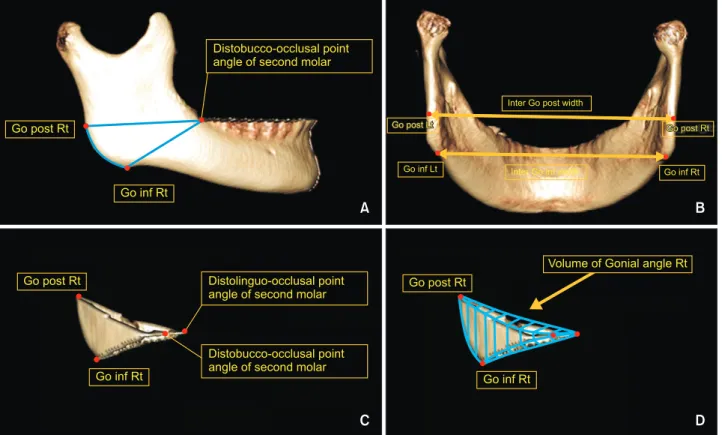
The reference points used to measure the widths of the mandibular angle area were the Go post (Gonion posterius: the most posterior point of the posterior border of the ramus) and Go inf (Gonion inferius: the most inferior point of the inferior border of the ramus).
The widths of inter-Go post right-left (Rt-Lt) and inter- Go inf Rt-Lt were measured bilaterally (Figure 2A and 2B).
Volume of the mandibular angle area
The volume of the mandibular angle area was calcu-
lated along two planes: a plane connecting the Go inf, distobucco-occlusal point angle, and distolinguo-occlusal point angle of the second molar; and a plane connecting the Go post, distobucco-occlusal point angle, and distolinguo-occlusal point angle of the second molar.
The volumes within the border were measured bilaterally (Figure 2C and 2D).
Statistical analysis
The data were analyzed using SAS (version 9.3; SAS Institute, Cary, NC, USA) and the cut-off for statistical significance was set at p < 0.05. To evaluate the reproducibility of measurements, all landmarks were measured twice by the same person with a 2-week interval between measurements. The intraclass correlational coefficients ranged from 0.890 to 0.937, indicating excellent intraexaminer reliability. The Wilcoxon signed-rank sum test and Wilcoxon rank sum test were used to compare the measurements before and 6 months after the first injection within the two groups and between the two groups, respectively.
RESULTS
Soft-tissue changes: Masseter muscle thickness and cross-sectional area
Masseter muscle thicknesses and cross-sectional areas differed statistically significantly before BoNT-A injection and 6 months after injection in both groups. At all section levels, group II exhibited a more substantial mean decrease than did group I (Table 1).
C30
C5
Mandibular plane
5 mmA B
Figure 1. A, Cone-beam computed tomography (CBCT) image cut at levels C5, C10, C15, C20, C25, and C30. Mandibular
CBCT images are digitally cut into 5-mm-thick sections parallel to the mandibular plane. B, The thickness and cross-
sectional area of the masseter muscle at each cut level. The arrows indicate the maximum thickness of the masseter
muscles, and the indicated areas represent the cross-sectional area of the masseter muscles.
Table 1. Mean changes in masseter muscle thickness and masseter muscle cross-sectional area 6 months after botulinum toxin type A injection in groups I and II
Change in thickness (mm) Change in cross-sectional area (mm
2)
Group I Group II
p
†Group I Group II
p
†Mean SD p* Mean SD p* Mean SD p* Mean SD p*
C5 −1.41 0.88 ** −2.38 1.27 **
†−55.40 34.22 ** −81.26 50.68 ** NS
C10 −1.72 0.84 ** −3.19 1.24 **
††−69.77 30.17 ** −117.84 52.84 **
†C15 −1.99 0.79 ** −2.41 1.29 **
††−71.88 30.17 ** −142.34 51.53 **
††C20 −2.04 0.81 ** −3.62 1.08 **
††−85.64 37.17 ** −170.12 63.97 **
††C25 −1.88 0.71 ** −3.81 0.95 **
††−81.94 33.42 ** −170.97 59.70 **
††C30 −1.60 0.99 ** −3.90 1.14 **
††−63.37 31.77 ** −165.88 56.87 **
††SD, Standard deviation; C5–30, the cone-beam computed tomography images of the mandible were digitally cut into 5.0-mm- thick sections parallel to the mandibular plane; NS, non-significant.
*p < 0.05, **p < 0.001; Comparison of the values before and 6 months after injection(s) in each group (Wilcoxon signed-rank sum test).
†
p < 0.05,
††p < 0.001; Comparison of the changes in thickness or cross-sectional area between groups I and II (Wilcoxon rank sum test).
Figure 2. A, Reference points for the width and volume of the mandibular angle area; Go post (Gonion posterius), Go inf (Gonion inferius), and distobucco-occlusal point angle. B, Inter-Go post right-left (Rt-Lt) and inter-Go inf Rt-Lt widths.
C, Reference points for the volume of the mandibular angle area; Go post, Go inf, distobucco-occlusal point angle, and distolinguo-occlusal point angle of second molar. D, Volume of the mandibular angle area.
A B
C D
Go post Rt
Go inf Rt
Distobucco-occlusal point angle of second molar
Go inf Lt
Inter Go post width
Inter Go inf width Go inf Rt
Go_post_Rt Go post Rt
Go post Rt
Go inf Rt
Distolinguo-occlusal point angle of second molar
Distobucco-occlusal point angle of second molar
Go post Rt
Go inf Rt
Volume of Gonial angle Rt
Go post LtGo post Lt
Hard-tissue changes: Width and volume of the mandibular angle area
No statistically significant differences in the width of the mandibular angle area were observed within either group, or between the two groups. However, the volume of the mandibular angle area decreased statistically significantly after BoNT-A injection in group II (Table 2).
DISCUSSION
BoNT-A is known to act specifically on muscles, and does not have any undesirable side effects. It blocks action potentials at neuromuscular junctions by inhibiting acetylcholine release. It does not damage the nerves or muscle structures, and muscle function is restored after the toxin is neutralized.
13BoNT-A rapi dly (within hours) and irreversibly binds to presynaptic neurons at the neuromuscular junctions. After being internalized, it acts on a zinc-dependent endoprotease to disrupt some of the peptides necessary for acetylcholine release.
14This action may take up to 2 weeks to complete, and effectively destroys the affected neuromuscular junction, thereby causing muscular paralysis.
5We demonstrated that the mean masseter muscle thicknesses and cross-sectional areas decreased after BoNT-A injection; this finding is consistent with those of previous studies. Park et al.
15reported that the average decrease in muscle thickness was typically 18–20% of the preinjection thickness, as determined by ultrasonography and CT. Kim et al.
16reported that the volume of the masseter muscle decreased after the injection of BoNT-A on each side, as determined by CT.
Shim et al.
17reported that the associated reductions in volume and thickness in the lower facial contour were highest at 12 weeks after BoNT-A injection. After muscle paralysis, there is ongoing turnover at the neuromuscular junction, even though toxin exposure enhances this activity such that muscular function begins to return after several weeks and is usually complete by 6 months.
5Thus, muscle atrophy is a temporary event and new
neuromuscular synapses can be resynthesized over a period of a few months.
7This means that additional injection of BoNT-A is required to sustain its effect in the lower facial contour. In the present study, we found that repeated injections of BoNT-A induced a greater reduction of masseter muscle thickness and cross-sec- tional area than did a single injection, as reported by Lee et al.
18This indicates that repeated injections of BoNT-A were more effective in improving masseteric hy- pertrophy, and suggests that repeated injections might induce more bony changes.
We observed no significant changes in the width of the mandibular angle area after BoNT-A injection in either group. However, we observed a significant change in the volume of the angle area in group II. This result implied there was no change in the shape of the mandible after a single set of bilateral BoNT-A injections, but repeated BoNT-A injections could affect the bone volume of the mandibular angle area. This finding is in agreement with the results of previous animal studies on Wistar rats and mice, which showed bone loss after BoNT-A injection into the muscles.
19,20BoNT-A injection into the hind limb muscles of mice caused a decrease in bone mineral content and volume in the hind limb bone.
20However, we observed fewer bony changes in our subjects than was observed in the abovementioned study on mice.
20This difference in findings could be attributed to the dose of BoNT-A injected in the present study, which could not reduce the masseter muscle force enough to cause bony changes in the mandible. This was supported by the fact that we did not observe a change in group I in which the patients received a single BoNT-A injection.
However, we observed a change in the volume of the angle area and additional reductions in muscle thickness and cross-sectional area among the patients in group II, which received an additional BoNT-A injection.
This study had several limitations. First, the sample size was too small to identify small changes in para- meters such as the mandibular angle volume. Larger studies may find a more significant reduction in the Table 2. Mean changes in the width of the mandibular angle area and volume of the mandibular angle area 6 months after injection in groups I and II
Change in group I Change in group II
p
†Mean SD p* Mean SD p*
Inter Go post –0.05 0.87 NS 0.00 1.02 NS NS
Inter Go inf 0.02 0.78 NS 0.02 0.77 NS NS
Mandibular angle volume –44.45 120.72 NS –186.90 151.97 **
††SD, Standard deviation; NS, non-significant.
*p < 0.05, **p < 0.001; comparison of the change in values before and 6 months after injection(s) in each group (Wilcoxon signed-rank sum test).
†