• 검색 결과가 없습니다.

Antioxidant Activities of Methanol Extracts from Root Parts of Korean Salad Plants

N/A
N/A
Protected

Academic year: 2021

Share "Antioxidant Activities of Methanol Extracts from Root Parts of Korean Salad Plants"

Copied!
7
0
0

로드 중.... (전체 텍스트 보기)

전체 글

(1)

Introduction

Pharmaceutical foods from plant resources have received great attention as functional agents that improve modulation or biologically-active functions of human body. Plants have many phytochemicals with various bioactivities, including antioxidant, anti-inflammatory, anticancer, and antidiabetic activities. Recently, there has been a worldwide trend towards the use of the phytochemicals from wild plants.

Phenolic compounds are considered as secondary metabolites that are synthesized by plants during normal development and in response to stress conditions such as infection, wounding, and UV radiation. These compounds occur ubiquitously in plants and are diversified group of phyto- chemicals derived from phenylalanine and tyrosine (Harborne and Turner, 1984; Shahidi and Maczk, 2004).

Free radical scavenging is the generally accepted mechanism for antioxidants inhibiting lipid oxidation. Antioxidants, inhibitors of lipid peroxidation, are important not only for

food protection but also for the defense of living cells against oxidative damage. The model of scavenging stable DPPH free radicals can be used to evaluate the antioxidative activities in a relatively short time (Brand-Williams et al., 1995) compared to other methods. The effect of antioxidants on DPPH radical scavenging was thought to be due to their hydrogen-donating ability (Blois, 1958). The toxic and otherwise unfavorable effects of synthesized food antioxidants have been widely noted. Phenolic compounds, such as butylated hydroxyanisole (BHA), BHT, and tert-butylhydroquinone (TBHQ), have been widely used as synthetic antioxidants in food lipid. Although those antioxidants are considered as safe natural antioxidants, they do not always provide effective protection against in vitro oxidation (Frankle, 1980). Neverthe- less, the phenolic antioxidants are still used extensively as food antioxidants because of their excellent results and low cost. When slightly larger doses (50 mg/kg/day) of these phenolic antioxidants are administered to rodents and monkeys, however, certain pathological, enzyme and lipid alterations as well as carcinogenic effects have been observed (Branen, 1975). Therefore, research on other natural antioxidants

Antioxidant Activities of Methanol Extracts from Root Parts of Korean Salad Plants

Sang-Uk Chon*, Tae-Soon Kim 1 , Ji-San Shin and Hee-Ock Boo 1 EFARINET Co. Ltd., BI Center, Chonsun University, Gwangju 501-759, Korea

1 PHYTO M&F Co. Ltd., BI Center, Chonsun University, Gwangju 501-759, Korea

Abstract - Phenolics level, total flavonoid content, and antioxidant were determined from the methanol extracts of the eight medicinal plants using roots. Total phenolics were found as the highest levels in the methanol extracts of Arctium lappa, and followed by Youngia sonchifolia and Cirsium japonicum. Total amount of the each phenol compounds were detected in C.

japonicum extracts (319.2 mg kg -1 ) as the greatest component, and followed by A. lappa (96.3 mg kg -1 ) and Y. sonchifolia (22.9 mg kg -1 ). Total flavonoid content showed the highest amount in methanol extracts from A. lappa (68.1 mg 100 g -1 ), and followed by Y. sonchifolia (11.2 mg 100 g -1 ). Lycoris radiate extracts (87.2%) had the highest nitrite scavenging activity and followed by A. lappa (81.5%) and Y. sonchifolia (77.5%). Methanol extracts of A. lappa at 25 mg 100 g -1 exhibited the highest DPPH radical scavenging activity by 90.8%, even though less activity than synthetic antioxidants Vitamin C or butylated hydroxytoluene (BHT). Level of polyphenols was highly correlated with antioxidative activity (r 2 = 0.85). The results suggest that several medicinal plants selected had the potent biological activities, and that their activities were differential depending on plant species.

Key words - Korean medicinal plants, methanol extracts, total phenolics, antioxidant activity

* Corresponding author. E-mail : [email protected]

(2)

has gained momentum as they are considered, rightly or wrongly, to pose no health risk to consumers (Wanasundara and Shahidi, 1994; Wanasundara et al., 1997). The develop- ment of alternative natural antioxidants has, therefore assumed as increased importance. Many investigators have found different types of antioxidants in various sources of plants (Larson, 1988).

The antioxidants present in fruits and vegetables limit the free radical initiation in the body and lower the incidence of various cancers. Vegetables, fruits and whole grains contain a wide variety of phytochemicals that have the potential to interfere with the development of cancer. A number of studies have suggested that regular consumption of tea decreased the risk of various types of cancers (Yang et. al., 2000; Kathiyar and Mukthar, 1996). The Korean medicinal plants in this study have long been used as traditional seasoned salads, and were screened for biologically-active effects of functional foods (Cho, 2005). Earlier studies showed that extracts from Areca catechu var. dulcissima possess antidepressant properties (Dar and Khatoon, 2000).

Au et al. (2001) suggested that the methanol extracts of Paeonia suffruticosa potently inhibit human immunodeficiency virus (HIV)-1 integrase. Lee et al. (1997) reported that silymarin and silybin purified from Silybum marianum have potential inhibiting activities against oxidation of 125 I-LDL by macrophages and endothelial cells.

Therefore, the phytochemicals present in various Korean medicinal plants, may act as preventative or therapeutic agents similar to prescription drugs. The objective of this research was to determine total phenolic level, antioxidant activity, and cytotoxicity of methanol extracts from root parts of the 8 Korean medicinal plants.

Materials and Methods

Preparation of methanol extracts

Root parts of the eight Korean medicinal salad plants, Lycoris radiata, Allium victorialis, Cirsium japonicum, Youngia sonchifolia, Arctium lappa, Lycoris aurea, Codonopsis lanceolata, and Lilium hansonii, were harvested in a mountain area of the Suncheon City, Korea, at a vegetative stage on June, 2005. The samples were directly freeze-dried at -40 ℃ for 5 days, ground with a Wiley mill to pass a 1-mm

screen, and stored in a refrigerator at 2 until used. The ℃ samples were extracted with 95% methanol at room temperature. The extract was then filtered through a Whatman No. 1 filter paper. The collected filtrate was evaporated to dryness under vacuum at 40 ℃ using a rotary evaporator (N-1000V-W, Eyela, Japan). After evaporation, the yield of dried extracts (methanol extract) was about 10% of the original plant sample. The methanol extracts from each plant were used for measuring DPPH radical scavenging activity, total phenolic content, and cytotoxicity.

Total phenol analysis

The concentration of total phenolics (TP) was measured using the Folin-Ciocalteu assay (Singleton and Rossi, 1965).

Briefly, 5 mL of Nanopure water, 0.5 - 1.0 mL of sample, and 1.0 mL of Folin-Ciocalteu reagent were added to a 25 mL volumetric flask. The contents were mixed and allowed to stand for 5-8 min at room temperature. Next, 10 mL of a 7%

sodium carbonate solution was added, and followed by the addition of Nanopure water filled to volume. Solutions were mixed and allowed to stand at room temperature for 2 h.

Sample aliquots were filtered through a Whatman 0.45 µm poly (tetrafluoroethylene) filter prior to the determination of TP concentration using a UV-1650 spectrophotometer (Shimadzu, Japan) monitoring 640 nm. TP content was standardized against ferulic acid and expressed as mg kg -1 of ferulic acid equivalents (FAE). The linearity range for this assay was determined as 0.5-5.0 mg/L FAE (R 2 = 0.9990), giving an absorbance range of 0.050-0.555 AU.

Identification and quantification of phenolic acids

The dried methanol extracts were redissolved in HPLC

grade MeOH to give 1,000 ppm for HPLC analysis. The

standard phenol compounds used for HPLC analysis were

coumarine, 3-hydrocinnamic acid, p-coumaric acid, salicylic

acid, ferulic acid, caffeic acid, chlorogenic acid, and syringic

acid (Aldrich Co., USA). The chemicals were purchased as

high purity standards and the used solvents were HPLC

spectral grade. The compounds were identified by a

high-performance liquid (HPLC) using SPP 10AVP (Shimadzu,

Tokyo, Japan) with a flow rate of 1 mL min -1 , the column was

CAPCELL PAK C18 SG120 (4.6 × 250 mm) and an

autoinjector with a 10 l sample loop was employed. The μ

(3)

mobile phase consisted of water, methanol and acetic acid in the ratio of 12:15:1 volume, respectively. The UV detector wavelength was set at 275 nm. Standard compounds were chromatographed alone and as mixtures. Retention times for the standard compounds and the major peaks in the extract were recorded. The compounds were identified by retention times or standard addition, and amounts were calculated by comparing peak area with those of standards.

Total flavonoid analysis

The total flavonoid content of methanol extracts from root parts of 8 Korean medicinal plants was determined according to colorimetric method as described by Zou et al (2004). In brief, 0.5 ml of sample solution was mixed with 2 ml of distilled water and subsequently with 0.15 ml of 5% NaNO 2

solution. After 6 min of incubation, 0.15 ml of 10% AlCl 3

solution was added and then allowed to stand for 6 min, followed by adding 2 ml of 4% NaOH solution to the mixture.

Immediately after water was added to the sample to bring the final volume to 5 ml, the mixture was thoroughly mixed and allowed to stand for another 15 min. The mixture absorbance was determined at wavelength 510 nm. The total flavonoid content was expressed in milligrams of rutin equivalents per gram of plant extracts.

Nitrate scavenging activity

This assay was carried out as described by Saha, Lajis, and Israf (2004) and Zhang, Nie, Tao, and Ye (2002) with some modifications. The pigment extract was diluted with the distilled water to a suitable concentration for analysis. Three ml of pigment sample was per in the tube (10 ml), and then 2 ml of citric acid buffer (pH 3.0) and 0.1 ml of 200 g/ml μ NaNO 2 were added, respectively. Finally, water was added up to 10 ml. The mixture was immediately incubated for 60 min in the water bath at 37 . Then equal volume of Griess ℃ reagent (1% sulfanilamide, 0.1% N-(1-naphthyl)-ethyline diamine hydrochloride, 2.5% H 3 PO 4 ) was added to the above mixture. The absorbance was determined by UV/Vis spectrophotometer (Dojin, Japan) after 10 min at 538 nm. At the same time the control (without NaNO 2 ) and standard (without NaNO 2 and without pigment sample) were also measure. Vc and butylated hydroxyanisole (BHA) were used

as the positive control compounds. NaNO 2 scavenging activity (Sa) was calculated using the following equation: Sa (%) = {OD s – (OD p – OD c )} / OD s x 100%. Where Sa is the NaNO 2 scavenging rate of tested sample (%), OD s is the OD value of standard, OP p is the OD value in the presence of tested sample, OD c is the OD value of control.

DPPH radical scavenging activity

DPPH (1,1-diphenyl-2-picrylhydrazyl) free radical scavenging assay was carried out according to the procedure described by Blosi (1958). Each methanol extract at various concentrations (3.1, 6.3, 12.5, 25, and 50 mg 100 g -1 ) was added to a 1.5 x 10 -4 M solution of DPPH in methanol and the reaction mixture was shaken vigorously. The amount of DPPH remaining was determined at 520 nm, and the radical scavenging activity was obtained from the following equation: Radical scavenging activity (%) = {(OD control – OD sample ) / OD control } x 100. The antioxidant activity of plant extracts was partially expressed as IC50, which was defined as the concentration (in mg 100 g -1 ) of extract required to inhibit the formation of DPPH radicals by 50%.

Results and Discussion

Total phenolics content

Total phenolic content showed the highest amount in methanol extracts from A. lappa (11.6 mg 100 g -1 ), and followed by Y. sonchifolia (8.1 mg 100 g -1 ) and C. japonicum (5.5 mg 100 g -1 ). However, L. radiata, C. lanceolata, and L.

hansonii extracts were very low (Fig. 1). The result was highly consistent with the finding of DPPH radical scavenging activity (Velioglu et al., 1998). Zhou and Yu (2006) also reported that total phenolic content of the tested vegetable extracts was correlated with the DPPH radical scavenging activity, suggesting that total phenolics can play a major role in the antioxidant activity of plant materials.

Identification and quantification of phenolic acids

The major antioxidant substances, coumarine, 3-hydrocinnamic

acid, p-coumaric acid, salicylic acid, ferulic acid, caffeic acid,

chlorogenic acid, and syringic acid present in the 8 Korean

medicinal plant species were analyzed by HPLC using

(4)

standard compound. Total amount of the compounds were detected in C. japonicum extracts (319.2 mg kg -1 ) as the greatest component, and followed by A. lappa (96.3 mg kg -1 ) and Y. sonchifolia (22.9 mg kg -1 ). Chlorogenic acid was detected in C. japonicum extracts (38.4 mg kg -1 ) as the greatest amount. Especially, C. japonicum have the highest amount of salicylic acid (Table 1). Radical scavenging effect of phenolic compounds isolated from natural sources has been widely studied (Yioshida et al., 1989). The antioxidative potency and phenolic acids are generally inter-related. These

phenolic compounds react with the free radicals formed during autoxidation, and generate a new radical which is stabilized by the resonance effect of the aromatic nucleus (Cuvelier et al., 1992).

Total flavonoid analysis

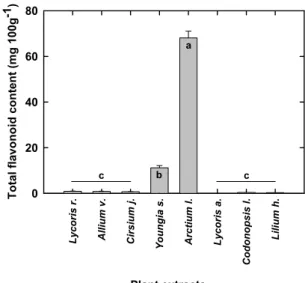
Total flavonoid content showed the highest amount in methanol extracts from A. lappa (68.1 mg 100 g -1 ), and followed by Y. sonchifolia (11.2 mg 100 g -1 ). However, in other plant extracts the content was very low (Fig. 2). Plant

Plant extracts

Lyco ris r. Allium v. Cirsium j. Yo ung ia s. Arct ium l. Lyco ris a. Codo nop sis l. Liliu m h .

Content of tota l ph enolic s (mg 100g -1 ) 0 2 4 6 8 10 12 14

a

b

c

cd cd

d d d

Fig. 1. Total phenolic content of methanol extracts from the root parts of the eight Korean medicinal plants. Means with the same letter in a graph are not significantly different at p<0.05. Bars represent SE.

Table 1. Contents of phenolic acids in the methanol extracts from the eight Korean medicinal plants using roots.

Plant species (Extracts)

Phenolic acids (mg kg -1 )

COU * 3HC PCO SAL FER CAF CHL SYR Total

Lycoris radiata 4.7 4.3 3.2 12.3

Allium victorialis 2.5 3.2 13.3 19.1

Cirsium japonicum 3.1 293.9 7.4 14.9 319.2

Youngia sonchifolia 7.8 2.1 13.1 22.9

Arctium lappa 4.9 14.2 3.4 20.9 3.5 11.1 38.4 96.3

Lycoris aurea 4.5 4.5

Codonopsis lanceolata 4.6 9.7 14.3

Lilium hansonii 4.1 5.3 9.4

* COU: coumarine, 3HC: 3-hydrocinnamic acid, PCO, p-coumaric acid, SAL: salicylic acid, FER: ferulic acid, CAF: caffeic acid, CHL:

chlorogenic acid, and SYR: syringic acid.

Plant extracts

Lyc o ris r. All ium v . Ci rs ium j. Y o ungia s. Arct ium l. Ly cori s a. Codonopsis l. L ili um h.

Total fla v onoid c onte n t (mg 1 00 g -1 ) 0 20 40 60 80

a

b

c c

Fig. 2. Total flavonoid content of methanol extracts from the root

parts of the eight Korean medicinal plants. Means with the same

letter in a graph are not significantly different at p<0.05. Bars

represent SE.

(5)

tissues contain a wide variety of compounds with antioxidant activity. Phenolic compounds (flavonoids and phenolic acids), nitrogen compounds (alkaloids, chlorophyll derivatives, amino acids and amines), carotenoids, lignans and terpenes were reported to possess antioxidative activity in suppressing the initiation or propagation of the chain reactions (Hall and Cuppett, 1997). Flavonoids and phenolic compounds are the main antioxidative compounds of fruits and vegetables (Huang et al. 1998). In this study, however, the magnitude of antioxidative potency varies with the type of extracts. This could be due to the different in concentration and type of antioxidative compounds present in these extracts.

Nitrite scavenging activity

The plant extracts exhibited a plant species-dependent radical scavenging activity by inhibiting nitrite. L. radiate extracts (87.2%) was the highest nitrite scavenging activity and followed by A. lappa (81.5%) and Y. sonchifolia (77.5%).

However, L. radiata, C. lanceolata, and L. hansonii extracts showed very low activities (Fig. 3).

DPPH radical scavenging activity

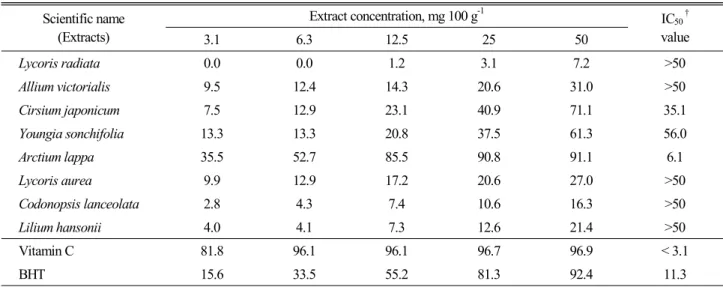
Methanol extracts of A. lappa had the highest DPPH radical scavenging activity, and followed by C. japonicum, and Y. sonchifolia, indicating IC 50 values of 6.1, 35.1, and 56.0 mg 100 g -1 , respectively (Table 2). These values were

lower than those of synthetic antioxidants Vitamin C and BHT, with IC 50 values of < 3.1 and 11.3 mg 100 g -1 , respectively. Methanol extracts of A. lappa at 25 mg 100 g -1 exhibited the highest DPPH radical scavenging activity by 90.8%. However, other extracts showed lower values in activity. All samples of plant species showed DPPH radical scavenging activity in a dose-dependent manner. The present results noted that various compounds that cause antioxidant

Plant extracts

L y co ri s r . Alliu m v. Cirs ium j. Young ia s . Arct ium l. L y c o ris a. C o d onopsis l. Lil ium h.

N itr it e sa lt s ca ve ngin g acti vity (% )

0 20 40 60 80 100

ab a bc b

bc bc

c c

Fig. 3. Nitrite scavenging ability of methanol extract from the root parts of the eight Korean medicinal plants using roots. Means with the same letter in a graph are not significantly different at p<0.05.

Bars represent SE.

Table 2. DPPH radical scavenging activity of methanol extracts from the eight Korean traditional salad plants using roots. Their activities were compared with synthetic antioxidants, Vitamin C and BHT.

Scientific name (Extracts)

Extract concentration, mg 100 g -1 IC 50 †

value

3.1 6.3 12.5 25 50

Lycoris radiata 0.0 0.0 1.2 3.1 7.2 >50

Allium victorialis 9.5 12.4 14.3 20.6 31.0 >50

Cirsium japonicum 7.5 12.9 23.1 40.9 71.1 35.1

Youngia sonchifolia 13.3 13.3 20.8 37.5 61.3 56.0

Arctium lappa 35.5 52.7 85.5 90.8 91.1 6.1

Lycoris aurea 9.9 12.9 17.2 20.6 27.0 >50

Codonopsis lanceolata 2.8 4.3 7.4 10.6 16.3 >50

Lilium hansonii 4.0 4.1 7.3 12.6 21.4 >50

Vitamin C 81.8 96.1 96.1 96.7 96.9 < 3.1

BHT 15.6 33.5 55.2 81.3 92.4 11.3

† Extract concentrations, which show 50% activity of DPPH radical scavenging, were determined by interpolation.

(6)

activity could be produced with different amount from plant species. Lee et al. (2003) reported that the methanol extracts of nine medicinal plants traditionally used in Chinese medicine were screened for antioxidant activity versus resveratrol, and that relatively high levels of DPPH radical scavenging activity were detected in extracts of Areca catechu var. dulcissima, Paeonia suffruticosa and Cinnamomun cassia (IC 50 < 6.0 µg mL -1 ). Especially, they reported that the extracts of Areca catechu var. dulcissima showed higher antioxidant activity than resveratrol in all experiments.

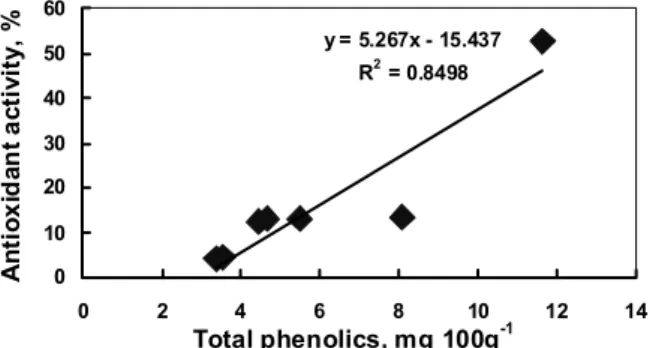
Correlation coefficient between the extracted polyphenols with methanol and antioxidative activity was about 0.85 (Fig.

4). Relatively high correlation between above mentioned variables in the studied extracts was compared with tea, propolis and U. davidiana extracts (Jastrzebski et al., 2007;

Turkmen et al., 2006; Jung et al., 2008).

In conclusion, methanol extracts from several plants among the eight Korean traditional salad plants using roots showed high antioxidant activity, through measurement of DPPH free radical scavenging activity. A. lappa showed the highest DPPH free radical scavenging activity with high levels of total phenolics and flavonoid. The medicinal plants dose-dependently increased the biological activities, in vitro.

Results also showed that total phenolics level was highly correlated with the free radical scavenging activity. Com- pounds that cause the DPPH free radical scavenging activities could be produced with different amounts and types of phytochemicals depending on plant species. Such differences might be related to specific compounds being produced in larger quantities in certain plant species. Therefore, the eight Korean medicinal plants using root parts had the potent

antioxidant activity with important values for an alternative based on natural plant extracts.

Acknowledgements

This research was conducted with support from the 2006 ARPC research fund (105088-33-3-HD110). Appreciation is expressed to Dr. Young-Min Kim at Donguinara Co. Ltd., Naju, Korea, for his technical assistance.

Literature Cited

Au T. K., T. B. Lam and T. B. Ng. 2001. A comparison of HIV-1 integrase inhibition by aqueous and methanol extracts of Chinese medicinal plants. Life Sci. 68: 1687-1694.

Blois, M. S. 1958. Antioxidant determinations by use of a stable free radical. Nature 26: 1199-1200.

Brand-Williams, W., M. E. Cuvelier and C. Berset. 1995. Use of free radical method to evaluate antioxidant activity. Food Sci. Technol. (London). 28: 25-30.

Branen, A. L. 1975. Toxicology and biochemistry of butylateed hydroxyanisole and butylated hydroxytoluene. JAOCS 52:

59-63.

Cho, J. Y., S. Y. Yang, S. O. Yu, B. W. Kim, H. G. Jang, S. U.

Chon, Y. J. Park and B. G. Heo. 2005. The actual distributing states of the fresh wild vegetables at five-day traditional markets in Jeonnam district. Kor. J. Hort. Sci. Technol. 23:

396-401.

Cuvelier, M. E., H. Richard and C. Berset. 1992. Comparison of the antioxidative activity of some acid-phenols: Structure- activity relationship. Biosci. Biotech. Biochem. 56 : 324-325.

Dar, A. and S. Khatoon. (2000) Behavioral and biochemical studies of dichloromethane fraction from the areca catechu nut. Pharmacology, Biochemistry and Behavior. 65:1-6.

Frankle, E. N. 1980. Lipid oxidation. A review. Progress in Lipid Research 19:1-22.

Hall, C. A. and S. L. Cuppett. 1997. Activities of natural antioxidants. In O. I. Aruoma, & S. L. Cuppett (Eds.), Antioxidant methodology in vivo and in vitro concepts (pp. 2

29). Champaign, IL, USA: AOCS Press.

Harborne, J. B. and M. Turner.1984. Plant chemosystematics.

Academic Press, London, UK.

Huang, Y., A. Tan, Y. Shen and J. Lu. 1998. Scavenging effect of total flavonoids of Lycium barbarum L. on active oxygen

y = 5.267x - 15.437 R

2

= 0.8498

0 10 20 30 40 50 60

0 2 4 6 8 10 12 14

Total phenolics, mg 100g

-1

A n tio x id an t a ctiv ity , %

Fig. 4. Correlation between the polyphenols amount and antioxidant

activity (%) in the eight Korean medicinal plants.

(7)

radicals and inhibitory effects on heat output from L 1210 cells. Wei Sheng Yen Chiu. 27: 109 111. –

Jastrzebski, Z, O. J. Medina, L. M. Moreno and S. Gorinstein.

2007. In vitro studies of polyphenol compounds, total antioxidant capacity and other dietary indices in a mixture of plants (Prolipid). Inter. J. Food Sci. Nutr. 58: 531-541.

Jung, M. J., S. I. Heo and M. H. Wang. 2008. Free radical scavenging and total phenolic conents from methanolic extracts of Ulmus davidiana. Food Chem. 108: 482-487.

Kathiyar, S. K. and H. Mukthar.1996. Tea in chemoprevention of cancer: epidemiologic and experimental studies. Int. J.

Onc. 8: 221-238.

Larson, R. A. 1988. The antioxidants of higher plants.

Phytochem. 27:969-978.

Lee, B. C., Y. K. Jeong and B. H. Ryu. 1997. Antioxidative effect of silymarin and silybin purified from Silybum marianum on oxidation of human low density lipoprotein by macrophages. Kor. J. Appl. Microbiol. Biotechnol. 25:

286-292.

Lee, S. E., H. J. Hwang, J. S. Ha, H. S. Ha, H. S. Jeong and J. H.

Kim. 2003. Screening of medicinal plant extracts for antioxidant activity. Life Sci. 73: 167-179.

Saha, K., N. H. Lajis and D. A. Israf. 2004. Evaluation of antioxidant and nitric oxide inhibitory activities of selected Malaysian medicinal plants. J Ethnopharmacol. 92: 263–

267.

Shahidi, F. and M. Naczk. 2004. Phenolics in food and nutraceuticals: Sources, applications and health effects.

CRC Press. Boca Raton, FL, USA.

Singleton, V. L. and J. A. Rossi. 1965. A colorimetry of total phenolics with phosphomolybdic-phosphotungstic acid reagents. Am. J. Enol. Vitic. 16: 144-158.

Turkmen, N, F. Sari and Y. S. Velioglu. 2006. Effects of extraction solvents on concentration and antioxidant activity of black and black mate tea polyphenols determined by ferrous tartrate and Folin-Giocalteu methods. Food Chem.

99: 835-841.

Velioglu, Y. S., G. Mazza, L. Gao and B. D. Oomah. 1998.

Antioxidant activity and total phenolics in selected fruits, vegetables, and grain products. J. Agric. Food. Chem. 46:

4113-4117.

Wanasundara, P. K .J. P. D., F. Shahidi and V. K. S. Shukla.

1997. Endogenous antioxidants from oilseeds and edible oils. Food Rev. International 13: 225-292.

Wanasundara, U. N. and F. Shahidi. 1994. Canola extracts as an alternative natural antioxidant for canola oil. J. Ame. Oil Chem. Soc. 71: 817-822.

Yang, C. S., J. Y. Chung, G. Yang, S. K. Chhanbra and M. J.

Lee. 2000. Tea and tea polyphenols in cancer prevention. J.

Nutr. 130(2S): 472S-478S.

Yoshida, T., K. Mori, T. Hatono, T. Okumura, I. Uehara, K.

Komagoe, Y. Fujita and T. Okuda.1989. Studies on inhibition mechanism of antioxidation by tannins and flavonoids. V. Radical-scavenging effects of tannins and related polyphenols on DPPH radical. Chem. Pharm. Bull.

37: 1919-1921.

Zhao, Y., B. Chen and S. Z. Yao. 2007. Separation of 20(S)- protopanaxdiol type ginsenosides and 20(S)-protopanaxtriol type ginsenosides with the help of macroporous resin adsorption and microwave assisted desorption. Separation and Purification Technology. 52: 533 538. –

Zhou, K. and L. Yu. 2006. Total phenolic contents and antioxidant properties of commonly consumed vegetables grown in Colorado. LWT 39: 1155-1162.

(Received 9 May 2008 ; Accepted 1 July 2008)

수치

Table 1. Contents of phenolic acids in the methanol extracts from the eight Korean medicinal plants using roots.
Table 2. DPPH radical scavenging activity of methanol extracts from the eight Korean traditional salad plants using roots
Fig. 4. Correlation between the polyphenols amount and antioxidant activity (%) in the eight Korean medicinal plants.

참조

관련 문서

Before identifying the anthocyanins of berries, experiments were conducted using different extracts, under 0.2% HCl-methanol extraction conditions, and as a

1) Effects of methanol extracts of Capsella bursa-pastoris on cyclooxygenase-2 (COX-2) and Inducible Nitric oxide synthase (iNOS) expression in human prostate cancer cell

That is, the dry powder of the sludge wastes, generated during the decommissioning of nuclear power plants, were compacted, and a study, focused on

Inhibitory effects of classified methanol extracts of Smilax china L on the COX-2 and iNOS expression of human colorectal cancer cell lines... Inhibitory

Waste lubricating oil, which is radioactive waste generated from nuclear power plants, is a lubricant for major equipment of nuclear power plants, and is incinerated

Methanol extracts from watermelon peels dramatically reduced inducible Nitric Oxide Synthase(iNOS) expression at various concentration and

Fig 4 : Inhibitory effects of classified methanol extracts of Acalypha australis the COX-2 protein expression of the human oral cavity carcinoma KB cells....

Eucommia ulmoides is a Traditional Chinese Medicine that has been used for longevity, being strengthen the muscles and joints. While traditional application of Eucommia was