• 검색 결과가 없습니다.

Nonsingular Terminal Sliding Mode Control of Overhead Crane System

N/A
N/A
Protected

Academic year: 2021

Share "Nonsingular Terminal Sliding Mode Control of Overhead Crane System"

Copied!
2
0
0

로드 중.... (전체 텍스트 보기)

전체 글

(1)

- 1683 -

오버헤드 크레인 시스템의 비특이성 터미널 슬라이딩 모드 제어

이신호

1

, 최윤호

2

, 박진배

1

1

연세대학교 전기전자공학과,

2

경기대학교 전자공학부

Nonsingular Terminal Sliding Mode Control of Overhead Crane System

Sin Ho Lee

1

, Yoon Ho Choi

2

and Jin Bae Park

1

1

Department of Electrical & Electronic Engineering, Yonsei University,

2

School of Electronic Engineering, Kyonggi University

Abstract - In this paper, a hierarchical nonsingular terminal sliding mode controller (TSMC) for overhead crane system using nonsingular terminal sliding surface (NTSS) is proposed, which can drive the error to zero in a finite time. Here, singular problem of controller is solved by NTSS. In addition, the controller has the double layer structure because the system is divided into two hierarchical subsystems. In the first layer, the nonsingular terminal sliding surfaces are hierarchically designed for each subsystem, and in the second layer, the whole sliding surface is designed as the linear combination of nonsingular terminal sliding surfaces. The asymptotic stability of the system is verified by Lyapunov analysis. Finally, we carry out simulations on the overhead crane system to illustrate the effectiveness of the proposed control method.

1. Introduction

Recently, a new control method called the terminal sliding mode control (TSMC) method, which is based on the concept of terminal attractor, has been developed [1], [2]. Here, the tracking error of systems with the TSMC method is driven to zero within finite time by contrast with the classical sliding mode control (CSMC) method. However, the TSMC method has a singularity problem. This problem has been overcome by nonsingular terminal sliding mode control (NTSMC) method [3]. The NTSMC method has not yet been applied to the control of underactuated systems such as overhead crane system.

Actually, the control of underactuated systems have been studied by many researchers using various control methods. Especially, the sliding mode control is well known method to control the systems.

Mon and Lin proposed the hierarchical fuzzy sliding mode control method [4]. This method solved the problems of coupled system which has instabilities, coupling effects and disturbance but it could not guarantee the stability of each subsystem. However, this method could not guarantee and prove the stability of system. Thus, to solve this problem, the double layer structure based controller is proposed [5]. Here, the classical sliding surface was used in each subsystem.

However, this method did not guarantee a finite convergence time. In addition, the complex mathematical technique was utilized to prove the asymptotic stability of each subsystem and whole system.

In this paper, we propose a nonsingular terminal sliding surface based hierarchical finite time control method for overhead crane system. The proposed control system, the double layer structure is used to guarantee the stability of system. In addition, the nonsingular terminal sliding surface is utilized to drive the error to zero in a finite time and solve the problem of singularity. We carry out computer simulations on the overhead crane system to verify the effectiveness of the proposed controller.

2. Nonsingular Terminal Sliding Mode Control of Underactuate System

In this paper, we consider a single-input multi-output (SIMO) nonlinear underactuated system as follows:

         

                    

         

                     

            (1)

where      is the state vector,               and     are nonlinear function,  represent the control inputs,

   and     are bounded external disturbances. It is assumed that the disturbances are bounded as        and        , where

and  are known positive constants.

Here, the NTSMC method is proposed to control the system and the nonsingular terminal sliding surface (NTSS) is designed as follows:

     

(2)

     

(3) where  and  are the error variable,    and    are constants satisfying      and        , respectively, and both denominator and numerator of    are odd integers.

Here, the final time of the whole system is chosen as follows [6]:

       

    

 (4)

where     is the initial value of  at    .

For the SIMO nonlinear underactuated system (1), it is difficult to control outputs [5]. Hence, we design the whole sliding surface of the second layer as the linear combination of two subsystem surface:

      (5)

where  and  are sliding mode parameters. In the proposed control method, the whole control input  is chosen as follows [5]:

          (6) where   and   represent the equivalent control inputs which are utilized when the system states are in the sliding mode for each subsystem, respectively and  is called the switching control which drives the system states toward the sliding mode.

3. Simulation Results

In this section, we apply the proposed control scheme to the overhead crane system to demonstrate the effectiveness of the proposed control system. In addition, we compare the performance of the proposed control method with that of the CSMC method using the double layer structure. The simplified structure of the overhead crane system is shown in Fig. 1. The trolley has a mass  and is driven by a force  on the  -direction rail. The load of a mass  is suspended from the trolley by a rigid rope whose length is .

The overhead crane system equation is chosen as follows:

2008년도 대한전기학회 하계학술대회 논문집 2008. 7. 16 - 18

(2)

- 1684 -

 

      

       

    

      

 

        

           

        

       

(7) where  is the moving distance of trolley and  is the sway angle of load.

<Table 1> The comparison of MSE

NTSMC CSMC

MSE 0.4077 0.6459

<Fig. 1> Overhead crane system

<Fig. 2> Comparison of tracking result for overhead crane system: position of trolley

<Fig. 3> Nonsingular terminal sliding surface for overhead crane system: position of trolley

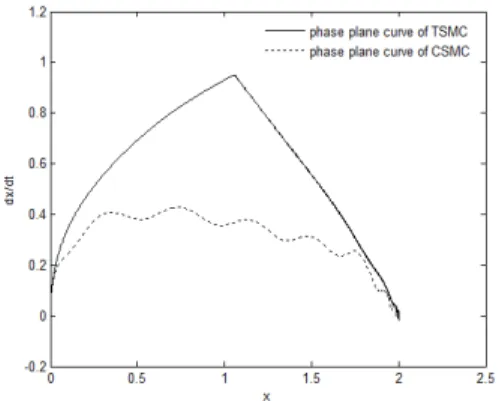
<Fig. 4> Phase plane for overhead crane system:

trolley moving distance

Here, we choose the proper initial values and the desired values. In addition, the differentiated initial value and the desired value are chosen as proper values. The results of the position of trolley for the NTSMC and the CSMC methods are compared in Fig. 2. From this figure, we can verify that the NTSMC method has faster convergence time than the CSMC method. Fig. 3 shows that the terminal sliding surface for overhead crane systems converges to zero. In addition, from Fig. 4, we can find that the error of trolley moving distance is asymptotically converged to equilibrium points.

Table 1 shows the simulation results for the CSMC and the NTSMC methods, where the mean square error (MSE) of the TSMC method is lower than that of the CSMC method.

3. Conclusion

In this paper, we have proposed a NTSS based hierarchical finite time control approach for nonlinear underactuated systems. Double layer structure is used to strictly guarantee the stability of whole system. Here, in first layer, the NTSSs of each subsystem are designed hierarchically. In addition, the whole sliding surface is designed as the linear combination of terminal sliding surfaces in the second layer. Besides, NTSS is utilized to solve the singularity problem. Finally, the proposed finite time controller based on the double layer has been applied to the overhead crane system which are the representative second order underactuated systems. From the computer simulation results, we can show the efficiency of proposed control approach.

[Reference]

[1] S. Tzafestas, M. Raibert and C. Tzafestas, “Robust Sliding-Mode Control Applied to a 5-Link Biped Robot,”

Journal of Intelligent and Robotics Systems, vol. 15, no. 1, pp. 67-133, 1996.

[2] M. Zak, "Terminal Attractors in Neural Networks," Neural Networks, vol. 2, no. 4, pp. 259-274, 1989.

[3] F. Yong, X. Yu and Z. Man, "Non-Singular Terminal Sliding Mode Control of Rigid Manipulators," Automatica, vol. 38, no.

12, pp. 2159-2167, 2002.

[4] Y. J. Mon and C. M. Lin, "Hierarchical Fuzzy Sliding Mode Control," Proc. IEEE World Congress on Computational Interlligence, pp. 656-661, 2002.

[5] W. Wang, J. Yi, D. Zhao and X. Liu, "Design of a Stable Sliding Mode Controller for a Class of Second-Order Underactuated Systems," Control Theory and Application, IEE Proceedings, vol. 151, no. 6, pp. 683-690, 2004.

[6] Z. Man, A. P. Paplinski and H. R. Wu, "A Robust MIMO Terminal Sliding Mode Control Scheme for Rigid Robotic Manipulators," IEEE Trans. Automatic Control, vol. 39, no.

12, pp. 2464-2469, 1994.

수치

Table  1  shows  the  simulation  results  for  the  CSMC  and  the  NTSMC  methods,  where  the  mean  square  error  (MSE)  of  the  TSMC  method  is  lower  than  that  of  the  CSMC  method.

참조

관련 문서

In this paper, a method for designing the path tracking controller for a surface vessel based on the sliding mode control with the switching law is proposed.. In order to have

A Adaptive discrete time sliding mode tracking controller has been applied in order to compensate the nonlinear friction characteristics in a hydraulic

In this paper, therefore, a novel sufficient condition of discretized equivalent control based sliding mode controller (SMC) for a second-order system with external disturbance to

added to the original system, the overall system including the low pass filter dynamics can not satisfy the matching condition.. So the integral SMC is applied for a

In this paper, a proposed controller based on fuzzy control and adaptive sliding mode control is presented for tracking control of robotic manipulators.. The proposed

A second order cascade LPF with advanced phase delay compensation method is proposed in this paper to strengthen the filtering capability instead of the first order LPF.

In order to establish such a control scheme based on the way conventional PI controller and sliding mode observer annexing characteristics of the system

In this paper, a new approach to the terminal sliding mode control using adaptive fuzzy sliding surfaces is proposed.. The idea behind this approach is to utilize an