- 1644 -
모델 불확실성과 외란이 있는 이동 로봇을 위한 적응 슬라이딩 모드 제어
박봉석*, 최윤호**, 박진배*
*연세대학교 전기전자공학과, **경기대학교 전자공학부
Adaptive Sliding Mode Control for Nonholonomic Mobile Robots with Model Uncertainty and External Disturbance
Bongseok Park*, Yoon Ho Choi**, Jin Bae Park*
*Dept. Electrical & Electronic Engineering Yonsei University,
**School of Electronic Engineering Kyonggi University Abstract - This paper proposes an adaptive sliding mode control
method for trajectory tracking of nonholonomic mobile robots with model uncertainties and external disturbances. The kinematic model represented by polar coordinates are considered to design a robust control system. Wavelet neural networks (WNNs) are employed to approximate arbitrary model uncertainties in dynamics of the mobile robot. From the Lyapunov stability theory, we derive tuning algorithms for all weights of WNNs and prove that all signals of an adaptive closed-loop system are uniformly ultimately bounded.
1. Introduction
The control of a mobile robot with nonholonomic constraints has attracted much attention because it is useful in many applications such as transportation, exploration, military issue, and so on. The robust control problem out of them has been steadily considered for mobile robots with uncertainties and external disturbances.
The sliding mode control (SMC) technique, in particular, has been used for a robust control of uncertain mobile robots because of its fast response, good transient performance, and robustness with regard to parameter variations [1],[2],[3]. Recently, Yang and Kim [4] applied the SMC technique to the trajectory tracking problem of nonholonomic mobile robots in polar coordinates. Chwa proposed a position controller and a heading direction controller using the SMC technique for nonholonomic mobile robots in [5]. Though he considered the mobile robot with kinematics in polar coordinates as treated in [4], he overcame constraints on the heading angle of the mobile robot and the angle coordinate in [4]. However, in [4] and [5], the model uncertainties were not treated and only external disturbances in the dynamics of the system were done. These points motivate us to design an upgraded controller capable of overcoming model uncertainties and external disturbances of mobile robots.
Accordingly, we propose an adaptive SMC (ASMC) system using neural networks for trajectory tracking of nonholonomic mobile robots with model uncertainties and external disturbances. In the proposed control system, the sliding surfaces presented in [5] are used. In this paper, we prove from the Lyapunov stability theory that all signals of the adaptive closed-loop system using the WNN are uniformly ultimately bounded. Adaptation laws for all weights of WNNs are derived from this procedure.
2. Model of Mobile Robots With Nonholonomic Constraints 2.1 Dynamics of Mobile Robots With Model Uncertainty The dynamic equation of the mobile robot system with nonholonomic constraints can be described by Euler-Lagrange formulation [4] as
, (1) where ∈ × is a symmetric, positive definite inertia matrix,
∈ × is the centripetal and Coriolis matrix, ∈ × is the gravitational vector, ∈ × is an input transformation matrix, ∈ × is a control input vector, and ∈ × is a vector of constraint forces. By using , we can rewrite the dynamic equation as
, (2)
where ,
. If model uncertainties and external disturbances influence the mobile robot, the actual dynamics equation of the mobile robot can be rewritten as
(3) where and denote known smooth nominal functions,
and ∆ denote unknown internal uncertainties including parametric and nonparametric uncertainties, denotes external disturbances, and is a torque vector applied to the left and right driving wheels. To divide nominal values and uncertainties, (3) is represented as
, (4) where denotes the uncertainty term.
Assumption 1 : The matrix is bounded and invertible.
Assumption 2: ≤ . 2.2 Kinematics of Mobile Robots
It is assumed that the driving wheels of the mobile robot purely roll and do not slip [4]. This nonholonomic constraint can be expressed as . Then, the kinematic equation
can be described by
, (5) where and are position variables, is a heading direction angle. In addition, the kinematic equation in polar coordinates is derived as follows:
, (6)
where and . 3. Adaptive Sliding Mode Control
The objective of trajectory tracking control problem is to design a robust adaptive controller so that the mobile robot can track the reference trajectory represented in polar coordinates as follows:
, (7)
where ; and are piecewise smooth and time-varying functions.
We use the siding surface expressed as follows [5]:
2007년도 대한전기학회 하계학술대회 논문집 2007. 7. 18 - 20
- 1645 -
Condition Nominal Actual
mass m(kg) 8 12
inertia I(kg-m2) 5 2.5
, (8) where , in which
and , and are positive constants, and
, (9) By using the computed-torque method, we can choose a torque control input composed of the nominal values and as
, (10) where is a control law. Substituting (10) into (4), we have
, (11) where and .
In this paper, we propose the control law using the WNNs which stabilizes the sliding surface (8) as
, (12) where ∙ is an approximation of the uncertainty term
, , . 4. Simulations
In this section, simulations for the tracking control of the wheeled-mobile robot are implemented to demonstrate the validity of the proposed control method. In addition, we compare the performance of the proposed control approach with that of the SMC approach presented in [5] to verify the robustness of the ASMC system using WNNs. Table 1 shows the uncertain system parameters of the mobile robot with model uncertainties where it is assumed that the nominal values are only known. The radius and width for the mobile robot are chosen as r=0.05m and R=0.25m. In addition, the constant external disturbance and the time-varying external disturbance given by
and ,respectively, are assumed to influence the nonholonomic mobile robot model. The initial locations for the mobile robot and the reference trajectory are given by and . To generate a curve, the reference velocity is chosen.
The controller parameters for the WNN-based ASMC system and the SMC system are chosen as ,
, , and .
<Table 1> Simulation parameters for mobile robot
(a)
(b)
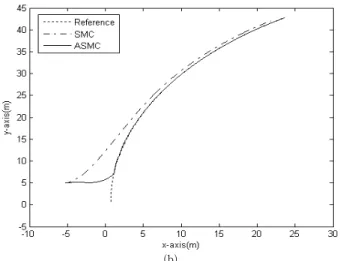
<Fig. 1> Trajectory tracking result of the proposed controller. (a) x-y plot under the constant external disturbance. (b) x-y plot under the time varying external disturbance.
Fig. 1 compares the tracking results of the proposed control system and the SMC system which represents a curve. In Fig. 1 (a) and (b), the control results under the constant external disturbances and the time-varying external disturbances are shown respectively. In Fig. 1, note that the performance of the proposed approach is better than that of the SMC approach proposed in [5] under the effects of the model uncertainties, and the constant or the time-varying external disturbances.
5. Conclusion
In this paper, the adaptive sliding mode controller for a nonholonomic wheeled mobile robot with model uncertainties and external disturbances has been proposed. To approximate the uncertainty terms, the WNNs have been employed and all their weights have been trained online by tuning laws derived from the Lyapunov stability theory. In addition, we have proved that all signals in the adaptive closed-loop system are uniformly ultimately bounded. Finally, from the simulation results for the mobile robot, it have been shown that the proposed controller has better tracking performance than the previous SMC approach based on kinematics in polar coordinates under the model uncertainties and the external disturbances.
6. Acknowledgement
This work was supported by the Brain Korea 21 Project in 2007.
[Reference]
[1] O.H. Dagci, U. Y. Ogras, and U. Ozguner, ``Path following controller design using sliding mode control theory'', in Proc. Amer.
Control Conf., vol. 1, pp. 903-908, 2003.
[2] S. Liu, H. Zhang, S. X. Yang, and J. Yu, ``Dynamic control of a mobile robot using an adaptive neurodynamics and sliding mode strategy'', in Proc. World Cong. Intelligent Control and Automation, vol. 6, pp. 5007-5011, 2004.
[3] S. Akhavan and M. Jamshidi, ``ANN-based sliding mode control for nonholonomic mobile robots'', in Proc. IEEE Int. Conf. Control Applications, pp. 664-667, 2000.
[4] J. M. Yang, and J. H. Kim, ``Sliding mode control of trajectory tracking of nonholonomic wheeled mobile robots'', IEEE Trans.
Robot. Automat. vol. 15, no. 3, pp. 578-587, 1999.
[5] D. K. Chwa, ``Sliding-mode tracking control of nonholonomic wheeled mobile robots in polar coordinates'', IEEE Trans. Contr.
Syst. Technol., vol. 12, no. 4, pp. 637-644, 2004.