Enhancing Preservice Teachers’ Science Self-Efficacy Beliefs and Pedagogical Content Knowledge (PCK) through Scientific
Investigations
Choi, Sanghee ․Lee, Young Hee
†(University of North Georgia)․(Dankook University)
†미국 초등교사교육 과정 과학교육방법론 수업(Science Methods Course)의 과학적 탐구 활동을 통한 예비교사들의 과학교수학습에 대한
자기 효능감 및 PCK 이해의 향상
최상희․이영희
† (북조지아대학교)․(단국대학교)†ABSTRACT
This study was designed to enhance preservice teachers’ self-efficacy beliefs and pedagogical content know- ledge (PCK) through scientific investigations based on current science education reforms. To do so, a science methods course was revised to include modeling effective scientific inquiry practices as well as designing and teaching scientific investigations in the K-5 practicum classrooms (Revised Science Methods Course). This study assessed the following research questions: (1) What level of PCK do preservice teachers have before and after the completion of RSMC; (2) To what extent do participants change their self-efficacy in science teaching after completing RSMC; and (3) Is there any correlation between participants’ changes in self-efficacy and the level of PCK. Participants were 76 preservice teachers enrolled in a science methods course offered at a medium-sized university in the midwestern United States. This study employed the STEBI-B survey and the PCK rubric. There result of the study indicated that there was significant increase in Personal Science Teaching Efficacy (PSTE) of the participant preservice teachers after the completion of the course. Based on the PCK rubric analysis, there was a significant increase in mean scores of the post-RSMC lesson compared to those of the pre-RSMC lesson.
The correlational analysis of participants showed a positive correlation between changes in self-efficacy and the level of PCK. Thus, it may be concluded that the reform-based science methods course had a positive impact on participants’ self-efficacy in science teaching through correcting misconceptions, developing higher level of PCK, and modeling scientific investigation in their practicum schools.
Key words : science self-efficacy, PCK (Pedagogical content knowledge), science methods course, inquiry, preservice teachers
2015.8.26
(접수), 2015.9.11(1심통과), 2015.10.5(2심통과), 2015.10.21(최종통과)E-mail: [email protected]
(Lee, Young Hee)I. Introduction
Current Reforms in science education call for sys- temic changes in K-12 science education as well as
science teacher education. The National Science Edu-
cation Standards (National Research Council, 1996)
states, “The current reform effort requires a substantive
change in how science is taught; an equally substantive
change is needed in professional development practices”
(p.56). Recently, the NRC reemphasizes the systemic change in science education again through a Frame- work for K-12 Science Education (NRC, 2012), which was developed to guide the development of the Next Generation Science Standards (NGSS). The Framework states, “The framework and subsequent standards will not lead to improvements in K-12 science education unless the other components of the system – curri- culum, instruction, professional development, and assess- ment – change…” (p.17).
To translate systemic changes in the science class- room, teachers are required to acquire different types of knowledge and skills toward innovative instruc- tional design and new standards (American Association for the Advancement of Science, 1998; NRC, 1996).
The NGSS (2013) states, “Throughout grades K-12, students should have the opportunity to carry out scientific investigations and engineering design projects related to the disciplinary core ideas” (p.9). A major goal of this reform is to develop scientific literacy through scientific investigations in student learning, allowing them to make meaningful constructions of scientific concepts.
To do this, students need to learn science through science and engineering practices, which emphasize scientific investigation on the basis of inquiry-based and problem-solving approaches. Science and engineering practice is explained by NGSS’s statement, “Students at any grade level should be able to ask questions of each about the texts they read, the features of phe- nomena they observe, and the conclusions they draw from their models and scientific investigation (p.55).”
This document also points out that the design and adaptation of science content to meet the interests, knowledge, understanding, abilities, and experiences of students is critical to promote successful science learning (NGSS, 2013).
These reforms demand that teachers develop both content knowledge as well as necessary pedagogical skills to teach science effectively. Subject matter know- ledge alone is not sufficient, instead; teachers’ pro- fessional knowledge of general pedagogical principles
and practices is essential for effective teaching (Bransford et al., 2000). Pedagogical content knowledge (PCK) is considered a critical factor to measure teachers’ pro- fessional knowledge (Shulman, 1986; 1987). Researchers view PCK as a form of practical knowledge that guides teachers’ understanding of science and its curri- cula, instructional strategies and practices (Magnusson et al., 1999).
Research suggests that PCK should be an important component in science teacher education (Duggan-Hass et al., 2000; Shulman, 1987). According to Park and Oliver (2008), teachers can develop a connection between content knowledge and pedagogical knowledge through the development of PCK. These teachers, therefore, become effective teachers who possess knowledge of representations of subject matter and knowledge of effective teaching practices incorporating these represen- tations. Other researchers (Beyer & Davis, 2011; van Driel et al., 1998) also suggest that PCK guides teachers to help students have better understanding of scientific ideas and concepts.
1. Self-Efficacy Beliefs and PCK
Teacher self-efficacy is the set of beliefs a teacher holds regarding his or her abilities to accomplish certain teaching tasks (Lunenburg, 2011). According to Steele (2010), teachers with a high level of self-efficacy have been shown to be more competent in their teaching and achieve at a higher academic level compared to teachers with a low self-efficacy. Therefore, teacher efficacy belief provides a useful framework for predicting teacher-teaching behavior by examining a person’s belief in his or her own competency (Nespor, 1987; Riggs &
Enochs, 1990). Self-efficacy beliefs are consistent with two dimensions of teacher efficacy, that of personal teaching efficacy (self-efficacy), a personal belief in their skills and abilities to be an effective teacher, and teaching efficacy (outcome expectancy), a personal belief that effective teaching will improve student learning (Bandura, 1977; Swars & Dooley, 2010).
Shulman (1986) proposed that PCK is a unique
combined knowledge of content and knowledge of
teachers in general pedagogy. It is a particular body of
knowledge, which teachers require to perform success- ful teaching. Wh and Sutikno (2015) suggested that PCK contains both content knowledge of the specific discipline and knowledge of instructional strategies to teach that discipline in the classroom. Thus, PCK is specifically for professional knowledge that teachers must develop through their teacher education preparation.
Students’ success depends on what the teachers know about a subject and how he or she can transfer to the students what he or she knows (Kola & Sunday, 2015).
Teacher self-efficacy is regarded as a critical com- ponent of teacher education and professional develop- ment of science teachers (Hebert et al., 1998). Naspor (1987) stressed that the level of confidence in teaching of teachers has a positive correlation with the level of their professional knowledge. Conceptually, PCK con- sisted of two dimensions: the understanding of content knowledge and the enactment of that knowledge in the classroom. Teachers with high self-efficacy demonstrated abilities to develop these two dimensions effectively (Stein & Wang, 1988). Therefore, teacher self-efficacy can be associated most closely with the successful mastery of PCK.
According to the review of literature, teacher edu- cation courses as well as college educators play a critical role in preservice teachers constructing positive beliefs in promoting reform-based science teaching (Clark & Peterson, 1986; Pajares 1992). Researchers also recognize the need to better prepare teachers to implement current science reforms by improving teaching effectiveness and developing scientific literacy (Gess- Newsome et al., 2003; NRC, 2012). According to the National Science Teacher Association (2003), effective teachers develop a deep understanding and skills of PCK during their teacher education preparation and later, they design and provide appropriate science learning experiences to K-12 students. The NGSS (2013) des- cribes this term, “skills” as “practices” to emphasize developing PCK through scientific investigations. Through these reforms, teachers are now asked to engage stu- dents in scientific practices and this, eventually, requires teachers to learn such practices for themselves. For this reason, it is necessary to bring a systemic change
to science teacher education courses and also to the faculty’s method of delivery.
2. Scientific Investigation and Self-efficacy Beliefs
NGSS (2013) emphasized that students should be engaged with scientific investigations by requiring both skills and knowledge that is specific to each investi- gation. Scientific investigation is a form of scientific inquiry that involves the formulation of a question that can be answered through an investigation. If students need to develop a greater understanding of science content when learning this way, that means, teachers must possess such knowledge and abilities to teach this way. In order to these teachers to achieve success with the use of scientific investigation, they need to increase scientific knowledge as part of their teacher education or later through professional development (NRC, 2012).
According to literature, pre-service teachers that experience learning science through scientific inquiry or investigation build their self-confidence to teach in future classrooms utilizing these practices (Duggan-Hass et al., 2000; McDonnough & Matkins, 2010). This means that the experiences of teachers are an im- portant element to change their science-teaching effi- cacy. Other studies found that well-designed science methods courses that are focused on scientific inquiry can successfully increase the levels of science teaching efficacy (Author, 2013; Ozdilek & Bulunuz, 2009;
Palmer, 2006). These studies also found that pre-service teachers who experienced inquiry and investigation as part of their instructional framework improved their science knowledge as well as their knowledge on how to teach science.
The purpose of the study was to enhance pre-service teachers’ self-efficacy beliefs and PCK through scientific investigations based on current science education reforms.
A science methods course was revised to include
modeling effective scientific inquiry practices as well
as designing and teaching scientific practices in the
K-5 practicum classrooms for the study. This study
assessed the following research questions: (1) What
level of PCK do pre-service teachers have before and after the completion of a revised science methods course (RSMC); (2) To what extent do these partici- pants change their self-efficacy in science teaching after completing RSMC; and (3) Is there any correla- tion between participants’ changes on self-efficacy and the level of PCK.
II. Methods
1. Participants
Participants in this study were 76 preservice tea- chers enrolled in a science methods course offered at a medium-sized university in the Midwestern United States. All participants except one were women (75 of 76). Of the 76 preservice teachers, 68 were Caucasian and 8 were African American. Most participants (84
%) were 20-30 years of age and others (16%) were 31 to 40 years of age. The majority of the participants (91%) had completed two or three college-level science courses before this study. The science methods course, a 3-credit course, required in the Teacher Education program is usually taken during the senior year. It occurs concurrently with 140 hours of supervised school- based teaching practicum for that semester.
2. Revised Science Methods Course (RSMC) The core framework of this revised science methods course (RSMC) was based on a constructivist idea of teaching and learning and was also a model for scien- tific inquiry practices for elementary preservice teachers.
This course was aimed at a major goal, improving preservice teachers’ pedagogical content knowledge in order for participants to enhance their confidence in teaching science. The RSMC was designed with curri- cula and activities to focus on core science concepts in the national and state standards. This course con- sisted of three phases; modeling effective scientific practices, designing two lessons, and teaching two lessons that emphasized scientific investigations in the participants’ practicum classrooms.
During the process of modeling, preservice teachers were engaged in collaborative scientific investigation
including formulating questions, exploring alternative solution strategies, and engaging in clinical problem- solving skills. For example, groups of participants were provided a wooden block, spring scale, a set of mass, and five different types of papers (construction paper, paper towel, aluminum foil paper, wax paper, and sand paper) and were to investigate relationships among force, motion, and friction. In this phase, participant teachers were expected to interpret the results of each investigation by using their content knowledge and the data they collected (Appendix A:
part 1). After the initial investigation, groups identified and developed their own understanding of each con- cept and their relationships through another investi- gation (Appendix A: part 2). They were further challen- ged to make connections between these concepts and Newton’s laws of motion. Then, they are asked to present their findings by using visual representations (i.e., a diagram and/or chart).
Groups finally engaged in a facilitated large group discussion followed by reviewing concepts to make sense of their experiences. Through this process, the participants deepened their understanding by correcting their misunderstandings. In this phase, an instructor facilitated a whole group discussion to review and guide them to construct the scientific content toward the investigation objective. Next, groups worked to apply the science concepts to a real world situation – control the speed of motion by strengthening or le- ssening the force of friction (Appendix A: part 3).
After modeling scientific practices, the preservice teachers were asked to design and teach two science lessons that included inquiry-based scientific investigations for their K-5 practicum classrooms.
3. Data Collection & Analysis
The study employed one-group, pretest-posttest design
and used a mixed-methods design involving both quan-
titative and qualitative research methodologies (Gall et
al., 2003; Merriam, 1998). The instrument used for
this study was the Science Teaching Efficacy Belief
Instrument Form B (STEBI-B; Enochs & Riggs, 1990)
for use with preservice elementary teachers. The STEBI-
B consists of 23 Likert-type items that measures two subscales, the 13-item Personal Science Teaching Efficacy (PSTE) and the 10-item Science Teaching Outcome Expectancy (STOE). The reliability estimate for this instrument, using Cronbach alpha coefficient, was .87 and .69 for the subscale (Cantrell et al., 2000; Enochs
& Riggs, 1990). The instrument was administered to all participants at the beginning and end of the RSMC.
Teachers’ PCK was evaluated through the PRIME PCK rubric (Gardner & Gess-Newsome, 2011). This rubric was designed for measuring content knowledge, pedagogical knowledge, and contextual knowledge within PCK. The PCK Content Knowledge (PCK-CK) consisted of four components including accuracy of content know- ledge, connections within and between topics, and the nature of science fluency with multiple modes of repre- sentation or examples of a topic. The possible score is 12 points. The PCK Pedagogical Knowledge (PCK-PK) contains three components, rational linking teaching strategies to student learning, strategies for eliciting student prior understandings, and strategies to promote student examination of their own thinking. The possi- ble score is 9 points. Lastly, the PCK Contextual Knowledge (PCK-CxK) includes understanding student variations, student prior concepts, and the impact of instructional decisions. The possible score is 3 points.
Participants’ interviews, written reflections (Appendix B), and videotapes of their classroom teaching practices were collected to provide evidence for the PCK. Two videotapes for each participant’s classroom teaching were collected at the beginning and end of the RSMC.
Interviews and written reflections were collected one time at the end of the RSMC. The videotapes were further excerpted to examine “what the students do and what the teacher does.” A set of these data was
Group Mean SD
t p
Teaching efficacy (PTSE)
Pre 33.66 2.38
3.259 .003*
Post 45.84 2.97
Outcome expectancy (STOE)
Pre 28.31 2.99
1.445 .159
Post 30.34 7.84
*Significant p<0.05
Table 1. T-test (two-tailed) results for self-efficacy and outcome expectancy (N=76)
scored based on the PRIME PCK rubric (Appendix C). The possible PCK score was 24 based on all of the categories. Scores in the range of 0 to 7 are considered as a low level of PCK, scores in mid range of 8 to 16 are considered as a medium level of PCK, and scores in the range of 17 to 24 are considered a high level of PCK (Gardner & Gess-Newsome, 2011).
For the rubric analysis of the PCK, triangulation of three evaluators was adopted and its inter-rater relia- bility was 0.89 (p<.01). The STEBI-B data was analyzed using SPSS (version PASW 18) to conduct a com- parison of means between the pretest and posttest employing a two-tailed dependent t-test for paired samples. To measure the correlations between the self- efficacy and level of PCK, a Canonical Correlation was calculated. This analysis allows investigating between variables (Afifi et al., 2011).
III. Results & Discussion
1. Changes in Self-Efficacy
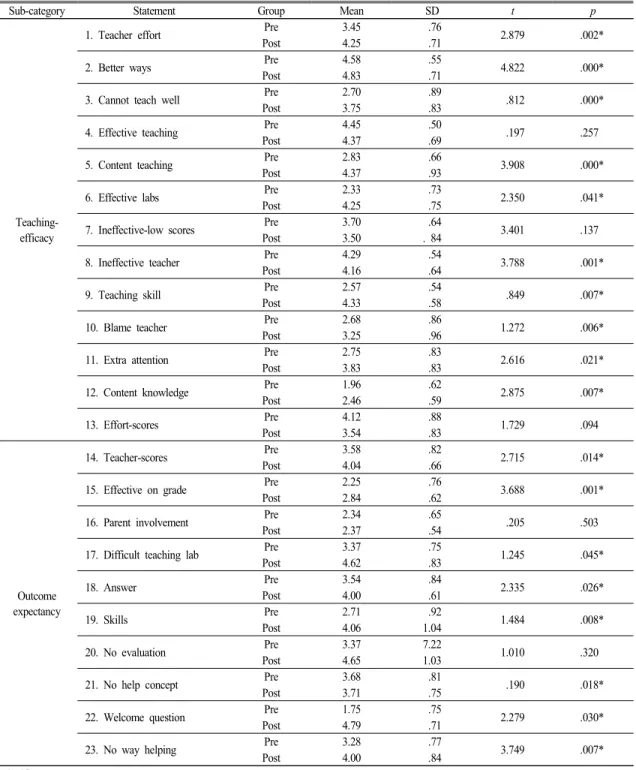
Mean scores, standard deviations, and a dependent, two-tailed t-test for paired samples were applied to the STEBI-B subscales (Table 1). Table 1 shows a signifi- cant difference between the mean scores of the pretest and posttest. The participant preservice teachers had significant increases in their science teaching efficacy mean scores (P<.05) which indicated significant improve- ment in their science teaching efficacy (PTSE) after taking the revised science methods course (RSMC).
Based on the t-test results, the preservice teachers
increased their efficacy especially in teaching science
content and science experiments according to the following
items: 5 (I know the steps necessary to teach science
concepts effectively); 6 (I will not be very effective in
monitoring science experiments); and 12 (I understand science concepts well enough to be effective in teaching elementary science) (Table 2).
On the other hand, the preservice teachers did not
Sub-category Statement Group Mean SD
t p
Teaching- efficacy
1. Teacher effort Pre 3.45 .76
2.879 .002*
Post 4.25 .71
2. Better ways Pre 4.58 .55
4.822 .000*
Post 4.83 .71
3. Cannot teach well Pre 2.70 .89
.812 .000*
Post 3.75 .83
4. Effective teaching Pre 4.45 .50
.197 .257
Post 4.37 .69
5. Content teaching Pre 2.83 .66
3.908 .000*
Post 4.37 .93
6. Effective labs Pre 2.33 .73
2.350 .041*
Post 4.25 .75
7. Ineffective-low scores Pre 3.70 .64
3.401 .137
Post 3.50 . 84
8. Ineffective teacher Pre 4.29 .54
3.788 .001*
Post 4.16 .64
9. Teaching skill Pre 2.57 .54
.849 .007*
Post 4.33 .58
10. Blame teacher Pre 2.68 .86
1.272 .006*
Post 3.25 .96
11. Extra attention Pre 2.75 .83
2.616 .021*
Post 3.83 .83
12. Content knowledge Pre 1.96 .62
2.875 .007*
Post 2.46 .59
13. Effort-scores Pre 4.12 .88
1.729 .094
Post 3.54 .83
Outcome expectancy
14. Teacher-scores Pre 3.58 .82
2.715 .014*
Post 4.04 .66
15. Effective on grade Pre 2.25 .76
3.688 .001*
Post 2.84 .62
16. Parent involvement Pre 2.34 .65
.205 .503
Post 2.37 .54
17. Difficult teaching lab Pre 3.37 .75
1.245 .045*
Post 4.62 .83
18. Answer Pre 3.54 .84
2.335 .026*
Post 4.00 .61
19. Skills Pre 2.71 .92
1.484 .008*
Post 4.06 1.04
20. No evaluation Pre 3.37 7.22
1.010 .320
Post 4.65 1.03
21. No help concept Pre 3.68 .81
.190 .018*
Post 3.71 .75
22. Welcome question Pre 1.75 .75
2.279 .030*
Post 4.79 .71
23. No way helping Pre 3.28 .77
3.749 .007*
Post 4.00 .84
*Significant p<0.05
Table 2. T-test (two-tailed) results by each item (N=76)
have significant changes in their teaching outcome ex-
pectancy (STOE) mean scores. Thus, their beliefs that
students will learn as a result of their teaching did not
change during the course. Based on the individual items
in STOE analysis, it is interesting to note that the participants acknowledged that teacher effectiveness was directly related to students’ science achievement.
However, they reported that they struggled in handling students’ science questions and did not know how to encourage students’ interests in science according to the following items: 15 (Students’ achievement in science is directly related to their teacher’s effectiveness in science teaching); 22 (When teaching science, I will usually welcome student questions); and 23 (I do not know what to do to turn students on to science) (Table 2).
2. Changes in Pedagogical Content Knowledge (PCK)
The topics which participants taught for pre and post RSMC lessons included a physical science do- main (matter, changes, force and motion, magnets), a life science domain (animal and plant life cycles and cells, classifications), and an earth science domain (water cycle, weather, moon phases). All chosen topics were aligned with the national and state curriculum standards for each grade level.
Based on the analysis of participants’ PCK scores (Table 3), there was a significant increase the mean scores for the post-RSMC lesson compared to those of the pre-RSMC lesson (p<.05). The range of scores was 3.4 to 21 and its mean score was 18.25 for the post-RSMC lesson. For the pre-RSMC lesson, the range of scores for PCK-Total was 0 to 9 and its mean score was 6.74. Looking at the mean scores in sub- categories, not only did participants’ PCK-Total improve but each sub-categories such as PCK- content knowledge (CK), pedagogical knowledge (PK), and contextual knowledge (CxK) also improved after taking the course (p<.05). PCK-CK was 7.65 out of 12, PCK-CK was
PCK-total PCK-CK PCK-PK PCK-CxK
Categories Pre Post
t p
Pre Postt p
Pre Postt p
Pre Postt p
Possible score 24 12.00 9.00 3.00
Mean 6.74 18.25 2.67 .009* 2.15 7.65 3.19 .017* 1.36 6.98 2.17 .008* 0 2.10 2.23 .014*
*Significant p<0.05
Table 3. Mean scores of participants’ PCK (N=76)
Fig. 1. Participants’ level of PCK
*Significant p<0.05
6.98 out of 9, and PCK-CxK was 2.1 out of 3 for the post-RSMC lesson and PCK-CK was 2.15 out of 12, PCK-CK was 1.36 out of 9, and PCK-CxK was 0 out of 3 for the pre-RSMC lesson.
According to the level of participants’ PCK (Fig.
1), participants significantly increased the level of PCK after the completion of the course. Forty-three percent (33) of the participants scored a high PCK, 36.8% (28) participants marked medium PCK, and 15.8% (15) participants exhibited low PCK for the post-RSMC lesson. On the other hand, 9.5% (7) participants scored high PCK, 22.6% (17) participants marked medium PCK, and 67.9% (52) participants exhibited low PCK for the pre-RSMC lesson. Based on the results of PCK analysis, participants gained significant content knowledge and developed effective teaching strategies to teach science. They also con- structed a deeper understanding of their students’ prior concepts, which is essential for their successful learning experiences.
3. Correlations: Self-Efficacy and Pedagogical Content Knowledge (PCK)
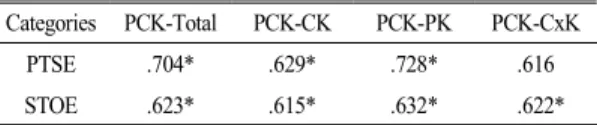
Table 4 shows the results of the correlational analysis
Categories PCK-Total PCK-CK PCK-PK PCK-CxK
PTSE .704* .629* .728* .616
STOE .623* .615* .632* .622*
*Significant p<0.05
Table 4. Correlation between self-efficacy and PCK
of participants’ changes in self-efficacy and the level of PCK. The participants exhibited a strong positive correlation between PCK-Total score and the Personal Science Teaching Efficacy (PSTE) and a moderate positive correlation with the Science Teaching Outcome Expectancy (STOE) (p<.05). By sub-categories, there were moderate positive correlations between PTSE and PCK-CK and PTSE and PCK-PK. There were also moderate positive correlations between STOE and PCK-CK and PCK-PK and PCK-CxK.
Based on the results of STEBI-B and Table 4, the participants increased their science teaching self-efficacy by gaining confidence in their content knowledge and pedagogical knowledge throughout the course. Interes- tingly, the PCK Contextual knowledge (PCK-CxK) showed a positive correlation with Science Teaching Outcome Expectancy (STOE). Since the PCK-CxK explains one’s understanding of leaners and learning, this understanding is likely to change one’s belief about their teaching will improve students’ learning.
IV. Conclusions
This study was designed to enhance preservice tea- chers’ self-efficacy beliefs and PCK through scientific investigations based on current science education re- forms. A revised science methods course (RSMC) was developed for this study. The results of the study indicated that there was significant increase in PTSE for the participant preservice teachers after the com- pletion of the course. However, there was no signifi- cant change in STOE. Based on the analysis of PCK rubric, there was a significant increase in mean scores of the post-RSMC lesson compared to those of the pre-RSMC lesson. In the pre-RSMC lesson, more than 50% of participants exhibited a low level of PCK, but in the post-RSMC lesson, the majority of participants
(84%) demonstrated medium to high levels of PCK.
Studies suggested that prior science learning experi- ences is strongly associated with PTSE scores. They reported that preservice elementary teachers with posi- tive science learning experiences demonstrated higher scores in PTSE (Bleicher, 2004; Mulholland et al., 2004). According to Bandura (1977), self-efficacy is promoted by performance accomplishment, which is defined as a personal successful experience of a specific task of learning. Tosun (2000) noted that negative science learning experiences induced a dislike toward science and its teaching. Other important factors that related to higher efficacy in science teaching included science content knowledge (Swars & Dooley, 2010), number of science courses taken, and extra science activities (i.e., science fairs, science club, etc.) in high school (Bleicher, 2004; Cantrell et al., 2003).
According to recent literature, a science methods course, only when it is well structured, can be success- ful in improving science teaching efficacy of preservice elementary teachers. Instructional strategies, in which these studies employed, included inquiry approach (Christol & Adams, 2006; Palmer, 2001; Wee et al., 2004), project-based learning (Yoon et al., 2006) and field-based learning (Swars & Dooley, 2010). Specifi- cally, McDonnough and Matkins (2010) found that scientific investigation also enhanced preservice teachers confidence in teaching. They suggested that scientific inquiry and its investigation increased preservice tea- chers’ self-efficacy by helping them to develop know- ledge in science and pedagogical skills in science instruction.
Bandura (1977) stated that self-efficacy indicates
the link between teachers’ PCK and their perceptions
of their own science teaching ability. Carrier (2009)
further suggested that teachers’ self-efficacy can be
improved with development of PCK and the PCK can
be improved through teaching experiences. Another
researcher added that preservice teachers develop their
PCK through teacher education courses (Hebert et al.,
1998). However, Appleton (2003) claimed that reformed
science methods courses do not always lead to the
success of improving preservice teachers’ PCK. The
revision must emphasize student misconceptions and constructivist views of learning in order to bring successful changes in self-efficacy and PCK.
The results of a correlational analysis for this study indicated the participants increased their science tea- ching self-efficacy by improving their content knowledge (PCK-CK), pedagogical knowledge (PCK-PK), and understanding of students (PCK-CxK) through the course.
These participants exhibited a strong positive correlation between self-efficacy and PCK-Total in science tea- ching as well as its sub-categories. According to Stein and Wang (1988), teacher self-efficacy is an important element to connect content knowledge and pedagogical skills of teachers in order to master PCK successfully.
Thus, it may be concluded that the reform-based science methods course had a positive impact on participants’
self-efficacy in science teaching. This resulted in par- ticipants building confidence in their own science tea- ching through correcting misconceptions, developing higher level of PCK, and modeling inquiry instruction in their practicum schools through scientific investi- gations.
Consideration regarding no changes in the STOE scale scores in this study and other studies may relate to the preservice teachers’ degree of successful science teaching experiences. Mulholland et al. (2004) suggested that preservice teachers’ inexperience in teaching may lead to their low science teaching outcome expectancy (STOE). As a result they do not trust that their effec- tiveness will make a difference in student learning.
Thus, researchers emphasize the importance of early field-experiences for preservice teachers to provide opportunities for teaching experiences (Cantrell et al., 2003; McDonnough & Matkins, 2010; Swars & Dooley, 2010). Additionally, other researchers reported that there are high possibilities that preservice teachers do not have enough opportunities to observe effective sci- ence instruction and practice their science teaching in their field placement classrooms due to the neglect of science instruction by elementary schools as well as teachers (Banilower et al., 2006; Davis et al., 2006).
Therefore, it is also recommended that the field- experiences must provide adequate opportunities of
quality teaching observations and teaching practices in science.
The findings in this study suggest that teacher pre- paration programs should make some changes in their curriculum and instruction in order to increase tea- ching efficacy and further higher teaching effective- ness. It is true that higher efficacy in science teaching has a positive impact on preservice teachers’ develop- ment of their pedagogical knowledge and vice versa.
This will eventually impact their teaching effective- ness. The findings of this study provide teacher edu- cators and teacher preparation programs important information to better prepare future elementary teachers.
국문요약
본 연구는 현 과학교육의 개혁 운동에 기초하여 예비 교사들의 자기 효능감과 교과교육지식(PCK) 이해의 향상을 위하여 과학적 탐구를 실행하였다.
이를 위하여 과학교육 방법론 수업(Science Method
Course)은 초등학교 교실에서 실행할 수 있는 효과
적인 과학 탐구 모델링 수업과 과학적 실천 교수학
습을 포함하도록 수정하였다(RSMC). 본 연구에서
는 다음과 같은 연구 문제를 조사하였다: (1) 수정
된 과학교육 방법론 수업(RSMC)의 처치 전후 예비
교사들의 PCK 정도는 어떠한가?: (2) RSMC 이수
후 과학 교수학습에서 예비교사들의 자기 효능감
의 정도는 어떻게 변화하였는가?: (3) 예비교사들의
자기 효능감과 PCK 수준의 변화는 어떤 상관관계
가 있는가? 연구에 참여한 예비교사들은 미국 중부
의 중간정도 규모의 대학의 교사교육 과정에서 제
공하는 과학교육 방법론 수업에 등록한 76명이며,
분석을 위해서 STEBI-B 설문지와 PCK 평가지를
이용하였다. 본 연구의 결과로는 예비교사들이 RSMC
이수 후 개인적 과학교수 효능감(PSTE: Personal
Science Teaching Efficacy)이 확실히 향상된 결과를
볼 수 있었다. 또한 PCK 평가지에 근거하면, RSMC
전과 후의 PCK 수준은 평균값이 현저히 상승하였
으며, 예비 교사들의 자기 효능감과 PCK 수준의 변
화 사이의 상관관계 분석에서는 긍정적인 상관관
계를 보여주었다. 따라서 본 연구에서는 과학교육
개혁 운동에 근거하여 설계된 과학교육방법론 수
업(RSMC)은 예비 교사들의 오개념의 수정, PCK
수준의 향상 증진, 그리고 현장 학교에서 탐구수업 의 모델링 등을 통하여 과학교수학습에서 자기 효 능감의 향상에 긍정적인 영향을 미친다고 결론 내 릴 수 있다.
주제어: 자기 효능감, 교과교육지식(PCK), 과학 교육 방법론, 탐구, 예비교사
References
Alfifi, A., Clark, V. A. & May, S. (2011). Practical multi- variate analysis (5
thEd.). Salem, OR: CRC Press.
American Association for the Advancement of Science.
(1990). Science for all Americans (pp. 1-11). New York: Oxford University Press.
American Association for the Advancement of Science.
(2001). Atlas of science literacy. Washington, DC:
Author.
Appleton, K. (2003). How do beginning primary teachers cope with science? Toward in understanding of science practice. Research in Science Education, 33, 1-25.
Appleton, K. & Kindt, I. (2002). Beginning elementary teachers’ development as teachers of science. Journal of Science Education, 21, 155-168.
Bandura, A. (1977). Self-efficacy: Toward a unifying theory of behavior change. Psychological Review, 84(2), 191- 215.
Banilower, E., Smith, P. S., Weiss, I. R. & Pasley, J. D.
(2006). The status of K-12 science teaching in the United States: Results from a national observation survey.
In D. Sunal & E. Wright (Eds.), The impact of the state and national standards on K-12 science teaching (pp. 83-122). Greenwich, CT: Information Age Publishing.
Beyer, C. J. & Davis, E. A. (2012). Learning to critique and adapt science curriculum materials: Examining the development of preservice elementary teachers' peda- gogical content knowledge. Science Education, 96(1), 130-157.
Bleicher, R. E. & Lindgren, J. (2005). Success in science learning and preservice science teaching self-efficacy.
Journal of Science Teacher Education, 16, 205-225.
Bleicher, R. E. (2004). Revisiting the STEBI-B: Measuring self-efficacy in preservice elementary teachers. School Science and Mathematics, 104(8), 383-391.
Bransford, J., Brown, A. & Cocking, R. (2000). How people learn: Brain, mind, experience and school. Commission on Behavioral and Social Sciences and Education of
the National Research Council, Washington, DC: National Academy.
Cantrell, P., Young, S. & Moore, A. (2003). Factors affecting science teaching efficacy of preservice elementary teachers. Journal of Science Teacher Education, 14(3), 177-192.
Carrier, S. (2009). The effects of outdoor science lessons with elementary school students on preservice teachers’
self-efficacy. Journal of Elementary Science Education, 21(2), 35-48.
Choi, S. (2013). Science teaching self-efficacy and anxiety in pre-service teachers: Its relationship to their con- ceptual understanding of physical Science. Presented at the 2013 National Conference of the National Association for Research in Science Teaching.
Christol, P. G. & Adams, A. D. (2006). Using the STEBI- B determine the impacts of a standards-driven course on pre-service students’ sense of personal and teaching efficacy in science education. Paper presented at 2006 Annual Conference of the Association for Science Teacher education. Anchorage, AK.
Davis, E. A., Petish, D. & Smithey, J. (2006). Challenges new science teachers face. Review of Educational Research, 76, 607-652.
Duggan-Haas, D., Enfield, M. & Ashman, S. (2000).
Rethinking the presentation of the NSTA standards for science teacher preparation. Electronic Journal of Science Education, 4(3), Retrieved Feb. 12, 2012 from http://
www.msu.edu/~dugganha/PCK.htm
Gall, M. D., Gall, J. P. & Borg, W. R. (2003). Edu- cational research (7th). Boston; Allyn & Bacon.
Gardner, A. L. & Gess-Newsome, J. (2011). A PCK rubric to measure teachers’ knowledge of inquiry-based instruction using three data sources. Paper presented at 2011 Annual Conference of the National Association for Research in Science Teaching. Orlando, FL.
Hebert, E., Lee, A. & Williamson, L. (1998). Teachers’
and teacher education students’ sense of efficacy: Quan- titative and qualitative comparisons. Journal of Research and Development in Education, 31(4), 14-225.
Lunenburg, F. C. (2011). Self-efficacy in the workplace:
Implications for motivation and performance. International Journal of Management, Business and Administration, 14(1), 1-6.
Magnusson, S., Krajcik, J. & Borko, H. (1999). Nature, sources and development of pedagogical content know- ledge for science teaching. In J. Gess-Newsome & N.
G. Lederman (Eds.), Examining pedagogical content
knowledge: The construct and its implications for science education (pp. 95-132). Dordrecht, The Netherlands: Kluwer Academic.
McDonnough, J. T. & Matkins, J. J. (2010). The role of field experience in elementary preservice teachers’ self- efficacy and ability to connect to practice. School Science and Mathematics, 110(1), 13-23.
Mulholland, J., Dorman, J. P. & Odgers, B. M. (2004).
Assessment of science teaching efficacy of preservice teachers in an Australia University. Journal of Science Teacher Education, 15(4), 313-331.
National Research Council (1996). National science education standards. Washington, DC: National Academy Press.
National Research Council. (2012). A framework for K-12 science education: Practices, crosscutting concepts, and core ideas. Washington, DC: National Academies Press.
National Science Teachers Association. (2003). Standards for science teacher preparation. Arlington, VA: NSTA.
Nespor, J. (1987). The role of beliefs in the practice of teaching. Journal of Curriculum Study, 18, 197-206.
NGSS Lead States. (2013). Next generation science stan- dards: For states, by states. Washington, DC: The National Academies Press.
Pajares, M. F. (1992). Teachers’ beliefs and educational research: Cleaning up a messy construct. Review of Educational Research, 62, 307-332.
Palmer, D. H. (2001). Factors contributing to attitude ex- change amongst preservice elementary teacher. Science Education, 86, 122-138.
Park, S. & Oliver, J. S. (2008). National board certifi- cation (NBC) as a catalyst for teachers’ learning about teaching: The effects of the NBC process on candidate teachers’ PCK development. Journal of Research in Science Teaching, 45(7), 812-834.
Riggs, I. M. & Enochs, L. G. (1990). Further develop- ment of an elementary science teaching efficacy belief instrument: A preservice elementary scale. School Science and Mathematics, 90(8), 694-706.
Shulman, L. S. (1986). Those who understand: Know- ledge growth in teaching. Educational Researcher, 15(2), 4-14.
Shulman, L. S. (1987). Knowledge and teaching: Foun- dations of the new reform. Harvard Review, 57(1), 1-21.
Steele, N. A. (2010). Three characteristics of effective teachers. Update, 28(2). 71-78.
Stein, M. K. & Wang, M. C. (1988). Teacher develop- ment and school improvement: The process of teacher change. Teaching and Teacher Education, 4, 171-187.
Strauss, A. & Corbin, J. (1990). Grounded theory: Basics of qualitative research. Newbury Park, CA: Sage.
Swars, S. L. & Dooley, C. M. (2010). Changes in teaching efficacy during a professional development school-based science methods course. School Science and Mathe- matics, 110(4), 193-202.
Tosun, T. (2000). The beliefs of preservice elementary teachers toward science and science teaching. School Science and Mathematics, 100(7), 374-379.
Van Driel, J. H., Verloop, N. & de Vos, W. (1998).
Developing science teachers' pedagogical content know- ledge. Journal of Research in Science Teaching, 35(6).
673-695.
Wee, B., Fast J., Shepardson, D., Harbor, J. & Boone, W (2004). Students’ perceptions of environmental-based inquiry experiences. School Science and Mathematics, 104(3), 112-118.
Wh, E. H. & Sutikno. (2015). Self-efficacy as affective domain of pedagogical content knowledge (PCK): The implications for preservice and inservice teachers in science teaching. International Journal of Education and Research, 3(1), 391-404.
Yoon, S., Pedretti, E., Benze, L., Hewitt, J., Perris, K. &
Oostveen, R. V. (2006). Exploring the use of cases and
case methods in influencing elementary preservice science
teachers’ self-efficacy beliefs. Journal of Science Teacher
Education, 17, 15-35.
Appendix A
An Example of Scientific Investigation: Friction & Newton’s Second Law
Objective: Friction is a very common (and sometimes troublesome) force. But do you know how it works?
Do you know what the force of friction depends on?
Focusing Question: If you are dragging the block at a constant velocity, what is the relationship between the force you are applying and the force of friction?
Martials: wooden blocks, mass sets, spring scale, five different surfaces (construction paper, paper towel, aluminum foil paper, wax paper, and sand paper)
Procedure:
1. Attach the spring scale to the wooden block 2. Gently pull the block and read the scale in Newton.
3. You are measuring the force required to move the block. Do not pull the scale up or down at an angle;
always pull it directly sideways.
Part 1. Friction and the Normal Force
Question: If you are dragging a box across the floor, and somebody jumps onto to it, will the box be harder to pull?
1. Write your prediction.
2. Investigate this by measuring the friction force between the block and the table as you add weight to the block. Try different masses (from 0.5 kg to 5.0 kg), and complete the table (see sample table below).
Trial Mass Force
1 2 3