* 1 Received on November 23, 2012; accepted on March 7, 2013
* 2 Division of Environmental Forest Science, Gyeongsang National University, Institute of Agriculture & Life Sciences, Jinju 660-701, Korea
* 3 Gyeongnam National University of Science and Technology, Department of Interior Materials Engineering, Jinju 660-758, Korea
* 4 Korea Research Institute of Chemical Technology, Daejeon 305-600, Korea
* 5 SK Energy Institute of Technology, Daejeon 305-712, Korea
†
Corresponding author : Jae-Kyung Yang (e-mail: [email protected])
Optimization of Bio-based Succinic Acid Production from Hardwood Using the Two Stage pretreatments* 1
Ji Young Jung *
2, Jong Soo Jo *
3, Young Wun Kim *
4, Byeng Tae Yoon *
4, Choon Gil Kim *
5, and Jae Kyung Yang *
2†ABSTRACT
The steam explosion-chemical pretreatment is a more effective wood pretreatment technique than the conventional physical pretreatment by accelerating reactions during the pretreatment process. In this paper, two-stage pretreatment processes of hardwood were investigated for its enzymatic hydrolysis and the suc- cinic acid yield from the pretreated solid. The first stage pretreatment was performed under conditions of low severity to optimize the amount of solid recovery. In the second stage pretreatment washed solid ma- terial from the first stage pretreatment step was impregnated again with chemical (alkaline or chlorine- based chemicals) to remove a portion of the lignin, and to make the cellulose more accessible to enzymatic attack. The effects of pretreatment were assessed by enzymatic hydrolysis and fermentation, after the two stage pretreatments. Maximum succinic acid yield (16.1 g L
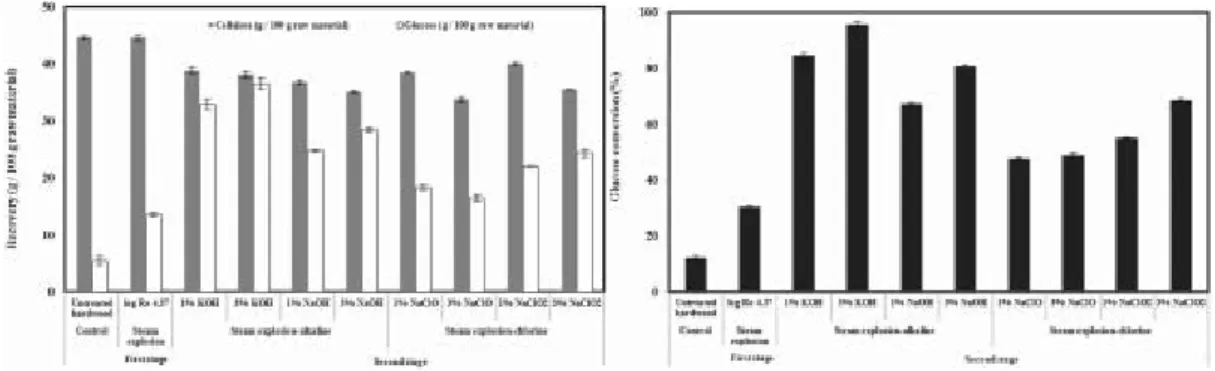
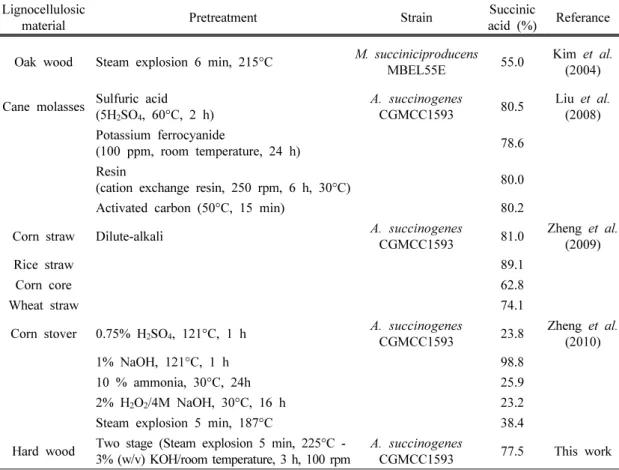
-1and 77.5%) was obtained when the two stage pretreatments were performed at steam explosion -3% KOH.
Keywords : hardwood, two stage pretreatments, steam explosion pretreatment, succinic acid
1. INTRODUCTION
Succinic acid, derived from fermentation of agricultural carbohydrates, has a specialty che- mical market in industries producing food and pharmaceutical products, surfactants and deter- gents, green solvents and biodegradable plastics, and ingredients to stimulate animal and plant
growth (Zeikus et al., 1999). Lignocellulosic mater-
ials represent renewable resources for production
of fuel ethanol from sugars. In particular, ligno-
cellulosic material such as woody biomass is re-
garded as a promising energy source because it is
renewable and consists of abundant carbohydrates.
Among the nutrient sources available, cellu- losic and hemicellulosic materials such as wood and municipal solid wastes are renewable and most abundant (Kim et al., 2004). Enzymatic hydrolysate of wood has been regarded as one of the most inexpensive carbon source for the fermentative production of biochemicals. Even though wood hydrolysate is a good source for fermentable glucose and xylose, it contains some unknown toxic or inhibitory compounds for cells, resulting in low efficiency of bioconversion (Lee et al., 1999; Converti et al., 1998; Palmqvist et al., 2000).
The main drawbacks in hydrolysing ligno- cellulosic biomass are to do with the low speci- fic activity of the enzymes and on the substrate structure itself. The utilization of lignocellulosic materials in a bioconversion process requires a pre-treatment step in order to break down the various physical and chemical barriers that greatly inhibit their susceptibility to bioprocess such as enzymatic hydrolysis and fermentation (Mosier et al., 2005). Generally, the pretreatment process is crucial and costly, which has a significant im- pact on the efficiency of subsequent enzymatic hydrolysis. The enzymatic hydrolysis of ligno- cellulose is mainly limited by several factors in- cluding crystallinity of cellulose, degree of poly- merization (DP), moisture content, available sur- face area and lignin content (Chang et al., 2000; Hendriks and Zeeman, 2009).
To overcome these obstacles, many pretreat- ment processes, including mechanical pretreat- ment, thermal pretreatment, acid pretreatment, al- kaline pretreatment, oxidative pretreatment, and some combinations, have been investigated ex- tensively (Hendriks and Zeeman, 2009). Among the different existing pre-treatment methods, steam explosion is one of the most commonly used for fractionation of biomass components. High- pressure steaming followed by rapid decom- pression is called steam-explosion. The steam ex-
plosion process has been tried and found useful in the low cost biomass conversion of wood and crop residues (Taylor and Yu 1995). It has been found as an effective pretreatment of wood bio- mass for biotechnological conversion for pro- duction of food, feed and chemicals (Jackob- sons et al., 1995; Kallavus and Cravitis, 1995).
The treatment results in substantial breakdown of the lignocellulosic structure, hydrolysis of the hemicellulosic fraction, depolymerization of the lignin components and defibration. Therefore, the accessibility of the cellulose components to de- gradation by enzymes is greatly increased (Moni- ruzzaman et al., 1996). Compared with alter- native pre-treatment methods, the advantages of steam explosion include a significantly lower en- vironmental impact, lower capital investment and less hazardous process chemicals (Li et al., 2001). On the other hand, the presence of de- gradation products from sugar and lignin is unavoidable and must be taken into account in order to minimize the potential negative effect on subsequent steps (Tengborg et al., 2001).
Recently, steam-explosion has been consider- ed as an effective pretreatment (Duff and Murray, 1996) of waste cellulosic materials for further processing, including olive stones (Fernández et al., 1999). The resultant material is finely divid- ed; and the main components-cellulose, hemi- cellulose, and lignin- are separated (Felizón et al., 2000). Furthermore, the enzymatic hydrolysis of cellulose is enhanced, which could create alternative uses for the hardwood.
Some bases can also be used for pretreatment
of lignocellulosic materials and the effect of al-
kaline pretreatment depends on the lignin content
of the materials (Fan et al., 1987). The mecha-
nism of alkaline hydrolysis is believed to be sa-
ponification of intermolecular ester bonds cross-
linking xylan hemicelluloses and other compo-
nents, for example, lignin and other hemicellu-
lose. The porosity of the lignocellulosic materials
increases with the removal of the crosslinks (Tarkow and Feist, 1969).
The aim of this work is to evaluate the frac- tionation of hard wood by the process sequence based on controlled steam explosion at high tem- perature followed by alkaline and chlorine pre- treatment. Also, we reported, the succinic acid production from pretreated hard wood hydro- lysate by Actinobacillus succinogenes CGMCC 1593.
2. MATERIALS and METHODS
2.1. Raw Material
The raw material used in the pretreatment experiments was wood chips, 2∼10 mm in size, derived from four year old stems of a hard- wood, which were chopped and gathered at Korea Forest Research Institute in the city of Seoul, Korea.
2.2. Pretreatment of Hardwood
2.2.1. First Stage Pretreatment
Steam explosion pretreatment, which was used as a physicochemical pretreatment, was carried out in a batch pilot unit equipped with a 1 L reaction vessel. The “severity parameter” (Ro) was used to map the destruction, desegregation, and depolymerization of Quercus variabilis. Ro was calculated using the following relationship :
Ro = {t*exp[(T - 100)/14.5]} (1)
where T is the temperature (°C) and t the time (min). A steam temperature of 225°C and pre- treatment time of 5 min were applied to realize a severity parameter value of log Ro = 4.37, which ensured a significant reduction of DP with the lowest degradation and produced a material more suitable for hydrolysis (De Bari et al.,
2002). After the saturated steam exposure, a ball valve at the bottom of the reactor was opened suddenly to bring the reactor rapidly to atmos- pheric pressure. This yielded the product, con- taining liquid and solid materials (Take et al., 2006). The exploded material was recovered in a cyclone and after cooling to about 40°C filtered for solid recovery. The solid fraction was water-washed and used for chemical pretreatment.
2.2.2. Second Stage Pretreatment
We added 100 ㎖ of 1%, 3% (w/v) of so- dium hydroxide (NaOH), potassium hydroxide (KOH), Sodium hypochlorite (NaClO) and Sodium chlorite (NaClO
2) to 200 ㎖ Erlenmeyer flasks at a steam exploded sample loading of 1% (w/v) in an shaking incubator (IS-97IR from Jeio-Tech Co., Korea) at the room temperature and 100 rpm for 3 hours. After the pretreatment, the sample was washed with water several times, and stor- ed at 4°C before enzymatic hydrolysis (Chang and Holtzapple, 2000).
2.3. Enzymatic Hydrolysis of Hardwood Pretreated with Different Methods The effects of the pretreatment conditions on the digestibility were assessed by enzymatic hy- drolysis of pretreated material from the pretreat- ment step. Enzymatic hydrolysis was performed in 1 g batches with 2% (w/w) pretreated material in 0.1 M sodium citrate buffer (pH 4.8) at a temperature of 40°C for 96 h. A commercial cellulase mixture, kindly supplied by Novozy- mes A/S (Bagsværd, Denmark), consisting of Celluclast 1.5 ℓ (65 FPU g-1), supplemented with the β-glucosidase preparation Viscozyme ℓ (24 CBU g-1) was used in enzymatic hydrolysis.
Samples were withdrawn after 0, 24, 48, 72 and
96 h to monitor the progress of hydrolysis. Du-
plicate experiments were run for each sample.
2.4. Succinic Acid Fermentation Actinobacillus succinogenes CGMCC 1593 was used for succinic acid fermentations. Cells were anaerobically grown in sealed anaerobic bottles (100 ㎖ ) under CO
2atmosphere. The me- dium for seed culture contained per liter : 2.5 g dextrose, 2.5 g dipotassium phosphate, 5 g sodi- um chloride, 17 g enzymatic digest of casein, 3 g enzymatic digest of soybean meal. The medium for fermentation followed as per liter : 30 g total sugar from wood hydrolysate, 10 g yeast ex- tract, 6 g urea, 1.09 g Na
2HPO
4, 0.95 g NaH
2PO
4, 0.2 g NaCl, 0.2 g MgCl
2, 0.2 g CaCl
2, 40 g MgCO
3, 20 µg Vitamin B12, 50 µg itamin B6, 50 µg Riboflavin, 50 µg Lipoic acid, 50 µg Ni- acin, 50 µg Thiamine hydrochloride, 50 µg Folic acid, 50 µg Vitamin B5, 50 µg ethyl p-amino- benzoate, 100 µg Biotin, to seed or fermentation medium, concentrated 2 M NaOH was added to adjust the pH to 6.5. The medium was heat sterilized (15 min at 121°C) in an anaerobic bottle sealed with a butyl rubber stopper with a nitrogen headspace. A. succinogenes CGMCC 1593 was incubated in sealed 150 ㎖ anaerobic bottles containing 50 ㎖ of the seed medium with CO
2as the gas phase at 37°C for 24 h.
For the fermentation experiments, the medium was inoculated with 5% (v/v) seed culture and incubated at 37°C for 48 h.
2.5. Analytical Methods
The raw material composition was determined according to the National Renewable Energy Lab- oratory (NREL, Golden, CO) analytical methods for biomass. Extractives are determined as the solubilized material after a Soxhlet extraction with ethanol for 24 h. Ashes result from raw material calcination at 550°C. Cellulose and hemicellu- lose content was determined based on monomer content measured after a two-step acid hydroly- sis procedure to fractionate the fiber. A first
step with 72% H
2SO
4at 30°C for 60 min was used. In a second step, the reaction mixture was diluted to 4% H
2SO
4and autoclaved at 121°C for 1 h. This hydrolysis liquid was then analysed for sugar content by high performance liquid chromatography (HPLC) in a Waters 2695 liquid chromatography with refractive index detector.
An Aminex HPX-87P carbohydrate analysis co- lumn (Bio-Rad, Hercules, CA) operating at 85°C with deionised water as mobile-phase (0.6 ㎖ /min)was used. The cellulose and hemicellulose contents were calculated using Eqs. (2) and (3), where 0.9 is the correction coefficient for hydration (Iyer and Lee, 1999):
% Cellulose
= glucose released (g) × 0.9 (2)
× 100
sample dry weight (g)
% Hemicellulose
= (3)
(xylose + galactose + arabinose released) (g) × 0.9
× 100 sample dry weight (g)
The solid residue remaining after this acid hydrolysis is considered as acid insoluble lignin.
The acid-soluble lignin content in the hydroly- sates is also quantified. The acid soluble lignin is determined based on UV spectrophotometry at 205 nm. Pre-treated solids were analyzed for sugar and acid insoluble lignin content as des- cribed above for raw material composition.
Glucose concentration from enzymatic hydro-
lysis samples was measured by high perform-
ance liquid chromatography (HPLC). Succinic
acid was analyzed by HPLC (high-performance
liquid chromatograph) system (Waters, Milford,
MA, USA) equipped with a cation-exclusion
column (Aminex HPX-87H; Bio-Rad Chemical
Division, Richmond, CA) and a refractive index
detector (Waters) as described previously (Liu
et al., 2008). The mobile phase was 0.005 N
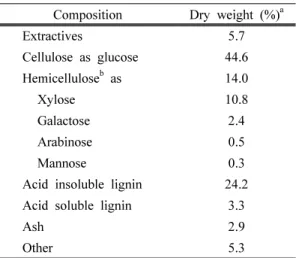
Table 1. Chemical composition of untreated hardwood
aComposition Dry weight (%)
aExtractives 5.7
Cellulose as glucose 44.6
Hemicellulose
bas 14.0
Xylose 10.8
Galactose 2.4
Arabinose 0.5
Mannose 0.3
Acid insoluble lignin 24.2 Acid soluble lignin 3.3
Ash 2.9
Other 5.3
a
Composition percentages are on a dry-weight basis.
H
2SO
4solution at a flow rate of 0.5 ㎖/min, and the column was operated at 55°C. Succinic acid yield was defined as the amount of succinic acid produced from 1 g sugar consumed, and was ex- pressed as a percentage. The sugar utilization was calculated as sugar consumed initial sugar, and was expressed in percentage (Zheng et al., 2009).
All analytical determinations were performed in duplicate and average results are shown.
3. RESULTS and DISCUSSION
3.1. Chemical Composition of Hardwood The chemical composition of the untreated hardwood used in this study is presented in Table 1. Based on the HPLC carbohydrate analy- sis, the sugar fraction was 58.6% of the dry biomass. Glucose, which is derived from both the hardwood fiber and plant cell wall, was the major component at 44.6%. Xylose, which is the major hemicellulose constituent, was 10.8%. Ara- binose, galactose and mannose accounted for only a small portion of the biomass. Both glucan and xylan content were lower than the reported values of 40∼55% glucan and 15∼40% xylan for other woody plant and agricultural residues (Milne et al., 1992; Sun et al., 2002; Zhu and Pan, 2010; J. Söderström et al., 2003; Jorgensen et al., 2007). The discrepancy between the holo- cellulose content and total sugars is probably due to sugar degradation during the intense hydroly- sis with sulfuric acid (Badger, 2002) used for the carbohydrate analysis procedure. Since the carbo- hydrate content of hardwood (based on mono- meric sugars) determined by HPLC analysis was more likely to represent the actual sugars avail- able after the treatments, subsequent calculations and analysis of data in this study were performed on the basis of HPLC measurements. The acid insoluble and soluble material from woody bio- mass is normally classified as lignin. The acid-
insoluble content of the hardwood was 24.2%
and lignin was higher than the reported values of 18∼25% other hardwoods (Sun et al., 2002;
Ucar,1990; Mosier et al., 2005).
3.2. Effect of Pretreatment on the Chemical Composition
The chemical composition change of hard-
wood is important indices for the effectiveness
of its pretreatment. Table 2 shows the two stage
pretreatment of this study, as well as yields of
both the steam explosion pretreatment solid re-
covered (%) and the insoluble residue recovered
by filtration after steam explosion-chemical pre-
treatment. It is found that the solid recovery is
significantly decreased by the steam explosion
treatment from 100% of raw material to 85% of
the steam exploded material. Fiber losses occur
during steam explosion because of the de-
position of fibers on the walls of the cyclone as
well as in the connecting piping between the
reactor vessel and the cyclone. Losses also
occurred through the escape of volatiles with
the steam and through the degradation of sugars
Table 2. Solids recovery of hardwood after steam explosion-alkaline, chlorine pretreatment processes Pretreatment
Pretreatment conditions
Solid recovered after pretreatment (%)
aConc.
(%)
bReaction temperature (°C)
Reaction time (min) First stage
Steam explosion (log Ro 4.37) 225 5 85.0
Second stage
Steam explosion-KOH 1 30 180 51.7
3 50.7
Steam explosion-NaOH 1 30 180 51.0
3 50.2
Steam explosion-NaClO 1 30 180 76.5
3 67.4
Steam explosion-NaClO
21 30 180 74.8
3 50.2
a
Percentages calculated from value on a dry-weight basis.
b
Conc. : chemical concentration.
Table 3. Chemical composition of hardwood after steam explosion-alkaline, chlorine pretreatment processes
Pretreatment Composition (%)
aConc. (%)
bCellulose Hemicellulose Lignin
eAsh First stage
Steam explosion (log Ro 4.37) 52.4 (44.5)
d4.0 (3.4) 31.7 (26.9) 2.4 (2.0) Second stage
Steam explosion-KOH 1 75.1 (38.8) 1.0 (0.5) 14.8 (7.7) 2.5 (1.3) 3 75.2 (38.1) -
c14.6 (7.4) 2.4 (1.2) Steam explosion-NaOH 1 72.0 (36.7) 0.5 (0.3) 16.5 (8.4) 3.6 (1.8) 3 69.9 (35.1) 0.2 (0.1) 17.4 (8.7) 3.0 (1.5) Steam explosion-NaClO 1 50.2 (38.4) 0.4 (0.3) 33.2 (25.4) 3.0 (2.3) 3 50.1 (33.8) 0.5 (0.3) 36.9 (24.9) 3.1 (2.1) Steam explosion-NaClO
21 53.4 (39.9) 0.6 (0.4) 33.1 (24.8) 2.8 (2.1) 3 70.6 (35.4) 0.2 (0.1) 47.4 (23.8) 2.6 (1.3)
a
Percentages calculated from values on a dry-weight basis.
b
Conc. : chemical concentration.
c
Amount of hemicellulose was too low to quantify.
d
Data are expressed in parentheses as a percentage based on dry weight of raw material.
e
Acid insoluble lignin and acid soluble lignin.
into furfural and 5-hydroxymethyl furfural, both of which are volatile compounds (Jeoh et al., 1998). Steam explosion conditions (log Ro 4.37)
were optimized to obtain maximum soild recovery
(data not shown). Alkaline and chlorine con-
sisted of two stages : KOH, NaOH, NaClO and
Table 4. Weight loss of hardwood after steam explosion-alkaline, chlorine pretreatment processes
Pretreatment Weight loss (%)
aConc. (%)
bCellulose Hemicellulose Lignin
cFirst stage
Steam explosion (log Ro 4.37) 0.2 75.7 2.0
Second stage
Steam explosion-KOH 1 13.0 96.3 72.2
3 14.6 100.0 73.1
Steam explosion-NaOH 1 17.7 98.2 69.4
3 21.4 99.3 68.2
Steam explosion-NaClO 1 14.0 97.8 7.6
3 24.4 97.6 9.6
Steam explosion-NaClO
21 10.5 96.8 10.0
3 20.6 99.3 13.5
a
Percentages calculated from values on a dry-weight basis.
b
Conc. : chemical concentration.
c