한국컴퓨터정보학회 하계학술대회 논문집 제21권 제2호 (2013. 7)
325
통신산업의 정보시스템 감사를 위한 단대단 분석
이중희*, 이상원○
*(주)재이컨설팅
○원광대학교 정보전자상거래학부(정보과학연구소)
e-mail: [email protected]*, [email protected]○
End-to-End Analysis to Audit Information Systems for Telecommunication Industry
Joong Hee Lee*, Sangwon Lee○
**J Consulting Co. Ltd.
○Division of Information and Electronic Commerce, Wonkwang University
● 요 약 ●
Although, there are so much information for telecommunication companies to manipulate and handle. there are still many side-effects in the field of completeness while transmitting information among information systems. Especially, works related to End-to-End Reconciliation bring about side-effects. In this research, we establish a proposed model for end-to-end analysis. After an experiment in a business company, we analyze its experimental results.
키워드: Information Systems, Audit, End-to-End
I. 서 론
Nowadays, there are so much information for telecommunication companies to manipulate and handle.
However, there are still many side-effects in the field of completeness while transmitting information among information systems. A major field with these side-effects is End-to-End Reconciliation. It is necessary for the most of the telecommunication industry to secure consistency to overcome gaps between business logics and information systems logics. The consistency is composed of completeness, accuracy, and timeliness. Completeness is the status where any data, information, and services of customers are not omitted. Accuracy is the status where information of customers and communication usages is correct. And, timeliness is the status where any transactions of data and information are not delayed. In this research, we analyze the completeness of information transmission among information systems and the legitimacy of errors or dropped records.
Also, we keep researching on the accuracy of information in
changing information for charging such as sender, receiver, calling time. We propose a model of end-to-end analysis in order to secure information consistency.
II. Design for End-to-End Analysis
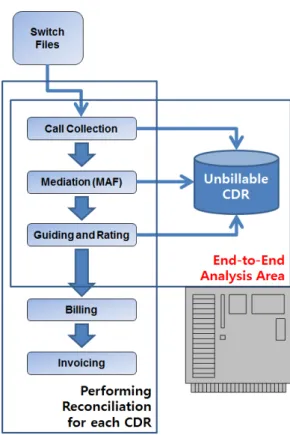
End-to-End Analysis is a kind of method to analyze revenue assurance that checks whether a created CDR(Call Detailed Record) is included in the charging subject completely and correctly for each stage (Fig. 1). MAF in the process means message acquisition and formatting. The whole process is composed of five major phases such as call collection, mediation, guiding and rating, billing, and invoicing. Switch files are input into call collection. Three phases (call collection, mediation, guiding and rating) interact with unbillable CDR. The database (unbillable CDR) operates dropped records and errors. The whole five phases performs reconciliation for CDR for each phase.
한국컴퓨터정보학회 하계학술대회 논문집 제21권 제2호 (2013. 7)
326
Fig. 1. Model for End-to-End Analysis
III. Experiment of End-to-End Analysis
We performed end-to-end analysis 2 times in a telecommunication company in China. The scope of first analysis is voice service, and that of second analysis of second analysis includes short message service, intelligent network service, and data service. The criteria for analysis are the scope of business and the risk of business. The scope of business is composed of sales-contribution degree and the number of CDR. The risk of business is also composed of service variety and system complexity (Fig. 2).
Fig. 2. Criteria for End-to-End Analysis
The analysis subject of SMS switchboard is 3,010,000 CDRs that occur from 15:00 to 16:00 on July 10 in 2012.
The analysis subject of intelligent network is 30,000 CDRs
한국컴퓨터정보학회 하계학술대회 논문집 제21권 제2호 (2013. 7)
327 that occur from 15:00 to 16:00 on July 10 in 2012. The
analysis subject of data service such as VOD is 9,100,000 EDR(Event Data Record) and 1,610,300 NDR(Normalizing Data Record). Since the result of end-to-end management is generally satisfactory fine, there are few errors. But we found a case where CRD is not created abnormally in generating intelligent network, which needs complimentary measures.
And there are omissions of charging in several intelligent switchboards. In addition, there are errors in classifying charging subjects in some PGS switchboard.
IV. Conclusions
We proposed a model for end-to-end analysis and performed an experiment for the verification of the model.
We make a conclusion that there are some errors and omissions of information and it is urgently needed for telecommunication companies to implement a periodic process of end-to-end analysis for related information systems.
References
[1] E. Turban, E. McLean, J. Wetherbe, Information Technology for Management, Wiley, 1999.
[2] R. Weber, Information Systems Control and Audit, Prentice Hall, 2013.
[3] H. S. McCreary, and E. M. Birch, “Computer Capacity Planning from an Auditing Perspective,” EDP Auditing, Vol. 76, No. 2, pp. 1-12, 1990.