김재욱 외 2인 : HEVC 고속 부호화를 위한 PU 탐색 조기 종료 기법 627 (Jae-Wook Kim et al. : An Early Termination Algorithm of Prediction Unit (PU) Search for Fast HEVC Encoding)
a) 한국항공대학교 항공전자 및 정보통신공학부(School of Elec., Telecom. & Comp. Eng., Korea Aerospace University)
‡Corresponding Author : 김재곤(Jae-Gon Kim) E-mail: [email protected] Tel: +82-300-0414
※본 연구는 교육과학기술부의 재원으로 한국연구재단의 기초연구사업(No. 2011-0023182)과 미래창조과학부 및 정보통신산업진흥원의 IT융합고급 인력과정지원사업 (NIPA-2014-H0301-14-1002)의 지원으로 수행되었음.
※이 논문의 연구결과 중 일부는 “3D Systems and Applications (3DSA 2014)”에서 발표한 바 있음.
Manuscript received July 25, 2014 Revised August 18, 2014 Accepted August 18, 2014
HEVC 고속 부호화를 위한 PU 탐색 조기 종료 기법
김 재 욱
a)
, 김 동 현a)
, 김 재 곤a) ‡
An Early Termination Algorithm of Prediction Unit (PU) Search for Fast HEVC Encoding
Jae-Wook Kim
a)
, Dong-Hyun Kima)
, and Jae-Gon Kima) ‡
요 약
최신 비디오 부호화 표준인 HEVC(High Efficiency Video Coding)에서는 재귀적으로 동일한 4개의 블록으로 분할될 수 있는 쿼드 트리 기반의 부호화단위(CU: Coding Unit) 구조를 적용하여 높은 부호화 효율을 얻는다. 각 깊이(depth) 레벨에서 각 CU는 가변 크 기의 예측단위(PU: Prediction Unit)로 분할된다. 하지만 각 부호화트리단위(CTU: Coding Tree Unit) 마다 최적의 CU 분할구조와 각 CU 마다 최적의 PU 모드를 결정하기 위한 상당한 계산 복잡도 증가를 야기한다. 본 논문에서는 이러한 계산 복잡도를 줄이기 위하여 PU 탐색을 조기 종료하는 고속 PU 결정 기법을 제시한다. 제한 기법은 상위 깊이 CU의 최적 모드와 부호화 율-왜곡 비용을 이용해 서 현재 깊이 CU에서의 특정 모드의 율-왜곡 비용 계산을 생략함으로써 PU 탐색을 조기 종료한다. 실험결과 제안기법은 HM 12.0 대비 0.2%의 비트 증가에 18.1%의 계산시간 감소 효과를 얻을 수 있음을 확인하였다.
Abstract
Abstract—The latest video coding standard, high efficiency video coding (HEVC) achieves high coding efficiency by employing a quadtree-based coding unit (CU) block partitioning structure which allows recursive splitting into four equally sized blocks. At each depth level, each CU is partitioned into variable sized blocks of prediction units (PUs). However, the determination of the best CU partition for each coding tree unit (CTU) and the best PU mode for each CU causes a dramatic increase in computational complexity. To reduce such computational complexity, we propose a fast PU decision algorithm that early terminates PU search.
The proposed method skips the computation of R-D cost for certain PU modes in the current CU based on the best mode and the rate-distortion (RD) cost of the upper depth CU. Experimental results show that the proposed method reduces the computational complexity of HM12.0 to 18.1% with only 0.2% increases in BD-rate.
Keywords : HEVC, Fast encoding, CU, PU 특집(레터)논문 (Special(Letter) Paper)
방송공학회논문지 제19권 제5호, 2014년 9월 (JBE Vol. 19, No. 5, September 2014) http://dx.doi.org/10.5909/JBE.2014.19.5.627
ISSN 2287-9137 (Online) ISSN 1226-7953 (Print)
628 방송공학회논문지 제19권 제5호, 2014년 9월 (JBE Vol. 19, No. 5, September 2014)
I. Introduction
The new international video coding standard of HEVC aims to substantially improve coding efficiency compared to the preceding state-of-the-art standard to reduce bit rate by half with comparable quality. Comparing to H.264/AVC, HEVC reduces the bit rate by almost 40%
with an equivalent objective quality and around 1.4 times coding complexity [1].
In HEVC, the newly adopted recursive quadtree-based CU partitioning structure is one of the major tools con- tributing the coding efficiency improvement. A picture is partitioned into coding tree units (CTU), and a quadtree structure is utilized to partition the CTU into smaller CUs.
The depth of the quadtree can be as large as four and a CTU presents a root node (depth 0) of the quadtree. The partitioning can be recursively continued until the max- imum depth is reached. To achieve the best coding per- formance, the best quadtree-based block partitioning struc- ture of CU and the associated PU and transform unit (TU) is searched recursively based on rate-distortion (RD) cost.
However, such recursive process determining optimal block structures results in drastic increase of computational complexities. There has been a lot of work to reduce the encoder complexity caused by the exhaustive CU splitting and PU decision process [2]-[6].
To reflecting the practical importance of reducing en- coder complexity, three optional fast mode decision schemes have been adopted in HEVC reference software, called HEVC test model (HM) [7]. For fast PU decision, the early skip detection (ESD) [2] method and the coded block flag (CBF) fast method (CFM) [3] terminate remain- ing PU decision processes when predefined specific con- ditions are met. In other words, the ESD checks inter 2N×2N first and terminate if motion vector difference is zero and CBF equal to zero. The CFM terminates if PU has CBF equal to zero. On the other hand, the early CU
termination (ECU) [4] terminates CU split if SKIP is de- termined as the best mode of current CU. In this way, a fast decision of CU depth is achieved.
In this paper, we present an early termination scheme of PU search based on the correlation between the upper depth level and the current depth level. The best PU mode and the RD cost obtained in the upper depth level are used to speed up the PU mode decision of the current depth lev- el under the basic assumption of high correlation between the best modes of both depth levels.
II. Mode Decision Process in HM
HM encoder determines the best quadtree based block structure for each CTU through the mode decision process.
For each CU, the best PU mode is chosen by evaluating the RD cost in order of MERGE, SKIP, INTER and INTRA.
INTER consists of square motion partition (INTER 2N×2N and INTER N×N), symmetric motion partition (SMP) (INTER N×2N and INTER 2N×N), and asymmetric motion partition (AMP). N×N inter/intra prediction are performed only when current CU size is the smallest size. At the end of prediction process, the mode having the smallest RD cost is chosen as the best mode of the current CU, and then the CU is split into four square sized sub-CUs and the mode decision process is performed in the next depth level.
After exhaustive search of all recursive partitioning blocks at every depth level, a quadtree-based coding struc- ture of CTU and the final prediction mode of each CU are determined based on the best cost of each depth.
III. Proposed Fast PU Decision Scheme
The process of CU partitioning and the associated mode
decision is performed recursively at every depth level. It
is likely that there exists considerable correlation between
consecutive depth levels in terms of coding information
김재욱 외 2인 : HEVC 고속 부호화를 위한 PU 탐색 조기 종료 기법 629 (Jae-Wook Kim et al. : An Early Termination Algorithm of Prediction Unit (PU) Search for Fast HEVC Encoding)
such as the best mode and the associated RD cost [5].
However, most of the existing fast mode decision schemes utilize coding information of the current depth level with- out consideration of the correlation between depth levels.
For instance, the ESD checks CBF and MVD after inter and skip modes search in the current depth. In addition, the CFM verifies CBF in inter modes search and the ECU confirms whether the best mode is skip or not in the current depth. The proposed scheme early terminates the mode search in the current depth by using coding information ob- tained in the upper depth.
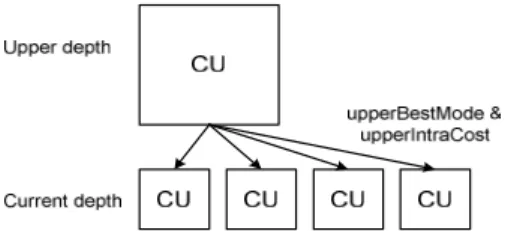
The details of the proposed fast mode decision scheme are as follows. In the top depth level, the RD cost for all modes are evaluated as the HM’s decision process since there is no available upper depth. In lower depth levels after the de- cision process at CTU level, when a CTU or CU is divided into four sub-CUs, the best mode of upper depth (upper BestMode) and RD cost of upper INTRA mode (upper IntraCost) are used in the current depth as shown in Fig. 1.
그림 1. 현재 깊이에서 사용되는 상위 깊이의 부호화 정보
Fig. 1. Encoding information of the upper depth to be used in the current depth
In order to speed up the mode search process by skipping some prediction modes, early termination points are se- lected under three conditions by using those two coding in- formation of the upper depth. The details procedure of the proposed fast mode decision scheme is shown in Fig. 2.
When the SKIP mode is decided as the best mode in the upper depth, it is assumed that the SKIP mode is most like- ly be the best mode in the current depth. As an additional condition, the RD cost of SKIP mode is compared to that of INTER 2N×2N mode that has usually relatively small
RD cost [6]. In order to do this, the search order of SKIP/Merger and INTER 2N×2N specified in HM is swap- ped as shown in the Fig. 2 and check whether the best RD cost is updated with that of SKIP mode or not after the evalu- ation of RD cost of SKIP mode. Then if the upper depth’s mode is SKIP and the best RD cost (BestCost) is updated after the SKIP mode search, the search process for remaining modes in the current depth is terminated and the current CU is split into four sub-CU by condition 1 (Cond1).
그림 2. 제안한 고속 PU 모드 결정 절차
Fig. 2. Proposed fast PU mode decision process
When the upper best mode is the INTER modes, the sec- ond early termination skipping INTRA modes search proc- ess can be occurred depending on the condition 2 and the condition 3. In other words, after evaluation of the RD costs for all INTER modes, the condition 2 confirms whether the best RD cost is updated or not, which means if the current best mode is one of the INTER modes.
The RD cost of INTRA mode is predicted from that of
upper depth based on the correlation of RD cost of INTRA
modes between the consecutive depths. The correlation can
assumed high since similar characteristics of reference sam-
ples are likely to be used for intra prediction in both
depths. Based on such considerations, the specific value of
INTRA RD cost can be predicted according to the ratio of
block sizes along with the consideration of prediction
accuracy. In the experiment, it is noted that 20% of the
630 방송공학회논문지 제19권 제5호, 2014년 9월 (JBE Vol. 19, No. 5, September 2014)
upper INTRA’s RD cost would be appropriate as the pre- dicted RD cost in terms of trade-off between complex re- duction and coding loss.
IV. Experimental Results
The proposed fast mode decision scheme is implemented into HM 12.0 [7]. We used the same test sequence set used for HEVC standard development. For experiments, random access (RA) configuration of Main Profile is used with 64×64 CTU and the maximum partition depth equal to 4.
Every test sequence in classes B, C, D, and E is used, and for each sequence 100 frames are encoded per given QP values QP (22, 27, 32, and 37). As a metric for the per- formance measure, the average time saving given by
∆
is used, where and denote encoding time of HM 12.0 and the proposed scheme implemented on HM 12.0. Table 1 summarizes the performance of the proposed scheme.
Class Sequences BD-rate (%)
Y U V ∆T
Class A Traffic 0.2% 0.1% 0.1% 13.5%
PeopleOnStreet 0.3% -0.3% -0.1% 12.8%
Class B Kimono 0.2% 0.1% -0.3% 13.5%
BasketballDrive 0.1% 1.0% 0.1% 21.9%
Class C
BasketballDrill 0.4% 0.4% 0.4% 19.8%
BQMall 0.3% 0.2% 0.2% 18.9%
PartyScene 0.2% 0.0% 0.0% 17.2%
RaceHorses 0.2% 0.3% 0.7% 10.5%
Class D
BasketballPass 0.0% 0.3% -0.3% 19.9%
BQSquare 0.0% -0.4% -0.1% 27.1%
BlowingBubbles 0.3% 0.1% -0.1% 17.1%
RaceHorses 0.4% 0.2% 0.2% 9.1%
Class E
FourPeople 0.1% -0.3% -0.2% 39.2%
Johnny 0.0% -0.1% -0.2% 40.1%
KristenAndSara 0.2% 0.0% 0.2% 39.4%
Average 0.2% 0.1% 0.0% 18.1%
표 1. 제안 기법의 부호화 효율 및 복잡도 감소(Anchor: HM 12.0) Table 1. Coding efficiency and complexity reduction of the proposed scheme (Anchor: HM 12.0)
As shown in Table 1, the proposed scheme can save 18.1% of the encoding time, on average, with just 0.2%
BD-rate increase. It can also be seen that the benefit of the proposed scheme is more significant for the sequences of the class E, which have sparse content and less motion.
V. Conclusions
In this paper, a fast PU mode decision scheme was presented. The proposed scheme early terminates the PU mode search process by using the best PU mode and the RD cost of INTRA mode in the upper depth level with as- sumption of high correlation between consecutive depth levels. Experimental results showed that the proposed scheme sped up the encoding process of HM 18.1%, on average, with just 0.2% BD-rate increase for various test sequences. It is expected that further enhancement can be obtained when the proposed scheme is combined with the existing fast mode decision methods since new features of correlation between consecutive depths is utilized.
참 고 문 헌 (References)
[1] J. Vanne, M. Viitanen, T. D. Hämäläinen, and A. Hallapuro,
“Comparative rate-distortion-complexity analysis of HEVC and AVC video codecs,” IEEE Trans. Circuits Syst. Video Technol., vol.22, no.12, pp.1885-1898, Dec. 2012.
[2] J. Yang, J. Kim, K. Won, H. Lee, and B. Jeon, “Early SKIP detection for HEVC,” JCT-VC document, JCTVC-G543, Nov. 2011.
[3] R. H. Gweon and Y.-L. Lee, “Early termination of CU encoding to re- duce HEVC complexity,” JCT-VC document, JCTVC-F045, Jul. 2011.
[4] K. Choi, S.-H. Park, and E. S. Jang, “Coding tree pruning base CU ear- ly termination,” JCT-VC document, JCTVC-F902, Jul. 2011.
[5] J.-H. Lee, C.-S. Park, and B.-G. Kim, “Fast coding algorithm based on adaptive coding depth range selection for HEVC,” in Proc. IEEE Int.
Conf. Consumer Elec. (ICCE), 2012.
[6] C.-S. Park et al, “Early termination algorithm of merge mode search for fast high efficiency video coding encoder,” J. Broadcasting Engineering, vol. 18, no. 5, Sep. 2013.
[7] I. Kim, K. McCann, K. Sugimoto, B. Bross, and W. Han, “High effi- ciency video coding (HEVC) Test Model 12 (HM12) encoder descrip- tion,” JCTVC document, JCTVC-M1002, Apr. 2013.