서 론
잉어목(Cypriniformes) 잉엇과(Cyprinidae)에 속하는 납자루 아과(Acheilognathinae) 어류는 암컷의 기다란 산란관을 이용하 여 담수 이매패류(Bivalves: Unionidae and Margaritiferidae)의 출수공에 산란하는 독특한 생활사를 가진 소형 담수어류로 알려 져 있다(Kim et al., 2015). 본 아과의 어류는 전 세계에 약 6속
및 81종으로 구성되어 있으며(Fricke et al., 2020), 현재 우리나 라에는 총 3속 16종이 분포하는 것으로 보고되어 있다(Chae et al., 2019).
자연 교잡(natural hybridization)은 오랜 기간에 걸쳐 개별적으 로 진화한 두 분류군이 자연적으로 2차 접촉하여 후대를 생산하 는 것을 의미하며(Genovart, 2009), 담수어류의 자연 교잡은 체 외수정, 산란 영역 경쟁, 제한된 산란 습성, 산란기 중복, 불완전 한 생식적 격리의 메커니즘, 부모 종의 불균형, 최근 분기된 종 간의 2차 접촉에 대한 감수성, 제한된 환경에서의 산란 숙주 공 유 또는 서식지 공유와 같은 생태생리학적 특성에 의해 일어나는 것으로 알려져 있다(Hubbs, 1955; Jansson et al., 1991; Kanoh,
—45 — http://www.fishkorea.or.kr
저자 직위: 김용휘(박사 후 연구원), 성무성(석·박사통합과정), 윤봉한(석·박사통합과정), 방인철(교수)
* Corresponding author: In-Chul Bang Tel: 82-41-530-1286, Fax: 82-41-530-1493, E-mail: [email protected]
ISSN: 1225-8598(Print), 2288-3371(Online). DOI: https://doi.org/10.35399/ISK.33.2.1
Accepted: April 1, 2021
서해안 독립 하천 대천천에서 납자루 Tanakia lanceolata (♀)와 한강납줄개 Rhodeus pseudosericeus (♂)의 자연 속간잡종 출현
김용휘·성무성·윤봉한·방인철*
순천향대학교 생명과학과
Occurrence of a Natural Intergeneric Hybrid between a Female Tanakia lanceolata and a Male Rhodeus pseudosericeus(Cypriniformes: Cyprinidae) in Daecheoncheon Stream Flowing into the Yellow Sea in the Republic of Korea by Yong Hwi Kim, Mu Sung Sung, Bong Han Yun and In-Chul Bang* (Department of Life Science, Soonchunhyang University, Asan 31538, Republic of Korea)
ABSTRACT A male, presumed to be an intergeneric hybrid between Tanakia lanceolata and Rhodeus pseudosericeus, was collected in the Boryeong Daecheoncheon Stream flowing into the Yellow Sea in the Republic of Korea. Morphological and molecular phylogenetic analyses were performed to discriminate the definite origin of the estimated natural hybrid. As a result of the morphological analysis, the color of the dorsal and anal fin rays edges of the natural hybrid individual, the upper and lower body colors followed the morphological characteristics of T. lanceolata, and that blue longitudinal stripe in the center of the caudal peduncle, the incomplete lateral line, and the barbels absent followed the morphological characteristics of R. pseudosericeus. In addition, as a result of the cytochrome b(cytb) gene analysis of mitochondrial DNA(mtDNA), the natural hybrid showed a nucleotide sequence similarity of 99.82 to 100% with T. lanceolata, and the maternal species was identified as T. lanceolata. As a result of the recombination activating gene 1(rag1) gene analysis of nuclear DNA(nDNA), the natural hybrid showed double peaks pattern reflecting both the single nucleotide polymorphism sites(38bp) between T. lanceolata and R. pseudosericeus, and the paternal species was identified as R. pseudosericeus. Therefore, a natural hybrid estimated male of Acheilognathinae analyzed in this study was found to be an intergeneric hybrid between a female T.
lanceolata and a male R. pseudosericeus.
Key words: Tanakia lanceolata, Rhodeus pseudosericeus, intergeneric hybrid, cytb, rag1
2000; Scribner et al., 2000; Candolin and Reynolds, 2002; Smith et al., 2004; Kim et al., 2010; Kim et al., 2015; Segherloo et al., 2018; Pinheiro et al., 2019). 납자루아과 어류의 경우, 묵납자루 Tanakia signifer와 납자루 T. lanceolata 간의 종간잡종(Kim et al., 2015), T. limbata와 납자루 간의 종간잡종(Hata et al., 2019), 한강납줄개 Rhodeus pseudosericeus와 떡납줄갱이 R. notatus (Kwak et al., 2020) 간의 종간잡종에 관한 연구들과 더불어, 각 시붕어 R. uyekii와 묵납자루 간의 속간잡종(Kim et al., 2010)까 지 빈번한 자연 교잡 출현 사례가 보고되어 있다. 또한, 암컷 T.
tanago와 흰줄납줄개 R. ocellatus 및 수컷 T. limbata에 대한 교 잡 유도 실험(Duyvene de Wit, 1964), 각시붕어와 떡납줄갱이 간 의 상호 교차 교잡 유도 및 형태 측정 특성 및 세포 유전학 분석 (Kim et al., 2012), 암컷 흰줄납줄개와 수컷 R. atremius fangi 간 잡종의 염색체 연구(Ueda and Ueda, 2018), 각시붕어와 흰줄납 줄개 간의 유도 잡종 초기생활사 연구(Park and Han, 2019) 등 연구 목적에 의한 인공 교잡 유도 사례도 보고되어 있다.
본 연구는 서해안 독립하천인 대천천 상류에서 납자루와 한강 납줄개의 외부 형태학적 특징을 공유하는 속간 자연 잡종 수컷 1 개체를 채집하여 이에 대한 형태학적 특징과 분자계통학적 분석 을 수행하였다.
재료 및 방법
1. 시료 확보
2020년 11월 14일 충청남도 보령시 청라면 대천천 청천저 수지 상류 St. 1에서 납자루아과 어류의 자연 잡종으로 추정되 는 수컷 1개체(Soonchunhyang University Collection, SUC;
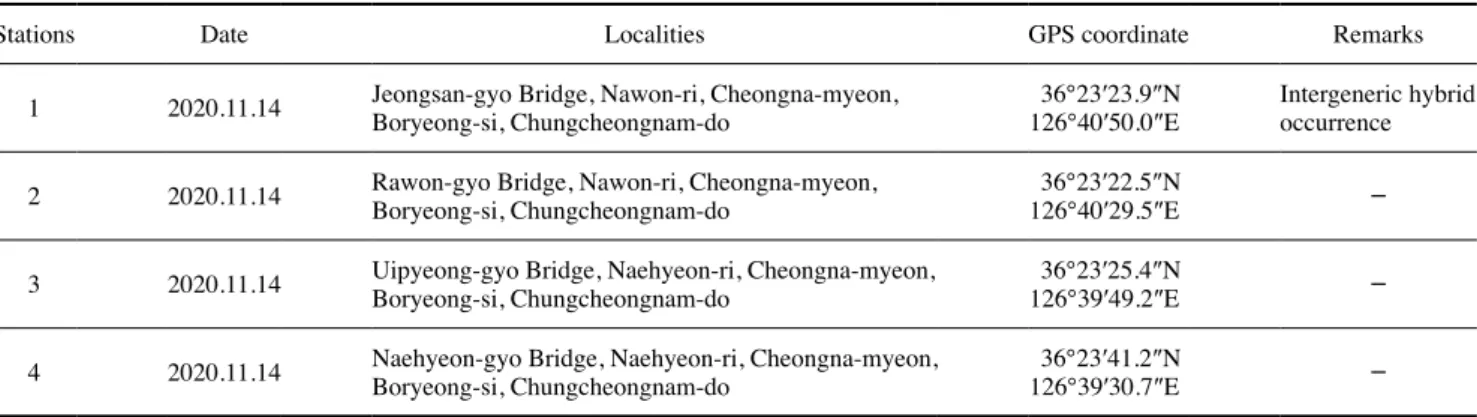
Voucher No. SUC15576; 체장 60mm)를 채집하였으며, 해당 자 연 잡종 추정 개체의 부모 종을 판별하기 위하여 대천천 상류 4 개 지점(St. 1~St. 4)에 대한 어류상 조사를 진행하였다(Table 1). 조사과정에서 출현한 부모 종으로 추정되는 멸종위기야생
생물 II급 한강납줄개 및 동소출현종은 Chae et al.(2019)에 따 라 동정과 기록을 한 후 모두 방류하였으며, 분류 체계는 Nelson et al.(2016)을 따랐다. 또한, 본 연구에서 사용한 어류 시료는 순천향대학교 어류표본수장고에 보관되어 있는 10% 포르말린 whole-body 액침표본과 99.9% 에탄올에 고정된 배지느러미를 분석에 사용하였다. 분자계통학적 분석은 자연 잡종 추정 개체 (SUC25943), 납자루 10개체(SUC25704-25713), 낙동납자루 T. latimarginata(SUC23719; 경상남도 함양군)를 사용하였으 며, 한강납줄개(SUC7091-7100)와 큰줄납자루 Acheilognathus majusculus(SUC6531)는 멸종위기야생생물 II급으로 지정되기 이전인 2012년 4월과 2011년 6월에 대천천 청천저수지 상류 및 전라북도 임실군 섬진강 일대에서 포획한 개체를 사용하였다.
2. 형태학적 분석
납자루아과 자연 잡종 추정 1개체 및 부모 종으로 추정되는 납자루와 한강납줄개는 살아있는 개체를 사용하여 사진 촬영한 후 분석에 이용하였다. 본 연구에서 사용된 한강납줄개의 사진은 멸종위기야생생물 II급으로 지정되기 이전인 2011년 11월에 촬 영한 사진을 사용하였다.
형태학적 분석에 사용된 주요 계수·계측 형질은 기본적으 로 Kim et al.(2015)에서 사용된 Hubbs and Largler(2004)의 방법을 따랐으며, 등지느러미 분지 연조 수(No. of dorsal fin rays, branched), 뒷지느러미 분지 연조 수(No. of anal fin rays, branched), 측선비늘 수(No. of scales in lateral series), 측선유 공비늘 수(No. of pored lateral line scales), 입수염(Barbels) 유무 등 5개의 계수 형질 및 체장(standard length)에 대한 두 장(head length), 체고(body depth), 등지느러미 기점 거리 (predorsal length), 가슴지느러미 기점 거리(prepectoral length), 배지느러미 기점 거리(preventral length), 뒷지느러미 기점 거리 (preanal length), 미병장(caudal peduncle length), 미병고(caudal peduncle depth)의 비율과 두장에 대한 문장(snout length), 안 경(eye diameter), 양안 간격(Interorbital width), 미병장(caudal
Table 1. Information of sampling location and fish fauna investigation localities
Stations Date Localities GPS coordinate Remarks
1 2020.11.14 Jeongsan-gyo Bridge, Nawon-ri, Cheongna-myeon,
Boryeong-si, Chungcheongnam-do 36°23′23.9″N
126°40′50.0″E Intergeneric hybrid occurrence 2 2020.11.14 Rawon-gyo Bridge, Nawon-ri, Cheongna-myeon,
Boryeong-si, Chungcheongnam-do 36°23′22.5″N
126°40′29.5″E -
3 2020.11.14 Uipyeong-gyo Bridge, Naehyeon-ri, Cheongna-myeon,
Boryeong-si, Chungcheongnam-do 36°23′25.4″N
126°39′49.2″E -
4 2020.11.14 Naehyeon-gyo Bridge, Naehyeon-ri, Cheongna-myeon,
Boryeong-si, Chungcheongnam-do 36°23′41.2″N
126°39′30.7″E -
peduncle length), 미병고(caudal peduncle depth)의 비율 등 13 개의 계측 형질을 각각 SMZ171 stereo microscope(Motic Co., China) 및 1/20mm digital calipers(Mitutoyo, Japan)를 이용하 여 측정한 후 비교 분석에 사용하였다. 또한, 측정된 계수·계측 형질을 사용하여 Nikoljukin(1972)이 제시한 잡종지수(hybrid index, Hindex)의 계산식을 사용하여 부모 종과 자연 잡종 간의 상관관계를 분석하였다. Hindex의 경우, 수치가 0에 가까울수 록 제1 부모 종의 형질을, 100에 가까울수록 제2 부모 종의 형질 을 나타내는 것으로 알려져 있으며, 수치가 0 미만 및 100 초과 일 경우에는 잡종 고유의 형질을 나타내고, 30에서 70 사이의 구 간은 제1, 2 부모 종의 중간형질을 나타내는 것으로 알려져 있어 (Ross and Cavender, 1981; Šorić, 2004; Witkowski et al., 2015;
Kwak et al., 2020), 본 연구에서도 이를 적용하여 분석하였다.
3. Genomic DNA 추출, PCR 및 Sequencing
실험어의 Genomic DNA(gDNA)는 배지느러미 일부를 절단 한 후, HiGeneTM Genomic DNA Prep Kit(Biofact, Daejeon, Republic of Korea)를 이용하여 추출하였다.
Polymerase Chain Reaction(PCR)은 미토콘드리아 DNA의 cytochrome b(cytb) 유전자 영역의 primer인 L14724(cytb_F, 5′-TGACTTGAAGAACCACCGTTG-3′)와 cbup1(cytb_R, 5′-GGATTACAAGACCGATGCTTT-3′), 핵 DNA의 recombi- nation activating gene 1(rag1) 유전자 영역의 primer인 RAG1- 1-F(5′-ATATTCCAGCCCCTGCACAC-3′)와 RAG-1-R (5′-ACATGGGCCAGAGTCTTGTG-3′)를 사용하였으며(Kim et al., 2002; Kim et al., 2015), PCR 조건은 총 볼륨 20μL의 AccuPower PCR Premix Kit(Bioneer, Republic of Korea)에 gDNA 100ng과 앞서 제시된 cytb와 rag1 유전자 영역의 primer 를 10pmole로 희석한 후, 3차 증류수와 혼합하여 95℃에서 5 분간 초기변성(initial denaturation)과 95℃에서 30초간 변성 (denaturation) 반응을 유도한 후, 55℃에서 30초간 결합 (annealing) 및 72℃에서 30초간 신장(extension) 반응을 35 회 실시하였으며, 72℃에서 7분간 최종 신장(elongation) 반 응을 수행하였다. PCR 산물은 1.5% agarose gel에 전기영동 한 후, GelDoc system(Bio-Rad Laboratories Inc., USA)을 사 용하여 PCR 산물의 증폭 여부를 확인하였다. 이후, PCR 산물 Table 2. List of fish species and individual numbers collected in the Daecheoncheon stream of Cheongna-myeon, Boryeong-si, Chung- cheongnam-do, the Republic of Korea on 2020
Species Stations
Total RA
(%)* Remarks**
1 2 3 4
Cyprinidae
Carassius auratus 1 6 7 0.14
Rhynchocypris oxycephalus 14 5 26 43 88 1.75
Rhodeus uyekii 5 64 72 362 503 10.02 E
Rhodeus pseudosericeus 242 137 236 1,211 1,826 36.37 EnII, E
Tanakia lanceolata 10 35 8 81 134 2.67
Tanakia lanceolata×Rhodeus pseudosericeus 1 1 0.02 IH
Pseudorasbora parva 3 3 0.06
Pungtungia herzi 12 18 2 6 38 0.76
Squalidus gracilis majimae 36 43 103 251 433 8.62 E
Zacco temminckii 212 107 327 724 1,370 27.28
Zacco koreanus 44 4 48 186 282 5.62 E
Zacco platypus 1 2 83 233 319 6.35
Cobitidae
Misgurnus mizolepis 2 2 4 0.08
Iksookimia koreensis 1 1 0.02 E
Odontobutidae
Odontobutis interrupta 3 1 2 6 0.14 E
Gobiidae
Rhinogobius brunneus 3 2 5 0.10
No. of families 2 3 3 4 4
No. of species 10 12 11 14 15
No. of individuals 580 420 908 3,112 5,018
*RA: relative abundance(%), **Remarks: EnII, endangered species rank II; E, endemic species; IH, intergeneric hybrid
은 sequencing 반응을 위하여 MG PCR Purification Kit(Cancer Rop Co., Ltd, Republic of Korea)을 사용하여 정제하였다.
Sequencing 반응은 BigDye® Terminator v3.1 Cycle Sequen- cing Kit(Applied Biosystems Inc., USA)를 사용하여 DNA Engine Tetrad 2 Peltier Thermal Cycler(Bio-Rad Laboratories Inc., USA)로 PCR 반응을 진행한 후, ABI PRISM 3730XL Analyzer(Applied Biosystems Inc., USA)로 loading하여 염기서 열 데이터를 얻었다.
4. 분자계통학적 분석
자연 잡종 추정 개체 및 부모 종으로 추정되는 납자루와 한강 납줄개에 대한 미토콘드리아 DNA의 cytb(1,140bp)와 핵 DNA 의 rag1(1,177bp) 유전자 염기서열 데이터는 Sequencher 5.4.6 (Gene Codes Corporation, USA)을 이용하여 잘못된 base-call 을 직접 확인한 후 trimming을 실시하였으며, 정확한 부계 추 정을 위하여 2n인 핵 DNA의 rag1 유전자 염기서열은 PHASE 2.1.1(Stephens et al., 2001; Stephens and Donnelly, 2003)의 hybrid model을 사용하여 각각 2개의 반수체 형(haplotype)으로 분리한 후 분석에 사용하였다.
자연 잡종 추정 개체의 모계 종을 판별하기 위하여 cytb 유전 자 염기서열을 비교 분석하였으며, 부계 종을 판별하기 위하여 rag1 유전자 염기서열의 chromatogram상에 나타나는 double peaks 양상을 비교 분석하였다.
본 연구에서 새로 결정된 납자루, 한강납줄개, 낙동납자루, 큰줄납자루의 염기서열 데이터는 NCBI Genbank에 등록(MW 559995~MW560009) 후 사용하였다. 이를 제외한 국내·외 납 자루아과 어류와 외집단으로 사용된 참중고기 Sarcocheilichthys variegatus wakiyae 및 황어 Tribolodon hakonensis의 염기서열 데이터는 NCBI Genbank에 등록되어 있는 데이터를 이용하였 다. 수집된 염기서열 데이터는 MUSCLE 3.6.31(Edgar, 2004)을 사용하여 다중염기서열정리(multiple sequence alignment)를 수 행하였다.
분자계통 분석에 사용된 최적 치환 모델(Best-fit substitution model)은 PartitionFinder2(Lanfear et al., 2017)를 사용하여 코돈의 염기 위치에 따라 계산된 corrected Akaike information criterion(AICc)의 값을 선정하였다. Maximum-likelihood(ML) 방법을 사용한 분자계통 분석은 RAxML 8.0.0(Stamatakis, 2014)을 사용하였으며, 최적 치환 모델은 cytb와 rag1 두 유전자 모두 GTR+I+G 모델을 적용한 후, rapid bootstrapping 방법으 로 1,000번 반복하여 분석하였다. Bayesian inference(BI) 방법 을 사용한 분자계통 분석은 MrBayes 3.2.7(Ronquist et al., 2012) 을 사용하였으며, 각각의 유전자 염기서열 데이터에 대한 최 적 치환 모델은 cytb 유전자의 경우 TRNEF+I+G, HKY+G, GTR +I +G 모델을, rag1 유전자의 경우 K81UF +I +G,
TVM+I, TVMEF+G 모델을 적용하여 1×10⁷ Markov Chain Monte Carlo(MCMC) 세대를 수행하여 계산하고, 1,000회마다 무작위로 샘플링한 후, 초기 25%는 burn-in으로 제거하였다. 이 후, TRACER 1.7.1(Rambaut et al., 2018)을 사용하여 Effective Sample Size(ESS) 값의 200 초과 여부를 확인한 후 분자계통 도 작성에 사용하였다. 작성된 모든 분자계통도는 Figtree 1.4.4 (Rambaut, 2018)를 사용하여 시각화하였다.
결 과
1. 동소출현종
충청남도 보령시 청라면 대천천 상류 일대의 4개 조사지점 (St. 1~St. 4)에서 납자루아과 자연 잡종 추정 개체의 부모 종
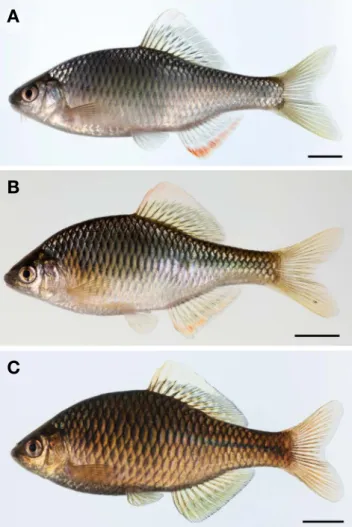
Fig. 1. Comparison of body color among males from Tanakia Lanceo- lata, T. lanceolata×Rhodeus pseudosericeus(intergeneric hybrid) and R. pseudosericeus. A: T. lanceolata, SUC25704, 83mm SL; B: T. lan- ceolata×R. pseudosericeus, SUC25943, 60mm SL; C: R. pseudoseri- ceus, no voucher number(only photograph), 66mm SL. Bar indicates 10mm.
A
B
C
을 파악하기 위하여 어류상 조사를 수행하였으며, 총 4과 15종 의 담수 어류를 확인하였다(Table 2). 우점종은 한강납줄개 R.
pseudosericeus(36.37%), 아우점종은 갈겨니 Zacco temminckii (27.28%)로 나타났으며, 이어서 각시붕어 R. uyekii(10.02%), 긴 몰개 Squalidus gracilis majimae(8.62%), 피라미 Zacco pla typus (6.35%), 참갈겨니 Zacco koreanus(5.62%) 납자루 T. lanceo- lata(2.67%) 등의 순으로 우세함을 확인하였다. 또한, 우리나라 고유종으로는 총 6종(40%)이 확인되었으며, 외래어종은 채집되 지 않았다. 동소출현한 납자루아과 어류는 전체 조사지점에서 환 경부 멸종위기야생생물 II급으로 지정된 한강납줄개를 비롯하여 납자루, 각시붕어 등 3종이 출현하였다. 특히, 한강납줄개의 경 우, 자연 잡종이 발견된 St. 1에서 41.72%의 매우 높은 빈도로 출현하였으며, 그에 비해 납자루는 1.72%, 각시붕어는 0.86%의 비교적 낮은 빈도로 출현하였다.
2. 형태학적 분석
납자루와 한강납줄개의 속간잡종으로 추정되는 개체의 주요
형태학적 특징을 부모 종과 비교 분석한 결과, 속간잡종 추정 개 체의 체색은 체측 중앙부를 기준으로 등 쪽에는 비교적 어두운 청갈색과 은백색이 혼재된 모습을 나타내었으며, 복부는 은백색 을 나타내어 납자루와 유사하였고 미병부 중앙은 파란색의 체측 종대가 나타나 한강납줄개의 특징이 나타났다. 또한, 지느러미의 경우, 등지느러미 앞쪽 상단과 뒷지느러미 테두리에는 연한 홍색 을 나타내어 납자루의 특징이 나타났다(Fig. 1).
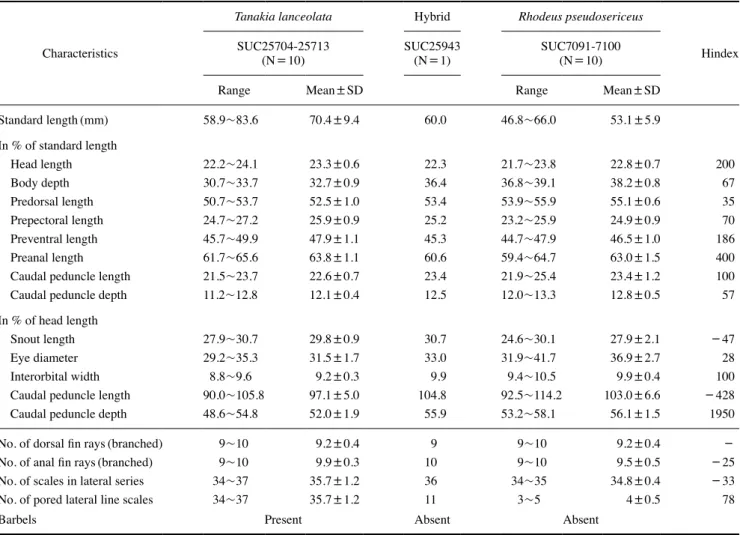
본 연구에서 납자루와 한강납줄개 및 이들 간의 자연 잡종으 로 추정되는 개체의 13개 계측 형질에 대한 Hindex를 계산하여 비교 분석한 결과(Table 3), 제1 부모 종인 납자루를 따르는 계 측 형질은 두장에 대한 안경의 비(Hindex=28) 1개 형질로 나 타났으며, 제2 부모 종인 한강납줄개를 따르는 계측 형질은 체장 에 대한 미병장의 비(Hindex=100)와 두장에 대한 양안 간격의 비(Hindex=100) 등 2개 형질로 나타났다. 제1, 2 부모 종의 중 간형질을 따르는 계측 형질은 체장에 대한 체고의 비(Hindex=
67), 등지느러미 기점 거리의 비(Hindex=35), 가슴지느러미 기 점 거리의 비(Hindex=70), 미병고의 비(Hindex=57) 등 4개
Table 3. Comparison of 13 proportional measurements, 5 meristic counts and hybrid index(Hindex) from Tanakia lanceolata, Rhodeus pseu- dosericeus and their intergeneric hybrid T. lanceolata×R. pseudosericeus collected at the Daecheoncheon stream of Cheongna-meyon, Bo- reyong-si, Chungcheongnam-do, the Republic of Korea on 2020
Characteristics
Tanakia lanceolata Hybrid Rhodeus pseudosericeus
Hindex SUC25704-25713
(N=10) SUC25943
(N=1) SUC7091-7100
(N=10)
Range Mean±SD Range Mean±SD
Standard length(mm) 58.9~83.6 70.4±9.4 60.0 46.8~66.0 53.1±5.9
In % of standard length
Head length 22.2~24.1 23.3±0.6 22.3 21.7~23.8 22.8±0.7 200
Body depth 30.7~33.7 32.7±0.9 36.4 36.8~39.1 38.2±0.8 67
Predorsal length 50.7~53.7 52.5±1.0 53.4 53.9~55.9 55.1±0.6 35
Prepectoral length 24.7~27.2 25.9±0.9 25.2 23.2~25.9 24.9±0.9 70
Preventral length 45.7~49.9 47.9±1.1 45.3 44.7~47.9 46.5±1.0 186
Preanal length 61.7~65.6 63.8±1.1 60.6 59.4~64.7 63.0±1.5 400
Caudal peduncle length 21.5~23.7 22.6±0.7 23.4 21.9~25.4 23.4±1.2 100
Caudal peduncle depth 11.2~12.8 12.1±0.4 12.5 12.0~13.3 12.8±0.5 57
In % of head length
Snout length 27.9~30.7 29.8±0.9 30.7 24.6~30.1 27.9±2.1 -47
Eye diameter 29.2~35.3 31.5±1.7 33.0 31.9~41.7 36.9±2.7 28
Interorbital width 8.8~9.6 9.2±0.3 9.9 9.4~10.5 9.9±0.4 100
Caudal peduncle length 90.0~105.8 97.1±5.0 104.8 92.5~114.2 103.0±6.6 -428
Caudal peduncle depth 48.6~54.8 52.0±1.9 55.9 53.2~58.1 56.1±1.5 1950
No. of dorsal fin rays(branched) 9~10 9.2±0.4 9 9~10 9.2±0.4 -
No. of anal fin rays(branched) 9~10 9.9±0.3 10 9~10 9.5±0.5 -25
No. of scales in lateral series 34~37 35.7±1.2 36 34~35 34.8±0.4 -33
No. of pored lateral line scales 34~37 35.7±1.2 11 3~5 4±0.5 78
Barbels Present Absent Absent
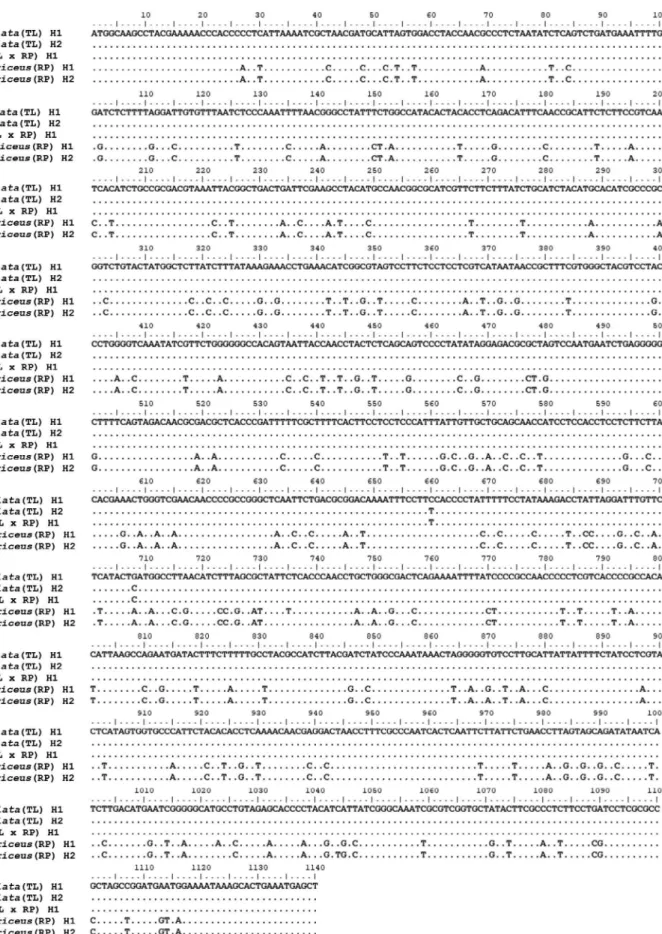
Fig. 2. Nucleotide sequence alignment of the cytochrome b(cytb) gene of mitochondrial DNA(mtDNA) from an intergeneric hybrid and its sup- posed parent species Tanakia lanceolata and Rhodeus pseudosericeus. TL: T. lanceolata; RH: R. pseudosericeus.
형질로 나타났다. 자연 잡종 고유의 형질을 나타낸 계측 형질은 체장에 대한 두장의 비(Hindex=200), 배지느러미 기점 거리의 비(Hindex=186), 뒷지느러미 기점 거리의 비(Hindex=400) 와 두장에 대한 문장의 비(Hindex = -47), 미병장의 비 (Hindex= -428), 미병고의 비(Hindex=1950) 등 6개 형질로 나타났다. 이들의 5개의 계수 형질을 Hindex로 계산하여 비교 분석한 결과(Table 3), 뒷지느러미 기조 수(Hindex= -25), 측 선비늘 수(Hindex= -33), 측선유공비늘 수(Hindex=78) 등 3 개의 계수 형질은 자연 잡종 고유의 형질을 나타내었으나, 등지 느러미 기조수는 제1, 2 부모 종이 서로 동일한 수치를 나타내어 Hindex로 비교할 수 없었다. 또한, 입수염이 존재하지 않는 점 은 제2 부모 종인 한강납줄개의 형질을 따르는 것으로 나타났다 (Fig. 1).
3. 분자계통학적 분석
자연 잡종 추정 개체의 모계를 판별하기 위하여 미토콘드리
아 DNA의 cytb 유전자 염기서열을 증폭한 결과, 총 1,140bp 의 염기서열이 증폭되었다(Fig. 2). 부모 종으로 추정되는 납자 루와 한강납줄개 간의 염기서열 변이는 178~180bp로 나타났 으며, 이에 따른 두 종 간의 염기서열 변이율은 15.61~15.79%
로 나타나 비교적 높은 변이율을 나타내었다. 한편, 자연 잡종 추정 개체와 납자루 간의 염기서열 변이는 0~2bp로 나타나 0.00~0.18%의 낮은 변이율을 나타내었다. 그러나 자연 잡종 추 정 개체와 한강납줄개 간의 염기서열 변이는 179~180bp로 나 타나 15.70~15.79%의 비교적 높은 변이율을 나타내어 납자루 와 한강납줄개 간의 변이율과 동일한 수준을 나타내었다. 이러 한 결과는 cytb 유전자를 이용한 ML과 BI 분자계통도에서 더 욱 뚜렷하게 나타났으며, 모두 높은 수치의 지지도(100BP/1.00 BBP)를 기반으로 자연 잡종 추정 개체(haplotype 1)는 납자루 (haplotype 1, 2)와 동일한 유전적 clade를 형성하였다(Fig. 3).
자연 잡종 추정 개체의 부계를 판별하기 위하여 핵 DNA의 rag1 유전자 염기서열을 증폭한 결과, 총 1,177bp의 염기서열이 증폭되었다. 부모 종으로 추정되는 납자루와 한강납줄개 간의 염 Fig. 3. Phylogenetic tree of the subfamily Acheilognatinae obtained from maximum-likelihood(ML) and Bayesian inference(BI) analyses of the cytochrome b(cytb) gene of mitochondrial DNA(mtDNA). Bootstrap values(BP, left) above 50% in the ML analysis and posterior probabilities values(BPP, right) above 0.50 in the BI analysis are displayed at the base of each node. The GenBank accession numbers are provided after each scientific name. The check mark indicates an intergeneric hybrid.
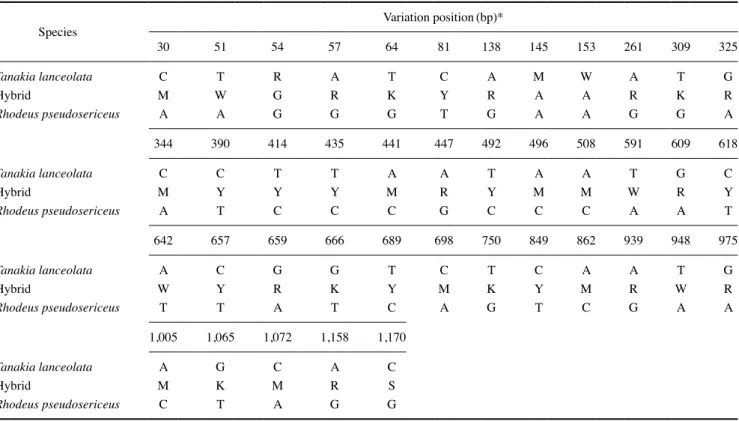
기서열 변이는 총 38~41bp로 나타났으며, 이에 따른 두 종 간 의 염기서열 변이율은 3.23~3.40%를 나타내었다. 한편, 자연 잡 종 추정 개체는 납자루와 한강납줄개 간의 염기서열 변이영역으 로 나타난 38bp(3.23%) 영역을 모두 반영하는 double peaks 양 상을 나타내었다(Fig. 4; Table 4). 따라서 rag1 유전자를 이용한 분자계통 분석 결과, 자연 잡종 추정 개체의 haplotype 1은 높은
지지도(100BP/1.00BBP)를 기반으로 납자루(haplotype 1~4) 와 동일한 유전적 clade를 형성하였으며, 자연 잡종 추정 개체 의 haplotype 2는 높은 지지도(100BP/1.00BBP)를 기반으로 한강납줄개(haplotype 1)와 동일한 유전적 clade를 형성하였다 (Fig. 5).
Table 4. Forty-one single-nucleotide polymorphism(SNP) based positions on the sequence to the recombination activating gene 1(rag1) gene of nuclear DNA(nDNA) from Tanakia lanceolata, Rhodeus pseudosericeus, and their intergeneric hybrid(T. lanceolata×R. pseudosericeus)
Species Variation position(bp)*
30 51 54 57 64 81 138 145 153 261 309 325
Tanakia lanceolata C T R A T C A M W A T G
Hybrid M W G R K Y R A A R K R
Rhodeus pseudosericeus A A G G G T G A A G G A
344 390 414 435 441 447 492 496 508 591 609 618
Tanakia lanceolata C C T T A A T A A T G C
Hybrid M Y Y Y M R Y M M W R Y
Rhodeus pseudosericeus A T C C C G C C C A A T
642 657 659 666 689 698 750 849 862 939 948 975
Tanakia lanceolata A C G G T C T C A A T G
Hybrid W Y R K Y M K Y M R W R
Rhodeus pseudosericeus T T A T C A G T C G A A
1,005 1,065 1,072 1,158 1,170
Tanakia lanceolata A G C A C
Hybrid M K M R S
Rhodeus pseudosericeus C T A G G
*R=A/G, Y=C/T, K=G/T, M=A/C, W=A/T, S=C/G
Fig. 4. Fragments of electropherograms to the recombination activating gene 1(rag1) gene in nuclear DNA(nDNA) provide clear evidence of Tanakia lanceolata and Rhodeus pseudosericeus and their intergeneric hybridization. The red arrows indicate double peaks to intergeneric hy- bridization.
고 찰
본 연구에서 저자들은 대천천 상류부에서 납자루아과 어류 의 자연 잡종으로 추정되는 수컷 1개체를 채집하였으며, 이를 형 태학적 및 분자계통학적 방법으로 비교 분석하였다. 본 자연 잡 종 개체의 경우, 등지느러미 앞쪽 상단 및 뒷지느러미 색깔이 연 한 홍색을 띠는 점, 등과 배 쪽 색상은 각각 청갈색 및 은백색 을 띠는 점, 두장에 대한 안경 비의 잡종지수가 제1 부모 종(납 자루)에 가까운 점 등은 납자루의 형태적 특징을 나타내었으며, 미토콘드리아 DNA의 cytb 유전자를 이용한 분자계통 분석에 서도 자연 잡종 개체는 납자루와 동일한 유전적 clade를 형성하 여 모계 유전을 하는 미토콘드리아의 일반적인 특성을 잘 나타 내었다(Hauswirth and Clayton, 1985). 염기서열 변이율은 함께 비교된 핵 DNA의 rag1 유전자보다 높게 나타나 미토콘드리아 유전자가 핵 유전자보다 변이율이 높다는 기존의 연구 결과를 잘 반영하였다(Brown et al., 1979; Wilson et al., 1985; Avise,
1986; Song et al., 2005). 반면, 미병부 중앙에 파란색의 체측종 대가 존재하는 점, 측선이 불완전한 점, 입수염이 존재하지 않 는 점을 비롯하여 체장에 대한 미병장의 비, 두장에 대한 안경 의 비 등의 잡종지수가 제2 부모 종(한강납줄개)과 동일한 점 등 은 한강납줄개의 형태적 특징을 나타내었다. 더불어, 핵 DNA의 rag1 유전자를 이용한 분자계통학적 분석에서 자연 잡종 개체 는 납자루와 한강납줄개 간의 단일염기다형성(single-nucleotide polymophism, SNP) 부위를 모두 반영하는 double peaks 현상을 나타내었으며, 그로부터 분리된 두 개의 haplotype은 분자계통 도에서 각각 두 부모 종과 동일한 유전적 clade를 형성하여 해당 자연 잡종 개체의 부계 종이 한강납줄개임을 지지하였다. 따라서 서해안 독립 하천인 대천천에서 발견된 납자루아과 어류의 자연 잡종 추정 수컷 1개체는 암컷 납자루와 수컷 한강납줄개 간의 속 간 자연 잡종 개체임이 명확히 밝혀졌다.
Kim et al.(2014)의 한강납줄개와 묵납자루 간 속간 자연 잡 종에 관한 연구에서 자연 잡종 개체의 경우, 등지느러미 가장 Fig. 5. Phylogenetic tree of the subfamily Acheilognatinae obtained from maximum-likelihood(ML) and Bayesian inference(BI) analyses of the recombination activating gene 1(rag1) gene of nuclear DNA(nDNA). Bootstrap values(BP, left) above 50% in the ML analysis and posterior probabilities values(BPP, right) above 0.50 in the BI analysis are displayed at the base of each node. The GenBank accession numbers are pro- vided after each scientific name. The check mark indicates an intergeneric hybrid.
자리에 노란색 띠가 있는 점은 묵납자루의 형태적 특징을, 미병 부 중앙에 파란색 체측종대가 있는 점, 측선이 불완전한 점, 입 수염이 존재하지 않는 점 등은 한강납줄개의 형태적 특징을 나 타내어, 본 연구 결과에서 나타난 납자루와 한강납줄개 간 속 간잡종의 형태적 패턴과 매우 유사하였다. 특히, 측선의 완전성 과 불완전성, 입수염의 유무는 납자루속(Tanakia)과 납줄개속 (Rhodeus) 어류를 식별하는 중요한 속간 진단 형질로서(Li et al., 2017), 해당 속들의 속간잡종 개체들이 이를 특징적으로 잘 반영하고 있는 것으로 판단되었다.
대천천의 청천저수지 상류 조사지점(St. 1~St. 4)에서 출현한 납자루아과 어류의 상대적 풍부도(relative abundance)는 전체 의 49.08%를 나타내어 우점하였으며, 이들이 산란 숙주로 이용 할 수 있는 담수 이매패류는 작은말조개 Unio douglasiae sinuo- latus와 말조개 U. douglasiae 등이 서식하는 것으로 확인되었 다(Kim et al., 2015, 2017; Kim and Park, 2020). 4개의 조사지 점에 설치된 인공구조물과 육상화로 인한 정수화 및 산란 숙주 인 담수 이매패류의 서식 등이 납자루아과 어류의 서식에 긍정 적인 영향을 끼치는 것으로 판단되었다. 또한, 납자루의 산란기 는 3~6월이며, 한강납줄개의 산란기 또한 4~6월로 알려져 있 어(Kim et al., 2015, 2017), 제한된 서식 환경과 산란 장소의 부 족으로 인하여 담수 이매패류의 출수공에 산란하는 습성을 가 진 납자루와 한강납줄개 간의 산란 경쟁에 영향을 미친 것으로 예상되었고, 이러한 과정에서 부모 종의 개체 수 불균형으로 인 하여 납자루보다 우점하고 있는 한강납줄개의 수컷이 sneaker 행동에 성공하여 자연적인 2차 접촉으로 인한 속간잡종 개체가 발생하였을 것으로 판단되었다. 한편, Kawamura and Hosoya (2000)는 납자루아과 잡종 어류의 성비의 경우, 수컷으로 편향될 가능성이 있음을 보고하였는데, 본 연구에서 속간잡종 개체 또 한 수컷이 발견되어 선행 연구 결과와 동일한 양상을 따랐다. 또 한, 본 연구에서 납자루와 한강납줄개 간의 자연 속간교잡 현상 이 납자루가 모계인 단방향으로만 관측되었기 때문에 추후 한강 납줄개를 모계로 한 자연 속간잡종의 탐색, 속간잡종 개체의 비 율 및 생식 여부 등의 후속 연구가 필요할 것으로 판단되었다.
요 약
납자루 Tanakia lanceolata와 한강납줄개 Rhodeus pseudo- sericeus 간의 속간잡종으로 추정되는 수컷 1개체를 서해안 독 립 하천인 보령 대천천에서 채집하였다. 해당 속간잡종 개체의 명확한 기원을 판별하기 위하여 형태학적 및 분자계통학적 분 석을 수행하였다. 형태학적 분석 결과, 속간잡종 개체의 등지느 러미 앞쪽 상단과 뒷지느러미 가장자리의 색상, 등과 배 쪽 색 상 등은 납자루의 형태적 특징을 따랐으며, 미병부 중앙에 파란 색 체측종대가 존재하는 점, 측선이 불완전한 점, 입수염이 없
는 점 등은 한강납줄개의 형태적 특징을 따랐다. 또한, 미토콘드 리아 DNA의 cytb 유전자 분석 결과, 속간잡종 개체는 납자루와 99.82~100%의 염기서열 유사도를 나타내어, 모계 종은 납자루 로 판단되었다. 핵 DNA의 rag1 유전자 분석 결과, 속간잡종 개 체는 납자루와 한강납줄개 간의 단일염기다형성 부위(38bp)를 모두 반영하는 double peaks 양상을 나타내어, 부계 종은 한강납 줄개로 판단되었다. 따라서 본 연구에서 분석한 납자루아과 자연 잡종 추정 개체는 암컷 납자루와 수컷 한강납줄개 간의 속간잡 종으로 판명되었다.
사 사
이 논문은 순천향대학교의 연구비를 지원받아 수행된 연구입 니다. 본 연구에서 실험 재료와 현지 채집에 도움을 주신 보령민 물생태관의 조성장 관장님께 감사의 말씀을 전해드립니다.
REFERENCES
Avise, J.C. 1986. Mitochondrial DNA and the evolutionary genetics of higher animals. Philos. Trans. R. Soc. Lond. B., 312: 325- 342. https://doi.org/10.1098/rstb.1986.0011.
Brown, W.M., M. George and A.C. Wilson. 1979. Rapid evolution of animal mitocondrial DNA. Proc. Natl. Acad. Sci., 76: 1967- 1971. https://doi.org/10.1073/pnas.76.4.1967.
Candolin, U. and J.D. Reynolds. 2002. Why do males tolerate sneak- ers? Tests with the European bitterling, Rhodeus sericeus.
Behav. Ecol. Sociobiol., 51: 146-152. https://doi.org/10.1007/
s00265-001-0422-6.
Chae, B.S., H.B. Song and J.Y. Park. 2019. A field guide to the fresh- water fishes of Korea. LG Evergreen Foundation, Seoul, Korea, 355pp.
Duyvene de Wit, J.J. 1964. Hybridization experiments in acheilog- nathine fishes(Cyprinidae, Teleostei). Crossings between female Tanakia tanago, Rhodeus ocellatus, and Acheilog- nathus limbatus, and male Acheilognathus limbatus. Copeia, 1964: 156-160. https://doi.org/10.2307/1440844.
Edgar, R. 2004. MUSCLE: multiple sequence alignment with high accuracy and high throughput. Nucleic Acids Res., 32: 1792- 1797. https://doi.org/10.1093/nar/gkh340.
Fricke, R., W.N. Eschmeyer and R. Van der Laan. 2020. Eschmeyer's catalog of fishes: genera, species, references. Available at:
http://researcharchive.calacademy.org/research/ichthyology/
catalog/fishcatmain.asp(accessed 7 Dec. 2020).
Genovart, M. 2009. Natural hybridization and conservation. Biodiv- ers. Conserv., 18: 1435-1439. https://doi.org/10.1007/s10531- 008-9550-x.
Hata, H., Y. Uemura, K. Ouchi and H. Matsuba. 2019. Hybridization
between an endangered freshwater fish and an introduced congeneric species and consequent genetic introgression.
PloS One, 14: e0212452. https://doi.org/10.1371/journal.
pone.0212452.
Hauswirth, W.W. and D.A. Clayton. 1985. Length heterogeneity of a conserved displacement-loop sequence in human mitochon- drial DNA. Nucleic Acids Res., 13: 8093-8104. https://doi.
org/10.1093/nar/13.22.8093.
Hubbs, C.L. 1955. Hybridization between fish species in nature. Syst.
Zool., 4: 1-20. https://doi.org/10.2307/2411933.
Hubbs, C.L and K.F. Lagler. 2004. Fishes of the Great Lakes region.
Unversity of Michigan Press, Ann Arbor, U.S.A., pp. 29-40.
https://doi.org/10.3998/mpub.17658.
Jansson, H., I. Holmgren, K. Wedin and T. Andersson. 1991. High frequency of natural hybrids between Atlantic salmon, Salmo salar L., and brown trout, S. trutta L., in a Swedish river. J.
Fish Biol., 39: 343-348. https://doi.org/10.1111/j.1095-8649.
1991.tb05096.x.
Kanoh, Y. 2000. Reproductive success associated with territoriality, sneaking, and grouping in male rose bitterings, Rhodeus ocellatus(Pisces: Cyprinidae). Environ. Biol. Fishes, 57:
143-154. https://doi.org/10.1023/A:1004585405848.
Kawamura, K. and K. Hosoya. 2000. Masculinization mechanism of hybrids in bitterlings(Teleostei: Cyprinidae). J. Hered., 91:
464-473. https://doi.org/10.1093/jhered/91.6.464.
Kim, B.S., E.J. Kang, H. Jang and I.S. Park. 2012. Morphometric traits and cytogenetic analysis in induced cross and recipro- cal hybrid between Rhodeus uyekii and R. notatus. Korean J.
Ichthyol., 24: 51-159.
Kim, C.H., W.O. Lee, Y.J. Kang and J.M. Baek. 2010. Occurrence of a natural intergeneric hybrid, Rhodeus uyekii×Acheilog nathus signifer(Pisces: Cyprinidae) from Jojongcheon Bukhan River.
Korean J. Ichthyol., 22: 225-229.
Kim, H.S. and J.Y. Park. 2020. Spawning characteristics of Hangang bitterling, Rhodeus pseudosericeus(Pisces: Acheilognathi- nae) in the host mussel with Glochidia. Korean J. Ichthyol., 32: 63-69. https://doi.org/10.35399/ISK.32.2.4.
Kim, H.S., J.D. Yoon, H. Yang, H.S. Choi and J.H. Lee. 2017. Repro- ductive characteristics of Rhodeus pseudosericeus(Pisces:
Acheilognathinae) in the Heukcheon, Namhangang (River), Korea. Korean J. Ichthyol., 29: 235-243.
Kim, H.S., S.W. Yun, H.T. Kim and J.Y. Park. 2015. Occurrence of a natural hybrid between Acheilognathus signifer and A. lanceo - latus(Pisces: Cyprinidae). Korean J. Ichthyol., 27: 199-204.
Kim, H.S., S.W. Yun, J.G. Ko and J.Y. Park. 2014. Occurrence of a natural intergeneric hybrid between Rhodeus pseudosericeus and Acheilognathus signifer(Pisces: Cyprinidae) from the Namhangang(river), Korea. Korean J. Ichthyol., 26: 153-158.
Kim, S.Y., C.B. Kim, I.S. Kim, J.Y. Park and H.Y. Park. 2002. Mole- cular systematics of Korean cobitids based on mitochondrial cytochrome b sequence. Korean J. Biol. Sci., 6: 45-51. https://
doi.org/10.1080/12265071.2002.9647632.
Kwak, Y.H., K.Y. Kim, K.S. Kim and H.Y. Song. 2020. Occurrence
of a natural interspecific hybrid between Rhodeus pseudoseri- ceus and R. notatus in Sangcheon Stream of the Han River, Kor ea. Korean J. Ecol. Environ., 53: 275-285. https://doi.org/
10.11614/ksl.2020.53.3.275.
Lanfear, R., P.B. Frandsen, A.M. Wright, T. Senfeld and B. Calcott.
2017. PartitionFinder 2: new methods for selecting parti- tioned models of evolution for molecular and morphological phylogenetic analyses. Mol. Biol. Evol., 34: 772-773. https://
doi.org/10.1093/molbev/msw260.
Li, F., T.Y. Liao, R. Arai and L. Zhao. 2017. Sinorhodeus microlepis, a new genus and species of bitterling from China(Teleostei:
Cyprinidae: Acheilognathinae). Zootaxa, 4353: 69-88. https://
doi.org/10.11646/zootaxa.4353.1.4.
Nelson, J.S., T.C. Grande and M.V.H. Wilson. 2016. Fishes of the world, 5th ed. John Wiley & Sons Inc., Hoboken, New Jersey, U.S.A., 707pp.
Nikoljukin, M.J. 1972. Distant hybridization in acipenseridae and teleostei, theory and practice. Moskava, 335pp.
Park, J.M. and K.H. Han. 2019. Early life history characteristics of an induced hybrid between Rhodeus uyekii and Rhodeus ocel- latus. Korean J. Fish. Aquat. Sci., 52: 408-417. https://doi.org/
10.5657/KFAS.2019.0408.
Pinheiro, A.P.B., R.M.C. Melo, D.F. Teixeira, J.L.O. Birindelli, D.C.
Carvalho and E. Rizzo. 2019. Integrative approach detects natural hybridization of sympatric lambaris species and emergence of infertile hybrids. Sci. Rep., 9: 4333. https://doi.
org/10.1038/s41598-019-40856-4.
Rambaut, A. 2018. FigTree. Version 1.4.4. Available at: http://tree.
bio.ed.ac.uk/software-/figtree(accessed 17 Sep. 2019).
Rambaut, A., A.J. Drummond, D. Xie, G. Baele and M.A. Suchard.
2018. Posterior summarisation in Bayesian phylogenetics using Tracer 1.7. Syst. Biol., 67: 901. https://doi.org/10.1093/
sysbio/syy032.
Ronquist, F., M. Teslenko, P. van der Mark, D.L. Ayres, A. Darling, S. Hohna, B. Larget, L. Liu, M.A. Suchard and J.P. Huelsen- beck. 2012. MrBayes 3.2: efficient bayesian phylogenetic inference and model choice across a large model space. Syst.
Biol., 61: 539-542. https://doi.org/10.1093/sysbio/sys029.
Ross, M.R. and T.M. Cavender. 1981. Morphological analyses of four experimental intergeneric cyprinid hybrid crosses. Copeia., 2:
377-387. https://doi.org/10.2307/1444226.
Scribner, K.T., K.S. Page and M.L. Bartron. 2000. Hybridization in freshwater species: a review of case studies and cytonuclear methods of biological inference. Rev. Fish Biol. Fish., 10:
293-323. https://doi.org/10.1023/A:1016642723238.
Segherloo, I.H., E. Normandeau, L. Benestan, C. Rougeux, G. Coté, J.S. Moore, N. Ghaedrahmati, A. Abdoli and L. Bernatchez.
2018. Genetic and morphological support for possible sym- patric origin of fish from subterranean habitats. Sci. Rep., 8:
1-13. https://doi.org/10.1038/s41598-018-20666-w.
Smith, C., M. Reichard, P. Jurajda and M. Przybylski. 2004. The repro - ductive ecology of the European bitterling(Rhodeus sericeus).
J. Zool., Lond., 262: 107-124. https://doi.org/10.1017/s0952
836903004497.
Song, S., Z.F. Pursell, W.C. Copeland, M.J. Longley, T.A. Kunkel and C.K. Mathews. 2005. DNA precursor asymmetries in mammalian tissue mitochondria and possible contribution to mutagenesis through reduced replication fidelity. Proc. Natl Acad. Sci. USA., 102: 4990-4995. https://doi.org/10.1073/
pnas.0500253102.
Šorić, V.M. 2004. A natural hybrid of Leuciscus cephalus and Albur- nus alburnus(Pisces, Cyprinidae) from the Ibar River, West - ern Serbia. Arch. Biol. Sci., 56: 23-32. https://doi.org/10.2298/
abs0402023s.
Stamatakis, A. 2014. RAxML version 8: a tool for phylogenetic analy- sis and post-analysis of large phylogenies. Bioinformatics, 30: 1312-1313. https://doi.org/10.1093/bioinformatics/btu033.
Stephens, M., N.J. Smith and P. Donnelly. 2001. A new statistical method for haplotype reconstruction from population data.
Am. J. Hum. Genet., 68: 978-989. https://doi.org/10.1086/
319501.
Stephens, M. and P. Donnelly. 2003. A comparison of bayesian meth- ods for haplotype reconstruction from population geno type data. Am. J. Hum. Genet., 73: 1162-1169. https://doi.org/10.
1086/379378.
Ueda, T. and Y. Ueda. 2018. Chromosomal studies of the hybrid bet- ween female Rhodeus ocellatus ocellatus and male Rhodeus atremius fangi in bitterlings(Teleostei: Cypriniformes: Achei- lognathinae). Natural Resources, 9: 17-22. https://doi.org/10.
4236/nr.2018.91002.
Wilson, A.C., R.L. Cann, S.M. Carr, M. George and U.B. Gyllensten.
1985. Mitochondrial DNA and two perspectives on evolution- ary genetics. Biol. J. Linn. Soc., 26: 375-400. https://doi.org/
10.1111/j.1095-8312.1985.tb02048.x.
Witkowski, A., J. Kotusz, K. Wawer, J. Stefaniak, M. Popiołek and J.
Błachuta. 2015. A natural hybrid of Leuciscus leuciscus(L.) and Alburnus alburnus(L.)(Osteichthyes: Cyprinidae) from the Bystrzyca River(Poland). Annal. Zool., 65: 287-293.
https://doi.org/10.3161/00034541anz2015.65.2.010.