Variation of γ-Oryzanol by Incorporation of Green Manure Crops in Korean Rice Cultivars
Heon-Woong Kim, Sung-Hyeon Lee, Young-Min Lee, Hwan-Hee, Jang, Kyung-A Hwang, Hyun-Suk Cho1, Jeong-Tae Lee1, Weon-Tai Jeon1*, and Jung-Bong Kim*
National Academy of Agricultural Science, Rural Development Administration
1National Institute of Crop Science, Rural Development Administration
(Received: July 21 2014, Revised: July 24 2014, Accepted: August 24 2014)
The γ-oryzanol, ferulic acid esters, which are well-known for their function on cholesterol lowering and prevention of inflammation, diabetes and cancer, are found in the seeds of cereal crops such as rice, corn, wheat and rye. Among them, rice has been reported to contain the highest ferulic acid esters. Since rice cultivation with green manure as a N source is an environmental friendly agricultural practice, it is necessary to identify and quantify as well as evaluate the variations in these compounds in rice samples as affected by different green manure conditions. A total of ten components of γ-oryzanol were isolated and cycloartenyl ferulate, 24-methylenecycloartanyl ferulate, campesteryl ferulate and sitosteryl ferulate were identified as the major components in Korean rice cultivars, ‘Unkwang’ and ‘Hopum’. Comparing the γ-oryzanol contents of these varieties, ‘Unkwang’ showed clearly similar pattern with conventional type. With the PLS-DA (partial least squares of discriminant analysis) using SIMCA 11.0 ver., the specific pattern and cluster of γ-oryzanol scores with green manure conditions were confirmed, and thus distinguishing green manure effects were possible.
Key words: Rice, γ-Oryzanol, Steryl ferulate, Green manure crop
(a) (b)
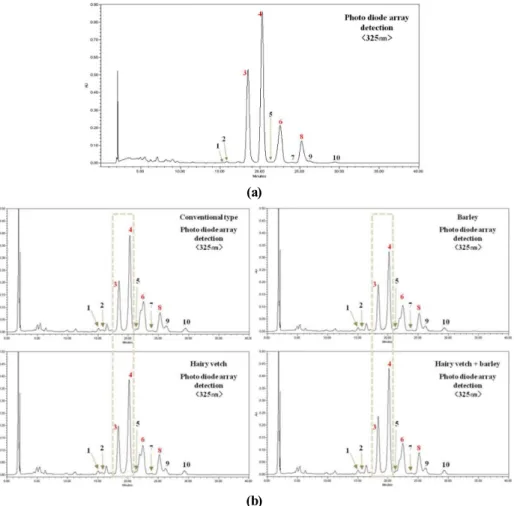
HPLC chromatograms of γ-oryzanol stadard and extracted from grains of the rice samples (a: standard mixture 2000ppm, b:
conventional type, barley, hairy vetch, hairy vetch+barley). 1. Δ7-stigmastenyl ferulate, 2. stigamsteryl ferulate, 3.
cycloartenyl ferulate, 4. 24-methylenecycloartanyl ferulate, 5. Δ7-campestenyl ferulate, 6. campesteryl ferulate, 7. Δ
7-sitostenyl ferulate, 8. sitosteryl ferulate, 9. campestanyl ferulate, 10. sitostanyl ferulate.
1)
*Corresponding author : Phone: +82312990520, E-mail: [email protected]
*Co-Corresponding author : Phone: +82312906674, E-mail: [email protected]
§Acknowledgement: This study was carried out with the support of ‘Cooperative Research Program for Agriculture Science & Technology Development (Project No. PJ00947202)’ Rural Development Administration, Republic of Korea.
Introduction
쌀은 영양섭취 및 식량 안보면에서 큰 영향력을 갖고 있 는 세계에서 가장 중요한 식량작물 중 하나이며, 특히 아시 아권에서는 다른 작물과 대치될 수 없는 국가 핵심 자원이 다. 쌀 도정 중 발생하는 부산물인 미강 생산량은 한국에서 매년 수십만톤에 이르며, 사료배합, 기타 기능성제품 등에 사용되는 것을 제외하고는 미곡종합처리장 (RPC; Rice Processing Complex) 시설에서 직접 비용을 들여 처리해야 하는 실정이다 (Han et al., 2012). 더군다나 γ-oryzanol, tocopherol, tocotrienol 등의 약리효능성분은 미강층에만 함유되어 있어, 미강을 고부가가치 자원으로 재생산, 응용 할 수 있는 기술이 절실히 필요하다.
쌀의 주요 기능성분으로 미강에만 다량 함유되어 있는 γ- oryzanol 혼합물들은 콜레스테롤 감소 효과를 보이는 triterpene alcohols 및 phytosterols과 강력한 항산화기능을 가진 ferulic acid가 에스테르 결합된 복합체이다 (Fang et al., 2003).
Ferulic acid 에스테르 복합체는 이미 벼, 야생벼, 옥수수, 밀, 호밀, 보리 등과 같은 화곡류작물의 종실로부터 확인되 었으며, 이중 벼에 가장 많이 함유되어 있다고 보고되었다 (Evershed et al., 1988; Seitz, 1989; Rogers et al., 1993;
Moreau et al., 1998; Xu & Godber 1999; Hakala et al., 2002; Fang et al., 2003). 미강에는 γ-oryzanol 혼합물이 비타민 E 유도체보다 13-20배 가까이 많이 함유되어 있을 뿐만 아니라, 항산화활성에서도 10배 가까이 높게 나타나는 것으로 보고되었다 (Bergman & Xu 2003; Abdel-Aal &
Hucl 1999).
최근 주요작물재배에 따른 녹비작물의 이용이 중요한 친 환경 농업기술로 주목받고 있다. 녹비작물이란 푸를 때 베 어서 토양에 넣어 주는 두과 (콩과)와 화본과 등의 작물로서 (Park et al., 2008), 토양의 물리성 개선 및 유기물 공급에 따른 미생물 활동의 증진 등으로 지력개선효과 및 농업생태 계 지속 유지에 중요한 역할을 하는 것으로 보고되었다 (Jeon et al., 2010; Choi et al., 2010; Kim & Lee 2011;
Yang et al., 2009). 특히 헤어리베치구 및 녹비보리와 헤어 리베치 혼파구에서 환원하여 벼를 재배한 결과, 관행시비와 유의적 쌀수량 차이가 없었으며 토양 유기물 함량이 약간 증가하고 물리성이 개선되는 결과를 보고한 바 있다 (Jeon et al., 2011; Jeon et al., 2012). 따라서 두과와 화본과 녹 비작물을 혼파재배할 경우 친환경 벼 재배가 가능할 뿐만 아니라 사료를 동시생산할 수 있어 경제성 등 여러 가지 면 에서 효율적일 것으로 판단되었다.
현재까지의 녹비재배 연구는 관행시비와 비교했을 때 벼 의 생육, 수량 등 농업적 특성을 확인하는 것으로 초점이 맞 춰줬으나, 실제 녹비처리에 따른 벼 품종 종실로부터 일반 및 기능성분을 평가한 사례는 거의 없는 실정이다. 따라서
녹비를 활용한 다양한 조건에서 생산된 벼 종실에 대해 기 능성분을 조사 분석한 후, 그에 따른 최적 재배환경 및 생산 기술 확립이 필요하다. 나아가 활성물질 고함유 벼 생산을 목표로 주요 기능성분을 신속하게 대량으로 분석할 수 있는 기술 역시 필요하다.
따라서 본 연구에서는 역상 (reverse phase) HPLC 방법을 기초로 하여 한국산 벼 품종 종실에 함유되어 있는 γ-oryzanol 개별성분의 분리, 동정 및 함량 평가 기술을 확립하였으며, 다양한 녹비처리에 대한 효과 검정을 위해 이들의 함량 및 조성을 평가하여 비교하고자 하였다.
Materials and Methods
본 포장시험은 경기도 수원시에 소재한 농촌진흥청 국립 식량과학원 작물환경 시험 포장에서 2010년도부터 2011년 도까지 2년간 그림 1과 같이 가을에 녹비작물을 파종, 동계 에 재배하고 이를 이듬해 봄 농경지에 환원한 다음 벼를 재 배하는 녹비작물과 벼의 윤작 시스템으로 진행되었다. 시험 토양은 강서통으로서 사양질 논토양이었고 처리내용은 헤 어리베치 단파, 녹비보리 단파, 헤어리베치+녹비보리 혼파 및 관행시비를 하였다. 헤어리베치 단파구는 녹비파종 2년 차이고, 녹비보리와 혼파재배구는 5년차 녹비를 재배하는 포장으로 공시한 벼 품종은 조생종인 운광벼와 중만생종인 호품벼 2품종을 사용하였다. 벼 재배방법은 2010년은 5월 14일에 녹비를 환원하고, 6월 5일에 25일묘를 기계이앙 하 였다. 2011년은 녹비환원시기가 5월 23일 녹비를 환원하고, 6월 3일에 기계이앙을 하였다. 녹비작물 환원구는 재배된 녹비작물을 전량 토양에 환원하였으며 헤어리베치 단파구, 헤어리베치와 혼파구는 화학비료를 시용하지 않았다. 관행 시비구는 질소, 인산, 칼리 각각 10a 당 9, 4.5, 5.7 kg을 시 용하였다.
기기 및 시약 전처리 과정 중에 refrigerated multi- purpose centrifuge (Hanil Science Industrial Co., Ltd.
Korea), ultrasonic bath (Daihan Scientific Co. Ltd., Korea) 이 추출 기기로 사용되었으며, 정량을 위한 외부표준물질로 서 γ-oryzanol mixture (Wako, Japan)이 사용되었다. 그밖 의 HPLC 시약으로 methanol (MeOH), acetonitrile (ACN), methylene chloride (MC), acetic acid 등은 Sigma (St. Louis, MO) 제품을 사용하였다.
시료 전처리 간이 제현기로 왕겨를 분리하여 현미 상 태로 만든 후 제현된 종자를 sample mill으로 곱게 분쇄한 뒤 5g으로 칭량하였다. 추출방법은 Miller와 Engel (2006)의 방법을 변형하여 진행되었다. 5g의 powder 시료를 conical tube (50 ml)에 담아 MC-MeOH (2:1, v/v) 40 ml으로 초음
(a)
(b)
Fig. 1. HPLC chromatograms of γ-oryzanol stadard and extracted from grains of the rice samples(a: standard mixture 2000ppm, b:
conventional type, barley, hairy vetch, hairy vetch+barley). 1. Δ7-stigmastenyl ferulate, 2. stigamsteryl ferulate, 3. cycloartenyl ferulate, 4. 24-methylenecycloartanyl ferulate, 5. Δ7-campestenyl ferulate, 6. campesteryl ferulate, 7. Δ7-sitostenyl ferulate, 8.
sitosteryl ferulate, 9. campestanyl ferulate, 10. sitostanyl ferulate.
파추출기 (30°C)에서 30분간 추출한 후, 원심분리하여 (3000 rpm, 10분, 15°C) 상층액을 취하였다. 추출액을 덜어내고 남은 잔여물에 추출 용매 40 ml을 넣고 초음파추출기 (30°C) 에서 30분간 추출, 원심분리하는 과정을 두번 더하여 추출 액을 모두 합하였다. 최종 추출 총액을 여과지 (Advantec No.1)로 여과하였으며, 여과액은 N2 가스로 농축한 다음, 2
㎖의 MC-MeOH (2:1, v/v)로 재용해하여 HPLC-DAD로 분 석하였다.
HPLD-DAD를 이용한 개별 γ-oryzanol의 조성 및 함 량 분석 개별 γ-oryzanol을 정량하기 위해 YMC PACK ODS-AM (4.6×250 mm I.D., 4 μm; YMC Co., Ltd., Japan) 역상 컬럼과 더불어 2998 photodiode array detector (PDA) 를 장착한 Alliance e2695 HPLC system (Waters Co. Milford, MA, USA)을 이용하여 분석하였다. 검출 파장은 250~400 nm (대표파장 325 nm)에서 수행되었으며, oven 온도는 30°C, 유속은 1.4 ml/min 이었다. 이동상은 MeOH : ACN : MC : acetic acid (50:44:3:3, v/v/v/v) 으로 50분간 일정하게 흘 려주었다.
다변량 통계 분석 모든 시료의 γ-oryzanol 정성 및 정량 정보 데이터를 바탕으로 정렬, 표준화한 후, SIMCA-P 11.0 software (Umetrics, Umea, Sweden)의 부분최소자승 판별법 (partial least squares of discriminant analysis:
PLS-DA) 모델을 통해 클러스터 분석을 하였다.
Results and Discussion
Fig. 1은 표준물질로 사용한 γ-oryzanol 혼합물과 녹비 조건에 따른 운광벼 시료 추출물로부터 HPLC 크로마토그 램을 나타낸 것이다. Kim 등 (2013)의 연구결과와 마찬가지로 총 10가지의 개별 성분이 분리되었고, 머무름 시간 15∼30분 사 이에서 피크를 보여 분석시간이 비교적 짧은 것을 확인할 수 있 었다. Cycloartenyl ferulate (CAF), 24-methylenecycloartanyl ferulate (24-MCF), campesteryl ferulate (CSF) 및 sitosteryl ferulate (SSF)이 주요 성분으로 확인되었다 (Evershed et al., 1988; Rogers et al., 1993; Norton, 1995; Xu & Godber, 1999; Miller & Engel, 2006).
분리된 각 개별성분별 화학구조는 LC-MS로 분석하여 얻
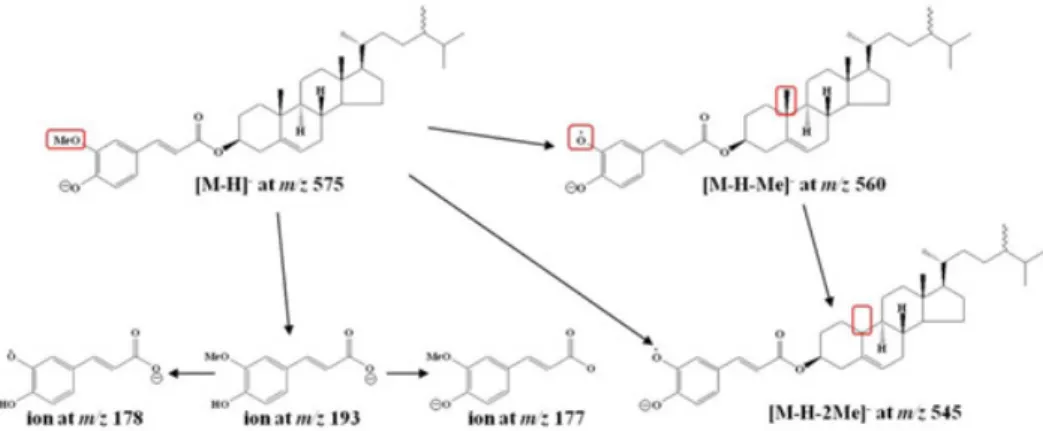
Fig. 2. Basically proposed fragment ion pattern of campesteryl ferulate in negative ion mode of ESI-MS (Fang et al., 2003).
Table 1. Compositions of γ-oryzanol extracted from grains of the ‘Unkwang’ cultivar grwon with different green manure treatments in 2010.
Green manure
crop
Weed control
Steryl and triterpene alcohol ferulates, proportions in total γ-oryzanol (%) γ-oryzanol content (mg/100g hulled rice)
1 2 3 4 5 6 7 8 9 10
Control
Chemical 1.3±0.1 0.8±0.1 20.1±0.6 39.7±0.4 1.0±0.1 21.6±0.8 0.6±0.1 10.1±0.1 3.1±0.0 1.9±0.0 44.8±2.1 Hand 1.3±0.0 0.8±0.1 20.2±0.6 39.4±0.4 1.1±0.0 21.7±0.9 0.6±0.0 10.2±0.0 3.0±0.0 1.8±0.0 44.5±2.8 Non 1.5±0.0 0.9±0.0 19.9±0.4 38.9±0.4 1.0±0.1 22.2±0.5 0.6±0.0 10.1±0.1 3.1±0.0 1.9±0.0 42.3±2.8
Hairy vetch
Chemical 1.4±0.1 0.8±0.1 19.6±0.7 39.9±0.3 1.2±0.1 21.3±1.0 0.6±0.0 10.2±0.1 3.0±0.0 1.9±0.0 45.1±4.1 Hand 1.3±0.1 0.8±0.1 20.6±1.1 39.3±0.6 1.0±0.1 21.3±1.4 0.7±0.1 10.3±0.1 3.1±0.1 1.9±0.0 46.8±3.4 Non 1.2±0.1 0.8±0.0 20.0±0.9 39.3±0.4 1.0±0.1 21.9±0.6 0.6±0.0 10.4±0.3 3.1±0.1 1.9±0.1 43.5±3.5
Barley
Chemical 1.5±0.0 0.8±0.0 21.0±0.1 38.3±0.1 1.1±0.0 20.9±0.3 0.6±0.0 10.7±0.0 3.1±0.0 2.0±0.0 36.2±2.7 Hand 1.5±0.0 0.8±0.0 21.3±0.3 38.0±0.2 1.0±0.0 21.2±0.6 0.6±0.0 10.7±0.0 3.0±0.0 1.9±0.0 39.0±4.3 Non 1.3±0.0 0.7±0.0 23.0±0.2 37.9±0.1 0.9±0.0 21.5±0.8 0.6±0.0 10.0±0.1 2.8±0.0 1.8±0.0 46.3±2.8 Hairy vetch
+ Barley
Chemical 1.4±0.1 0.7±0.1 20.5±0.4 39.9±0.4 1.1±0.1 20.5±0.9 0.6±0.0 10.4±0.0 3.0±0.0 1.9±0.0 45.9±3.0 Hand 1.3±0.1 0.7±0.1 21.0±0.5 40.0±0.4 1.1±0.1 20.5±1.0 0.6±0.0 10.0±0.0 2.9±0.0 1.9±0.0 49.4±3.2 Non 1.6±0.1 0.9±0.1 19.9±0.6 38.0±0.5 1.2±0.0 22.8±1.8 0.6±0.0 10.6±0.0 3.0±0.0 1.8±0.0 37.8±2.8
Mean 1.4 0.8 20.6 39.0 1.1 21.5 0.6 10.3 3.0 1.9 43.5
S.D.a 0.1 0.1 0.9 0.8 0.1 0.7 0.0 0.3 0.1 0.0 3.9
1. Δ7-stigmastenyl ferulate, 2. stigamsteryl ferulate, 3. cycloartenyl ferulate, 4. 24-methylenecycloartanyl ferulate, 5.
Δ7-campestenyl ferulate, 6. campesteryl ferulate, 7. Δ7-sitostenyl ferulate, 8. sitosteryl ferulate, 9. campestanyl ferulate, 10.
sitostanyl ferulate.
Each value represents means±SD of three replicates in samples
은 mass spectra 정보들을 토대로 재확인할 수 있었다 (Fang et al; 2003; Kim et al., 2013). 전체구조로부터 앞머리부 분이 강력한 항산화활성을 나타내는 ferulic acid moiety (m/z 177, 178, 193)로 나타나는 것을 알 수 있었으며, methyl group fragment (CH3;m/z 15)이 잘려나가는 패턴을 분석하여 얻은 정보들을 토대로 확인할 수 있었다 (Fig. 2).
2010 및 2011년도에 운광벼 품종 종실의 처리전체 γ- oryzanol 총평균함량은 현미 100 g당 각각 43.5±3.9, 39.5
±3.5 mg 이었으며, 처리에 따른 개별성분별 비중 변화는 거의 없었다. γ-oryzanol 총함량에 있어 녹비처리별 화학
제초구는 2010년도에 관행보다 헤어리베치 및 HV+보리가 비슷하거나 다소 증가하는 경향을 보였으나, 보리에서는 약 10 mg 정도 감소하는 경향을 보였다. 2011년도 역시 전년도 와 유사하게 관행 및 보리보다 헤어리베치 및 HV+보리가 증가하는 경향을 나타냈다 (Table 1, 2). 이는 년도별 재배 환경에 따른 약간의 차이도 존재하지만, 전반적으로 헤어리 베치구 및 녹비보리와 헤어리베치 혼파구에서 관행시비와 유의적 쌀수량 차이가 없었다고 보고한 연구결과와 비슷한 패턴을 나타냈다 (Jeon et al, 2012).
2010 및 2011년도에 호품벼 품종 종실의 처리전체 γ-
Table 2. Compositions of γ-oryzanol extracted from grains of the ‘Unkwang’ cultivar grwon with different green manure treatments in 2011.
Green manure
crop
Weed control
Steryl and triterpene alcohol ferulates, proportions in total γ-oryzanol (%) γ-oryzanol content (mg/100g hulled rice)
1 2 3 4 5 6 7 8 9 10
Control (6 years)
Chemical 0.6±0.0 0.9±0.0 22.1±0.2 37.0±0.1 0.0±0.0 22.8±0.5 0.6±0.0 11.1±0.0 3.0±0.0 2.0±0.0 37.8±0.6 Organic 0.6±0.0 0.9±0.0 22.9±0.1 37.3±0.0 0.0±0.0 21.6±0.4 0.6±0.0 11.0±0.0 2.9±0.0 1.9±0.0 43.1±4.1 Hairy
vetch (3 years)
Chemical 0.6±0.0 0.8±0.0 22.1±0.7 37.4±0.4 0.0±0.0 22.4±1.7 0.6±0.0 11.1±0.1 2.9±0.0 1.9±0.0 43.7±1.1 Organic 0.6±0.1 0.9±0.0 22.3±0.5 37.5±0.3 0.0±0.0 22.1±1.1 0.6±0.0 11.0±0.0 2.9±0.0 1.9±0.0 34.7±3.7 Barley
(6 years)
Chemical 0.6±0.0 0.8±0.0 21.9±0.2 36.6±0.2 0.0±0.0 23.3±0.3 0.6±0.0 11.2±0.1 3.0±0.0 2.0±0.0 37.0±0.2 Organic 0.6±0.1 0.9±0.0 23.1±0.7 37.1±0.3 0.0±0.0 22.1±0.9 0.6±0.0 10.7±0.0 2.9±0.0 1.9±0.0 39.5±1.2 Hairy
vetch +Barley (6 years)
Chemical 0.6±0.0 0.8±0.0 22.3±0.2 37.4±0.1 0.0±0.0 22.0±0.2 0.6±0.0 11.4±0.0 2.9±0.0 2.0±0.0 40.6±3.0
Organic 0.6±0.0 0.8±0.0 22.0±0.3 37.0±0.2 0.0±0.0 23.1±0.4 0.6±0.0 11.1±0.0 2.9±0.0 1.9±0.0 39.9±1.5
Mean 0.6 0.9 22.3 37.2 0.0 22.4 0.6 11.1 2.9 1.9 39.5
S.D.a 0.0 0.0 0.5 0.3 0.0 0.9 0.0 0.2 0.0 0.0 3.5
1. Δ7-stigmastenyl ferulate, 2. stigamsteryl ferulate, 3. cycloartenyl ferulate, 4. 24-methylenecycloartanyl ferulate, 5.
Δ7-campestenyl ferulate, 6. campesteryl ferulate, 7. Δ7-sitostenyl ferulate, 8. sitosteryl ferulate, 9. campestanyl ferulate, 10.
sitostanyl ferulate.
Each value represents means±SD of three replicates in samples
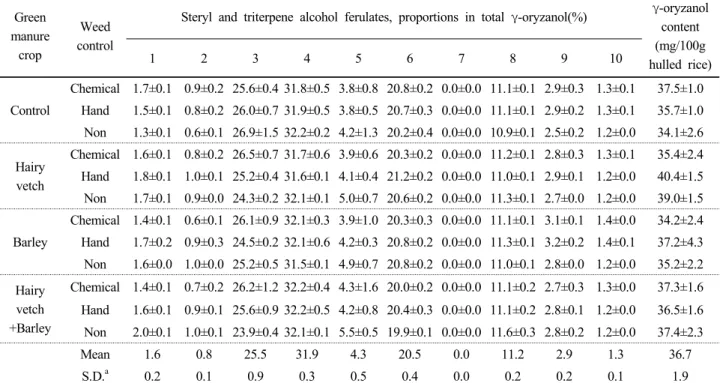
Table 3. Compositions of γ-oryzanol extracted from grains of the ‘Hopum’ cultivar grwon with different green manure treatments in 2010.
Green manure
crop
Weed control
Steryl and triterpene alcohol ferulates, proportions in total γ-oryzanol(%) γ-oryzanol content (mg/100g hulled rice)
1 2 3 4 5 6 7 8 9 10
Control
Chemical 1.7±0.1 0.9±0.2 25.6±0.4 31.8±0.5 3.8±0.8 20.8±0.2 0.0±0.0 11.1±0.1 2.9±0.3 1.3±0.1 37.5±1.0 Hand 1.5±0.1 0.8±0.2 26.0±0.7 31.9±0.5 3.8±0.5 20.7±0.3 0.0±0.0 11.1±0.1 2.9±0.2 1.3±0.1 35.7±1.0 Non 1.3±0.1 0.6±0.1 26.9±1.5 32.2±0.2 4.2±1.3 20.2±0.4 0.0±0.0 10.9±0.1 2.5±0.2 1.2±0.0 34.1±2.6 Hairy
vetch
Chemical 1.6±0.1 0.8±0.2 26.5±0.7 31.7±0.6 3.9±0.6 20.3±0.2 0.0±0.0 11.2±0.1 2.8±0.3 1.3±0.1 35.4±2.4 Hand 1.8±0.1 1.0±0.1 25.2±0.4 31.6±0.1 4.1±0.4 21.2±0.2 0.0±0.0 11.0±0.1 2.9±0.1 1.2±0.0 40.4±1.5 Non 1.7±0.1 0.9±0.0 24.3±0.2 32.1±0.1 5.0±0.7 20.6±0.2 0.0±0.0 11.3±0.1 2.7±0.0 1.2±0.0 39.0±1.5
Barley
Chemical 1.4±0.1 0.6±0.1 26.1±0.9 32.1±0.3 3.9±1.0 20.3±0.3 0.0±0.0 11.1±0.1 3.1±0.1 1.4±0.0 34.2±2.4 Hand 1.7±0.2 0.9±0.3 24.5±0.2 32.1±0.6 4.2±0.3 20.8±0.2 0.0±0.0 11.3±0.1 3.2±0.2 1.4±0.1 37.2±4.3 Non 1.6±0.0 1.0±0.0 25.2±0.5 31.5±0.1 4.9±0.7 20.8±0.2 0.0±0.0 11.0±0.1 2.8±0.0 1.2±0.0 35.2±2.2 Hairy
vetch +Barley
Chemical 1.4±0.1 0.7±0.2 26.2±1.2 32.2±0.4 4.3±1.6 20.0±0.2 0.0±0.0 11.1±0.2 2.7±0.3 1.3±0.0 37.3±1.6 Hand 1.6±0.1 0.9±0.1 25.6±0.9 32.2±0.5 4.2±0.8 20.4±0.3 0.0±0.0 11.1±0.2 2.8±0.1 1.2±0.0 36.5±1.6 Non 2.0±0.1 1.0±0.1 23.9±0.4 32.1±0.1 5.5±0.5 19.9±0.1 0.0±0.0 11.6±0.3 2.8±0.2 1.2±0.0 37.4±2.3
Mean 1.6 0.8 25.5 31.9 4.3 20.5 0.0 11.2 2.9 1.3 36.7
S.D.a 0.2 0.1 0.9 0.3 0.5 0.4 0.0 0.2 0.2 0.1 1.9
1. Δ7-stigmastenyl ferulate, 2. stigamsteryl ferulate, 3. cycloartenyl ferulate, 4. 24-methylenecycloartanyl ferulate, 5.
Δ7-campestenyl ferulate, 6. campesteryl ferulate, 7. Δ7-sitostenyl ferulate, 8. sitosteryl ferulate, 9. campestanyl ferulate, 10.
sitostanyl ferulate.
Each value represents means±SD of three replicates in samples
Table 4. Compositions of γ-oryzanol extracted from grains of the ‘Hopum’ cultivar grwon with different green manure treatments in 2011.
Green manure
crop
Weed control
Steryl and triterpene alcohol ferulates, proportions in total γ-oryzanol (%) γ-oryzanol content (mg/100g hulled rice)
1 2 3 4 5 6 7 8 9 10
Control (6 years)
Chemical 0.8±0.0 0.8±0.1 23.8±1.7 31.3±0.1 0.0±0.0 26.2±1.4 0.4±0.2 12.1±0.2 2.9±0.1 1.8±0.0 27.6±0.6 Organic 0.8±0.0 0.8±0.2 24.7±2.2 31.5±0.4 0.0±0.0 24.9±1.9 0.4±0.2 12.1±0.4 2.9±0.1 1.8±0.1 24.9±1.1 Hairy vetch
(3 years)
Chemical 0.6±0.0 0.8±0.0 26.4±0.6 31.5±0.0 0.0±0.0 23.8±0.5 0.6±0.0 11.4±0.0 3.0±0.0 1.7±0.0 37.5±1.0 Organic 0.7±0.1 1.0±0.2 25.1±1.5 31.5±0.0 0.0±0.0 25.3±1.2 0.5±0.0 11.2±0.1 3.0±0.0 1.7±0.0 34.2±3.6 Barley
(6 years)
Chemical 0.7±0.1 0.9±0.0 25.6±1.2 31.3±0.0 0.0±0.0 24.5±1.1 0.5±0.0 11.7±0.1 3.0±0.0 1.8±0.0 35.9±1.7 Organic 0.7±0.0 0.8±0.1 24.8±1.6 31.9±0.1 0.0±0.0 24.5±1.4 0.5±0.0 11.8±0.2 3.0±0.1 1.8±0.1 27.0±1.7 Hairy vetch
+Barley (6 years)
Chemical 0.7±0.0 0.9±0.0 26.3±0.5 31.3±0.0 0.0±0.0 23.9±0.4 0.5±0.0 11.7±0.0 3.0±0.0 1.7±0.0 31.2±0.6 Organic 0.7±0.0 0.8±0.1 24.1±1.7 31.9±0.2 0.0±0.0 25.5±1.3 0.5±0.0 11.8±0.2 3.0±0.0 1.8±0.0 33.5±2.4
Mean 0.7 0.8 25.1 31.5 0.0 24.8 0.5 11.7 3.0 1.7 31.5
S.D.a 0.1 0.1 1.5 0.3 0.0 1.3 0.1 0.3 0.1 0.0 4.6
1. Δ7-stigmastenyl ferulate, 2. stigamsteryl ferulate, 3. cycloartenyl ferulate, 4. 24-methylenecycloartanyl ferulate, 5.
Δ7-campestenyl ferulate, 6. campesteryl ferulate, 7. Δ7-sitostenyl ferulate, 8. sitosteryl ferulate, 9. campestanyl ferulate, 10.
sitostanyl ferulate.
Each value represents means±SD of three replicates in samples
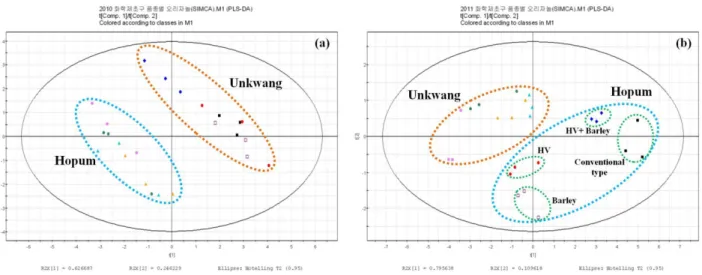
Fig. 3. Scores plotting chart of principal components 1 and 2 of the PLS-DA results obtained from the data set by γ-oryzanol profiling in green manure conditions(Varietal classification in chemical weeding; a. 2010 year, b. 2011 year).
oryzanol 총평균함량은 현미 100 g당 각각 36.7±1.9, 31.5±
4.6 mg이었으며, 운광벼와 마찬가지로 처리에 따른 개별성 분별 비중 변화는 거의 없었다. γ-oryzanol 총함량에 있어 녹비처리별 화학제초구는 2010년도에 보리가 다른처리구에 비해 약간 낮은 함량을 나타냈으나, 전반적으로 대부분의 처리구가 관행구와 유사한 경향을 보였으며, 2011년도에는 관행보다 모든 녹비처리구가 증가하는 경향을 나타냈다 (Table 3, 4). 품종에 따른 녹비처리 효과의 차이를 알 수 있 었으며, 호품벼보다는 운광벼에서 처리별 효과 경향이 보다 뚜렷하게 나타났다.
또한 운광벼 및 호품벼 품종 종실로부터 γ-oryzanol 개 별성분 중 CAF, 24-MCF, CSF 및 SSF가 주요성분임이 확 인되었다. 호품벼의 경우 운광벼와 달리 CAF의 비중 (평균 25%)이 상당히 증가하였으며, 반대로 24-MCF의 비중 (평 균 31%)은 감소하였다. 따라서 녹비처리에 따른 γ-oryzanol 함량 변화는 녹비작물의 질소고정능력과 연관되어 있을 것 으로 판단되었으며, 이러한 결과들은 벼 생육과정 중 질소 가 오리자놀 형성에 있어서 중요한 역할을 하는 것으로 사 료되었다. γ-Oryzanol 역시 구조적인 면에서, ferulic acid esters 화합물로 페놀화합물에 속하며, 페놀화합물은 작물
Fig. 4. Scores plotting chart of principal components 1 and 2 of the PLS-DA results obtained from the data set by γ-oryzanol profiling in green manure conditions(Classification by green manure crops as chemical control of weeding in 2010 year; a.
Unkwang, b. Hopum).
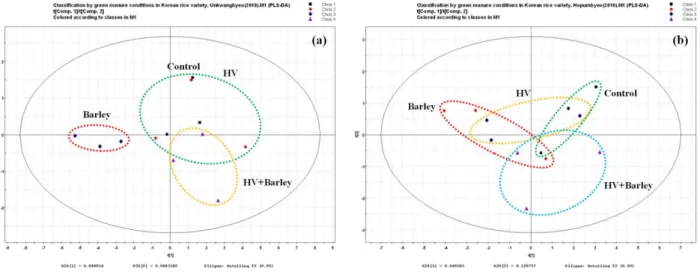
Fig. 5. Scores plotting chart of principal components 1 and 2 of the PLS-DA results obtained from the data set by γ-oryzanol profiling in green manure conditions(Classification by green manure crops as chemical control of weeding in 2010 year; a.
Unkwang, b. Hopum).
의 대표적인 이차대사산물로서 기상, 시비, 토양 등 재배환경 에 영향을 많이 받는다는 연구보고가 있기 때문에 이와 연관 성 있는 연구가 추후 필요할 것으로 판단되었다 (Wilhelmina 2005; Phuong & Emily 2008; Sylwester & Wlodzimierz 2009). 또한 질소고정능력별로 보다 다양한 녹비작물처리 에 대해 γ-oryzanol 분석이 필요할 것으로 사료되었다.
모든 분석대상시료의 대사체 분석 데이터는 표준화작업 을 거쳐 주성분 스코어를 통해 시각화시킬 수 있으며, 개별 스코어(시료)에는 녹비처리에 따른 운광벼 및 호품벼 종실 에 대한 γ-oryzanol 조성 및 함량 등의 모든 정보를 나타내 어 전체적인 패턴, 변이 및 클러스터 형성 여부 등을 한눈에 확인할 수 있었다. 2010 및 2011년도에 녹비처리별 화학제 초구에서 운광벼와 호품벼는 서로 다른 클러스터를 형성하
였는데, 이는 오리자놀 개별성분 조성 및 총함량에 따른 차 이를 반영하는 것으로 나타났다. 특히 2011년도 호품벼는 클러스터 안에 녹비처리별 세부클러스터가 형성되었다 (Fig. 3).
호품벼의 경우, 2010년도에 전반적인 처리구가 관행구와 유사한 경향을 보였으나, 2011년도에는 크게 2개의 클러스 터 안에 독립된 2개의 클러스터를 각각 형성하였으며, 이는 처리별 함량 변화가 뚜렷함을 나타내었다. 운광벼의 경우, 2010년도에 헤어리베치 및 HV+보리 처리구는 같은 클러스 터에 속하며, 관행구와는 유사한 경향을 보였으나, 보리는 단독 클러스터를 형성하여 관행구보다 다소 낮은 함량을 나 타내었다. 반면에 2011년도에는 관행구가 보리와 유사하며, 이들보다 헤어리베치 및 HV+보리가 높은 함량을 나타내었
다 (Fig. 4, 5). 년도별 처리구에 따른 오리자놀 함량 변화는 녹비투입량 및 재배환경 등의 변화로 인해 생겼을 것으로 사료되었다.
Conclusion
녹비 환원에 따른 벼 품종 운광벼 및 호품벼에 대해 역상 HPLC 방법을 이용하여 γ-oryzanol 함량 및 개별성분 조성 을 평가한 결과는 다음과 같다.
1. 운광벼 및 호품벼 시료로부터 총 10종의 γ-oryzanol 개 별 성분이 분리되었으며, 이중 cycloartenyl ferulate, 24-methylenecycloartanyl ferulate, campesteryl ferulate 및 sitosteryl ferulate가 주요 성분으로 확인되었다.
2. 2010 및 2011년도에 운광벼 품종 종실의 처리전체 γ- oryzanol 총평균함량은 현미 100 g당 각각 43.5±3.9, 39.5±3.5 mg 이었으며, 호품벼는 100 g당 각각 36.7±
1.9, 31.5±4.6 mg으로 나타났다.
3. 년도별, 처리별 모든시료에서 개별성분별 비중 변화는 거의 없었으며, 2010년도 운광벼의 경우 γ-oryzanol 총 함량에 있어 녹비처리별 화학제초구는 관행보다 헤어리 베치 및 HV+보리가 비슷하거나 다소 증가하는 경향을 보였으나, 보리에서는 약 10 mg 정도 감소하는 경향을 보였다.
4. 2010 및 2011년도에 녹비처리별 화학제초구에서 운광벼 와 호품벼는 서로 다른 클러스터를 형성하였는데, 이는 오리자놀 개별성분 조성 및 총함량에 따른 차이를 반영 하는 것으로 나타났다. 특히 운광벼의 경우, 2010년도에 헤어리베치 및 HV+보리 처리구는 같은 클러스터에 속 하며, 관행구와는 유사한 경향을 보였으나, 보리는 단독 클러스터를 형성하여 관행구보다 다소 낮은 함량을 나타 내었다.
References
Abdel-Aal, E.S.M. and Hucl, P. 1999. A rapid method for quantifying total anthocyanins in blue aleurone and purple pericarp wheats. Cereal Chemistry 76, 350-354.
Bergman, C.J. and Xu, Z. 2003. Genotype and environment effects on tocopherols, tocotrienols and gamma-oryzanol contents of Southern US rice. Cereal Chemistry 80(4):
446-449.
Choi, B.S., Jung, J.A., Oh, M.K., Jeon, S.H., Goh, H.G., Ok, Y.S.
and Sung, J.K. 2010. Effects of green manure crops on improvement of chemical and biological properties in soil.
Korean J. Soil Sci. Fert. 43(5):528-536.
Evershed, R.P., Spooner, N., Prescott, M. and Goad, L.J. 1988.
Isolation and characterisation of intact steryl ferulates from seeds. Journal of Chromatography A 440, 23-35.
Fang, N., Yu, S. and Badger, T.M. 2003. Characterization of triterpene alcohol and sterol ferulates in rice bran using LC-MS/MS. Journal of Agricultural and Food Chemistry 51, 3260-3267.
Hakala, P., Lampi, A.M., Ollilainen, V., Werner, U., Murkovic, M., Wahala, K., Karkola, S. and Piironen, V. 2002. Steryl phenolic acid esters in cereals and their milling fractions.
Journal of Agricultural and Food Chemistry 50, 5300-5307.
Han, S.I., Nam, M.H., Kim, S.Y., Jang, K.C., Oh, S.H., Seo, W.D. and Ra, J.E. 2012. Transformation of rice by-products.
RDA Interrobang 65, 1-3.
Jeon, W.T., Hur, S.O., Seong, K.Y., Oh, I.S., Kim, M.T. and Kang U.G. 2011. Effect of green manure hairy vetch on rice growth and saving of irrigation water. Korean J. Soil Sci. Fert.
44(2):181-186.
Jeon, W.T., Seong, K.Y., Kim, M.T., Oh, G.J., Oh, I.S. and Kang, U.G. 2010. Changes of soil physical properties by glomalin concentration and rice yield using different green manure crops in paddy. Korean J. Soil Sci. Fert. 43(2):119-123.
Jeon, W.T., Seong, K.Y., Oh, G.J., Kim, M.T., Lee, Y.H., Kang U.G., Lee, H.B. and Kang H.W. 2012. Changes of biomass of green manure and rice growth and yield using leguminous crops and barley mixtures by cutting heights at paddy. Korean J. Soil Sci. Fert. 45(2):192-197.
Kim, E.S. and Lee, Y.H. 2011. Response of soil microbial communities to applications of green manures in paddy at an early rice-growing stage. Korean J. Soil Sci. Fert. 44(2):
221-227.
Kim, H.W., Kim, J.B., Shanmugavelan, P., Kim, S.N., Cho, Y.S., Kim, H.R., Lee, J.T., Jeon, W.T. and Lee D.J. 2013. Evaluation of γ-oryzanol content and composition from the grains of pigmented rice-germplasms by LC-DAD-ESI/MS. BMC Resarch Notes 6:2-11.
Miller, A. and Engel, K.H. 2006. Content of γ-oryzanol and composition of steryl ferulates in brown rice (Oryza sativa L.) of European origin. Journal of Agricultural and Food Chemistry 54, 8127-8133.
Moreau, R.A., Powell, M.J. and Singh, V. 2003. Pressurized liquid extraction of polar and nonpolar lipids in corn and oats with hexane, methylene chloride, isopropanol, and ethanol.
Journal of the American Oil Chemists’ Society 80, 1063-1067.
Norton, R.A. 1995. Quantitation of steryl ferulate and p-coumarate esters from corn and rice. Lipids 30, 269-274.
Park, S.T., Jeon, W.T., Kim, M.T., Sung, K.Y., Ku, J.H., Oh, I.S., Lee, B.K., Yoon, Y.H., Lee, J.K., Lee, K.H. and Yu, J.H. 2008.
Understanding of environmental friendly agriculture and rice production using green manure crops. RDA, NICS. Sammi.
Suwon. 20-21.
Phuong MN, Emily DN. 2008. Effects of nitrogen fertilization on the phenolic composition and antioxidant properties of
Basil (Ocimum basilicum L.). J Agric Food Chem 56:
8685-8691.
Rogers, E.J., Rice, S.M., Nicolosi, R.J., Carpenter, D.R., McClelland, C.A. and Romanczyk, L.J.Jr. 1993. Identification and quantification of γ-oryzanol components and simultaneous assessment of tocols in rice bran oil. Journal of the American Oil Chemists’ Society 70, 301-307.
Seitz, L.M. 1989. Stanol and sterol esters of ferulic and p- coumaric acids in wheat, corn, rye and triticale. Journal of Agricultural and Food Chemistry 37, 662-667.
Sylwester S, Wlodzimierz S. 2009. The effect of various nitrogen fertilization and foliar nutrition regimes on the concentrations of sugars, carotenoids and phenolic compounds in carrot
(Daucus carota L.). Sci Hort 120:315-324.
Wilhelmina K. 2005. Effects of production and processing factors on major fruit and vegetable antioxidants. J Food Sci 70:R11-R19.
Xu, Z. and Godber, J.S. 1999. Purification and identification of components of γ-oryzanol in rice bran oil. Journal of Agricultural and Food Chemistry 47, 2724-2728.
Yang, C.H., Ryu, J.H., Kim, T.K., Lee, S.B., Kim J.D., Baek, N.H., Kim, S., Choi, W.Y. and Kim, S.J. 2009. Effect of green manure crops incorporation with rice cultivation on soil fertility improvement in paddy field. Korean J. Soil Sci. Fert.
42(5):371-378.