Introduction
Animal manure from livestock production and processing facilities is increasingly applied to agricultural soils for disposal and/or nutrient recycling (Coyne et al., 1995). The importance of livestock wastewater to sustainable water resource also continues to increase (Cosgrove and Rijsbermann, 2000). Among many recycling practices of treated livestock wastewater, its use for irrigation ranks the number one practice in Korea because irrigation water consists of 21% of total agricultural water use and it does not require high quality of water compared to drinking water (Park et al., 1997).
Treated livestock wastewater has many advantages in economic and environmental points of view include: 1)
reducing fertilizer application; 2) increasing crop yield; 3) reducing the amount of effluent from wastewater treatment plants. Despite of these advantages, the usage of livestock wastewater without adequate safeguards raises obvious potential health risks for farmers and consumers while the actual risks depend on many factors like the living conditions of the exposed population.
Once livestock wastewater is land applied, it becomes a potential agricultural non-point source of pollution. One of the main concerns with land application of livestock manure is groundwater and surface water contamination through nutrient- and/or pathogen-containing runoff during or after a storm event (Stoddard et al., 1998).
Contamination of water sources via runoff has been reported from grazed land, feedlots, land treated with animal manures or slurry and sewage treated land. Along with these occurrences, the inter-relationship of microbial transport with environmental factors has raised much attention and concern (Jawson et al., 1982 Thornley &
Pathogenic E. coli Inactivation in Upland Soils to a Change of Soil Moisture Content and Temperature
Min-Kyeong Kim, Min-Young Kim1, Chul-Man Choi2, Byong-Gu Ko*, Soon-Ik Kwon, and Hang-Yeon Weon3
Department of Agricultural Environment, National Academy of Agricultural Science (NAAS), Rural Development Administration (RDA), Suwon, 441-707, Korea
1Department of Agricultural Engineering, NAAS, RDA, Suwon, 441-707, Korea
2Analysis Support Center, The Foundation of Ag. Tech. Commercialization and Transfer, Suwon, 441-707, Korea
3National Agrobiodiversity Center, NAAS, RDA, Suwon, 441-707, Korea
The application of livestock manure to cropland is a practice that has been used for centuries. Agricultural crops can utilize nutrients from manure, and the producer can utilize land for disposal, although in a
"sustainable system" the concept is manure utilization and not waste disposal. However, meeting regulatory criteria regarding microbial quality remains an expensive and time consuming process. The purpose of this study was to quantify the level of environmental impact of soil moisture and temperature on fecal coliform (Escherichia coli orE. coli) survival in upland soils forsound application of livestock manure. Samples were collected up to 30 days depending on the given conditions. The inactivation rate of E. coli increased linearly with increased temperature while the inactivation rate gradually decreased with decreased soil moisture level.
The overall findings of this study showed that the temperature was the limited factoron E. coli survival in soils over soil moisture content. This study will provide useful and practical guidelines to applicators of soil in deciding appropriate handling and time frames for land application for sustainable agriculture.
Key words: fecal coliforms, Escherichia coli, soil moisture content, temperature, inactivation rate, upland soil
Received : January 29. 2010 Accepted : February 16. 2010
*Corresponding author : Phone: +82312900219 Email: [email protected]
Bos, 1985).
Clearlinks between livestock wastewater irrigation and the health of exposed farming households were shown through many studies. There is also considerable evidence showing the impact on soil and groundwater through high nutrient levels, salts, or heavy metals, especially the existence of pathogenic microorganisms (Cattaneo et al., 1997; Dominguez-Mariani et al., 2004 Stine et al., 2005).
Best practice is one that ensures the level of risk and level of difficulty for a particular site is managed appropriately so that the desired outcome is achieved.
However, there are no universal standards governing the production and quality of reclaimed water, although the World Health Organization(WHO) has developed guide- lines for the use of reclaimed water that recommend monitoring fecal coliforms and intestinal nematodes (WHO, 1989 2002).
More than 150 pathogens associated with risk to human health are found in livestock manure. They include Campylobacter spp., Salmonella spp., Listeria mono- cytogenes, Escherichia coli O157:H7, Cryptosporidium parvum and Giardia lamblia, which account for over 90%
of human food and waterborne diseases (Pell, 1997).
Potential risks of livestock wastewater due to the existence of pathogenic microorganisms addressed many studies to assess the impact of irrigation with livestock wastewater on soil, crop and neighboring water (Jang et al., 2009).
According to the extensive literature review, there are numerous variables affecting the inactivity of pathogens and pathogen indicators in soil and in sewage sludge mixed with soil. Knowledge concerning the influence of environmental factors such as temperature, pH, salinity, etc., on microbial growth is of crucial practical importance in wastewater treatment (O’Shaughnessy et al., 2008).
The primary factors can be narrowed to soil moisture, temperature, rate of desiccation, and competing micro- organisms (Haas et al., 1999; Rusin et al., 2002 Song et al., 2005). In addition, field studies indicated that virus adsorption is dependent on soil pH, cation exchange capacity, organic matter content and clay content (O’shaughnessyet al., 2008). However, the survival mechanism of microorganism cannot be expressed in
closed formulas because there are much of the known and qualitative information in nature and the data are limited.
Therefore, this study was designed to further investigate the influence of two key factors, soil moisture content and temperature on microbial reduction in upland soil with the objectives to quantify individual or combined their contributions on E. coli reduction in upland soils.
Materials and Methods
Soil preparation and experimental procedure The soil used for this study was field soil from the experimental station (Yeoju city, Korea). Soil was sieved using a 2-mm mesh and dried to a natural moisture level in the shade. Soils used in this study were autoclaved for three consecutive days to remove any pre-existed enteric microorganisms in soils.The prepared soil was stored at room temperature until it was needed for the experiment.
Soil texture was loam and its chemical properties are listed in Table 1.
Fecal coliform, E. coli, was used as a pathogen indicator in this study, and it frequently assayed for the purpose of designating the bacterial microbial quality. Ten gram of dried soils were placed into sterilized 50-mL glass bottles and its moisture content was adjusted to 10, 35, 65 and 80% (g water g dry soil-1) depending on control level by adding sterile distilled water. Fifteen soil samples were prepared identically for each soil moisture control and the bottles were closed with lids to maintain constant soil moisture content. While preliminary study revealed that the amount of evaporation throughout the experimental period was negligible, all bottles were weighed prior to packing the soils inoculated with E. coli and again prior to sacrificing the bottle when assaying the samples to determine if any significant amount of moisture was lost.
The temperature of an incubator (VS 1203 PF-M, Vision Science, Korea) was set to three different levels (20, 25 and 32 ). The temperatures were based on a range of℃ average heat units measured during crop cultivation period including rainy season in Korea. Two thermo- couples, relative humidity and temperature sensors
Table 1. Selected characteristics of the soils.
Soil Texture pH EC Av.P2O5 O.M. T-N Ca Mg K Na
(1:5) (dS m-1) (mg kg-1) (g kg-1) (%) --- (cmol+ kg-1) ---
Loam 6.7 1.06 1,046 40.1 0.40 4.38 1.49 1.15 0.27
(CS500 RH, Campbell Scientific, Logan, Utah, USA) were placed inside the incubator to monitor any change of temperature and humidity which might affect on microbial survival.
After soil moisture content and temperature were controlled, each bottle was then inoculated with 1.0 mL of Escherichia coli KACC 13821 (E. coli 13821) obtained from the National Agrobiodiversity Center, National Academy of Agricultural Science (NAAS), Rural Development Administration of Korea (RDA).
The amended soils with predetermined amounts of distilled water and 1 mL of E. coli suspension were compacted into bottles to a given depth such that the bulk density of soil sample was approximately 1.29 g cm3-1, similar to the field bulk density of loam soil. E. coli suspension with a concentration of 2×10⁸cfu mL-1was used for inoculation.
Microbial Sampling and Assay Samples were collected at various intervals over the experimental periods, which varied from 3 to 28 days depending on the temperature control. The dilution and plating method was usedto enumerate E. coli under various conditions. The dilution solution was comprised of 0.85% sodium chloride (NaCl) and the agar utilized for plating was TSA (Tryptic Soy Agar) (Difco Co., Detroit, MI, USA). Samples were taken at days of 3, 7, 14, 21 and 28 day. To prevent any inconsistent soil sub-sampling, an entire volume of soil in each bottle was assayed. The content in the bottle was mixed on a stir plate for 30 minutes and the mixture was then centrifuged at 5,000 rpm by a high speed centrifuge.
After centrifugation, 0.1 to 1 mL of supernatant solution was assayed.
Results and Discussion
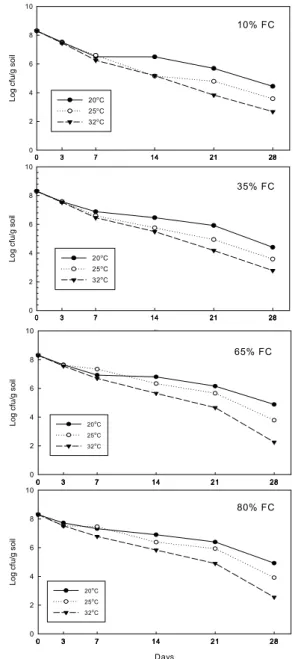
Dynamics of fecal coliforms in soils The con- trolled study was designed and conducted under different conditions of temperatures and moisture levels. Three temperature levels (20, 25 and 32°C) and four moisture content levels (10, 35, 65 and 80%) were set up. Figure 1 shows the impact of soil moisture content and temperature on E. coli survival. Even though the impact of soil moisture contents for microbial survivability was not that significant, the lowest and highest survivals of E. coli were found at 10% and 80% of soil moisture contents, respectively. Overall observation from a series of
experiments was that E. coli survived longer under humid and low temperature.
Days
0 3 7 14 21 28
0 3 7 14 21 28
0 3 7 14 21 28
0 3 7 14 21 28
Log cfu/g soil
0 2 4 6 8 10
20oC 25oC 32oC
Days
0 3 7 14 21 28
0 3 7 14 21 28
0 3 7 14 21 28
0 3 7 14 21 28
Log cfu/g soil
0 2 4 6 8 10
20oC 25oC 32oC
Days
0 3 7 14 21 28
0 3 7 14 21 28
0 3 7 14 21 28
0 3 7 14 21 28
Log cfu/g soil
0 2 4 6 8 10
20oC 25oC 32oC
Days
0 3 7 14 21 28
0 3 7 14 21 28
0 3 7 14 21 28
0 3 7 14 21 28
Log cfu/g soil
0 2 4 6 8 10
20oC 25oC 32oC
10% FC
35% FC
65% FC
80% FC
Fig. 1. Logarithmic description of E. coli recovery under various temperature and soil moisture(FC; Field Capacity) conditions.
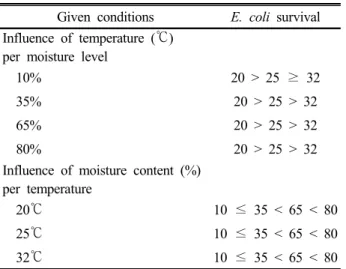
In most cases, the difference in E. coli survival became significant at 21 days, thus, the statistical analysis using analysis of variance (ANOVA) followed by Duncan’s multiple-range test with a significant level of p≤0.05 was performed using SAS statistical package (SAS Institute Inc., Cary, NC, USA). Table 2 lists the effects of temperature and soil moisture content on E. coli survival in soils. Significant main and interaction effects were temperature (p << 0.01) and moisture level (p = 0.013).
Since bacteria are aquatic organisms and growth is
restricted to the aqueous phase and on the soil-liquid interface, drought-stress caused by low humidity and high temperature may be expected to cause a rapid population decline which is confirmed in the presented study (Mawdsley et al., 1995).
Table 2. Influence of temperature and moisture content on survival of E. coli at 21 days (summary of multi- factor ANOVA)a.
Given conditions E. coli survival Influence of temperature ( )℃
per moisture level
10% 20 > 25 ≥ 32
35% 20 > 25 > 32
65% 20 > 25 > 32
80% 20 > 25 > 32
Influence of moisture content (%) per temperature
20℃ 10 ≤ 35 < 65 < 80
25℃ 10 ≤ 35 < 65 < 80
32℃ 10 ≤ 35 < 65 < 80
a> : significant difference; ≥ : not significant difference p=0.05
Response of microbial inactivation to a change of soil moisture and temperature levels To describe the microbial responses to environmental stresses over time, the microbial inactivation rate () was calculated using the first-order kinetic equation (Pang, 2009):
where : initial number of E. coli,
N : final number of E. coli and t : time.
Figure 2 shows the calculated microbial inactivation rates and their dependence on soil moisture and temperature levels. It is noted that as the temperature increased, the number of E. coli gradually decreased over time, which is consistent with the previous studies by Price and Todd (2004), Song et al. (2005) and O’Shaughnessy et al (2008). Heat injures cells by damaging cell membranes when heat is transferred from surrounding water molecules. Therefore at high tem- peratures, heat impacts microorganisms by damaging their cellular membranes and possibly their intracellular
proteins, DNA, and ribosomes (Woo et al., 2000). In addition, dryness(the difference of soil moisture contents) adds severe stress to heat on many bacteria, for example, E coli in air-dry state usually dies within 12-48h (Atlas and Bartha, 1997). Each curve representing different temperatures with a fixed moisture level clearly showed that microbial inactivation was temperature-dependent.
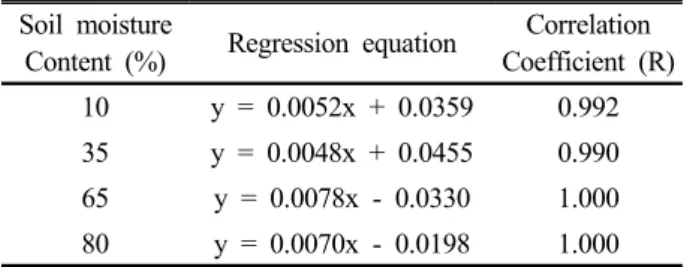
The regression equations for each temperature and moisture were estimated and listed in Table 3 and Table 4.
High correlation coefficients showed that the inactivation rate appeared to be linearly related to temperature. While E. coli survival was less sensitive to a change of soil moisture contents rather than a change of temperature, the slope of regression equations increased at a very low level as soil moisture content increased. This means that E. coli survived somewhat better in wetter soil (Table 3). In contrary to low and mild temperatures(e.g., 20, 25ºC), low correlation coefficient at temperature of 32 ºC may be caused by experimental errors. Each correlation coefficients for soil moisture and temperature levels showed E. coli survived better and show good activity in wetter soil under mild temperature.
Fig. 2. Inactivation rates of E. coli depending upon tem- perature (top) and soil moisture content (bottom).
Table 3. Regression equation of E. coli inactivation rates (y) depending upon temperature (x).
Soil moisture
Content (%) Regression equation Correlation Coefficient (R) 10 y = 0.0052x + 0.0359 0.992 35 y = 0.0048x + 0.0455 0.990 65 y = 0.0078x - 0.0330 1.000 80 y = 0.0070x - 0.0198 1.000
Table 4. Regression equation of E. coli inactivation rates (y) depending upon soil moisture content (%).
Temperature
(ºC) Regression equation Correlation Coefficient (R) 20 y = -0.0003x + 0.1437 0.837 25 y = -0.0002x + 0.1722 0.890 32 y = 0.0002x + 0.1972 0.380
Conclusion
There are numerous benefits and risks associated with treated livestock wastewater application for non-potable irrigation. The most successful schemes have the highest benefits with the risks well managed. This study investigated the survival of E. coli in soil at various temperature and soil moisture conditions. The inactivation of E. coli increased linearly as temperature increased. E.
coli survival better in humid conditions; its greatest survival was at 80% soil moisture for all studied temperatures. This implies the existence of an optimal or a threshold soil moisture level for E. coli survival.
Evaporation of soil moisture accelerates E. coli inacti- vation significantly at higher temperatures, but minimal effects were observed at lower temperatures. Survival curves of pathogenic organism that were subjected to combined stress conditions are often complicated and multiphase. This study assured that soil moisture contents and temperature levels were the main governing factors of microbial survival in upland soils.
It should be noted in this study that there is no single recipe that can be applied across all situations. Practices used at one site may appear less sophisticated, or use a more basic level of technology than another. However, this study achieved valuable outcomes that there is a certain correlation between E. coli inactivation and environmental factors. To meet the regulation criteria for upland soil, it is necessary to reduce the microbial quantity
to a certain level. This study then will provide strong evidence that managing treated livestock wastewater- under high temperature and low moisture levels is an effective way of reducing pathogens within a given time period, enabling increased utilization of livestock wastewater while minimizing health-related risks to humans as well as the environment.
References
Atlas, R.M., and R. Bartha. 1997. Microbial Ecology:
Fundamentals and Applications. Benjamin/Cummings Publishing Company, Inc., California, pp. 334-340.
Cattaneo, M.V., C. Masson, and C.W. Greer. 1997. The influence of moisture on microbial transport, survival and 2,4-D biodegradation with a generally marked Burkholderia cepacia in unsaturated soil columns. Biodegradation. 8:87-96.
Cosgrove, W.J., and F.R. Rijsbermann. 2000. World water vision-making water everybody’s business. Earthscan Publications, London, United Kingdom.
Coyne, M.S., R.A. Gilfillen, R.W. Rhodes, and R.L. Blevins.
1995. Soil and fecal coliform trapping by grass filter strips during simulated rain. J. Soil and Water Cons. 50(4):
405-408.
Dominguez-Mariani, E., A. Acrrillo-Chavez, A. Ortega, and T.
Orozco-Esquivel. 2004. Wastewater reuse in Valsequillo Agricultural area, Mexico: Environmental impact on groundwater. Water, Air, and Soil Pollution. 155:251-267.
Haas, C.N., J.B. Rose, and C.P. Gerba. 1999. Quantitative microbial risk assessment. John Wiley & Sons Inc., New York.
Jang, T.I., H.K. Kim, E.J. Lee, S.W. Park, and C.E. Park. 2009.
Mass balance analysis of reclaimed wastewater irrigationon paddy fields in Korea. 2009 ASABE Annual International Meeting. Reno, Nevada, June 21-24, 2009.
Jawson, M.D., L.F. Elliott, K.E. Saxton, and D.H. Fortier. 1982.
The effect of cattle grazing on indicator bacteria in runoff from a Pacific Northwest Watershed. J. Environ. Qual. 11:
621-627
Mawdsley, J.L., R.D. Bardgett, R.J. Merry, B.F. Pain, and M.K.
Theodorou. 1995. Pathogens in livestock waste, their potential for movement through soil and environmental pollution. Appl. Soil Ecol. 2:1-15.
O’shaughnessy S.A., M.Y. Kim, and C.Y. Choi. 2008.
Mathematical model to predict pathogen die-off in biosolids.
J. Residuals Science & Technology. 5:87-93.
Pang, L. 2009. Microbial removal rates in subsurface media estimated from published studies of field experiments and large intact soil cores. Journal of Environmental Quality, 38(4): 1531-1559.
Park, M.H., N.S. Park, H. Park, H.S. Shin, and B.D. Kim. 1997.
An economic analysis of desalination for potential application in Korea. Desalination. 114:209-221.
Pell, A.N. 1997. Manure and microbes: public and animal health
problem. J. Dairy Sci. 80: 2673-2681.
Price, P.B., and S.T. Todd. 2004. Temperature dependence of metabolic rates for microbial growth, maintenance, and survival. PNAS, 101:4631-4636.
Rusin, P., S. Maxwell, and C.P. Gerba. 2002. Comparative surface-to-hand and finger trip-to-mouth transfer efficiency of gram-positive bacteria, gram-negative bacteria, and phage.
Journal of Applied Microbiology. 93:585-592.
Song, I., C.Y. Choi, S. O’Shaughnessy, and C.P. Gerba. 2005.
Effects of temperature and moisture on coliphage PRD-1 survival in soil. J. of Food Protection. 68:2118-2122.
Stine, S.W., I. Song, C.Y. Choi, and C.P. Gerba. 2005.
Application of microbial risk assessment to the development of standards for enteric pathogens in water used to irrigate fresh produce. J. Food Prot. 68:913-918.
Stoddard, C.S., M.S. Coyne, and J.H. Grove. 1998. Fecal bacteria survival and infiltration through a shallow agricul-
tural soil: timing and tillage effects. J. Environ. Qual. 27:
1516-1523.
Thornley, S., and A.W. Bos. 1985. Effects of livestock wastes and agricultural drainage on water quality: An Ontario case study. J. Soil Water Conserv. 40: 172-175.
Woo, I.S., I.K. Rhee, and H.D. Park. 2000. Differential damage in bacterial cells by microwave radiation on the basis of cell wall structure. Applied and Environmental Microbiology.
66(5): 2243-2247.
World Health Organization. 1989. Health guidelines for the use of wastewater in agriculture and aquaculture. World Health Organization, Geneva,
World Health Organization (WHO). 2002. Guidelines for the microbiological quality of treated wastewater used in agriculture: recommendations for revising WHO guidelines.
Bull. WHO. 78:1104-1116.
밭토양에서 토양수분과 온도변화에 따른 분변성 대장균 사멸율 변화
김민경 김민영· 1·최철만2·고병구*·권순익 원항연· 3
농촌진흥청 국립농업과학원 농업환경부, 1농촌진흥청 국립농업과학원 농업공학부,
2농업기술실용화재단, 3농촌진흥청 국립농업과학원 농업유전자원센터
전 세계적으로 가축분뇨를 농경지에 시용하는 것은 작물과 토양에 양분을 공급하는 측면에서 오래 전부터 이용되어 왔으
며 최근 들어서는 자원을 재순환하기 위한 측면으로 이용되고 있다 그러나 환경적인 측면에서 가축분뇨를 농경지에 시, . ,
용하였을 때 미생물적 평가나 규제기준은 비용과 시간이 많이 요구되어 우리나라에서는 이에 대한 연구가 수행되지 못한
실정이다 따라서 본 연구는 밭토양에서 토양수분과 온도조건에 따른 분변성 대장균의 사멸율을 조사하여 분변성 대장균. ,
이 외부 환경에 영향을 미칠 수 있는 수준을 평가하고자 수행하였다 시료는 토양수분조건. (10, 35, 65, 80%) 및 온도조건
별로 정해진 기간 일 동안 배양되었으며 각각의 시료에 포함된 대장균의 수는
(20, 25, 30 )℃ (3, 7, 14, 21, 28 ) plating
를 이용하여 측정되었다 분산분석을 통한 측정자료의 통계분석 결과 분변성 대장균의 생존에는 토양수분함량과
method . ,
온도가 주 요인이었는데 특히 토양수분함량이 감소할수록 그리고 온도가 증가할수록, E. coli의 사멸율은 직선적으로 증가
하였다 또한 토양수분 조건과 온도조건 중에서 분변성 대장균의 사멸율은 온도조건에 더 상관이 높은 것으로 나타났으. ,
며 모든 온도조건에서, 10%의 토양수분조건에서 분변성 대장균의 사멸율이 높았다 이는 토양수분이. E. coli의 사멸에 제
한적인 요인으로 작용하였음을 의미한다 따라서 본 연구는 가축분뇨를 농경지에 시용할 때 인체의 위해성과 외부 환경의. ,
건전성을 유지하기 위해서는 고온 저습한 토양조건에서 시용하여야 한다는 현실적인 가이드라인을 제시하고자 한다.