서 언
인삼은 다년생작물로 생장이 비교적 늦으며 직사광, 선과 고온의 피해를 막기 위해 해가림 재배한다 인삼은. 양분을 천천히 흡수하는 특성이 있으므로 수년간 재배, 하는 동안 안정적인 양분공급을 위해서는 완효성인 유 기물의 사용이 적당하다 유기물의 시용은 토양의 물리. 적 성질을 개선하여 인삼 뿌리의 생장을 좋게 하기 때 문에 인삼을 식부할 예정지에 1-2년간 유기물을 시용하 여 경운을 반복하여 부숙시키는 예정지 작업이 중요하 다 (Park et al., 1982: Lee et al., 1985). 인삼재배 에는 그 동안 약토가 널리 이용되었으나 재료공급에 어 려움이 있어 그 대용으로 다양한 유기물의 사용이 시도, 되고 있다 (Nam et al., 2002: Lee et al., 2003).
토양생물은 농업토양생태계에서 유기물의 분해나 양 분의 이동과정에서 중요한 역할을 하며 토양의 비옥도 를 유지한다 (Filser, 2002; Cobo et al., 2002). 토 양미생물은 유기물을 분해하며 토양미소동물은 잔사를,
기계적으로 분쇄하거나 이동시키는 역할을 하기도 한다 (Heneghan et al., 1999; Siepel and Maaskamp, 농업생태계에서 유기물 시용은 식물 근권부의 1994).
분비물과 더불어 토양생물의 생체량과 분포에 영향을 미치는 주요한 요소이다(Bunemann et al., 2006). 토 양중의 유기물이 인삼에 이용되기 위해서는 토양생물에 의한 분해과정을 거쳐야 하며 적합한 분해조건의 조성, 을 위하여 이들의 생체량 및 개체군 밀도 변화에 대한 연구가 필요하다 토양생물의 중요성에 대한 인식은 점. 점 증가하는 추세이지만 인삼재배지에 있어서 이들에, 대한 연구는 아직 부족한 실정이다 본 연구는 부엽토와. 돈분퇴비의 시용에 대한 토양생물상의 변화를 알아보고 자 토양생태계를 이해하기 위한 기초적인 연구를 수행, 하였다.
재료 및 방법
유기물 처리 및 토양 시료 채취 본 연구는 충청 북도 음성군에 위치한 농촌진흥청 인삼과 시험포장에서 수행하였다 유기물의 종류별 시용량 별로 토양의 화학. , 성과 미생물상의 변화를 유기물의 처리하지 않은 무처
인삼재배지 유기물 시용이 토양미생물과 미소동물에 미치는 영향
어진우 박기춘· *·이성우 배영석 연병열· · 농촌진흥청 인삼과
Effects of Organic Materials on Soil Organisms in a Korean Ginseng Field
Jinu Eo, Kee-Choon Park*, Sung-woo Lee, Yeoung-Seuk Bae, and Byung-Ryul Yeon Ginseng Research Division, Rural Development Administration,
The aim of this study is to evaluate the effects of organic materials on soil organisms. Changes in the community structure, and population density of soil organisms (microbes, nematodes, and microarthropods) were studied in a Korean ginseng field. Phospholipid fatty acids analysis showed that the relative abundances of bacteria, fungi, and actinomycetes did not differ significantly. The aerobes/anaerobes ratio was the lowest in soils amended with leaf mold, indicating that the decomposition speed was slow. Further, the addition of leaf mold to the soil enhanced the saturated/monounsaturated fatty acid ratio and cyclopropyl fatty acid/precursor ratio, which indicated an increase in environmental stresses. Application of pig manure compost (PMC) had positive effects on the population density of nematodes, and negative effects on that of oribatid mites. The population densities of nematodes, and microarthropods remained relatively low in the plots that had been treated with leaf mold or pig manure compost. It is suggested that pre-planting soil management directed at enhancing the biological decomposition efficiency should be continued over a long period to increase the soil bioactivity in virgin soils.
Key words: Leaf mold, Microarthropod, Nematode, Pig manure compost, Phospholipid fatty acid
접수: 2010. 2. 12 수리: 2010. 4. 13 연락저자
* : Phone: +82438715556 E-mail: [email protected]
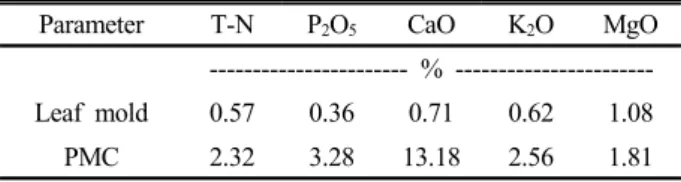
리 토양과 비교하였다. 2007년에 토양을 1.5 m로 성토 하여 조성한 포장에서 2008년 3월 20일에 부엽토 활( 엽수 와 돈분퇴비를) ha당 각각 15 t 또는 30 t을 시용 하였고 유기물의 조성은, Table 1에 나타내었다. 2008 년 월3 27일에 자경종 묘삼을 정식하였고 해가림은 청, 색 차광지를 사용하여 2008년 월4 20일부터 해가림 피 복을 시작하였으며 농약은 사용하지 않았다 각 처리구, . 의 크기는 0.9 m × 1.8 m이었고 난괴법, 3반복으로 배치하였다 토양의 화학성 분석을 위한 시료는. 2008년 월에 채취하여 조사하였다 지방산분석을 위한 토양시
9 .
료는 2009년 6월 15일에 채취하였고 토양미소동물을, 분석하기 위해 2009년 6월 15일 및 8월 15일 두 차례 조사하였다. 토양시료는 식물 사이의 공간에서 0-10 깊이의 토양을 네 곳에서 오거로 채취한 후 골고루 cm
혼합하였다.
토양화학성 분석 상온 건조 후 보관된 토양 시료 를 이용하여 토양화학분석법 (NIAST, 1998)에 의해 유기물 총질소 유효태인산 및 치환성양이온을
pH, EC, , ,
분석하였다. pH와 EC는 초자전극법 총탄소 및 총질소, 함량은CN 분석기 (Vario Max CN, Elementar Anal- 를 이용하여 측정하였으며 ysenesysteme, Germany)
토양유기물 함량은 측정한 총탄소함량을 이용하여 계산 하였다. 유효인산함량은 Lancaster법으로 측정하였으 며 치환성 양이온함량은, 1 N NH4OAc (pH 7.0)으로 침출한 후 그 여과액을 ICP (Integra XL DUAL, GBC 를 이용하여 측정하 Scientific Equipment, Australia)
였다.
인지질 지방산
(Phospholipid Fatty Acid, PLFA) 및
미소동물 분석 동결건조하여 냉동보관한 토양시료를 이용하여 인지질 지방산을 추출한 후 토양미생물 군락의 구성을 분석하였다 (Peacock et al., 2001). 간단히 요 약하면, 4 g의 토양 시료에chloroform (4 mL), methanol (8 mL), buffer solution (3.2 mL, pH 7.4)을 혼합하여 지질을 추출한 후 silicic acid column으로 neutral-,및 로 분리하였다 이 중에서
glyco- phospho-lipid .
인지질을 메틸화한 지방산에 fatty acid methyl ester 를 내부 표준물질로 넣은 다음
19:0 MIDI Sherlock
Microbial Identification System (MIDI Inc., Newark, 으로 지방산을 정성
DE) ․ 정량하였다 각 인지질지방산의.
값은 각 시료에서 총 인지질 지방산의 백분율로 표시하 였다. Fatty acid methyl ester 19:0 150 ng μL-1 농 도를 내부표준물질로 이용하였다. 전체 PLFA 중에서 주요 지표 지방산은Li et al. (2006)의 방법에 따른 지 방산 분석 지표들을 이용하여 지방산을 분류하였다 단. 불포화 지방산은 16:1 ω5c, 17:1 ω8c, 18:1 ω7c, 포화 지방산은 14:00, 15:00, 16:00, 17:00, 18:00, 20:00 을 지표지방산으로 이용하였다 그램 음성균의 지표 지. 방산은 18:1 ω7c, 19:0cy ω8c, 17:1 ω8c, 그램양성균 은 i14:0, i15:0, a15:0, i16:0, i17:0, a17:0, 세균은 그램 음성균과 양성균에 대한 지표지방산을 모두 이용 하였다. 곰팡이는 18:2 ω6,9c, 방선균은 10Me16:0,
은 을 이용
10Me17:0, TBSA10Me18:0, VAM 16:1 ω5c 하였다.
미소동물 선충의 총개체밀도를 분석하기 위해 10
의 토양을 을 이용하여 시간 동
g Baermann funnel 48
안 선충을 추출하였다 추출한 선충은. TAF (trietha- 용액에 고정하여 보관하였다가 총 nolamine formalin)
개체밀도를 조사하였다 소형절지동물은. 300 mL의 토 양을 Tullgren funnel을 이용하여 72시간 동안 추출하 여 광학현미경으로 관찰하면서 톡토기류 및 응애류로, 등으로 분류하였다.
통계 유기물 시용의 미생물 PLFA및 미소동물에 대한 효과는 ANOVA와 Duncan test로 분석하였으며, 를 SAS v9.1 (SAS Institute Inc., Cary, NC, USA) 이용하여 수행하였다.
결과 및 고찰
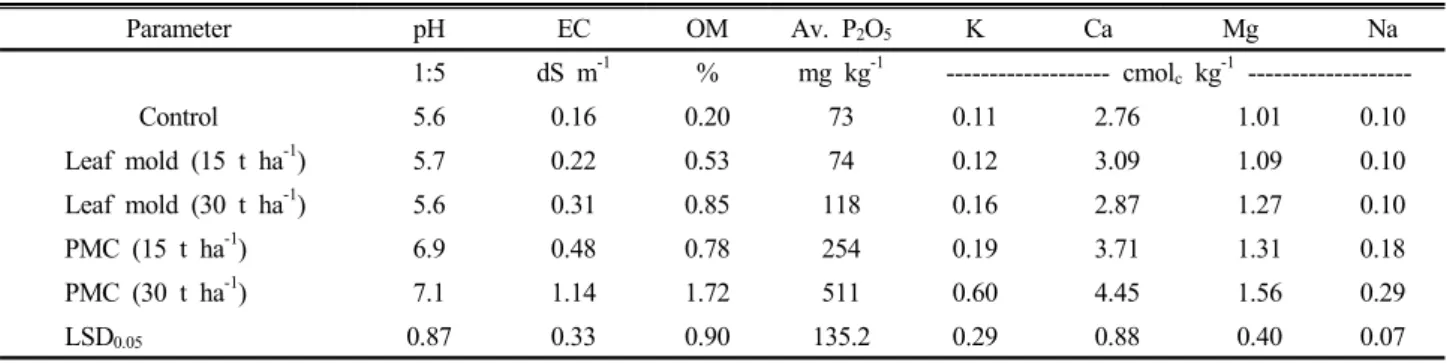
토양의 화학성을 조사한 결과, pH와 EC는 돈분퇴비 시용구가 대조구와 부엽토 처리구보다 높았으며 유기물, 함량도 돈분퇴비 시용구가 높았다 (Table 2). 질소 유, 효인산 칼륨 칼슘 마크네슘의 함량도 돈분퇴비 시용, , , 구가 높았다 미생물 군집구조와 생리적 상태를 비교하. 기 위하여 추출한 인지질 지방산을 분석한 결과 총 74 개의 지방산이 확인되었다 이들 지방산 중에서 세균. , 곰팡이 방선균의 생물적 지표가 되는 지방산과 토양 미, 생물 군집의 생리적 지수를 나타내는 지표 지방산을 이 용하여 분석한 결과 유기물의 종류와 양에 따라서 일부 미생물 군락과 지표의 차이가 관찰되었다 (Fig. 1).
Table 1. Elemental composition of leaf mold and pig manure compost (PMC).
Parameter T-N P2O5 CaO K2O MgO --- % --- Leaf mold 0.57 0.36 0.71 0.62 1.08
PMC 2.32 3.28 13.18 2.56 1.81
지표 지방산의 분석결과를 보면 곰팡이 세균 방선, , 균의 경우 처리간 유의성 있는 차이는 없었지만 내생균, 근균인 VAM의 상대적 밀도는 돈분퇴비 15 t ha-1 및 30 t ha-1 처리구에서 모두 3.8%로서 1.6%인 대조구보 다 높았다 (Fig. 1A). Nilsson 등 (2007)은 토양 pH와 균근균의 밀도 사이에 정의 상관관계가 있었다고 보고
하였는데 돈분퇴비 처리구의 결과를 보면, VAM의 상대 적 밀도와pH가 모두 높았기 때문에 VAM 밀도의 변화 는 돈분퇴비의 시용에 의해 높아진pH에 영향을 받았을 것으로 사료된다.
미생물군락의 생리적 지표인 그램음성균 그램양성균/ 비 율 호기성균 혐기성균 비율 포화지방산 단불포화지방산, / , / 비율, Cyclopropyl 지방산 전구체 비율 곰팡이 밀도 세/ , / 균 밀도 등의 지수 등에서도 일부 지수는 처리 간 차이 를 보였다(Fig. 1B) 포화지방산 단불포화지방산 비율은/ 부엽토 30 t ha-1 처리구가 대조구 및 돈분퇴비 30 t ha-1 처리구보다 유의성 있게 높았다. Cyclopropyl 지 방산 전구체 비율은 부엽토/ 30 t ha-1 처리구가 다른 모든 처리구보다 높았고 부엽토, 15 t ha-1 처리구는 대 조구 및 돈분퇴비 처리구보다 높았으며 곰팡이 세균 비율, / 은 처리간 차이가 없었다 스트레스 정도를 보여주는 지표. 로 이용되는 포화지방산 단불포화지방산과/ Cyclopropyl 지방산 전구체 지방산 비율은 부엽토 처리구에서 증가/ 하였는데 부엽토 처리가 혐기조건 조성 등으로 토양 미, 생물 생태에 영향을 미쳤기 때문으로 보인다 그램음성. 균은 신선유기물이 투여된 토양에서 우세하고 분해가 진전됨에 따라서 번성하는데 (Kramer and Gleixner, 그램음성균 그램양성균 비율의 처리간 차이가
2008), /
나타나지 않았다 돈분퇴비 처리구의 경우 유기물의 함. 량은 크게 증가하였지만 미생물이 유기물 시용에 따른, 토양 이화학성 변화에도 영향을 받는다는 것을 (Wong
고려해보면 와 의 증가 등으로 인
et al., 1998) , EC pH
한 스트레스 환경으로 인해 그램음성균 그램양성균 비/ 율이 대조구와 차이가 없었던 것으로 사료된다.
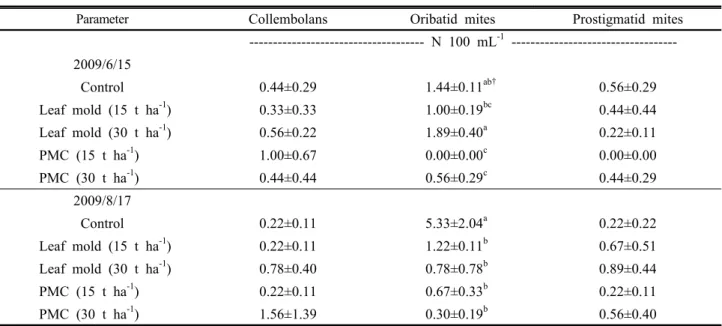
선충의 개체밀도는 대조구와 비교하여 부엽토 시용구 에서 차이가 없었지만 돈분퇴비 시용구에서는 시용량에, 비례하여 증가하였으며 이러한 경향은 월과 월에 비, 6 8 슷하게 나타났다 (Fig. 2). 톡토기류는 처리간 유의적 차이가 없었다 날개응애류는 소형절지동물 중에서 개체. 밀도가 가장 높았으며 돈분퇴비 시용구에서 감소하는, 경향이 나타났고 전기문응애류의 개체밀도는 처리간 차, 이가 없었다 (Table 3). 토양생물의 군집 구조 및 개체
Table 2. Chemical characteristics of soils affected by application of leaf mold and pig manure compost (PMC).
Parameter pH EC OM Av. P2O5 K Ca Mg Na
1:5 dS m-1 % mg kg-1 --- cmolc kg-1 ---
Control 5.6 0.16 0.20 73 0.11 2.76 1.01 0.10
Leaf mold (15 t ha-1) 5.7 0.22 0.53 74 0.12 3.09 1.09 0.10
Leaf mold (30 t ha-1) 5.6 0.31 0.85 118 0.16 2.87 1.27 0.10
PMC (15 t ha-1) 6.9 0.48 0.78 254 0.19 3.71 1.31 0.18
PMC (30 t ha-1) 7.1 1.14 1.72 511 0.60 4.45 1.56 0.29
LSD0.05 0.87 0.33 0.90 135.2 0.29 0.88 0.40 0.07
a
Microbial group
Fungi Bacteria Actinomycetes VAM
Relative abundance as a percentage of total PLFA (n mol%)
0 10 20 30 40
Control Leaf mold (15 t ha-1) Leaf mold (30 t ha-1) PMC (15 t ha-1) PMC (30 t ha-1)
a a a a
a a aaa
a a
a a
bababa a A
a
Microbial index G-/G+ bacteria
Aerobes/anaerobes Saturated/mono-unsaturated fatty acid
Cyclo-fatty acid/precursor Fungi/bacteria
Ratio index
0.0 0.5 1.0 1.5 2.0 2.5 3.0 3.5
Control Leaf mold (15 t ha-1) Leaf mold (30 t ha-1) PMC (15 t ha-1) PMC (30 t ha-1)
a a a a
a
aa a
b b c
ab ab b
c b a
c c a a a aa B
Fig. 1. The microbial community (A), and the main ratio
indexes (B) based on the analysis of phosphor-
lipid fatty acids extracted in Korean ginseng field
amended with leaf mold and pig manure com-
post (PMC). Data with the same letter indicates
no significant difference, and data with different
letter indicates significant difference at 0.05 level
according to Duncan test. Error bars indicate
standard deviation.
크기는 시비에 영향을 받는다 (Verschoor et al., 2001:
고 보고된 바 있다 유기물 시 Opperman et al., 1993) .
용은 일반적으로 선충의 밀도를 높이지만 (Verhoeven, 효과가 없거나 오히려 감소시키기도 한다 2001),
돈분퇴비 시용구에서 선충의 (Bulluck et al., 2002).
총개체밀도가 증가한 것은 먹이가 되는 미생물의 생체 량이 증가했기 때문인 것으로 추측된다 유기물 시용에. 의하여 소형절지동물의 밀도도 높아졌다는 보고도 있으 나 (Mueller et al., 1993), 날개응애류의 개체밀도는 돈분퇴비 시용구에서 낮아지는 경향이 나타났다 토양의.
와
pH EC는 소형절지동물의 밀도에 영향을 줄 수 있으
므로 (Lindberg and Persson, 2004), 돈분퇴비 시용 구의 pH와 EC가 증가에 따른 토양의 이화학성 변화에 의한 영향으로 추측된다.
본 연구에서 미소동물의 개체밀도는 매우 낮은 수준 으로 나타났다 선충의 개체밀도는 약. (2 10× 4 - 5 10× 5 N m-2)로 조사되어 온대지방에서 보고된 수치, (1 10× 5 - 1 10× 7 N m-2)와 비교하였을 때 매우 낮았다 (Petersen and Luxton, 1982: Robertson and Freckman,
소형절지동물의 밀도는 약
1995). 1000-2500 N m-2로 일반적으로 농업생태계에서 보고된 수치 (1 10× 3 - 1 10× 5 N m-2)와 비교할 때 매우 낮은 수준이었다 (Coleman 본 포장은 새롭게 성토하여 조성하는 et al., 2004).
과정에서 유기물함량이 0.2% 정도로 유기질이 적은 토 양을 사용하였기 때문에 초기의 미소동물 밀도가 매우 낮았다고 추측된다 인삼재배지 선정에 있어서 연작피해. 를 피하기 위해 초작지나 개간지를 이용하는 경우가 많 은데 새로 성토하여 재배지를 조성할 경우 유기물을 효, 율적으로 분해하기 위해서는 장기간의 예정지 관리를 통하여 토양미생물 및 미소동물의 밀도를 증가시키는 과정이 필요할 것으로 사료된다.
요 약
본 연구는 인삼재배지 포장에서 부엽토와 돈분퇴비 시용이 토양생물에 미치는 영향을 조사하고자 토양미생, 물 선충 응애 등 미소동물의 군집과 개체밀도의 변화, , 를 관찰하였다 토양 미생물 군락 조성과 생태를 조사하.
Jun 15 Aug 17
Nema to des ( N g
-1)
0 2 4 6
8 Control
Leaf mold (15 t ha-1) Leaf mold (30 t ha-1) PMC (15 t ha-1) PMC (30 t ha-1) a
b
a
b b b
b
b b b
Time
Fig. 2. Population density of total nematodes affected by application of leaf mold, and pig manure compost (PMC). Data with the same letter indicates no significant difference according to Duncan test.
Error bar indicates the standard error of the mean.
Table 3. Population density of microarthropods affected by application of leaf mold, and pig manure compost (PMC).
Parameter Collembolans Oribatid mites Prostigmatid mites
--- N 100 mL-1 --- 2009/6/15
Control 0.44±0.29 1.44±0.11ab† 0.56±0.29
Leaf mold (15 t ha-1) 0.33±0.33 1.00±0.19bc 0.44±0.44 Leaf mold (30 t ha-1) 0.56±0.22 1.89±0.40a 0.22±0.11 PMC (15 t ha-1) 1.00±0.67 0.00±0.00c 0.00±0.00 PMC (30 t ha-1) 0.44±0.44 0.56±0.29c 0.44±0.29
2009/8/17
Control 0.22±0.11 5.33±2.04a 0.22±0.22
Leaf mold (15 t ha-1) 0.22±0.11 1.22±0.11b 0.67±0.51 Leaf mold (30 t ha-1) 0.78±0.40 0.78±0.78b 0.89±0.44 PMC (15 t ha-1) 0.22±0.11 0.67±0.33b 0.22±0.11 PMC (30 t ha-1) 1.56±1.39 0.30±0.19b 0.56±0.40
†Means of samples followed by the same letter within a column are not significantly different (P < 0.05, n = 3). Treatment means and standard error are presented.
기 위하여 인지질지방산을 추출하여 지표지방산으로 분 석한 결과 세균 곰팡이 방선균의 상대밀도는 차이가, , 없었다 부엽토 처리구에서 환경스트레스 지표인 포화지. 방산 단불포화지방산 비율과/ Cyclopropyl 지방산 전구/ 체 지방산 비율이 높게 나타났으며 호기성 혐기성균 비, / 율이 낮았던 것은 유기물의 분해속도가 느리다는 것을 시사한다. 돈분퇴비 처리구에서 내생균근균인 VAM의 상대밀도 증가는 pH 증가의 영향으로 보이지만 유기물, 증가에도 불구하고 그램음성균 그램양성균 비율과 스트/ 레스 지표가 대조구와 차이가 없었던 것은 EC나 pH 증 가 등으로 인한 토양의 이화학성 변화에 의한 결과로 보인다 돈분퇴비 시용구에서 선충의 개체밀도는 증가하. 였지만, 날개응애류의 개체밀도는 감소하였다. 부엽토 또는 돈분퇴비의 시용에도 불구하고 토양동물의 개체밀 도는 일반 농경지와 비교할 때 매우 낮은 수준으로 나 타났으며 개간지의 경우 장기간의 예정지 관리를 통해, 토양생물의 밀도를 높여 유기물의 분해효율을 증가시키 는 과정이 필요할 것으로 판단된다.
인 용 문 헌
Bulluck, L.R., K.R. Barker, and J.B. Ristaino. 2002.
Influences of organic and synthetic soil fertility amendments on nematode trophic groups and community dynamics under tomatoes. Appl. Soil Ecol. 21:233-250.
Bunemann, E.K., G.D. Schwenke, and L. Van Zwieten.
2006. Impact of agricultural inputs on soil organisms-a review. Aust. J. Soil Res. 44:379-406.
Cobo, J.G., E. barrios, D.C.L. Kass, and R.J. Thomas.
2002. Decomposition and nutrient release by green manures in a tropical hillside agroecosystem. Plant Soil 240:331-342.
Coleman, D.C., D.A. Crossley, and P.F. Hendrix. 2004.
Fundamentals of soil ecology, 2nd ed. Elsevier Academic Press, New York, USA, p.98-101.
Filser, J. 2002. The role of collembolan in carbon and nitrogen cycling in soil. Pedobiologia 46:234-245.
Heneghan, L., D.C. Coleman, X. Zou, D.A. Crossley, and B.L. Haines. 1999. Soil microarthropod contributions to decomposition dynamics: Tropical-temperature compa- risons of a single substrate. Ecology 80:1873-1882.
Kramer, C., and G. Gleixner. 2008. Soil organic matter in soil depth profiles: Distinct carbon preferences of micro- bial groups during carbon transformation. Soil Biol.
Biochem. 40:425-433.
Lee, G.S., S.S. Lee, and J.D. Chung. 2003. Effect of several kinds of composts on root yield of ginseng see- dlings. J. Ginseng Res. 27:32-36.
Lee, I.H., C.S. Park, Y.H. Yu, and C.S Yuk. 1985. Studies
on soil management in ginseng preplanting soil (I) Changes of soil characteristics between pre-and post- management in the preplanting soil. Korean J. Ginseng Sci. 9:15-23.
Li, W.H., C.B. Zhang, H.B. Jiang, G.R. Xin, and Z.Y.
Yang. 2006. Changes in soil microbial community associated with invasion of the exotic weed, Mikania micrantha HBK. Plant Soil 281:309-324.
Lindberg, N. and T.Persson. 2004. Effects of long-term nutrient fertilisation and irrigation on the microarthropod community in a boreal Norway spruce stand. Forest Ecol. Manag. 188:125-135.
Mueller, B.R., M. Roth, and P. Rittner. 1993. Influence of compost and lime on population structure and element concentrations of forest soil invertebrates. Boil. Fert.
Soils 15:165-173.
Nam, Y.K., J.I. Lee, and K.H. Han. 2002. Production of organic compost to exclusive use in a Ginseng. J.
KOWREC. 10:139-147.
National Institute of Agricultural Science and Technology (NIAST). 1988. Methods of soil and crop plant analysis.
National Institute of Agricultural Science and Techno- logy. Suwon, Korea.
Nilsson, L.O., E. Baath, U. Falkengren-Grerup, and H.
Wallander. 2007. Growth of ectomycorrhizal mycelia and composition of soil microbial communities in oak forest soils along a nitrogen deposition gradient.
Oecologia 153:375-384.
Opperman, M.H., M. Wood, P.J. Harris, and C.P. Cherrett.
1993. Nematode andnitrate dynamics in soils treated with cattle slurry. Soil Biol. Biochem. 25:19-24.
Park, H., S.K. Mok, and K.S. Kim. 1982. Relationship between soil moisture, organic matter and plant growth in ginseng plantations. J. Korean Soc. Soil Sci. Fert.
15:156-161.
Peacock, A.D., M.D. Mullen, D.B. Ringelberg, D.D. Tyler, D.B. Hedrick, P.M, Gale, and D.C. White. 2001. Soil microbial community responses to dairy manure or ammonium nitrate applications. Soil Biol. Biochem.
33:1011-1019.
Petersen, H., and M. Luxton. 1982. A comparative analysis of soil fauna populations and their role in decomposition processes. Oikos 39:287-388.
Robertson, G.P., and D.W. Freckman. 1995. The spatial distribution of nematode trophic groups across a cultivated ecosystem. Ecology76:1425-1432.
Siepel, H., and F. Maaskamp. 1994. Mites of different feeding guilds affect decomposition of organic matter.
Soil Biol. Biochem. 26:1389-1394.
Verhoeven, R. 2001. Response of soil microfauna to organic fertilisationin sandy virgin soils of coastal dunes.
Biol. Fertil. Soils 34:390-396.
Verschoor, B.C., R.G.M. De Goede, F.W. De Vries, and L. Brussaard. 2001. Changes in the composition of the plant-feeding nematode community in grasslands after cessation of fertiliser application. Appl. Soil Ecol.
17:1-17.
Wong, J.W.C., K.M. Lai, M. Fang, and K.K. Ma. 1998.
Effect of sewage sludge amendment on soil microbial activity and nutrient mineralization. Environ. Int. 24:
935-943.