• 검색 결과가 없습니다.

Perception and use of gait measures among physical therapists in South Korea

N/A
N/A
Protected

Academic year: 2021

Share "Perception and use of gait measures among physical therapists in South Korea"

Copied!
6
0
0

로드 중.... (전체 텍스트 보기)

전체 글

(1)

http://crossmark.crossref.org/dialog/?doi=10.14474/ptrs.2017.6.2.90&domain=pdf&date_stamp=2017-6-25

Received: 27 April, 2017 Revised: 6 June, 2017 Accepted: 7 June, 2017 Corresponding author: Suk Min Lee

Department of Physical Therapy, College of Health Science and Social Welfare, Sahmyook University, 815 Hwarang-ro, Nowon-gu, Seoul 01795, Republic of Korea Tel: 82-2-3399-1632 Fax: 82-2-3399-1639 E-mail: [email protected]

This is an Open-Access article distributed under the terms of the Creative Commons Attribution Non-Commercial License (http://creativecommons.org/licens es/by-nc/4.0) which permits unrestricted non-commercial use, distribution, and reproduction in any medium, provided the original work is properly cited.

Copyright © 2017 Korean Academy of Physical Therapy Rehabilitation Science

https://doi.org/10.14474/ptrs.2017.6.2.90 pISSN 2287-7576

eISSN 2287-7584

Phys Ther Rehabil Sci 2017, 6 (2), 90-95 www.jptrs.org

Perception and use of gait measures among physical therapists in South Korea

Ho Young Jang a , You Lim Kim b , Sung-jin Kim b , Tak Yong Yoon b , Kyung Hun Kim c , Ick Keun Ahn b , Suk Min Lee b

a

Department of Physical Therapy, St. Paul's Hospital, The Catholic University of Korea, Seoul, Republic of Korea

b

Department of Physical Therapy, College of Health Science and Social Welfare, Sahmyook University, Seoul, Republic of Korea

c

Department of Physical Therapy, Gimcheon University, Gimcheon, Republic of Korea

Objective: The purpose of this study was to investigate the physical therapists’ perception of the use of gait measures, the fre- quency of the gait measures used, and also to identify the barriers that limit the use of these assessment tools.

Design: Cross-sectional study.

Methods: Physical therapists from the Seoul, Gyeonggi area from March to July 2016 were included in the study. Over the course of 18 weeks, a cross-sectional study was conducted with a self-report questionnaire. A total of 700 questionnaires were distributed and 350 questionnaires (50%) were collected, however with the exclusion of 140 questionnaires due to non-consent, a total of 210 questionnaires (30%) were analysed.

Results: Out of the 10 standardized assessment tools, the therapists showed the highest perception for the timed up and go test (TUG [n=153, 72.9%]) and they also had high perception for the 10 meters walk test (10MWT [n=149, 71.0%]), and 6-minute walk test (6MWT [n=123, 58.6%]). The respondents answered that the TUG (n=116, 55.2%), 10MWT (n=100, 47.6%), and 6MWT (n=51, 24.3%) was used the most often. On the contrary, only four (1.9%) therapists have used the Chedoke-McMaster stroke assessment and the Rivermead Mobility Index. The lack of time was considered as the most important barrier to the use of assessment tools in clinical practice.

Conclusions: Through this study, it has been shown that the domestic physical therapists used the TUG and the 10MWT mainly due to high recognition and evaluation status; however, the lack of time was the greatest impediment to the clinical application of the gait assessment tools.

Key Words: Gait, Measurement tools, Physical therapists

Introduction

Walking, which is defined as an activity that moves the limbs repeatedly to progress the body forward while main- taining postural stability, is considered as the most basic type of physical activity ability used in everyday life and social participation [1]. Musculoskeletal injuries or impairments of the nervous systems, such as stroke, traumatic brain in- jury, spinal cord injury, cerebral palsy, or Parkinson’s dis- ease may all cause gait pathologies, which may lead to diffi- culties in daily life practice and social participation, result-

ing in poor quality of life [2].

Physical therapy is a method to improve physical mobility due to pathology through the use of several intervention methods, such as neurophysiological approaches (Bobath), biofeedback, electrical stimulation, physical fitness train- ing, high-intensity therapy, repetitive task-specific training, gait training using visual cues, treadmill training plus body weight support and robotic-assisted body weight supported treadmill training [3-6].

For treatment to be effective, an accurate gait assessment

of the patient should be prioritized. The assessment identi-

(2)

Table 1. Verification of reliabilty

Field Content Item no. No. of

question Reliability Individual assessment tool frequency of its use Use of the 10 gait assessment tools II. 1-10 10 0.811 Perception of individual assessment tools Perception of the 10 gait assessment tools III. 1-10 10 0.901 fies the cause of the gait impairment, assists to establish a

treatment plan, and is used as an outcome measure. It pro- vides information needed to educate patients and their care- givers, thereby gaining credibility. It is also a resource for sharing information among rehabilitation specialists and is an important part of evidence-based practice [7-9]. The standardized gait assessment tools currently being used in- clude functional performance tests such as the 10 meters walk test (10MWT), 6-minute walk test (6MWT), timed up and go test (TUG), or motor assessment scale (MAS) such as the walking item, dynamic gait index (DGI), rivermead mo- bility index (RMI), functional ambulation classification (FAC), functional independent measure (FIM), Chedoke- McMaster stroke assessment, as well as other tools that are ordinal scale-based or instrumented measurement tools that produce kinetic and kinematic data [10-12].

Several evaluation tools such as these are currently being utilized for research or clinical evaluation purposes [13], and although having an accurate understanding and in- formation about the assessment tools may serve as a stable basis for therapeutic interventions, most studies focus on what interventions are effective for patients, research on the proper understanding and use of such tools are insufficient [14].

Van Peppen et al. [15] has reported that lack of time and burden of cost in the clinical setting is an impediment to the use of assessment tools. Other studies have reported that a lack of knowledge about the assessment tools is a major im- pediment to their use [16]. In addition, the floor and ceiling effects of the assessment tools are difficult to assess for a va- riety of patients, and evaluating with use of equipment also has limitations in terms of space, securing professional man- power, and equipment being expensive [12,17]. Due to these barriers, it is not easy for therapists to perform a clinical as- sessment of the patients’ functional level [18]. However, there is no research on the domestic physical therapists’ per- ception of the various gait assessment tools, the frequency of the tools being used, and the barriers in the use of these tools tools that may be imposed onto the therapists.

Therefore, the purpose of this study was to investigate the

perception of gait assessment tools by physical therapists, the frequency of its use, and to investigate the barriers that may affect the evaluation process. In this way, physical therapists will provide the basic data for applying effective assessment tools for gait evaluation.

Methods

Subject and procedure

Physical therapists from general hospitals, hospice, pub- lic health centers, and physical therapy seminars from the Seoul, Gyeonggi area who understood and agreed to the study procedures were included in the study.

After receiving permission to use the survey used from a study by Salbach et al. [16], the Korean translation process was commenced in December of 2015, and after the survey was examined by 11 physical therapists within the same year, the questionnaire was revise. In January 2016, the study was approved by the ethics committee of Sahmyook University (IRB No. SYUIRB2015-098). The purpose of this study was to investigate the physical therapists’ percep- tion of the gait assessment tools from the Seoul and Gyeonggi area from March 20, 2016 to July 22, 2016 through a cross-sectional study with use of a self-filling questionnaire consisting of 35 items. The distribution of the questionnaires were either performed at a physical therapy seminar, or after receiving an informed consent by phone, the questionnaires were sent and retrieved by mail, or they were personally distributed and retrieved through personal visits to the hospital where the therapists were located. From a total of 700 questionnaires that had been distributed, 350 questionnaires (50%) were retrieved, however, with the ex- clusion of 140 questionnaires (20%), the remaining 210 questionnaires (30%) were used for analysis.

Survey instrument

The questionnaire consisted of eight items that asked

about general characteristics, such as gender, age, level of

education, clinical experience, treatment field, number of

daily patient treatments, name of institution, and institution

(3)

Table 3. Perception of individual gait assessment tools (N=210)

Gait assessment tool High Medium Low Total

10 meters walk test 149 (71.0) 50 (23.8) 11 (5.2) 210 (100)

6-minute walk test 123 (58.6) 70 (33.3) 17 (8.1) 210 (100)

TUG 153 (72.9) 48 (22.9) 9 (4.3) 210 (100)

DGI 86 (41.0) 94 (44.8) 30 (14.3) 210 (100)

RMI 58 (27.6) 115 (54.8) 37 (17.6) 210 (100)

FAC 87 (41.4) 97 (46.2) 26 (12.4) 210 (100)

MAS 98 (46.7) 88 (41.9) 24 (11.4) 210 (100)

FIM 88 (41.9) 101 (48.1) 21 (10.0) 210 (100)

Chedoke-McMaster stroke assessment 56 (26.7) 116 (55.2) 38 (18.1) 210 (100)

Instrumented measurement tools 115 (54.8) 76 (36.2) 19 (9.0) 210 (100)

Total 101 (48.0) 86 (41.0) 23 (11.0) 210 (100)

Values are presented as number (%).

The sum of the percentages does not equal 100% because of rounding.

TUG: timed up and go test, DGI: dynamic gait index, RMI: rivermead mobility index, FAC: functional ambulation classification, MAS: motor assessment scale, FIM: functional independent measure.

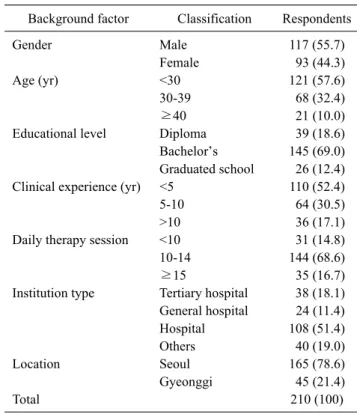
Table 2. General characteristics of subjects (N=210) Background factor Classification Respondents

Gender Male 117 (55.7)

Female 93 (44.3)

Age (yr) <30 121 (57.6)

30-39 68 (32.4)

≥40 21 (10.0)

Educational level Diploma 39 (18.6)

Bachelor's 145 (69.0)

Graduated school 26 (12.4) Clinical experience (yr) <5 110 (52.4)

5-10 64 (30.5)

>10 36 (17.1)

Daily therapy session <10 31 (14.8)

10-14 144 (68.6)

≥15 35 (16.7)

Institution type Tertiary hospital 38 (18.1) General hospital 24 (11.4)

Hospital 108 (51.4)

Others 40 (19.0)

Location Seoul 165 (78.6)

Gyeonggi 45 (21.4)

Total 210 (100)

Values are presented as number (%).

The sum of the percentages does not equal 100% because of rounding.

location (Supplementary material). The standardized gait assessment tools that were in question for their recognition amongst the therapists were the 10MWT [19], 6MWT [19], TUG [20], DGI [21], RMI [22], FAC [23], MAS [19], FIM [19], Chedoke-McMaster stroke assessment [19], in- strumented measurement tools [12]. The questionnaire con- sisted of a total of 35 items, which included 10 items on per- ception of the measures, 10 items on the frequency of the as- sessment tools used, three items asking about the compre- hensive perception of the assessment tool, four items asking about the barriers imposed in using the gait assessment tool.

The 5-point Likert scale was used to answer the questionnaire.

In order to test the internal consistency of the ques- tionnaire items, the reliability coefficient Cronbach α was calculated as shown in Table 1.

Data analysis

All data was analyzed with use of IBM SPSS Statistics ver. 21.0 (IBM Co., Armonk, NY, USA). A frequency analy- sis was performed to normalize the general characteristics of subjects’ perception and frequency of use of the gait assess- ment tools, and the obstacle factors imposed on gait assessment.

Results

The general characteristics of the respondents are shown in Table 2. In the evaluation of the perception of the in- dividual gait assessment tools, the TUG was found to be the

most useful (n=153, 72.9%), and the therapists showed high perception and understanding of the 10MWT (n=149, 71.0%) and the 6MWT (n=123, 58.6%).

On the contrary, only 56 therapists were aware of the

Chedoke-McMaster stroke assessment (n=56, 26.7%; Table

3).

(4)

Table 4. Comprehensive perception of gait measurement (N=210)

Comprehensive perception of gait measurement High Medium Low Total

Do you think standardized gait measures quantify for the severity of a gait disorder? 89 (42.4) 102 (48.6) 19 (9.0) 210 (100) Are standardized gait measures suitable for assessing walking ability of mild,

moderate, or severe patients?

72 (34.3) 114 (54.3) 24 (11.4) 210 (100)

Are the clinical practice guidelines suggesting for special assessment tools for evaluating or monitoring walking ability?

40 (19.0) 122 (58.1) 48 (22.9) 210 (100)

Total 67 (31.9) 113 (53.8) 30 (14.3) 210 (100)

Values are presented as number (%).

Table 5. Use of individual gait assessment tools (N=210)

Gait measure High Medium Low Total

10 meters walk test 100 (47.6) 44 (21.0) 66 (31.4) 210 (100)

6-minute walk test 51 (24.3) 34 (16.2) 125 (59.5) 210 (100)

TUG 116 (55.2) 34 (16.2) 60 (28.6) 210 (100)

DGI 22 (10.5) 25 (11.9) 163 (77.6) 210 (100)

RMI 4 (1.9) 12 (5.7) 194 (92.4) 210 (100)

FAC 44 (21.0) 15 (7.1) 151 (71.9) 210 (100)

MAS 50 (23.8) 29 (13.8) 131 (62.4) 210 (100)

FIM 25 (11.9) 26 (12.4) 159 (75.7) 210 (100)

Chedoke-McMaster stroke assessment 4 (1.9) 11 (5.2) 195 (92.9) 210 (100)

Instrumented measurement tools 20 (9.5) 22 (10.5) 168 (80.0) 210 (100)

Total 44 (21.0) 25 (11.9) 141 (67.1) 210 (100)

Values are presented as number (%).

The sum of the percentages does not equal 100% because of rounding.

TUG: timed up and go test, DGI: dynamic gait index, RMI: rivermead mobility index, FAC: functional ambulation classification, MAS: motor assessment scale, FIM: functional independent measure.

In regards to comprehensive perception of the assessment tools, 89 therapists (42.4%) answered that the gait assess- ment tools were useful when asked the question, “Do you think standardized gait measures quantify for the severity of a gait disorder?” For the question, “Are standardized gait measures suitable for assessing walking ability of mild, moderate, or severe patients?”, 72 therapists (34.3%) con- sidered the gait assessment tools to be fit and suitable. For the final question that asked “Are the clinical practice guide- lines suggesting for special assessment tools for evaluating or monitoring walking ability?” 40 therapists (19.0%) an- swered ‘highly agree’ or ‘agree’ while 48 therapists (22.9%) answered ‘highly disagree’ or ‘disagree’ (Table 4).

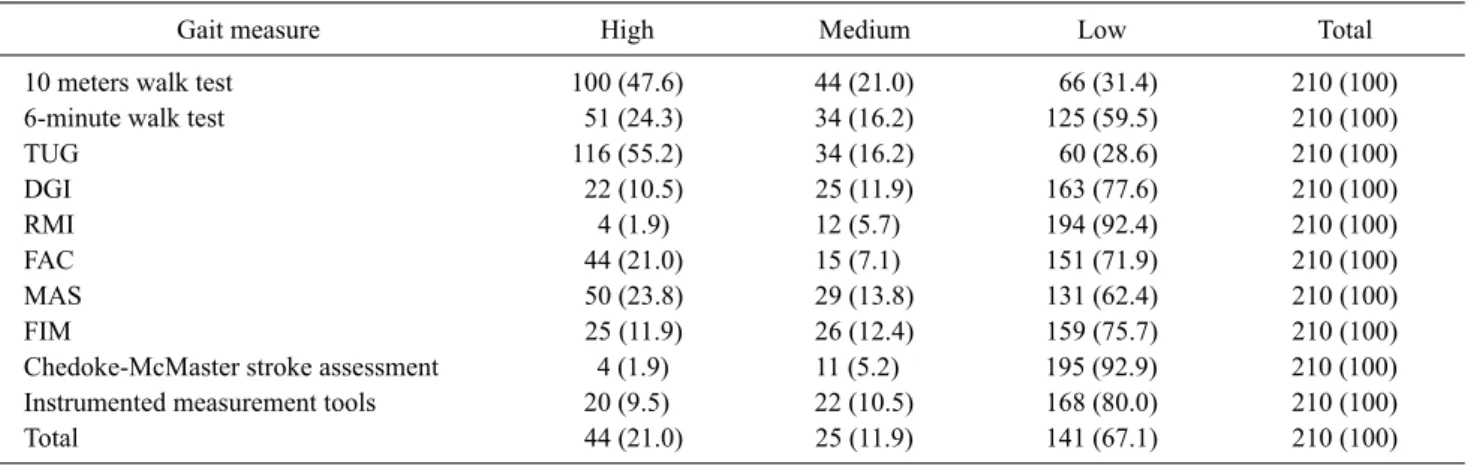
The respondents answered that they had always or fre- quently used the TUG (n=116, 55.2%), 10MWT (n=100, 47.6%) and 6MWT (n=51, 24.3%). In contrast, only 4 (1.9%) respondents stated that they used the Chedoke- McMaster stroke assessment and RMI (Table 5). From the questions asking about the barriers imposed on the use of gait assessment tools within the clinic, lack of time was

shown to be the greatest obstacle.

Discussion

Gait pathologies have a negative impact on the perform- ance of daily life activities and social participation, which lowers quality of life [2]. Physical therapy can play a major role in addressing gait pathologies [3-6] and therefore, per- formance of an accurate gait assessment is a priority in de- veloping effective gait interventions [7]. Therefore, the pur- pose of this study was to investigate the physical therapists’

perception and frequency of the gait measures used, the bar-

riers imposed on the use of the gait measures, and to provide

basic data for effective application of the measures. In re-

gards to perception of the gait assessment tools, the thera-

pists were the most aware of the functional performance

tests for gait, such as the TUG, 10MWT, and 6MWT. In con-

trast, there was a variety of perception rates for the assess-

ment tools based on an ordinal scale, such as the DGI (n=86,

41.0%), RMI (n=58, 27.6%), FAC (n=87, 41.4%), MAS

(5)

(n=98, 46.7%), FIM (n=88, 41.9%), Chedoke-McMaster stroke assessment (n=56, 26.7%) as presented in Table 3.

Therefore, the Chedoke-McMaster stroke assessment and RMI had a low perception rate (recognition) compared to the DGI, FAC, MAS, FIM.

Although the comprehensive perception of the assess- ment tools showed that the existing tools used for gait as- sessment was useful for treating patients, the assessment tools showed a lower perception of the patient’s degree of in- jury or evaluating all other aspects of gait (Table 4). This may be due to the evaluation category of a single assessment tool is limited. To improve this, it is necessary to use a wide range of evaluation tools. Similar to how the Postural Assessment Scale for Stroke and Activities-specific Balance Confidence is used to address the limitations of the Berg Balance Scale, the use of several assessment tools is more effective rather than use of a single assessment tool [17,24].

Subsequently, 40 respondents (19.0%) answered ‘highly agree’ or ‘agree’ and 48 respondents (22.9%) answered

‘highly disagree’ or ‘disagree’ to the question, “Are the clin- ical practice guidelines suggesting for special assessment tools for evaluating or monitoring walking ability?” Therefore, although there is a need for clinical practice guidelines to suggest for assessment tools to evaluate gait ability or to monitor gait, they are currently still lacking [14,16].

Rather than the use of ordinal scale-based assessment tools, functional performance tests, such as the TUG, 10MWT, and 6MWT are the most frequently used appa- rently due to its simplicity and time limitation imposed with- in the clinic (Table 5).

In addition, although the gait assessment tools are consid- ered useful, the evaluation status is low, which is affected by the clinical environment (Tables 3, 5). A previous study has shown that the Chedoke-McMaster stroke assessment (61.1%) is the most commonly used assessment tool [16], however, this study only showed a rate of 1.9%. It appears that different curricula and health care systems across the countries have an effect on the use of the assessment tools [8,25]. Lack of time was considered to serve as the largest obstacle in the use of gait assessment tools. Of the general characteristics of this study, 144 therapists (68.6%) had 10-14 daily therapy sessions, 35 therapists (16.7%) had 15 daily or more daily therapy sessions, and 179 therapists (85.2%) had over 10 daily therapy sessions while a Canadian study reported that 291 therapists (78.9%) had over 10 daily therapy sessions, which demonstrates how busy the domes- tic clinical environment is [26]. A busy, domestic clinical en-

vironment may have influenced the selection of gait assess- ment tools and could be an important indicator of the differ- ent clinical circumstances across the countries

This study has shown that the therapists were the most highly aware of the functional performance tests, such as the TUG, 10MWT, and 6MWT and that the lack of time posed as the greatest obstacle in use of gait assessment tools. This result may be used as a basis for effective gait assessment tool application.

This study has some limitations. It is difficult to general- ize the results of this study through only analysing the re- sponses from 210 physical therapists in the Seoul and Gyeonggi area. Out of the numerous gait assessment tools available, this study only selected 10 gait assessment tools for analysis purposes. It is difficult to exclude subjectivity and bias of the individual since this research was conducted through self-filling questionnaires. In addition, it is difficult to obtain statistical results by simple analysis of frequency.

Further studies should consider factors that may affect the therapists’ decision making in gait measures and eliminate the barriers in the use of those measures. In addition, there is a need for comparison of the use of gait measures from other countries as well as a guideline for the use of an appropriate measure within the clinic.

Conflict of Interest

The authors declared no potential conflicts of interest with respect to the authorship and/or publication of this article.

Supplementary Materials

Supplementary data can be found with this article online at https://doi.org/10.14474/ptrs.2017.6.2.90.

References

1. Perry J. Gait analysis: normal and pathological function.

Thorofare, NJ: Slack; 1992.

2. Mayo NE, Wood-Dauphinee S, Côté R, Durcan L, Carlton J.

Activity, participation, and quality of life 6 months poststroke.

Arch Phys Med Rehabil 2002;83:1035-42.

3. Langhorne P, Coupar F, Pollock A. Motor recovery after stroke:

a systematic review. Lancet Neurol 2009;8:741-54.

4. Sidaway B, Anderson J, Danielson G, Martin L, Smith G. Effects of long-term gait training using visual cues in an individual with Parkinson disease. Phys Ther 2006;86:186-94.

5. Behrman AL, Lawless-Dixon AR, Davis SB, Bowden MG, Nair

(6)

P, Phadke C, et al. Locomotor training progression and outcomes after incomplete spinal cord injury. Phys Ther 2005;85:1356-71.

6. Hornby TG, Zemon DH, Campbell D. Robotic-assisted, body- weight-supported treadmill training in individuals following motor incomplete spinal cord injury. Phys Ther 2005;85:52-66.

7. Best R, Begg R. Overview of movement analysis and gait features. In: Begg R, Palaniswami M, editors. Computational in- telligence for movement science: neural networks and support vector machines, and other emerging technologies. Hershey, PA:

Idea Group Inc.; 2006. p. 1-69.

8. Pattison KM, Brooks D, Cameron JI, Salbach NM. Factors influ- encing physical therapists' use of standardized measures of walk- ing capacity poststroke across the care continuum. Phys Ther 2015;95:1507-17.

9. American Physical Therapy Association. Guide to physical therapist practice. 2nd ed. Alexandria, VA: American Physical Therapy Association; 2001. p. 9-746.

10. Tyson S, DeSouza L. A systematic review of methods to measure balance and walking post-stroke. Part 1: ordinal scales. Phys Ther Rev 2002;7:173-86.

11. Tyson S, DeSouza L. The measurement of balance and walking post-stroke. Part 2: functional performance tests. Phys Ther Rev 2002;7:187-91.

12. Kim BO. Methods in clinical gait analysis. J Korean Acad Rehabil Med 1994;18:191-202.

13. Berg KO, Maki BE, Williams JI, Holliday PJ, Wood-Dauphinee SL. Clinical and laboratory measures of postural balance in an elderly population. Arch Phys Med Rehabil 1992;73:1073-80.

14. Kang TW, Oh DW. Literature review of walking performance tests for people with post-stroke hemiparesis. Korean J Neural Rehabil 2013;3:28-43.

15. Van Peppen RP, Maissan FJ, Van Genderen FR, Van Dolder R, Van Meeteren NL. Outcome measures in physiotherapy manage- ment of patients with stroke: a survey into self-reported use, and barriers to and facilitators for use. Physiother Res Int 2008;13:

255-70.

16. Salbach NM, Guilcher SJ, Jaglal SB. Physical therapists' percep- tions and use of standardized assessments of walking ability post-stroke. J Rehabil Med 2011;43:543-9.

17. Sibley KM, Salbach NM. Applying knowledge translation theo- ry to physical therapy research and practice in balance and gait assessment: case report. Phys Ther 2015;95:579-87.

18. Grimmer K, Bialocerkowski A, Kumar S, Milanese S. Imple- menting evidence in clinical practice: the ‘therapies’ dilemma.

Physiotherapy 2004;90:189-94.

19. Finch E, Brooks D, Stratford PW, Mayo NE; Canadian Physio- therapy Association. Physical rehabilitation outcome measures:

a guide to enhanced clinical decision making. 2nd ed. Baltimore:

Lippincott, Williams & Wilkins; 2002.

20. Podsiadlo D, Richardson S. The timed “Up & Go”: a test of basic functional mobility for frail elderly persons. J Am Geriatr Soc 1991;39:142-8.

21. Shumway-Cook A, Woollacott MH. Motor control: theory and practical applications. Baltimore: Williams & Wilkins; 1995.

22. Collen FM, Wade DT, Robb GF, Bradshaw CM. The rivermead mobility index: a further development of the rivermead motor assessment. Int Disabil Stud 1991;13:50-4.

23. Holden MK, Gill KM, Magliozzi MR. Gait assessment for neu- rologically impaired patients. Standards for outcome assess- ment. Phys Ther 1986;66:1530-9.

24. Blum L, Korner-Bitensky N. Usefulness of the Berg balance scale in stroke rehabilitation: a systematic review. Phys Ther 2008;88:559-66.

25. Kim K, Park ES, Cho YH, Cho JS, Yu JE, Park RJ, et al. A study on the development of standard curriculum for physical therapy in Korea. J Korean Soc Phys Ther 2006;18:23-32.

26. Sibley KM, Straus SE, Inness EL, Salbach NM, Jaglal SB.

Clinical balance assessment: perceptions of commonly-used

standardized measures and current practices among physi-

otherapists in Ontario, Canada. Implement Sci 2013;8:33.

수치

Table 1. Verification of reliabilty
Table 3. Perception of individual gait assessment tools (N=210)
Table 5. Use of individual gait assessment tools  (N=210)

참조

관련 문서

Head-up tilt test is an effective diagnostic test in noncardiac syncope and EEG is a valuable test in neuropychiatric syncope, especially in seizure.. Key words

The self-esteem scale used comprehended Coopersmith's (1967) Self-Esteem Test and Lee Yeong-seon's (1997) Measures for Adaptation to School Life, composed of

The study derived the problems according to results of field-centered synthetic analysis on yellow croakers of fishery system currently used in Chujado, Korea

The Mann-whitney U test was used to compare and analyze the salivary cortisol concentration according to the duration of symptoms in the temporomandibular disorder patient group

The purpose of this study is to use Lucia jig, leaf gauge, and cotton roll among the anterior deprogramming devices being used to induce the centric

The results of the repeated measures ANOVA of health-related physical fitness suggested that the main effect based on test time had a significant difference

In addition, Korea enacted International Development Cooperation Act(enforcing in July 2010)as basic law of ODA and is seeking for various measures for the performance

In conclusion, the result that the walk-using safety educational activities designed for young children had effects on their safety problem solving ability