틸라피아의 혈액성상에 미치는 온도와 비소의 복합적 영향
정지원ㆍ김용석ㆍ강주찬†1) 부경대학교 수산생명의학과
Combined effects of temperature and arsenic on hematological parameters of tilapia Oreochromis niloticus
Ji Won Jeong, Young Sug Kim and Ju-Chan Kang†
Department of Aquatic Life Medicine, Pukyong National University, Busan 608-737, Korea
Experiments were carried out to determine the hematological changes in freshwater tilapia Oreochromis niloticus, after water temperature (20, 25 and 30℃) and arsenic concentrations (200, and 400 ppb) exposure 20 days. The RBC count and hematocrit (Ht) were significantly increased in As 400 ppb and water temperature 30℃. Hemoglobin (Hb) was significantly increased under combined As (200 and 400 ppb) and water temperature 30℃. The tilapia exposed to water temperature 30℃ and As concentration 400 ppb increase significantly in calcium concentration. The high concentrations of total protein and glucose concentrations were observed at water temperature 30℃ and As concentration 400 ppb. A significant increment GOT and GPT activities in the tilapia serum noticed at water temperature (25 and 30℃) and As concentration (200, 400 ppb). These results indicate that tilapia can be affected by high water temperature (30℃) and As concentration (400 ppb) in terms of inorganic matter, organic matter and enzyme activity in serum.
Key words :Oreochromis niloticus, Temperature, Arsenic, Hematological changes
비소 화합물은 산소(O), 염소(CI) 및 황(S)과 결합한 무기 비소 화합물과 탄소(C)와 수소(H)와 결합한 유기 비소 화합물로 나뉘며 비소에 대한 위해성은 이온의 상태나 화합물의 형태에 따라 다른 것으로 알려져 있다 (Reimer et al., 2002). 비소는 일반적으로 수서 환경 내에서는 무기 비소의 형태로 존재하며, 3가 비소는 체내에서 redox와 methylation 반응으로 5가 비소로 산 화되고 5가 비소 중 일부분은 다시 3가 비소로 환원된 다 (Eisler , 1988; Phillips, 1994). 일반적으로 무기비소
†Corresponding author: Ju Chan Kang
Tel : +82-51-629-5944 Fax : +82-51-629-5938 Email : [email protected]
의 경우 삼산화비소(AsⅢ)는 수생생물에 유해하며 (Hall and Burton, 1982), 오산화비소(As Ⅴ)보다 독성이 강하며 (Akter et al., 2005), 일반적으로 유기 비소가 무기 비소보다 독성이 낮다 (Kobayashi et al., 2005).
비소는 살충제, 목재 보존제 및 농작물에 필요한 보충 제뿐만 아니라 유리와 전자 기기의 제조에도 사용되어 져 왔고 (Eisler, 1988), 광산, 제련, 금속 제조와 화석 연료 등으로 사용되어지고 있어 국내를 비롯하여 많은 국가의 오염원이 되고 있다 (Ayotte et al., 2003; Karagas et al., 2002; Mukgerjee et al., 2006). 비소는 수중 생활을 하는 어류에 있어서는 호흡 및 먹이섭취와 관련하여 육상동물보다 취약하며 (Heather, 2005), 수서 환경의
비소농도가 증감됨에 따라 개체수가 감소한다 (Larsen and Francesconi, 2003: Liao et al., 2003; Reimer et al., 2002). 특히 비소는 어류의 간에서 산화 스트레스를 유발하며 (Bhattacharya and Bhattacharya, 2007), 혈액학 적 변동을 유발하기도 한다 (Tripathi et al., 2003).
한편 외인성 물질에 대한 혈액학적 성상은 어체의 생리적인 변화에 대한 간접적인 지표로 사용되어 왔 으며 (Smet and Blust, 2001), 어류 생체내의 대사작용 과 연관하여 stress 요인에 대한 기본적인 자료로 이용 될 수 있다 (Waring et al., 1992). 따라서 본 연구는 어류의 온도변화에 따른 생리적 변동에 미치는 비소 의 영향을 파악하기 위하여 틸라피아를 대상으로 이 들의 혈액학적 변동을 검토하였다.
재료 및 방법
실험어
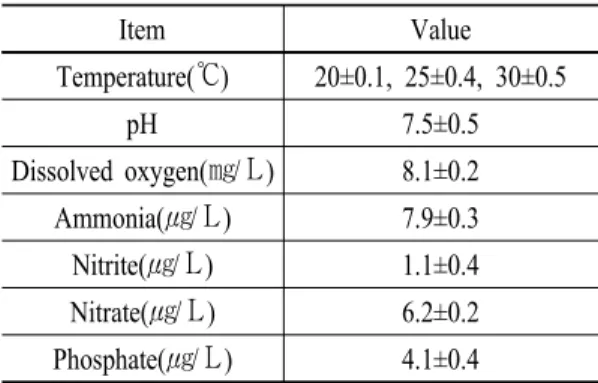
틸라피아 (Oreochromis niloticus)는 부경대학교 양 어장에서 분양받아 실험실에서 4주간 순치시킨 후, 외관상 질병증세가 없는 유사한 크기의 개체 (전장 14.98±1.7 8cm, 체중 56.35±8.77 g)를 선별하여 실험 에 사용하였다. 이때 수온, pH 및 용존산소는 각각 19.2∼20.4℃, 6.8∼7.2 및 6.9∼7.1 ㎎/L이었으며, 기 타 사육수의 수질은 Table 1과 같다.
Item Value
Temperature(℃) 20±0.1, 25±0.4, 30±0.5
pH 7.5±0.5
Dissolved oxygen(㎎/ℓ) 8.1±0.2 Ammonia(㎍/ℓ) 7.9±0.3 Nitrite(㎍/ℓ) 1.1±0.4 Nitrate(㎍/ℓ) 6.2±0.2 Phosphate(㎍/ℓ) 4.1±0.4
Table 1. The chemical components of freshwater quality used in the experiments
실험과정
모든 실험은 항온실에서 유리수조(500×280×310 ㎜) 를 사용하여 매일 새로운 용액으로 교환하는 환수식 방법에 의해 실시하였다. 온도는 Electronic thermostat (MS701-H, Mink, korea)를 이용하여 20℃, 25℃와 3 0℃로 유지시켰다. 비소(As)농도는 sodium arsenite를 1000 mg/L의 표준용액을 만들어 급성독성실험을 바 탕으로 200 ppb 및 400 ppb로 설정하였다. 실험은 각각의 실험구간에 따라 틸라피아를 10미씩 수용하 여 20일 동안 2회 반복을 실시하였다.
혈액채취
실험어는 Ethyl p-aminobensoate (Sigma chemical, St.
Louis, MO)으로 마취시킨 뒤, heparine-Na (5,000 I.U., Choongwae pharm. co.)을 처리한 주사기를 사용하여 미부 정맥에서 채혈하였다. 채혈한 혈액을 사용하여 적혈구 수 (Red Blood Cell count), hemoglobin (Hb) 및 hematocrit (Ht) 를 측정하였다. 적혈구 수는 Hendrick’s diluting solution으 로 혈액을 1:200으로 희석한 후, hemo-cytometer (Improved Neubauer, Germany)를 이용하여 광학 현미경하에서 계수 하였다. 혈중 Hb농도는 시판되고 있는 임상용 kit (Sigma Co., USA)를 이용하여 cyan-methemoglobin법으로 측정하 였으며, Ht은 hematocrit 모세관으로 혈액을 채혈한 후, microgematocrit centrifuge (HAWKSLEY AND SONS Ltd., England)에서 12,000 rpm으로 5분간 원심 분리하고, 판독 판 (Micro-Haematocrit reader, HAWKSLEY AND SONS, England)으로 측정하였다.
혈청지수 분석
채취한 혈액은 4℃, 6000 rpm으로 5분간 원심분리 하여 (MICRO 22R, Hettich, Germany) 혈청을 분리하 였다. 혈청의 무기성분인 칼슘(calcium)은 arsenaso Ⅲ 법, 마그네슘(magnesium)은 xylidyl blue-Ⅰ법을 사용
하였다 (Asan Pharm Co., Ltd). 혈청의 유기성분 변화 를 관찰하기 위하여 총단백질 (total protein)과 글루코스 (glucose)의 변동을 조사하였으며 각각 biuret법 및 GOD/POD법을 사용하는 임상용 키트 (Asan Pharm. Co., Ltd)를 사용하여 측정하였다. 혈청 중 효소 활성의 변화 를 보기 위하여 GOT (glutamic oxalate transaminase), GPT (glutamic pyruvate transaminase)를 측정하였다.
GOT와 GPT는 Reitman-Frankel법으로 측정하였다.
통계 분석
대조구와 각 실험구 사이의 통계학적 유의성은 SPSS 통계프로그램 (SPSS Inc.)을 이용하여 ANOVA test를 실시한 후 P 값이 0.05 미만일 때 유의성이 있는 것으로 간주하였다.
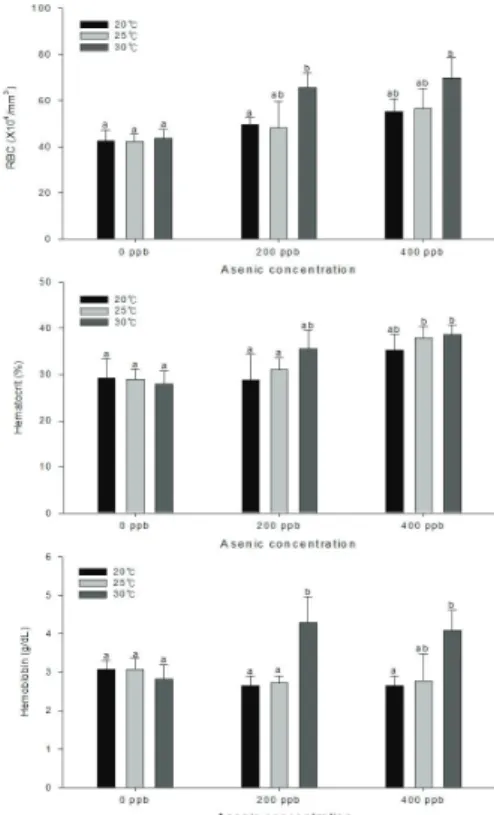
Fig. 1. Changes of RBC count, hematocrit (Ht) and hemoglobin concentration in tilapia exposed to water temperature and As concentration during 20 days
결 과
혈액성상
온도변화에 따른 비소에 노출된 틸라피아의 혈액성 상의 변화를 Fig. 1에 나타냈다. 틸라피아의 적혈구 수는 온도 30℃의 200 ppb 이상에서 유의하게 증가하였 고, Ht는 온도 25℃ 및 30℃의 400 ppb에서 유의한 증가 를 나타냈다 (P<0.05). 또한 Hb 농도는 온도 30℃의 200 ppb 이상에서 유의한 증가가 관찰되었다 (P<0.05).
무기성분
온도변화에 따른 비소에 노출된 틸라피아의 혈청 무기성분의 변화를 Fig. 2에 나타냈다. 비소에 노출시 킨 틸라피아의 혈청 무기성분인 Ca농도는 수온 30℃
의 400 ppb에서 유의하게 증가하였으며 (P<0.05), Mg 농도는 대조구를 비롯한 모든 실험구에서 변동을 나 타내지 않았다.
Fig. 2. Changes of calcium and magnesium concentrations in tilapia exposed to water temperature and As concentration during 20 days
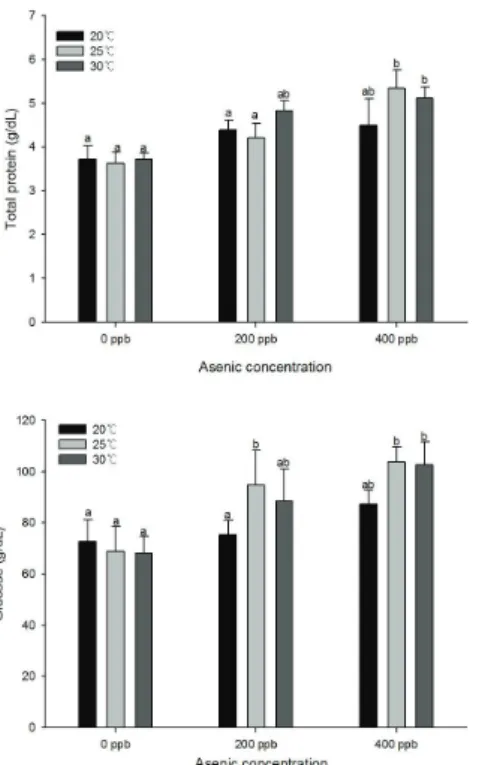
Fig. 3. Changes of total protein and glucose concentrations in tilapia exposed to water temperature and As concentration during 20 days
유기성분
온도변화에 따른 비소에 노출된 틸라피아의 혈청 유기성분의 변화를 Fig. 3에 나타냈다. 틸라피아의 혈청 총 단백질농도는 온도 25 및 30℃의 비소농도 400 ppb에서 유의하게 증가하였고, glucose농도는 온 도 25℃의 200 ppb 비소농도, 온도 25 및 30℃의 400 ppb 비소농도에서 유의하게 증가하였다 (P<0.05).
효소활성
온도변화에 따른 비소에 노출된 틸라피아의 혈청 효소활성의 변화를 Fig. 4에 나타냈다. 틸라피아의 혈청 GOT 활성은 온도 25 및 30℃의 200 ppb 이상의 비소농도, GPT 활성은 온도 20, 25 및 30℃의 200 ppb 이상의 비소농도에서 유의한 증가를 나타냈다 (P<0.05).
Fig. 4. Changes of GOT and GPT activities in tilapia exposed to water temperature and As concentration during 20 days
고 찰
일반적으로 오염물질에 대한 어류의 스트레스인 요인은 혈장기질의 변화 및 적혈구 등의 변화로 감지 할 수 있다. 어류의 혈청 유기ㆍ무기효소의 활성은 스트레스지표로 사용할 수 있으며, 다양한 환경요인 에 의해 영향을 받는다 (Min and Kang, 2008). 비소는 어류의 혈액학적 지표를 변화시킬 수 있으며, 어체의 발달에 영향을 미치기도 한다 (Ishaque et al., 2004).
또한 어류의 혈액학적 지표는 독성 물질에 대한 생리 학적 변화 및 어류의 구조 및 기능적인 상태를 파악하 기 위하여 사용되고 있으며 (Suvetha et al., 2010), 적혈구 수, Hb, Ht등이 다소 증가하는 경향이 관찰된 다 (Mattsson et al., 2001). 적혈구 수는 영양소, 산소, 노폐물과 carbonic acid gas를 수송하고 배출하며 이
는 빈혈과 혈액 생성기능을 판단하는데 좋은 지표이다. 본 연구에서 온도변화에 따른 비소에 노출된 틸라 피아의 적혈구 수는 온도 30℃의 200 ppb 이상에서 유의하게 증가하였고, Ht는 온도 25℃ 및 30℃의 400 ppb에서 유의하게 증가하였으며, Hb 농도는 온도 3 0℃의 200 ppb 이상에서 유의한 증가를 나타냈다.
Ht는 유기물질에 노출될 경우에 감소하는 경향이 있 으나 중금속 노출에서는 증가하는 경향이 있다 (Wilson and Taylor, 1993). 또한 중금속 노출된 어류의 적혈구수, Ht값 및 Hb농도는 일반적으로 증가하는 경향을 나타내어 본 연구의 틸라피아에서도 유사한 결과를 보였다 (Larsson et al., 1980; Drastichova et al., 2004; Smet and Blust, 2001; Oliverira et al., 2006;
Federici et al., 2007). 이와 같은 이유는 비소가 아가미 를 손상시켜 어류의 호흡 능력에 영향을 미친 것으로 생각되며, 어류의 아가미손상은 아가미 기능을 저해 시키고 이로 인하여 가스교환에 영향을 받아 혈액 내 산소 결핍을 유도하며, 이에 대한 적혈구 세포에서 의 보상반응으로 부족한 산소를 전달하기 위해 혈액 내 산소전달 능력을 증가시킨 결과로 사료된다. 또한 비소는 적혈구 팽창의 증가에 영향을 끼치며 (Nemcsok and Boros., 1982), 이러한 원인도 Ht의 증가 에 영향을 끼친 것으로 생각된다. 또한 Hb의 증가는 비소에 의한 독성영향으로 변성된 Hb의 갱신과 조직 에 산소를 공급하기 위하여 증가된 것으로 보인다. 비소에 노출시킨 틸라피아의 혈청 무기성분인 Ca 은 수온 30℃의 400 ppb에서 유의하게 증가하였으며, Mg은 모든 실험구에서 변동을 나타내지 않았다. 이 는 비소가 틸라피아의 혈청 내 삼투압 및 Ca 이온조 절에 영향을 미칠 수 있다는 것을 의미한다. 틸라피아 의 혈청 총 단백질농도는 온도 25 및 30℃의 비소농도 400 ppb에서 유의하게 증가하였다. 혈중 단백질의 총량은 어류의 건강상태를 나타내는 지표로서 정상
치보다 낮거나 높은 경우에는 단백의 합성, 분해, 흡 수에 이상이 있을 수 있다. 일반적으로 독성물질에 노출된 어류의 단백질농도는 증가하며 (Figueiredo et al., 2006), 이는 어류가 스트레스 상황을 극복하기 위한 하나의 생리적 적응기구라고 추측하고 있다 (Li et al., 2010). 또한 틸라피아의 glucose농도는 온도 25℃의 200 ppb 비소농도, 온도 25 및 30℃의 400 ppb 비소농도에서 유의하게 증가하였다. 일반적으로 어류의 혈청 glucose농도의 증가는 스트레스의 반응 으로 인한 증상일 수 있으며, 순환하는 glucose농도의 증가는 스트레스로 인한 카테콜라민이나 코르티스 테로이드농도의 증가와 연관이 있다 (Min and Kang, 2008). 또한, 스트레스를 극복하기 위하여 에너지 대 사와 이동이 발생하며 에너지 대사에 필요한 glucose 농도가 증가한다 (Wendelaar bonga, 1997).
GOT와 GPT는 일반적으로 간세포독성의 지표로 사용되어졌으며, 이러한 효소의 증가는 간 손상이나 상처의 결과로 볼 수 있다 (Yang et al., 2003). 본 연구에서 틸라피아의 혈청 GOT는 온도 25 및 30℃의 200 ppb이상의 비소농도, GPT는 온도 20, 25 및 30℃
의 200 ppb 이상의 비소농도에서 유의한 증가를 나타 냈다. 일반적으로 어류가 독성물질에 노출될 경우에 는 GPT에 비해 GOT가 더 많이 증가하지만 만성 간세 포 손상의 경우에는 GPT가 높은 경우도 있다. GOT와 GPT의 증가는 일반적으로 스트레스로 인한 반응으 로 볼 수 있으며 (Roy and Phattacharya, 2006), 비소노 출에 의한 간세포의 사멸을 유도하는 간의 생리병리 학적인 상황을 반영한다 (Limuro et al., 1998). 본 실험 의 틸라피아의 GOT 및 GOT활성의 증가는 비소에 의한 간세포의 손상으로 인한 혈액 내 증가의 결과로 생각된다 (Lavanya et al., 2011).
이상의 결과 및 논의에서 틸라피아의 혈액성상, 혈청의 무기, 유기농도 및 효소활성은 비소농도 200
ppb 이상에서 부분적으로 영향을 받고 있으며, 이 영향은 온도가 높을수록 영향이 클 것으로 생각된다.
요 약
본 연구는 어류의 온도변화 (20, 25 및 30℃)에 따른 생리적 변동에 미치는 비소 (200 및 400 ppb)의 영향을 파악하기 위하여 틸라피아, Oreochromis niloticus를 대상으로 이들의 혈액학적 변동을 검토하였다.
틸라피아의 적혈구 수는 온도 30℃의 200 ppb 이상, Ht는 온도 25℃ 및 30℃의 400 ppb, Hb 농도는 온도 30℃의 200 ppb 이상에서 유의한 증를 나타냈다. 혈청 무기성분인 Ca농도는 수온 30℃의 400 ppb에서 유의 하게 증가하였으나, Mg농도는 변동을 나타내지 않았 다. 혈청 총 단백질농도는 온도 25 및 30℃의 비소농도 400 ppb, glucose농도는 온도 25℃의 200 ppb 비소농도, 온도 25 및 30℃의 400 ppb 비소농도에서 유의하게 증가하였다. 혈청 GOT활성은 온도 25 및 30℃의 200 ppb 이상의 비소농도, GPT활성은 온도 20, 25 및 30℃
의 200 ppb 이상의 비소농도에서 유의한 증가를 나타 냈다. 이상의 결과 및 논의에서 틸라피아의 혈액성상, 혈청의 무기, 유기농도 및 효소활성은 비소농도 200 ppb 이상에서 부분적으로 영향을 받고 있으며, 이 영 향은 온도가 높을수록 영향이 클 것으로 생각된다.
참고문헌
Akter, K.F., Owens, G., Davey, D.E. and Naidu, R.: Arsenic speciation and toxicity in biological systems. Rev.
Environ. Contam. Toxicol., 184:97-149, 2005.
Ayotte, J.D., Montgomery, D.L., Flanagan, S.M. and Robinson, K.W.: Arsenic in groundwater in eastern New England:accurrence, controls, and human
health implications. Environ. Sci. Technol., 37:2075-2083, 2003.
Bhattacharya, A. and Battacharya, S.: Induction of oxidative stress by As in Clarias batrachus: involvement of peroxisomes. Ecotoxicol. Evioron. Saf., 66:178-187, 2007.
Drastichova, J., Svobodova, Z., Luskova, V. and Machova, J.: Effects of Cadmium on Hematological Indices of Common Carp(Cyprinus carpio L.). Eviron.
Com. Toxicol., 72:725-732, 2004.
Eisler, R.: Arsenic hazards to fish, wild life and invertrates:
a synoptic review. U.S. Fish. Wildl. Serv. Biol., 85:1-12, 1988.
Federici, G., Benjamin, J.S. and Richard, D.H.: Toxicity of titinium dioxide nanoparticles to rainbow trout(Oncorhynchus mykiss):gill injury, oxidative stress, and other physiological effects. Aqua.
Toxicol., 84:415-430, 2007.
Figueiredo, A., Fontainhas-F, A., Peixoto, F., Rocha, E.
and Reis-H, M.A.: Effects of gender and temperature on oxidative stress enzymes in Nile tilapia Oreochromis niloticus exposed to paraquat.
Biochem. Physiol., 85:97-103, 2006.
Hall, L.W Jr. and Burton D.T.: Effect of power plant coal pile and coal waste runoff and leachate on aquatic biota: an overview with research recommendations.
Critic Reviews in Toxicol., 10:287-302, 1982.
Heather, B., Jeff, G.R. and Patricia, M.S.: Arsenic exposure alters hepatic arsenic species composition and stress-mediated gene expression in the common killifish(Fundulus heteroclitus). Aquat. Toxicol., 77:257-266, 2005.
Ishaque, A.B., Tchounwou, P.B., Wilson, B.A. and
Washington, T.: Developmental arrest in Japanese medaka(Oryzias latipes) embryos exposed to sublethal concentrations of atrazine and arsenic trioxide. J. Environ. Biol., 25:1-6, 2004.
Karagas, M.R., Stukel, T.A. and Tosteson, T.D.: Assessment of cancer risk and environmental levels of arsenic in New Hampshire. Environ. Health., 205: 85-94, 2002.
Kobayashi, Y., Cui, X. and Hirono. S.: Stability of As metabolites As triglutathione (As(GS)3) and methyl As diglutathione (CH2As(GS)2), in rat bile.
Toxicol., 211:115-123, 2005.
Larsen, E.H. and Fransesconi, K.A.: Arsenic concentrations correlate with salinity for fish taken from the North Sea and Baltic Waters. J. Mar. Biol., 83:283-284, 2003.
Larsson, A., Lehtinen, K.J. and Haux, C.: Biochemical and hematological effects of a titanium dioxide industrial effluent on fish. Bull. Environ. Contam.
Toxicol., 25:427-435, 1980.
Lavanya, S., Ramesh, M., Kavitha, C. and Malarvvizhi, A.: Hematological, biochemical and ionoregulatory responses of Indian major carp Catla catla during chronic sublethal exposure to inorganic arsenic.
Chem., 82:977-985, 2011.
Liao, C.N., Chen, B.C., Singh, S., Lin, M.C., Liu, C.W.
and Han, B.C.: Acute toxicity and bioaccumulation of arsenic in tilapia(Oreochrmis mossambicus) fron an blackfoot disease area in Taiwan. Environ.
Toxicol., 18:252-259, 2003.
Limuro, Y., Nishiura, T., Hellerbrand, C., Behrns, K.E., Schoonhoven, R., Grisham, J.W. and Brenner, D.A.:
NFκB prevents apoptosis and liver dysfunction
during liver regeneration. J. Clin. Invest., 101:
802-811, 1998.
Li, Z.H., Josef, V., Vladimir, Z., Roman, G., Jana, M., Jitka, K. and Tomas, R.: Hepatic antioxidant status and hematological parameters in raibow trout, Oncorhynchus mykiss, after chronic exposure to carbamazepine. Chem. Biol. Int., 183:98-104, 2010.
Mattsson, K., Lehtinen, K. J. and Tana, J.: Effect of pulpmill effuents and restricted diet on growth and phygiology of rainbow trout(Oncorhynchus mykiss). Exotoxicol. Environ. Saf., 49:144-154, 2001.
Min, E.Y. and Kang, J.C.: Effect of waterborne benomyl on the hematological and antioxidant parameters of the Nile tilapia, Oreochromis niloticus. Pest.
Biochem. Physiol., 92:138-143, 2008.
Mukgerjee, A., Sengupta, M.K., Hossain, M.A., Ahamed, S., Das, B., Nayak, B., Lodh, D., Rahman, M.M.
and Chakraborti, D.: Arsenic contamination in groundwater:a global perspective with emphasis on the Asian scenario. Health. Popul. Nutr., 24:142-163, 2006.
Nemcsok, J. and Boross, L.: Comparative studies on the sensitivity of different fish species to metal pollution. Acta Biol. Hung., 33:23-27, 1982.
Oliverira, C.A., Neto, R., Mela, M., Silva, P.H., Randi, M.A.F., Rabitto, I.S., Alves, S.R.M. and Pelletier, E.: Hematological findings in neotropical fish Hoplias malabaricus exposed to subchronic and dietary doses of methylmercury, inorganic lead, and tributyltin chloride. Environ. Research., 101:74-80, 2006.
Phillips D.J.H.: The chemical forms of arsenic in aquatic
organisms and their interrelationships. Arsenic in the Environment. PartⅠ. Cycling and Characteristics., 263-288, 1994.
Roy, S. and Bhattacharya, S.: Arsenic-induced histopathology and synthesis of stress proteins in liver and kidney of Channa punctatus. Ecotoxicol. Environ. Saf., 65:218-229, 2006.
Smet, S. M. and Blust, R.: Stress Responses and Changes in Protein Metabolism in Carp Cyprinus carpio during Cadmium Exposure. Ecotoxicol. Environ.
Saf., 48:255-262, 2001.
Suvetha, L., Ramesh, M. and Saravanan, M.: Influence of cypermethrin toxicity on ionic regulation and gill Na+/K+-ATPase activity of a freshwater teleost fish Cyprinus Carpio. Environ. Toxicol.
Pharmacol., 29:44-49, 2010.
Tripathi, S., Sahu, D.B., Kumar, R. and Kuma, A.: Effect of acute exposure of sodium arsenite (Na2AsO3) on some hematological parameters of Clarias
batrachus (common Indian catfish) in vivo.
Environ. Health., 45:183-188, 2003.
Waring, C.P., Stagg, R.M. and Poxton, M.G.: The effects of handling on flounder(Platichthys flesus L.) and atlantic salmon(Salmo salar L.). J. Fish. Biol., 41:131-144, 1992.
Wendelaar bonga, S.E.: The stress response in fish. Physiol., 77:591-625, 1997.
Wilson, R.W. and Taylor, E.W.: The physiological responses of freshwater rainbow trout, Oncorhinchus mykiss, during acutely lethal copper exposure. J. Comp.
Physiol.B, 163:38-47, 1993.
Yang, J.L. and Chen, H.C.: Serum metabolic enzyme activities and hepatocyte ultrastructure of common carp after gallium exposure. Zool. Stud., 42:455-461, 2003.
Manuscript Received : August 8, 2011 Revised : March 5, 2012 Accepted : March 10, 2012