Isolation and Characterization of Phosphate Solubilizing Bacteria Pantoea Species as a Plant Growth Promoting Rhizobacteria
Chang Yeon Yun and Yong Hwa Cheong*
Department of Bio-Environmental Science, Sunchon National University, Suncheon 57922, Korea Received July 21, 2016 /Revised August 16, 2016 /Accepted August 18, 2016
Plant growth-promoting rhizobacteria (PGPR) have gained worldwide importance and acceptance due to their agricultural benefits. These microorganisms are potential tools for sustainable agriculture, with effects on plant growth, biofertilization, induced systemic resistance, and biocontrol of plant pathogens.
In this study, four different Pantoea species were isolated from field soil, and their plant growth-pro- moting characteristics were studied. Based on 16S rDNA gene sequencing analyses, the se were group- ed into Pantoea ananatis, Pantoea citrea, Pantoea dispersa, Pantoea vagans and named as Pa1, Pc1, Pd1, Pv1, respectively. All of these strains have their ability for solubilization of insoluble phosphate de- pending on pH decrease at the range around pH 5 at 1days after inoculation and production of plant hormone indole acetic acid (IAA) with 85.3±16.3 μg/ml of Pa1, 183.9±16.8 μg/ml of Pc1, 28.8±17.3 μg/
ml of Pd1 and 114.1±16.5 μg/ml of Pv1, respectively. Pa1, Pc1 and Pd1 also have high activity for production of gibberellin (GA3) hormone with 331.1±19.2 μg/ml of Pa1, 288.5±16.8 μg/ml of Pc1, 309.2±
18.2 μg/ml of Pd1, but Pv1 does not. Furthermore, all these species have significantly promoted the growth of the lettuce seedling plants at the range around 32~37% for fresh weight and 10~15% for shoot length enhancement, so that these microbe could be used as a potential bio-fertilizer agents.
Key words : Biofertilizer agent, IAA and GA3 production, pantoea species, phosphate solubilizing bacteria (PSB), plant growth promoting rhizobacteria (PGPR)
*Corresponding author
*Tel : +82-61-750-3298, Fax : +82-61-751-8011
*E-mail : [email protected]
This is an Open-Access article distributed under the terms of the Creative Commons Attribution Non-Commercial License (http://creativecommons.org/licenses/by-nc/3.0) which permits unrestricted non-commercial use, distribution, and reproduction in any medium, provided the original work is properly cited.
Journal of Life Science 2016 Vol. 26. No. 10. 1163~1168 DOI : http://dx.doi.org/10.5352/JLS.2016.26.10.1163
서 론
일반적으로 토양에서 식물생장은 많은 비생물학적 및 생물 학적 요인들에 의해 영향을 받는다. 식물의 뿌리주변 영역인 근권의 환경조건이 식물생장에 중요한 역할을 하며, 특히 토 양미생물 활동의 영향을 받는 것으로 알려져 있다[2].
식물생장촉진미생물(plant growth-promoting rhizobateria:
PGPR)은 많은 종류의 식물 근권에 존재하면서 식물에 유익한 생장촉진효과를 나타낸다. 식물에 영향을 미치는 직·간접적 메커니즘으로는 인돌 아세트산(IAA) 혹은 지베렐린(GA) 식 물생장 호르몬 생성, 질소고정(nitrogen fixation), 무기 인산염 등의 영양소 가용화 및 식물병원성 균주에 대한 저항성 증진 등으로 알려지고 있다. 지금까지 많은 미생물들이 식물생장촉 진미생물로 알려지고 있으며 특히 Pseudomonas, Azospirillum, Burkholderia, Bacillus 및 Serratia 등의 다양한 미생물들이 식물 생장을 촉진시키는 것으로 잘 알려져 있다[1, 7, 9, 13, 19-20, 27, 34].
특히 인산(phosphorus: P)은 많은 종류의 식물 필수영양소 들 중에서 질소(nitrogen: N) 다음으로 중요한 식물의 핵심 영양요소이면서 식물의 광합성 작용, 에너지 전달, 신호 전달, 고분자 물질의 생합성, 호흡 및 콩과 식물에서의 질소 고정 작용 등을 포함하여 거의 모든 주요 대사 과정에서 중요한 역할을 담당하고 있다[16, 26]. 비록 인산은 토양에서 무기 또 는 유기형태로 풍부하게 존재하고 있지만 대부분 흡수할 수 없는 불용성 형태로 존재하기 때문에 식물생장의 주요 제한인 자로 작용하고 있다[23]. 이런 불용성 형태의 인산 화합물을 가용성형태로 전환시키는데 중요한 역할을 하는 것 중 하나가 인산 가용화 미생물(phosphate solubilizing bacteria: PSM)로 알려져 있다[15, 24-25]. 지금까지 많은 인산 가용화 미생물들 이 보고되고 있으며 이들 중 특히 Pseudomonas, Bacillus, Bur- kholderia, Pantoea 속등이 주요 미생물로 알려지고 있다[12, 25, 30]. 많은 인산 가용화 미생물들은 인산 가용화 활성뿐 만 아니 라, 인돌 아세트산 호르몬 생성 능력을 가지면서 식물 생장을 촉진시키는 효과를 나타내는 것으로 알려져 있다[19, 25, 30].
따라서 현재 식물 생장 촉진효과를 보이는 많은 미생물들의 중요성이 대두되고 있으며, 특히 농업적으로 유익한 미생물을 작물에 대한 생물비료 재료로 중요하게 사용할 수 있으므로, 인산 분해 미생물을 포함한 다양한 식물 생장 촉진 미생물들 의 분리 및 특성을 규명하는 연구들이 널리 수행 되고 있다[1, 34].
Pantoea 속 미생물들은 토양, 물 등 자연환경에 널리 분포하
인산 분해 활성 균주 분리 및 16S rDNA 동정
인산 분해 활성을 가진 미생물을 분리하고자 순천시 서면 지본리 소재 순천대학교 부속농장의 유기농 재배지 토양으로 부터 시료를 채취하여 0.5% 인산칼슘[Ca3(PO4)2]를 포함하는 Pikovskaya agar배지에 도말하여 인산 분해 활성을 보이는 균주를 분리하였다[22]. 분리된 미생물로부터 genomic DNA 를 분리하여 16S rDNA 영역을 27F primer (5’-AGAGTTTGA TCCCTGGCTCAG-3’) 과 1492R primer (5’-GGTTACCTTGT TACGACTT-3’)을 이용하여 연쇄 증폭 반응(polymerase chain reaction: PCR)을 이용하여 확보하였다. 확보된 16S rDNA 연 쇄 증폭 반응 산물을 Solgent 회사(Daejeon, Korea)에 염기서 열분석을 의뢰하여 염기서열을 확보한 다음, BLAST analysis 와 NCBI database(http://www.ncbi.nlm.nih.gov/BLAST)를 이용하여 유사염기서열을 분석하였다. Phylogenic tree는 CLUSTAL X 프로그램을 이용하여 neighbor-joining 방법과 MEGA4 프로그램을 활용하여 분석하였다[17, 28, 33].
인산분해 활성 및 pH 측정
미생물들의 인산 분해 활성을 정량적으로 측정하고자 0.5%
Ca3(PO4)2가 함유되어있는 Pikovskaya 용액배지에 균을 접종 한 다음, 30℃ 배양기에서 1일, 2일, 3일 및 5일간 배양한 후 원심 분리한 다음 미생물 배양 상등액을 확보하여 molybde- num-blue 방법[21]을 이용하여 인산 분해 활성을 조사하였고, 또한 pH 변화를 pH 미터기를 이용하여 정량적으로 분석하였 다.
인돌 아세트산 및 지베렐린 생성 활성 측정
인돌 아세트산 생성 활성은 Leveau 와 Lindow 방법[18]에 따라 측정하였다. 분리된 균주를 0.2% tryptophan을 함유하고 있는 King's medium에 24시간 배양한 다음, 배양액 상등액과 Salkowski's reagent를 1:2(v/v)의 비율로 혼합 한 다음, Gordon 과 Weber 방법[10]을 바탕으로 분홍색으로 발색되는 정도를 흡광 광도계 (UV-Visible Spectrophotometer, Shimad- zu)를 이용하여 530 nm에서 흡광도로 측정하였다.
6일간 생육시킨 상추가 존재하는 pot 당 균주 수를 108 pfu/ml 농도에 맞춰 각각 100 ml을 접종 한 다음, 2주 후에 생체량 및 상층부 생장길이를 측정하여 비교하였다. 모든 실험은 3반 복 이상 수행하여 평균값을 측정하였다.
통계분석
모든 실험 data는 SAS package [29]를 이용한 ANOVA (a- nalysis of variance)에 적용하여 분석하였다. 다양한 처리 방 법들 사이의 차이는 5%(p≤0.05) 확률 유의 수준에 해당하는 LSD (least significant differences test)를 사용하여 비교 하였 다[32]. 모든 처리는 3회 반복 하였다.
결과 및 고찰
인산 분해 미생물 Pantoea species 분리 및 16S rDNA 분자생물학적 동정
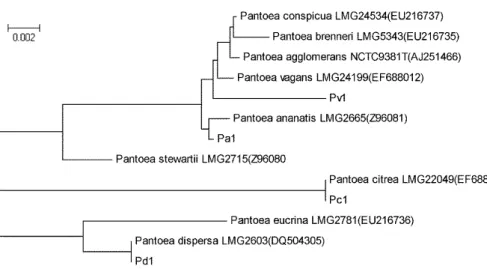
인산분해 능력을 가진 미생물을 분리하고자 순천시 서면 지본리 소재 순천대학교 부속농장의 유기농 재배지 토양으로 부터 채취한 시료를 0.5% Ca3(PO4)2가 함유되어있는 Pikovskaya agar 배지에 도말하여 3일 배양 후 투명환(clear zone)을 보이 는 약 50여종의 미생물을 확보하였다. 이들 분리된 미생물들을 16S rDNA 염기서열 분석방법으로 확인한 결과, Pseudomonas, Burkholderia, Bacillus, Pantoea속 미생물들로 확인되었다. 이들 중 서로 다른 네 종류의 Pantoea species를 각각 Pa1, Pc1, Pd1, Pv1으로 명명한 다음 무기 인산염 분해 활성등 식물생장 촉진 능력을 규명하고자 하였다. 16S rDNA 염기서열을 이용하여 BLAST search 와 phylogenic tree 분석방법에 의하여 미생물 을 분석한 결과, Pa1는 Pantoea ananatis LMG2665와 99% 유사 성, Pc1는 Pantoea citrea LMG22049와 99% 유사성, Pd1는 Pantoea dispersa LMG2603와 99% 유사성, Pv1는 Pantoea va- gans LMG241999와 95% 유사성을 각각 보였다(Fig. 1).
Pantoea속 미생물들은 다양한 자연환경에 존재하고 있으며 현재까지 20여종 이상이 확인되고 있다[35]. 이들 중 Pantoea agglomerans, Pantoea ananatis, Pantoea eucalypti, Pantoea crpri-
Fig. 1. Phylogenic tree between isolated Pa1, Pc1, Pd1 and Pv1 and other related Pantoea species based on 16S rRNA gene sequences.
The GenBank accession number is given for each organism and the scale bar indicates 0.002 substitutions per nucleotide position.
pedii등 일부 종들은 높은 인산분해활성을 가지고 있는 것으로 보고되고 있고 아울러 식물생장촉진 및 식물 병 저항성 증진 등의 유익한 기능을 보이는 것으로 연구 되고 있다[4-6, 8, 31].
따라서 본 연구에서 분리된 서로 다른 네 종류의 Pantoea 미생 물들의 식물 생장 촉진 활성에 대한 특성을 비교 분석하고자 하였다.
인산 분해 활성 비교 측정
분리 확보된 네 종류의 Pantoea species (Pa1, Pc1, Pd1, Pv1) 의 무기인산분해능력을 확인하고자 각각 미생물을 LB 용액배 지에서 overnight 배양한 후 108 pfu/ml 농도의 균주를 각각 50 μl와 500 μl를 Ca3(PO4)2가 함유되어있는 Pikovskaya agar 와 liquid 용액(10 ml)에 접종한 후 투명환 생성 활성과 흡광도 를 통한 정량적인 분석을 수행하였다(Fig. 2). 고체배지에서 모든 균주들은 매우 높은 무기 인산 분해 능력을 보이는 활성 을 보였다(Fig. 2A). 무기 인산 분해능력을 정량적으로 분석한 결과(Fig. 2B)에 의하면, 분리된 네 종류의 Pantoea 미생물은 모두 접종 후 1일차에 가장 높은 활성(113.2±6.8 mg/l for Pa1, 107.1±5.9 mg/l for Pc1, 90.4±6.2 mg/l for Pd1, 122.5±7.5 mg/l for Pv1)을 보인 후 점차적으로 감소하는 경향을 보였다.
같은 조건에서의 pH변화를 0일, 1일, 2일, 3일, 5일 배양된 상 등액을 측정한 결과(Fig. 2C)에 의하면, Pa1의 경우는 각각 6.2, 5.1, 5.9, 6.3, 6.6, Pc1의 경우는 각각 6.1, 5.0, 5.9, 6.1, 6.3, Pd1의 경우는 각각 6.2, 5.2, 5.6, 6.0, 6.6, Pv1의 경우는 각각 6.1, 4.9, 5.9, 6.1, 6.5값을 보였다. 따라서 미생물의 인산분해 활성은 pH 가 가장 낮은 1일차에 가장 높은 활성을 보이다가 pH가 점차 증가함에 따라 분해활성이 낮아지는 결과를 보이는 것으로 인산분해활성은 pH 감소와 상당한 연관성이 있는 것으로 나 타났다.
일반적으로 미생물에 의한 무기 인산 분해 활성은 미생물이
생성하는 글루코니산(gluconic acid) 등의 유기산에 의해 중요 하게 영향을 받는 것으로 알려져 있으며 많은 인산분해 미생 물의 경우 인산분해 활성은 pH감소와 상관성을 보여주었다 [4, 30-31]. 최근에는 발표된 인산 분해 미생물인 Pantoea cypri- pedii PS1의 경우에도 인산 분해 활성이 초기 2일차에 가장 높은 활성을 보이다가 점차적으로 감소하는 경향을 보였고 pH변화도 본 연구결과와 유사하게 인산 분해 활성이 높은 2일 차에 가장 낮은 수치를 보이다가 점차적으로 증가하는 결과를 보였다[31]. 따라서 본 연구에서 분리된 네 종류의 미생물들 역시 다양한 유기산 생성으로 pH를 감소시키면서 무기인산 분해활성을 보이는 것으로 생각된다.
식물호르몬 인돌 아세트산 및 지베렐린 생성 활성 지금까지 보고된 많은 인산 분해 미생물의 경우 다양한 기 작으로 식물생장을 촉진하는 것으로 알려져 있으며, 특히 식 물의 대표적인 생장 호르몬인 인돌 아세트산과 지베렐린 생성 으로 식물생장을 촉진하는 기작이 대표적으로 알려져 있다.
따라서 본 연구에서 분리된 인산 분해 미생물의 인돌 아세트 산과 지베렐린 생성 활성을 측정한 결과 대부분의 미생물의 경우 매우 높은 인돌 아세트산과 지베렐린 생성 활성을 보였 다(Fig. 3). 지베렐린 생성의 경우, Pa1, Pc1, Pd1의 경우 각각 331.1±19.2 μg/ml, 288.5±16.8 μg/ml, 309.2±18.2 μg/ml 농도 의 매우 높은 활성을 보인 반면 Pv1의 경우 10.2±11.5 μg/ml의 아주 낮은 활성을 보였다(Fig. 3A). 인돌 아세트산 호르몬 생성 활성은 네 종류의 미생물인 Pa1, Pc1, Pd1, Pv1 모두 높은 활성 을 보였고, 생성농도의 경우 각각 85.3±16.3 μg/ml, 183.9±16.8 μg/ml, 28.8±17.3 μg/ml, 114.1±16.5 μg/ml 수치를 보였다 (Fig. 3B).
옥신(auxin)은 대표적인 식물 생장 호르몬으로서 세포의 생 장과 분화, 곁눈 생장, 뿌리신장, 꽃과 열매의 발달 등의 기능
C
Fig. 2. Plate assay (A) and liquid assay (B) for phosphate solubi- lizing activity and pH change (C) of four Pantoea species (Pa1, Pc1, Pd1 and Pv1). The numbers above the bars mean the average number each condition, respectively, from 3 replicate experiments. Error bars mean the SD by LSD at p≤0.05, respectively.
Fig. 3. Production of plant hormone GA3 (A) and IAA (B) from four Pantoea species (Pa1, Pc1, Pd1 and Pv1). The num- bers below the bars mean the average number each con- dition, respectively, from 3 replicate experiments. Error bars mean the SD by LSD at p≤0.05, respectively.
을 수행하는데, 일부 세균들이 식물 근권에서 옥신을 생성 후 분비하고 이를 식물이 흡수하여 생장에 이용할 수 있다. 인돌 아세트산은 대표적인 옥신 계통의 호르몬으로 줄기 절편의 길이 생장을 촉진하고 줄기와 뿌리의 발달, 꽃과 과실의 발생, 그리고 굴성 운동 등을 유도한다. 다른 대표적인 식물호르몬 인 지베렐린(GA3)은 diterpenoid 복합체로서 식물의 생장과 종자의 발아, 줄기의 신장, 잎의 성장, 개화유도 및 휴면 타파 그리고 과육의 성숙을 조절한다고 알려져 있다. 특히 대부분 의 인산분해미생물과 식물생장촉진미생물은 일반적으로 인 돌 아세트산과 지베렐린 호르몬 생성하며 궁극적으로 식물생 장을 촉진하는 기능을 가지는 것으로 알려져 있다[1, 3, 14,
18-19, 31]. 따라서 본 연구에서 분리된 네 종류의 인산분해 미생물인 Pantoea species의 경우에도 인산 분해 능력뿐만 아 니라 인돌 아세트산과 지베렐린 같은 식물생장호르몬을 생성 함으로써 잠재적으로 식물생장촉진 활성을 가지는 것으로 생 각된다.
식물 생장 촉진 활성
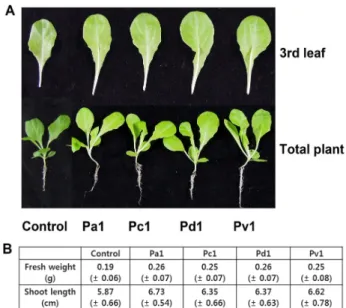
분리된 네 종류의 Pantoea 균주들이 인산분해활성, 식물호 르몬 인돌 아세트산과 지베렐린 생성능력을 가지고 있으므로, 다른 식물 생장 촉진 미생물들처럼 식물생장촉진 활성을 검정 하고자 어린 상추 식물을 대상으로 균주 접종 후 식물의 생장 특성을 조사하였다(Fig. 4). 처리된 네 종류의 미생물 모두 식 물의 생장을 촉진시키는 활성으로 보였으며 생체량(fresh weight)의 분석결과에 의하면 대조구의 경우 0.19±0.06 g/
plant를 보인 반면, 처리구의 경우 0.25~0.26±0.08 g/plant를 보였으며 대조구에 비해 상대적으로 32~37%의 증진효과를 보 였다. 상층부 길이생장(shoot length)의 경우에도 대조구에 비 해 10~15% 증가를 보였다.
많은 식물 생장 촉진 미생물은 인돌 아세트산 혹은 지베렐 린 등의 식물생장 호르몬 생성 및 무기 인산염등 영양소의 가용화 작용으로 식물생장을 촉진하는 것으로 알려져 있다.
Fig. 4. Effects of isolated Pantoes spp (Pa1, Pc1, Pd1 and Pv1) inoculation on growth of lettuce seedlings. Photographs (A) were taken at 2 weeks after inoculated. The numbers (B) mean the average number on fresh weight (g/plant) and shoot length (cm/plant) from 10 independent plants each condition, respectively. Mean values (mean +/- SD) sharing the same letter do not differ significantly by LSD at p≤0.05. All data was analyzed from 3 replicate experiments.
많은 미생물들 중에서 Pantoea속에 속하는 Pantoea agglomer- ans, Pantoea eucalypti, Pantoea cypripedii, Pantoea ananatis 등의 미생물들의 경우에도 다른 식물 생장 촉진 미생물처럼 인산 가용화 활성뿐 아니라, 인돌 아세트산 또는 지베렐린 호르몬 생성 능력을 가지고 있으며 아울려 식물생장을 촉진 시키는 효과를 가지고 있는 것으로 알려져 있다[4-6, 8, 31].
전 세계적으로 지속 가능한 친환경 농업의 관심증대로 인하 여 생물비료와 생물농약의 중요성이 대두되고 있으며 많은 연구자들에 의해 다양한 유용미생물들이 보고되고 있다. 따라 서 본 연구에서 분리된 네 종류의 Pantoea ananatis (Pa1), Pantoea citrea (Pc1), Pantoea dispersa (Pd1), Pantoea vagans (Pc1) 미생물들 역시 친환경 농업에 적용될 수 있는 인산 분해 활성, 식물 생장 호르몬 생성 활성등 다양한 생물비료특성 및 식물 생장 촉진 특성을 보이므로 이들 미생물을 미생물비료 재료로 경작지에 적용한다면 농가의 수익증대에 기여할 수 있을 것으 로 생각된다.
감사의 글
이 논문은 2014년도 순천대학교 학술기반조성비로 연구되 었습니다.
References
1. Bhattacharyya, P. N. and Jha, D. K. 2012. Plant growth-pro- moting rhizobacteria (PGPR): emergence in agriculture.
World J. Microbiol. Biotechnol. 28, 1327-1350.
2. Bloemberg, G. V. and Lugtenberg, B. 2001. Molecular basis of plant growth promotion and biocontrol by rhizobacteria.
Curr. Opin. Plant Biol. 4, 343-350.
3. Bottini, R., Cassan, F. and Piccoli, P. 2004. Gibberellin pro- duction by bacteria and its involvement in plnat growth promotion and yield increase. Appl. Microbiol. Biotechnol. 65, 497-503.
4. Castagno, L. N., Estrella, M. J., Sannazzaro, A. I., Grassano, A. E. and Ruiz, O. A. 2011. Phosphate-solubilization mecha- nism and in vitro plant growth promotion activity mediated by Pantoea eucalypti isolated from Lotus tenuis rhizosphere in the Salado River Basin (Argentina). J. Appl. Microbiol. 110, 1151-1165.
5. Dastager, S. G., Deepa, C. K., Puneet, S. C., Nautiyal, C.
S. and Pandey, A. 2009. Isolation and characterization of plant growth-promoting strain Pantoea NII-186. From Wes- tern Ghat forest soil, India. Lett. Appl. Microbiol. 49, 20-25.
6. da Silva, J. F., Barbosa, R. R., de Souza, A. N., da Motta, O. V., Teixeira, G. N., Carvalho, V. S., de Souza, A. L. and de Souza Filho, G. A. 2015. Isolation of Pantoea ananatis from sugarcane and characterization of its potential for plant growth promotion. Genet. Mol. Res. 14, 15301-15311.
7. Dey, R., Pal, K. K., Bhatt, D. M. and Chauhan, S. M. 2004.
Growth promotion and yield enhancement of peanut (Arachis hypogaea L.) by application of plant growth promot- ing rhizobacteria. Microbiol. Res. 159, 371-394.
8. Dutkiewicz, J., Mackiewicz, B., Lemieszek, M. K., Golec, M.
and Milanowski, J. 2016. Pantoea agglomerans: a mysterious bacterium of evil and good. Part IV. Beneficial effects. Ann.
Agric. Environ. Med. 23, 206-222.
9. Glick, B. R. 1995. The enhancement of plant growth by free living bacteria. Can. J. Microbiol. 4, 1109-1114.
10. Gordon, S. A. and Weber, R. P. 1951. Colorimetric estima- tion of indole acetic acid. Plant Physiol. 2, 192-195.
11. Holbrook, A., Edge, W. and Bailey, F. 1961. Spectrophoto- metric method for determination of gibberellic acid. Adv.
Chem. Ser. 28, 159-167.
12. Illmer, P. A. and Schinner, F. 1992. Solubilization of in- organic phosphates by microorganisms isolated from forest soil. Soil Biol. Biochem. 24, 389-395.
13. Jeon, J. S., Lee, S. S., Kim, H. Y., Ahn, T. S. and Song, H.
G. 2003. Plant growth promotion in soil by some inoculated microorganisms. J. Microbiol. 41, 271-276.
14. Jha, Y. and Subramanian, R. B. 2014. Characterization of root-associated bacteria from paddy and its growth promo- tion efficacy. 3 Biotech. 4, 325-330.
15. Khan, A. A., Jilani, G., Akhtar, M. S., Naqvi, S. M. S. and Rasheed, M. 2009. Phosphorus solubilizing bacteria: occur- rence, mechanisms and their role in crop production. J.
Agric. Biol. Sci. 1, 48-58.
16. Khan, M. S., Zaidi, A., Ahemad, M., Oves, M. and Wani,
초록:식물 생장 촉진 활성을 가진 인산분해 미생물 Pantoea 종의 분리 및 특성 규명
윤창연․정용화*
(순천대학교 생명산업과학대학 생물환경학과)
식물생장촉진미생물(PGPR)은 농업생산성에 전세계적으로 매우 중요한 기작과 기능을 하는 것으로 알려져 있 다. 이들 미생물들은 식물생장조절, 생물비료, 식물의 병 저항 및 방제 등 다양한 기작으로 식물생장을 촉진하면서 유용하게 이용되고 있다, 본 논문에서는 토양으로부터 네 종류의 서로 다른 Pantoea 종을 분리하여 식물생장 특성 을 규명하고자 하였다. 16S rDNA 유전자의 분석에 의하면, 이들은 각각 Pantoea ananatis, Pantoea citrea, Pantoea dispersa, Pantoea vagans으로 확인되었고 각각 Pa1, Pc1, Pd1, Pv1으로 명명하였다. 분리된 모든 종들은 pH 5정도 의 수치를 보이는 접종 1일차에 매우 높은 인산 분해 활성을 보였으며 배지의 pH 감소와 높은 상관성을 보였다.
또한 네 종류의 모든 Pa1, Pc1, Pd1, Pv1종은 각각 85.3±16.3 μg/ml, 183.9±16.8 μg/ml, 28.8±17.3 μg/ml, 114.1±
16.5 μg/ml 농도의 매우 높은 인돌 아세트산 생성활성을 보였다. 지베렐린 생성의 경우 Pa1, Pc1와 Pd1는 각각 331.1±19.2 μg/ml, 288.5±16.8 μg/ml, 309.2±18.2 μg/ml 농도로 높은 활성을 보였지만, Pv1는 10.2±11.5 μg/ml 농도의 비교적 낮은 생성활성을 보였다. 또한 모든 분리 종들은 어린 상추식물의 경우 생체량의 32~37%, 상층부 길이의 10~15% 생장을 촉진하는 활성을 보이므로 이들 분리된 미생물을 잠재적으로 식물생장촉진을 위한 미생 물비료제재로 사용할 수 있다고 생각된다.
growth promotion abilities of six bacterial isolates using Zea mays as indicator plant. Soil Biol. Biochem. 42, 1229-1235.
21. Murphy, J. and Riley, J. P. 1962. A modified single solution method for the determination of phosphate in natural waters. Anal. Chim. Acta. 27, 265-270.
22. Pikovskaya, R. I. 1948. Mobilization of phosphorus in soil in connection with vital activity of some microbial species.
Microbiologiya 17, 362-370.
23. Rengel, Z. and Marschner, P. 2005. Nutrient availability and management in the rhizosphere: exploiting genotypic differ- ences. New Phytol. 168, 305-312.
24. Richardson, A. E. 2001. Prospects for using soil micro- organisms to improve the acquisition of phosphorus by plants. Aust. J. Plant Physiol. 28, 897-906.
25. Rodriguez, H. and Fraga, R. 1999. Phosphate solubilizing bacteria and their role in plant growth promotion. Biotech- nol. Adv. 17, 319-339.
26. Saber, K., Nahla, L. D. and Chedly, A. 2005. Effect of P on
31. Singh, O., Gupta, M., Mittal, V., Kiran, S., Nayyar, H., Gulati, A. and Tewari, R. 2014. Novel phosphate solubilizing bac- teria ‘Pantoea cypripedii PS1’ along with Enterobacter aerogenes PS16 and Rhizobium ciceri enhance the growth of chickpea (Cicer arietinum L.). Plant Growth Regul. 73, 79-89.
32. Steel, R. G. D. and Torrie, J. H. 1980. Principles and Procedu- res of Statistics 2nd Edn. New York, NY: McGraw Hill Book Co. Inc.
33. Thompson, J. D., Gibson, T. J., Plewniak, F., Jeanmougin, F. and Higgins, D. G. 1997. The clustal x windows interface:
flexible strategies for multiple sequence alignment aided by quality analysis tools. Nucleic Acids Res. 25. 4876-4882.
34. Vessey, J. K. 2003. Plant growth promoting rhizobacteria as biofertilizers. Plant Soil 255, 571-586.
35. Walterson, A. M. and Stavrinides, J. 2015. Pantoea: insights into a highly versatile and diverse genus within the Enter- obacteriaceae. FEMS Microbiol. 39, 968-984.