• 검색 결과가 없습니다.

Comparative evaluation of the efficacy of wound healing with and without dehydrated human amniotic/chorionic membrane in alveoloplasty: a pilot study

N/A
N/A
Protected

Academic year: 2021

Share "Comparative evaluation of the efficacy of wound healing with and without dehydrated human amniotic/chorionic membrane in alveoloplasty: a pilot study"

Copied!
7
0
0

로드 중.... (전체 텍스트 보기)

전체 글

(1)

I. Introduction

Wound healing is an integral part of oral surgery, and it plays an important role in patient prognosis. After any surgi- cal procedure in the oral cavity, it takes a minimum of one to one-and-a-half months for the wound to heal completely 1 .

Appropriate wound closure is of great importance in any surgical procedure, especially intraoral procedures 2,3 . Healing can occur in two ways: primary intention healing and second- ary intention healing. Healing that occurs without scar tissue formation is termed primary intention and healing that occurs with granulation tissue formation is termed secondary inten- tion 1,2 .

Primary healing occurs in clean and neat wounds with no infection, while wounds with uneven edges and infections generally heal through secondary intention 1 . Factors such as bleeding, vascularity, granulation tissue formation, suppura- tion, tissue discoloration, and pain are determining factors of wound healing 4 .

Various factors aid in wound healing and numerous ma- terials and techniques are continuously proposed to aid in wound healing, which can be classified into pharmacological agents and non-pharmacological agents. The pharmacologi- cal agents include various drugs that aid in healing like anti- inflammatory drugs, immune-suppressants, and antimicrobial drugs.

Bioinert materials and membranes include plasma rich fibrin (PRF), plasma rich platelets (PRP), bone grafts, skin grafts, collagen membrane, and hydrocolloid materials 2,3 . The disadvantage of these materials is that they require a separate surgical site or a donor site. The patient must un- dergo secondary procedures for graft procurement. Collagen membrane has challenging handling properties. PRF and PRP require a blood draw from patients. Thus, there is a need for materials that have easy handling properties, are inexpensive,

This is an open-access article distributed under the terms of the Creative Commons Attribution Non-Commercial License (http://creativecommons.org/

licenses/by-nc/4.0/), which permits unrestricted non-commercial use, distribution, and reproduction in any medium, provided the original work is properly cited.

CC
Comparative evaluation of the efficacy of wound healing with and without dehydrated human amniotic/chorionic membrane in

alveoloplasty: a pilot study

Monica Gajul, Kalyani Bhate, Sayali Awate, Pradnya Kakodkar, Sonal Shah Department of Oral & Maxillofacial Surgery, Dr. D. Y. Patil Vidyapeeth, Pune, India

Abstract (J Korean Assoc Oral Maxillofac Surg 2021;47:279-285)

Objectives: Wound healing is an integral part of any surgical procedure. Appropriate wound closure is critical to any successful surgical procedure, especially intraoral procedures. Various factors aid in wound healing, both pharmacological and non-pharmacological. Dehydrated human amniotic/

chorionic membrane (dHACM) is an emerging bioinert material that contains anti-inflammatory properties, angiogenetic properties, osteogenic po- tential, and various growth factors. The purpose of this study was to evaluate the efficacy of wound healing properties of dHACM in bilateral alveolo- plasty patients.

Materials and Methods: A prospective split-mouth study was conducted on 10 patients. Site A received sutures with dHACM and site B was su- tured without dHACM. Wound healing was assessed with the Landry, Turnbull, and Howley Index.

Results: Sites A and site B were compared. A P <0.05 and a test value of 22 was obtained, indicating a statistical difference between the two sites.

Conclusion: Our study showed better healing with dHACM than without.

Key words: Biological dressings, Amnion, Wound Healing, Alveoloplasty

[paper submitted 2021. 2. 18 / revised 2021. 4. 24 / accepted 2021. 5. 10]

Copyright © 2021 The Korean Association of Oral and Maxillofacial Surgeons.

Monica Gajul

Department of Oral & Maxillofacial Surgery, Dr. D. Y. Patil Vidyapeeth, Sant Tukaram Nagar, Pimpri, Pune 411018, India

TEL: +91-20-67116419 E-mail: [email protected]

ORCID: https://orcid.org/0000-0001-5087-5786

(2)

and can be made easily available to patients. One such mate- rial is amniotic membrane.

The amniotic membrane is the innermost layer of the placenta, consisting of a thick basement membrane and an avascular stromal matrix 1,4 . It can be used as a graft and as a dressing to facilitate reconstruction and to promote healing 4 . It is an emerging novel method that aids in wound healing 4,5 . It is widely used for better healing in diabetic foot, as a burn dressing, and for orbital surgery. The amniotic membrane is an excellent graft material that helps heal soft and hard tissue.

Certain surgical procedures are only carried out in the oral cavity. Alveoloplasty is often performed prior to receiving a denture or to bring pain relief. The main procedural objective of alveoloplasty is to round out sharp bony edges and remove any bony spicules or undercuts present after an extraction 5,6 . The amniotic membrane has been used in the oral cavity for

pre-cancerous lesions and procedures like vestibuloplasty and is also commonly used with alveoloplasty. However, a thorough search of the English-language medical literature revealed no evaluations of amniotic membrane for wound healing after alveoloplasty. This pilot study aims to assess amniotic membrane efficacy for wound healing after alveolo- plasty.

II. Materials and Methods

This prospective split-mouth pilot study was conducted in the Department of Oral & Maxillofacial Surgery, Dr. D. Y.

Patil Vidyapeeth after an ethical clearance was granted by the Institutional Review Board (No. DPU/1185/19). Using a convenience sampling technique with random allocation, 10 patients with bilaterally edentulous jaws who reported to our center and required bilateral alveoloplasty procedure were selected.

Sample size: n=20 alveoloplasty sites; n=[(Z 1 -α–Zβ) 6 ] 2 /3 Site A: n=10 (with dehydrated human amniotic/chorionic membrane [dHACM])

Site B: n=10 (without dHACM)

Patients who fit the following inclusion criteria were cho- sen for the study: (i) indicated for alveoloplasty in the upper and lower jaw bilaterally; (ii) >45 years or older; and (iii) willing to participate. The exclusion criteria were: (i) history of tobacco chewing, smoking, or alcohol consumption and (ii) any of the following medical conditions—coagulation dis- orders, metabolic bone disorders, drug consumption leading to gingival hyperplasia, pregnancy, history of radiotherapy, chemotherapy, or having recently undergone any operative procedures.

A detailed history was taken of all enrolled participants.

All participants were well-informed of the study goals and procedures and everyone was given a printed informed con- sent form. All necessary preoperative radiographs that is—

Table 1. Landry, Turnbull, and Howley Index for checking the healing of soft tissues

Healing index Tissue color Bleeding

palpation Granulation

tissue Incision margins Suppuration

1 (very poor: Two or more

signs are present.) >50% of red gingiva Yes Yes Not epithelialized, with loss of

epithelium beyond incision margin. Yes

2 (poor) >50% of red gingiva Yes Yes Not epithelialized, with exposed

connective tissue. No

3 (good) 25%-50% of red gingiva No No No exposed connective tissue. No

4 (very good) >25% of red gingiva No No No exposed connective tissue. No

5 (excellent) All pink tissues No No No exposed connective tissue. No

Monica Gajul et al: Comparative evaluation of the efficacy of wound healing with and without dehydrated human amniotic/chorionic membrane in alveoloplasty: a pilot study. J Korean Assoc Oral Maxillofac Surg 2021

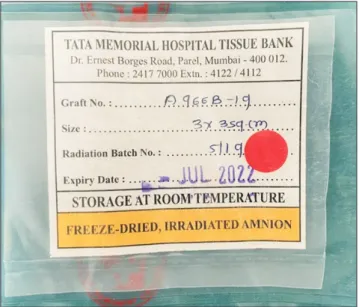
Fig. 1. Dehydrated human amniotic/chorionic membrane ob- tained from human placental extract.

Monica Gajul et al: Comparative evaluation of the efficacy of wound healing with and without dehydrated human amniotic/chorionic membrane in alveoloplasty: a pilot study.

J Korean Assoc Oral Maxillofac Surg 2021

(3)

Orthopantomagram has been taken. Preoperative workups, such as a complete blood profile, were performed for all pa- tients. Site selection and dHACM placement side (TATA Tis- sue Bank, Mumbai, India; Fig. 1) were determined using the Sequentially Numbered Opaque Sealed Envelopes (SNOSE) technique.

One operator carried out all alveoloplasty surgical proce- dures and another investigator recorded the healing index at seven days and 21 days postoperatively using the Landry, Turnbull, and Howley Index.(Table 1)

Patients were taken for surgery and routine painting and draping were performed. Local anesthetic injection of 2%

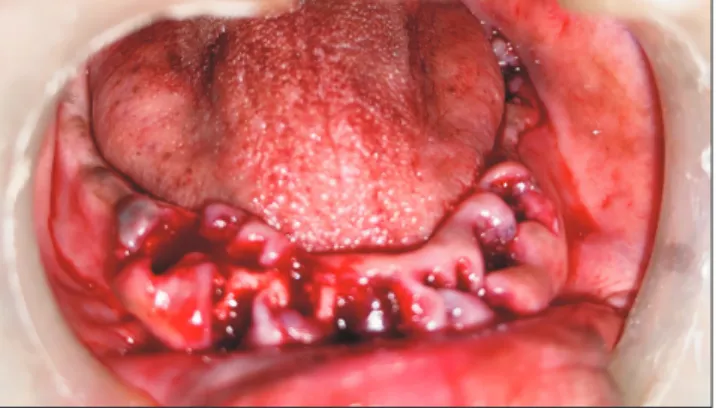
lignocaine hydrochloride with 1:200,000 adrenaline was ad- ministered at the alveoloplasty region. A crestal incision was made and a full-thickness mucoperiosteal flap was raised us- ing a Molts Periosteal Elevator (No. 9; iM3, St., Vancouver, WA, USA). Any irregular bone was levelled and smoothened with a bone rongeur and bone file.(Fig. 2) For all 10 patients,

the amniotic membrane was placed at site A and was not placed in site B.(Fig. 3) Wound closure was done with 3-0 silk sutures.(Fig. 4) Gauze was placed after surgery. The same procedure was repeated at site B. Postoperative instructions were given to the patient. Analgesics (Paracip 500 mg; Cipla GX, Mumbai, India) were prescribed. The patient was called the next day for follow-up and again on the seventh and 21st days. Healing was measured using the Landry, Turnbull, and Howley Index. The analysis was performed using IBM SPSS Statistics software (ver. 22.0; IBM, Armonk, NY, USA). A P<0.05 was considered statistically significant.

III. Results

This experimental split-mouth study was conducted from 2019 to 2020 to assess the efficacy of dHACM for accelerat- ing the wound healing process. Most patients were between

Fig. 2. Alveoloplasty procedure done on lower jaw.

Monica Gajul et al: Comparative evaluation of the efficacy of wound healing with and without dehydrated human amniotic/chorionic membrane in alveoloplasty: a pilot study.

J Korean Assoc Oral Maxillofac Surg 2021

Fig. 3. Dehydrated human amniotic/chorionic placed after alveo- loplasty procedure.

Monica Gajul et al: Comparative evaluation of the efficacy of wound healing with and without dehydrated human amniotic/chorionic membrane in alveoloplasty: a pilot study.

J Korean Assoc Oral Maxillofac Surg 2021

Fig. 4. Closure done with 3-0 silk after placement of dehydrated human amniotic/chprionic procedure.

Monica Gajul et al: Comparative evaluation of the efficacy of wound healing with and without dehydrated human amniotic/chorionic membrane in alveoloplasty: a pilot study.

J Korean Assoc Oral Maxillofac Surg 2021

Fig. 5. Demographic chart of patients.

Monica Gajul et al: Comparative evaluation of the efficacy of wound healing with and without dehydrated human amniotic/chorionic membrane in alveoloplasty: a pilot study.

J Korean Assoc Oral Maxillofac Surg 2021

Females Males

6

5

4

3

2

1

0

No. of patients

(4)

45-55 years with a mean age of 50.5±10.50 years. Of 10 pa- tients, 5 were male and 5 were female.(Fig. 5)

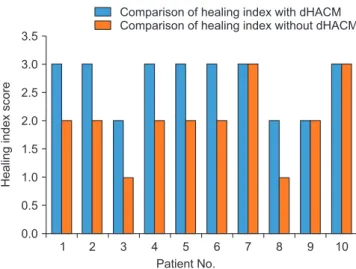
Wound healing was compared between the two sites using the Landry, Turnbull, and Howley Index. A score of 5 indicat- ed excellent tissue healing while a score of 1 indicated very poor healing. Among site A (dHACM) cases, scores ranged from 2 to 5, while site B (no dHACM) cases ranged from 1 to 5. Though the individual parameters that make up the index were not significantly different between the two site groups,

the total count, i.e., the healing index, was different.(Fig. 6) Tissue color comparisons did not reveal significant differenc- es between the two groups (Fig. 7; P>0.05. The inter-group comparison of the healing index, which consists of tissue col- or, bleeding on palpation, granulation tissue, suppuration, and overall healing, was significantly different (P<0.05, Mann–

Whitney U test value=22; Fig. 8).

IV. Discussion

Denture prosthetics are important for restoring quality of life to edentulous patients. Loss of teeth leads to loss of facial contour, low self-esteem, and, ultimately, compromised aes- thetics 5 . A primary requisite for receiving good dentures is a smooth alveolar ridge. Traumatic extraction and poor healing of extraction sockets often lead to bony spicules on the alveo- lar ridge, which makes denture prosthesis difficult and even painful 6 .

Furthermore, appropriate wound closure after any intraoral surgical procedure is always of great concern 7 . After alveolo- plasty, good healing is important for successful receipt of the fabricated denture. In 2016, Politis et al. 1 conducted a study on wound healing in the oral cavity, in which they defined the mouth as an enigmatic structure in which wound heal- ing occurs amidst millions of bacteria. Healing of hard tissue requires approximately six months 1 . Various materials and grafts can be used as adjuncts or catalysts for wound healing,

Fig. 8. Overall comparison of healing index of soft tissues. (HA:

dehydrated human amniotic/chorionic membrane).

Monica Gajul et al: Comparative evaluation of the efficacy of wound healing with and without dehydrated human amniotic/chorionic membrane in alveoloplasty: a pilot study.

J Korean Assoc Oral Maxillofac Surg 2021

EGFR Tissue

color without

HA Healing index without HA Healing index

with HA Suppuration

without HA Suppuration

without HA Suppuration

with HA

Incision margins without HA

Incision margins with

HA

Granulation tissue without

HA Granulation tissue without

HA Granulation tissue with HA

Granulation tissue with HA

Bleeding on palpation without HA

Bleeding on palpation with

HA Tissue color

without HA Fig. 6. Comparison of healing index. Mann–Whitney U test val-

ue=22, P <0.05. There is a significant difference between the two groups. (dHACM: dehydrated human amniotic/chorionic mem- brane)

Monica Gajul et al: Comparative evaluation of the efficacy of wound healing with and without dehydrated human amniotic/chorionic membrane in alveoloplasty: a pilot study.

J Korean Assoc Oral Maxillofac Surg 2021 1

3.5 3.0 2.5 2.0 1.5 1.0 0.5 0.0

Comparison of healing index with dHACM Comparison of healing index without dHACM

2 3 4 5 6 7 8 9 10

Healing index score

Patient No.

Fig. 7. Comparison of tissue color. Mann–Whitney U test val- ue=38, P >0.05. There is no statistically significant difference between the two groups. (dHACM: dehydrated human amniotic/

chorionic membrane)

Monica Gajul et al: Comparative evaluation of the efficacy of wound healing with and without dehydrated human amniotic/chorionic membrane in alveoloplasty: a pilot study.

J Korean Assoc Oral Maxillofac Surg 2021 1

3.5 3.0 2.5 2.0 1.5 1.0 0.5 0.0

Comparison of tissue color with dHACM Comparison of tissue color without dHACM

2 3 4 5 6 7 8 9 10

Healing index score

Patient No.

(5)

particularly PRF, PRP, skin grafts, and dHACM 8 .

The amnion is the deepest layer of the human placenta 8-19 , and it has distinctive properties. It is made up of three lamina:

an overlying tissue, a basement sheath, and a stromal layer beneath 13,14 . It possesses the unique property of low immu- nogenicity, which makes it an excellent grafting material.

It behaves as a barrier and does not allow for fibrous tissue proliferation 12,15 . The amnion also possesses antiangiogenic and anti-inflammatory substances, including interleukin (IL)- 1 receptor antagonist, tissue inhibitors of metalloproteinase-1, -2, -3, and -4, and IL-10.31 and -32 15-17 .

Because of these characteristics, dHACM is thought to fos- ter new blood vessel growth, encourage tissue proliferation, and recruit mesenchymal progenitor cells that ultimately aid in better wound healing 17 . Its ease of use and obtainment has led to widespread use in many medical areas 17,18 .

According to Zhou et al. 20 , the amniotic membrane also possesses osteoblastic properties that encourage new bone formation. Similar effects were observed in our previous study when dHACM was used as a graft material for soft tis- sue healing, and it also contributed to uneventful healing of the alveolar bone underneath 21-23 . In this study, a comparison of wound healing efficacy with and without dHACM was performed in alveoloplasty patients. The parameters assessed were the healing index, tissue color, bleeding on palpation, granulation tissue, and suppuration 18 .

This study compared bilateral sites in the same patients.

This approach offers the unique advantage of reducing vari- ables like immune response, healing capacity, and inflamma- tory reaction. Because both sites are in the same patient, all these factors are controlled for.

Doig and Simpson 24 carried out an experiment that random- ized patients into various groups according to medications and discussed the various randomization strategies to conceal randomization arrangements. They found that the SNOSE strategy was both powerful and affordable. This technique was used in this study to reduce bias 21 .

There are many parameters to assess wound healing, but the Landry, Turnbull, and Howley Index is easy and conve- nient to score 4 . It has a scoring range from 1 to 5, the lowest being 1 and the highest being 5. The parameters measured in this index are the healing index, tissue color, bleeding on palpation, granulation tissue, and suppuration, and this index was selected to compare wound healing in alveoloplasty pa- tients with and without dHACM 4 .

Although no significant variations were found in any of the Landry, Turnbull, and Howley Index parameters, the

mean overall healing index score was higher in sites where amniotic membrane was used. In seven patients, the healing index was higher on the amniotic membrane side than the non-membrane side; the other three patients showed similar healing in both sites. This can be attributed to the low level immune response of the amniotic membrane 15-17,19 . Accord- ing to a 2020 study by Puyana et al. 21 , amniotic tissue cells expressed microbial peptides like IL-10, tumor necrosis factor (TNF)-α, and interferons, which are known to inhibit inflammation. In this study, a similar effect was seen because dHACM is anti-inflammatory by nature. The results were significantly different between the sites, so it can be conclud- ed that dHACM is better than suturing alone.

The other parameter assessed was tissue color. According to a 2014 study by Tsuno et al. 16 , the amniotic membrane enhances formation of new blood vessels. Identical effects were found in our study, which yielded similar results fol- lowing new angiogenesis, resulting in improved tissue color.

Although tissue color was not significantly different between the two site groups, six out of 10 patients showed better tis- sue color on their dHACM-treated side than their suture- alone side.

dHACM is a promising material for wound healing. Many studies have concluded that is has multiple effective uses in many medical areas. The advantages of dHACM include its easy handling properties, convenient procurement process, cost efficiency, no requirement of a separate surgical site, and no fear of immuno-histocompatibility rejection 11,12,15,16,18 . No studies have reported any adverse reactions caused by dHACM.

This is a pilot study with a small sample size. A multi-cen- ter study with a larger sample size is needed to corroborate our study results.

This study was conducted in older patients, where healing is delayed compared with younger patients. The study shows that amniotic membrane enhances healing in this population.

V. Conclusion

In our study, we assessed wound healing with and without

dHACM in alveoloplasty patients. Our findings suggest that

dHACM aids in wound healing due to its low immunogenic-

ity, anti-inflammatory, and angiogenetic properties. Hence,

we recommend the use of dHACM as a wound-healing graft

material for alveoloplasty without fear of adverse events.

(6)

ORCID

Monica Gajul, https://orcid.org/0000-0001-5087-5786 Kalyani Bhate, https://orcid.org/0000-0002-6654-6060 Sayali Awate, https://orcid.org/0000-0002-3809-0836 Pradnya Kakodkar, https://orcid.org/0000-0002-1540-8100 Sonal Shah, https://orcid.org/0000-0001-8424-0105

Authors’ Contributions

M.G. participated in data collection and wrote the manu- script. K.B. and P.K. participated in the study design and per- formed statistical analyses. S.S., S.A., and M.G. participated in the study design and coordination and helped draft the manuscript. All authors read and approved the final manu- script.

Acknowledgements

The authors acknowledge the support of the Department of Oral and Maxillofacial Surgery.

Ethics Approval and Consent to Participate

The study was approved by the Institutional Review Board (No. DPU/1185/19) of Dr. D. Y. Patil Vidyapeeth. Informed consent was obtained from all patients.

Conflict of Interest

No potential conflict of interest relevant to this article was reported.

References

1. Politis C, Schoenaers J, Jacobs R, Agbaje JO. Wound healing problems in the mouth. Front Physiol 2016;7:507. https://doi.

org/10.3389/fphys.2016.00507

2. Tenenhaus M. The use of dehydrated human amnion/chorion membranes in the treatment of burns and complex wounds: current and future applications. Ann Plast Surg 2017;78(2 Suppl 1):S11-3.

https://doi.org/10.1097/SAP.0000000000000983

3. Tettelbach W, Cazzell S, Reyzelman AM, Sigal F, Caporusso JM, Agnew PS. A confirmatory study on the efficacy of dehydrated human amnion/chorion membrane dHACM allograft in the man- agement of diabetic foot ulcers: a prospective, multicentre, ran- domised, controlled study of 110 patients from 14 wound clinics.

Int Wound J 2019;16:19-29. https://doi.org/10.1111/iwj.12976 4. Gangwani KD, Shetty L, Kulkarni D, Seshagiri R, Chopra R.

Piezosurgery versus conventional method alveoloplasty. Ann Maxillofac Surg 2018;8:181-7. https://doi.org/10.4103/ams.

ams_162_18

5. Nandhana S, Kathiravan. Incidence of alveoloplasty post extraction – a retrospective study. J Pharm Sci Res 2017;9:441-3.

6. Van der Weijden F, Dell'Acqua F, Slot DE. Alveolar bone di- mensional changes of post-extraction sockets in humans: a sys- tematic review. J Clin Periodontol 2009;36:1048-58. https://doi.

org/10.1111/j.1600-051X.2009.01482.x

7. Suthar P, Shah S, Waknis P, Limaye G, Saha A, Sathe P. Compar- ing intra-oral wound healing after alveoloplasty using silk sutures and n-butyl-2-cyanoacrylate. J Korean Assoc Oral Maxillofac Surg 2020;46:28-35. https://doi.org/10.5125/jkaoms.2020.46.1.28 8. Arai N, Tsuno H, Okabe M, Yoshida T, Koike C, Noguchi M, et al.

Clinical application of a hyperdry amniotic membrane on surgical defects of the oral mucosa. J Oral Maxillofac Surg 2012;70:2221- 8. https://doi.org/10.1016/j.joms.2011.09.033

9. Faulk WP, Matthews R, Stevens PJ, Bennett JP, Burgos H, Hsi BL. Human amnion as an adjunct in wound healing. Lancet 1980;1:1156-8. https://doi.org/10.1016/s0140-6736(80)91617-7 10. Kim JS, Kim JC, Na BK, Jeong JM, Song CY. Amniotic mem-

brane patching promotes healing and inhibits proteinase activity on wound healing following acute corneal alkali burn. Exp Eye Res 2000;70:329-37. https://doi.org/10.1006/exer.1999.0794

11. Rinastiti M, Harijadi, Santoso AL, Sosroseno W. Histological evaluation of rabbit gingival wound healing transplanted with hu- man amniotic membrane. Int J Oral Maxillofac Surg 2006;35:247- 51. https://doi.org/10.1016/j.ijom.2005.09.012

12. Amemiya T, Nakamura T, Yamamoto T, Kinoshita S, Kanamura N.

Immunohistochemical study of oral epithelial sheets cultured on amniotic membrane for oral mucosal reconstruction. Biomed Mater Eng 2010;20:37-45. https://doi.org/10.3233/BME-2010-0613 13. Kothari CR, Goudar G, Hallur N, Sikkerimath B, Gudi S, Kothari

MC. Use of amnion as a graft material in vestibuloplasty: a clini- cal study. Br J Oral Maxillofac Surg 2012;50:545-9. https://doi.

org/10.1016/j.bjoms.2011.09.022

14. Lakshmi S, Bharani S, Ambardar K. Repair of an oroantral com- munication by a human amniotic membrane: a novel technique.

J Korean Assoc Oral Maxillofac Surg 2015;41:194-7. https://doi.

org/10.5125/jkaoms.2015.41.4.194

15. Kar IB, Singh AK, Mohapatra PC, Mohanty PK, Misra S. Repair of oral mucosal defects with cryopreserved human amniotic mem- brane grafts: prospective clinical study. Int J Oral Maxillofac Surg 2014;43:1339-44. https://doi.org/10.1016/j.ijom.2014.07.018 16. Tsuno H, Arai N, Sakai C, Okabe M, Koike C, Yoshida T, et al.

Intraoral application of hyperdry amniotic membrane to surgically exposed bone surface. Oral Surg Oral Med Oral Pathol Oral Radiol 2014;117:e83-7. https://doi.org/10.1016/j.oooo.2012.05.014 17. Ahn KM, Lee JH, Lee UL, Lee JH, Lee JW, Kim SP, et al. Devel-

opment of biocompatible dressing material made of collagen and amniotic membrane and wound healing experiment in rat. J Korean Oral Maxillofac Surg 2006;32:189-99.

18. Hassan M, Prakasam S, Bain C, Ghoneima A, Liu SS. A ran- domized split-mouth clinical trial on effectiveness of amnion- chorion membranes in alveolar ridge preservation: a clinical, radiologic, and morphometric study. Int J Oral Maxillofac Implants 2017;32:1389-98. https://doi.org/10.11607/jomi.5875

19. Lyons AB, Chipps LK, Moy RL, Herrmann JL. Dehydrated human amnion/chorion membrane allograft as an aid for wound healing in patients with full-thickness scalp defects after Mohs micrographic surgery. JAAD Case Rep 2018;4:688-91. https://doi.org/10.1016/

j.jdcr.2018.03.015

20. Zhou S, Sun C, Huang S, Wu X, Zhao Y, Pan C, et al. Efficacy of adjunctive bioactive materials in the treatment of periodontal intrabony defects: a systematic review and meta-analysis. Biomed Res Int 2018;2018:8670832. https://doi.org/10.1155/2018/8670832 21. Puyana S, Ruiz S, Elkbuli A, Bernal E, McKenney M, Askari M, et

al. The use of dehydrated human amniotic membrane versus amni-

otic/chorionic membrane allografts to treat partial thickness facial

(7)

burns. J Craniofac Surg 2020;31:201-3. https://doi.org/10.1097/

SCS.0000000000005834

22. Nanda S, Chakraborty S, Ray A, Inamuddin. Healing of cervi- cal necrotizing fasciitis using amniotic membrane as a dress- ing material. Natl J Maxillofac Surg 2011;2:147-51. https://doi.

org/10.4103/0975-5950.94469

23. Cullum D, Lucas M. Minimally invasive extraction site manage- ment with dehydrated amnion/chorion membrane (dHACM): open- socket grafting. Compend Contin Educ Dent 2019;40:178-83.

24. Doig GS, Simpson F. Randomization and allocation concealment: a practical guide for researchers. J Crit Care 2005;20:187-91; discus- sion 191-3. https://doi.org/10.1016/j.jcrc.2005.04.005

How to cite this article: Gajul M, Bhate K, Awate S, Kakod-

kar P, Shah S. Comparative evaluation of the efficacy of wound

healing with and without dehydrated human amniotic/chorionic

membrane in alveoloplasty: a pilot study. J Korean Assoc Oral

Maxillofac Surg 2021;47:279-285. https://doi.org/10.5125/jka-

oms.2021.47.4.279

수치

Table 1. Landry, Turnbull, and Howley Index for checking the healing of soft tissues
Fig. 3. Dehydrated human amniotic/chorionic placed after alveo- alveo-loplasty procedure.
Fig. 8. Overall comparison of healing index of soft tissues. (HA:

참조

관련 문서

Fluorescent microscope image to evaluate wound healing in vitro in the scratch assay using a confluent monolayer of HaCaT keratinocytes... NSAIDs

The study expounds the differences in the rearing attitudes between Yanbian and Korean mothers and Jeju-do mothers through the comparative analysis of

In this study, 1st and 2nd pilot studies was accomplished for revising evaluation standards and as a result, the procedure for implementing mathematics

A A A A Study Study Study Study Analysis Analysis Analysis Analysis of of of of the the the the J. Bach, a representative composer in Baroque period. Composed

A clinical study of the efficacy of gold-tite square abutment screws in cement-retained implant restorations.. An abutment screw loosening study of a Diamond

Histologic evaluation of early human bone response to different implant surfaces2. Histologic evaluation of human bone integration on machined and

A Study on the Evaluation of Space Recognition Space Recognition Space Recognition in the Space Recognition in the in the in the Concourse of Hospital using the

This article, in terms of retrospective evaluation, intended to present a suitable alternative for the present with the normative analysis, the comparative