Cushing syndrome in pregnancy, diagnosed after delivery
Han Byul Kim
1, Mi Kyung Kim
2, El Kim
3, Keun Soo Ahn
4, Hye Soon Kim
2, Nam Kyung Kim
51
Division of Endocrinology and Metabolism, Department of Internal Medicine, Raphael Hospital, Daegu, Korea
2
Division of Endocrinology and Metabolism, Department of Internal Medicine, Keimyung University Dongsan Hospital, Daegu, Korea
3
Department of Neurosurgery, Keimyung University Dongsan Hospital, Daegu, Korea
4
Department of Surgery, Keimyung University Dongsan Hospital, Daegu, Korea
5
Park Kyung Dae Clinic of Internal Medicine, Gyeongju, Korea
Cushing syndrome (CS) is rare in pregnancy, and few cases have been reported to date. Women with untreated CS rarely become pregnant because of the ovulatory dysfunction induced by hy- percortisolism. It is difficult to diagnose CS in pregnancy because of its very low incidence, the overlap between the clinical signs of hypercortisolism and the physiological changes that occur during pregnancy and the changes in hypothalamus-pituitary-adrenal axis activity that occur during pregnancy and limit the value of standard diagnostic testing. However, CS in pregnancy is associated with poor maternal and fetal outcomes; therefore, its early diagnosis and treatment are important. Here, we report two patients with CS that was not diagnosed during pregnancy, in whom maternal and fetal morbidity developed because of hypercortisolism.
Keywords: Complication; Cushing syndrome; Hypercortisolism; Pregnancy
Introduction
Cushing syndrome (CS) is rare in pregnancy, with only about 220 cases having been reported to date. Women with untreated CS rarely become pregnant because CS is associated with a high preva- lence of ovulatory disturbances, which are induced by cortisol ex- cess [1]. Furthermore, even if pregnancy occurs, hypercortisolism is associated with higher incidences of maternal and fetal complica- tions; therefore, the early diagnosis and treatment of CS are im- portant [2]. Here, we report two cases of CS that was diagnosed within the 12 months following delivery.
Cases
This study was approved by the Institutional Review Board of the Keimyung University Dongsan Hospital (IRB No: 2020-05-007).
Yeungnam Univ J Med 2021;38(1):60-64 https://doi.org/10.12701/yujm.2020.00290
Received: April 21, 2020 Revised: May 11, 2020 Accepted: May 12, 2020 Corresponding author:
Hye Soon Kim
Division of Endocrinology and Metabolism, Department of Internal Medicine, Keimyung University Dongsan Hospital, 56 Dalseong-ro, Jung-gu, Daegu 41931, Korea Tel: +82-53-258-2982 Fax: +82-53-258-7982 E-mail: [email protected]
1. Case 1
A 37-year-old women presented with bilateral flank pain and weight gain. She became pregnant in 2013 and underwent cesare- an section at 35 weeks of gestation because of pulmonary arterial hypertension. A 1,720-g infant was delivered, but after delivery, the patient gained 14 kg and reported persistent bilateral flank pain over a 5-month period. The patient had a 3-year history of hyper- tension and dyslipidemia, and was taking atenolol (50 mg), nifed- ipine (60 mg), and atorvastatin (10 mg) once daily. On admission, her blood pressure was 130/70 mmHg and her body mass index (BMI) was 36.9 kg/m
2. She showed Cushingoid features, includ- ing truncal obesity, striae cutis, and buffalo hump. Her morning plasma cortisol concentration was 22.04 μg/dL and her plasma ad- renocorticotrophic hormone (ACTH) concentration was 12.07 pg/mL. Her plasma renin activity, plasma aldosterone concentra- tion, and aldosterone-to-renin ratio were within the normal ranges, and the concentrations of other adrenal hormones were unremark-
Copyright © 2021 Yeungnam University College of Medicine
This is an Open Access article distributed under the terms of the Creative Commons Attribution Non-Commercial License (http://creativecommons.org/licenses/by-nc/4.0/)
which permits unrestricted non-commercial use, distribution, and reproduction in any medium, provided the original work is properly cited.
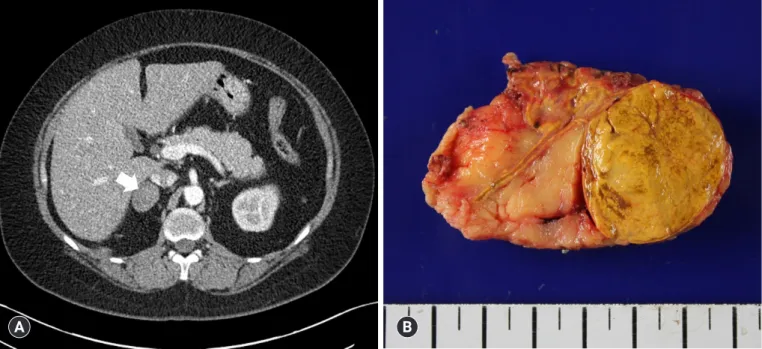
able. A low-dose dexamethasone suppression test demonstrated autonomous cortisol excess (Tables 1-3). Contrast-enhanced ab- dominal computed tomography revealed a 35×28 mm hypoatten- uating nodule in the right adrenal gland (Fig. 1), and in venous and delayed phases showed significant enhancement and rapid wash- out, which was consistent with a cortical adenoma. We, therefore, diagnosed adrenal CS. A laparoscopic right adrenalectomy was performed and pathological examination revealed that the mass was an adrenal cortical adenoma. On the day of surgery, 200 mg of intravenous hydrocortisone was administered to avoid an adrenal crisis, and the dose was gradually tapered off. Four months after the surgery, the patient resumed menstruation. The patient’s body mass decreased from 92.6 kg before surgery to 70 kg 6 months lat- er. Long-term follow-up of the patient showed that her blood pres- sure had improved. She was able to stop taking antihypertensive drugs and hydrocortisone 2 years after surgery.
2. Case 2
A 34-year-old woman attended our outpatient department be- cause of weight gain and easy bruising. She was diagnosed with gestational diabetes during her 25th week of gestation and she de-
livered a 2,200-g female infant by cesarean section during the 37th week. She returned to the hospital 8 months after delivery be- cause she had not experienced menstruation, even after stopping breastfeeding, and had gradually gained weight and noticed multi- ple bruises. Her blood pressure was 170/106 mmHg and her BMI was 24.6 kg/m
2. On physical examination, she had a moon face, buffalo hump, multiple bruises, and abdominal striae. Laboratory investigations revealed morning plasma cortisol and ACTH con- centrations suggestive of ACTH-dependent hypercortisolism (Tables 1, 2). Low-dose dexamethasone suppression testing was not associated with a reduction in plasma cortisol concentration, but high-dose dexamethasone suppression testing was, which was consistent with a diagnosis of Cushing disease (CD) (Table 3).
Pituitary magnetic resonance imaging revealed a 3×4×6 mm hy- pointense nodule on the left side of the pituitary gland (Fig. 2).
Endonasal pituitary adenomectomy was performed via an endo- nasal transsphenoidal approach, and the pathological finding was an ACTH-producing pituitary adenoma (World Health Organi- zation grade I). One day following surgery, her plasma ACTH concentration had decreased from 68.48 to 20.43 pg/mL. In addi- tion, her plasma cortisol concentration had decreased to 1.18 µg/
Table 1. Summary of the clinical characteristics of the reported cases Case Principal
complaint Physical
examination BMI
(kg/m
2) Blood pressure
(mmHg) Imaging result Diagnosis Maternal
outcome Pregnancy
outcome Management 1 Bilateral flank
pain, weight gain
Truncal obesity, striae cutis, buffalo hump
36.9 140/100 Right adrenal adenoma (35× 28 mm)
Adrenal Cushing
syndrome Pulmonary arterial
hypertension LBW (1,720 g)
a), preterm birth (35+1 wk)
b)Laparoscopic right adre- nalectomy 2 Weight gain Moon face, buf-
falo hump, purple striae
24.6 170/106 Pituitary mi- croadenoma (3× 4× 6 mm)
Cushing disease Gestational diabetes LBW (2,200 g)
a)Pituitary ade- nomectomy via a TSA BMI, body mass index; LBW, low birth weight; TSA, transsphenoidal approach.
a)