The Effect of 12weeks Pilates Mat Exercise on Body Composition and Lipid Metabolism in Obese Middle-aged
Women
Soon-Gi Baek
Professor, Dept. of Medical Beauty Care, Jungwon University
12주간 필라테스 매트 운동이 비만중년여성의 신체구성 및 지질대사에 미치는 영향
중원대학교 의료뷰티케어학과 교수백순기
Abstract This study aims to provide basic data for maintaining and promoting health of obese middle-aged women who are interested in various chronic diseases such as cardiovascular disease and coronary artery disease by comparing and analyzing the effect on body composition and lipid metabolism through a 12-week Pilates mat exercise program for obese middle-aged women. This study targeted middle-aged women residing in Gyeonggi-do A, who are obese middle-aged women in their 40s and 50s with a body fat ratio of 30% or more, and had no regular exercise in the past three months. Obese middle-aged women(n=19) were divided into two groups, the Pilates mat exercise program group(n=9) and the control group(n=10), conducting exercise for 60 minutes three times a week for 12 weeks. As a result of analysis, the exercise group had a positive effect on body weight, skeletal muscle mass, body fat mass, body fat percentage, and BMI in body composition, but not in the control group. In the lipid metabolism, the exercise group had a positive effect on TC, TG, HDL-C, LDL-C, and FFA, but not in the control group. These results suggest that the 12-week Pilates mat exercise program conducted in this study is an exercise program that can prevent cardiovascular and chronic diseases in obese middle-aged women.
Key Words : Pilates mat exercise program, Obese, Middle-aged women, Body composition, Lipid metabolism
요 약 본 연구는 비만중년여성을 대상으로 12주간 필라테스 매트 운동 프로그램을 통하여 신체구성과 지질대사에 미치
는 영향을 비교 분석하여 심혈관질환 및 관상동맥질환 등 각종 만성질환에 관심을 두고 있는 비만중년여성의 건강유지 및 증진에 기초자료를 제공하고자 한다. 비만중년여성들을 대상으로 필라테스 매트 운동프로그램군과 통제군으로 구분하 여 12주간 주당 3회 60분간 실시하였다. 측정변인으로는 신체구성과 지질대사의 변화를 분석하였으며 통계처리는 이원 반복측정 분산분석을 실시하였다. 분석결과 신체구성에서 운동군은 체중, 골격근량, 체지방량, 체지방율 및 신체질량지수 에서긍정적인 영향을 미쳤으며 통제군에서는 유의한 영향을 미치지 않았다. 지질대사에서 운동군은 총콜레스테롤, 중성지 방, 고밀도 지단백 콜레스테롤, 저밀도 지단백 콜레스테롤, 유리지방산에서 긍정적인 영향을 미쳤으며 통제군에서는 유의 한 영향을 미치지 않았다. 이와 같은 결과는 본 연구에서 실시한 12주간 필라테스 매트 운동 프로그램이 비만 중년여성들 의 심혈관계 및 만성질환을 예방 할 수 있는 운동 프로그램이라고 생각된다.
키워드 : 필라테스 매트 운동, 비만, 중년여성, 신체구성, 지질대사
*Corresponding Author : Soon-Gi Baek([email protected]) Received October 1, 2020
Accepted October 20, 2020
Revised October 19, 2020 Published October 31, 2020
1. Introduction
Recent social developments, advances in medical care and abundant food have led to improved living conditions, longer life expectancy and an increase in the middle-aged population. However, health life expectancy tends to decrease due to illness or injury[1].
On the other hand, as the life span of humans steadily increases, interest in how to design and live their lives is increasing in old age. In particular, the middle-aged generation participates in economic activities as active as adolescents and plays a pivotal role in society[2]. In addition, middle age can be said to be the most important period in the life cycle, since it greatly affects on living a healthy life and quality of life in old age[3]. For women in this period, complex and systematic health care in both physical and emotional aspects is more important than ever[4].
In the case of women, if their health is not properly managed as they enter middle age, obesity may occur due to autonomic imbalance, decreased energy consumption, decreased muscle mass, and increased abdominal obesity[5]. As described above, the prevalence of obesity also increases as age increases, and in the case of Korean women, the prevalence of obesity increases rapidly among middle-aged women[6].
Obesity, a major cause of disease, indicates excessive body fat mass due to lack of physical activity, overeating or genetic factors, and an imbalance between energy intake and consumption, and increases the risk of coronary artery disease, cardiovascular disease and chronic disease[7,8].
In middle-aged women, due to the accumulation of body fat, obesity is very closely related to metabolic syndrome as insulin resistance and free fatty acids increase[9]. The
increase in free fatty acid caused by obesity inhibits the insulin action, and hyperinsulinemia, a compensatory mechanism for insulin, activates the sympathetic nerve and can cause hypertension[10]. When free fatty acid in the blood(FFA: free fatty acid) flows into the liver, it promotes the formation of very low-density lipoprotein cholesterol(VLDL-C) increasing triglyceride(TG) concentration, and decreasing high- density lipoprotein cholesterol(HDL-C)[11].
Regular exercise can significantly reduce the prevalence of various chronic diseases such as cardiovascular system, musculoskeletal and endocrine immune diseases, including obesity[12]. Among these exercises, Pilates exercise is known as a stable and effective exercise for middle-aged women who are difficult to perform high-intensity exercise by controlling the intensity of exercise and using a variety of movements to avoid straining the muscles[13]. It has a positive effect on body composition and blood lipids through an increase in total energy consumption, lipolysis capacity, energy consumption rate, and lipid utilizatio due to the increase in basal metabolism[14].
This study compares and analyzes the results of Pilates mat exercise for 12 weeks on body composition and fat metabolism in obese middle-aged women. Therefore, we intend to provide basic data for maintaining and promoting the health of obese middle-aged women who are interested in Pilates and various chronic diseases such as cardiovascular disease and coronary artery disease.
2. Research Method 2.1 Subject of study
This study targeted 20 middle-aged women
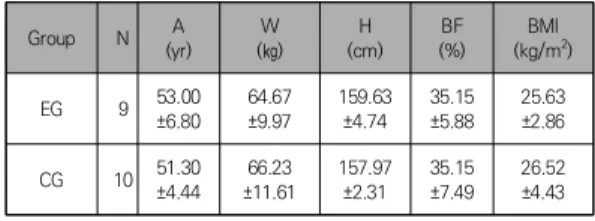
residing in Gyeonggi-do A, who are obese middle-aged women in their 40s and 50s with a body fat ratio of 30% or more, and had no regular exercise in the past three months. They agreed with the purpose of this study and participated voluntarily. Prior to the experiment, the purpose of the study, the method, and the contents of the experiment were sufficiently explained, and the consent to the test was received. However, one of the study subjects gave up halfway due to personal reasons, and a total of 19 people participated in the experiment. By random assignment, Pilates Exercise Group (EG) consisted of 9 subjects and Control Group : CG) consisted of 10 subjects The physical characteristics of the study subjects are as shown in Table 1.
Table 1. Physical characteristics of Subject's
Group N A
(yr) W
(㎏) H
(cm) BF
(%) BMI
(kg/m2)
EG 9 53.00
±6.80 64.67
±9.97 159.63
±4.74 35.15
±5.88 25.63
±2.86 CG 10 51.30±4.44 66.23
±11.61 157.97
±2.31 35.15
±7.49 26.52
±4.43 EG: Exercise Group, CG: Control Group
A: Age, W: Weight, H: Height
BF: % Body fat, BMI: Body Mass Index M±SD(Mean±Sid)
2.2 Research design
In this study, to verify the exercise effect of obese middle-aged women participating in the Pilates mat exercise program, pre-and post-tests were conducted by dividing the Pilates mat exercise group(n=9) and the control group(n=10). The exercise program of the Pilates mat exercise group was reconstructed using pre test post test randomized groups design to suit the purpose of this study, and the exercise program was conducted for a total of 12 weeks, 60 minutes a day, 3 times a week.
During the course of the study, the control
group was encouraged to maintain the same lifestyle as before participating in the study.
2.3 Measurement method and exercise program
2.3.1 Body composition
The subjects were to keep an empty stomach before measurement for at least 8 hours on the day of measurement, urinated 30 minutes before measurement, and rested for 30 minutes in the laboratory. Then, height, weight, skeletal muscle mass (kg), Body mass index(BMI) and body fat percentage(% fat) were measured with a body composition analyzer (Inbody 720, Biospace, Korea) to which the bioelectrical resistance analysis was applied. At the time of measurement, the subjects removed various metals attached to the body while wearing comfortable clothes, stepped on the measuring instrument which was wiped with an electrolyte tissue, held the handle part with both hands, and stood upright with the arms open to both sides.
2.3.2 Blood analysis
Subjects were asked to maintain an empty stomach for at least 10 hours before the blood draw, and to avoid vigorous physical activity the day before and on the day of the experiment and to get enough sleep. Blood was drawn before and 12 weeks after the start of the Pilates mat exercise program. On the day of blood collection, 10 ml of venous blood was collected from the antecubital vein using an anticoagulant injection after arriving at the laboratory at 8 am and maintaining a comfortable state for about 30 minutes.
Collected blood was centrifuged at 3,000 rpm for 20 minutes using a centrifuge according to each analysis item. Then, plasma and serum excluding cellular components were extracted
and kept in a storage tube in a freezer at -70°C.
The analysis items were triglycerides(TG),
high-density lipoprotein cholesterol (HDL-C), low-density lipoprotein cholesterol (LDL-C), and total cholesterol(TC) and free fatty acid(FFA),
and the analysis was requested to GC medical foundation.
2.3.3. Pilates mat exercise program
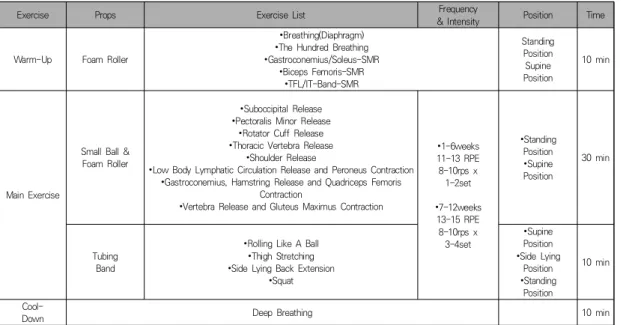
Before starting the Pilates mat exercise program, the subjects were fully explained to familiarize themselves with the principles of Pilates and Pilates mat exercise. In this study, the Pilates mat exercise program was reorganized according to the purpose of this study by reorganizing the exercise program of Back[15].
The program applied basic movements used in Pilates to keep the center of the body and included giving feedback to the test subjects
allowing them to focus on the precise movements slowly. The exercise being conducted 3 times a week for 12 weeks, the intensity of exercise was set to Rating of Perceived Exertion (RPE) 11-13 during 1-6 weeks and to RPE 13-15 during 7-12 weeks, increasing gradually.
The program consisted of 10 minutes of warm-up exercise, 40 minutes of main exercise (pilates mat exercise), and 10 minutes of clean-up exercise. The detailed Pilates mat exercise program is presented in Table 2. On the other hand, the control group was to maintain the usual lifestyle during the same treatment period.
Table 2. Pilates mat exercise program
Exercise Props Exercise List Frequency
& Intensity Position Time Warm-Up Foam Roller
∙Breathing(Diaphragm)
∙The Hundred Breathing
∙Gastroconemius/Soleus-SMR
∙Biceps Femoris-SMR
∙TFL/IT-Band-SMR
Standing Position Supine Position
10 min
Main Exercise
Small Ball &
Foam Roller
∙Suboccipital Release
∙Pectoralis Minor Release
∙Rotator Cuff Release
∙Thoracic Vertebra Release
∙Shoulder Release
∙Low Body Lymphatic Circulation Release and Peroneus Contraction
∙Gastroconemius, Hamstring Release and Quadriceps Femoris Contraction
∙Vertebra Release and Gluteus Maximus Contraction
∙1-6weeks 11-13 RPE 8-10rps x 1-2set
∙7-12weeks 13-15 RPE 8-10rps x 3-4set
∙Standing Position
∙Supine Position
30 min
Tubing Band
∙Rolling Like A Ball
∙Thigh Stretching
∙Side Lying Back Extension
∙Squat
∙Supine Position
∙Side Lying Position
∙Standing Position
10 min
Cool-
Down Deep Breathing 10 min
2.4 Data analysis
The data analysis of this study used SPSS PC+
for window (version 21.0) statistical program. In the data analysis of this study, the mean (M) and standard deviation (SD) were calculated to present descriptive statistics of all measured data.
Two-way ANOVA with repeated measures was conducted to verify the difference in the mean of the pre and post test results of the two groups.
The significance level of all statistical analysis was set to p<.05 level.
3. Results
This study categorized obese middle-aged women into a Pilates mat exercise group and a control group, and then experimented to investigate the effect of the 12-week Pilates mat
exercise program on body composition and lipid metabolism.
3.1 Changes in Body Composition
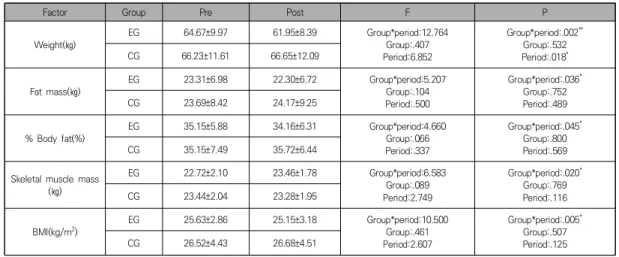
Table 3. Changes in body composition pre and post the pilates mat exercise program for 12weeks
Factor Group Pre Post F P
Weight(㎏) EG 64.67±9.97 61.95±8.39 Group*period:12.764
Group:.407 Period:6.852
Group*period:.002**
Group:.532 Period:.018*
CG 66.23±11.61 66.65±12.09
Fat mass(㎏) EG 23.31±6.98 22.30±6.72 Group*period:5.207
Group:.104 Period:.500
Group*period:.036* Group:.752 Period:.489
CG 23.69±8.42 24.17±9.25
% Body fat(%) EG 35.15±5.88 34.16±6.31 Group*period:4.660
Group:.066 Period:.337
Group*period:.045* Group:.800 Period:.569
CG 35.15±7.49 35.72±6.44
Skeletal muscle mass (㎏)
EG 22.72±2.10 23.46±1.78 Group*period:6.583
Group:.089 Period:2.749
Group*period:.020* Group:.769 Period:.116
CG 23.44±2.04 23.28±1.95
BMI(kg/m2) EG 25.63±2.86 25.15±3.18 Group*period:10.500
Group:.461 Period:2.607
Group*period:.005* Group:.507 Period:.125
CG 26.52±4.43 26.68±4.51
Table 4. Changes in lipid metabolism pre and post the pilates mat exercise program for 12weeks
Factor Group Pre Post F P
TC(mg/dL) EG 208.77±16.09 191.22±16.26 Group*period:14.551
Group:1.269 Period:10.096
Group*period:.001***
Group:.276 Period:.006**
CG 205.80±11.35 207.21±13.48
HDL(mg/dL) EG 53.00±9.83 57.00±11.77 Group*period:4.580
Group:.430 Period:3.066
Group*period:.047* Group:.430 Period:.098
CG 51.90±6.90 51.50±7.79
LDL(mg/dL) EG 120.88±16.17 112.44±15.24 Group*period:27.169
Group:.290 Period:9.350
Group*period:.001***
Group:.597 Period:.007*
CG 121.60±30.52 123.80±29.89
TG(mg/dL) EG 164.55±27.23 158.66±20.32 Group*period:4.541
Group:.170 Period:.525
Group*period:.048* Group:.685 Period:.478
CG 164.80±28.63 167.70±22.30
FFA(μEq/L) EG 417.77±46.49 393.88±49.27 Group*period:4.545
Group:.028 Period:4.180
Group*period:.048* Group:.870 Period:.057
CG 411.60±98.98 142.10±100.64
In order to find out the effect of the 12-week Pilates mat exercise program on body composition, the average for each group and the results of the two-way repeated ANOVA analysis are as shown in Table 3. There was a significant difference in weight by measurement period(p=.018), and there was an interaction effect by period×group(p=.002). In the body fat
mass, there was no significant difference by measurement period, and there was an interaction effect by period×group(p=.036). In the body fat percentage, there was no significant difference by measurement period, and there was an interaction effect by period×group(p=.045). In skeletal muscle mass, there was no significant difference by
measurement period, and there was an interaction effect by period×group(p=.020). In addition, in the body mass index, there was no significant difference by measurement period, and there was an interaction effect by period × group (p=.005).
3.2 Changes in Lipid Metabolism
In order to find out the effect of the 12-week Pilates mat exercise program on lipid metabolism, the average and two-way repeated ANOVA analysis results for each group are as shown in Table 4. There was a significant difference in TC by measurement period (p=.006), and there was an interaction effect by period×group(p=.001). In HDL-C, there was no significant difference by measurement period, and there was an interaction effect by period×group(p=.047). In LDL-C, there was a significant difference by period(p=.007), and there was an interaction effect by period×group (p=.001). In TG, there was no significant difference by measurement period, and there was an interaction effect was observed by period×group (p=.048). In addition, there was no significant difference by measurement period in FFA, and there was an interaction effect by period×group (p=.048).
4. Discussion
The purpose of this study is to investigate the effect of participation in the Pilates mat exercise program on body composition and fat metabolism of obese middle-aged women, and to provide an effective Pilates mat exercise program for maintaining and promoting the health of obese middle-aged women. To achieve this purpose, a Pilates mat exercise program was conducted for obese middle-aged women three times a week for 12 weeks for 60
minutes, and the changes in body composition and fat metabolism were compared, and based on the results of this study, the following will be discussed.
Pilates exercise is gaining popularity as a type of obesity prevention exercise, a common health problem in the modern world [16], Also, Pilates exercise can be an interesting alternative to traditional aerobic exercise to improve body composition[17].
Looking at domestic and overseas previous studies on changes in body composition through Pilates exercise, Cho[18]’s study on obese female college students who performed Pilates mat exercise three times a week for 70 minutes for 12 weeks showed positive effects on weight loss through decrease of weight and body fat percentage.
Also, in a study by Shim, Kim, & Ko[19] on obese middle-aged men who performed Pilates exercise three times a week for 65 minutes for 12 weeks, despite there was no statistical change in weight, BMI, and WHR, positive effects were reported on the waist and hip circumference.
Lee[20] reported that there was no statistical change in body composition as a result of performing pilates exercise with props and equipment for 60 minutes, three times a week for 8 weeks, for adult women. In addition, in a study by Lee[21], there was no significant difference in body weight, BMI, and body fat percentage as a result of pilates exercise three times a week for 40 minutes for 8 weeks, but a significant difference was reported in the fat-free percentage. Meanwhile, a study by Şavkin & Aslan[17] reported that overweight and obese women had a positive effect on body composition as a result of performing Pilates exercise three times a week for 90 minutes for 8 weeks. In a study by Sevimli & Sanri[22], a
Cardio Pilates exercise program for 60 minutes three times a week for 4 weeks in middle-aged women reported a significant reduction in body fat percentage, body fat mass, and hip circumference. A study by Cakmakçi[23]
reported a positive effect on body composition as a result of conducting a Pilates program on obese women including ball and mat exercise four times a week for 60 minutes for 8 weeks.
In this study, as a result of conducting a Pilates mat exercise program three times a week for 60 minutes for 12 weeks on obese middle-aged women, positive results were found in body composition such as weight, body fat percentage, BMI, and lean mass. These results are the same as previous studies that reported that Pilates exercise is effective in reducing body fat mass and increasing lean mass[17], and it is thought that Pilates mat exercise shows the effect of exercise which increases lean mass and increases energy consumption to reduce body fat. Therefore, it is thought that the 12-week Pilates mat exercise program conducted in this study can apply Pilates exercise to improve body composition.
Excessive accumulation of adipose tissue increases body fat mass, causing obesity, and increases blood lipid concentration. High blood lipids in the body are associated with the risk of dyslipidemia and cardiovascular disease. To prevent such diseases, blood lipid levels must be improved[24], and exercise is one of the ways that has been proposed to improve them[25]. It has been reported that among various exercises, Pilates can improve blood lipids[26].
Looking at a previous study on the change in fat metabolism through Pilates exercise, Shim, Kim, & Ko[19]’s study on middle-aged men who conducted Pilates exercise three times a week for 65 minutes for 12 weeks, after 65 minutes of Pilates exercise, there was no statistical change
in TC and HDL-C, but a positive effect was reported in LDL-C. In a study by Choi[27] on elderly women with high blood pressure who conducted Pilates mat gymnastics program five times a week for 60 minutes for 24 weeks reported a positive effect on improving blood lipids. A study by Kim, Kim & Kim[28] on female college students in their twenties who conducted Pilates exercise for 70-80 minutes three times a week for 8 weeks also reported there was no statistical change in TC, TG, and LDL-C, but a positive effect was reported in HDL-C. A study by Lee & Oh[29] on middle-aged women also reported that conducting Pilates mat exercise for 60 minutes three times a week for 12 weeks helped improve lipids. However, a study by Sahinci Gokgul & Hazar[30] reported that there was no statistical change in LDL-C and HDL-C in both groups of middle-aged women as a result of performing Pilates and circuit exercise for 30 minutes three times a week for 8 weeks.
On the other hand, looking at a previous study on the change of fat metabolism through exercise, Yoon, Lee & Kim[31]'s study showed that moderate-intensity aerobic exercise on male college students according to the difference in cardiorespiratory fitness level has an effect on free fatty acids. Kim & Soon[32]’s study on middle-aged menopausal women who conducted aerobic and complex exercise for 60 minutes three times a week for 12 weeks showed significant decrease of free fatty acids in the aerobic and complex exercise groups. In a study by Park, Jung & Yang[33] on obese middle school girls who conducted badminton, walking, T-ball, and handball at the exercise intensity of 50-64% HRR or RPE 13-15 for 12 weeks depending on their physical activity level reported a significant decrease in free fatty acid.
In this study, as a result of conducting a Pilates mat exercise program on obese middle-aged women three times a week for 60 minutes for 12 weeks, positive results were found in fat metabolism such as TC, TG, LDL-C, HDL-C, and FFA. These results indicate that pilates exercise increases glycogen synthase, oxidase activation and lipoprotein lipase activity in skeletal muscle and adipose tissue. It also increases fatty acid oxidation and energy generation substrate using fatty acids, which is activated as an energy source, leading mitochondria to stimulate energy metabolism, thereby activating the oxidation rate of fat[34-36].
Therefore, it is thought that the 12-week Pilates mat exercise program conducted in this study can be regarded as an alternative exercise program for improving fat metabolism. In addition, through the 12-week Pilates mat exercise conducted in this study, positive changes in body composition and fat metabolism leads to lowering the risk of various diseases, and moreover, it can prevent cardiovascular and chronic diseases that threaten obese middle-aged women. In future studies, if various studies on exercise programs are continuously conducted, it will show that the interventional Pilates mat exercise program is a more effective exercise method for improving body composition and fat metabolism for obese middle-aged women.
5. Conclusion & Suggestion
According to the results of this study, it is confirmed that the 12-week Pilates mat exercise program is an effective exercise method by exerting a positive effect on body composition and lipid metabolism. In conclusion, the 12-week Pilates mat exercise program for obese middle-aged women is
thought to be an exercise program that can help with health management of obese middle-aged women by inducing positive changes in lipid metabolism with effective control of body composition. Moreover, it is thought that it can prevent various chronic diseases such as cardiovascular disease and coronary artery disease and improve risk factors.
REFERENCES
[1] Korean Ministry of Health and Welfare. (2017).
Gidaesumyeong(0-se gidaeyeomyeong)mit yubyeonggigan jeoe gidaesumyeong(geongangsumyeong)[2016 life expectancy(at birth) and expected lifespan without disease(healthy life expectancy)]. Sejong: Korean Ministry of Health and Welfare; 2017.
[2] J. E. Choᆞ, J. U. Park & M. Y. Hwang. (2019).
Development of Pilates Salutogenic Program of Middle-aged Women. Journal of fisheries and marine sciences education, 31(6), 1790-1800.
DOI:0.13000/JFMSE.2019.12.31.6.1790
[3] C. N. Shin, Y. S. Lee & M. Belyea. (2018). Physical activity, benefits, and barriers across the aging continuum. Applied Nursing Research, 44, 107-112. DOI:10.1016/j.apnr.2018.10.003 [4] D. R. Schreiber & N. D. Dautovich. (2017).
Depressive symptoms and weight in midlife women: the role of stress eating and menopause status. Menopause, 24(10), 1190-1199.
DOI:10.1097/GME.0000000000000897
[5] A. A. A. Gravena, S. C. R. Brischiliari, T. C. R.
Lopes, C. M. D. Agnolo, M. D. B. Carvalho & S. M.
Pelloso. (2013). Excess weight and abdominal obesity in postmenopausal Brazilian women: a population-based study. BMC Womens Health, 13, 46.
DOI:10.1186/1472-6874-13-46
[6] Korea Disease Control and Prevention Agency Call Center. (2017). Major results of the 7th National Health and Nutrition Survey (2016).
[7] A. Engin. (2017). The definition and prevalence of obesity and metabolic syndrome. Advances in experimental medicine and biology, 960, 1-17.
DOI:10.1007/978-3-319-48382-51
[8] K. Ohashi, R. Shibata, T. Murohara & N. Ouchi.
(2014). Role of anti-inflammatory adipokines in
obesity-related diseases. Trends in endocrinology and metabolism, 25(7), 348-355.
DOI:10.1016/j.tem.2014.03.009
[9] J. P. Girod & D. J. Brotman. (2003). The metabolic syndrome as a vicious cycle: does obesity beget obesity?. Medical Hypotheses,
60(4), 584-589.
DOI:10.1016/s0306-9877(03)00053-7.
[10] Z. J. Ward, M. W. Long, S. C. Resch, C. M. Giles, A. L. Cradock & S. L. Gortmaker. (2017).
Simulation of Growth Trajectories of Childhood Obesity into Adulthood. New England Journal of
Medicine, 377(22), 2145-2153.
DOI:10.1056/NEJMoa1703860
[11] E. Sonestedt, S. Hellstrand, I. Drake, C. A. Schulz, U. Ericson, J. Hlebowicz, M. M. Persson, B.
Gullberg, B. Hedblad, G. Engstrom & M.
OrhoMelander. (2016). Diet Quality and Change in Blood Lipids during 16 Years of Follow-up and Their Interaction with Genetic Risk for Dyslipidemia. Nutrients, 8(5), 274-283.
DOI:10.3390/nu8050274
[12] M. P. Nigdelis, S. J. Martinez-Dominguez, D. G.
Goulis & F. R. Perez-Lopez. (2018). Effect of programmed exercise on perceived stress in middle-aged and old women: A meta-analysis of randomized trials. Maturitas, 114, 1-8. DOI:
10.1016/j.maturitas.2018.05.004
[13] B. Siler. (2000). The Pilates Body: Broadway Books,New York, NY.
[14] S. Dilek & Y. Güder. (2018). The effect of pregnancy Pilates-assisted childbirth preparation training on childbirth fear and neonatal outcomes. Quality & Quantity, 52(6), 2667-2679.
DOI:10.1007/s11135-018-0682-0
[15] S. G. Back. (2015). Effects of Using Prop for Convergence Pilates Met Exercise on the Immunoglobulin in Middle-aged Women. Journal of the Korea Convergence Society, 6(5),329-336.
DOI:10.15207/JKCS.2015.6.5.329
[16] R. Jago, L. Marielle, J. M. Missaghian, T.
Baranowski. (2006). Effect of 4 weeks of Pilates on the body composition of young girls.
Preventive medicine, 42(3), 177-180. DOI:
10.1016/j.ypmed.2005.11.010
[17] R. Şavkin & U. B. Aslan. (2017). The effect of Pilates exercise on body composition in sedentary overweight and obese women. The Journal of Sports Medicine and Physical Fitness, 57(11),1464-1470.
DOI: 10.23736/S0022-4707.16.06465-3
[18] W. J. Cho. (2015). The Effects of a Pilates Mat Exercise Program on Body Composition, Leptin, Ghrelin, and Adiponectin in Obese College Women. The Korea Journal of Sports Science, 24(4), 1315-1326.
UCI:G704-001369.2015.24.4.023
[19] S. Y. Shim, Y. M. Kim & S. K. Ko. (2011). The Effects of Pilates on Body Composition, Cholesterol, CRP and Leptin in Male Obese Adults. The Korea Journal of Sports Science, 20(3), 1301-1312.
UCI: G704-001369.2011.20.3.099
[20] Y. J. Lee. (2020). TheEffect of Small Equipment and Apparatus Pilates Exercises on Body Composition and Balance Capacity in Adult Women. Master’s Thesis. Ulsan University, Ulsan.
[21] S. B. Lee. (2018). The Effect of 8-Weeks Pilates Exercise on Body Composition, Basic Physical Fitness and Balance of Elderly Women. Master’s Thesis. Dongshin University, Naju.
[22] D. Sevimli & M. Sanri. (2017). Effects of Cardio-Pilates Exercise Program on Physical Characteristics of Females. Universal Journal of Educational Research, 5(4),677-680.
DOI: 10.13189/ujer.2017.050417
[23] O. Cakmakçi. (2011). The effect of 8 week Pilates exercise on body composition in obese women.
Collegium Antropologicum, 35(4), 1045-1050.
DOI: 10.23736/S0022-4707.16.06465-3
[24] B. Klop, J. W. F. Elte & M. C. Cabezas. (2013).
Dyslipidemia in obesity: mechanisms and potential targets. Nutrients, 5(4), 1218-1240.
DOI: 10.3390/nu5041218
[25] K. Rees, M. Dyakova, K. Ward, M. Thorogood &
E. Brunner. (2013). Dietary advice for reducing cardiovascular risk. Issue 3, Cochrane Collaboration, John Wiley & Sons. 1-157.
[26] S. N. Nam, J. H. Kim, H. J. Kim, H. J. Kim, I. K.
Kim & J. H. Park. (2007). The Effect of 12 Weeks Pilates Met Exercise on the Blood Lipids in Middle-aged Women. The Korea Journal of Sport Science, 16(4),781-793.
UCI: G704-001369.2007.16.4.030.
[27] P. B. Choi. (2012). The effects of pilates mat gym program on blood pressure, heart rate and lipids profile in elderly women with hypertension. The Korea Journal of Sports Science, 21(2),893-903.
UCI:G704-001369.2012.21.2.085.
[28] H. J. Kim, J. Y. Kim & C. S. Kim. (2014). The effects of pilates exercise on lipid metabolism
and inflammatory cytokines mRNA expression in female undergraduates. Journal of Exercise Nutrition & Biochemistry, 18(3), 267-275.
DOI:10.5717/jenb.2014.18.3.267
[29] J. M. Lee & D. J. Oh. (2019). Mat Pilates Affe-ted to the Estrogen and Blood Lipids in Middle-Aged Woman. The Korea Journal of Sport Science, 28(1), 1085-1092.
DOI: 10.35159/kjss.2019.02.28.1.1085
[30] B. Sahinci Gokgul & Hazar S. (2017). The effect of eight-week cyclic exercises and Pilates exercises in women to some physical parameters and blood lipids. Turkish Journal of Sport and Exercise, 19(1), 60-64.
[31] S. J. Yoon, J. S. Lee & S. C. Kim. (2012). Effects of Moderate Aerobic Exercise with Cardiorespiratory Fitness Level Difference on Growth Hormone, Glucose, Insulin, Free Fatty Acids and Insulin Resistance. The Korea Journal of Sports Science, 21(3), 1053-1063.
UCI: G704-001369.2012.21.3.083.
[32] C. H. Kim & A. R. Soon. (2016). The Effects of Exercise Types on Metabolic Syndrome Risk Factors, FFA, HOMA-IR and hs CRP in Menopausal Middle-Aged Women. Journal of Korean Physical Education Association for Girls and Women, 30(2), 271-293.
DOI: 10.22472/kpeaw.2016.30.2.271.
[33] C. W. Park, J. H. Jung & J. H. Yang. (2013). Effects of Physical Activity Level on Blood Concentration of Free Fatty Acid, Ceramide and Insulin Resistance in Obesity Middle School Girls.
Korean Journal of Physical Education, 52(4), 641-652.
[34] S. J. Kang, B. R. Kim & S. L. Jung. (2010). The effect of aerobic exercise on insulin resistance and free fatty acids of impaired fasting glucose in middle aged women. Korean Journal of Physical Education, 49(2), 399-408.
UCI: G704-000541.2010.49.2.028.
[35] S. Mann, C. Beedie & A. Jimenez. (2014).
Differential effects of aerobic exercise, resistance training and combined exercise modalities on cholesterol and the lipid profile:
review, synthesis and recommendations. Sports Medicine, 44(2), 211-221.
DOI 10.1007/s40279-013-0110-5.
[36] D. J. Bioshop, C. Granata & N. Eynon. (2014). Can we optimise the exercise training prescription to maximise improvements in mitochondria function and content?. Biochimica et Biophysica
Acta, 1840(4),1266-1275.
DOI:10.1016/j.bbagen.2013.10.012
백 순 기(Soon-Gi Baek) [정회원]
․ Feb, 2004: Dongduk Womens University, Department of Physical Education (Ph.D)
․ March, 2013 ~ Present : Professor of Medical Beauty Care at Jungwon University
․ Research Interests : Healthcare. Exercise rehabilitation
․ E-Mail : [email protected]