http://dx.doi.org/10.6110/KJACR.2013.25.10.534
급배기 방식 개선에 따른 생물안전 밀폐시설의 Risk Assessment와 초기 건설비 저감에 대한 연구
A Study on the Risk Assessment and Reduction of Initial Construction Cost in a Biosafety Laboratory According to Improvement of Supply and Exhaust Method
황지현(Ji Hyun Hwang)1, 홍진관(Jin Kwan Hong)2†,주영덕(Young Duk Ju)3
1
가천대학교 대학원 건축설비학과 ,
2가천대학교 건축설비학과
†,
3나라컨트롤
1
Department of Building Equipment and System Eng, Graduate School of Gachon University, Sungnam City 461-701, Republic of Korea
2
Department of Building Equipment and System Eng, Gachon University, Sungnam City 461-701, Republic of Korea
3
Department of Building Services, Naracontrols INC., Seoul 135-100, Republic of Korea (Received February 20, 2013; revision received August 2, 2013)
Abstract In general, entire supply air of the BSL3 laboratory should be vented to the outside for its biosafety and the air conditioning system should always be operating to maintain a room pressure difference. In this regard, annual energy consumption is approximately five or ten times greater than the magnitude of the office building. In addition, to adjust room pressure difference to the set value efficiently, the supply and exhaust duct system are installed in each room of the BSL3 lab. Thus, initial construction cost is extremely high. In this study, multizone simulation is performed to estimate maintaining the appropriate room pressure difference in the case of changing model A (each room supply and exhaust system) to model B (each zone supply and exhaust system) for verification of the BSL3 lab biosafety. Also, in the case of these two models, the multizone simulation for three kinds of biohazard scenario is performed as part of risk assessment. The analysis of initial construction cost of two models is conducted for comparison. According to the studies, initial construction cost of model B is less than about 22% of existing model A. Moreover, biosafety of the BSL3 lab is still maintaining in the case of the two models.
Key words Biosafety laboratory, BSL3 lab(생물안전 밀폐시설), Biohazard scenario(생물재해 시나리오), Supply and exhaust duct system(급배기 시스템), Multizone simulation(멀티죤 시뮬레이션), Risk assessment(위해성 평가 ), Initial construction cost(초기 건설공사비)
†Corresponding author, E-mail: [email protected]
1. 서 론
생물안전 밀폐시설 (Biosafety Laboratory, BSL)이란 감 염성 물질을 안전하게 관리하여 연구원의 생물안전 사 고를 예방하고 생물재해를 방지하는 것을 목적으로 하 는 시설이다 . 이러한 BSL은 실험실의 생물안전을 위해서 전외기 급기 및 전배기를 해야 하는 음압시설로 공기 조화설비를 상시 가동하고 있기 때문에 동일 규모 일 반 사무소 건물에 비해 5∼10
(1, 2)배 더 많은 양의 에너 지가 소비되는 에너지 다소비 건물로 알려져 있다. 특 히 , BSL에서 위해 3등급 병원체를 취급하는 생물안전
3등급 밀폐시설(Biosafety Level 3 Laboratory, BSL3)은 각
실 마다 급배기 덕트가 설치되어 있다. 또한 각각의 급
배기에 반드시 HEPA Filter를 통과한 후 급배기
(3)하여
야 하므로 덕트 설계가 복잡하며 자재비등 초기 건설
공사비가 기존에 비해 5배 이상 많이 소비되는 경제적
인 문제가 있다. 이에 본 연구에서는 멀티죤 시뮬레이
션을 통하여 기존의 공조방식과 비교하여 BSL3의 급배
기방식 변경 시에도 BSL3의 실별 순차적인 음압 유지
(4)와 실간 차압이 형성되는지를 파악하고, BSL3에서 예
기치 않은 생물재해(Biohazard)가 발생될 경우를 가상
하여 실험실내에서 미생물 오염원의 확산
(5)으로 생물
안전에 문제가 없는지를 위해성평가 (Risk Assessment)
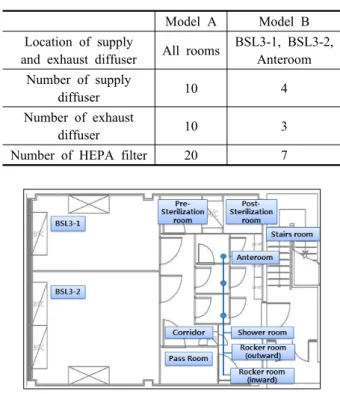
Model A Model B Location of supply
and exhaust diffuser All rooms BSL3-1, BSL3-2, Anteroom Number of supply
diffuser 10 4
Number of exhaust
diffuser 10 3
Number of HEPA filter 20 7 Table 1 Specification of Model A and Model B
Fig. 1 Floor plan of BSL3 Lab.
Fig. 2 Multizone base Model A.
Fig. 3 Multizone base Model B.
Fig. 4 Researcher movement.
측면에서 수행하였다 . 이러한 연구를 통해 BSL3의 급 배기방식 변경 시에도 결과에 문제가 없다면 최근 문 제점으로 떠오르고 있는 외기부하의 증가
(6)에 따른 유 지운영비 문제와 기존의 각실 급배기방식 적용으로 인 한 과다한 초기 건설공사비 문제에 실제적으로 대응할 수 있는 건설 방안이 제안될 것으로 판단된다 .
2. 연구내용 및 방법2.1 BSL3 Lab. 멀티존 시뮬레이션 모델링
본 연구에서는 국내 K지역에 설립된 생물안전 3등 급 밀폐시설을 해석대상으로 하였으며 대상 시설의 평 면도는 Fig. 1과 같다. Fig. 1의 해석대상 BSL3 Lab.을 멀티죤 시뮬레이션 프로그램인 CONTAM 3.0
(7)(8)으로 급배기 시스템 변경에 따른 순차적인 음압 유지와 각 실간 차압을 해석
(9)하였다. 기존의 각실 급배기방식으 로 하는 Model A와 실험실의 특정 실만 급배기하는 Model B에 대한 급배기구와 HEPA 필터의 설치 개수 를 Table 1에 나타내었다.
본 해석에서 BSL3의 실압 설계 검토를 위하여 Model A, Model B의 총 풍량을 급기 3,400 m
3/h, 배기 3,700 m
3/h로 하였으며, BSL3 실간 공기 이동 통로들의 Leakage area
(10)를 25 cm
2/item로 설정하여 해석을 수행하였다.
2.2 Risk Assessment를 위한 시나리오 설정
대상 연구실에서 연구원의 입 퇴실 동선은 Fig. 4와
같으며 기류는 일반구역에서 오염구역으로의 일방향
흐름을 원칙으로 하고 있다. Fig. 4와 같이 연구자는
오염구역으로 입갱의실을 통해 실험실로 진입하고 퇴
실시에는 실험복을 탈의하여 오염원을 일차적으로 제
거하고 샤워 후 전실을 통해 퇴실하도록 하고 있다.
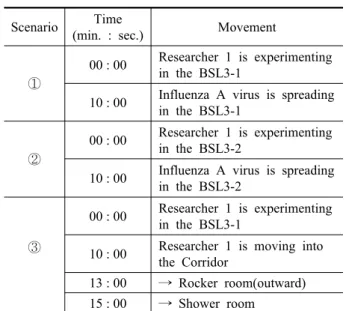
Scenario Time
(min. : sec.) Movement
①
00 : 00 Researcher 1 is experimenting in the BSL3-1
10 : 00 Influenza A virus is spreading in the BSL3-1
②
00 : 00 Researcher 1 is experimenting in the BSL3-2
10 : 00 Influenza A virus is spreading in the BSL3-2
③
00 : 00 Researcher 1 is experimenting in the BSL3-1
10 : 00 Researcher 1 is moving into the Corridor
13 : 00 → Rocker room(outward) 15 : 00 → Shower room
Table 2 Simulation scenario
Infection Influenza A
Mean Diameter 0.098 ㎛
Filter HEPA Filter(MERV 16)
(12)Table 3 Contaminant condition
Fig. 5 Air flow and differential pressure of Model A.
Fig. 6 Air flow and differential pressure of Model B.
본 해석에서는 위와 같은 재실자의 이동 동선 에 따 라 실제 해석대상 BSL3에서의 인플루엔자 병원균 확 산에 대하여 아래와 같은 3가지 경우의 생물재해 시나 리오를 설정하고 각 경우에 병원균 확산에 대하여 위 해성평가(Risk assessment)
(11)해석을 수행하였다.
시나리오 ①은 BSL3-1 실험실 내부에서 예상치 못한 병원균의 확산이 발생하는 경우로 연구원이 BSL3-1 실험실에서 고위험균을 이용한 실험을 수행하는 경우 이다 . 시나리오 ②는 BSL3-2 실험실 내부에서 연구원 이 실험 중 예상치 못한 병원균의 확산이 발생하는 경 우이다 . 시나리오 ③은 BSL3-2 실험실 내부에서 연구 원이 실험 중 예상치 못한 병원균에 오염되어 내부복 도에서 출갱의실을 거쳐 샤워실로 이동하여 병원균의 확산이 발생하는 경우이다. Table 2에 오염물의 이동 경로 해석을 위해 설정된 해석 시나리오를 나타내었다 .
위의 3가지 시나리오의 경우에 인플루엔자 병원균 10,000 CFU/m
3가 발생되는 것으로 가정하였으며 급기 및 배기시스템에는 MERV 16등급
(12)의 HEPA Filter가 설치된 것으로 설정하였다 .
2.3 각 Model에 따른 초기건설비 산정 비교
Table 1에서 설명한 바와 같이 Model A와 Model B 에 대해 초기 투자비의 증감을 산정하기 위해 HEPA
Filter, 공조덕트, 각종 엘보나 레듀서 등 장비물량을 산출하고 , Model A와 Model B의 경우에 건설에 필요 한 자재비와 노무비를 산정하고 이를 비교하였다 .
3. 시뮬레이션 해석 결과3.1 BSL3 Lab.의 멀티죤 시뮬레이션 해석
Fig. 5와 Fig. 6은 Model A와 Model B에 대해서 멀티 죤 시뮬레이션을 수행한 해석결과를 나타내고 있다 . Fig. 5는 모든 실에 급배기를 실시했을 경우이며, Fig. 6 는 각 실의 급배기구 수를 조정하여 전실과 BSL3 Zone 에만 급배기를 실시하고 중간 각 실의 급배기를 생략한 경우를 나타내고 있다 . 두 모델은 전실에서 실험실로 점점 더 순차적으로 음압으로 되어 공기흐름이 일 방향 으로 잘 유지되고 있음을 알 수 있다.
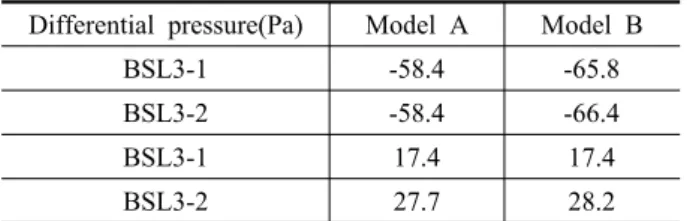
Table 4의 해석결과와 같이 두 Model 모두 BSL3의 요
구되는 조건인 청정구역에서 오염구역까지의 압력차가
최소 12.5 Pa 이상이며 BSL3 -1, BSL3-2 실험실의 실압
또한 -24.5 Pa 이상 유지되어 적절한 실간 압력분포를
유지하는 것을 확인했다. 또한 오히려 특정 실에만 급
배기를 했던 Model B의 경우에도 BSL3-1은 -65.8Pa,
BSL3-2은 -66.4Pa로 Model A의 경우보다 -7.4Pa 더 음
Differential pressure(Pa) Model A Model B
BSL3-1 -58.4 -65.8
BSL3-2 -58.4 -66.4
BSL3-1 17.4 17.4
BSL3-2 27.7 28.2
Table 4 Simulation results
Fig. 7 Influenza A concentration in case of scenario ① (Model A).
Fig. 8 Influenza A concentration in case of scenario ① (Model B).
Fig. 9 Influenza A concentration in case of scenario ② (Model A)
Fig. 10 Influenza A concentration in case of scenario ② (Model B).
압으로 유지되었다 . 따라서 급배기구 수를 적절히 조절 하더라도 실험실내의 설정 실압 유지가 가능하다는 것 을 확인할 수 있으며, Model B로 시공함으로써 HEPA Filter, 공조덕트, 각종 엘보나 레듀서 등 장비물량의 절감과 그에 따른 자재비와 노무비 및 궁극적으로 초 기 건설비 절감의 큰 효과를 얻을 수 있을 것으로 판단 된다.
3.2 시나리오에 따른 Risk Assessment
위와 같이 실간 설정압력차를 유지하여 일방향의 공 기흐름을 가진 실험실에서 인플루엔자를 사용하여 실 험하는 경우 앞서 설명한 3가지의 생물재해 시나리오
를 설정하여 인플루엔자 병원균 확산에 대한 위해성평 가를 수행하였다 .
Fig. 7∼Fig. 8은 시나리오 ①의 경우와 Fig. 9∼ Fig.
10은 시나리오 ②의 경우에 Model A와 Model B에 대 한 해석결과를 나타내고 있는데 시나리오 ①과 ②의 경우 모두 큰 차이를 나타내지 않고 있음을 알 수 있다.
시나리오 ①, 시나리오 ②의 경우 병원균 발생 10분 경과 후 최고농도에 도달한 후 병원균이 급격히 감소 되며 25∼30분 정도가 지나면 거의 제거되며 다른 실 로의 확산은 없음을 나타내고 있다.
Fig. 11는 Model A의 시나리오 ③의 경우로서, BSL3-1 실험실 내부에서 연구원이 실험 중 예상치 못한 병원균 에 오염되는 경우로 연구원이 BSL3-1 실험실 입실 직후 10분 동안 Influenza A 병원균이 발생되고 병원균에 노출 된 연구원이 내부복도를 거쳐 샤워실로 동선을 이동한 경우에 대한 것이다 . 연구원이 병원균 발생 13분 후에 출 갱의실로 이동하고 15분 후에 안전영역인 Shower room 으로 이동하는 것을 가정하였다 .
Fig. 11를 보면 알 수 있듯이 병원균 발생 최소 30∼
35분 후에 전량 제거되는 것을 확인할 수 있었다. 또한
샤워실과 전실로의 확산은 없는 것을 확인할 수 있었다.
Fig. 11 Influenza A concentration in case of scenario ③ (Model A).
Fig. 12 Influenza A concentration in case of scenario ③ (Model B).
Construction cost
Model A Model B
Materials costs
Labor cost
Materials costs)
Labor cost Installing
equipment
40,990 (100%)
2,220 (100%)
32,570 (79.5%)
380 (17.1%) Installing duct
and fittings
14,670 (100%)
5.370 (100%)
13,430 (91.5%)
3,120 (58.1%) Sub-total 55,660
(100%) 7,590 (100%)
46,000 (82.6%)
3,500 (46.1%) Total 63,250
(100%)
49,500 (78.3%) Table 5 Comparison results of initial construction cost
(Unit : 1,000Won)
Model B의 시나리오 ③의 경우인 Fig. 12의 경우도 Fig. 11와 유사한 양상으로 병원균이 제거됨을 확인할 수 있었다. 이와 같은 시뮬레이션을 통하여 Model A와 Model B의 두 경우 모두 고 위험성 병원균을 취급하 는 실험 중에도 외부로의 병원균 확산은 없을 것으로 예상된다.
3.3 급배기 방식변경에 따른 초기건설비 비교 및 경제성 평가
이에, 기존의 각실 급배기방식으로 하는 Model A와 몇 개의 존으로 나누어 급배기하는 Model B의 두 모델 을 비교한 해석결과가 모두 실간 차압유지가 가능함을 알 수 있었다 . 또한 3가지 생물재해 시나리오에 따른 두 모델의 위해성평가(Risk Assessment) 해석결과 실험 실내의 생물안전성에는 문제가 발생하지 않는다는 사 실을 확인하였다 .
따라서 , 기존 급배기방식인 Model A를 Model B로 개선 변경할 경우 초기 건설비의 절감효과를 산정하기 위해서 HEPA Filter, 공조 덕트, 각종 엘보나 레듀서 등 장비물량을 산출하고, Model A와 Model B의 각 경
우 건설에 필요한 자재비와 노무비를 산정하고 이를 비교하였다 . 이를 위해서 우선 공종을 장비설치공사와 공조 덕트 공사로 분류하여 Model A와 Model B의 자 재비와 노무비 및 전체 건설비를 산정하여 Table 5에 요약하여 나타내었다.
그 결과 특정한 실에만 급배기하였던 Model B가 기 존의 각실 급배기방식인 Model A보다 자재비가 17.4%, 노무비가 53.9% 절감되며, 이를 합친 총 초기건설비는 기존방식을 적용하는 경우에 비해 약 22%의 절감효과 가 있음을 알 수 있다.
4. 결 론
앞서 설명한 바와 같이 생물안전 밀폐시설은 특수 음압시설로 높은 청정도를 유지하기 위해 , 모든 실에 HEPA를 통한 급배기설치로 초기 건설비가 높다. 또한 전외기, 전배기 공조시스템으로서 상시로 가동해야 하 기 때문에 유지운영비가 많이 소요된다.
이에 본 연구에서는 BSL3 실험실에 적합한 환경을
유지하면서 초기시공비용 저감하기 위해 기존의 BSL3
Lab. 각 실에 급배기를 하는 Model A와 특정 실에만
급배기를 하는 Model B의 두 모델을 비교하였다. 해석
결과 Model B의 경우에도 Model A와 유사하게 실간
차압과 실의 음압이 정상적으로 유지된다는 것을 알 수
있다 . 또한, 실험실의 생물안전성을 검증하기 위한 3가
지 생물재해 시나리오에 대한 해석결과 Model B의 경
우에도 Model A와 같이 병원균의 외부확산이 방지되
는 것을 확인할 수 있었다 . 따라서 기존의 각실 급배
기방식에서 몇 개의 존으로 나누어 특정 실에만 급배
기를 하는 방식으로 급배기방식을 변경을 함으로써 실
험실의 생물안전성을 유지하면서, 자재비 17.4%, 노무
비 53.9%의 절감이 가능하며, 이를 합한 초기 건설비는
최대 약 22% 정도 절감할 수 있을 것으로 판단된다.
그러나 이러한 연구는 전체 체적이 315.94 m
3인 해 석대상으로 설정한 특정 BSL3의 운영조건에서 도출된 연구결과이므로 이를 일반화하기 위해서는 향후 다양 한 평면구성 및 운영조건의 경우에도 이와 같은 개선 방안의 실제적인 적용을 통한 검증이 필요할 것으로 판단된다 .
후 기
“이 논문은 2013년도 가천대학교 교내연구비 지원 에 의한 결과임 ”(GCU-2013-0174).
참고문헌