¶ Corresponding Author: Ji-Eun Kim, Dept. of Hotel and Tourism Management, Catholic University of Daegu, 13-13, Hayang-Ro, GumRak-Li, Hayang 38430, South Korea, Tel. +82-53-850-3425, Fax. +82-53-359-7160, E-mail: [email protected]
Culinary Science & Hospitality Research. 2016;22(6):33-51.
https://cshr.jams.or.kr/ ISSN 2466‐0752 (Print) ISSN 2466‐1023 (Online)
The Effects of Authentic Leadership on Service-Oriented Organizational Citizenship Behaviors:
The Role of Goal Commitment as a Mediator - A Case of Five Star Deluxe Hotel Employees -
Yong-Joo Kwon1 and Ji-Eun Kim2.
1Dept. of Hotel Management, Kyung Hee University
2.¶Dept. of Hotel and Tourism Management, Catholic University of Daegu
ABSTRACT: The hotel industry needs to make the competitive advantage difficult to be imitated in order to remain sustainable in competitive business circumstances. Front-line employees' service-oriented citi- zenship behaviors(OCBs) can be such a strength from the perspective of organizational system. With an aim of investigating the antecedents of the hotel front-line employees' service-oriented OCBs, this study proposed a theoretical framework linking authentic leadership to service-oriented OCBs with goal commit- ment as a mediator. A total of 260 cases without missing values have been used for the final analysis and structural equation modeling (SEM) is employed using the SPSS and AMOS 7. It was first found that self-awareness and relational transparency of authentic leadership made a significant impact on their goal commitment while balanced processing and moral perspective failed to influence them. Second.
goal commitment influenced all sub-factors of service-oriented OCBs. Third, moral perspective and rela- tional transparency of authentic leadership significantly influenced service-oriented OCBs while self-aware- ness and relational transparency failed to make it. Finally, goal commitment significantly makes an inter- vening effect for the relationship between self-awareness & service-oriented OCBs and relational trans- parency & service-oriented OCBs but failed to intervene the other relationships. The results provide theo- retical and practical implications regarding directions of leadership styles and HR management in the hotel industry and suggestions for the further extended studies.
Keywords: authentic leadership, service-oriented organizational citizenship behaviors, goal commitment
INTRODUCTION
Recently, the leading five star deluxe hotel organi- zations including Lotte, Shilla and Chosun have built more hotels and extend hotel areas over the provin- ces to fulfill the demand of Chinese and any other inbound travellers[1]. Increasing demand could be an opportunity for the hotel business while the in- creasing supply could be a threat against it. There- fore, the hotel industry, where imitation is easier
than any other industry, need to develop something difficult or impossible to copy in order to survive in competitive circumstances. One of the hardest items to be copied in the hospitality business is software such as service quality because service quality asso- ciates with multiple systems and human resources management and these are not as easy as hardware copies[2]. Specifically, the front-line employees, who mainly contact customers, are the most important asset in the hotel organizations[3] and their beha-
viors influence the customers' total experiences in hotels and their intention of revisit[2].
Therefore, the front-line employees' customer ori- ented behaviors are important in providing com- petitive advantages which cannot be imitated. The customer-contact employees' extra efforts to deve- lop better services are service-oriented citizenship behaviors and include loyalty, service-delivery, and participation OCBs[4]. Service-oriented OCBs are de- rived from organizational citizenship behaviors, the employees' discretionary behaviors beyond their job descriptions regardless of reward or other types of compensations[5] and specifically applied to the hospitality industry. In this study, the fundamental factors to increase the employees' service-oriented behaviors are questioned.
The driving force of the employees' behaviors in the hotel industry is the managers' leadership[6].
The leadership in the hospitality industry has been the researchers' interest and since then the posi- tively influential leadership styles have been found.
For example, there are transformational leader- ship[7], transactional leadership[9] and emotional leadership[10], etc. Further, the common base for all the positive leadership styles has been developed and Avolio and Gardner[11] proposed authentic leadership which is a leader's behavioral pattern to make a harmonious relationship with subordinates on the basis of positive psychology and morality as such a common denominator. Although there is a need to develop a study model to explain authentic leadership and the employees' organizational beha- viors in the hospitality industry little study is avail- able. Therefore this study intends to develop a stu- dy model to explain such a relationship. At the same time, organizational commitment has been found as an antecedent of OCBs[12]. Specifically, the mediat- ing effect of organizational commitment between the employees' perception on the organizational variables and organizational outcomes have been an increasingly involved field of study because previous studies have proved its significance to the organi- zation, e.g.[8]. This study selects goal commitment as a mediator to investigate the mediation effect on authentic leadership and service-oriented OCBs be- cause the goals of the hotel organizations are inter- related with service orientations.
Based on above discussions, the purpose of this study is to present a study model on the relation- ship between authentic leadership and service-ori- ented OCBs mediated through goal commitment fo- cused on the front-line hotel employees. First, this study aims to study whether authentic leadership significantly influence the front-line hotel employ- ees' goal commitment. Second, this study aims to identify whether goal commitment has a positive ef- fect on the front-line hotel employees' service-ori- ented OCBs. Third, the relationship between au- thentic leadership and service-oriented OCBs are go- ing to be identified. Finally, this study investigates whether goal commitment mediates the relationship between authentic leadership and service-oriented OCBs. The study results can provide practical im- plications for human resources management in the hotel industry.
LITERATURE REVIEW
Authentic Leadership in the Hotel Industry Authentic leadership has been found as a com- mon denominator to support leadership styles such as ethical leadership and transformational leadership motivating the peoples' positive behaviors[13-16].
Authentic leadership is a leader's behavioral pat- tern driven by his or her positive psychology and morality[4]. Such a behavioral pattern is explained by clear expression of the leaders’ values, accep- tance of the others' opinions, and information shar- ing for decision-making process. Further, authentic leaders develop themselves toward positive direc- tions with their behavioral patterns and keep harmo- nious relationship with their subordinates.
According to the studies on authentic leadership, e.g.[4], Four types of behaviors explain authentic leadership. These behaviors are balanced processing, internalized moral perspective, relational transpa- rency, and self-awareness. Balanced processing asso- ciates with the behaviors objectively concerning all relevant information ahead of a decision making.
Leaders who practice balanced processing take vari- ous opinions from others although they challenge their existing positions. Internalized moral per- spective means that leaders make decisions and be- have based on internal moral standards and values,
rather than being pressured by others such as peers, organizational, and societal pressures[14]. Leaders who are perceived to exhibit relational transparency openly share information and express their own thoughts and feelings. In other words, they make personal disclosures without hesitation because they pursue true relationships. Finally, self-awareness re- quires the extent leaders understand their own st- rengths, weaknesses, and desires, as well as recog- nizing how others judge their leadership. Therefore, self-awareness consists of self-knowledge of their abilities and self-image reflected over others. When leadership have high self-awareness, they enhance their leadership effectiveness using self-knowledge and reflected self-image. Leaders thus have room for development because they truly know their weak- ness.
Goal Commitment in the Hotel Industry
Goal commitment refers to individuals’ determi- native commitment to reach a specific goal[17]. It implies individuals' motives to make an effort to ac- complish a goal and the consistent concentration on that goal over time and an unwillingness to give it up. In order to accomplish organizational goals, the organizational members need to be committed to them and make their own efforts because high goal setup itself never automatically leads to goal accom- plishment[18]. In goal theories, it has been proven that the level of goals predict the members' perfor- mance. The studies suggest the difficult goals make them reach high performance[17]. To accomplish such difficult goals, the employees' commitment to goals is a primary condition to make them summit extra efforts beyond their capabilities[18].
The hotel organizations also present higher goals than ever reached every year based on their mission statement and try to motivate their employees to work on their duties beyond their expectations.
From this perspective, hotel practitioners need to be concerned with how to motivate employees. Leader- ship decides the employees' behaviors as well as at- titudes to a large extent. This study sees the rela- tionship between authentic leadership and goal commitment.
Service-Oriented OCBs in the Hotel Industry
Organizational citizenship behaviors(OCBs) were originally suggested by[19]. He or she explained the term as a voluntary cooperation. Later[20], clearly defined OCBs as the members' extra-role behaviors although they are not rewarded. Since then, the idea has been extended to the organizations as a necessary variable for overall management. For ex- ample, Tsai and Su[21] mentioned OCBs could be in- formal behaviors based on the manual and/or job description but informal behaviors not described as job requirement. This kind of behaviors are asso- ciated with trust towards the organizations. In other words, the organizations may be able to take their organizational goals to higher level than expectation when the employees' voluntary attitudes exist.
Further, Katz and Kahn[22] presented three orga- nizational behaviors to reach organizational effi- ciency such as the employees' system observance, flexibility at work, and innovative activities beyond job roles. Specifically, innovative activities beyond job control are related to OCBs because these in- clude voluntary extra-role behaviors. Like this, OCBs are considered as one of the focal organizational be- haviors together with in-role behaviors such as sys- tem observance and flexibility.
The importance of OCBs are not exceptional in the hospitality industry; thus it has been applied to the related studies. However, business traits in the hospitality industry are somewhat different from those of other industries. For example, front-line em- ployees interact with external customers and they confront a variety of situations, which are not noted in the manual. At this point, service-oriented OCBs were suggested by Podsakoff and MacKenzie[23]
Service-oriented OCBs include sub-factors such as loyalty OCBs, participation OCBs, and service delivery OCBs.
First, loyalty OCBs mean the employees' extra-role behaviors to keep good words about their organi- zations and the organizational products[24]. For ex- ample, loyal employees would recommend their or- ganizations as a good place to work and describe their products and services as something valuable to experience.
Second, participation OCBs refer to the employ- ees' proactive behaviors to present their ideas and suggestions to develop quality service and pro-
ducts[24]. For example, the employees in partic- ipation OCBs may not hesitate to suggest ideas to provide better customers services and encourage others to exchange their ideas as well.
Third, service-delivery OCBs include the employ- ees' extra efforts to serve their customers based on the service manual and honesty. For example, they may display reliable and courteous manners towards their customers as observing manuals on various services. Although the service manual is part of in-role behaviors, it involves the employees' personal efforts such as consciences and self-management such as emotional control.
To synthesize, these frontline employees in the hospitality industry constitute an important image in relation to services and products. Therefore their ex- tra-role behaviors as well as extra efforts may influ- ence overall organizational performance. Likewise, service-oriented OCBs can be granted important meaning in the hospitality industry because they in- clude primary efforts that should be conducted by the front-line employees: loyalty, participation, and service-delivery OCBs. They devote themselves to provide quality service and organizational perfor- mance. As a result, it is likely to be valued to inves- tigate the antecedents of service-oriented OCBs fo- cused on the hospitality industries so as to provide some insight of human resources management.
The Relationship between Authentic Leadership and Goal Commitment
The existing studies on the relationship between authentic leadership and the employees' commit- ment mostly use organizational commitment as the commitment variable. For example[25], verified that authentic leadership makes a significantly positive impact on the employees' organizational commit- ment. Further, Emuwa[26] depicted that the sub- ordinates' perception on authentic leadership posi- tively influenced their commitment to the leaders.
In addition, if the subordinates perceive their su- periors' authenticity, they display affective commit- ment to their organizations[27]. In other words, au- thentic leadership is the antecedent of the employ- ees' commitment to their leaders and organizations.
Hassan and Ahmed[28] also suggested that employ- ees are committed to their roles at work and per-
form well when they perceive their leaders' authen- ticity. Han[29] added that authentic leadership sig- nificantly influenced the members' organizational commitment mediated through psychological capi- tal and LMX(leader member exchange).
Based on the previous studies, authentic leader- ship is likely to influence subordinates' goal commit- ment in hotel organizations as well. This study sug- gests the following hypotheses regarding the rela- tionship between authentic leadership and goal commitment in the hotel industry.
H1: Superiors’ authentic leadership has a sig- nificantly positive impact on the subordi- nates’ goal commitment in the hotel in- dustry.
H1a: Superiors' self-awareness has a significant- ly positive impact on the subordinates' goal commitment in the hotel industry.
H1b: Superiors' internal moral perspective has a significantly positive impact on the sub- ordinates' goal commitment in the hotel industry.
H1c: Superiors' balanced processing has a sig- nificantly positive impact on the sub- ordinates' goal commitment in the hotel industry.
H1d: Superiors' relational transparency has a significantly positive impact on the sub- ordinates' goal commitment in the hotel industry.
The Relationship between Goal Commitment and Service-Oriented OCBs
Goal-oriented individuals are likely to extend their capabilities taking various challenges and apply dif- ferent methods to solve any kinds of problems[30].
Therefore, they use their flexibility when they serve customers as well. Beside, they make extra efforts to obtain more knowledge and experience related to their jobs to develop their careers[31].
In addition, the people committed to the goals are willing to take extra role activities although they are not acknowledged[32]. In other words, they are more interested in goal accomplishment rather than rewards or recognition from their organizations.
According to LePine et al[33], employees who ha-
ve emotional commitment toward their organiza- tions are more likely to present organizational citi- zenship behaviors. They are affectionate to their or- ganizations so that they don't hesitate to make extra role behaviors.
Finally, the significant impact of the employees' commitment toward their organizations on their or- ganizational citizenship behaviors are supported in Truckenbrodt’s study[34]. Based on the existing liter- ature, this study presents the following hypotheses:
the impact of the hotel employees' goal commit- ment on the sub-factors of service-oriented OCBs.
H2: Hotel employees’ goal commitment has a significantly positive impact on their service oriented OCBs.
H2a: Hotel employees’ goal commitment has a significantly positive impact on their loya- lty OCBs.
H2b: Hotel employees’ goal commitment has a significantly positive impact on their service delivery OCBs.
H2c: Hotel employees’ goal commitment has a significantly positive impact on their par- ticipation OCBs.
The Relationship between Authentic Leadership and Service-oriented OCBs
For decades, the studies on OCBs have identified various predictors of OCBs. For example, there are the employees' personality, the individuals' congru- ence with their jobs, organizational environment, and their preception of the superiors' leadership styles[35]. Podsakoff et al[35] emphasized the rela- tively strong impact of job attitude, organizational variables and leadership made on OCBs among the various predictors proved.
This study concerns authentic leadership for the predictor. Leadership is compulsory factor to give ideal direction to employees. Specifically, if leaders support their subordinates, they experience commit- ment toward their organizations; then they are more likely to show OCBs than those who are not. The significant influence of authentic leadership on the employees' OCBs has been proven throughout seve- ral studies.
For example, Luthans and Avolio[36] suggested
that authentic leadership strengthened the organiza- tional members' positive emotions through personal and social identification processes. Their positive emotions also led them to organizational commit- ment and job satisfaction, which brought out orga- nizational citizenship behaviors.
Further, Yammarino et al[37] reasoned authentic leadership improved the subordinates' optimism, self-efficacy, team efficacy, and organizational effi- cacy. Yammarino et al[36] added the validity of the direct influence of authentic leadership on organiza- tional performance. Avolio et al Yammarino et al[37]
also supported the relationship between authentic leadership and positive organizational behaviors.
Walumbwa et al[4]'s study result added a literature of the positive influence of authentic leadership on organizational citizenship behaviors, organizational commitment, and satisfaction with leaders to the literature.
Valsania et al[38] also verified that moral per- spective and relational transparency of authentic leadership successfully made a positive impact on the employees' organizational citizenship behaviors.
The leaders' relational transparency enhanced the employees' OCBs in Wong and Cummings's study [39]. Walumbwa et al[40] added a study result of a significant relationship between authentic leadership and organizational citizenship behaviors as well.
In addition, the domestic scholars showed their interest in studies on the relationship between au- thentic leadership and organizational citizenship behaviors. For example, the significant positive im- pact of authentic leadership on organizational citi- zenship behaviors have been proven the in the stud- ies of Chun et al[41], Hong[42], Lee[43], Kim and Nam[44]. Specifically, Nam[45] focused on the dining industry, suggesting the leaders' self-awareness in authentic leadership significantly improved the em- ployees' organizational citizenship behaviors.
Based on the existing literature regarding the sig- nificant relationship between authentic leadership and OCBs, this study assumed the significant rela- tionship between authentic leadership and service- oriented OCBs. Finally, centered on frontline hotel employees, the following hypotheses have been dra- wn.
H3: Superiors’ authentic leadership has a signifi- cantly positive impact on the subordinates’
service-oriented organizational citizenship be- havior in the hotel industry.
H3a: Superiors’ self-awareness has a significant- ly positive impact on subordinates’ loyal- ty OCBs in the hotel industry.
H3b: Superiors’ self-awareness has a significant- ly positive impact on subordinates’ servi- ce-delivery OCBs in the hotel industry.
H3c: Superiors’ self-awareness has a significant- ly positive impact on subordinates’ partic- ipation OCBs in the hotel industry.
H3d: Superiors’ internal moral perspective has a significantly positive impact on sub- ordinates’ loyalty OCBs in the hotel in- dustry.
H3e: Superiors’ internal moral perspective has a significantly positive impact on sub- ordinates’ service delivery OCBs in the hotel industry.
H3f: Superiors’ internal moral perspective has a significantly positive impact on sub- ordinates’ participation in the hotel indu- stry.
H3g: Superiors’ balanced processing has a sig- nificantly positive impact on subordina- tes’ loyalty OCBs in the hotel industry.
H3h: Superiors’ balanced processing has a sig- nificantly positive impact on subordina- tes’ service delivery OCBs in the hotel in- dustry.
H3i: Superiors’ balanced processing has a sig- nificantly positive impact on subordina- tes’ participation OCBs in the hotel in- dustry.
H3j: Superiors’ relational transparency has a significantly positive impact on subordi- nates’ loyalty OCBs in the hotel industry.
H3k: Superiors’ relational transparency has a significantly positive impact on subordi- nates’ service delivery OCBs in the hotel industry.
H3l: Superiors’ relational transparency has a significantly positive impact on subordi- nates’ participation OCBs in the hotel in- dustry.
Goal Commitment as a Mediator
Leadership plays a critical role to direct the em- ployees towards ideal attitudes for their organi- zations as well as organizational goal accomplish- ment[46]. This idea supports the suggested study model of the relationship among authentic leader- ship, goal commitment, and service-oriented OCBs.
However, how the constructs are related to each other is the matter of concern.
The existing literature has been suggesting the people's commitment as an intervening mechanism to explain leadership and organizational performan- ces. For example, Yeh and Hong[47] and Chen[48]
verified the intervening effect of organizational com- mitment for the relationship between leadership be- haviors and employees' job performances. Yiing et al[49] also used organizational commitment as an in- tervening variable for the relationship between lead- ership style and the employees' job performances and the significant effect as an intervening variable has been proven. Based on the previous studies, this study suggests goal commitment as an intervening variable for the relationship between authentic lea- dership and service-oriented OCBs.
Most of all, according to Fun[2], organizational commitment mediates the relationship between hu- man resource management practices and the cus- tomer-contact employees' service-oriented OCBs.
Therefore, the following hypotheses have been pro- posed and assumed that the effect of servant leader- ship on front-line employees in the hotel industry would be mediated through their goal commitment.
H4: Goal commitment positively mediates the re- lationship between authentic leadership and service-oriented organizational citizenship be- haviors in the hotel industry.
H4a: Goal commitment positively mediates the relationship between authentic leadership and loyalty in the hotel industry.
H4b: Goal commitment positively mediates the relationship between authentic leader- ship and service delivery in the hotel industry.
H4c: Goal commitment positively mediates the relationship between authentic leadership and participation in the hotel industry.
Goal commitment
Loyalty
Service delivery
Participation H2a+
H2c+
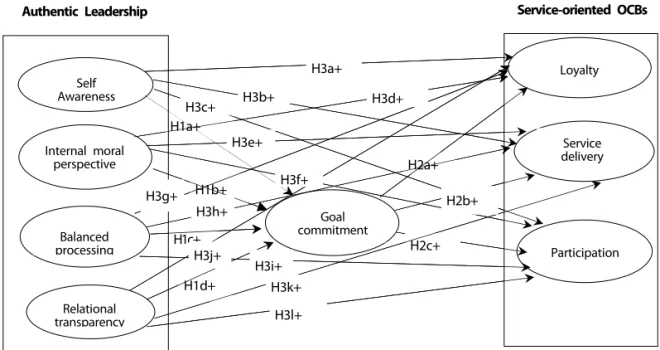
Figure 1. Conceptual model.
Service-oriented OCBs
H1a+
H1b+
H1d+
H1c+
Internal moral perspective
Self Awareness
Balanced processing
Relational transparency Authentic Leadership
H3b+
H3a+
H3c+ H3d+
H3e+
H3f+
H3j+
H3k+
H3l+
H3g+ H2b+
H3h+
H3i+
METHODS
Settlement of Proposed Model
As illustrated in Figure 1, based on the proposi- tions developed from the literature review, a con- ceptual model is proposed to describe the relation- ship among authentic leadership, goal commitment, and service-oriented OCBs.
Measurement Authentic Leadership
Authentic leadership in the hotel industry refers to driving hotel employees toward positive direc- tions, hence the organizational goal accomplishment based on a leader's positive psychology and mo- rality. This definition infers from Walumbwa et al[4]
and May et al[50]. Measurement items are employed from Walumbwa et al[4]. The subfactors of authentic leadership include self-awareness, internal moral per- spective, balanced processing, and relational trans- parency and each factor consists of four items. Total number of 16 items were rated on a Likert five-point scale from "strongly disagree" to "strongly agree".
Goal Commitment
Goal commitment in the hotel industry means the hotel employees' willingness not to abandon the or-
ganizational goals and consistent attitudes towards the goal accomplishment. This is based on Freund [18]. This study employs the measurement items of Hollenbeck et al[51] and Klein et al[52]. The five items were answered using a Likert five-point scale (1=strongly disagree, 5=strongly agree).
Service-oriented Organizational Citizenship Beha- viors(OCBs)
Service oriented OCBs in the hotel industry are the hotel employees' willingness to provide extra efforts for more advanced service quality and better image of their hotels. This is based on Bettencourt et al[24], from which the measurement items were employed. The measurement items include 16 items explaining three sub-factors: service-delivery OCBs, loyalty OCBs, and participation OCBs. These have been rated using a Likert five-point scale from 1-5 points (for strongly disagree to strongly agree, re- spectively).
Data Collection and Sampling Frame
This study targets front-line employees in the ho- tel industry, hence front-line employees in five-star deluxe hotels in Korea. The front-line employees of JW Marriot and Hyatt in Seoul were asked to be sur- veyed to conduct a preliminary study. They were
asked to mark whether any items are difficult to un- derstand and respond to each item over the period from May 10th to May 25th in 2016. The 50 cases were collected and it was investigated whether the suggested model is a reasonable fit.
The convenience sampling was adopted for the main survey, which included JW Marriot, Grand Hyatt, Westin Chosun, and Shilla hotels in Seoul.
Sheraton hotel in Incheon, Paradise hotel in Pusan, and Haevichi resort in Jeju. The employees in the managers' levels in each hotel have been asked to survey their front-line employees after the study purposes were explained. To fulfill the needs of re- search ethic recently issued, the employees' survey confidentiality was provided and the respondents are willingly allowed to refuse the survey or to ter- minate it even in the middle of the survey process.
About 300 cases had been distributed to the hotels and conducted from June 1st to June 20th. The total number of 285 cases were collected and 260 cases have been used for the study after the cases with missing values had been subsequently dropped.
Data Analysis
The collected data were analyzed using SPSS 19.0 and AMOS 7 software program. Through these pro- grams, descriptive statistics, multi-variate analysis of variance, and structural equation modeling (SEM) were utilized. Frequency analysis, reliability analysis after using Cronbach's alpha, and confirmatory ana- lysis were operated. Furthermore, in order to under- stand different relationship between variables, a cor- relation analysis was conducted. To verify the hy- potheses and model of the study, confirmatory fac- tor analysis was used to examine conformity of the causal relationship among each factor and cova- riance structure analysis was used to investigate each path coefficient. Further, the intervening effect of goal commitment between authentic leadership and service-oriented OCBs have been verified using Bootstrapping.
In assessing model fit, the following indices were employed: GFI (Goodness-of-fit index: desirable at ≧ 0.90), AGFI (Adjusted Goodness of fit Index: desirable at ≧0.90), RMR (Root Mean Square Residual: desir- able at ≦0.05), NFI (Normed fit index: desirable at
≧0.90), CFI (Comparative fit index: desirable at ≧
0.90), χ2 (chi-square: desirable at >0.05), TLI (Tucker- Lewis Index: desirable at ≧0.90), RMSEA (Root Mean Square Error of Approximation: desirable at <0.05).
Further, in terms of reliability of the measurement.
Cronbach's α was adequate at higher than 0.60[53].
If construct reliability reached above 0.7, convergent validity or internal consistency was secured[54]. In addition, construct validity was fulfilled if each value of factor loading was above 0.5 and convergent vali- dity was guaranteed as long as AVE reaches above 0.5[54].
RESULTS
Demographics
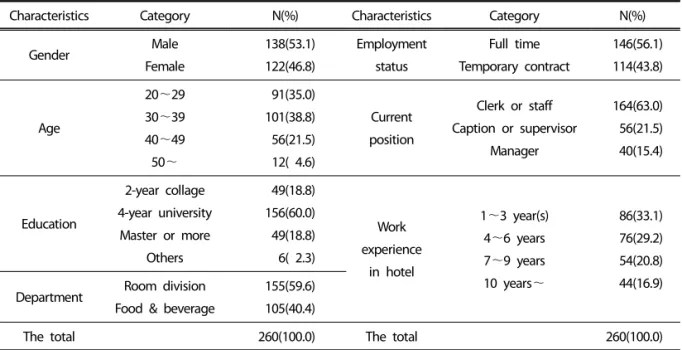
Table 1 describes the respondents’ demographic characteristics. They consist of 53.1 % of males and 46.8% of females. The majority of them (20~29:
35.0%. 30~39:38.8%) are in the age groups of 20~
39. Moreover, the majority of the respondents (60.0
%) have a degree of four-year university. The depart- ments are limited to room division and food and beverage department because front line employees in hotel organizations are targeted. As a result, room division includes 59.6% of the respondents and food and beverage include 40.4% of them. In addition, full time employees consist of 56.1% and employees in temporary contract consist of 43.8%. The current positions are divided into three categories including clerk, caption, and manager because the levels of subordinates are focused in this study (clerk or staff:
63.0%; caption or supervisor: 21.5%; manager:15.4%).
Also, the number of 86 people (33.1%) have 1~3 year(s) of work experience and 76 people (29.2%) have 4~6 years. The last of the respondents have work experience of seven years or more.
The confirmatory measurement model was as- sessed to evaluate the construct validity of the measurement used in this study. As noted by Noar [55](2003), confirmatory factor analysis (CFA) proce- dures can provide confirmation that psychometric properties at scale are satisfactory in extending be- yond exploratory analytic technique.
Measurement Model
It was noted that CFA can add further information about dimensionality of scale by testing a variety of
Characteristics Category N(%) Characteristics Category N(%)
Gender Male
Female
138(53.1) 122(46.8)
Employment status
Full time Temporary contract
146(56.1) 114(43.8)
Age
20~29 30~39 40~49 50~
91(35.0) 101(38.8) 56(21.5) 12( 4.6)
Current position
Clerk or staff Caption or supervisor
Manager
164(63.0) 56(21.5) 40(15.4)
Education
2-year collage 4-year university
Master or more Others
49(18.8) 156(60.0) 49(18.8) 6( 2.3)
Work experience
in hotel
1~3 year(s) 4~6 years 7~9 years 10 years~
86(33.1) 76(29.2) 54(20.8) 44(16.9) Department Room division
Food & beverage
155(59.6) 105(40.4)
The total 260(100.0) The total 260(100.0)
Table 1. Descriptive statistics of sample (N=260)
models against one another[55]. In this study, the confirmatory factor analysis was completed with maximum likelihood estimation.
CFA was applied to all the items and chi-square of 825.746, degree of freedom of 563, and p-value of 0.000(p<0.001). Further, the value in chi-square/df should be less than three to secure overall goodness of fit[54]. The value of chisqure/df shows 1.467 so that overall goodness of fit is identified.
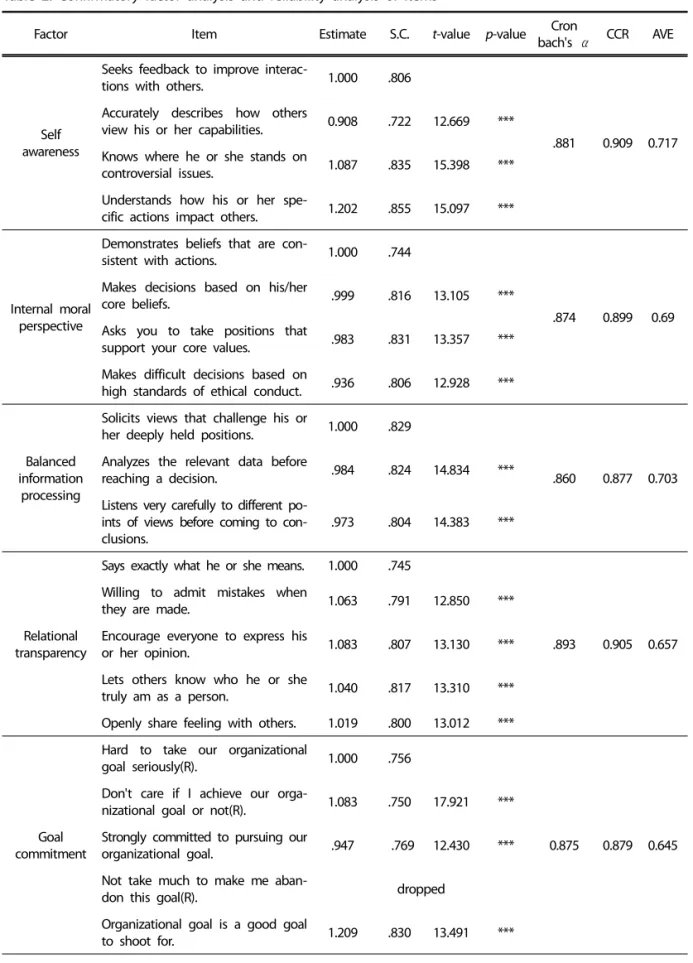
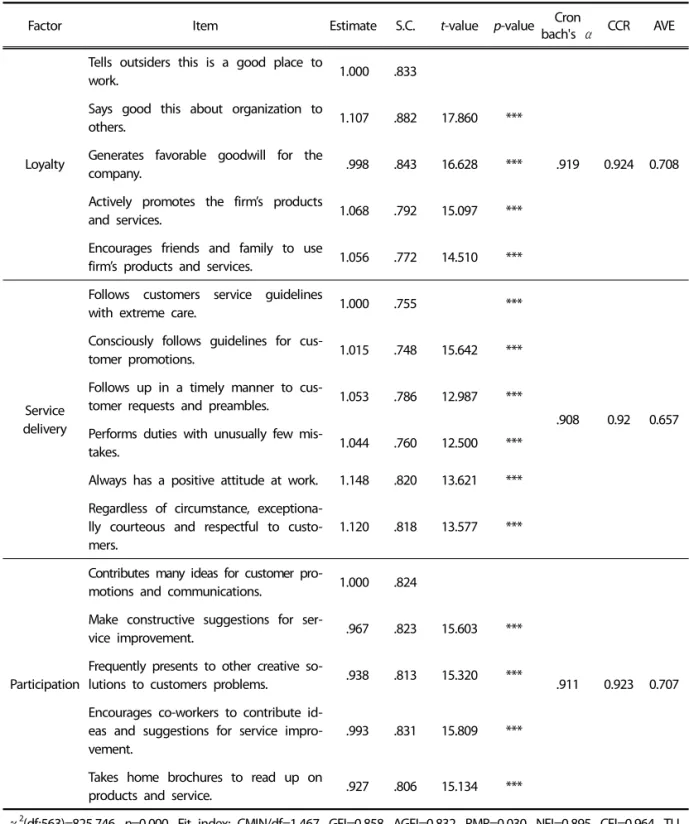
As presented in Table 2, GFI(0.858), NFI(0.895) and AGFI(0.832) indicate unfulfilled indices, however, RMR(0.030), CFI(0.964), TLI(0.959), and RMSEA(0.042) indicate the reasonable fit of the data. The relatively small sample sizes limit the possibility of reaching the 0.9 cutoff value for some fit indices and they are not dependable as "a stand alone index "[56, p. 54].
Further, a strict adherence to suggested cutoff val- ues can result in the improper rejection of an ac- ceptable model[57]. Therefore, the relationship am- ong the latent variables can be presumed with the reasonable fit of the data.
Further, Table 2 presents standard estimates for a measurement model. One of goal commitment items has been dropped due to unfulfillment of the requirement to explain a concept; factor loading should be higher than 0.5 and a few items that do not satisfy the criteria can be dropped[54]. Then, fac- tor loading of all measures was moderate(ranging
from 0.722 to 0.855). The factor loadings demon- strated that relevant measurement items performed moderately well in reflecting the designated under- lying construct.
Overall Reliability and Validity
As the survey items are adapted from different streams of studies, it is important to ensure con- struct reliability and validity. Cronbach's coefficient alpha was calculated to determine reliability of the measurement.
As indicated in Table 2, Conbach's α of each con- struct in measurement model is ranged from 0.860 to 0.919 significantly a scale with high level of reli- ability and reaches the fulfillment level.
In terms of construct reliability, the values of eight constructs ranged from 0.877 to 0.924 and meet the requirements. Table 2 presents factor loading of each variable is above 0.722, showing a moderate to high construct validity[54]. Further, Table 2 in- dicates the fulfillment of the criteria of convergent validity since each average variance extracted (AVE) reaches between 0.645 to 0.717.
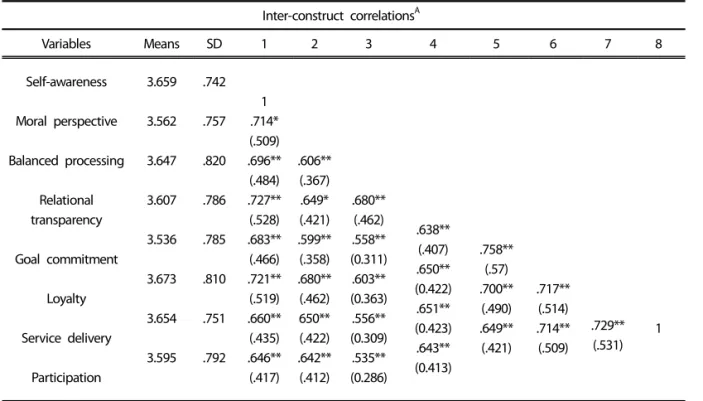
Discriminant validity was established using the procedures outlined by Fornell and Larcker[58]. Ta- ble 3 shows the correlations between the latent variables and Table 2 presents the average variance extracted (AVE) of each construct. According to
Factor Item Estimate S.C. t-value p-value Cron
bach's α CCR AVE
Self awareness
Seeks feedback to improve interac-
tions with others. 1.000 .806
.881 0.909 0.717 Accurately describes how others
view his or her capabilities. 0.908 .722 12.669 ***
Knows where he or she stands on
controversial issues. 1.087 .835 15.398 ***
Understands how his or her spe-
cific actions impact others. 1.202 .855 15.097 ***
Internal moral perspective
Demonstrates beliefs that are con-
sistent with actions. 1.000 .744
.874 0.899 0.69 Makes decisions based on his/her
core beliefs. .999 .816 13.105 ***
Asks you to take positions that
support your core values. .983 .831 13.357 ***
Makes difficult decisions based on
high standards of ethical conduct. .936 .806 12.928 ***
Balanced information
processing
Solicits views that challenge his or
her deeply held positions. 1.000 .829
.860 0.877 0.703 Analyzes the relevant data before
reaching a decision. .984 .824 14.834 ***
Listens very carefully to different po- ints of views before coming to con- clusions.
.973 .804 14.383 ***
Relational transparency
Says exactly what he or she means. 1.000 .745
.893 0.905 0.657 Willing to admit mistakes when
they are made. 1.063 .791 12.850 ***
Encourage everyone to express his
or her opinion. 1.083 .807 13.130 ***
Lets others know who he or she
truly am as a person. 1.040 .817 13.310 ***
Openly share feeling with others. 1.019 .800 13.012 ***
Goal commitment
Hard to take our organizational
goal seriously(R). 1.000 .756
0.875 0.879 0.645 Don't care if I achieve our orga-
nizational goal or not(R). 1.083 .750 17.921 ***
Strongly committed to pursuing our
organizational goal. .947 .769 12.430 ***
Not take much to make me aban-
don this goal(R). dropped
Organizational goal is a good goal
to shoot for. 1.209 .830 13.491 ***
Table 2. Confirmatory factor analysis and reliability analysis of items
Factor Item Estimate S.C. t-value p-value Cron
bach's α CCR AVE
Loyalty
Tells outsiders this is a good place to
work. 1.000 .833
.919 0.924 0.708 Says good this about organization to
others. 1.107 .882 17.860 ***
Generates favorable goodwill for the
company. .998 .843 16.628 ***
Actively promotes the firm’s products
and services. 1.068 .792 15.097 ***
Encourages friends and family to use
firm’s products and services. 1.056 .772 14.510 ***
Service delivery
Follows customers service guidelines
with extreme care. 1.000 .755 ***
.908 0.92 0.657 Consciously follows guidelines for cus-
tomer promotions. 1.015 .748 15.642 ***
Follows up in a timely manner to cus-
tomer requests and preambles. 1.053 .786 12.987 ***
Performs duties with unusually few mis-
takes. 1.044 .760 12.500 ***
Always has a positive attitude at work. 1.148 .820 13.621 ***
Regardless of circumstance, exceptiona- lly courteous and respectful to custo- mers.
1.120 .818 13.577 ***
Participation
Contributes many ideas for customer pro-
motions and communications. 1.000 .824
.911 0.923 0.707 Make constructive suggestions for ser-
vice improvement. .967 .823 15.603 ***
Frequently presents to other creative so-
lutions to customers problems. .938 .813 15.320 ***
Encourages co-workers to contribute id- eas and suggestions for service impro- vement.
.993 .831 15.809 ***
Takes home brochures to read up on
products and service. .927 .806 15.134 ***
χ2(df:563)=825.746, p=0.000, Fit index: CMIN/df=1.467, GFI=0.858, AGFI=0.832, RMR=0.030, NFI=0.895, CFI=0.964, TLI
=0.959, RMSEA=0.042, ***: 0.000, (R):reversed scored.
Table 2. Continued
Fornell and Larcker[58], squared correlation of the constructs must be less than the AVE of each under- lying construct in order for the constructs to have discriminant validity. As suggested in Table 2 and
Table 3, each AVE is ranged from 0.645 to 0.717, while squared correlations are ranged from 0.286 to 0.574. These outcomes meet the requirements of discriminant validity. As a result, it seems to be sig-
Inter-construct correlationsA
Variables Means SD 1 2 3 4 5 6 7 8
Self-awareness
Moral perspective
Balanced processing
Relational transparency
Goal commitment
Loyalty
Service delivery
Participation
3.659
3.562
3.647
3.607
3.536
3.673
3.654
3.595 .742
.757
.820
.786
.785
.810
.751
.792 1 .714*
(.509) .696**
(.484) .727**
(.528) .683**
(.466) .721**
(.519) .660**
(.435) .646**
(.417) .606**
(.367) .649*
(.421) .599**
(.358) .680**
(.462) 650**
(.422) .642**
(.412)
.680**
(.462) .558**
(0.311) .603**
(0.363) .556**
(0.309) .535**
(0.286)
.638**
(.407) .650**
(0.422) .651**
(0.423) .643**
(0.413)
.758**
(.57) .700**
(.490) .649**
(.421)
.717**
(.514) .714**
(.509)
.729**
(.531) 1
** significant at p<0.01 (two-way).
A Two standard-error interval estimate of correlation does not include value.
( ) squared correlation.
Table 3. Correlation matrix between the constructs
nificant to investigate the relationship among the suggested constructs.
Test of Hypotheses
1) Results of Overall Measurement Model Tes- ting
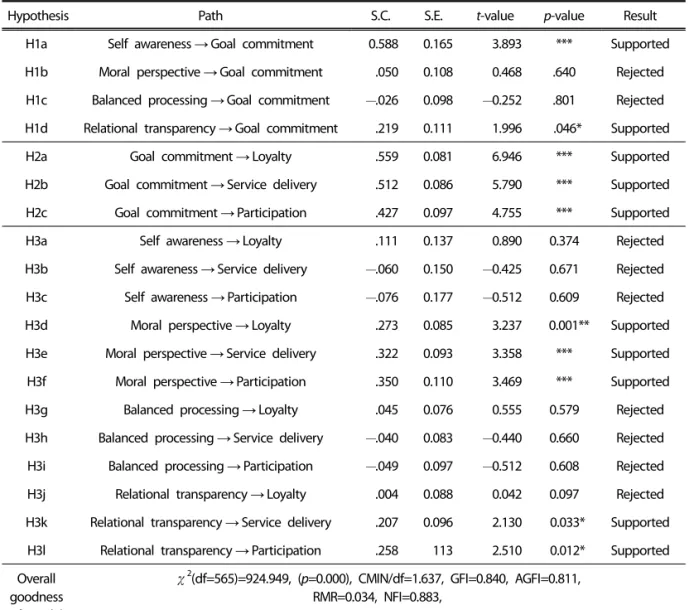
Table 4 illustrated the strength of the relation- ships among the constructs, showing path coeffi- cients and overall goodness of model fit indices.
Overall, the model was acceptable fit except GFI, AGFI, and NFI; (χ2: df=565)=924.949 (p=0.000), GFI=
0.840, AGFI=0.811, RMR=0.034, NFI=0.883, TLI=0.945, CFI=0.950, RMSEA=0.050. Although GFI, AGFI, and NFI do not fulfill the suggested cutoff, it is unrea- sonable to reject the suggested model[56,59]. Since the indices are sensitive to sample size, sole reliance on them is not recommended.
2) Results of Hypotheses Testing
The path coefficients were analyzed to examine
the suggested hypotheses as follows.
First, it has been found that superiors’ authentic leadership partially makes a significantly positive im- pact on front-line employees’ goal commitment. For example, it depicts path coefficient of 0.588 for the impact of the leaders' self-awareness on goal com- mitment (t>1.96). The leaders' relational transpa- rency makes a significantly positive impact on the front-line employees' goal commitment as well with path coefficient of 0.219(t>1.96). Thus, hypothesis 1a and 1d are supported. However, moral perspective and balanced processing failed to influence their goal commitment. Thus, hypothesis 1b and 1c are rejected. Therefore hypothesis 1 is partially support- ed. The results are consistent with existing studies, e.g.[27], which support the significant effect of au- thentic leadership on the group members' commit- ment towards their organizations.
Second, the positive relationship between the ho- tel front-line employees' goal commitment and their loyalty OCBs have been proven. For example, it de- picts path coefficient of 0.559 for the impact of goal
Hypothesis Path S.C. S.E. t-value p-value Result H1a Self awareness→ Goal commitment 0.588 0.165 3.893 *** Supported H1b Moral perspective→ Goal commitment .050 0.108 0.468 .640 Rejected H1c Balanced processing→ Goal commitment —.026 0.098 —0.252 .801 Rejected H1d Relational transparency→ Goal commitment .219 0.111 1.996 .046* Supported
H2a Goal commitment→ Loyalty .559 0.081 6.946 *** Supported
H2b Goal commitment→ Service delivery .512 0.086 5.790 *** Supported
H2c Goal commitment→ Participation .427 0.097 4.755 *** Supported
H3a Self awareness→ Loyalty .111 0.137 0.890 0.374 Rejected
H3b Self awareness→ Service delivery —.060 0.150 —0.425 0.671 Rejected H3c Self awareness→ Participation —.076 0.177 —0.512 0.609 Rejected
H3d Moral perspective→ Loyalty .273 0.085 3.237 0.001** Supported
H3e Moral perspective→ Service delivery .322 0.093 3.358 *** Supported H3f Moral perspective→ Participation .350 0.110 3.469 *** Supported
H3g Balanced processing→ Loyalty .045 0.076 0.555 0.579 Rejected
H3h Balanced processing→ Service delivery —.040 0.083 —0.440 0.660 Rejected H3i Balanced processing→ Participation —.049 0.097 —0.512 0.608 Rejected H3j Relational transparency→ Loyalty .004 0.088 0.042 0.097 Rejected H3k Relational transparency→ Service delivery .207 0.096 2.130 0.033* Supported
H3l Relational transparency→ Participation .258 113 2.510 0.012* Supported Overall
goodness of model fit indices
χ2(df=565)=924.949, (p=0.000), CMIN/df=1.637, GFI=0.840, AGFI=0.811, RMR=0.034, NFI=0.883,
TLI=0.945, CFI=0.950, RMSEA=0.050
*** : Significant at <0.001, ** significant at p<0.01, * significant at p<0.05.
Table 4. Parameter estimates in structural model
commitment on loyalty (t>1.96). Also, the signifi- cantly positive influence of goal commitment on service delivery OCBs has been supported with path coefficient of 0.512(t>1.96). At the same time, goal commitment in the hotel industry positively sig- nificant influence on participation OCBs in this study (path coefficient of 0.427, t>1.96). Therefore, hypo- thesis 2a, 2b, and 2c are supported. Therefore, hypo- thesis 2 is fully supported. The results are similar to the existing literature, e.g.[33], which significantly re- late authentic leadership to organizational commit- ment.
Third, self-awareness fails to make a significant in- fluence on loyalty, service-delivery, and participation OCBs. Therefore, hypothesis 3a, 3b, and 3c are re- jected. On the other hand, moral perspective makes a significantly positive impact on loyalty(path co- efficient of 0.273; t>1.96), service-delivery(path co- efficient of 0.322; t>1.96), and participation OCBs (path coefficient of 0.350; t>1.96). Thus, hypothesis 3d, 3e, and 3f are supported. In addition, Balanced processing fails to make a significant impact on each subfactor of service-oriented OCBs. Thus, hypothesis 3g, 3h, and 3i are rejected. Further, hypothesis 3j is
Self awareness
Moral perspective
Balanced processing
Relational transparency
Goal commitment
Total effects
Goal commitment 0.588 0.050 —0.026 0.219 -
Loyalty 0.439 0.301 0.030 0.126 0.559***
Service delivery 0.241 0.347 —0.053 0.320 0.512***
Participation 0.174 0.371 —0.060 0.351 0.427***
Direct effects
Goal commitment 0.588*** 0.050 0.026 0.219*
Loyalty 0.111 0.273** 0.045 0.004 0.559***
Service delivery —0.060 0.322*** —0.040 0.207* 0.512***
Participation —0.076 0.350*** —0.049 0.258* 0.427***
Indirect effects
Loyalty 0.329** 0.028 —0.015 0.123*
Service delivery 0.301** 0.026 —0.013 0.112*
Participation 0.251* 0.021 —0.011 0.093*
Note: significance of indirect effect are verified using Bootstrapping, significant at * p<0.05, ** p<0.01, *** p<
0.001.
Table 5. Total, direct, and indirect effects among latent variables rejected and 3k and 3l are supported because the
influence on service-delivery(path coefficient of 0.207;
t>1.96) and participation OCBs are positively sig- nificant(path coefficient of 0.258; t>1.96) while the impact of relational transparency on loyalty OCBs don't fulfill the demand level for support. As a result, hypothesis 3 is partially supported. In other words, authentic leadership partially influence front-line employees' service-oriented OCBs in the hotel in- dustry. The results share consistency with Valsania et al[36], which suggests the significant effect of the leaders' moral perspective and relational transpa- rency on the employees' organizational citizenship behaviors. The result also supports the idea of Wong and Cummings[39], which proves the significant ef- fect of a leader's relational transparency on the em- ployees' OCBs.
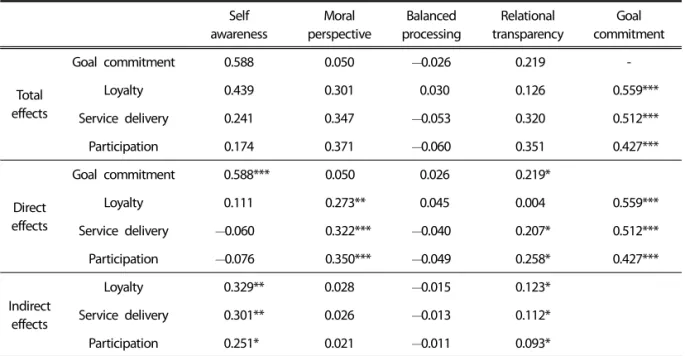
3) The Total, Direct, Direct, and Indirect Effects Table 5 summarizes total, direct, and indirect ef- fects among latent variables for measurement. As shown in the table, self-awareness and relational transparency perceived by front-line employees in the hotel industry has a significantly direct impact on their goal commitment while moral perspective
and balanced processing fail to explain the variance of goal commitment. Above all, self-awareness sh- ows the largest impact on goal commitment (path coefficient: 0.588) among all the investigated rela- tionships.
In addition, the hotel employees’ goal commit- ment directly influence their service-oriented OCB.
Specifically, loyalty was influenced by goal commit- ment the most (path coefficient: 0.559). Further, self-awareness fails to explain the variance of servi- ce-oriented OCBs. However, the indirect effects of self-awareness on service-oriented OCBs through goal commitment are significantly positive: path co- efficient of 0329(t<1.96) for the effect on loyalty OCBs, path coefficient of 0.301(t<1.96) for the effect on service-delivery, and path coefficient of 0.251 (t<1.96) for the effect on participation OCBs. Moral perspective makes a significantly positive impact on all subfactors of service-oriented OCBs while it doesn't make any indirect effect on them through goal commitment. Balanced processing fails to make direct and indirect effect on all subfactors of servi- ce-oriented OCBs. Relational transparency has an in- significant effect on loyalty OCBs but has a sig- nificant effect on service-delivery OCBs and partici-