온도 제어 비평형 분자동역학 방법을 이용한 나노임프린트 리소그라피 공정의 전산모사
권성진†․이영민*․임세영**
Simulation for nanoimprint lithography process using temperature controlled nonequilibrium molecular dynamics.
Sungjin Kwon, Youngmin Lee and Seyoung Im
Key Words: Nanoimprint lithography(나노임프린트 리소그라피), Polymer(고분자), Temperature controlled molecular dynamics(온도제어 분자 동역학)
Abstract
Temperature is an essential process variable in nanoimprint lithography(NIL) where the temperature varies between room temperature and above the glass transition temperature. To simulate NIL process, we employ both the Nose-Poincare method for temperature controlled molecular dynamics(MD) and force field for polymer material i.e. polymethyl methacrylate(PMMA), which is most widely selected as NIL resist. Nose-Poincare method, which convinces the conservation of Hamiltonian structure and time-reversal symmetry, overcomes the drawbacks inherent in the conventional methods such as Nose thermostat and Nose-Hoover thermostat. Thus, this method exhibits enhanced numerical stability even when the temperature fluctuation is large. To describe PMMA, we adopt the force field which account for bond stretch, bending, torsion, inversion, partial charge, and van der Waals energy.
†KAIST 기계공학과
E-mail : [email protected]
TEL : (042)869-3068 FAX : (042)869-3095 * KAIST 기계공학과
** KAIST 기계공학과
1. 서 론
Nanoimprint lithography(NIL) 기술은 경제적이고 도 효과적으로 나노구조물을 제작할 수 기술로, 각인된 스탬프(stamp)를 기판(substrate) 위에 스핀 코팅(spin-coating)된 폴리머 소재의 레지스트 (resist) 표면에 눌러 나노구조물을 반복적으로 전 사하는 기술이다[1,2]. 이러한 NIL 기술은 1996년 프린스턴 대학의 Chou[1] 등에 의해서 개발되었 고, 최근 우리나라의 연구진에 의해서 이러한
NIL 공정을 통한 나노 디바이스의 제작에 대해 많은 연구가 진행되고 있다.
이러한 NIL공정의 해석에 있어서 온도 제어와 와 폴리머 소재의 힘과 에너지를 표현하는 force field의 구현이 중요하다. 2장에서는 이러한 온도 제어의 성공적인 방법인 Recursive Multiple Nose-Poincare Thermostat[3]에 대하여 설명을 하 고, 3장에서는 polymethyl methacrylate (PMMA)의 표현을 위한 force field[4] 구현을 보이겠다.
2. Recursive Multiple Nose-Poincare Thermostat를 이용한 온도제어
2.1 Recursive Multiple Nose-Poincare Thermostat를 이용한 온도제어 이론
Thermostat을 이용한 정온과정의 구현은
Nose[5,6]에 의하여 제안되었으나 이 방법은 시간 변환이 필요하기 때문에 실공간의 변수를 사용할 수 없고 이로 인한 시간상관함수(time-correlation function)의 계산에 어려움이 있었다. 후에 Hoover[6,7]가 실공간에 대한 변수를 사용하여 수 정하였으나 이 방법은 수학적으로 정준변환 (canonical transformation)이 아니므로 확장된 헤밀 토니안(extended Hamiltonian)으로부터 그 운동방 정식을 얻을 수 없고 심플렉틱 시간적분 (symplectic integration)을 적용할 수 없어 수치적 불안정성을 가지고 있었다. 하지만 이는 Leimkuhler[3],등에 의하여 제안된 Poincare 변환을 사용함으로써 해결되었다. 이러한 변환을 이용한 확장된 헤일토니안은 식(1)과 같이 표현된다.
s kT Q N
V p s H m
s H H H
f s s
i i
i Nose
Nose NP
2 ln
~ ) 2 (
~ ) (
2 2
2 0
+ + +
=
−
=
∑
p q (1)
여기서 q 는 입자의 위치, p
~i는 운동량 m
i는
입자의 질량, s는 thermostat변수이고, Q
s는
thermostat의 가상 질량, p
~s는 thermostat의 운동 량, N
f는 총 자유도수, k는 볼쯔만 상수 (Boltzmann constant)를 T는 온도를 나타낸다. 또 여기서 H
0는 H
Nose의 초기 값으로 초기에 H
~를 0을 만드는 헤밀토니안이다. 하지만 좀 더 정 밀한 해석을 위하여 Leimkuhler[3]등에 의하여 순 환다중 thermostat을 적용하였다. thermostat체인은 앞서 적용한 thermostat을 제어하기 위한 방법인 반면, 순환다중 thermostat은 앞선 thermostat을 포 함한 전 시스템을 제어하고, 이를 적용한 확장 헤밀토니안은 (2)와 같이 표현된다. 여기서는 일 반적인 경우 M개의 thermostat을 이용한 경우이 다. 여기서 a
j와 C
j로 이루어진 보조 함수 (auxiliary function)은 음의 피드백(negative feedback)역할을 하여 thermostat을 제어한다.
⎥⎥
⎥⎥
⎥⎥
⎥⎥
⎥
⎦
⎤
⎢⎢
⎢⎢
⎢⎢
⎢⎢
⎢
⎣
⎡
⎟−
⎟
⎠
⎞
⎜⎜
⎝
⎛ −
+
− + +
+ +
+ +
=
∑
∑
∑
=
−
= +
−
−
0 2
2 1
2
1
1
2 2
1 2 2
2 2 2 1
2
2 1
2 ) ln (
) 1 (
2 ln
~
2
~ )
2 (
~
C H s s a
kT j N
s kT Q N
p
s s Q
p s V
s s m
s s s H
M
j j
j j j f
f M s
M
j j j M
s
i i M
i
M recursive
Poincare Nose
M
j
L L
L
p q
(2)
3. Polymethyl methacrylate (PMMA)의 표현을 위한 force field 구현 및 NIL
공정 해석 개요
3.1 PMMA force field
PMMA는 NIL 공정에서 많이 사용되는 폴리머 레지스트로 Fig. 1(a)와 같은 구조를 가지고 있다.
폴리머 해석에서는 흔히 수소와 같이 질량의 작 은 원자의 자유도를 줄이기 위하여 연합 원자 (united atom) 모델을 사용하여 폴리머를 표현한 다. 예를 들어, Fig. 1(b)에서 CH
3와 같은 분자를 하나의 입자로 나타내어 자유와 계산 시간을 줄 인다[4].
(a)
(b)
Fig. 1 Molecular structure of PMMA . (a) all
atom model, (b) united atom model[4]
Fig. 2 Foce-field components
이렇게 자유도가 감소한 PMMA의 표현을 위해 서는 정확한 force field의 사용이 중요하다. 본 연 구에서는 Fig. 2와 같이 PMMA 분자 내부와 다른 분자 사이의 힘과 에너지 계산에 있어서 bond stretch, bending, torsion, inversion, Van der Waals, 그리고 electro static(Coulomb) 성분을 고려하였 다.[4]
이러한 PMMA분자와 그 사슬을 구조를 고려하 여 Fig. 3과 같이 NIL 공정을 위한 초기 모델을 만들었다. Fig. 3은 14000개의 PMMA 입자를 이
용하였고, ‘가로×높이×두께‘가 각각
21nm×7nm×2nm이고 가로 방향과 두께 방향으로 는 주기 경계 조건을 적용하였다. 여기서 기판과 스템프의 재료는 실리콘을 사용하였다.
Fig. 3 Initial model for NIL process simulation.
(a)
(b)
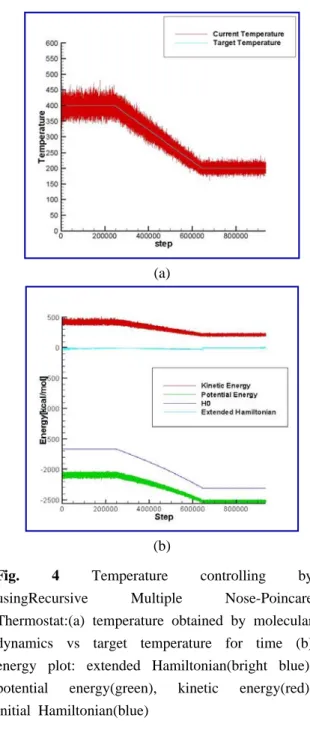
Fig. 4 Temperature controlling by usingRecursive Multiple Nose-Poincare Thermostat:(a) temperature obtained by molecular dynamics vs target temperature for time (b) energy plot: extended Hamiltonian(bright blue), potential energy(green), kinetic energy(red), initial Hamiltonian(blue)
4. 결 론
우선, 앞서 2장에서 언급한 Recursive mltiple
Nose-Poincare termostat이 온도의 제어에 적합한
방법인지를 확인하기 위하여, 236개의 알루미늄
원자에 Lennard-Jones 포텐셜을 사용한 분자 동역
학 문제에 적용하여 보았다. 그 결과는 Fig. 4(a)
처럼 시스템이 원하는 온도를 잘 표현하고 있었
고 Fig. 4(b)는 앞서 이론에서 언급한대로 온도를
제어하는 동안 확장 헤밀토니안이 0에 가까운 값
을 잘 표현함을 보여준다.
Fig. 5 Result of NIL process simulation: (a) temperature control (b) reaction tip force
알루미늄의 경우의 예제를 통하여 Recursive Multiple Nose-Poincare Thermostat이 시스템 온도 를 정확하게 제어함을 확인하였고, Fig. 3과 같 은 NIL 공정에 적용하였다. Fig 5는 NIL 공정 중 에 온도와 스템프가 받는 힘을 나타낸 선도이다.
앞선 예제와 마찬가지로 이 경우에도 목표 온도 를 분자 동역학 해석이 잘 표현함을 확인했다.
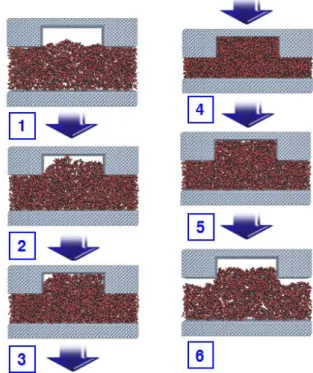
Fig. 6과 Fig. 7은 분자 동역학 해석을 통해 얻 은 NIL 공정 해석 결과이다. Fig. 6은 스템프와 폴리머 소재간의 인력이 기판과 폴리머 소재간의 인력보다 커서, 스템프를 제거하는 과정에서 폴 리머 소재와 흡착 현상이 발생하였다. 실제로 이 러한 현상은 실험과 공정 중에도 많이 발생하고
Fig. 6 Result of NIL process simulation without considering ASL effect
이를 줄이기 위하여 Anti-sticking Layer(ASL)를 사용한다. 이러한 ASL의 효과를 표현하기 위하여 폴리머 소재와 스템프와의 인력을 결정하는 force field의 계수를 조정하여 Fig. 7과 같은 결과를 얻 었다.
Fig. 7 Result of NIL process simulation with
considering ASL effect
후 기
본 연구는 과학기술부가 주관하는 21세기 프론 티어연구개발사업의 일환인 나노메카트로닉스기
술개발사업단의 연구비 지원
(M102KN010010-07K14 01-01010) 을 통해 수행되 었습니다.
참고문헌