다른 온도 조절 상태에서 분자 동역학에서 콜라겐 단백질의 거동
윤영준*, 조강희**, 한석영***
The behavior of collagen-like molecules in response to different temperature setting methods in steered molecular
dynamic simulation
Young-June Yoon*, Kang-Hee Cho**, Seog-Young Han***
요 약 타입 1 콜라겐 단백질은 인체 내에서 가장 많이 존재하는 단백질이다. 이 단백질은 점탄성 거동을 보이며 이는 힘줄에서도 찾아볼 수 있다. 분자동역학 시뮬레이션 방법에는 rescaling 방법과 reassignment 방법으로 온도를 조절할 수 있다. rescaling 방법은 온도를 주어진 온도로 책정하는 방법이고, reassignment 방법은 원하는 온도로 맥스웰 분 포를 이용하여서 온도를 책정하는 방법이다. 우리는 reassignment 방법에서 콜라겐 단백질의 거동이 시간에 따라서 변 화하는 현상을 찾아내었다. 반면에 rescaling 방법에서는 시간에 무관하게 거동하였다. 콜라겐에 다른 속도로 인장을 가 하였을 경우, 예를 들어 0.5, 1, 2, 5 Å/ps의 속도로 40 Å까지 힘을 가했을 경우, rescaling 방법에서는 속도에 따른 변화가 거의 없었던 반면, reassignment 방법의 경우 대략 80nm, 100nm, 130nm, 180nm까지 인장이 되었음을 보 여준다. 이 현상에 대한 물리학적 의미를 명확하게 규명하지는 못하였지만, 단백질에 관한 시뮬레이션을 실행하는데 있어 서 주의를 기울여 수행하여야 한다는 점에서 이 논문의 가치가 있다고 생각한다.
Abstract Collagen type I is the most abundant protein in the human body. It shows viscoelastic behavior, which is what confers tendons with their viscoelastic properties. There are two different temperature setting methods in molecular dynamics simulations, namely rescaling and reassignment. The rescaling method maintains the temperature by scaling the given temperature, while the reassignment method sets the temperature according to a Maxwell distribution at the target temperature. We observed time-dependent behavior when the reassignment method was applied in tensile simulation, but not when the rescaling method was applied. Time-dependent behavior was observed only when the reassignment method was applied or when one side of the collagen molecule was stretched to a greater extent than the other side. As result, the collagen is elongated to 80nm, 100nm, 130nm, and 180nm, respectively, when the collagen is pulled by different velocities, 0.5, 1, 2, and 5 Å/ps, up to 40 Å. The results do not provide a detailed physical explanation, but the phenomena illustrated in this result are important for caution when further simulations are performed.
Key Words : molecular dynamics, collagen, stress-strain curve, constant temperature, viscoelasticity
This research was supported by the Basic Science Research Program through the National Research Foundation of Korea (NRF) funded by the Ministry of Education (grant number 2015R1D1A1A09057878).
* Center for Creative Convergence Education, Hanyang University
** Manufacturing Engineering Team, Doosan Mottrol
*** Corresponding Author : Corresponding author, School of Mechanical Engineering, Hanyang University ([email protected])
Received October 13, 2020 Revised October19, 2020 Accepted October 19, 2020
1. Introduction
Collagen type I is the most abundant protein in the human body and is subjected to tensile stress as a component of bone, teeth, skin, tendons, and ligaments. The building block of collagen type I is tropocollagen, a triple-helical structure of three polypeptides. The helical structure is stabilized primarily by H-bonding between residues. Every third residue in each of these molecules is a glycine (GLY), and about one-fourth of the tropocollagen molecule consists of proline (PRO) and hydroxyproline (HYP). The crystal structure of a tropocollagen peptide has been solved (Protein Data Bank ID: 1QSU) [1].
Hydration of a protein is important in its function and assembly. Water molecules interact with the backbone of 1QSU. This influences the collagen-type molecule’s behavior when exposed to stimuli such as mechanical loading due to locomotion or movement. When protein is subject to external loading, the interaction of water molecules with the protein determines the force distribution in the backbone of the protein molecule. In connective tissues, water molecules around collagen determine interactions between the residues of collagen and water molecules. H-bonds are established between collagen and water, which affect the mechanical behavior of collagen molecules [2].
The mechanical behavior of collagen molecules can be determined theoretically and experimentally. Similar to the experimental pulling of proteins using atomic force microscopy (AFM) [3] and laser
optical tweezers (LOT) [4], molecular dynamics tools such as Steered Molecular Dynamics (SMD) [5] can be used to investigate the behavior of proteins under mechanical force. While a molecular dynamics simulation can show interactions among collagen molecules and water molecules, SMD simulations can reveal the behavior of specific atoms of the collagen molecule subjected to external pulling.
There are two ways to conduct SMD simulations: using a constant force to pull selected atoms or using a constant velocity.
For SMD simulations, the force field among atoms has to be defined to determine the potential energy of the system of particles. CHARMM (Chemistry at Harvard Macromolecular Mechanics) model has been widely used to investigate the behavior of proteins and related materials and structures in biophysics, and provides a basic description of proteins [6]. It includes harmonic and anharmonic terms describing van der Waals (vdW) interactions, ionic (Coulomb) interactions, as well as hydrogen bonding. Because the bonds between atoms are modeled by harmonic springs, bonds among atoms cannot be broken and new bonds cannot be formed. Furthermore, charges are fixed and cannot be changed, and the equilibrium angles among residues are not altered by stretching. However, CHARMM does not have hydroxyproline residues (“HYP” in the PDB file), and a description of these residues has to be added as an extension to the standard CHARMM force field.
Collagen molecules show viscoelastic behavior like tendons [7]. Energy storage
capability of tendons is due to the stretching of triple helical collagen molecules. Energy dissipation is caused by the sliding of neighboring fibrils and bundles of fibrils during tensile deformation [8]. The viscoelastic behavior of collagen molecules cam be modeled mathematically using an elastic spring and a viscous element. The elastic spring represents the elastic stretching of collagen triple helices and the viscous element represents the sliding of collagen fibrils over each other.
In collagen and tendons, mechanical behavior is dependent upon pulling velocity, but not all SMD simulations show time-dependent mechanical behavior.
2. Method
2.1 Protein selection and psf generation The crystal structure 1QSU was downloaded from the Protein Data Bank (PDB). 1QSU is a collagen-type 1 molecule that is composed of three chains with a triple helical structure.
The psf file was generated from the downloaded 1QSU pdf file using the program psfgen. This software generates a psf file that calculates interaction between atoms in molecules. We employed the CHARMM force field in psfgen and used the two input files
“top_all22_prot.inp” and
“par_all22_prot.inp” that do not have HYP residues. We therefore added the topology and parameter files of HYP residues to the 1QSU pdb file.
The generated psf file connected the N-terminal of 1QSU with the C-terminal,
but this connection should not exist and we therefore removed it and divided 1QSU into three chains. Note that 1QSU was aligned in the y-direction and solvated in water.
2.2 Minimization and equilibrium
Energy minimization and equilibrium are required for molecular dynamics simulations.
For minimization and equilibrium, the temperature was set to 0K for 2 ps (from 0 to 2 ps). For the 10 ps from 2 to 12 ps, temperature was gradually increased from 0K to 300K. For the next 88 ps (from 22 to 110 ps), the temperature was set to 300K to allow for convergence of minimization and equilibrium. Two different temperature setting methods, namely rescaling and reassignment methods, were used to maintain the temperature at 300K. The rescaling method maintains the temperature by scaling the given temperature, while the reassignment method sets the temperature according to a Maxwell distribution at the target temperature.
2.3 Steered Molecular Dynamics (SMD) The N-terminal of the 1QSU protein was fixed and the C-terminal was set to be the SMD atom. The SMD atom was connected to a dummy atom by an imaginary spring.
The dummy atom was pulled at a constant velocity (0.5Å/ps, 1Å/ps, 2Å/ps and 5Å/ps).
Data were generated by SMD simulation and plotted using Microsoft Excel.
Simulation parameters are provided in Table 1.
3. Results
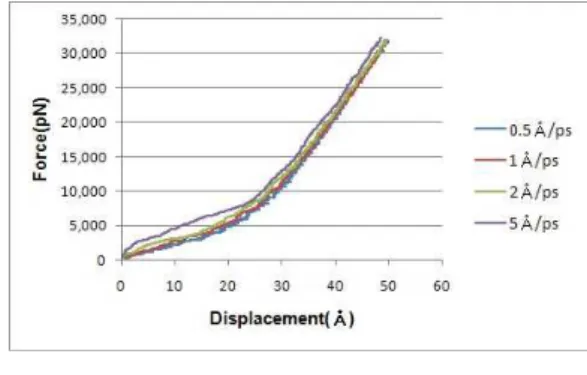
The mechanical behavior of the collagen-like molecule can be visualized in Figures 1 and 2. The triple helical 1QSU molecule was unwound and stretched uniformly using the rescaling method shown in Figure 1. The mechanical behavior of 1QSU was not time-dependent (Figure 3). In this simulation, the temperature for the simulation was set to 300K using the rescaling method. However, the triple helical 1QSU molecule was stretched without unwinding (see Figure 2) when the reassignment method was employed to maintain the temperature at 300K. The mechanical behavior of 1QSU when using the reassignment method revealed a time-temperature dependence similar to that of a tendon, which is shown in Figure 4. As results, the collagen is elongated to 80nm, 100nm, 130nm, and 180nm, respectively, when the collagen is pulled by different velocities, 0.5, 1, 2, and 5 Å/ps, up to 40 Å.
4. Discussion
The velocity of collagen molecules determined by the Maxwell-Boltzman distribution (reassignment method) was not equal to that of other collagen molecules along the 1QSU collagen-like microfibril’s backbone. However, the velocity of collagen molecules determined by the rescaling method was equal to that of other collagen molecules along the 1QSU collagen-like microfibril’s backbone regardless of where the collagen
molecules were located. The right side of the collagen molecule moved faster than the left side of the collagen molecule when the reassignment method was employed (Figure 2). The right side of the collagen molecule unwound and stretched compared to the left side because the velocity of collagen molecules of the stretched side determined by the Maxwell-Boltzman distribution was faster on the right than the left. The velocities of each molecule by rescaling method are determined by the given temperature, but those by reassignment method are randomly selected by Maxwell-Boltzman distribution. The difference between these two methods is the reassignment method, which is involved with the collision among molecules while the rescaling method selects the velocity for the given temperature. Thus we think that the collision among molecules from the left side increases the displacement between molecules.
We suspect that the viscoelastic behavior of collagen and tendons is due to the local elongation of collagen molecules due to collision of water molecules between collagen molecules, as shown in Figure 2. No time-dependent behavior would be observed if collagen molecule fibrils unwound uniformly and stretched as shown in Figure 1, but time-dependent behavior has been observed in the collagen and tendon experiments. Note that a similar trend was observed by Gautieri et al. [9] i.e. the deformation rate affects the elasticity of collagen molecules. Then we can conclude
that the collagen fibrils are elastically elongated unwound when no collision between collagen molecules and water are involved, but those are viscoelastically elongated, or time dependently, when the collision between collagen molecules and water occurs. Experiments should therefore be conducted to determine if collagen fibril elongation occurs uniformly or not.
(a)
(b)
Fig. 1. Behavior of collagen-like molecules when the rescaling method was used. (a) Structure before deformation and (b) structure after deformation.
(a)
(b)
(c)
Fig. 2. Behavior of a collagen-like molecule when the reassignment method is used. (a) Before deformation, (b) after deformation (80 ps), and (c) 270 ps after deformation.
Fig. 3. Force-displacement curves of collagen-like molecule when the rescaling method was used.
Fig. 4. Force-displacement curve of collagen-like molecules when the reassignment method was used.
Table 1. Simulation parameters Simulation conditions Values Time step 2 fs
Pulling velocity 0.5, 1, 2, 5 Å/ps Spring constant 4.17 kcal/mol/Å2
REFERENCES
[1] S. R. Ahuja, K. D. Hong, K. S. Hong, "The Rapport Multimedia Conferencing System: A Software Overviews", Proc. of 2nd IEEE Conf erence on Computer Workstations, pp. 52-5 8, March, 1988.
[1] Kramer, R.Z., Venugopal, M.G., Bella, J., Ma yville, P., Brodsky, B., Berman, H.M. “Stagge red molecular packing in crystals of a colla gen-like peptide with a single charged pai r”, J. Mol. Biol., 301(5), pp. 1191-1205, 2000 [2] Hulmes, D.J.S. Collagen Diversity, Synthesis
and Assembly. In Collagen: Structure and M echanics (Ed. P.Fratzl, 2008, 15-47, Springer Science+Business Media, LLC, New York, N Y)
[3] Balooch, M., Wu-MAgidi, I-C., Balazs, A., Lu ndkvist, A.S., Marshall, S.J., Marshall, G.W., Siekhaus, W.J., Kinney, J.H. “Viscoelastic pro perties of demineralized human dentin meas ured in water with stomic force microscope (AFM)-based indentation”, Journal of Biomed ical Materials Research (Part A), 40(4), pp. 5 39-544, 1998
[4] Sun, Y.L., Luo, Z.P., Fertala, A. An, K.N. “Di rect quantification of the flexibility of type I collagen monomer”, Biochemical and Biop hysical Research Commnunications, 295(2), pp. 382-386, 2002
[5] Zhang, D., Chippada, U. Jordan, K. “Effect of the Structural Water on the Mechanical P roperties of Collagen-like Microfibrils: A Mo lecular Dynamics Study”, Annals of Biomedic al Engineering, 35(7), 1216-1230, 2007 [6] MacKerell, A.D., Bashford, D., Bellott, M., D
unbrack, R.L., Evanseck, J.D., Field, M.J.,Fisc her, S., Gao, J., Guo, H., Ha, S., Joseph-Mc Carthy, D., Kuchnir, L., Kuczera, K., Lau, F.
T.K., Mattos, C., Michnick, S., Ngo, T., Ngu yen, D. T., Prodhom, B., Reiher, W.,E. III, R oux, B., Schlenkrich, M., Smith, J.C., Stote, R., Straub, J., Watanabe, M., Wiorkiewicz-K uczera, J., Yin, D., Karplus, M. “All-Atom E mpirical Potential for Molecular Modeling a nd Dynamics Studies of Proteins”, J. Phys. C hem. B, 102(18), pp. 3586-3616, 1998 [7] Puxkandl, R., Zizak, I., Paris, O., Keckes, Te
sch, W., Bernstorff, S., Purslow, P., Fratzl, P.
“Viscoelastic properties of collagen: synchrot ron radiation investigations and structural m odel”, Phil. Trans. R. Soc.Lond.B, 357(1418), pp. 191-197, 2002
[8] Silver, F.H., Landis, W.J. Viscoelasticity, Ener gy Storage and Transmission and Dissipation by Extracellular Matrices in Vertebrates, In Collagen: Structure and Mechanics (Ed. P.Fra tzl, 2008, 15-47, Springer Science+Business Media, LLC, New York, NY)
[9] Gautieri, A., Buehler, M.J., Redaelli, A. Defo
rmation rate controls elasticity and unfoldin g pathway of single tropocollagen molecule s. Journal of The Mechancial Behavior of Bi omedical materials, 2(2), pp. 130-137, 2009
저자약력
Young-June Yoon
• B.E (1996) Mechanical Engineering, Myongji University
• M.E. (2001) Mechanical Engineering, City College of New York
• Ph.D. (2005) Mechanical Engineering, City University of New York
Biomechanics, Mechanobiology, Micromechanics, and Ultrasound therapeutic medical treatments
Kang-Hee Cho
• B.S. (2009) Department of Mechanical Engineering, Daejin University
• M.S. (2012) School of Mechanical Engineering, Hanyang University
Production of swing motors and to develop new products; Installing and renovating performance facilities that meet product performance standards;
Optimizing each process and line, manufactureing fixtures to improve productivity, and reducing manufactureing cost; Standard time for each line and engaged in LOB improvement activities.
Seog-Young Han