Effects of Polygonati Rhizoma Extracts on the Collagenase Activity and Procollagen Synthesis in Hs68 Human Fibroblasts and Tyrosinase Activity
Dong-Su Park#, Seon-Mi Shin, Kang-Hyun Leem*
College of Korean Medicine, Semyung University, Jechon 390-711, Korea
ABSTRACT
Objectives: This study was designed to investigate the collagen metabolism and tyrosinase activity of Polygonati Rhizoma extracts (PR). It's effects are to tonify spleen qi and augment the spleen yin. It enrichs the yin and moisten the lung.
Methods : The effect of PR on type I procollagen production and collagenase (matrix metalloproteinase-1, henceforth referred as MMP-1) activity in human normal fibroblasts Hs68 after ultraviolet B (UVB, 312 nm) irradiation was measured by ELISA method. The tyrosinase activity after treatment of PR was measured.
Results : There were no cytotoxicity at concentrations of 10, 30, 100 µg/ml. The reduced type I procollagen production was recovered by PR in UVB damaged Hs68 cells at a concentration of 100 µg/ml (16.2 ± 0.0 ng/ml) from control group (13.9 ± 0.5 ng/ml). However there was no statistical significance. PR reduced The increased MMP-1 activity after UVB damage at concentrations of 10 µg/ml, 30 µg/ml, and 100 µg/ml in a dose dependent manner (42.2 ± 20.5%, 44.8 ± 8.5%, and 22.0 ± 5.8%). PR 100 µg/ml treatment showed the statistical significace (p < 0.05). PR significantly reduced the tyrosinase activity at a concentration of 10 mg/ml (32.0 ± 12.8%, p < 0.05). However, the L-DOPA oxidation was not changed.
Conclusion : PR showed the anti-wrinkle effects and whitening effects in vitro. Although more researches are needed to validate the efficacy, these results suggest that PR may have potential as an anti-aging ingredient in cosmetic herb markets.
Key words : Polygonati Rhizoma, type I procollagen, collagenase, tyrosinase
Introduction
1)Polygonati Rhizoma (PR) is the root of Polygonatum sibiricum, P. falcatum, or P. kingianum1). It's effects are to tonify spleen qi and augment the spleen yin. It enrichs the yin and moisten the lung1,2). Accordingly, PR has been used to delay the aging process.
There are two major theories of aging: the programmatic theory states that aging is an inherent genetic process, and the stochastic theory states that aging represents random environmental damage. Processes that are associated with cellular damage and aging are the production of free radicals (a process much enhanced after ultraviolet irradiation) and an increasing number of errors during DNA replication.
Cellular manifestations of intrinsic aging include decreased life span of cells, decreased responsiveness of cells to growth signals, which may reflect loss of cellular receptors to growth factors, and increased responsiveness to growth inhibitors. All these findings are more pronounced in cells derived from photodamaged skin3).
It has been shown that UV irradiation leads to the formation of reactive oxygen species (ROS) that activate the mitogen-activated protein (MAP) kinase pathway, which subsequently induces the expression and activation of matrix metalloproteinases (MMPs) in human skin in vivo4,5). MMPs including collagenase are considered key factors in the photoaging process.
In the present study, we investigated the effect of PR on type I procollagen production and collagenase activity in human normal fibroblasts Hs68 after UVB
*Corresponding author : Kang-Hyun Leem, College of Korean Medicine, Semyung University, Jechon 390-711, Korea.
·Tel : +82-43-649-1341 ·Fax: +82-43-649-1341 ·E-mail : [email protected]
#First author : Dong-Su Park, College of Korean Medicine, Semyung University, Jechon 390-711, Korea.
·Tel : +82-43-649-1341 ·E-mail : [email protected]
·접수:2013년 4월 24일 ·수정:2013년 5월 22일 ·채택:2013년 5월 24일
(312 nm) irradiation. The tyrosinase activity after treatment of PR was measured as well.
Materials and Methods
1. Sample preparation
Polygonati Rhizoma was purchased from Omniherb (Cultivated in Korea). Polygonati Rhizoma extracts (PR) was prepared as follow. 100 g of Polygonati Rhizoma in 2,000 ml distilled water was heated in a heating extractor for 3 hours. The extract was filtered and concentrated by using the rotary evaporator. The extracts were lyophilized by using freeze dryer (15.3 g). The extract was dissolved in water and filtered three times through micro-filter paper and syringe filter (Whatman #2, 0.45 µm to 0.2 µm). Filtered material was placed in the disinfected vial and was sealed for further study.
2. Reagents
All reagents were purchased from Sigma-Aldrich except as mentioned below (St. Louis, MO, USA).
3. Cell culture
Hs68 human fibroblasts (Health Protection Agency Culture Collections, UK) were cultured in Dulbecco's Modified Eagle's medium (Gibco, USA) containing 10%
fetal bovine serum, 1% antibiotics at 37℃ in a humidified atmosphere of 5% CO2. When cells reached above confluency, subculture was conducted at a split ratio of 1:3.
4. UVB irradiation
A UVB lamp (Vilber Lourmat, France) was used as a UVB source. In brief, Hs68 cells were rinsed twice with phosphate-buffered saline (PBS), and all irradiations were performed under a thin layer of PBS (200 µl/well). Immediately after irradiation, fresh serum-free medium was added to the cells. After 24 hours incubation period, responses were measured.
Mock-irradiated blanks followed the same schedule of medium changes without UVB irradiation.
5. Cell viability
General viability of cultured cells was determined by reduction of 3-(4,5-dimethylthiazol-2-yl)-2,5 -diphenyltetrazolium bromide (MTT) to formazan. The
Hs68 cells were seeded in 24-well plates at a density of 2×10⁵/ml per well and cultured at 37℃ in 5% CO2. Cells were pretreated with the sample at a concentration of 10, 30, and 100 µg/ml for 24 hours prior to UVB irradiation. After UVB irradiation, cells were retreated with the sample and incubated for additional 24 hours, before being treated with 0.05 mg/ml (final concentration) of MTT. The blank and control group was cultivated without sample treatment. The cells were then incubated at 37℃ for additional 4h. The medium containing MTT was discarded, and MTT formazan that had been produced was extracted with 200 µl of DMSO. The absorbance was read at 595 nm with a reference wavelength of 690 nm. The cell viability being calculated as follows:
Cell viability (%)
= [(OD595 of sample) / (OD595 of control)] × 100
6. Assays of collagen type I synthesis and collagenase inhibition
Hs68 human fibroblasts were inoculated into 24-well plate (2×10⁵ cells/well) and cultured at 37℃
in 5% CO2. Cells were pretreated with the sample at a concentration of 10, 30, and 100 µg/ml for 24 hours prior to UVB irradiation. After UVB irradiation, cells were retreated with the sample and incubated for additional 24 hours. The blank and control group was cultivated without sample treatment. After culturing, the supernatant was collected from each well, and the amount of pro-collagen type I was measured with a procollagen type I C-peptide assay kit (Takara Bio, Japan). The activity of collagenase was measured with a matrix metalloproteinase-1 (MMP-1) human biotrak ELISA system (Amersham life science, USA).
7. Tyrosinase inhibition assay
Tyrosinase activity was determined essentially as previously described6). The reaction mixtures were prepared by adding 40U of mushroom tyrosinase to 20 µl of PR dissolved in distilled water (0.1, 1, and 10 mg/ml), and then adding 40 µl of 1.5 mM L-tyrosine and 220 µl of 0.1 M sodium phosphate buffer (pH 6.5). The resulting mixture (300 µl) was incubated for 10 min at 37℃ and then absorbance at 490 nm was measured. The same mixture, but without PR extract, was used as a control.
8. Inhibition of L-DOPA oxidation
The inhibitory effect of PR on L-DOPA oxidation was determined according to the method of Joshi with a slight modification7). 50 µl of PR dissolved in 0.1 M sodium phosphate buffer (0.1, 1, and 10 mg/ml) was added to 40 U of mushroom tyrosinase in 900 µl of 0.1 M sodium phosphate buffer (pH 6.5). After 6 min of incubation at 37℃, 3 mM of L-DOPA was added.
Then the mixture was incubated at 37℃ for 15 min.
Activities were quantified by measuring absorbance at 475 nm. The same mixture, but without PR extract, was used as a control.
9. Statistical analysis
The results were expressed as means ± standard error of the mean (SEM). Significances of changes were evaluated using the one-way ANOVA with Dunnett's post-hoc test. Values of p < 0.05 were considered significant.
Results
1. Cytotoxicity on Hs68 human fibroblasts
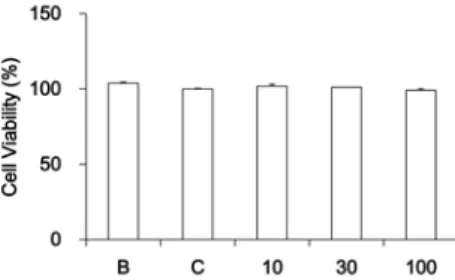
In order to evaluate the cytotoxicity of PR, samples were prepared at various concentrations and used to treat human fibroblasts (Hs68). The results of this evaluation are shown in Fig 1 at concentrations of 10, 30, 100 µg/ml. The cell viability was recalculated into 100% of control group. The cell viabilities of PR 10 µg/ml treated, PR 30 µg/ml treated, PR 100 µg/ml treated are 101.8 ± 1.4%, 101.1 ± 0.0%, and 99.1 ± 1.0%, respectively. PR showed no cytotoxicity up to the effective concentration for anti-wrinkle activity (less than 100 µg/ml).
Figure 1. Cell viability of PR on Hs68 human fibroblasts. B: blank, distilled water treated group without UVB irradiation. C: control, distilled water treated group with UVB irradiation. 10, 30, and 100: Polygonati Rhizoma extracts (PR 10, 30, and 100 µg/ml) treated group. Data are expressed as the mean ± SEM of three experiments.
2. Assay of collagen type I synthesis
To evaluate the amount of collagen type I synthesis that occurred upon exposure to the sample, collagen type I was quantitatively detected by using the procollagen type I C-peptide assay kit previously described in methods section. Collagens are synthesized as precursor molecules, called procollagens. These molecules contain additional peptide sequences, usually referred to as 'propeptides', at both the amino-terminal end and the carboxy-terminal end. These propeptides are cleaved from the collagen triple-helix molecule during its secretion, after which the triple-helix collagens are polymerized into extracellular collagen fibrils. Thus, the amount of free propeptide stoichiometrically reflects the amount of collagen molecules synthesized8). The amounts of type I collagen synthesis of PR were shown in Figure 2. PR increased the expression of type I collagen at a concentration of 100 µg/ml (16.2 ± 0.0 ng/ml) from control group (13.9 ± 0.5 ng/ml). However, there was no significant difference. The collagen amounts of PR 10 µg/ml and 30 µg/ml treated group did not showed any significance, either (13.3 ± 2.6 ng/ml and 15.9
± 3.6 ng/ml).
Figure 2. Effect of PR on collagen type I synthesis in human fibroblast cells. B: blank, distilled water treated group without UVB irradiation. C: control, distilled water treated group with UVB irradiation. 10, 30, and 100: Polygonati Rhizoma extracts (PR 10, 30, and 100 µg/ml) treated group. Data are expressed as the mean ± SEM of three experiments. *: significantly different from the control, p < 0.05.
3. Assay of collagenase activity
To evaluate the collagenase activity, MMP-1 activity was quantitatively measured by using the previously described matrix metalloproteinase-1 assay kit. The activities of MMP-1 of PR treatment were recalculated into 100% of control group (Figure 3). PR reduced the MMP-1 activity at concentrations of 10 µg/ml, 30 µg/ml, and 100 µg/ml in a dose dependent manner (42.2 ± 20.5%, 44.8 ± 8.5%, and 22.0 ± 5.8%). PR 100 µg/ml treatment showed the statistical significace (p < 0.05).
Figure 3. Effect of PR on collagenase activity in human fibroblast cells. B: blank, distilled water treated group without UVB irradiation. C: control, distilled water treated group with UVB irradiation. 10, 30, and 100: Polygonati Rhizoma extracts (PR 10, 30, and 100 µg/ml) treated group. Data are expressed as the mean ± SEM of three experiments. *: significantly different from the control, p < 0.05.
4. Inhibitory effects on tyrosinase activity
The activities of PR on tyrosinase activity were recalculated into 100% of control group (Figure 4). PR significantly reduced the tyrosinase activity at a concentration of 10 mg/ml (32.0 ± 12.8%, p < 0.05).
The tyrosinase activity of PR 0.1 and 1 mg/ml treated groups did not show any significance (93.3 ± 5.4%
and 84.8 ± 2.5%).
Figure 4. Effect of PR on tyrosinase activity. C: control, distilled water treated group. 0.1, 1, and 10: Polygonati Rhizoma extracts (PR 0.1, 1, and 10 mg/ml) treated group. Data are expressed as the mean ± SEM of three experiments. *: significantly different from the control, p < 0.05.
5. L-DOPA oxidation
The activities of PR on L-DOPA oxidation were recalculated into 100% of control group (Figure 5).
Although there was no significant difference, PR slightly reduced the L-DOPA oxidation activity at concentrations of 10 mg/ml (94.5 ± 2.4%). PR 1 and 0.1 mg/ml treated groups did not show any activity (112.4 ± 2.2% and 110.1 ± 0.0% respectively).
Figure 5. Effect of PR on L-DOPA oxidation. C: control, distilled water treated group. 0.1, 1, and 10: Polygonati Rhizoma extracts (PR 0.1, 1, and 10 mg/ml) treated group. Data are expressed as the mean ± SEM of three experiments.
Discussion
The PR has been used for spleen and stomach qi deficiency with lassitude, fatigue, and loss of appetite.
Also for spleen and stomach yin deficiency with dry mouth, loss of appetite, loss of taste, dry stool, and a dry, red tongue. It has also been used for dry cough with little sputum production due to lung qu and yin deficiency and cough due to consumption. It could be used for any type of cough where dryness is significant.
It could also been used for exhaustion of kidney essence with lower back pain, light-headedness, and weakness of the lower extremities along with wasting and thirsting disorder1,2).
The skin aging is one of the most obvious evidence of aging. There are some patents about the PR-containing compositions for retarding skin aging. The skin is increasingly exposed to ambient UV-irradiation thus increasing risks for photooxidative damage with long-term detrimental effects like photoaging, characterized by wrinkles, loss of skin tone and resilience. Photoaged skin displays alterations in the cellular component and extracellular matrix with accumulation of disorganized elastin and its microfibrillar component fibrilin in the deep dermis and a severe loss of interstitial collagens, the major structural proteins of the dermal connective tissue. It has been shown that UV irradiation leads to the formation of reactive oxygen species (ROS) that activate the mitogen-activated protein (MAP) kinase pathway, which subsequently induces the expression and activation of matrix metalloproteinases (MMPs) in human skin in vivo4,5). MMPs are known to be over-expressed in human fibroblasts within hours after exposure to UV irradiation. Therefore, MMPs areconsidered key regulators in the photoaging process. Inhibiting the major collagen-degrading enzymes like MMPs would be a useful agents for anti-aging.
In order to evaluate the cytotoxicity of PR, samples
were prepared at various concentrations and used to treat human fibroblasts (Hs68). There was no cytotoxicity in all treated concentrations.
Collagen is a group of naturally occurring proteins.
In nature, it is found exclusively in animals, especially in the flesh and connective tissues of mammals9). It is the main component of connective tissue, and is the most abundant protein in mammals, making up about 25% to 35% of the whole-body protein content10). Collagen, in the form of elongated fibrils, is mostly found in fibrous tissues such as tendon, ligament and skin, and is also abundant in cornea, cartilage, bone, blood vessels, the gut, and intervertebral disc. In muscle tissue it serves as a major component of endomysium. Collagen constitutes 1% to 2% of muscle tissue, and accounts for 6% of the weight of strong, tendinous muscles11). Collagen occurs in many places throughout the body. So far, only 29 types of collagen have been identified and described. Over 90% of the collagen in the body, however, is of type I, II, III, and IV. Among them, collagen type I is placed at skin, tendon, vascular, ligature, organs, and bone (main component of bone).
Collagen-related diseases most commonly arise from genetic defects or nutritional deficiencies that affect the biosynthesis, assembly, postranslational modification, secretion, or other processes involved in normal collagen production. In this study, the amount of collagen type I was slightly increased at concentrations of PR 30 µg/ml and 100 µg/ml. However, there was no statistical significance. To evaluate the collagenase activity, MMP-1 activity was quantitatively measured.
PR significantly reduced the MMP-1 activity at 100 µg/ml. The activities of PR on tyrosinase activity were significantly effective at 10 mg/ml.
In conclusion, PR showed the anti-MMP-1 activities.
These results suggest that PR may have potential as an anti-aging ingredient in cosmetic herbal drugs. I think further studies will be needed to unravel exactly under the molecular mechanisms.
Acknowledgement
This paper was supported by the Semyung University Research Grant of 2012.
References
1. Kim IR, Kim HC, Kuk YB, Park SJ, Park YK, Park JH, Seo BI, Seo YB, Song HJ, Shin MK, Lee YJ, Lee YC, Lee JH, Leem KH, Cho SI, Chung JK, Joo
YS, Choi HY. Boncho-Hak. Seoul : Young-Lim Press. 2007 : 651-2.
2. Chen JL, Chen TT. Chinese Medical Herbology and Pharmacology. CA : Art of Medicine Press. 2004 : 736-8.
3. Yaar M, Gilchrest BA. Cellular and molecular mechanisms of cutaneous aging. J Dermatol Surg Oncol. 1990 ; 16(10) : 915-22.
4. Fisher GJ, Datta SC, Talwar HS, Wang ZQ, Varani J, Kang S, Voorhees JJ. Molecular basis of sun-induced premature skin ageing and retinoid antagonism. Nature. 1996 ; 379(6563) : 335-9.
5. Shin JY, Hur W, Wang JS, Jang JW, Kim CW, Bae SH, Jang SK, Yang SH, Sung YC, Kwon OJ, Yoon SK. HCV core protein promotes liver fibrogenesis via up-regulation of CTGF with TGF-beta1. Exp Mol Med. 2005 ; 37(2) : 138-45.
6. Vanni A, Gastaldi D, Giunata G. Kinetic investigations on the double enzyme activity of the tyrosinase mushroom. Ann Chim. 1990 ; 80 : 35-60.
7. Joshi PC, Carraro C, Pathak MA. Involvement of reactive oxygen species in the oxidation of tyrosine and dopa to melanin and in skin tanning. Biochem Biophys Res Commun. 1987 ; 142(1) : 265-74.
8. Kim YH, Chung CB, Kim JG, Ko KI, Park SH, Kim JH, Eom SY, Kim YS, Hwang YI, Kim KH.
Anti-wrinkle activity of ziyuglycoside I isolated from a Sanguisorba officinalis root extract and its application as a cosmeceutical ingredient. Biosci Biotechnol Biochem. 2008 ; 72(2) : 303-11.
9. Müller WEG. The Origin of Metazoan Complexity:
Porifera as Integrated Animals. Integr Comp Biol.
2003 ; 43(1) : 3-10.
10. Di Lullo GA, Sweeney SM, Korkko J, Ala-Kokko L, San Antonio JD. Mapping the ligand-binding sites and disease-associated mutations on the most abundant protein in the human, type I collagen. J Biol Chem. 2002 ; 277(6) : 4223-31.
11. Sikorski ZE. Chemical and Functional Properties of Food Proteins. Boca Raton : CRC Press. 2001 : 242.