1. 서론
사회가 급격하게 변하고 그에 따라 스트레스가 많은 환경에서 현대를 살아가고 있는 누구에게나 적응의 문제
는 중요하지만 대학생활의 성공적인 적응은 미래의 사회 적 역할 수행을 보다 용이하게 하며 성숙된 성인으로 가 기 위한 아주 중요한 시기라 할 수 있다[1].
치과의료 현장에서 치과위생사에게 기대되는 역할과
치위생과 학생들의 자아존중감과 공감능력, 대인관계능력과의 융합 관계
이성림
원광보건대학교 치위생과 교수
Convergence relationship of Self-esteem, Empathy ability and Interpersonal relationship ability in dental hygiene students
Sung-Lim Lee
Professor, Department of Dental Hygiene, Wonkwang Health Science University
요 약 본 연구의 목적은 자아존중감과 공감능력, 대인관계능력과의 융합 관계를 파악하고자 전북지역 치위생과 351명 을 대상으로 조사하였다. 수집된 자료는 SPSS software program 22.0 통계프로그램으로 분석하였다. 대인관계능력은 건강상태(p=0.005)와 전공만족도(p=0.004)에서 통계적으로 유의한 차이가 있었다. 자아존중감과 공감능력, 대인관계능 력은 양의 상관관계를 보였다(r=0.600, p<0.01). 대인관계능력에 영향을 주는 융합 요인은 자아존중감과 공감능력이었 으며(p<0.001) 설명력은 38.0%였다. 따라서 자아존중감과 공감능력, 대인관계능력을 향상시키기 위한 치위생 교육프로 그램 개발이 필요하리라 생각된다.
주제어 : 공감능력, 대인관계능력, 자아존중감, 치위생과 학생, 융합
Abstract This study was to investigate the convergence relationship of self-esteem, empathy ability and interpersonal relationship ability of 351 dental hygiene students in Jeollabuk-do area. The data were analyzed using SPSS software program 22.0. In case of interpersonal relationship ability, there were significantly different means with health state(p=0.005) and major satisfaction(p=0.004). Self-esteem, empathy ability and interpersonal relationship ability was positive correlated(r=0.600, p<0.01). The factors influencing interpersonal relationship ability were self-esteem and empathy ability(p<0.001). The explanatory power of the study was 38.0%. It is necessary to develop a dental hygiene education program for improving self-esteem, empathy ability and interpersonal relationship ability.
Key Words : Empathy ability, Interpersonal relationship ability, Self-esteem, Dental hygiene students, Convergence
*This paper was supported by Wonkwang Health Science University in 2019
*Corresponding Author : Sung-Lim Lee([email protected]) Received June 14, 2019
Accepted July 20, 2019
Revised July 2, 2019 Published July 28, 2019
책임이 과거에는 단순업무나 기술에 가치를 두었다면 의 료환경이 빠르게 변화하는 요즘에는 예방과 교육, 동료 간 대인관계 및 환자응대, 경영의 동반자로서의 역할 등 새로운 역량이 요구하고 책임 또한 확대되고 있다[2].
대인관계능력은 치위생과 학생에게는 향후 의료서비 스를 제공하는 과정에서 다양한 사람들과 긍정적인 상호 작용을 해야 하기 때문에 더욱 필요하다고 할 수 있다.
국가고시 위주의 교육과정과 전문직업인이 갖추어야 하 는 기술적 역량만 강조하는 경우가 많아 대인관계에 관 한 교육이나 훈련은 접하기 어려운 실정이다[3].
자아존중감이란 자신을 존중하고 성공적이고 가치가 있다고 스스로 평가하는 것이며 이런 자아존중감은 상황 에 대한 인지적 해석에 영향을 주어 대인관계에 긍정적 혹은 부정적인 영향을 미친다[4]. 자아존중감이 낮은 사 람은 자기의 가치를 낮게 평가하므로 타인에 대해 열등 감을 갖게 되어 현실과 미래에 대해 소극적이고 부정적 인 태도로 임하게 되며, 반대로 높은 사람은 자신이 처한 현실에 대해 적극적이고 긍정적인 자세로 현재의 상황을 극복하고 자신을 격려하며 미래를 준비[5]한다고 하였다.
자아존중감이 높은 사람은 박 등[6]은 인생의 목적이나 목표를 뚜렷이 하고 발전하기 위한 많은 노력과 시간을 투자하므로 현대사회에서 인정받는 사람이 될 가능성이 높다 라고 하였다.
공감은 자신의 감정을 타인과 역지사지 할 수 있는 능 력을 의미하며[7], 타인의 감정 혹은 경험을 자신의 것처 럼 느껴서 타인에 대한 이해력과 예측력을 증가시켜 그 에 맞는 적정한 반응을 한다[8]. 공감은 대인관계를 형성 하는 기본 바탕이 되고, 인간관계 속에서 공감적 이해가 이루어진다면 이타적 동기를 유발하여 친사회적 행동을 증가시킨다고 하였다[9]. 공감능력은 성공적인 대인관계 능력을 형성하는 중요한 역할을 하는 것으로 조사되었다 [3,10].
대인관계능력이란 주위 사람들과 신뢰감 및 친근감을 구축하여 인간관계를 성공적으로 맺기 위한 기본적인 핵 심 능력이라 할 수 있으며, 다른 사람의 마음과 감정, 느 낌을 이해하고 원만한 관계를 유지해 나가는 것이다[11].
대학생의 좋지 않은 대인관계 경험은 심리적 장애를 초 래하여 보다 풍부하고 성숙된 인간으로 성장 발달을 저 해하고[12], 대인관계형성의 범위가 급격히 증가하는 매 우 중요한 시기임에도 현대사회의 경쟁 및 선후배, 친구, 교수 등과의 대인관계에서 어려움을 겪게 되고 다양한 스트레스를 경험한다[13]고 하였다.
치위생과 학생들의 자아존중감과 공감능력, 대인관계
능력에 관한 선행연구로는 자아존중감[5,6,14], 공감능력 [15], 대인관계능력[16-18] 등이 있었으나 자아존중감과 공감능력, 대인관계능력을 모두 포함한 융합 관계 연구는 거의 없는 것으로 파악되었다. 이에 본 연구는 치위생과 학생들의 자아존중감과 공감능력, 대인관계능력과의 융 합 관계를 파악하여 그들에 대한 이해를 돕고, 자아존중 감과 공감능력, 대인관계능력을 향상시키기 위한 치위생 교육프로그램 개발에 기초자료를 제공하고자 한다.
2. 연구대상 및 방법
2.1 연구대상
본 연구는 전북 지역 일 대학교의 치위생과 학생 351 명을 편의 추출하여 연구의 목적을 설명한 후 서면으로 동의한 학생들에게 2019년 5월 24일부터 5월 31일까지 구조화된 자기기입법에 의한 설문조사를 실시하였다. 표 본 수는 G*power 3.1 for Windows 프로그램을 이용 하였으며, 효과크기 .30, 유의수준 .05, 통계적 검정력 .95를 적용한 결과 필요 최소 표본수는 134명으로 나타 났다.
2.2 연구방법
일반적 특성은 학년, 종교, 건강상태, 전공만족도, 임 상실습 경험여부 등 5문항으로 구성하였으며 자아존중감 10문항은 Rosenberg[19]가 개발하고 이 등[20]이 이 용한 도구를 사용하였다. 공감능력 28문항은 Davis[21]가 개발하였던 대인관계반응척도(Interpersonal reactivity index)를 정 등[22]이 연구에 이용하였던 도구를 사용하 였다. 대인관계능력 15문항은 Warner[23]가 개발하고 PSI 컨설팅이 번역한 도구를 정[24]이 수정하고 김 등[3]
이 연구에 이용하였던 도구를 사용하였다. ‘매우 그렇다’
5점, ‘전혀 그렇지 않다’ 1점까지 리커드 척도로 부정문 항은 역환산하였으며 점수가 높을수록 자아존중감, 공감 능력, 대인관계능력이 높은 것을 의미한다. 신뢰도 Cronbach's Alpha는 자아존중감은 0.886, 공감은 0.758, 대인관계능력은 0.828이었다.
2.3 통계분석
수집된 자료는 SPSS software program(SPSS 22.0, SPSS Inc., Chicago, USA)을 사용하여 일반적 특성은 기술통계를 하였고. 일반적 특성에 따른 자아존중감과 공
감능력, 대인관계능력의 차이는 t-test와 one-way ANOVA로 분석하고 사후검정은 Scheffe multiple range test로 하였다. 자아존중감과 공감능력, 대인관계 능력의 상관성는 Pearson's Correlation Coefficient 로 분석하였고 대인관계능력에 영향을 주는 융합 요인을 알아보기 위해 Stepwise multiple Regression을 실시 하였다.
3. 연구결과
3.1 자아존중감과 공감능력, 대인관계능력
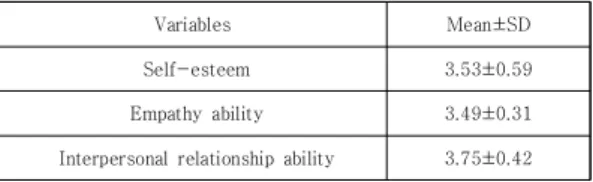
자아존중감과 공감능력 평균은 전체 평균 5점 만점에 각각 3.53점, 3.49점으로 나타났으며. 대인관계능력 평 균은 3.75점으로 조사되었다. Table 1
Variables Mean±SD
Self-esteem 3.53±0.59
Empathy ability 3.49±0.31
Interpersonal relationship ability 3.75±0.42 Table 1. Diescriptive statistics of variables
3.2 일반적 특성에 따른 자아존중감과 공감능력, 대 인관계능력
일반적 특성 중 1학년이 36.2%로 가장 많았고, 2학년 33.0%, 3학년 30.8%이었다. 종교는 없다가 74.6%이었 고, 건강상태는 양호가 67.5%로 가장 많았다. 전공만족 도는 만족이 50.4%로 가장 많았고, 임상실습경험 여부는 있다가 32.3%, 없다가 67.8%이었다.
자아존중감은 학년(p=0.002), 건강상태(p=0.000), 전 공만족도(p=0.000), 그리고 임상실습경험 여부(p=0.001)에 서 통계적으로 유의한 차이가 있었다. 공감능력은 학년 (p=0.010), 건강상태(p=0.008), 그리고 전공만족도 (p=0.007)에서 유의한 통계적 차이가 있었고, 대인관계 능력은 건강상태(p=0.005)와 전공만족도(p=0.004)에서 유의한 통계적 차이가 있었다. Table 2
3.3 자아존중감과 공감능력, 대인관계능력 상관관계
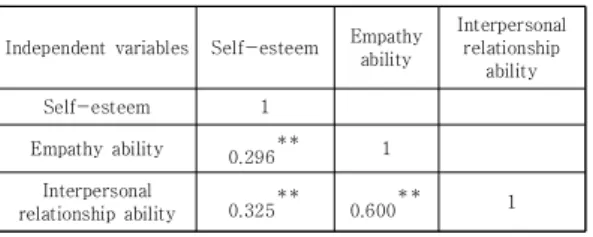
자아존중감은 공감능력과 대인관계능력간에 유의한 양의 상관관계가 있었으며. 공감능력은 대인관계능력과 유의한 양의 상관관계가 있었다(r=0.600, p<0.01).
Table 3
Characteristic N(%)
Self-esteem Empathy ability Interpersonal relationship ability
Mean±SD t or F
(p) Mean±SD t or F
(p) Mean±SD t or F
(p)
Grade
1 127(36.2) 3.52±0.61
6.497 (0.002)
3.53±0.31
4.641 (0.010)
3.79±0.41
1.247 (0.289) 2 116(33.0) 3.40±0.62
3.42±0.32 3.71±0.43
3 108(30.8) 3.68±0.51
3.52±0.30 3.76±0.41
Religion Yes 89(25.4) 3.44±0.56 -1.630
(0.104)
3.51±0.33 0.586 (0.559)
3.78±0.44 0.784 (0.434)
No 262(74.6) 3.56±0.60 3.48±0.31 3.74±0.41
Health status
Healthy 237(67.5) 3.67±0.54
25.184 (0.000)
3.53±0.31
4.889 (0.008)
3.80±0.43
5.383 (0.005)
Moderate 98(27.9) 3.23±0.57 3.41±0.33 3.64±0.37
Not Healthy 16(4.6) 3.15±0.65
3.43±0.24
3.69±0.45
Major satisfaction
Satisfied 177(50.4) 3.69±0.54
18.040 (0.000)
3.54±0.32
5.053 (0.007)
3.83±0.42
5.596 (0.004)
Moderate 144(41.0) 3.40±0.58 3.43±0.30 3.68±0.38
Dissatisfied 30(8.6) 3.13±0.64
3.48±0.33
3.67±0.49
Experience in clinical practice
Yes 113(32.2) 3.68±0.51 3.479
(0.001)
3.50±0.30 0.551 (0.582)
3.75±0.41 -0.142 (0.887)
No 238(67.8) 3.46±0.62 3.48±0.32 3.76±0.42
Table 2. Self-esteem, empathy ability and interpersonal relationship ability by general characteristics (N=351)
Independent variables Self-esteem Empathy ability
Interpersonal relationship
ability
Self-esteem 1
Empathy ability 0.296 1 Interpersonal
relationship ability 0.325
0.600 1
p<0.01.
Table 3. Correlations among variables
3.4 대인관계능력에 영향을 주는 융합 요인
대인관계능력에 영향을 주는 융합 요인은 자아존중감 과 공감능력이었고, 자아존중감이 높을수록, 공감능력이 좋을수록 대인관계능력이 좋은 것으로 나타났으며, 모형 에 대한 적합도는 F값이 108.397, 유의확률은 0.000로 유의한 것으로 조사되었다. 이 모형의 설명력은 38.0%로 나타났다. Table 4
Variables B SE β t p
Self-esteem 0.114 0.031 0.161 3.661 0.000
Empathy ability 0.731 0.058 0.552 12.541 0.000
F= 108.397 Adjusted R
= 0.380
Table 4. Convergence factors affecting interpersonal relationship ability
4. 고찰 및 결론
이 연구는 치위생 대학생들의 자아존중감과 공감능력, 대인관계능력과의 융합 관계를 파악하여 그들에 대한 이 해를 돕고, 자아존중감과 공감능력, 대인관계능력을 향상 시키기 위한 치위생 교육프로그램 개발에 기초자료를 제 공하고자 시도하였다.
자아존중감은 전체 평균 5점 만점에 3.53점으로 치위 생과 학생을 대상으로 한 연구에서 이 등[5]은 3.49점, 박 등[25]은 3.47점, 임 등[26]은 2.79점으로 본 연구보 다 다소 낮았다. 자아존중감은 전체적인 적성 및 능력에 대한 스스로의 평가이며 자신을 존중하고 바람직하게 여 기고 가치 있는 존재라고 생각하는 것을 의미[27]하는 것 인데 그 동안의 연구결과들을 보면 치위생과 학생들의 자아존중감은 높지 않음을 알 수 있었다. 그러므로 후속 연구를 통해 자신의 삶에 적극적인 자세로 임할 수 있는
자아존중감 향상 방안들을 마련해야 한다고 사료된다.
공감능력 평균은 3.49점이었으며, 간호대학생의 연구 에서 정[28]은 3.51점, 조 등[29]은 3.43점으로 거의 유 사한 결과가 나타났다. 환자와 치료적 관계를 형성하는데 필수조건이며 또한 공감은 그 치료적 대인관계를 발전시 키는 중요인자라고 하였으므로[30] 공감능력은 치위생 교육과정을 통해 반드시 함양해야 하는 역량으로 생각된 다.
대인관계능력 평균은 3.75점으로 이는 김 등[3]의 3.23점, 소 등[17]의 3.37점, 한 등[18]의 3.54점보다 다 소 높게 나타났다.
일반적 특성에 따른 자아존중감은 학년, 건강상태, 전 공만족도, 임상실습경험 여부에서 통계적으로 유의한 차 이가 있었다. 학년이 높을수록 자아존중감이 높게 나타난 김[14]과 박 등[25]의 연구결과와 유사하였다. 전공만족 도는 임 등[26]과 김[14]의 연구에서 전공만족도가 높을 수록 자아존중감이 높게 나타난 결과와 일치하였다. 본 연구에서는 건강상태가 양호할수록, 임상실습경험이 있 을수록 자아존중감에 영향을 주는 것으로 나타났지만 기 존의 연구결과가 없어 비교하지는 못했다.
일반적 특성에 따른 공감능력은 학년, 건강상태, 전공 만족도에서 유의한 차이가 있었다. 즉 학년이 높을수록, 건강상태가 양호할수록 그리고 전공만족도가 높을수록 공감능력이 높은 것으로 조사되었고 이는 김 등[3]의 연 구결과와 일치하였으며 조 등[29]은 학년에서, 채[10]는 학년, 전공만족도에서 유의한 차이를 나타냈는데 이는 일 반적 특성에 구성문항이 모두 달라서 일치되는 항목만 비교하였으므로 추후 같은 항목으로 연구할 필요가 있다 고 생각한다. 치위생 대학생의 공감능력 향상을 위한 관 심과 교육에 대한 노력이 절실하다고 사료된다.
일반적 특성에 따른 대인관계능력은 건강상태와 전공 만족도에서 통계적으로 유의한 차이가 있었다. 이는 소 등[17]의 연구 결과와 일치하였다. 정 등[22]은 학년과 임상실습경험 여부에서 채[10]는 학년, 건강상태, 전공만 족도에서 유의한 차이를 나타냈다. 건강상태 좋을수록 대 인관계에 긍정적이고 적극적으로 대처하며 전공만족도가 높을수록 전공에 대한 관심은 자신감으로 이어져 대인관 계까지 영향을 주는 것으로 사료되므로 치위생과 학생들 을 대상으로 대인관계능력 증진을 위한 효과적인 융합 교육 프로그램 개발이 필요하다고 생각된다.
자아존중감과 공감능력, 대인관계능력과 관련성을 파 악한 결과 자아존중감과 공감능력, 대인관계능력은 유의 한 양의 상관관계가 있었다. 자아존중감이 대인관계능력
에 관련이 있다고 보고한 이 등[16]과 이 등[4]과도 유사 하였다. 공감능력과 대인관계능력에 관련성은 김 등[3]과 채[10]의 연구결과와 일치하였다.
대인관계능력에 영향을 주는 융합 요인은 자아존중감 과 공감능력이었고, 자아존중감이 높을수록, 공감능력이 좋을수록 대인관계능력이 좋은 것으로 나타났으며 (p<0.001), 이 모형의 설명력은 38.0%로 나타났다.
이 연구는 전북 지역 일 대학교의 치위생과 학생을 조 사대상으로 한 결과이므로 일반화하기에는 제한점이 있 지만 치위생과 학생들의 자아존중감과 공감능력, 대인관 계능력과는 밀접한 관련성이 있는 것으로 조사되었다. 따 라서 자아존중감과 공감능력, 대인관계능력을 향상시키 기 위한 치위생 교육프로그램 개발을 위한 후속연구가 이루어져야 할 것으로 사료된다.
REFERENCES
[1] H. W. Cheon, M. S. Yu & M. J. Jun. (2018). The Convergenced Influence of character on adjustment to college life in dental hygiene students: focused on the mediating effects of interpersonal relations.
Journal of Convergence for Information Technology, 8(6), 49-57.
DOI : 10.22156/CS4SMB.2018.8.6.049
[2] C. S. Lee et al. (2012). Influential Job-Related Characteristics for the Job Satisfaction and Turnover Possibility of Dental Hygienists. Journal of Dental Hygiene Science, 12(6), 666-674.
[3] S. J. Kim & H. H. Kim. (2013). Impact of Communication Competence and Empathy Abilities on Interpersonal Relationship Abilities among Dental Hygiene Students. Journal of Dental Hygiene Science, 13(3), 304-313.
[4] M. S. Lee & K. M. Chae. (2012). The mediating effects of emotion regulation strategies on the relationship between self-esteem and interpersonal relationship abilities. Journal of Korea Cognitive Behaver Therapy, 12(1),63-75.
[5] H. K. Lee & O. J. Ju. (2015). Influence of socio-demographic characteristics and ethical type on self-esteem in dental hygiene students. Journal of Korean Society of Dental Hygiene, 15(3), 497-504.
DOI : 10.13065/jksdh.2015.15.03.497
[6] J. H. Park, H. J. Song & B. Y. Lee. (2018). The Influences of Ethical propensity, Self-esteem and Clinical satisfaction on Major satisfaction in Dental hygiene students. Journal of The Korea Convergence Society, 9(6), 261-269.
DOI : 10.15207/JKCS.2018.9.6.261
[7] J. Stein-Parbury. (2013). Patient and person:
Interpersonal skills in nursing(5th edition). Sydney:
Elsevier Health Sciences.
[8] S. Baron-Cohen & S. Wheelwright. (2004). The empathy quotient: an investigation of adults with Asperger syndrome or high functioning autism, and normal sex differences. Journal of Autism and Developmental Disorders, 34(2), 163-175.
[9] J. S. Ju. (2006). The effects of the communication training program for university students’ communication and human relationship. unpublished master’s thesis, Kyungpook National University, Daugu.
[10] M. O. Chae. (2016). Ego resilience, Empathic Ability and Interpersonal relationship ability in Nursing Students. Journal of the Korea Academia-Industrial cooperation Society, 17(5),95-103.
DOI : 10.5762/KAIS.2016.17.5.95
[11] O. S. Lee, M. O. Gu & M. J. Kim. (2015). Influence of Emotional Intelligence and Ego Resilience on Interpersonal Relationship of Nurses. Journal of the Korea Academia-Industrial cooperation Society, 16(6), 3902-3910.
DOI : 10.5762/KAIS.2015.16.6,3902
[12] H. J. Jeong. (2014). The effects of interpersonal problems on depression in university students: Mediating effect of experiential avoidence and ambivalence over emotional expressiveness. Unpublished master’s thesis, University of Daegu Catholic, Daugu.
[13] K. S. Kim & H. R. Kim. (2013). Changes in the characteristics of first-year student at the university of education: Based on the survey of entering freshman in 2013 at seoul national university of education. Journal of korea Elementary Education, 24(3),185-205.
DOI : 10.20972/kjee.24.3.201309.185
[14] J. Y. Kim. (2018). Convergent Relationship between Self-Esteem, Resilience, and Occupational Self- Efficacy among Dental Hygiene Students. Journal of The Korea Convergence Society, 9(1), 269-276.
DOI : 10.15207/JKCS.2018.9.1.269
[15] M. H. Kim & M. S. Kim. (2014). The Influence of Adult Attachment on Depression, Self-Esteem, Empathy in Female College Students with a Major in Health Science. Journal of Social. Sciences, 29(1), 23-37.
[16] J. Y. Lee, H. J. Kim & H. J. Go. (2014). The effects of self-esteem, interpersonal relationship abilities on department satisfaction in the dental hygiene students. Journal of Korean Society of Dental Hygiene, 14(1), 39-47.
DOI : 10.13065/jksdh.2014.14.01.39
[17] M. H. So & Y. Y. Cho. (2016). Relations between Interpersonal Ability, Social Support, and Clinical Practice Satisfaction of Some Dental Hygiene Students in Gyeonggi province. Journal of Korea Society for School & Community Health Education, 17(3),117-129.
[18] J. H. Han & K. E. Kim. (2015). Interpersonal Skills Caused by Emotional Intelligence and Ego Resilience of Students Majoring in Dental Hygiene. Journal of Dental Hygiene Science, 15(6), 746-752.
DOI : 10.17135/jdhs.2015.15.6.746
[19] M. Rosenberg. (1965). Society and the adolescence self-image. Princeton: NJ: Univ.of Princeton Press. 1.
[20] S. L. Lee, J. S. Kwag & J. H, Choi. (2015). Correlation and influencing factors on oral health awareness, oral health behavior, self-esteem and OHIP-14 in childcare teachers. Journal of Korean Society of Dental Hygiene, 15(2), 261-269.
DOI : 10.13065/jksdh.2015.15.02.261
[21] M. H. Davis. (1980). A multidimensional approach to individual differences in empathy. JSAS Catalog of Selected Documents in Psychology. American Psychological Association, Washington, 85.
[22] H. S. Jeong & K. L. Lee. (2015). Empathy and Clinical Practice Stress in Nursing Student, Journal of the Korea Academia-Industrial cooperation Society, 16(9), 6044-6052.
DOI : 10.5762/KAIS.2015.16.9.6044
[23] J. Warner. (2005). Networking and relationship building profile: Facilitator`s Guide. HRD Press, Amherst,1-57.
[24] T. Y. Chung. (2011). The structural relationship between corporate managers' life-long education coaching leadership and its member's problem solving ability and interpersonal ability. Doctoral dissertation. Ajou University, Suwon.
[25] K. H. Park & H. J. Choi. (2015). Correlations of self-esteem, major satisfaction and career identity in dental hygiene students. Journal of Korean Society of Dental Hygiene, 15(2), 279-286.
DOI : 10.13065/jksdh.2015.15.02.279
[26] S. A. Lim & H. J. Youn. (2013). Ego resilience, Empathic Ability and Interpersonal relationship ability in Nursing Students. Journal of Korean Society of Dental Hygiene, 13(4), 669-676.
DOI : 10.13065/jksdh.2013.13.04.669
[27] M. Rosenberg. (1965). Society and the adolescence self-image. Princeton: NJ: Univ.of Princeton Press.
16-31.
[28] H. Jeong. (2018). A Convergence study of the Effects of Job-esteem and Empathy on Customer orientation in Nursing students. Journal of The Korea Convergence Society, 9(10), 599-607.
DOI : 10.15207/JKCS.2018.9.10.599
[29] M. K. Cho & H. Jeong. (2018). A Convergence study of the Effects of Empathy and Communication skill on Clinical stress in Nursing students. Journal of The Korea Convergence Society, 9(11), 539-547.
DOI : 10.15207/JKCS.2018.9.11.539
[30] E. B. Larson & X. Yao. (2005). Clinical Empathy as Emotional Labor in the Patient-physician Relationship.
American Medical Association, 293(9),1100-1106.
이 성 림(Sung-Lim Lee) [정회원]
․ 2004년 2월 : 계명대학교 공중 보건 학과(보건학박사)
․ 1996년 3월 ~ 2019년 2월 : 광양보 건대학교 치위생과 교수
․ 2019년 3월 ~ 현재 : 원광보건대학교 치위생과 교수
․ 관심분야 : 구강보건학, 치위생학
․ E-Mail : [email protected]