• 검색 결과가 없습니다.

A Study on the Dielctric Properties of the PTC $BaTiO_3$ Ceramic Thin Films

N/A
N/A
Protected

Academic year: 2021

Share "A Study on the Dielctric Properties of the PTC $BaTiO_3$ Ceramic Thin Films"

Copied!
5
0
0

로드 중.... (전체 텍스트 보기)

전체 글

(1)

A Study on the Dielctric Properties of the PTC BaTiO 3 Ceramic Thin Films

Ik-Tae Im* and Byung Moon So

*Dept. Mechanical Design Engineering, College of Eng., Chonbuk National University

Dept. IT Applied System Engineering, College of Eng., Chonbuk National University

ABSTRACT

The films were deposited at evaporator system and were annealed at heat treatment. The films had a dense microstructure with fine grains. The electrical properties of the films were dramatically controlled with annealing. Samples Preparation were analyzed in term of positive temperature coefficient of Resistivity Samples were made in the substrate tempera-true of 400

o

C deposition time of 10 hours, and forward power of 210watt. R-T(resistivity-temperature) Characteristics of the samples were investigated as a function of the substrate type and the ambient temperature. The resistivity of the thin film specimens was compared with that of the bulk type specimens. By using RF/DC magnetron sputtering system, we obtained lower resistivity in the thermistor with thin BaTiO

3

film than that in the bulk type thermistor.

Key Words : BaTiO

3

, Thin Film, PTC

1. Introduction

Ceramic materials with very high electrical and thermal characteristics are widely studied due to the rapid growth of electronics industries including semi- conductor, personal computers and robots. Thin film technology is considered as one of the candidates to overcome the difficulties such as cost, volume and weight of chips and performance arisen to the devel- opment of electronic chips.

Thin films of Perovskite materials such as BaTiO

3

[1-3] SrTiO

3

and LiNbO have been tried using various techniques including evaporation, sput- tering, plasma enhanced chemical vapor deposi- tion[8], laser ablation, sol-gel process, hydrothermal process, molecular beam epitaxy and screen printing, and applied to thermistors capacitors, integrated optics, solid state display, FET nonvolatile memory and high frequency transducers.

Lots of studies have been devoted to find the possi- bility of thin film thermistor which uses the grain boundary in principle but it has not been fully under- stood. Thin film positive temperature coefficient ther-

mistor was first proposed by Feldman[4] in 1954. He used evaporation in vacuum to deposit BaTiO

3

thin films. After his study, BaTiO

3

thin films were depos- ited from various techniques such as using solu- tion[5], DC sputter[6] and RF sputter[7]. PTC semiconducting film was achieved by adding Y

2

O

3

into BaTiO

3

in 1972. Thin films having PTC charac- teristics could be obtained from the optimized process conditions in case of RF sputter. However, it is diffi- cult to use the PTC films in mass production chips because of its high electrical resistivity.

In order to obtain good electrical characteristics, SiO

2

is added to BaTiO

3

for fabricating PTC thermistor in this study. The optimum process conditions of RF/

DC magnetron sputtering were found at first, and then thin films of BaTiO

3

with SiO

2

PTC thermistor were deposited from the optimized conditions. The electrical characteristics and dielectric constants according to the wave length were investigated. The films were heat treated before measuring the characteristics.

2. Experiments

2.1. Targets and thin films

Targets were prepared to obtain desired composi-

E-mail : [email protected]

(2)

tion of BaTiO

3

films. The final composition of the target, Ba

0.907

Y

0.003

Ti

1.01

O

3.02

+0.5 wt%SiO

2

, was determined from the trial-and-error method by examining the con- tents of the deposited thin films. Raw materials used in the target are listed in table 1 with the suppliers. Manga- nese, which was usually added to increase the change of resistance, was not considered in this study. Targets were prepared using normal PTC ceramic process as shown in Fig. 1 using high purity TiO

2

and BaCO

3

. Uniform size particles, obtained from sieve shaker of 45 mm mesh after the reaction, were pressed with high pressure of 7000 kg/cm

2

and 3000 kg/cm

2

in a cylindrical mold with two different diameters. Polyvi- nyl alcohol was used as a binder. Targets were sin-

tered at 1350

o

C for two hours in ZrO

2

surrounding powders.

Sputtered target was heated for 20 minutes at 800 after silver paste had been printed to the both sides of the target. This target, 5.08cm diameter was used as specimen and an electrode. Silver plates as electrodes which is needed to measure the electrical characteris- tics was deposited on both sides of the thin film disc in a vacuum under 5.7×10

−5

torr.

2.2. Sputtering

Thin films of the PTC BaTiO

3

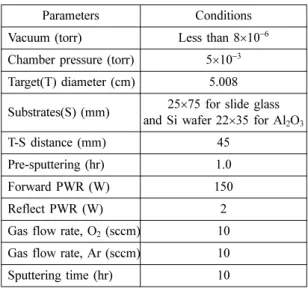
were deposited using a RF-magnetron sputter. Distance between the target and the substrate was set as 45mm during the process. Characteristics of the PTC thermistor are very sensitive to the amount of additives, temperature and surrounding gases. Sputter conditions such as a working gas, pressure, temperature of a substrate, sputter time and electrical power also affect the char- acteristics of the thin films. Sputtering conditions used in the experiment are listed in Table 1.

2.3. Electrodes

In order to measure the resistivity -temperature characteristics on a substrate, the electrodes were pre- pared using thermal evaporation. Fig. 2 shows the structure of the electrodes. Gold was coated up to 200 Åto see the surface structure using DC sputter at 140 V, 6.0 mA for 4 minutes.

3. Results and discussions

Bulk specimen of a target was put into the closed Table 1. Sputtering conditions used for a preparation of

specimens

Parameters Conditions

Vacuum (torr) Less than 8 ×10

−6

Chamber pressure (torr) 5 ×10

−3

Target(T) diameter (cm) 5.008 Substrates(S) (mm) 25×75 for slide glass

and Si wafer 22 ×35 for Al

2

O

3

T-S distance (mm) 45

Pre-sputtering (hr) 1.0

Forward PWR (W) 150

Reflect PWR (W) 2

Gas flow rate, O

2

(sccm) 10 Gas flow rate, Ar (sccm) 10

Sputtering time (hr) 10

Fig. 1. Diagram for the processing of a target.

Fig. 2. Horizontal (left) and vertical (right) structure of the

electrodes.

(3)

bath maintained at constant temperature in order to measure the resistivity-temperature characteristics.

Temperature of surrounding of the specimen was

heated by Joule heating. The same technique was used to the thin films except using a shield box to remove noise.

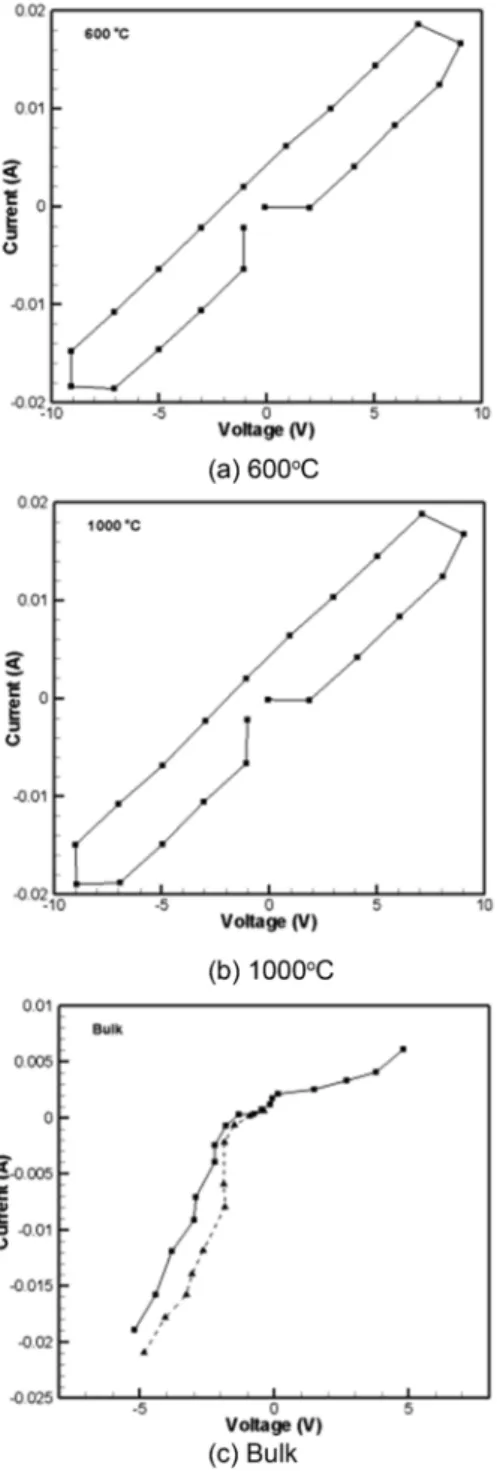
Fig. 3 shows the current values when the step volt- age from minus 9.0 V to 9.0 V was applied to the specimen. The applying voltage was first increased from 0.0 to 9.0 V then decreased to minus 9.0 V and increased again to the initial value. The specimen was heat treated at different temperature, 600

o

C, 800

o

C, 1000

o

C and 1200

o

C before measurement. The output currents were very similar even at the different heat treatment temperatures as shown in Fig. 3(a) 600

o

C and Fig. 3(b) 1000

o

C. It can be seen that the current to the voltage makes a Hysterisis loop for all tempera- tures. The current versus voltage curve for the bulk shown in Fig. 3(c) also shows the Hysterisis loop below 0.0 V.

Fig. 4 shows the dielectric constants and dielectric loss function according to the variations of the photon energy. The dielectric constant showed increasing tendency when the photon energy was increased from 1.6 eV to 2.5 eV. The constant was then decreased when the photon energy was more increased over 2.5 eV.

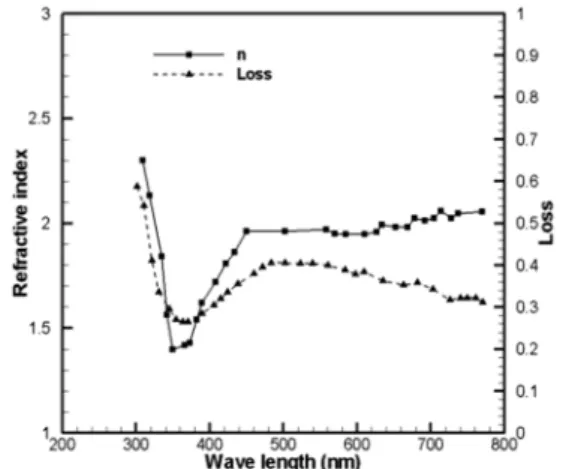
However, it was rapidly increased when the photon energy was larger than 3.5 eV. Fig. 5 shows the refractive index when the photon energy was given to the specimen with the same incident angle of 70 degree as of the dielectric constant measurements.

Fig. 3. Current-voltage curves for the specimen with different heat treatment temperature and the bulk.

Fig. 4. Dielectric constant variation according to the photon

energy.

(4)

The results shown in Fig. 5 are identical to those of Fig. 4 when = h/2 = 1.054×10

−34

J ⋅s.

Fig. 6 and Fig. 7 show the variations of impedance, admittance and phase angle according to the fre- quency. The frequency was varied from 100 Hz to 14.0 MHz, and the bias and oscillation levels were 1.0V and 1.0V

rms

. The data were obtained by the imped- ance/grain-phase analyzer (4194A, HP). Impedance curve showed an abrupt change near 1.0 MHz and this was attributed to the reactance change. Admittance variation shown in Fig. 7 shows the inverse values of the impedance.

Conductance and susceptance were measured by the same analyzer to the impedance and shown in Fig. 8.

Like the impedance and admittance, we can also see the discontinuities near 1.0MHz in case of the sus-

ceptance. Considering the results shown in Figs. 6, 7 and 8, reactance of the film seem to change abruptly over the particular frequency.

4. Conclusion

In this study, thin films having composition of (Ba

0.997

Y

0.003

Ti

1.03

O

3.02

+ 0.5wt%SiO

2

) were depos- ited using RF/DC magnetron sputter and the electrical characteristics were analyzed. From the analyses results, we can conclude the followings.

Dielectric constant varies largely depending on the photon energy. It shows increasing-decreasing- increasing tendency.

Refractive index also varies according to the wave length. It shows rapid drop in short wave length region.

Fig. 5. Refractive index and loss according to the variation of the wave length.

Fig. 6. Dependency on frequency for the absolute impedance.

Fig. 7. Dependency on frequency for the admittance.

Fig. 8. Dependency on frequency for the conductance and

susceptance.

(5)

Impedance, admittance and susceptance have dis- continuities around 1.0MHz and this is attributed to the abrupt change of the reactance.

References

1. Anderson, W.A., “Electrical and Dielectric Properties of Thin Film BaTiO

3

Capacitors Deposited by Ratio Frequency Magnetron Sputtering,” J. Vac. Sci. Tech- nal., A10(4), pp. 733-736, 1992

2. Anderson, W.A., “Effect of Barrier Layer on BaTiO

3

Thin Film Capacitors on Si Substrates,” J. Elec. Mat., 23(1), pp. 53-56, 1994

3. Shintani, Y, “Behaviors of High-Energy Electrons and Neutral Atom in the Sputtering of BaTiO

3

,” Jpn. J.

Appl. Phy, 14(12), pp. 1875-1879 , 1975

4. Felderman, C. “Formation of Thin Films of BaTiO

3

by Evaporation,” Rev. Sci. Instrum., 12(6), pp. 463- 466 1955.

5. Dervies, R.C, “On the Preparation of the Single-Crys- tal Films of BaTiO

3

,” J. Am. Ceramic. Soc., 45, pp.

225-228, 1962

6. Shintani, Y. “Preparation of the BaTiO

3

Films by DC Diode Sputtering,” J. Appl. Phys, 14, pp. 2376-2380 1970

7. Nagatomo, T., “Fabrication of BaTiO

3

Films by Pla- nar Magnetron Sputtering,” Ferroelectrics, 37, pp.

681-684 1981

8. D.j.Qui, P.Yua., and H.Z. Wu, Solid State Commun, 134, 735, 2005

접수일: 2012년 9월 3일, 심사일: 2012년 9월 12일,

게재확정일: 2012년 9월 17일

수치

Fig. 1. Diagram for the processing of a target.
Fig. 3 shows the current values when the step volt- volt-age from minus 9.0 V to 9.0 V was applied to the specimen
Fig. 5. Refractive index and loss according to the variation of the wave length.

참조

관련 문서

“Influence of DC magnetron sputtering parameters on the properties of amorphous indium zinc oxide thin film”, Thin Solid Films, 445,

Properties of ITO thin films deposited by RF magnetron sputtering with process pressure.. Seong-Jin Jeong*, Deok-Kyu KiM † and

A layer of ZTO thin film less than ~200nm in thickness, as a blocking layer, was deposited by DC magnetron sputtering method directly onto the anode electrode to be isolated from

Keywords : DC magnetron sputtering, Cr underlayer and capping layer, CoSm magnetic film, magnetic dipole interaction, irreversible susceptibility, magnetic moment decay,

We demonstrated the thin film deposition of sodium phosphorous oxynitride (NaPON) via RF magnetron sputtering of Na 3 PO 4 , as a solid-state Na-ion conductor similar

The electrical and optical properties of amorphous In-Tin-Zinc-Oxide(ITZO) deposited at room temperature using rf-magnetron sputtering were investigated.. The resistivity of

Properties of Al-doped ZnO Transparent Conducting Oxide Films Deposited with Ar Flow Rate by RF Magnetron

So RF magnetron sputtering and sol- gel process were combined together to prepare the MgO film with little time consume, good crystalline quality and larger grain growth based on