• 검색 결과가 없습니다.

Characterization of RF Sputter-deposited Sodium Phosphorous Oxynitride Thin Films as a Solid-state Sodium-ion Conductor

N/A
N/A
Protected

Academic year: 2021

Share "Characterization of RF Sputter-deposited Sodium Phosphorous Oxynitride Thin Films as a Solid-state Sodium-ion Conductor"

Copied!
7
0
0

로드 중.... (전체 텍스트 보기)

전체 글

(1)

한국표면공학회지 J. Korean Inst. Surf. Eng.

Vol. 50, No. 4, 2017.

https://doi.org/10.5695/JKISE.2017.50.4.237

<연구논문>

ISSN 1225-8024(Print) ISSN 2288-8403(Online)

Characterization of RF Sputter-deposited Sodium Phosphorous Oxynitride Thin Films as a Solid-state Sodium-ion Conductor

Sang-Eun Chun

*

School of Materials Sciences and Engineering, Kyungpook National University, Daegu 41566, South Korea (Received August 21, 2017 ; revised August 27, 2017 ; accepted August 28, 2017)

Abstract

We demonstrated the thin film deposition of sodium phosphorous oxynitride (NaPON) via RF magnetron sputtering of Na

3

PO

4

, as a solid-state Na-ion conductor similar to lithium phosphorous oxynitride (LiPON), which is a commonly used solid electrolyte. The deposited NaPON thin film was characterized by scanning electron microscopy, X-ray diffractometry, and electrochemical impedance spectroscopy, to investigate the feasibility of the solid-state electrolyte in several different cell configurations. The key properties of a solid- state electrolyte, i.e., ionic conductivity and activation energy, were estimated from the complex non-linear least square fitting of the measured impedance spectra at various temperatures in the range of 27-90

o

C. The ionic conductivity of the NaPON film was measured to be 8.73 × 10

-6

S cm

-1

at 27

o

C, which was comparable to that of the LiPON film. The activation energy was estimated to be 0.164 eV, which was lower than that of the LiPON film (0.672 eV). The obtained values encourage the use of a NaPON thin film in the future as a reasonable solid-state electrolyte.

Keywords : Sodium phosphorous oxynitride (NaPON), RF magnetron sputtering, Ion conductor, Ionic conductivity, Activation energy

1. Introduction

All-solid-state batteries have acquired significant attention as a safer energy storage device in light of several accidental explosions involving the conventional “wet” Li-ion batteries [1,2]. Safety can be achieved by replacing flammable organic electrolytes with nonflammable solid-state electrolytes in the current Li-ion based energy devices. To satisfy the ever-growing demand for miniaturized electronic components, the use of solid-state electrolytes, in which the volumetric energy density of the solid phase is higher than that of the liquid phase, is preferred over liquid electrolytes. In this perspective, microbatteries have been developed by employing a

thin solid-state electrolyte and solid electrodes [3-5].

In addition to nonflammability and a higher energy density, solid electrolytes offer several advantages such as chemical stability and no leakage, making them a promising candidate for use in future energy devices.

Various solid-state lithium electrolytes have been researched with the goal of developing a Li-ion based all-solid-state battery. Lithium phosphorous oxynitride (LiPON) is one of primarily used solid electrolytes, because it can provide a high energy output due to the wide stable potential window of a LiPON film (0-5 V vs Li

+

/Li) [6,7]. Thin films of LiPON have been successfully incorporated into all- solid-state rechargeable lithium batteries [6,8-11]. In spite of the multiple benefits of the LiPON electrolyte as a solid phase, there are issues that need to be addressed when assembling a practical solid- state battery: the low ionic mobility through the solid phase, the reduced interfacial contact area with an electrode material, and the greater complexity in the

* Corresponding Author: Sang-Eun Chun

School of Materials Science and Engineering, Kyungpook National University.

Tel: +82-053-950-5566 ; Fax: +82-053-950-6559

E-mail: [email protected]

(2)

manufacturing process of solid electrolytes as compared to liquid electrolytes. Ongoing studies are attempting to overcome these issues by reducing the film thickness and incorporating more nitrogen into the film [12-14].

Most of the currently used solid electrolytes, including LiPON, were designed to transport Li ions through solid electrolytes, because the most widely used electrodes donate/accept Li ions to store/release energy, respectively. However, as lithium is a limited resource and is expensive, there is a growing demand in developing energy devices based on ions other than lithium for future energy system [15-18].

Sodium is a potential alternative to lithium, due to its lower cost, non-toxicity, and greater abundance than lithium. Various sodium-based electrodes and electrolytes have been developed to fabricate sodium- based energy systems [19-21]. However, the availability of solid-state ionic conductors for Na ions is very limited. To achieve Na-ion based high energy density systems, a solid-state Na-ion conductor is required. Thin film Na-ion conductors can also be used in a number of other applications like commercial molten Na-based batteries and sensors [19,22-24].

Similar to Li-ion solid electrolytes, solid-state Na- ion conductors also require a high ionic conductivity, electrochemical stability, and mechanical stability. Na ions, being larger in size than Li ions, have a higher resistance to migration than Li ions, resulting in a slower charging/discharge rate (and correspondingly, lower power density). Therefore, a reasonable conductivity should be ensured to achieve a good power performance. Electrochemical compatibility of the solid electrolyte with Na ions is necessary for stable long-term cyclability. The dendritic structure of sodium may grow during cycling; this is detrimental to long-term cycling. Therefore, the mechanical stability of a solid-electrolyte needs to be checked. Typically, solid electrolytes with a low ionic conductivity have an increased conductivity at high temperatures due to a lower activation energy.

Therefore, the ionic conductivity at high temperatures needs to be estimated.

Herein, we report the application of a solid-state sodium phosphorous oxynitride (NaPON) thin film analog to LiPON prepared by radio frequency (RF) magnetron sputtering, as a solid-state Na-ion conductor. The feasibility of this deposited RF film as a Na-ion conductor was explored based on the conductivity and activation energy, since good ionic

conductivity and low activation energy are essential for a high energy output and good power performance. Electrochemical analysis using ac- impedance spectroscopy was carried out on the NaPON film to assess the abovementioned properties. The results were discussed by comparing the impedance spectra data for LiPON and NaPON.

2. Experimental

2.1. Preparation of NaPON and LiPON films The sodium phosphorous oxynitride (NaPON) thin film was sputtered on a glass substrate by RF magnetron sputtering of a sodium phosphate (Na

3

PO

4

) target using a similar manufacturing process as described elsewhere [6]. As a control solid-state electrolyte thin film, a lithium phosphorous oxynitride (LiPON) film was also prepared on the same substrate via RF magnetron sputtering of a lithium phosphate (Li

3

PO

4

) target.

The targets for depositing the LiPON and NaPON films were manufactured by two-step calcination of the Li

3

PO

4

and Na

3

PO

4

powders, respectively. First, the as-received Li

3

PO

4

(Sigma-Aldrich) and Na

3

PO

4

(96 %, Sigma-Aldrich) powders were heated to 900

o

C for 1 h in a horizontal tube furnace (Lindberg Blue M, Thermo Scientific) under air (first calcination step). The calcined powder was then grinded with a ceramic mortar and pestle. The grounded powder was mixed with 5 mL of N-Methyl-2-pyrrolidone (NMP, anhydrous 99.5 %, Sigma-Aldrich) and 2 mL of methanol (99 %), and then poured into a stainless steel mold to obtain a pellet-type target. The mixed powder was then pressed with a force of 100 kg cm

-2

. Both pressed targets were heat-treated at 200

o

C for 1 h, and then heated at 900

o

C for 1 h under air (second calcination step). The volume of the Na

3

PO

4

target slightly contracted during calcination. In contrast, no noticeable volume contraction was observed for the Li

3

PO

4

target.

The sputtering power for deposition is an important

factor that determines the surface topography and

growth rate of films. The optimum power for

successful deposition was estimated to be 50 W and

100 W for NaPON and LiPON, respectively. For

NaPON, application of a sputtering power higher

than 80 W during the deposition resulted in cracking

and burning of the target surface. During film

sputtering, the sputtering chamber was maintained

with nitrogen to the grow the oxynitride layer that is

reported to show a good ionic conductivity [6].

(3)

2.2. Characterization

The surface morphology and cross-sections of the deposited films were analyzed by scanning electron microscopy (SEM-EDS, Philips XL30) at a working distance of 10 mm and acceleration voltage of 5 kV.

The crystal structure of the specimen was determined by X-ray diffractometry (XRD) (Rigaku, powder X- ray diffractometer, Cu Kα radiation source ( λ = 1.5418 Å)) within the 2θ range of 8

o

-90

o

.

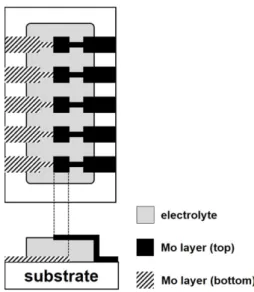
For electrochemical measurements, the thin film was sandwiched between two molybdenum (Mo) films on a glass substrate. Thin Mo films were deposited as current collector/blocking electrodes on the top and bottom of the NaPON film. The Mo film was sequentially deposited after sputtering a titanium (Ti) bonding layer on the glass substrate. A schematic of the specimen structure for the electrochemical experiments is illustrated in Fig. 1.

Since both the NaPON and LiPON thin films can undergo degradation in a humid and oxygen-rich environment, the prepared specimen was quickly transferred to a transparent jar filled with dry Ar immediately upon completion of the film deposition in the sputtering chamber. The overlapped geometric area between the bottom and top layers of Mo layers was designed to be 16 mm

2

(4 mm × 4 mm).

The conductivity and activation energy of the deposited specimens were analyzed by electrochemical impedance spectroscopy to study their feasibility as a solid-state electrolyte. The impedance spectra were taken at a specific potential with a sine wave of amplitude 5 mV over the

frequency range of 0.05 Hz-5 × 10

5

Hz. The measured impedance spectra were fitted to the equivalent circuit model to extract the physical parameters of the electrolyte. The impedance behavior of the specimens was measured at various temperatures between room temperature (27

o

C) and 120

o

C. Li-ion transport in the solid electrolyte film was tested with cyclic voltammetry (CV) at a scan rate of 5 mV/s. Impedance spectra and voltammetry measurements were performed with a potentiostat/

galvanostat (SP-300, Bio-logic).

3. Results and Discussion

The surface structure of the deposited film characterized by SEM is illustrated in Fig. 2(a) and (b). By sputtering the lab-made Na

3

PO

4

and Li

3

PO

4

targets for 10 h at 50 W and 100 W, 1.24 µm and 1.22 µm thick films, respectively, were grown on the substrate, based on the SEM images. The growth rates of the RF sputtered films were calculated to be 124 nm h

-1

and 122 nm h

-1

for the NaPON and LiPON films, respectively. The translucent thin films were then deposited. The cross-sectional images show that continuous homogeneous films were sputtered by RF-sputtering the Na

3

PO

4

and Li

3

PO

4

targets for both thin films. A rapid growth rate is preferred in the preparation of solid films for manufacturing efficiency. Hence, RF sputtering of Na

3

PO

4

is a suitable technique to deposit solid-state NaPON thin films.

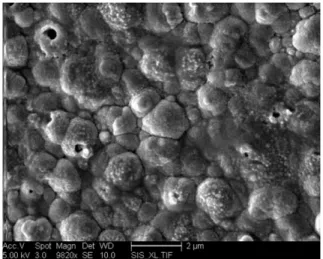
To investigate whether the NaPON film reacts with moisture, it was exposed to air for 1 h. The SEM image in Fig. 3 shows that the surface morphology of the NaPON film underwent a transformation after exposure to air for 1 h. After exposure to air, the surface of the NaPON thin film became swollen due to the reactive property of oxynitride to moisture, which is similar to that in the LiPON thin film [25].

Fig. 1. Schematic diagram of the plain and cross- sectional views of the Mo/NaPON/Mo sandwich cell configuration.

Fig. 2. SEM micrographs of the cross-section of (a) Mo/

NaPON and (b) Mo/LiPON/Mo sandwich structure

deposited on the glass substrate by RF magnetron

sputtering method.

(4)

Electrical measurements on the swollen NaPON film gave inconsistent results; hence, prolonged exposure to air should be avoided while handling as-sputtered NaPON samples.

The crystallinity of the prepared NaPON film was analyzed by overlaying the XRD patterns of the NaPON and LiPON thin films, for comparison (Fig.

4). No characteristic diffraction peak was observed for the NaPON film deposited on glass; only a broad diffraction peak was observed at around 25

o

, which is indicative of the formation of an amorphous NaPON film. Analog to the amorphous LiPON film prepared by sputtering Li

3

PO

4

in N

2

, an amorphous NaPON film can be deposited by Na

3

PO

4

in a N

2

environment at ambient temperature [6,26]. Non- crystallinity is crucial for a solid film to be used as

an electrolyte, since ions can move more rapidly through a solid film of an amorphous structure than that of a crystalline phase [7]. Incorporation of nitrogen into the RF-sputtered NaPON film can significantly increase the ionic conductivity of the film [6]. Both the amorphous structure and nitrided glass network contribute toward enhancement of the ionic conductivity of the solid-state NaPON electrolyte.

As an electrolyte material in an energy system, a key property is sufficient ionic conductivity at an ambient temperature, because poor ionic conductivity leads to low power energy and low energy efficiency [8]. The ionic conductivity of a thin film can be quantitatively determined by the following conductivity equation.

(1) where σ is the conductivity, d is the film thickness, A is the geometric area of the Mo contact, and R

el

is the thin film electrolyte resistance. The resistance of the solid electrolyte can be obtained by fitting the equivalent circuit model to the experimentally measured impedance spectra at room temperature.

Figure 5(a) illustrates the Nyquist plots of the impedance spectra measured for the NaPON and LiPON thin films. Both impedance spectra have the shape of two successive semi-circles in the medium frequency range with an intercept on the real axis at low frequencies without a blocking region. Both semi-circles can be modeled as the resistor and the constant phase element (CPE) in parallel, where CPE was used to describe the non-ideal behavior of the capacitor component [27]. The first arc corresponds to the electrochemical behavior in the electrolyte, while the second one involves the grain boundary [6]. The modified CPA model was used to model the impedance behavior of both RF-sputtered thin films between the top and bottom layers of Mo, as shown in Fig. 5(b) [28]. In the equivalent circuit model, Z

inter

is the interfacial impedance between the current collectors and the electrolyte, C

g

is the geometric capacitance, Z

el

is the electrolyte capacitance, R

el

is the electrolyte resistance, Z

GB

is the grain boundary capacitance, and R

GB

is the grain boundary resistance.

The impedance spectra were fitted to the equivalent circuit model introduced above based on the complex non-linear least square (CNLS) fitting to estimate the electrolyte resistance (R

el

) [27]. The analyzed conductivities are listed in Table 1. The RF-

σ d

A --- 1 R

el

---

= Fig. 3. Surface morphology transformation of the RF-

sputtered NaPON thin film after exposure to ambient environment for 1 h.

Fig. 4. X-ray diffraction (XRD) patterns of NaPON and

LiPON solid films RF sputtered on the glass substrate.

(5)

sputtered NaPON sample showed reasonable conductivity (8.73 × 10

-6

S cm

-1

) as a solid electrolyte, which is comparable to the previously reported conductivities of a number of solid electrolytes [3- 5,7-9,28,29]. Furthermore, the LiPON thin film prepared for comparison also showed a similar conductivity (8.11 × 10

-6

S cm

-1

).

Another critical parameter as a solid electrolyte is the activation energy, because this value is related to the kinetics of ionic migration. In a solid-state electrolyte, ionic species can move through empty

sites such as vacancies or accessible interstitial sites.

For a large number of ionic species to move, the empty sites should have a low activation energy barrier to movement. Thus, a lower activation energy indicates a more facile movement of the mobile ions through the ionic conductor. The activation energy can be calculated from the least square fit of the Arrhenius equation (2) based on the plot of conductivity measured at the various temperatures for both the NaPON and LiPON films, as:

(2) where σ is the ionic conductivity measured from the impedance spectra at a specific temperature, k is the Boltzmann constant (1.38 × 10

-23

J/K), and E

a

is the activation energy. When ln( σT) is plotted as a function of 1/T, the y-intercept is ln( σ

0

) and the value of the slope corresponds to the activation energy.

Before measuring the conductivity at different temperatures, the thin films samples were maintained at a measurement temperature for 1 h.

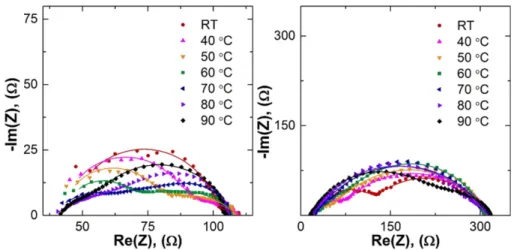
Figure 6 shows the Nyquist plots of the impedance spectra obtained from both the NaPON and LiPON films at various temperatures between 27

o

C and 90

o

C. All Nyquist plots for both samples show two successive semi-circles with the x-axis intercept at low frequencies. The arc of the first semicircle was found to decrease in size with an increase in temperature for both thin films. The decreasing arc size indicates that the electrolyte would have had a lower resistance at higher temperatures, because the first semi-circle in the impedance spectra represents the ionic conductivity of the electrolyte film. This result is good agreement with our expectation that the empty sites would move fast in the solid film due to the applied thermal energy [30]. Conductivity was determined by fitting the impedance spectra obtained at various temperatures to the circuit model of Fig.

5(b) based on the CNLS fitting model [27].

Figure 7 shows a graph of the natural logarithm of σT as a function of 1000/T. A linear relationship was observed between the two parameters in the low- temperature range (room temperature-70

o

C); this linear trend deviated at higher temperatures. Hence, the CNLS fitting was carried out for the measured values obtained between room temperature and 70

o

C. The activation energies obtained for both films are summarized in Table 1. The NaPON thin film has a lower activation energy than the LiPON thin film (0.164 eV vs. 0.672 eV). The lower activation

ln ( σT ) ln σ ( )

0

E

a

kT --- –

=

Fig. 5. (a) Nyquist plots of the impedance spectra experimentally measured on Mo/NaPON/Mo and Mo/

LiPON/Mo film structures at an open circuit potential at an ambient temperature (inset: enlarged impedance data of NaPON and LiPON films) and (b) equivalent circuit model used to estimate the electrolyte resistance for both oxynitride films (LiPON and NaPON). In the Nyquist plot of (a), the empty dots indicate that the experimentally measured impedance data and the solid lines are the fitting values based on the equivalent circuit of (b).

Table 1. Parameters of the RF-sputtered NaPON and LiPON thin films estimated from the impedance spectra

Sputtered film Conductivity, σ (27

o

C)

Activation energy, E

a

NaPON 8.73×10

-6

S cm

-1

0.164 eV

LiPON 8.11×10

-6

S cm

-1

0.672 eV

(6)

energy of the NaPON film demonstrates its potential for use as a solid-state electrolyte film, since a low activation energy implies facile kinetics of the empty sites through the solid film. In addition, ionic conductivity can rapidly increase with increasing temperature due to the lower activation energy.

Therefore, a much higher conductivity can be obtained at a higher temperature in the NaPON thin film as compared to the LiPON thin film.

The reasonably high ionic conductivity and low activation energy of the RF-sputtered NaPON films are indicative of a good solid electrolyte. Similar to the solid-state LiPON thin films, it is believed that the amorphous structure of NaPON films could contribute to the improvement in ionic conductivity.

In addition, the nitrogen incorporated into the film could also contribute to an enhancement in the conductivity.

4. Conclusions

We reported the preparation of a solid-state sodium phosphorous oxynitride (NaPON) film deposited at room temperature via RF magnetron sputtering of a Na

3

PO

4

target at 50 W in a pure N

2

environment.

The deposited NaPON film was continuous and homogenous, and the growth rate was measured to be 124 nm h

-1

. The RF-sputtered NaPON film was found to be a potential solid-state electrolyte to transport Na ions based on the electrochemical impedance spectroscopy analysis. For comparison, a lithium phosphorous oxynitride (LiPON) film, commonly used as a Li-ion conductor, was deposited with the same RF magnetron sputtering technique from a Li

3

PO

4

target. The NaPON film was found to have a reasonable ionic conductivity of 8.73 × 10

-6

S cm

-1

similar to that of the LiPON film (8.11 × 10

-6

S cm

-1

). This relatively high conductivity is a key characteristic for a good solid-state electrolyte.

Moreover, the NaPON film showed a lower activation energy of 0.164 eV than the 0.672 eV for the LiPON film. The lower activation energy indicates a facile movement of the conducting ions through the film. Both, the reasonable ionic conductivity and the activation energy for the NaPON film, provides a lower series resistance for the electrolyte in the electrochemical cell. The lower resistance of the electrolyte allows for a higher Fig. 6. Nyquist plots of the impedance spectra experimentally measured on (a) Mo/NaPON/Mo and (b) Mo/LiPON/Mo sandwich configuration at an open circuit potential between room temperature and 90

o

C (temperature step: 10

o

C).

The empty dot indicates the experimentally measured impedance value. The solid lines in (a) and (b) were determined by CNLS fitting of the experimental impedance spectra to the equivalent circuit model of (c).

Fig. 7. Arrhenius plots of the conductivity in NaPON and

LiPON thin films as a function of temperature between

27

o

C and 90

o

C.

(7)

power density and energy efficiency. A full-cell characterization needs to be performed to demonstrate the role of the NaPON film as an electrolyte in a Na-ion full-cell.

Acknowledgement

This work was supported by the National Research Foundation of Korea (NRF) grant funded by the Korea government (Ministry of Science, ICT &

Future Planning) (NRF-2017R1C1B2005470).

References

[1] J. Freed, in, AP, https://www.usatoday.com/story/

todayinthesky/2014/01/15/boeing-confirms-new- 787-battery-incident/4494157/, 2014.

[2] S. Kovach, in, http://www.businessinsider.com/

samsung-issues-galaxy-note-7-battery-report-2017- 1, 2017.

[3] C. Lethien, M. Zegaoui, P. Roussel, P. Tilmant, N. Rolland, P.A. Rolland, Microelectron. Eng., 88 (2011) 3172-3177.

[4] F. Xu, N.J. Dudney, G.M. Veith, Y. Kim, C.

Erdonmez, W. Lai, Y.-M. Chiang, J. Mater. Res., 25 (2011) 1507-1515.

[5] S.D. Jones, J.R. Akridge, Solid State Ion., 53 (1992) 628-634.

[6] X. Yu, J.B. Bates, G.E. Jellison, F.X. Hart, J.

Electrochem. Soc., 144 (1997) 524-532.

[7] J.B. Bates, N.J. Dudney, G.R. Gruzalski, R.A. Zuhr, A. Choudhury, C.F. Luck, J.D. Robertson, J. Power Sources, 43 (1993) 103-110.

[8] N. Kamaya, K. Homma, Y. Yamakawa, M.

Hirayama, R. Kanno, M. Yonemura, T. Kamiyama, Y. Kato, S. Hama, K. Kawamoto, A. Mitsui, Nat.

Mater., 10 (2011) 682-686.

[9] B. Wang, J.B. Bates, F.X. Hart, B.C. Sales, R.A.

Zuhr, J.D. Robertson, J. Electrochem. Soc., 143 (1996) 3203-3213.

[10] J.B. Bates, D. Lubben, N.J. Dudney, F.X. Hart, J.

Electrochem. Soc., 142 (1995) L149-L151.

[11] C. Sun, J. Liu, Y. Gong, D.P. Wilkinson, J. Zhang, Nano Energy, 33 (2017) 363-386.

[12] Y.G. Kim, H.N.G. Wadley, J. Vac. Sci. Technol.

A, 26 (2008) 174-183.

[13] C.H. Choi, W.I. Cho, B.W. Cho, H.S. Kim, Y.S.

Yoon, Y.S. Tak, Electrochem. Solid State Lett., 5 (2002) A14-A17.

[14] R. Marchand, D. Agliz, L. Boukbir, A. Quemerais, J. Non-Cryst. Solids, 103 (1988) 35-44.

[15] R.K. Evans, Energy, 3 (1978) 379-385.

[16] S.E. Kesler, P.W. Gruber, P.A. Medina, G.A.

Keoleian, M.P. Everson, T.J. Wallington, Ore Geol.

Rev., 48 (2012) 55-69.

[17] C. Grosjean, P.H. Miranda, M. Perrin, P. Poggi, Sust. Energ. Rev., 16 (2012) 1735-1744.

[18] T.C. Wanger, Conser. Lett., 4 (2011) 202-206.

[19] J.F. Whitacre, T. Wiley, S. Shanbhag, Y. Wenzhuo, A. Mohamed, S.E. Chun, E. Weber, D. Blackwood, E. Lynch-Bell, J. Gulakowski, C. Smith, D.

Humphreys, J. Power Sources, 213 (2012) 255-264.

[20] Z. Zeng, X. Jiang, R. Li, D. Yuan, X. Ai, H.

Yang, Y. Cao, Adv. Sci., 3 (2016) 1600066-n/a.

[21] F. Wu, N. Zhu, Y. Bai, L. Liu, H. Zhou, C. Wu, ACS Appl. Mater. Interfaces, 8 (2016) 21381- 21386.

[22] B.L. Ellis, L.F. Nazar, Curr. Opin. Solid State Mater.

Sci., 16 (2012) 168-177.

[23] D. Kundu, E. Talaie, V. Duffort, L.F. Nazar, Angew.

Chem. Int. Ed., 54 (2015) 3431-3448.

[24] V. Palomares, P. Serras, I. Villaluenga, K.B. Hueso, J. Carretero-Gonzalez, T. Rojo, Energy Environ.

Sci., 5 (2012) 5884-5901.

[25] R. Marchand, J. Non-Cryst. Solids, 56 (1983) 173- 178.

[26] A. Le Sauze, E. Gueguen, R. Marchand, J. Non- Cryst. Solids, 217 (1997) 83-91.

[27] J.R. Macdonald, W.R. Kenan, Impedance Spectroscopy: Emphasizing Solid Materials and Systems, Wiley, 1987.

[28] J.B. Bates, N.J. Dudney, G.R. Gruzalski, R.A. Zuhr, A. Choudhury, C.F. Luck, J.D. Robertson, Solid State Ion., 53 (1992) 647-654.

[29] B. Put, P.M. Vereecken, J. Meersschaut, A.

Sepúlveda, A. Stesmans, ACS Appl. Mater.

Interfaces, 8 (2016) 7060-7069.

[30] P. Shewmon, Diffusion in Solids, Wiley, 1991.

수치

Fig. 1. Schematic diagram of the plain and cross- cross-sectional views of the Mo/NaPON/Mo sandwich cell configuration.
Fig. 4. X-ray diffraction (XRD) patterns of NaPON and LiPON solid films RF sputtered on the glass substrate.
Figure 6 shows the Nyquist plots of the impedance spectra obtained from both the NaPON and LiPON films at various temperatures between 27 o C and 90 o C
Fig. 7. Arrhenius plots of the conductivity in NaPON and LiPON thin films as a function of temperature between 27 o C and 90 o C

참조

관련 문서