151
Copyright © 2014 The Korean Society of Fisheries and Aquatic Science pISSN:0374-8111, eISSN:2287-8815
서 론
대황
(Eisenia bicyclis)
은갈조류의식용해조류로phlorotan-
nins
과 같은생리활성 물질을다량함유하고 있으며,
대황으로부터분리된항산화활성을지닌
phlorotannins
에는eckol, phlorofucofuroeckol-A, dieckol
그리고8,8′-bieckol
등이보고 되고있다(Okada et al., 2004).
또한,
대황의phlorotannins
은 항균(Eom et al., 2011),
항염증(Jung et al., 2013),
항고지혈증(Jang et al., 2008)
및항당뇨(Okada et al., 2004)
등의다양한 생리활성을가지고있다고보고되어있다.
대황과같은해조류의유용성분을추출하여이용할때에는해 조류를유기용매추출
,
열수추출,
산·
알칼리처리또는효소처 리등의방법들이대부분이다(Do et al., 1997; Kim and Bae,
2002).
하지만해조류에포함되어있는다당류대부분이비소화성복합다당류이기때문에산이나알칼리에비교적안정하 고특수한미생물효소에의하지않고서는분해가어려워여러 가지생체활성물질의변질및파괴등을초래하거나효과적인 추출이어려운단점을가지고있다
(Song et al., 2011).
또한이 러한추출방법들은고비용,
복잡한공정및환경오염등의문제 뿐만아니라,
해조류추출액에알긴산등의점질다당류와해조 류특유의향,
풍미,
조직감등이잔존하는한계점이있다(Lim et al., 1995; Kim and Bae, 2002; Song et al., 2011).
이러한단 점을극복하기위하여효모,
유산균,
곰팡이등의발효미생물 을이용한다시마,
감태및톳등의해조류발효에대한연구가 진행되었다(Bae and Kim, 2010; Eom et al., 2010; Song et al., 2011).
대황의경우, Eom et al. (2011)
이발효에의한대황추
대황(Eisenia bicyclis) 추출액의 항산화 및 항염증 활성에 대한 유산균 발효의 영향
한해나·엄성환
1·김지훈·김덕훈·김송희·김윤혜·염승목·김영목*
부경대학교 식품공학과, 1한국식품연구원
Effects of Lactic Acid Bacterial Fermentation on the Antioxidant and Anti-inflammatory Activity of Brown Algae Eisenia bicyclis Extract
Hae-Na Han, Sung-Hwan Eom
1
, Ji-Hoon Kim,Deok-Hoon Kim, Song-hee Kim, Yunhye Kim, Seung-Mok Yeom and Young-Mog Kim*Department of Food Science and Technology, Pukyong National University, Busan 608-737, Korea
1
Korea Food Research Institute, Sungnam 463-746, Korea
This study was conducted to evaluate the effect of lactic acid bacterial fermentation on the antioxidant and anti- inflammatory activity of an edible brown alga, Eisenia bicyclis . Lactic acid bacteria were inoculated into and cultivat- ed in E. bicyclis water extract. The antioxidant activity of the extract was assayed before and following fermentation.
Antioxidant activity was determined by assaying the levels of radical scavenging activity against 2,2′-diphenyl-1-pic- rylhydrazyl (DPPH), hydroxyl radical and alkyl radical. The lactic acid bacterial fermentation of E. bicyclis extract resulted in enhanced antioxidant activity. The greatest enhancement of antioxidant activity was seen in the DPPH radical scavenging assay, in which E. bicyclis extract was fermented by Pediococcus pentosaceus MBP-34 strain for 12 h. This fermented extract also exhibited higher inhibitory activity (96.66%) on nitric oxide production compared with other lactic acid bacterial fermented extracts or raw extract (189.60%). In conclusion, fermentation by bacterial strain is an attractive strategy for developing value-added food ingredients.
Key words: Anti-inflammatory activity, Antioxidant activity, Eisenia bicyclis, Fermentation, Lactic acid bacteria
This is an Open Access article distributed under the terms of the Creative Commons Attribution Non-Commercial Licens (http://creativecommons.org/licenses/by-nc/3.0/)which permits unrestricted non-commercial use, distribution, and reproduction in any medium, provided the original work is properly cited.
http://dx.doi.org/10.5657/KFAS.2015.0151 Korean J Fish Aquat Sci 48(2) 151-157, April 2015 Received 7 April 2015; Revised 8 April 2015; Accepted 9 April 2015
*Corresponding author: Tel: +82. 51. 629. 5832 Fax: +82. 51. 629. 5824
E-mail address: [email protected]
한해나
ㆍ
엄성환ㆍ
김지훈ㆍ
김덕훈ㆍ
김송희ㆍ
김윤혜ㆍ
염승목ㆍ
김영목152
출액의폴리페놀 함량증가와
2,2′-diphenyl-1-picrylhydrazyl (DPPH) radical
및hydroxyl radical
소거활성에대한단편적 인연구결과만보고하였다.
이에본연구에서는우수한생리 활성을가지고있는것으로알려져있음에도불구하고상대적 으로상업적적용에대한연구가미진한대황의활용도를높이 기위하여미생물발효에의한대황발효액의항산화활성및항 염증활성변화를비교하였다.
본연구에서얻어진결과는향후 발효공정을이용한다양한해조류발효제품개발에연결될것 으로기대된다.
재료 및 방법
시료
본연구에사용된대황
(E. bicyclis)
은2014
년8
월에채취한울 릉도산을구입하여사용하였다.
대황의염을제거하기위해물 로3
회세척한후일광건조하였다.
건조된대황은분쇄기(HMF -1000A; Hanil Electronics, Seoul, Korea)
를통해분말화한후-70℃
냉동고에보관후, Eom et al. (2011)
이보고한방법에따 라건조된대황분쇄물에20
배의물(w/v)
을첨가하고121℃
에 서15
분간열수추출하였다.
대황추출액의발효를위하여사용된균주는전통발효식품에 서분리하여부경대학교식품공학과식품미생물학연구실에서 보관중인유산균들을사용하였다
. MRS
배지(Difco; Sparks, MD)
에발효균주를24
시간배양후,
배양액10%
를대황추출 액에접종하고30℃
에서진탕배양(120 rpm)
하였다.
발효액을 에탄올로3
회추출후여과하여진공회전농축기(Eyela Co., To- kyo, Japan)
로농축하여분석에사용하였다.
페놀 함량 측정
Folin-Ciocalteu
법(Waterman and Mole, 1994)
을 수정한Kim at al. (2006)
의방법에따라phenolic compound
를정량 하였다.
먼저시료를spectrophometer
의측정범위까지희석을 하고희석된시료80 μL
와1 N Folin-Ciocalteu reagent 0.4 mL
를eppendorf tube
에넣은후3
분간상온에서방치한후, 7.5%
Na
2CO
3를0.32 mL
넣고암실에서20
분간방치하였다.
이후 시료를96 well plate
에0.2 mL
씩옮긴후GENios® micro- plate reader (Tecan Austria GmbH, Grödig, Austria)
를사용 하여765 nm
에서흡광도값을측정하였다.
추출물안의total phenolic content
의농도는표준물질로galic acid
를이용한다 음선형방정식을사용하여나타내었다.
Y=0.007X+0.063, r²= 0.9997
여기서
Y
는흡광도값, X
는total phenolic compound
를나타 낸다.
추출물1g
당galic acid equivalents
의mg (mg GAE/g)
로나타내었다.
DPPH radical 소거능 측정
DPPH radical
소거능은Qureshi et al. (2010)
의방법으로분 석하였다.
시료100 μL
에150 μM DPPH
용액100 μL
를혼합 후반응액을96 well plate
에옮겨암실에서30
분간방치후GE- Nios® microplate reader (Tecan Austria GmbH, Grödig, Aus- tria)
를통해517 nm
에서흡광도를측정하였다. DPPH radical
소거능은아래의식으로계산하였다.
Radical scavenging activity (%) =
Absorbance of control – absorbance of test× 100
Absorbance of controlHydroxyl radical 소거능 측정
Hydroxyl radical
소거능은Rosen and Rauckman (1984)
의 방법으로분석하였다.
시료20 μL
에0.3 M DMPO 20 μL, 10 mM FeSO
420 μL, 10 mM H
2O
220 μL
를혼합한다음quartz capillary tube
에옮긴후2.5
분후에electron spin resonance (ESR) spectrometer
로측정하였다.
실험조건은다음과같다: magnetic field, 336.5±5 mT; power, 1 mW; modulation fre- quency, 9.41 GHz; amplitude, 2.5×100; sweep time, 30 sec;
temperature 298 K. Hydroxy radical
소거능은H
과H
0의상대 적인높이에의해측정하는다음수식에의해계산되었다.
Radical scavenging activity (%) = (1 -
HH) × 100
0
Alkyl radical 소거능 측정
Alkyl radical (peroxyl radical)
은Hiramoto et al. (1993)
의방법에따라다음과같이측정하였다. 10 μL
의시료에각 각10 μL
의phosphate buffered saline (PBS), 40 mM AAPH [2,2-azobis-(2-amidinopropane)-dihydrochloride], 40 mM POBN α-(4-pyridyl-1- oxide)-N-tert-butylnitrone
을 첨가한 다.
그리고37℃
에서30
분간반응시킨후quartz capillary tube
에옮겨ESR spectrometer
를이용하여측정하였다.
실험조건 은다음과같다: magnetic field, 336.5±5 mT; power, 7 mW;
modulation frequency, 9.41 GHz; amplitude, 6.0×100; sweep time, 30 sec; temperature 298 K. Alkyl radical
소거능은아래 의식으로계산하였다.
Radical scavenging activity (%) = (1 -
H) × 100
H0세포 배양
마우스의 대식세포주인
Raw 264.7 cell
은 한국세포주은행(KCLB)
에서분양받았으며,
세포배양을위해10% fetal bo-
vine serum (FBS)
과1% penicillin-streptomycin
을포함하는Dulbecco’s Modified Eagle Medium (DMEM)
배지를사용하 였다.
세포는37℃, 5% CO
2조건에서배양하였다.
MTT assay에 의한 세포 생존율 측정
96-well plate
에Raw 264.7 cell 1×10
5개를분주하고, 4
시 간뒤에새배지로교체후일정농도(0.5 mg/mL)
의대황추출 액및유산균대황발효액을24
시간동안처리하였다.
이후, 3- (4,5-dimethylthiazol-2-ly)-2,5-diphenyltetrazolium bromide (0.1 mg/mL)
을 각well
에처리하여4
시간배양한후형성된insoluble formazan
을DMSO
에녹이고ELISA reader (Wallac 1420, USA)
를통해540 nm
에서흡광도를측정하였다. Cell base nitric oxide (NO) assay
Raw 264.7 cell
을96 well plate
에1×10
5개를분주하고, 24
시 간뒤에새배지로교체후일정농도(0.5 mg/mL)
의대황추출 액및유산균대황발효액을1
시간동안전처리후lipopolysac- charide (LPS)
를1 μg/mL
로24
시간동안처리하였다.
세포배 양상층액50 μL
를96 well
에덜어놓고Griess
용액(1% sulfa- nilamide/0.1% N-(1-naphthyl)-ethylenediamine dihydrochlo- ride/2.5% H3PO4) 50 μL
를첨가하고5
분후ELISA reader (Wallac 1420; Perkin Elmer, Turku, Finland)
를통해540 nm
에서흡광도를측정하였으며, 3
반복을원칙으로하여평균값 을구하였다.
결과 및 고찰
페놀 함량의 측정
페놀화합물은다양한생리활성기능을가지고있다고알려져 있다
(McDougall et al., 2005).
육상식물의페놀화합물과비 슷한구조를띄는phlorotannin
은해조류에서유래된phenolic
compound
로서여러생리활성들과관련된것으로보고되고있다
(Lee et al., 2008).
본실험에사용된10
종의균주들중에서대황발효에유용한균주를탐색하기위해대황발효추출액의 페놀함량을측정하였다
.
대황발효에대한이전연구에서Eom et al. (2011)
은대황의페놀함량은발효24
시간에최대치를기 록하였다가그이후에는감소하는경향을보인다고보고하였 다.
이에본실험에서는이전결과를토대로발효12
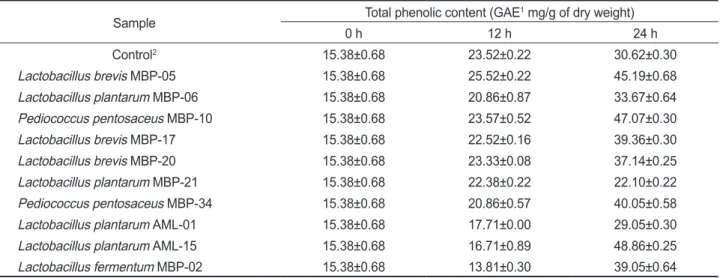
시간과24
시간후의유산균대황발효액에서페놀화합물의변화를측정 하였다(Table 1).
유산균발효에의해대황발효액의페놀함 량이증가하는경향을확인할수있었다.
가장높은페놀함량 은Lactobacillus plantarum AML-15
에의한발효24
시간후[48.86 mg galic acid (GAE)/g]
에관찰되었고,
다음은Pedio- coccus pentosaceus MBP-10
에의한발효24
시간후(47.07 mg GAE/g)
로나타났다(Table 1).
그이외에, L. brevis MBP-5
및P. pentosaceus MBP-34
에의한발효24
시간후에높은페놀 함량이나타났다.
이러한결과는
L. brevis LB-20
균주에의한유산균톳발효 액이대조구인톳추출액(
비발효)
에비해페놀화합물의함량 이증가하였다는보고(Song et al., 2011)
와미생물발효다시마 추출액에서페놀화합물함량증가에대한보고(Bae and Kim, 2010; Eom et al., 2010)
와도일치한다.
또한해조류발효에대 한다른연구자들의결과와마찬가지로대황발효중에유산균 들이생성하는다양한효소들에의한가수분해작용으로대조 구(
무발효구)
에비해페놀화합물의함량이증가한것으로판 단된다(Park et al., 2005; Eom et al., 2011; Song et al., 2011).
DPPH radical 소거능 측정
대황추출액과유산균대황발효액을대상으로
DPPH radi-
cal
소거능활성을실험한결과는Fig. 1
에나타내었다.
발효하 지않은대황추출물(
대조구)
의경우DPPH radical
소거활성은34.86%
로Eom et al. (2011)
이보고한대황추출액의DPPH radical
소거활성(36.11%)
과비슷한결과를나타내었다.
반면Table 1. Change of total phenolic contents in Eisenia bicyclis water extract by lactic acid bacteria fermentation
Sample Total phenolic content (GAE1 mg/g of dry weight)
0 h 12 h 24 h
Control2 15.38±0.68 23.52±0.22 30.62±0.30
Lactobacillus brevis MBP-05 15.38±0.68 25.52±0.22 45.19±0.68
Lactobacillus plantarum MBP-06 15.38±0.68 20.86±0.87 33.67±0.64
Pediococcus pentosaceus MBP-10 15.38±0.68 23.57±0.52 47.07±0.30
Lactobacillus brevis MBP-17 15.38±0.68 22.52±0.16 39.36±0.30
Lactobacillus brevis MBP-20 15.38±0.68 23.33±0.08 37.14±0.25
Lactobacillus plantarum MBP-21 15.38±0.68 22.38±0.22 22.10±0.22
Pediococcus pentosaceus MBP-34 15.38±0.68 20.86±0.57 40.05±0.58
Lactobacillus plantarum AML-01 15.38±0.68 17.71±0.00 29.05±0.30
Lactobacillus plantarum AML-15 15.38±0.68 16.71±0.89 48.86±0.25
Lactobacillus fermentum MBP-02 15.38±0.68 13.81±0.30 39.05±0.64
1 Gallic acid equivalents, 2 Eisenia bicyclis water extract.
한해나
ㆍ
엄성환ㆍ
김지훈ㆍ
김덕훈ㆍ
김송희ㆍ
김윤혜ㆍ
염승목ㆍ
김영목154
유산균대황발효액은대조구에비하여
DPPH radical
소거활성이증가하는경향을나타내었다
.
이러한결과는다시마추출액이곰팡이와효모의발효에의 해
DPPH radical
소거활성이증가하였다는Eom et al. (2010)
과Bae and Kim (2010)
의연구결과와도같은경향을나타내고 있다.
이는미생물의발효에의해항산화활성을가지는것으로 알려진페놀화합물이증가하기때문인것으로판단된다.
하지 만페놀화합물의함량과DPPH radical
소거능활성사이에유 의적인상관관계는관찰되지않았다.
대황발효에사용된유산 균주들중에서상대적으로페놀화합물함량이낮은P. pento- saceus MBP-34
균주를가지고12
시간발효한대황발효추출 물의DPPH radical
소거능이83.75%
로가장높은활성을나타 내었다(Fig. 1). Eom et al. (2013)
은Cadida utilis
를이용한대 황발효에서발효중에페놀화합물함량의변화보다는대황에 서항산화등의생리활성에중요한지표물질인eckol, dieckol, dioxinodehydroeckol
및phlorofucofuroeckol-A
등의phloro- tannins
화합물의함량변화가더중요하다고보고하고있다.
따라서본연구에서얻어진페놀화합물의함량과
DPPH radical
소거활성간의역상관관계를보다면밀하게분석하기위해서는
페놀화합물의함량측정뿐만아니라유산균발효에의한
phlo-
rotannins
함량의변화에대한연구가필요할것으로판단된다. Hydroxyl radical 소거능 측정
Hydroxyl radical
은노화와관련된원인물질인활성산소중 에서반응성이가장강하여생체내각종조직및세포막등의산화에중요한역할을하는것으로알려져있다
(Heo and Wang,
2008).
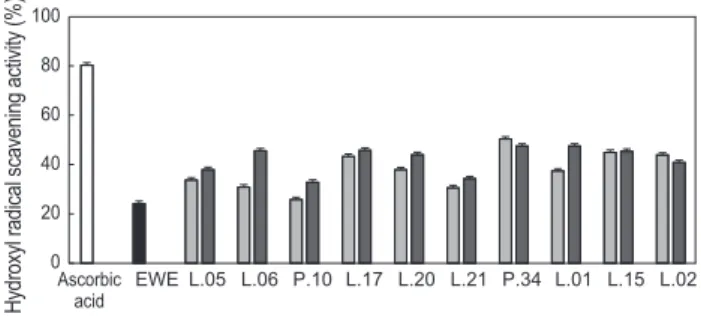
유산균대황발효액의hydroxyl radical
의소거활성을 실험한결과는Fig. 2
와같다. Positive control
인ascorbic acid
의경우
80.42%
의활성을나타내었고,
대황추출액의경우에는
30.51%
로Kim and Lee (2004)
가보고한대황의건조조건 에따른hydroxyl radical
소거활성(42%)
과유사하였다.
하지 만,
유산균대황발효액은대황추출액(
대조구)
보다hydroxyl radical
소거활성이증가하는경향을나타내었다.
특히P. pen- tosaceus MBP-34
에의해12
시간발효된것이50.41%
로가장 높은활성이관찰되었다.
이러한결과는유산균대황발효액이정제된화합물이아닌 점을고려한다면상당히뛰어난
hydroxyl radical
소거활성을 가지고있는것으로판단된다. Eom et al. (2010)
도효모다시마 발효액의항산화활성의증가에대해보고하고있으나그활성 증가는대황추출액과마찬가지로radical
의종류에따라차이 가있다.
이는해조류들중에존재하는항산화물질의종류,
함 량및미생물발효에의한해조류대사산물등의차이에기인하 는것으로생각되지만현재이에대한연구는진행되어있지않 으며향후연구가필요한것으로판단된다.
Alkyl radical 소거능 측정
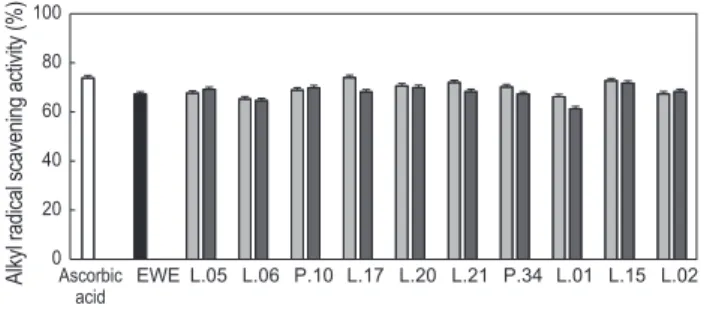
대황추출액과유산균대황발효액을대상으로
alkyl radical
소거활성을실험한결과는Fig. 3
과같다. Positive control
인ascorbic acid
는73.81%
의활성을나타내었고,
대황추출액의경우에는
67.27%,
유산균대황발효액은대부분유산균발효에의해대조구인대황추출액의
alkyl radical
소거활성보다소폭증진되는것으로나타났다
.
또한천연항산화제중alkyl
radical
소거능이매우우수한것으로알려진ascorbic acid
와 비교시동일농도에서대등한alkyl radical
소거능을나타내었 으며alkyl radical
의소거활성이뛰어나다고알려진chitooligo- saccharides (25%)
보다월등한소거활성을나타내었다(Ngo et
0 20 40 60 80 100
Ascorbic
acid EWE L.05 L.06 P.10 L.17 L.20 L.21 P.34 L.01 L.15 L.02
DPPH radical scavening activity (%)
0 20 40 60 80 100
Ascorbic
acid EWE L.05 L.06 P.10 L.17 L.20 L.21 P.34 L.01 L.15 L.02
Hydroxyl radical scavening activity (%)
0 20 40 60 80 100
Ascorbic
acid EWE L.05 L.06 P.10 L.17 L.20 L.21 P.34 L.01 L.15 L.02
Alkyl radical scavening activity (%)
0 20 40 60 80 100 120
Ascorbic
acid EWE L.05 L.06 P.10 L.17 L.20 L.21 P.34 L.01 L.15 L.02
Cell viability (%) NO production (%)
200 4060 10080 120140 160180 200220 240
-- +
- +
EWE + A.C +
L.05 + L.06 +
P.10 + L.17 +
L.20 + L.21 +
P.34 + L.01 +
L.15 + LPS L.02
Extract
Fig. 1. Effect of lactic acid bacteria fermentation on DPPH radical scavenging activity of Eisenia bicyclis water extract. Results are means ±SD of triplicate data. □, ascorbic acid (500 µg/mL); ■, EWE (E. bicyclis water extract, 500 µg/mL); ■, E. bicyclis water extract fermented by lactic acid bacterial strains for 12 h (500 µg/
mL); ■, E. bicyclis water extract fermented by lactic acid bacterial strains for 24 h (500 µg/mL). L.05, Lactobacillus brevis MBP-05;
L.06, L. plantarum MBP-06; P.10, Pediococcus pentosaceus MBP- 10; L.17, L. brevis MBP-17; L.20, L. brevis MBP-20; L.21, L.
plantarum MBP-21; P.34, P. pentosaceus MBP-34; L.01, L. plan- tarum AML-01; L.15, L. plantarum AML-15; L.02, L. fermentum MBP-02.
0 20 40 60 80 100
Ascorbic
acid EWE L.05 L.06 P.10 L.17 L.20 L.21 P.34 L.01 L.15 L.02
DPPH radical scavening activity (%)
0 20 40 60 80 100
Ascorbic
acid EWE L.05 L.06 P.10 L.17 L.20 L.21 P.34 L.01 L.15 L.02
Hydroxyl radical scavening activity (%)
0 20 40 60 80 100
Ascorbic
acid EWE L.05 L.06 P.10 L.17 L.20 L.21 P.34 L.01 L.15 L.02
Alkyl radical scavening activity (%)
0 20 40 60 80 100 120
Ascorbic
acid EWE L.05 L.06 P.10 L.17 L.20 L.21 P.34 L.01 L.15 L.02
Cell viability (%) NO production (%)
200 4060 10080 120140 160180 200220 240
-- +
- +
EWE + A.C +
L.05 + L.06 +
P.10 + L.17 +
L.20 + L.21 +
P.34 + L.01 +
L.15 + LPS L.02
Extract
Fig. 2. Effect of lactic acid bacteria fermentation on hydroxyl radi- cal scavenging activity of Eisenia bicyclis water extract. Results are means ±SD of triplicate data. □, ascorbic acid (500 µg/mL); ■, EWE (E. bicyclis water extract, 500 µg/mL); ■, E. bicyclis water extract fermented by lactic acid bacterial strains for 12 h (500 µg/
mL); ■, E. bicyclis water extract fermented by lactic acid bacterial strains for 24 h (500 µg/mL). Bacterial strains were the same as listed in Fig. 1.
유산균 발효에 의한 대황의 항산화 및 항염증 활성 변화
155
al., 2010).
이상의다양한
radical
에대한소거활성에대한항산화실험결과를종합하여보면대황추출액은
DPPH radical, hydroxyl radical
및alkyl radical
과같은각종유해radical
생성을억제시 키는효과를가지고있으며그활성은유산균발효에의해서증 가되는것을확인할수있었다.
이에유산균발효에의해서세 포독성이생성되지않는다면천연항산화제로써의이용가능성이높을것으로판단되어이후
MTT assay
를이용한세포독성에관한연구를진행하였다
.
MTT assay에 의한 세포 생존율 측정
유산균발효에따른대황추출액의세포독성에대해조사하
기위하여
MTT assay
를이용하여세포독성에관한연구를진행하였다
(Fig. 4). MTT assay
에의한세포독성실험결과, Raw 264.7 cell
생존율은positive control
인ascorbic acid
는70.02%
의세포생존율을
,
대황추출액의경우에는57.70%
를나타내었 다.
유산균에의한대황추출물의발효액은대부분발효시간에 관계없이대조구보다높은세포생존율을나타내었다(Fig. 4).
특히
P. pentosaceus MBP-34
에의해12
시간발효된대황발효 추출물의경우, 101.76%
로가장높은Raw 264.7 cell
생존율 을나타내어유산균발효에의해세포독성을유발하는물질들 이경감되는것으로판단되었다.
다시마추출액의경우에도효 모발효에의해세포생존율이다소증가한다고보고하고있다(Eom et al., 2010).
이러한결과는전통발효식품에서분리한 유산균및효모등의발효미생물이해조류의발효중에인체에 유해한독성물질을생산하지않는다는것을의미하며향후전 통발효식품에서분리된미생물을이용한다양한해조류가공 기술개발에연결될것으로기대된다(Eom et al., 2010; Kang et al. 2010).
유산균의 발효에 의한 대황 추출액의 항염증 활성 증가
대황추출액은항산화활성외에도항염증에대한활성등이 보고되고있으며(Ryu and Kim, 2006), MTT assay
에서세포독성을나타내지않는농도인
0.5 mg/mL
에서유산균대황발효액의항염증활성을조사하였다
.
유산균대황발효액의항염 증효과를조사하기위하여세포내염증의지표인NO
생성 을LPS
로유도하였고유산균대황발효액의세포보호효과(cell protective effect)
를NO
생성억제활성으로측정하였다.
유산균발효액의경우
,
대부분24
시간발효보다12
시간발효 한대황발효액에서NO
생성능억제효과가상대적으로우수 한것으로나타났다(Fig. 5).
특히P. pentosaceus MBP-34
균주 Fig. 3. Effect of lactic acid bacteria fermentation on alkyl radicalscavenging activity of Eisenia bicyclis water extract. Results are means ±SD of triplicate data. □, ascorbic acid (500 µg/mL); ■, EWE (E. bicyclis water extract, 500 µg/mL); ■, E. bicyclis water extract fermented by lactic acid bacterial strains for 12 h (500 µg/
mL); ■, E. bicyclis water extract fermented by lactic acid bacterial strains for 24 h (500 µg/mL). Bacterial strains were the same as listed in Fig. 1.
0 20 40 60 80 100
Ascorbic
acid EWE L.05 L.06 P.10 L.17 L.20 L.21 P.34 L.01 L.15 L.02
DPPH radical scavening activity (%)
0 20 40 60 80 100
Ascorbic
acid EWE L.05 L.06 P.10 L.17 L.20 L.21 P.34 L.01 L.15 L.02
Hydroxyl radical scavening activity (%)
0 20 40 60 80 100
Ascorbic
acid EWE L.05 L.06 P.10 L.17 L.20 L.21 P.34 L.01 L.15 L.02
Alkyl radical scavening activity (%)
0 20 40 60 80 100 120
Ascorbic
acid EWE L.05 L.06 P.10 L.17 L.20 L.21 P.34 L.01 L.15 L.02
Cell viability (%) NO production (%)
200 4060 10080 120140 160180 200220 240
-- +
- +
EWE + A.C +
L.05 + L.06 +
P.10 + L.17 +
L.20 + L.21 +
P.34 + L.01 +
L.15 + LPS L.02
Extract
Fig. 4. Effect of lactic acid bacteria fermentation on cell cytotoxic- ity (Raw 264.7 cells) of Eisenia bicyclis water extract. Results are means ±SD of triplicate data. □, ascorbic acid (500 µg/mL); ■, EWE (E. bicyclis water extract, 500 µg/mL); ■, E. bicyclis water extract fermented by lactic acid bacterial strains for 12 h (500 µg/
mL); ■, E. bicyclis water extract fermented by lactic acid bacterial strains for 24 h (500 µg/mL). Bacterial strains were the same as listed in Fig. 1.
0 20 40
Ascorbic
acid EWE L.05 L.06 P.10 L.17 L.20 L.21 P.34 L.01 L.15 L.02
DPPH radical scavening activity (%)
0 20 40 60 80 100
Ascorbic
acid EWE L.05 L.06 P.10 L.17 L.20 L.21 P.34 L.01 L.15 L.02
Hydroxyl radical scavening activity (%)
0 20 40 60 80 100
Ascorbic
acid EWE L.05 L.06 P.10 L.17 L.20 L.21 P.34 L.01 L.15 L.02
Alkyl radical scavening activity (%)
0 20 40 60 80 100 120
Ascorbic
acid EWE L.05 L.06 P.10 L.17 L.20 L.21 P.34 L.01 L.15 L.02
Cell viability (%) NO production (%)
200 4060 10080 120140 160180 200220 240
-- +
- +
EWE + A.C +
L.05 + L.06 +
P.10 + L.17 +
L.20 + L.21 +
P.34 + L.01 +
L.15 + LPS L.02
Extract
Fig. 5. Effect of lactic acid bacteria fermentation on cell (Raw 264.7 cells) based nitric oxide assay of Eisenia bicyclis water extract. Results are means ±SD of triplicate data.
■, blank; ■,
lipopolysaccharide(LPS, 1 µg/mL); □, A.C (ascorbic acid, 500 µg/mL); ■, EWE (E. bicyclis water extract, 500 µg/mL); ■, E. bicyclis water extract fermented by lactic acid bacterial strains for 12 h (500 µg/mL); ■, E. bicyclis water extract fermented by lactic acid bacterial strains for 24 h (500 µg/mL). Bacterial strains were the same as listed in Fig. 1.
0 20 40 60 80 100
Ascorbic
acid EWE L.05 L.06 P.10 L.17 L.20 L.21 P.34 L.01 L.15 L.02
DPPH radical scavening activity (%)
0 20 40 60 80 100
Ascorbic
acid EWE L.05 L.06 P.10 L.17 L.20 L.21 P.34 L.01 L.15 L.02
Hydroxyl radical scavening activity (%)
0 20 40 60 80 100
Ascorbic
acid EWE L.05 L.06 P.10 L.17 L.20 L.21 P.34 L.01 L.15 L.02
Alkyl radical scavening activity (%)
0 20 40 60 80 100 120
Ascorbic
acid EWE L.05 L.06 P.10 L.17 L.20 L.21 P.34 L.01 L.15 L.02
Cell viability (%) NO production (%)
200 4060 10080 120140 160180 200220 240
-- +
- +
EWE + A.C +
L.05 + L.06 +
P.10 + L.17 +
L.20 + L.21 +
P.34 + L.01 +
L.15 + LPS L.02
Extract
한해나
ㆍ
엄성환ㆍ
김지훈ㆍ
김덕훈ㆍ
김송희ㆍ
김윤혜ㆍ
염승목ㆍ
김영목156
에서
12
시간발효한대황발효추출액에서NO
생성(98.66%)
이대조구(189.60%)
대비약2
배이상낮아가장항염증활성이 뛰어난것으로나타났다(Fig. 5). P. pentosaceus MBP-34
균주 에의한대황발효추출액의NO
생성억제활성이positive con- trol
인ascorbic acid (69.84%)
보다는떨어지지만발효액이정 제된화합물이아닌점을고려한다면뛰어난NO
생성억제효 과를가진것으로판단된다.
또한이러한결과는다른해조류추 출액이미생물발효에의해서항염증활성이증가한다는다른 보고들과도일치하였다(Eom et al., 2010; Kang et al., 2010).
본연구에서는대황추출액을이용한부가가치가높은식품 소재의개발을위하여유산균을이용한발효공정의적용가능 성을검토하였다
.
그결과,
세포독성에영향을미치지않으면서 대황의항산화활성뿐만아니라항염증활성을증가시킬수있 는우수한유산균주P. pentosaceus MBP-34
를확보하였다.
또 한이균주의경우효모와곰팡이와같은진균류에비해상대적 으로단시간발효에의해항산화및항염증활성증가가가능하 다는점등에있어서향후기능성이강화된해조류발효제품개 발에연결될것으로기대된다.
사 사
본논문은중소기업청에서지원하는
2014
년도산학연협력기 술개발사업(No. C0191509)
의연구수행으로인한결과물임을 밝힙니다.
또한이논문은수산과학발전에깊은관심을가지 고계셨던고강영환님을기리기위해미국시애틀소재SKS
Trading Co.
의지원에의해조성된부경대학교발전기금의장학금지원에의해이루어진연구로이에감사드립니다
.
References
Bae HN and Kim YM. 2010. Improvement of the functional qualities of sea tangle extract through fermentation by As-
pergillus oryzae. Fish Aquat Sci 13, 12-17. http://dx.doi.
org/10.5657/FAS.2010.0012.
Do JR, Kim EM, Koo JG and Jo KS. 1997. Dietary fiber contents of marine algae and extraction condition of the fiber. Korean J Fish Aquat Sci 30, 291-296. http://dx.doi.org/10.5657/
KFAS.1997.0291.
Eom SH, Lee BJ and Kim YM. 2010. Effect of yeast fermenta- tion on the antioxidant and anti-inflammatory activity of sea tangle water extract. Korean J Fish Aquat Sci 43, 117-124.
http://dx.doi.org/10.5657/KFAS.2010.0117.
Eom SH, Lee DS, Kang YM, Son KT, Jeon YJ and Kim YM.
2013. Application of yeast Candida utilis to ferment Eise-
nia bicyclis for enhanced antibacterial effect. Appl Biochem
Biotechnol 171, 569-582.Eom SH, Yu DU and Kim YM. 2011. Enhancement of polyphe- nol content and antioxidant activity of brown alga Eisenia
bicyclis extract by microbial fermentation. Fish Aquat Sci
14, 192-197. http://dx.doi.org/10.5657/FAS.2011.0192.
Kang YM, Lee BJ and Kim JS. 2010. Alcohol metabolizing ac- tivity of fermented sea tangle juice. Korean J Fish Aquat Sci 43, 1-5. http://dx.doi.org/10.5657/KFAS.2010.0001.
Kim HS and Bae TJ. 2002. Studies on the hydrolysis of seaweed using microorganism and its application. Korean J Food Nu- tri 15, 257-266.
Kim JA and Lee JM. 2004. The change of biologically function- al compounds and antioxidant activities in Hizikia fusiformis with drying methods. Korean J Food Culture 19, 200-208.
Kim KH, Tsao R, Yang R and Cui SW. 2006. Phenolic acid pro- files and antioxidant activities of wheat bran extracts and the effect of hydrolysis conditions. Food Chem 95, 466-473.
Lee DS, Kang MS, Hwang HJ, Eom SH, Yang JY, Lee MS and Kim YM. 2008. Synergistic effect between dieckol from
Ecklonia stolonifera and β-lactams against methicillin-re-
sistant Staphylococcus aureus. Biotechnolo Bioprocess Eng 13, 758-764.Lim SB, Kim SH, Ko YH, Oh CK, Oh MC, Ko YG and Park CS. 1995 Extraction yields of Hizikia fusiforme and Aloe
vera Linne by supercritical carbon dioxide and antimicro-
bial activity of their extracts. Korean J Food Sci Technol 27, 68-73.McDougall GJ, Shpiro F, Dobson P, Smith P, Blake A and Stew- art D. 2005. Different polyphenolic components of soft fruits inhibit α-amylase and α-glucosidase. J Agric Food Chem 53, 2760-2766.
Heo SI and Wang MH. 2008. Antioxidant activity and cytotox- icity effect of extracts from Taraxacum mongolicum H. Kor J Pharmacogn 39, 255-259.
Hiramoto K, Kato T and Kikugawa K. 1993. Generation of DNA-breaking activity in the Maillard reaction of glucose- amino acid mixtures in a solid system. Mutat Res 285, 191- Jang YH, Choi SW and Cho SH. 2008. Effect of Eisenia bicyclis 198.
and its pill on serum lipid status in rats fed high fat diet. Ko- rean J Food Nutri 41, 5-12.
Jung, HA, Jin SE, Ahn BR, Lee CM and Choi JS. 2013. Anti- inflammatory activity of edible brown alga Eisenia bicyclis and its constituents fucosterol and phlorotan nins in LPS- stimulated RAW 264.7 macrophages. Food Chem Toxicol 59, 199-206.
Ngo DN, Kim MM, Qian ZJ, Jung WK, Lee SH and Kim SK.
2010. Free radical-scavenging activity of low molecular weight chitin oligosaccharides lead to antioxidant effect in live cells. J Food Biochem 34(S1), 161-177.
Okada Y, Ishimaru A, Suzuki R and Okuyama T. 2004. A new phloroglucinol derivative from the brown alga Eisenia bicy-
clis: potential for the effective treatment of diabetic compli-
cations. J Nat Prod 67, 103-105.Park KE, Jang MS, Kim CW, Kim YK, Seo YW and Park HY.
2005, Antioxidant activity on ethanol extract from boiled-
water of Hizikia fusiformis. J Korean Soc Appl Biol Chem 48, 435-439.
Qureshi MN, Kuchekar BS, Logade NA and Haleem MA. 2010.
In-vitro antioxidant and in-vivo hepatoprotective activity of Leucas ciliata leaves. Rec Nat Prod 4, 124-130.
Rosen GM and Rauckman EJ. 1984. Spin trapping of superox- ide and hydroxyl radicals. Methods Enzymol 105, 198-209.
Ryu HS and Kim HS. 2006. Effect of Zingiber officinale and
Hizikia fusiforme water extracts on no production in macro-
phage of mice. Korean J Food Nutr 19, 327-331.Song HS, Kim HK, Min HO, Choi JD and Kim YM. 2011.
Change of physicochemical and sensory properties of
Hizikia fusiformis water extract by the fermentation of lactic
acid bacteria. Korean J Fish Aquat Sci 44, 104-110. http://dx.doi.org/10.5657/KFAS.2011.0104.
Waterman PG and Mole S. 1994. Analysis of phenolic plant me- tabolites. Blackwell Scientific Publications, Oxford, 83-91.