[논 문] 한국재료학회지 DOI: 10.3740/MRSK.2008.18.2.065 Kor. J. Mater. Res.
Vol. 18, No. 2 (2008)
65
†
Corresponding author
E-Mail : [email protected] (Y. H. Jiang)
Effect of Coiling Temperature on the Annealed Texture in Cu/Nb Added Ultra Low Carbon Steels
Yinghua Jiang
†, Young-Koo Park and Oh-Yeon Lee
Division of Advanced Materials Engineering, Chonbuk National University, South Korea
(Received December 5, 2007 : Accepted January 2, 2008)
Abstract The present work was performed to investigate the effect of coiling temperature on the annealed texture in Cu/Nb-added ultra-low-carbon steels. The ultra-low-carbon steels were coiled at 650 and 720
oC, respectively. The result showed that the Cu-added ultra-low-carbon steel at a low coiling temperature produced a desirable annealed texture related to good formability. On the other hand, Nb-added ultra-low-carbon steel at a high coiling temperature also produced a desirable texture. This is attributed to the effect of Nb, which retards recrystallization during the coiling process.
Key words microstructure, texture, Cu/Nb added ultra low carbon steel, coiling temperature.
1. Introduction
Recently, the newly developed ultra low carbon steel is expected to be applied in a wide range of automotive parts and applications more excellent formability.
1)The formability is closely related to the texture of the steel ultra low carbon steel sheet. Recently, a lot of attention was focused on the improvement of the final product texture through proper control of the processing parameters: heating temperature, coiling temperature, cold reduction, annealing temperature.
2)Among these, this study investigated the effect of coiling temperature on the annealed texture in Cu/Nb added ultra low carbon steels. In this paper, the two annealed ultra low carbon steels were investigated. One was based on Cu and the other was based on Nb. The Nb-added ultra low carbon steel has good formability and non-aging feature 3) .However the availability of Nb was restricted by its price and weldability effect. But for Cu-added ultra low carbon steel, C content was controlled in the range of ppm ( <30 ppm) itself without the help of the carbide forming elements such as Nb and Ti. The price of Cu is low and Cu-added ultra low carbon steel appears excellent bake hardening behavior and non-aging effect.
In the present paper, the annealed texture characteristics were studied in two different ultra low carbon steels after coiling at different temperatures.
2. Experimental procedure
The chemical compositions for the experimental ultra low carbon steels are listed in Table 1. The 30 mm thick slab was hot rolled down to 3.2 mm. Finish rolling was carried out at 920
oC followed by coiling at 650 and 720
oC.
The hot bands were subsequently cold-rolled to 78% and annealed at 800
oC for 60sec. The final thickness of the experimental ultra low carbon steel was 0.7 mm.The steel sheets with 10 mm ×10 mm×0.7 mm in size were cut in the normal direction (ND). The steel sheets were polished and etched with the nital for optical microscopy. The pole figure {110}, {200}, {211} were measured by Co K α radiation and the orientation distribution function (ODF) is calculated by using the progression extension.
3. Results
3.1 Microstructure
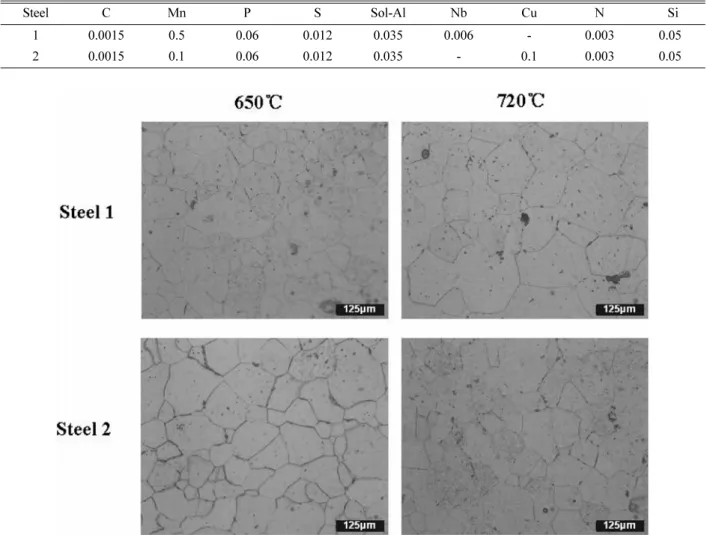
Fig. 1 shows the annealed microstructures of two
different ultra low carbon steels coiled at the temperature
of 650 and 720
oC. As it can be seen, the microstructures
are recrystallized and equiaxed ferrite grains. For the Nb-
added ultra low carbon steels, the grain size at high
coiling temperature was greater than at low coiling
temperature. In the case of Cu-added ultra low carbon
steels, the grain size of each sample is almost the same
regardless of different coiling temperature.
66 Yinghua Jiang, Young-Koo Park and Oh-Yeon Lee
3.2 Texture
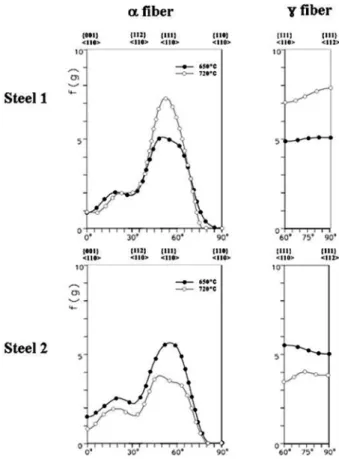
Fig. 2 shows the corresponding intensity changes of α- fiber (<110>//RD) and γ-fiber (<111>//ND) for the two steels coiled at 650 and 720, respectively. In the Nb-added ultra low carbon steel, on the α-fiber, the intensities were high in vicinity of {112~223}<110> at the two coiling temperatures. The most intense component {223}<110>
exhibited an intensity 5-or 7-fold greater than random, respectively. In the γ-fiber, the texture stretched from {111}<110> to {111}<112>, with a strong {111}<112>
component. The {111}<112> component with the intensity 7.5-fold greater than random at high coiling temperature was larger than that at low coiling temperature. It was seen at the coiling temperature of 720
oC the two fibers appeared stronger than that at the coiling temperature of 650
oC. Especially, the γ-fiber appears strong. In the Cu- added ultra low carbon steel, similarly, on the α-fiber, the intensities were high in vicinity of {112~223}<110> at
the two coiling temperatures. The most intense component {223}<110> exhibited an intensity 5-or 3-fold greater than random. In the γ-fiber, the texture stretched from {111}<110> to {111}<112> component. At the coiling temperature of 650
oC the {111}<110> component is identified as a peak orientation, but at the coiling tem- perature of 720
oC the {111}<123> component is identified as a peak orientation. The two components exhibited a 5.5-or 4-fold increase over random, respectively. And at the coiling temperature of 650
oC the two fibers appeared stronger than that at the coiling temperature of 720
oC. On the whole, the Nb-added ultra low carbon steel shows desirable texture at the coiling temperature of 720
oC, but the Cu-added ultra low carbon steel shows desirable texture at the coiling temperature of 650
oC. Fig. 3 shows the corresponding intensity changes of ε-fiber (<110>//TD) for the two steels coiled at 650 and 720
oC, respectively.
The ε-fiber of the Nb-added ultra low carbon steel at the Table 1. Chemical composition of the experimental ULC steels (wt.%)
Steel C Mn P S Sol-Al Nb Cu N Si
1 0.0015 0.5 0.06 0.012 0.035 0.006 - 0.003 0.05
2 0.0015 0.1 0.06 0.012 0.035 - 0.1 0.003 0.05
Fig. 1. Optical micrographs of the annealed steels.
Effect of coiling temperature on the annealed texture in Cu/Nb added ultra low carbon steels 67
coiling temperature of 720
oC is stronger than that at the coiling temperature of 650
oC. On the other hand, the ε- fiber of the Cu-added ultra low carbon steel at the coiling temperature of 650
oC is stronger than that at the coiling temperature of 720
oC. In the ε-fiber, the maximum intensity is at {554}<225> component for two different steels.
Especially, the {554}<225> intensity of Nb-added ultra low carbon steels at high coiling temperature is stronger than others.
4. Discussions
After coiling at 650 and 720
oC, respectively, the microstructures in the Nb- or Cu-added ultra low carbon steels showed recrystallized and equiaxed grains. In the Nb-added ultra low carbon steel, the grain sizes at high coling temperature of 720
oC is larger than that at low coiling temperature of 650
oC. The lower the coiling temperature, the lower the content of carbon in the solid solution. This may be connected with the segregation of certain amount of carbon during cooling from the annealing temperature, which is intensified in fine grain steels obtained at a low coiling temperature.
4)But for Cu-added ultra low carbon steel, the grain sizes are the same, which corresponds the results obtained in.
5)It is evident from above results that evolution of texture in the high temperature coiling condition is different from that in the low temperature coiling one. In the Nb-added ultra low carbon steel, the α-, γ-and ε-fibers are in the ascendant at the high coiling temperature. It is known that Nb, whether in solution or tied in precipitates, suppresses recrystallization processes in ferrite.
6)So this might cause the increase in recrystallization temperature.
The development of texture is dependent on the develop- ment of recrystallization. If the recrystallization of ferrite is progressively retarded by the Nb, the development of texture is also retarded. In the Cu-added ultra low carbon steel, the α-, γ-and ε-fibers are dominant at the low coiling temperature. In the past, several studies revealed that the high temperature coiling resulted in the formation of fine pre-precipitation of Cu, which caused a deterioration of texture. This just explained the result. It was noted the intensity along the ã-fiber peaks at {111}<112> in the Nb-added ultra low carbon steel with the coiling temperature of 720
oC, but at {111}<110> in the Cu-added ultra low carbon steel with the coiling temperature of 650
oC. It was known that the {111}<112>
component is a typical component of annealing texture in steels, and an increase in its intensity indicates that the material has reached a more complete state of recrystal- lization.
6)And the increase of {111}<112> is related to the increase of the neighboring {554}<225> intensity.
According to the Fig. 3 the {554}<225> component in the γ-fiber appears the strongest in the Nb-added ultra low carbon steel with the coiling temperature of 720
oC.
The increase of {554}<225> is attributed to the solutes effect of Nb.
7)Fig. 2. The α and γ fiber skeleton lines of the annealed steels.
Fig. 3. The ε fiber skeleton lines of the annealed steels.
68 Yinghua Jiang, Young-Koo Park and Oh-Yeon Lee