791
감태( Ecklonia cava) 에탄올 추출물의 α-Amylase 저해활성에 미치는 열 및 pH의 영향
김동현·정지연1·김꽃봉우리·이청조·곽지희·김민지
선우찬·김현지·정슬아·김태완2·조영제3·안동현✽
부경대학교 식품공학과/식품연구소,
1CJ 식품연구소,
2안동대학교 식품생명공학과,
3경북대학교 식품공학부
Effects of Heat and pH Treatments on α -Amylase Inhibitory Activity of Ecklonia cava Ethanol Extract
Dong-Hyun Kim, Ji-Yeon Jung
1, Koth-Bong-Woo-Ri Kim, Chung-Jo Lee, Ji-Hee Kwak, Min-Ji Kim, Chan Sunwoo, Hyun-Jee Kim, Seul-A Jung,
Tae-Wan Kim
2, Young-Je Cho
3and Dong-Hyun Ahn
✽Department of Food Science and Technology/Institute of Food Science, Pukyong National University, Busan 608-737, Korea
1
Food Research Center, CJ Research Institute, Seoul 152-051, Korea
2
Department of Food Science and Technology, Andong National University, Gyeongbuk 760-740, Korea
3
School of Food Science of Biotechnology, Kyungpook National University, Daegu 702-701, Korea
This study examined the inhibitory activity of
Ecklonia cava
(EC) against α-amylase to evaluate the availability of EC extract as a functional food agent. To verify the inhibitory activity of EC against porcine pancreatic α-amylase, potato starch was used as a substrate. This analysis revealed that EC ethanol extract exhibited high α-amylase inhibi- tory activity. For potential application within the food industry, the stability of the activity of EC ethanol extract under various heat and pH conditions was examined. The α-amylase inhibitory activity of EC ethanol extract was not af- fected by the heat and pH treatment conditions used in this study. These results suggest that EC has the potential for development as a functional food agent.Key words:
Ecklonia cava
, Ethanol extract, α-Amylase inhibitor, Functional food agent서 론
생물이 살아가기 위해 생명체 내에서 일어나는 대사작용, 생 합성 및 생분해 작용 등 대부분의 생명 활동이 효소에 의해서 일 어나며, 각각의 경로의 특정 효소가 정상적으로 작용하지 않거 나 과도하게 작용할 경우, 신체 균형을 유지하지 못하여 여러 가 지 질병을 유발시킨다(Jung, 1997). 그 중, 대표적인 질병으로 당뇨병은 인슐린 작용 또는 인슐린 분비의 이상으로 발생하는 대사 장애 증후군이다.
우리나라 당뇨병 환자 중 인슐린 비의존형인 제2형 당뇨병 의 발생빈도가 제1형 당뇨병 발병률보다 높다(Zimmet et al., 2001). 일반적으로 글루코스가 췌장의 â-cell로 들어가면 혈액 에서 인슐린 분비를 촉진시키는데, 이는 주변 세포들로 부터 글 루코스 흡수를 촉진시킨다. 그러나 제2형 당뇨병은 인슐린 분비 가 부적절하게 되어, 주변 세포들이 인슐린에 대하여 저항성을 띄어 고혈당 증세를 나타낸다(McCue and Shetty, 2004; Turner
et al., 1992). 고혈당 증세가 지속적이게 되면 망막, 신장, 신경 및 심혈관계 등 심각한 합병증을 유발한다(Franz et al., 2002;
Krentz et al., 2007; Saini et al., 2007). 따라서 고혈당증을 조절 하는 것은 당뇨병과 합병증을 예방하는데 아주 중요하다.
고혈당증을 조절하는 방법으로 전분의 분해 및 소화를 지연 시켜 글루코스의 흡수를 저하시키는 방법이 있는데, 소화기관 에 존재하는 α-amylase와 같은 탄수화물 분해효소의 기능을 저해시키는 것이다(Bhandari et al., 2008). 현재 α-amylase 저 해제로서 의약품형태인 방선균(
Actinoplanes
sp.)의 발효에 의 해 생산되는 acarbose는 침샘과 췌장에서 분비되는 α-amylase 와 소장의 brush border 막에서 존재하는 α-glucosidase의 활 성을 저해한다(Itsuo et al., 1981; de Melo et al., 2006). 그러 나 acarbose는 α-amylase 및 α-glucosidase 저해활성은 높은 반면, 과다 억제하여 지속적으로 복용 시 복부팽만감, 복명, 설 사 등의 부작용이 있는 것으로 알려져 안전성에 문제가 되고 있다(Hanefeld, 1998; Kageyama et al., 1997). 따라서 오늘날 에는 섭취 시 부작용이 적은 천연물로부터 α-amylase 저해제 를 탐색하는 연구가 활발히 이루어지고 있다. Chrzaszcz and*Corresponding author: [email protected]
<단보>
3.2.1.1, type VI, Sigma Co., St Louis, MO, USA)을 효소로, potato starch (type IV, Sigma Co.)를 기질로 사용하여 Ali et al.
(2006)의 방법을 변형하여 측정하였다. 즉, 시료를 농도별로 희 석하여 40 µL와 16 unit/mL의 α-amylase 200 µL를 유리튜브 에 분주 후, 25℃에서 5분간 반응시킨 후, 0.5% starch 400 µL를 분주 후 혼합하여 3 분간 반응하였다. 이 반응액을 200 µL 취하 여 96 mM DNS (3, 5-dinitrosalicylic acid, potassium sodium tartrate in 2 M NaOH) 발색시약 100 µL와 혼합시킨 후 85℃, 15분간 반응시켰다. 냉각된 초순수를 900 µL 첨가하여 540 nm 에서 흡광도를 측정하였다. Positive control은 항당뇨 치료제로 사용되고 있는 α-amylase 저해제인 acarbose (Sigma Co.)를 사 용하였으며, 시료의 농도는 추출물의 건조중량을 기준으로 하여 나타냈으며, α-amylase 저해활성은 다음과 같이 표기하였다.
저해율(%)=100-[(시료를 첨가한 흡광도/시료를 첨가하지 않은 흡광도)]×100
열 및 pH 처리에 의한 α-Amylase 저해제 안정성
열 안정성은 추출물의 농도를 5 mg/mL로 하여 60℃에서 10, 30 및 60분, 80℃와 100℃에서 각각 10 및 20분간 열처리 하였 고, 121℃, 1.2 atm에서 15분간 가압가열 처리한 후, 이를 급냉 하여 4℃에서 보관하여 실험에 사용하였다. pH 안정성은 추출 물 농도를 10 mg/mL로 하여 시료의 pH를 측정하고 1 N NaOH 와 1 N HCl을 가하여 pH 2, 4, 6, 8 및 10으로 조절하고 실온에 서 24시간 방치시킨 후, 본래의 pH로 중화시켜 최종 5 mg/mL 농도로 희석하여 실험에 사용하였다(Lee et al., 2009b).
통계처리
실험결과에 대한 통계처리는 SAS software (Statistical ana- lytical system V8.2, SAS Institute Inc, Cary, NC, USA)을 이 용하여 분산분석을 하였으며, 조사 항목들 간의 유의적 검정은
P
<0.05 수준에서 Duncan의 다중검정법으로 실시하였다.결과 및 고찰
감태 추출물의 α-Amylase 저해 활성
감태 에탄올 및 물 추출물을 5, 2.5 및 1 mg/mL의 농도에서 α-amylase 저해활성을 측정한 결과(Table 1), 감태 에탄올 추 출물이 각각 84.45, 71.02, 52.38%이었으며, IC50 값이 0.956 mg/mL로, 물 추출물의 52.44, 47.14, 40.47%의 IC50 값 4.79 mg/mL보다 높은 저해활성을 보였으며, 농도 의존적으로 저해 활성이 증가하였다. 그러나 positive control 인 acarbose의 IC50
값 0.438 mg/mL보다 높은 값이었다. 그러나 물 추출물의 경우 에는 활성이 낮게 나타났으며, 이러한 결과는 해조류인 지충이 에탄올 추출물에서 α-amylase의 높은 저해 활성을 나타냈지만, 물 추출물에서는 활성이 나타나지 않은 결과와 유사한 결과였으 Janicki(1933)은 발아된 곡물들로부터 amylase 활성을 저해하
는 천연물질을 발견하였으며, 두류(Mulimani and Rudrappa, 1994; Liener, 1979), 보리(Weselake et al., 1983), 산사(Kim et al., 2007), 제비꽃(Lee et al., 2008), 갈근(Park et al., 2009) 등 의 육상식물이나 한약제 등에서 α-amylase 저해제의 연구가 활 발히 진행되고 있다.
반면에, 최근에는 육상식물과 달리 고압, 저온, 저산소의 독 특한 환경조건인 해양에서 서식하는 해조류의 생리활성에 관한 연구가 많이 진행되고 있으나, 아직까지는 육상식물에 비해 연 구 정도가 매우 미비한 실정이다. 해조류의 생리활성에 관한 연 구보고에 따르면 항산화(Kim et al., 2008a; Kim et al., 2009), 항균(Lee et al., 2009c; Park et al., 2010; Yoon et al., 2010), 항 암(Zhuang et al., 1995), 면역증진(Lee et al., 2011) 등의 다양 한 효능이 알려져 있다(Gupta and Abu-ghannam, 2011). 특히 제주도 및 동해안에서 널리 분포되어 있는 감태는 생리활성의 주 구성성분인 phlorotannin이 다량 함유되어 있어 항산화 활성 (Kang et al., 2005), 항염증(Shin et al., 2006), 항응고(Burtin, 2003), 효소저해제(Jung, 2011; Lee et al., 2010b; Yoon et al., 2009) 등 다양한 생리활성을 나타내고 있다. Lee et al. (2010b) 은 감태 유래의 phlorotanin 화합물인 dieckol이 상업적으로 α -glucosidase 및 amylase 저해제로 이용되는 acarbose보다 저해 효과가 뛰어나다고 보고하였다.
이에 α-amylase에 대한 감태 에탄올 추출물의 저해효과를 실질적으로 식품산업에 이용하기 위해, 열 및 pH 안정성을 측정 하여 기능성 식품 소재로서 산업적 이용 가능성을 알아보았다.
재료 및 방법
실험재료
본 실험에서는 남해안 제주도에서 서식하는 감태(
Ecklonia cava
)를 담수로 깨끗이 수세하여 이물질을 제거하고 동결건조 하여 분쇄기(Deasung atron, Seoul, Korea)로 분쇄한 후 -20℃에서 보관하면서 실험에 사용하였다.
물 및 에탄올 추출
분쇄한 감태 분말에 10배량의 94% 에탄올 또는 물을 가하여 실온에서 24시간 교반하여 추출한 후, 3,000 rpm, 4℃, 10 min 의 조건으로 원심분리(UNION 32R, Hanil Co., Incheon, Ko- rea)하여, 상층액은 취하고 잔사는 다시 10배량의 용매를 각각 가하여 2회 더 반복하여 추출하였다. 총 3회 추출한 상층액을 여 과지(Advance 5A, Toyo roshi kaisha, Tokyo, Japan)로 여과하 여, rotary evaporator (RE200, Yamato Co., Tokyo, Japan)을 이 용하여 37℃에서 농축시킨 후 -20℃에서 보관하면서 사용하였 다.
α-Amylase 저해활성 측정
α-Amylase 저해활성은 porcine pancreatic amylase (EC
로 개발되어 질 수 있을 것으로 사료되어진다.
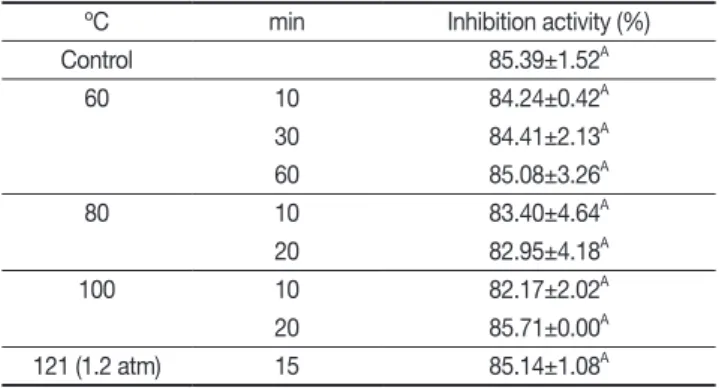
열 안정성
식품을 가공하는 과정 중 식중독 원인 미생물 및 부패 미생물 의 살균의 목적으로 열처리 공정이 수반된다. 이러한 열처리 공 정 중에서도 높은 α-amylase 저해활성을 나타낸 감태 에탄올 추출물이 안정성을 지니는지 확인하기 위해 열 안정성을 측정하 였다. 감태 에탄올 추출물을 열처리 후 α-amylase 저해활성을 측정한 결과(Table 2), 모든 처리구에서 무처리와 유의적인 차 이가 없는 것으로 나타났다. 이는 Lim et al. (2005)이 보고한 말 채나무 추출물을 열 안정성 검토 결과, 열처리에서 안정하였으 며, Kim et al. (2009)은 패의 70% 에탄올 추출물의 열처리에 의 한 항산화능을 측정한 결과에서도 안정한 것으로 나타났다. 또 한 Jung (2011)은 감태 에탄올 추출물의 lipase 저해활성을 측정 한 결과, 열처리에 안정한 것으로 나타나, 같은 경향을 나타내었 다. 이에 반해, Lee et al. (2010c)가 보고한 해조류 지충이 에탄 올 추출물의 α-amylase 저해활성이 121℃, 15분 처리한 경우 를 제외한 모든 처리구에서 무처리구에 비해 유의적으로 증가하 였으며, Mulimani and Rudrappa (1994)가 병아리 콩에서 추출 한 α-amylase 저해제를 열처리한 결과, 저해 활성이 감소하였 다고 보고한 결과와는 다른 경향을 나타내었다. 따라서 감태 에 탄올 추출물은 열에 안정한 것으로 확인되었으며, 특히 121℃, 15분 조건에서 안정한 것으로 미루어 볼 때, 고압멸균을 실시하 는 레트로트 및 can 제품의 형태로도 널리 이용 가능할 수 있어, 며(Lee et al., 2010c), 또한 말채나무 에탄올 추출물이 물 추출물
보다 높은 α-amylase 저해 활성을 보인 결과와 유사하다(Lim et al., 2005).
천연물의 유효성분을 추출하는데 에탄올 추출법은 소수성 물질들이 주로 추출되므로, 감태 에탄올 추출물에서 α-amylase 저해활성 물질은 소수성 물질일 것으로 사료된다(Kim et al., 2008b). 감태에 함유되어 있는 polyphenol 화합물은 phlorotan- nin 계열의 물질로 단백질과 친화력이 강해서 주로 소수성 및 수 소결합을 통해 효소와 결합력이 뛰어나다고 알려져 있다(Birari and Bhutani, 2007; Deavile et al., 2007). Lee et al. (2010a)은 감태 메탄올 추출물로부터 분리된 phlorotannin 계열인 dieckol 이 당뇨병과 관련하여 고혈당증 유발 산화 스트레스에 의한 상 처를 개선시키는 효과가 있는 것을 확인하였으며, 추가적으로 dieckol이 α-glucosidase와 α-amylase의 활성을 저해한다고 보고하였다. 이는 dieckol이 지니고 있는 hydroxyl group이 단 백질과 결합하여 복합체를 이루어, α-glucosidase 및 amylase 의 효소 활성 및 결합 부위에 결합하여 활성을 저해한다고 보고 하였으며, 나아가 당뇨를 유발한 쥐에서 식후 혈당 강화가 상 당히 억제됨을 알 수 있었다(Lee et al., 2010b). 또한 Lee et al.
(2009a)는 dieckol이 α-glucosidase에 기질농도와 관계없이 비 경쟁적 저해를 한다고 보고하여, 감태가 잠재적인 당뇨 치료제
Inhibition activity (%) IC
501(mg/mL)
5 mg/mL 2.5 mg/mL 1 mg/mL
Ethanol 84.45±3.51
Aa71.02±0.15
Ba52.38±2.88
Cb0.956±0.053
bWater 52.44±4.28
Ab47.14±3.24
ABb40.47±2.78
Bc4.79±0.410
aAcarbose 80.81±0.77
Aa74.59±0.26
Aa62.42±3.62
Ba0.438±0.031
cTable 1. α-Amylase inhibitory activity of
Ecklonia cava
extracts1IC50 value is the concentration of sample required for 50% inhibition.
A-C Means in the row bearing different superscript in samples are significantly different by Duncan's multiple range test (
P
<0.05).a-c Means in the column bearing different superscript in samples are significantly different by Duncan's multiple range test (
P
<0.05).Table 2. α-Amylase inhibitory activity of
Ecklonia cava
etha- nol extract after heat treatmentConcentration : 5 mg/mL.
Data are not significanfly different.
ºC min Inhibition activity (%)
Control 85.39±1.52
A60 10 84.24±0.42
A30 84.41±2.13
A60 85.08±3.26
A80 10 83.40±4.64
A20 82.95±4.18
A100 10 82.17±2.02
A20 85.71±0.00
A121 (1.2 atm) 15 85.14±1.08
ATable 3. α-Amylase inhibitory activity stability of
Ecklonia cava
ethanol extract after pH treatmentConcentration : 5 mg/mL.
A-C Means in the column bearing different superscript in sam- ples are significantly different by Duncan's multiple range test (
P
<0.05).pH Inhibition activity (%)
Control (pH 5.26) 85.39±1.52
A2 82.09±1.53
C4 84.36±0.14
AB6 82.75±0.17
BC8 85.38±0.28
A10 85.40±1.05
A식품산업 전반적인 열처리 가공공정에서 α-amylase 저해제 소 재로 사용하기에 적합할 것으로 판단된다.
pH 안정성
식품은 그 원재료 유래 및 가공의 목적으로 인해 다양한 pH 영역을 지니고 있다. 감태 에탄올 추출물을 식품에 이용하기 위 해 여러 pH 영역에서 α-amylase에 대하여 저해활성 안정성 을 측정하였다(Table 3). pH 2에서 감태 에탄올 추출물의 α -amylase 저해활성이 82.09%으로 무처리구의 α-amylase 저해 활성인 85.39% 보다 활성이 다소 감소하였지만, 이는 Lee et al.
(2010c)이 보고한 해조류 지충이 에탄올 추출물의 α-amylase 저해물질이 무처리구 보다 pH 2에서 54.08%활성이 감소한 결 과보다는 매우 안정한 것으로 나타났으며, 그 밖에 다른 pH 영 역에서도 매우 안정한 결과를 나타내었다. 말채나무 추출물의 α-amylase 저해물질 역시 pH 2 영역의 강산성 하에서 안정하 다고 보고한 Lim et al. (2005)의 결과와 감태 에탄올 추출물의 lipase 저해활성이 pH 2-10의 범위에서 안정하였다고 보고한 Jung (2011)과 유사한 경향을 보였다. 이러한 결과들을 미루어 보아 식물의 종류에 따라 그 유래의 생리활성 물질들이 다양한 pH 범위에서 나타내는 활성의 안정성은 다른 경향을 보이는 것 으로 사료된다(Lee et al., 2010c). 따라서 감태 에탄올 추출물을 다양한 영역의 pH 범위의 식품에 적용가능 할 것으로 기대되어 진다.
사 사
본 연구는 지식경제부의 2009년도 지역산업기술개발사업의 지원에 의해 이루어진 것으로 이에 감사드립니다.
참고문헌
Ali H, Houghon PJ and Soumyanath A. 2006. α-Amylase inhibitory activity of some Malaysian plants used to treat diabetes; with particular reference to
Phyllanthus amarus
. J Ethnopharmacol 107, 449-455.Bhandari MR, Jong-Anurakkun N and Kawabata J. 2008. α -Glucosidase and α-amylase inhibitory activities of Nep- alese medicinal herb Pakhanbhed (
Bergenia ciliate
Haw.).Food Chem 106, 247-252.
Birari RB and Bhutani KK. 2007. Pancreatic lipase inhibitors from natural sources: unexplored potential. Drug Discov Today 12, 879-889.
Burtin P. 2003. Nutritional value of seaweeds. EJEAF Che 2, 498-503.
Chrzaszcz T and Janicki J. 1933. “Sisto-amylase”, a natural inhibitor of amylase. Biochem Zeitschrift 260, 364-368.
de Melo EB, Gomes AS and Carvalho I. 2006. α- and β -Glucosidase inhibitors : chemical structure and biological
activity. Tetragedron 62, 10277-10302.
Deavile ER, Green RJ, Muller-Harvey I, Willoughby I and Frazier RA. 2007. Hydrolyzable tannin structures influ- ence relative globular and random coil protein binding strengths. J Agr Food Chem 55, 4554-4561.
Franz MJ, Bantle JP, Beebe CA, Brunzeu JD and Chasson JL.
2002. Evidence-based nutrition principles and recommen- dations for the treatment and prevention of diabetes and related complications. Diabetes Care 25, 148-198.
Gupta S and Abu-ghannam N. 2011. Bioactive potential and possible health effects of edible brown seaweeds. Trends Food Sci Tech 22, 315-326.
Hanefeld M. 1998. The role of acarbose in the treatment of non-insulin-dependent diabetes mellitus. J Diabetes Com- plicat 12, 228-237.
Itsuo S, Makoto O, Tomio Y, Atsushi O, Choitsu S, Hosai Y, Mitsuo M and Shigeaki B. 1981. Effect of α-glucosidase inhibitor on human pancreatic and salivary α-amylase.
Clin Chim Acta 117, 145-152.
Jung JY. 2011. Lipase inhibitory activity of
Ecklonia cava
ex- tracts. MS Thesis, Pukyong National University, Busan, Korea.Jung SH. 1997. Development and application of enzyme inhib- itor. In: Regulation of enzyme activity. Oh SH, ed. Doseo Press, Seoul, Korea. 1-2.
Kageyama S, Nakamichi N, Sekino H and Nakano S. 1997.
Comparison of the effect of acarbose and voglibose in healthy subjects. Clin Ther 19, 720-729.
Kang KA, Lee KH, Chae SW, Zhang R, Jung MS, Lee YK, Kim Y, Kim HS, Joo HG, Park JW, Ham MY, Lee NH and Hyun JW. 2005. Eckol isolated from
Ecklonia cava
attenu- ates oxidative stress induced cell damage in lung fibroblas cells. FEBS Lett 579, 6295-6304.Kim AR, Song EJ, Kim MJ, Lee SY, Kim KBWR, Kim JH, Kim SJ, Hong YK, Park JG, Kim JH, Lee JW, Byun MW and Ahn DH. 2008a. Effect of gamma irradiation on anti- oxidant properties and physical characteristics of
Sargas- sum siliquastrum
water extract. J Korean Soc Food Sci Nutr 37, 357-361.Kim JH, Kim MU and Cho YJ. 2007. Isolation and identifica- tion of inhibitory compound from
Crataegi fructus
on α -amylase and α-glucosidase. J Korean Soc Appl Biol Chem 50, 204-209.Kim KH, Roh SG, Li CR, Jin CF, Kim A and Choi WC.
2008b. Anti-diabetic effects of banaba leaf extracts (
La- gerstroemia speciosa
Pers.) through solvents. J Life Sci 18, 1305-1311.Kim MJ, Choi JS, Song EJ, Lee SY, Kim KBWR, Lee SJ, Kim SJ, Yoon SY, Jeon YJ and Ahn DH. 2009. Effects of heat and pH treatments on antioxidant properties of
Ishige oka-
murai
extract. Korean J Food Sci Technol 41, 50-56.Krentz AJ, Clough G and Byrne CD. 2007. Interactions be- tween microvascular and macrovascular disease in diabe- tes: pathophysiology and therapeutic implications. Diabe- tes Obes Metab 9, 781-791.
Lee BB, Park SR, Han CS, Han DY, Park EJ, Park HR and Lee SC. 2008. Antioxidant activity and inhibition activity against α-amylase and α-glucosidase of
Viola mandsh- urica
extracts. J Korean Soc Food Sci Nutr 37, 405-409.Lee CJ, Song EJ, Kim KBWR, Jung JY, Kwak JH, Choi MK, Kim MJ, Kim DH, Sunwoo C, Park JG, Kim JH, Choi JI, Lee JW, Byun MW and Ahn DH. 2011. Effect of gamma irradiation on immune activity and physicochemical prop- erties of
Myagropsis myagroides
water extract. Kor J Fish Aquat Sci 44, 50-57.Lee SH, Han JS, Heo SJ, Hwang JY and Jeon YJ. 2010a.
Protective effects of dieckol isolated from
Ecklonia cava
against high glucose-induced oxidative stress in human umbilical vein endothelial cells. Toxicol In Vitro 24, 375- 381.Lee SH, Li Y, Karadeniz F, Kim MM and Kim SK. 2009a.
α-Glucosidase and α-amylase inhibitory activities of phloroglucinal derivatives from edible marine brown alga,
Ecklonia cava
. J Sci Food Agric 89, 1552-1558.Lee SH, Park MH, Heo SJ, Kang SM, Ko SC, Han JS and Jeon YJ. 2010b. Dieckol isolated from
Ecklonia cava
inhibits α-glucosidase and α-amylase in vitro and allevi- ates postprandial hyperglycemia in streptozotocin-induced diabetic mice. Food Chem Toxicol 48, 2633-2637.Lee SJ, Song EJ, Kim KBWR, Lee CJ, Jung JY, Kwak JH, Choi MK, Kim MJ, Kim TW and Ahn DH. 2010c. In- hibitory effects of
Sargassum thunbergii
ethanol extract against α-amylase. Kor J Fish Aqua Sci 43, 648-653.Lee SJ, Song EJ, Lee SY, Kim KBWR, Kim SJ, Yoon SY, Lee CJ, and Ahn DH. 2009b. Antioxidant activity of leaf, stem and root extracts from
Orostachys japonicus
and their heat and pH stabilities. J Korean Soc Food Sci Nutr 38, 1571- 1679.Lee SY, Song EJ, Kim KBWR, Yoon SY, Kim SJ, Lee SJ, Hong YK, Lim SM and Ahn DH. 2009c. Antimicrobial activity of ethanol extract from
Sargassum thunbergii
. J Korean Soc Food Sci Nutr 38, 502-508.Liener I. 1979. Significance for humans of biologically active factors in soybeans and other food legumes. J Am Oil Chem Soc 56, 121-129.
Lim CS, Li CY, Kim YM, Lee WY and Rhee HI. 2005. The inhibitory effect of
Cornus walteri
extract against α-amy- lase. J Korean Soc Appl Biol Chem 48, 103-108.McCue PP and Shetty K. 2004. Inhibitory effects of rosmarinic acid extracts on porcine pancreatic amylase
in vitro
. AsiaPac J Clin Nutr 13, 101-106.
Mulimani VH and Rudrappa G. 1994. Effect of heat treatment and germination on alpha amylase inhibitor activity in chick peas (
Cicer arietinum
L.). Plant Food Hum Nutr 46, 133-137.Park JH, Baek MR, Lee BH, Yon GH, Ryu SY, Kim YS, Park SU and Hong KS. 2009. α-Glucosidase and α-amylase inhibitory activity of compounds from roots extract of
Pu- eraria thunbergiana
. Korean J Medicinal Crop Sci 17, 357-362.
Park NB, Song EJ, Kim KBWR, Lee CJ, Jung JY, Kwak JH, Choi MK, Kim MJ, Nam KW and Ahn DH. 2010. An- timicrobial activity of
Myagropsis yendoi
extract. Kor J Fish Aquat Sci 43, 642-647.Saini AK, Kumar HSA and Sharma SS. 2007. Preventive and curative effect of edaravone on nerve functions and oxi- dative stress in experimental diabetic neuropathy. Eur J Pharmacol 568, 164-172.
Shin HC, Hwang HJ, Kang KJ and Lee BH. 2006. An antioxi- dative and antiinflammatory agent for potential treatment of osteoarthritis from
Ecklonia cava
. Arch Pharm Res 29, 165-171.Turner R, Hattersley A and Cook J. 1992. Type Ⅱ diabetes:
search for primary defects. Ann Med 24, 511-516.
Weselake RJ, Macgregor AW, Hill RD and Duckworth HW.
1983. Purification and characteristics of an endogenous α -amylase inhibitor from barley kernels. Plant Physiol 73, 1008-1012.
Yoon NY, Eom TK, Kim MM and Kim SK. 2009. Inhibitory effect of phlorotannins isolated from
Ecklonia cava
on mushroom tyrosinase activity and melanin formation in mouse B16F10 melanoma cells. J Agric Food Chem 57, 4124-4129.Yoon SY, Lee SY, Kim KBWR, Song EJ, Lee SJ, Lee CJ, Park NB, Jung JY, Kwak JH, Nam KW and Ahn DH. 2010.
Antimicrobial activity of the
Sargassum fulvellum
ethanol extract and the effect of temperature and pH on their activ- ity. Korean J Food Sci Technol 42, 155-159.Zhuang C, Itoh H, Mizuno T and Ito H. 1995. Antitumor active fucoidan from the brown seaweed, umitoranoo (
Sargaum thunbergii
). Biosci Biotech Bioch 59, 563-567.Zimmet P, Alberti K and Shaw J. 2001. Global and societal im- plications of the diabetes epidemic. Nature 414, 782-787.