서 론
식물플랑크톤 군집은 수중 내 자체유기물 생산의 중요 한 역할을 하며, 수중 생태계 내 다른 구성요인들의 변화 에 따라 종 천이 및 현존량의 변화를 일으키며(James, 1979), 특히 수온, 빛, 영양염, 수체의 물리적 교란 등과 같은 요인들에 의해 군집구조 및 우점종 천이를 나타내
는 것이 보통이다(Reynolds et al., 1983; Sommer et al., 1986). 또한 담수역의 식물플랑크톤 군집은 상류지역으 로부터 유입되는 물질의 성상이나 유속, 또는 방류에 의 해 결정되기 때문에(이와 한, 2004), 이들의 분포 및 계절 적 변동을 파악하는 것은 그 수역의 전체 생태계를 이해 하는데 매우 중요하다(Raymont, 1980).
주암호는 순천시 주암면에 위치하며 최대저수용량 4.5 억톤, 평균수심 15 m 규모로서, 전남-광주지역의 상수원
─
─ 249 ──
주암호 식물플랑크톤 군집 동태-와편모조
Peridinium bipes
를 중심으로이 기 호∙백 순 기∙김 백 호1,*
(동신대학교 교육대학원 환경교육과, 1한양대학교 자연과학대학 생명과학과)
Dynamics of Phytoplankton Community in Lake Juam, Korea. Lee, Ki--Ho, Soon--Ki Baik and Baik--Ho Kim1,*(Department of Environmental Education, Dongshin University, Naju 520-- 714, Chonnam; 1Department of Life Science, Hanyang University, Seoul 133--791, Korea )
Dynamics of phytoplankton community were monthly examined at two sites in Lake Juam from January to December 2003. One site is located near the Dam, an intake tower, where obtain a drinking water resource, the other site is located in the shallow region, Mundeok-bridge, the upstream or effluent part of lake. During the study, there made little the differences in physicochemical factors between two sites, but numbers of species and standing crops of phytoplankton differ remark- ably. Totally, 41% of green algae and 35.8% of diatoms were comprised of total phytoplankton species, while 46.3% of dinoflagellates and 27.6% of cyanobacteria contributed in total standing crops of phytoplankton community. Cyanobacterium Microcystis aeruginosa and diatom Fragilaria crotonensis dominated the Dam site during a warm season, while dinoflagellates Peridinium bipes and Asterionella formosa were at the shallow region during a cold season, respectively. According to the CCA analysis, dissolved oxygen, chemical oxygen demand and total phosphate strongly affected the growth of P. bipes with low water temperature. In addition, the increment of total nitrogen and water temperature affected biomass of a cyanobacterium M. aeruginosa. Collectively, it may suggest that the majority of annual primary production of Lake Juam is covered by two dominant species Peridinium bipes in cold season and Microcystis aeruginosa in warm season.
Key words : Lake Juam, Microcystis aeruginosa, Peridinium bipes, population dynamic, species succession, CCA analysis
* Corresponding author: Tel: 02) 2220-0909, Fax: 02) 2296-1741, E-mail: [email protected]
및 수력발전 등의 목적으로 1990년 3월 처음 담수가 시 작되었다(김, 1996). 주암호는 국내 대부분의 호수들과 마찬가지로 건설초기부터 가정하수, 산업폐수, 농, 축산 폐수 등의 유입으로 인한 부영양화가 급속히 이루어져 매년 상류 유입부를 중심으로 남조류 Microcystis aeru- ginosa가 대발생을 일으켰으며, 최근(2002년 이후)에는 와편모조Peridinum bipes가 저온기 동안 저수지 전역에 걸쳐 대발생하는 이른바 담수적조를 일으키고 있다(최, 2005). 주암호를 비롯하여 최근 2~3년간 저온기를 중심 으로 한반도 남부지역에 와편모조 Peridinium bipes의 대발생이 일어나고 있으며(미발표), 이들은 주로 상수원 수 공급 및 정수과정은 물론 경관적 장해가 뚜렷하기 때 문에 조류 대발생의 원인 및 제어를 위한 기초적인 생태 조사가 절실히 필요하다. 현재까지 주암호 식물플랑크톤 에 관한 연구는 비교적 많은 편이나(Choi et al., 1994;
이, 1994; 이와 송, 1995; 김, 1996; 정 등, 1998; 김 등, 2001; Kim and Hwang, 2004), 대부분 고온기 남조 Microcystis aeruginosa의 거동을 중심으로 이루어졌으 며, 저온기를 포함한 연구는 거의 없다.
본 연구는 주암호의 식물플랑크톤 군집의 생태학적 특 성을 파악하기 위하여 취수탑 부근과 호소유입부에서 기 초 환경요인과 식물플랑크톤 군집의 동태를 조사하였다.
재료 및 방법
1. 조사지점 및 조사기간
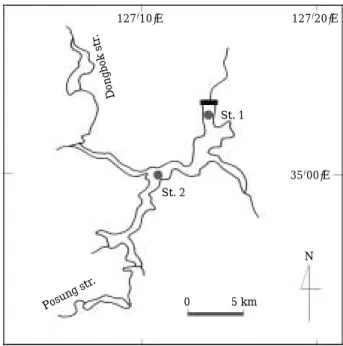
조사지점은 전라남도 순천시 주암읍 소재 주암호 댐 부근의 상수원수 취수탑(St. 1)과 문덕교(St. 2) 근접부로 서 2003년 1월부터 12월까지 월 1회씩 총 12회 실시하 였다(Fig. 1). 주암호는1992년에 높이 57 m, 길이 330 m 의 인공다목적 댐으로 축조되었으며, 유역면적1,010 km2, 저수량 4.6억t이다. 주암호는 광주-전남지역에 하루 약 64만t의 생활용수를 공급하고 있으며, 광양만의 공업용 수로도 사용되고 있다. 유역은 대부분 산간지로 형성되어 있고, 하천 주변에는 소규모 농가와 농경지, 소규모의 음 식점과 숙박업소가 산재해 있다.
2. 환경요인 분석
이화학적 환경요인 조사로 수온, pH, DO, 탁도 등은 Portable multi-parameter (YSI 610-D, USA)를 이용하 여 현장에서 직접 측정하였다. COD와 영양염 분석은 5 L Van Dorn 채수기를 이용하여 현장수 4 L를 폴리에틸렌
채수통에 넣고 ice box에 담아 실험실로 운반한 후 수질 오염공정시험방법에 준하여 분석하였다(환경부, 2004).
COD는 과망간산 칼륨법으로 측정하였으며, 총질소는 수 중의 질소화합물을 알칼리성 과황산칼륨의 존재하에 120�C에서 유기물과 함께 분해하여 질산이온으로 산화 시킨 다음 산성에서 자외부(220 nm) 흡광도를 측정하여 질소를 정량하였다. 총인은 유기물을 산화 분해하여 모든 인 화합물을 인산염(PO4-P) 형태로 변화시킨 다음 인산 염을 아스코르빈산 환원 흡광도법으로880 nm에서 측정 하였다. Chlorophyll a의 농도는 현장수 500 mL를1.2µm GF/C (Whatman) filter로 여과한 후, 90% acetone 10 mL 를 주입하여 암병에 넣고 마쇄하여 24시간 동안 냉암소 에 보관 후, UV/Visible Spectrophotometer (DU 800, Beckman Coulter, Inc.)를 사용하여 multiple waveleng- th에서 측정하였다.
3. 식물플랑크톤 분석
식물플랑크톤의 동정과 계수를 위해 5 L Van Dorn 채 수기로 채수한 후, 250 mL 폴리에틸렌 채집병에 시료를 넣고, Lügol 용액으로(최종농도 1%) 고정하여 실험실로 운반하였다. 실험실에서 72시간 이상 침강시킨 후 시료 의 조류 농도에 따라 2~5배 농축을 실시하였고 시료의 광산화에 대한 오차를 최소화하기 위해 알루미늄 호일로 빛을 차단시켰다. 농축한 시료는 잘 혼합한 후, Sedgewick
Dongbok str
.
Posung str .
St. 2
5 km 0
N St. 1
127o10′E 127o20′E
35o00′E
Fig. 1. Sampling sites in Lake Juam.
-Rafter Counting Chamber에 시료 1 mL를 10분 이상 침전시킨 다음 광학현미경(Nikon eclipse 600, Japan) 200배 하에서 군체 또는 세포수를 계수하였다. 식물플랑 크톤의 동정은 동일종의 현미경 1,000배 하에서 이루어 졌으며, 일본담수조류도감(Hirose et al., 1981)을 비롯한 다양한 문헌을 참고하였다(Cox, 1996; Abé, 1981;
Geitler, 1932; Desikachary, 1959; Ettl, 1978; Komárek and Fott, 1983; Popovsky and Pfiester, 1990; Krammer and Lange-Bertalot, 1991; Green and Leadbeater, 1994; Sandgren et al., 1995). 식물플랑크톤 군집의 특성 을 파악하기 위하여 출현 종수와 개체수를 근거로 우점 종을 선정하였으며, 군집의 우점도 지수는 Naughton’s dominance index (McNaughton, 1967), 종 다양성 지수는 Shannon-Weaver식(Pielou, 1966)을 각각 사용하여 산 출하였다.
4. 자료분석
조사기간 동안 두 정점에서의 환경요인이 식물플랑크 톤 군집에 미치는 효과를 파악하기 위하여2개 정점에서 conical corresponding analysis (CCA)분석을 실시하였으
며(MVSP Plus, 2002), 상관성 분석을 위해 Pearson’s correlation coefficients를95% 수준에서 계산하였다.
결 과
1. 이화학적 환경요인
현장에서 직접 측정된 수온은 전체적으로 계절성이 뚜 렷한 전형적인 온대지역 수온pattern을 보였으며, 두 정 점간의 수온 차이는 시기에 따라 다소 차이를 보였다. 정 점 1 (취수탑)의 경우, 2월(4.4�C)에 가장 낮고 9월(25.7
�C)에 가장 높았으며, 정점 2 (문덕교) 역시 2월(2.6�C)과 9월(28.1�C)에 각각 최저와 최고치를 보였다. 조사시기에 따라 정점1보다 정점2에서 수온 차가 심하였다. 용존산 소는 정점1에서 전체적으로 8.5~12.9 mg L-1의 분포를 보였고, 수온이 높았던 8월에 가장 낮았으며, 4월에 가장 높았다. 정점 2에서는 8.5~15.2 mg L-1범위로서 정점 1 에 비해 다소 큰 폭의 변화를 보였다. 탁도는 정점1에서 1.3~6.7 NTU의 범위를 보였으며, Peridinium bipes현존 량이 높았던 4월에 가장 높게 나타났다. 정점 2에서는
5 10 15 20
DO (mg L-1)
J F M A M J J A S O N D
0 10 20 30 40
WT (oC) 0 5 10 15
Turbidity (NTU)
1 2 3 4 5 6
COD (mg L-1)
St. 1 St. 2
0 20 40 60 80 100
Chl-a (mg L-1)
J F M A M J J A S O N D
6 7 8 9 10
pH
0.00 0.02 0.04 0.06
TP (mg L-1) 0.0 0.5 1.0 1.5 2.0
TN (mg L-1)
Fig. 2. Monthly variations of physicochemical factors in Lake Juam from January to December 2003.
1.4~11.3 NTU로 나타났으며, 5월에 11.3 NTU로 가장 높게 나타났다. pH는 남조 Microcystis aeruginosa, 규조 Fragilaria crotonensis 현존량이 높았던 고온기(6~9월) 에 높았으며, Asterionella formosa의 현존량이 높았던 저 온기(11~12월, 1~3월)에 상대적으로 낮았다. 정점 1의 경우, 6.7~9.0 범위로서 3월에 가장 낮았으며, 8월에 가 장 높았다. 정점 2에서는 6.6~9.4로서 5월에 가장 낮았 고9월에 가장 높았다(Fig. 2).
화학적 산소요구량(COD)은 정점 1에서 2.3~3.8 mg L-1의 범위로 식물플랑크톤 현존량이 낮았던 12월(2.3 mg L-1)에 가장 낮았으며, Microcystis aeruginosa현존량 이 가장 높았던 7월(3.8 mg L-1)에 가장 높게 나타났다. 정점 2에서는 2.6~4.8 mg L-1의 범위로서 정점 1에 비 해 다소 높은 수준이었으며, 7월에 4.8 mg L-1로 가장 높 게 나타났다. 총인은 정점 1에서 0.004~0.028 mg L-1로 서 정점 2에 비해 전체적으로 낮은 농도를 보였으며, 저 온기(2월, 11월, 12월)에 가장 낮았다. 정점 2에서는 0.009~0.048 mg L-1범위로서 강우집중시기(5~8월)에 높은 농도를 보였다. 총질소는 1월에 정점 1과 2사이에 큰 차이를 보이다가 점차 비슷한 수준을 보였으며, 정점 1에서 0.03~0.97 mg L-1, 정점 2에서 0.41~1.70 mg L-1 의 범위를 보였다. 총인과 총질소는 정점 2에서 남조 Microcystis aeruginosa가 우점하였던 시기에 비교적 높 은 농도를 보였다. 엽록소a농도는 정점1에서 4.4~66.2 mg L-1로서 Peridinium bipes가 우점하였던 5월에 가장 높았으며, 11~12월에도 비교적 높았다. 정점 2의 경우, 5.6~86.0 mg L-1로 9월에 가장 낮았으며, Peridinium bipes, Microcystis aeruginosa가 다시 증가하기 시작한 11월에 가장 높은 농도를 나타냈다(Fig. 2).
2. 식물플랑크톤 군집의 특성
1) 종조성
조사기간 동안 주암호에서 출현한 식물플랑크톤은 총 6강 11목 26과 43속 67종으로 녹조류 28종(41.8%), 규 조류 24종(35.8%), 남조류 9종(13.4%), 와편모조류, 황색 편모조류, 유글레나류 등은 각각2종(3%)이었다(Table 1, 2, Fig. 3). 조사 지점별로는 정점 1 (취수탑)에서 총 6강 11목 21과 36속 54종으로 녹조류 24종(44.4%), 규조류 17종(31.5%), 남조류8종(14.8%), 와편모조류와 황색편모 조류가 각각 2종(3.7%), 유글레나류가1종(2%)이 출현하 였다. 정점 2 (문덕교)에서는 총 6강 11목 26과 38속 60 종으로 녹조류가 24종(40%), 규조류 23종(38.3%), 남조 류 7종(11.7%), 와편모조류와 황색편모조류, 유글레나류 가 각각 2종(3.3%)이 출현하였다. 두 지점 공히 고온기
6~9월에 가장 다양한 종이 출현하였다. 정점 1에서 8월 에 26종으로 가장 많은 종이 출현하였으며, 3~5월 사이 에 10종 미만이었다. 정점 2에서는 10월에 29종으로 가 장 많은 종이 출현하였으며, 3월에 8종이 출현하였다 (Table 1, 2).
2) 현존량
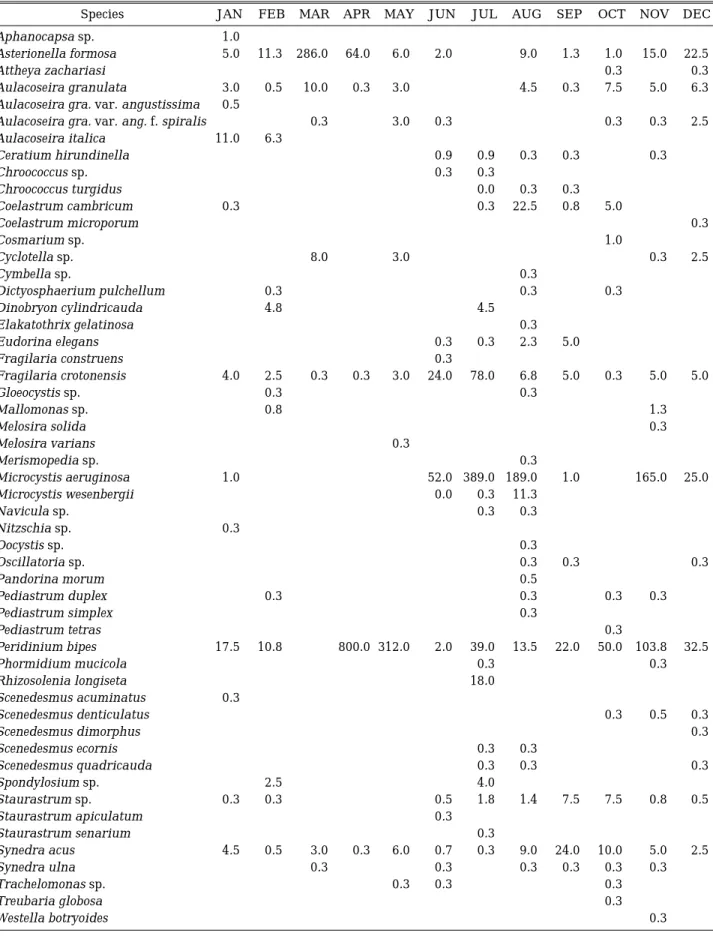
조사지점별 식물플랑크톤 현존량은 종 출현과는 큰 차 이를 보였는데, 남조류의 경우, 종 출현(13.4%)에 비해 현존량은 전체의 27.6%로 높은 비율을 나타냈으며, 35.8%를 차지하였던 규조류는 오히려 현존량은23.6%로 낮았다. 가장 많은 종이 출현하였던 녹조류(41.8%)는 현 존량에서는2.1%만을 차지하였고, 와편모조류(총 출현종 의3%)는 현존량의46.3%로 가장 높았다(Fig. 3). 정점 1 에서 식물플랑크톤 현존량은4월에 864.8×10³ cells mL-1 으로 가장 높았으며, 2월에 40.8×10³ cells mL-1로 가장 낮았다(Table 1). 분류군별로 와편모조류가 총 1406.0× 103 cells mL-1로 가장 높았으며 4월에(800×103 cells mL-1)로 최고치를 보였으며, 남조류는 총 837.0×10³ cells mL-1로서 7, 8월에 높은 현존량(201.0~389.8×10³ cells mL-1)를 보였다. 규조류는 총 722.8×10³ cells mL-1 로서 3월에 최고치(307.8×10³ cells mL-1)를 보였으며, 나머지 분류군들은 비교적 낮은 현존량(0.8~64.1×10³ cells mL-1)를 보였다. 정점2에서 식물플랑크톤 현존량은 6월에1135.5×103 cells mL-1로 가장 높았고, 2월(90.8× 10³ cells mL-1)에 가장 낮았다(Table 2). 분류군별는 남조 류가 1766.5×103 cells mL-1로 최고치를 보였으며, 6~8 월 사이에 높은 출현을 보였다. 와편모조류는 1414.0× 103 cells mL-1로서 저온기(1월, 11월)에 높게 출현하였으 며, 규조류는 총 944.5×10³ cells mL-1로서 7월에 최고치 (327.1×10³ cells mL-1)을 보였으며, 유글레나류, 황색편 모조류, 녹조류는 다른 분류군에 비해 비교적 적은 현존 량을 보였다. 정점1에서 높은 식물플랑크톤 현존량을 보 였던 4월에는 종 출현은 가장 낮았으며, 높은 종 출현을 보였던 8~12월, 특히 1~2월에는 매우 낮은 현존량을 나타냈다(Fig. 4). 정점 2의 경우, 정점 1과는 다소 차이 를 보였는데, 높은 현존량을 보였던6~7월에 종 출현 역 시 비교적 높게 나타났으며, 가장 낮은 종 출현을 보였던 3월에 현존량 역시 낮게 나타났다(Fig. 4).
3) 우점종 및 군집지수
조사기간 동안 각 정점별 식물플랑크톤 군집의 우점종 및 우점도 지수, 다양도 지수를 각각 산출하였다(Table 3). 정점 1에서는 저온기(1월, 12월)에 와편모조류 Peri- dinium bipes가 우점하였고, 2~3월에는 규조 Asterio-
Table 1. List and abundance of phytoplankton in St. 1 from January to December, 2003 (unit: 103 cells mL-1).
Species JAN FEB MAR APR MAY JUN JUL AUG SEP OCT NOV DEC
Aphanocapsa sp. 1.0
Asterionella formosa 5.0 11.3 286.0 64.0 6.0 2.0 9.0 1.3 1.0 15.0 22.5
Attheya zachariasi 0.3 0.3
Aulacoseira granulata 3.0 0.5 10.0 0.3 3.0 4.5 0.3 7.5 5.0 6.3
Aulacoseira gra. var. angustissima 0.5
Aulacoseira gra. var. ang. f. spiralis 0.3 3.0 0.3 0.3 0.3 2.5
Aulacoseira italica 11.0 6.3
Ceratium hirundinella 0.9 0.9 0.3 0.3 0.3
Chroococcus sp. 0.3 0.3
Chroococcus turgidus 0.0 0.3 0.3
Coelastrum cambricum 0.3 0.3 22.5 0.8 5.0
Coelastrum microporum 0.3
Cosmarium sp. 1.0
Cyclotella sp. 8.0 3.0 0.3 2.5
Cymbella sp. 0.3
Dictyosphaerium pulchellum 0.3 0.3 0.3
Dinobryon cylindricauda 4.8 4.5
Elakatothrix gelatinosa 0.3
Eudorina elegans 0.3 0.3 2.3 5.0
Fragilaria construens 0.3
Fragilaria crotonensis 4.0 2.5 0.3 0.3 3.0 24.0 78.0 6.8 5.0 0.3 5.0 5.0
Gloeocystis sp. 0.3 0.3
Mallomonas sp. 0.8 1.3
Melosira solida 0.3
Melosira varians 0.3
Merismopedia sp. 0.3
Microcystis aeruginosa 1.0 52.0 389.0 189.0 1.0 165.0 25.0
Microcystis wesenbergii 0.0 0.3 11.3
Navicula sp. 0.3 0.3
Nitzschia sp. 0.3
Oocystis sp. 0.3
Oscillatoria sp. 0.3 0.3 0.3
Pandorina morum 0.5
Pediastrum duplex 0.3 0.3 0.3 0.3
Pediastrum simplex 0.3
Pediastrum tetras 0.3
Peridinium bipes 17.5 10.8 800.0 312.0 2.0 39.0 13.5 22.0 50.0 103.8 32.5
Phormidium mucicola 0.3 0.3
Rhizosolenia longiseta 18.0
Scenedesmus acuminatus 0.3
Scenedesmus denticulatus 0.3 0.5 0.3
Scenedesmus dimorphus 0.3
Scenedesmus ecornis 0.3 0.3
Scenedesmus quadricauda 0.3 0.3 0.3
Spondylosium sp. 2.5 4.0
Staurastrum sp. 0.3 0.3 0.5 1.8 1.4 7.5 7.5 0.8 0.5
Staurastrum apiculatum 0.3
Staurastrum senarium 0.3
Synedra acus 4.5 0.5 3.0 0.3 6.0 0.7 0.3 9.0 24.0 10.0 5.0 2.5
Synedra ulna 0.3 0.3 0.3 0.3 0.3 0.3
Trachelomonas sp. 0.3 0.3 0.3
Treubaria globosa 0.3
Westella botryoides 0.3
Table 2. List and abundance of phytoplankton in St. 2 from January to December, 2003 (unit: 103 cells mL-1).
Species JAN FEB MAR APR MAY JUN JUL AUG SEP OCT NOV DEC
Anabaena sp. 0.3
Ankistrodesmus falcatus 0.3
Asterionella formosa 5.5 12.2 80.0 60.5 9.0 25.0 0.5 0.3 1.8 48.0 6.9
Attheya zachariasi 5.5 0.3
Aulcoseira granulata 0.5 0.2 6.0 5.5 6.0 12.0 9.0 3.0 0.5 12.0 6.0 6.5
Aulcoseira gra. var. ang. f. spiralis 0.3 5.5 0.3 6.3 0.5 7.5 0.6 6.0
Aulcoseira gra. var. angustissima 0.5 0.2
Aulcoseira italica 5.0 0.6 0.3
Ceratium hirundinella 0.3 1.0
Characium limneticum 0.3
Chroococcus sp. 0.3 1.0 0.3
Chroococcus turgidus 0.3
Closterium sp. 3.0
Coelastrum cambricum 0.2 0.5 12.0 0.3 0.6
Coelastrum microporum 0.3 0.3
Cosmarium sp. 0.3 0.4
Cyclotella sp. 0.3 6.0 0.3 1.0 0.3 0.3
Cymbella sp. 0.3 0.3 0.3 0.3 4.0
Dictyosphaerium pulchellum 0.2 0.3
Dinobryon cylindricauda 4.0
Elakatothrix gelatinosa 0.3
Eudorina elegans 0.3 0.3 24.0 0.9 10.0 0.5 0.3
Fragilaria construens 5.0 0.3
Fragilaria crotonensis 3.5 0.8 18.0 11.0 65.0 25.0 4.0 42.0 4.0 6.0 7.2
Gloeocystis sp. 0.6 0.3
Golenkinia radiata 0.3
Gomphonema sp. 0.3 0.3
Mallomonas sp. 0.6 6.0 0.3
Melosira solida 0.3
Melosira varians 0.3
Merismopedia sp. 0.3
Microcystis aeruginosa 2.0 271.0 189.0 37.5 50.0 99.0 130.0
Microcystis wesenbergii 0.3 10.0 0.3 45.0
Navicula sp. 0.3 0.4 0.3
Nitzschia acicularis 0.3
Nitzschia actinastroides 0.5 0.3
Nitzschia sp. 0.2
Oscillatoria sp. 0.3 0.8 0.3 3.0
Pandorina morum 0.3 0.5
Pediastrum duplex 0.2 0.3 0.3 0.3 0.3
Pediastrum simplex 0.3
Pediastrum tetras 0.3 0.3
Peridinium sp. 358.6 69.6 110.0 87.0 51.0 21.0 27.0 37.5 46.0 306.0 299.0
Phacus bipes 0.3
Rhizosolenia eriensis 0.3
Scenedesmus acuminatus 0.3
Scenedesmus acutus 0.5 0.3
Scenedesmus denticulatus 0.3 0.3
Scenedesmus ecornis 0.3
Scenedesmus quadricauda 0.8 0.8 2.0 0.3 0.3
Staurastrum sp. 0.5 0.2 0.3 0.3 3.0 12.0 9.3 6.0 0.3
Staurastrum senarium 0.3 0.3 0.5
Surirella sp. 0.3 0.3
Surirella linearis 0.5
Synedra acus 9.0 1.0 3.0 5.5 3.0 8.8 259.0 13.3 7.5 9.0 18.0 1.3
Synedra rumpens 0.3
Synedra ulna 0.3 0.3 0.8 5.0 32.0 2.0 0.3
Trachelomonas sp. 5.5 0.3 0.4 0.3
Treubaria globosa 0.3 0.3
nella formosa, 4~5월에는 Peridinium bipes가 다시 우 점하였다. 한편, 수온이 20�C 이상으로 증가한 6~8월에 는 남조Microcystis aeruginosa가 우점하는 계절적 천이 현상이 뚜렷하였다(Fig. 5). 정점 1에서의 우점도 지수는 3~6월까지는 0.962~0.999로 비교적 높은 반면, 7월부 터 0.869로 점차 감소하였고, 2월에는 0.539로 최저치를 나타냈다. 정점 2에서도 정점1과 유사하게 저온기(11월
~5월)에 와편모조류 Peridinium bipes가 우점하였으며, 3월에 규조 Asterionella formosa, 6월~10월에 남조 Microcystis aeruginosa가 우점하는 뚜렷한 천이현상을 보였다(Fig. 5). 정점 2에서의 우점도 지수는 정점1과 다
르게 저온기(12~3월)에0.513~0.952로 높은 반면, 고온 기(8~11월)에는 0.513~0.796로 오히려 낮게 나타났다 (Table 3). 한편, 종 다양성 지수는 정점1의 경우0.27~
1.89로서 3월~5월에 낮았으며, 6월부터 증가하여 2월에 1.89로 가장 높았다. 정점 2에서는 전체적으로 0.61~
2.06 범위로서12월~3월까지 낮은 수준을 보였으며, 4월
~11월까지는 비교적 높았다(Table 3). 결과적으로 조사 기간 동안 높은 현존량을 보였던 와편모조류Peridinium bipes, 규조류 Asterionella formosa는 주로 저온기(4~5 월, 10~12월)에 우점한 반면, 남조류 Microcystis aerug- inosa와 규조류Fragilaria crotonensis는 고온기(7~9월)
Cyanophyceae Bacillariphyceae
Chlorophyceae Dinophyceae
Euglenophyceae Chrysophyceae No. of species
2.99%
2.99%
2.99%
41.8%
35.8%
13.4%
Standing crops
0.373%
0.0248%
46.3%
2.11%
23.6%
27.6%
Fig. 3. Relative composition in species number and standing crops of each taxonomic class in phytoplankton in Lake Juam from January to December 2003.
Site 1
No. species
Site 2 0
10 20 30 40
J F M A M J J A S O N D
No. species Standing crops
0 200 400 600 800 1000 1200 1400
J F M A M J J A S O N D
Standing crops (103cells mL-1)
Fig. 4. Monthly variations in the number of species and total standing crops of phytoplankton in Lake Juam from January to December 2003.
에 우점하는 특징을 보였다(Fig. 5).
3. 식물플랑크톤과 환경요인과의 관계
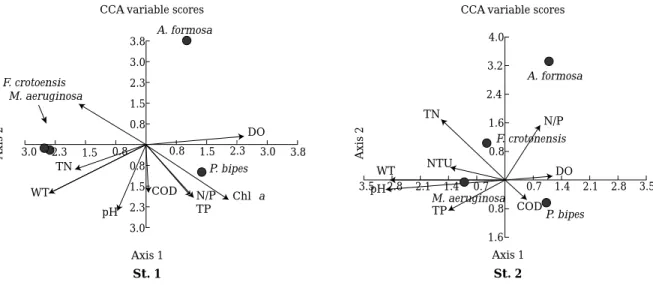
조사기간 동안 출현한 주암호의 식물플랑크톤 중, 우점 종이었던Peridinium bipes, Asterionella formosa, Micro- cystis aeruginosa, Fragilaria crotonensis등은 수온에 의 해 그 분포가 뚜렷하게 차이를 나타냈다. 정점 1에서 와 편모조류P. bipes가 우점하였던 4~5월에는 엽록소 a는 물론, pH, 탁도 등이 뚜렷하게 증가하였으며, 정점 2에서 남조 M. aeruginosa가 우점하였던7월에는 총인, 총질소, pH 등이 높은 수준을 유지하였다. 또한 규조F. crotonen- sis가 우점하였던 6~7월에는 두 정점 모두 총인, pH가 높게 나타났다(Figs. 2, 5). 이러한 우점종들과 환경요인 들간의 상호관계에 대한 CCA분석에 따르면, 저온기에 우점하였던 와편모조 P. bipes는 주로 DO, COD, TP 등 의 영향을 많이 받았으며, 남조 M. aeruginosa, F. croto- nensis는 수온을 비롯한 TN, TP 등의 영향을 받은 것으 로 나타났다(Fig. 6). 이러한 현상은 정점에 따라 차이를 보였으나, Asterionella formos는 어떠한 환경요인과도 관 련성을 보이지 않았다.
Table 3. Dominant phytoplankton species and indices of dominance (DI) and diversity (H′) in Lake Juam from January to December, 2003.
Site Months 1st dominant species 2nd dominant species DI H′
JAN Peridinium bipes Melosira italica 0.588 1.85
FEB Asterionella formosa Peridinium bipes 0.539 1.89
MAR Asterionella formosa Melosira ranulata 0.962 0.34
APR Peridinium bipes Asterionella formosa 0.999 0.27
MAY Peridinium bipes Asterionella formosa 0.945 0.39
St. 1 JUN Microcystis aeruginosa Fragilaria crotonensis 0.907 1.07
JUL Microcystis aeruginosa Fragilaria crotonensis 0.869 0.96
AUG Microcystis aeruginosa Coelastrum cambricum 0.774 1.30
SEP Synedra acus Peridinium bipes 0.679 1.65
OCT Peridinium bipes Synedra acus 0.710 1.44
NOV Microcystis aeruginosa Peridinium bipes 0.886 1.14
DEC Peridinium bipes Microcystis aeruginosa 0.571 1.76
JAN Peridinium bipes Synedra acus 0.952 0.89
FEB Peridinium bipes Asterionella formosa 0.901 0.90
MAR Asterionella formosa Fragilaria crotonensis 0.907 0.84
APR Peridinium bipes Asterionella formosa 0.810 1.38
MAY Peridinium bipes Asterionella formosa 0.84 0.97
St. 2 JUN Microcystis aeruginosa Fragilaria crotonensis 0.835 2.06
JUL Synedra acus Microcystis aeruginosa 0.850 1.17
AUG Microcystis aeruginosa Peridinium bipes 0.770 1.36
SEP Fragilaria crotonensis Microcystis aeruginosa 0.538 1.55
OCT Microcystis aeruginosa Peridinium bipes 0.513 1.78
NOV Peridinium bipes Microcystis aeruginosa 0.796 1.30
DEC Peridinium bipes Microcystis aeruginosa 0.948 0.61
J F M A M J J A S O N D
0 100 200 300 0 100 200 300 0 400 800 1200
0 400 800 1200
Peridinium bipes
Asterionella formosa
Fragilaria crotonensis Microcystis aeruginosa
St. 1 St. 2
Fig. 5. Monthly variations of four dominant phytoplank- ton species in Lake Juam from January to De- cember 2003.
고 찰
저온기에 담수역에서 와편모조류Peridinium대발생은 국내는 물론(Kim, 1987; 이와 조, 1994; 등, 1994; 이 등, 1998; 김 등, 2001) 세계적으로(Pollinger and Berman, 1975; Nakamoto, 1975; Endo and Nagata, 1984; Ikeda et al., 1997; Wu et al., 1998; Yamada et al., 1998; Kishimoto et al., 2001) 널리 알려져 왔다. 이들은 주로 호수의 상류 지천 유입부에서 발생하며(Kim et al., 1985a, b; Kim, 1987; 이 등, 1998), 정수과정에서 여과폐쇄를 비롯한 이, 취미발생, THMs생성 및 불쾌한 경관 등 다양한 수질문제 를 야기하고 있다(Pollinger and Berman, 1975; 등, 1994). 본 조사에서는 저온기를 중심으로 정점1 (취수탑) 에서 식물플랑크톤 총 현존량의 46%를 차지하였다. 뿐만 아니라 동일 시기의 영양염(총질소, 총인)의 농도는 정점 2보다 훨씬 낮았다. 선행연구에 의하면 Peridinium발생 은 주로 휴면포자가 높게 분포하는 수심이 낮은 상류 유 입부에서 일어나는 것으로 알려지고 있는데(Kim et al., 1985a, b; Kim, 1987; 이 등, 1998), 본 연구에서는 호소 유입부에 비해 수심이 깊고, 수표면에 빛 도달이 원할한 취수탑 부근에서 보다 높게 출현하였으며, CCA분석결과 에 의하면, 영양염이 아닌 DO, COD, TP 등(Fig. 6) 같은 환경요인에 의해 큰 영향을 받을 수 있음을 보여주고 있 어, Peridinium휴면포자의 분포 및 patch의 이동경로 등에 대한 연구 등 담수적조 발생기작에 대한 다양하고
세밀한 연구가 추후 필요하다고 판단되었다.
주암호에서 남조 Microcystis aeruginosa의 출현은 주 암댐 건설(1992년) 이후2002년 현재까지 계속되어 왔으 며(Choi et al., 1994; Kim and Hwang, 2004), 주로 상류 유입부에 높은 현존량을 나타냈다. Kim and Hwang (2004)에 의하면 최근에 M. aeruginosa의 현존량은 계절 에 상관없이 낮았으며 고온기 동안에도104 cells mL-1이 하이며, Aulacoseira granulata, Cryptomonas tetrapyre- noidsa등이 높게 출현하였다. M. aeruginosa는 정점1, 2 공히 수온과 영양염에 의해 크게 영향을 받는 것으로 나 타났으며(Fig. 6), 본 조사에서도 6월에 정점 2에서 취수 탑에 비해 높은 현존량를 보였으나104 cells mL-1이하였 으며, 저온기에는 더욱 감소하였다. 또한 정점 2 (문덕교) 에서 M. aeruginosa의 높은 현존량은 영양염(총인, 총질 소)과 높은 관련을 보였으며, Perindinium이나 Asterio-
nella가 점차 감소하면서 그 현존량이 증가하기 시작하
여 낮은 현존량이긴 하나12월까지 지속적으로 출현하는 특징을 보였다. 그러나 해를 거듭할수록 아직 그 원인에 대해서는 정확히 알 수 없으나 주암호에 있어M. aerugi- nosa의 감소는 분명한 것으로 판단된다. 이는 Peridi- nium bipes의 높은 성장으로 인한 M. aeruginosa의 allelopathic inhibition (Wu et al., 1998) 또는 하절기 잦 은 강우로 인한 수온 감소(김, 1996) 등 원인에 대한 추 후 연구가 계속되어야 할 것이다.
한편, Asterionella formosa는 겨울철에 중영양성 호소 에서 출현되는 대표적인 종으로서(Maberly et al., 1994), St. 1
CCA variable scores
Axis 1
Axls 2
F. crotoensis M. aeruginosa
A. formosa
P. bipes DO
Chl-a COD
pH WT
TN
N/P TP 3.8
3.0
3.0 3.8 2.3
2.3 1.5
1.5 0.8
0.8
-3.0 -2.3 -1.5 -0.8 -3.0 -2.3 -1.5-0.8
4.0
3.5 2.8 2.1 -3.5 -2.8 -2.1 -1.4-0.7 0.7 1.4
3.2 2.4 1.6 0.8
-1.6 -0.8
A. formosa
F. crotonensis
M. aeruginosa
P. bipes TP COD
pH
WT NTU
TN N/P
DO
Axis 1 St. 2
Axis 2
CCA variable scores
Fig. 6. CCA analysis of phytoplankton community (dominant species) and environmental factors in two different sites in Lake Juam from January to December 2003. St. 1 is the sampling site near Dam, St. 2- is the effluent site from the two small tributaries.
본 조사에서는Peridinium bipes와 거의 유사한 출현 특 성을 나타냈다. 특히 3월에 최고현존량을 보였을 때, pH, 엽록소 a농도 등의 변화가 크지 않은 점으로 보아 식물 플랑크톤 총현존량에 대한 Asterionella formosa의 기여 도는 크지 않은 것으로 판단된다. 다만 이들이 정점에 상 관없이 저온기에 지속적으로 출현하였고, 규조 Fragil- aria crotonensis와 중복되지 않은 분포 등으로 미루어 보아 수온에 대한 지표성이 매우 높은 것으로 사료되었 다. 또한 비록 현존량은 낮았지만 고온기 동안 Microcy- stis aeruginosa와 함께 우점하는 Fragilaria crotonensis 는 주암댐 건설 초기부터 지속적으로 우점하였고(Choi et al., 1994; 김, 1996), 이번 조사에서도 정점에 상관없이 높게 출현하였는데, 본 연구결과에 의하면 환경요인 중 주로 총질소에 대해 영향을 받는 것으로 나타났다(Fig.
6). 이는 주암호의 총질소 농도가 소양호(김 등, 2001)와 크게 다르지 않으며, 호수 유입부는 물론 댐 근접부까지 호수 전수역에 걸쳐 총질소가 높게 분포한다는 선행연구 (김, 1996)와 무관하지 않을 것으로 사료되었다. 최근 연 구에 의하면(최, 2005), 주암호P. bipes의 대발생이 암모 니아와 높은 관련이 있으며, 본 연구의 우점종이었던 Fragilaria crotonensis가 가장 밀접한 관계를 보인 것으 로 판단되었다.
결론적으로 조사기간 동안 두 정점의 이화학적 환경요 인은 유사한 수준을 보인 반면, 식물플랑크군집은 3월에 A. formosa, 4~5월에 P. bipes, 6~9월까지 M. aerug- inosa, F. crotonensis등으로 변화되었다가 9월부터는 낮 은 현존량이지만 M. aeruginosa, P. bipes, A. formosa가 서로 혼재하여 나타나는 종 천이현상이 뚜렷하였다. 이러 한 천이현상은 수온에 절대적으로 의존되었는데, 저온기 에 우점하였던 P. bipes나 A. formosa 등은 수온이 증가 하여도 완전히 사라지지 않고 다시 수온이 감소하면 서 서히 그 현존량이 증가하였으며, 고온기에 우점하였던 M. aeruginosa, F. crotonensis등은 수온감소와 함께 서 서히 그 현존량이 감소하다가 1~5월 동안에는 거의 나 타나지 않는다. 따라서, 주암호에서 저온기를 중심으로 대발생하는 Peridinium bipes는 고온기 조차 비교적 높 은 현존량을 나타내며, 남조 M. aeruginosa보다 체적이 매우 크기 때문에 당분간 이 두 종이 주암호1차 생산에 절대적으로 기여할 것으로 사료되었다.
적 요
전남-광주권의 주요 상수원의 하나인 주암호의2개 정
점(취수탑, 문덕교)에서 2003년 1월부터 12월까지 매월 1회씩 환경요인과 식물플랑크톤 군집의 변동을 조사하였 다. 조사기간 동안 두 정점의 환경요인은 큰 차이를 보이 지 않았으나 식물플랑크톤 출현 및 종 조성은 뚜렷한 차이 를 나타냈다. 식물플랑크톤은 6분류군 중 녹조류(41.8%), 규조류(35.8%)가 가장 높은 종 출현을 보였으며, 와편모 조류(46.3%), 남조류(27.6%)가 가장 높은 현존량을 나타 냈다. 취수탑에서는 저온기를 중심으로 주로 Peridinium bipes, 문덕교에서는 고온기를 중심으로 Microcystis aeruginosa가 각각 우점하였으며, 수온 및 조사 정점에 대한 지표성이 높았다. CCA 분석에 따르면, P. bipes은 DO와 COD에 의해, M. aeruginosa는 수온이나 총질소에 크게 영향을 받는 것으로 나타났다. 따라서 주암호의 식 물플랑크톤 군집은 1차적으로 수온에 의해 크게 지배되 며, 호수내 연간 1차 생산에 있어 두 우점종P. bipes, M.
aeruginosa가 가장 크게 기여하는 것으로 나타났다.
인 용 문 헌
김범철, 박주현, 허우명, 임병진, 황길순, 최광순, 최종수. 2001.
국내 주요 호수의 육수학적 조사(4): 주암호. 한국육수학회 지34: 30-44.
김백호. 1996. 주암호 식물플랑크톤의 생태학적 연구. 전남대 박사논문.
이옥민. 1994. 주암호의 연간(’92) 식물플랑크톤의 분포 및 현 존량의 동태. 한국육수학회지27: 327-337.
이옥민, 송호영. 1996. 주암호의 연간(’93) 식물플랑크톤의 분 포 및 현존량의 동태. 한국육수학회지28: 427-436.
이욱세, 한명수. 2004. 체류시간이 서로 다른 부영양수계에서 플랑크톤군집의 생태학적 특성. 한국육수학회지 37: 263- 271.
이은주, 조규송. 1994. 소양호 식물플랑크톤의 연간변화. 한국 육수학회지27: 9-22.
이은주, 김범철, 조규송. 1998. 소양호 지류에서의(상걸리) 식물 플랑크톤 군집구조(1984~1997). 한국육수학회지 31:
119-128.
정 진, 조영관, 김종선, 이진종. 1998. 주암호 조류분포의 계절 별 변화에 관한 연구. 대한위생학회지13: 1-13.
최지영. 2005. 주암호와 상사호 식물플랑크톤의 군집특성: 와 편모조 Peridinium sp. 개체군의 동태 및 성장특성. 한양 대 석사논문.
환경부. 2004. 수질오염공정시험법. p. 435.
宮功, , 圭, 權 , . 1994. 댐의 담수적조의 현황 및 제어에 관한 연구(I). 1994년 대한환 경공학회 춘계학술연구발표회 논문초록집1-2-6. pp. 81- 88.
Abé, T.H. 1981. Studies on the order Peridinidae an unfinished monograph of the armoured dinoflagellata.
The Nippon Printing and Publishing Co., Tokyo.
Choi, M.K., B.H. Kim, Y.T. Chung and I.S. Wui. 1994.
Occurrence and dynamics of phytoplankton in Lake Chuam. Kor. J. Limnol. 27: 79-91.
Cox, E.J. 1996. Identification of freshwater diatom from live material. Chapman & Hall. London.
Desikachary, T.V. 1959. Cyanophyta. ICAR New Delhi, p.
686
Endo, T. and H. Nagata. 1984. Resting and germination of cysts of Peridinium sp. (Dinophyceae). Bull. Plankton.
Soc. Japan. 31: 23-33.
Ettl, H. 1978. Xanthophyceae. 1. Sussw.-Fl. (2 Ed.) 3: 1- 530.
Geitler, L. 1932. Cyanophyceae. Krypt-Fl. 14: 1-1196.
Green, J.C. and B.S.C. Leadbeater. 1994. The haptophyte algae. Systematic Association, Special 51, Oxford, p.
446
Hirose, H., M. Akiyama, T. lriya, K. Imahori, H. Kasaki, K.
Tsumura, M. Hirano and T. Yamagishi, 1981. Illustra- tions of the Japanese freshwater algae, Uchidarocka- kuho Publishing Co., Tokyo, 931.
Ikeda, T., Y. Ohnishi, K. Hatamochi, K. Ishida and A.
Kawai. 1997. Physiological characteristics of a dino- flagellate Peridinium bipes f. occulatum Red-tides in the Reservoirs. Nihon Rikusui Gakkai 58: 395-403.
James, A. 1979. The value of biological indicators in rela- tion to other parameters of water quality. In: James A.
and L. Evison (eds.). Biological Indicators of Water Quality. John Wiley and Sons, New York. pp. 1-16.
Kim, B.H. and S.O. Hwang. 2004. The structure of the plankton community and the cyanobacterial bloom during the rainy season in mesoeutrophic lake (Lake Juam), Korea. Kor. J. Sanit. 19: 51-59.
Kim, B.C. 1987. An ecological study of phytoplankton in Lake Soyang. Ph. D. Thesis of Seoul National Univer- sity.
Kim, B.C., K.S. Cho and J.H. Shim. 1985a. Temporal and spatial variation of chlorophyll a concentration an in Lake Soyang. J. Kor. Wat. Poll. Res. Contr. 1: 18-23.
Kim, B.C., K.S. Cho and T.S. Ahn. 1985b. A horizontal variation of primary producticity and environmental factors in Lake Soyang. Kor. J. Limnol. 18: 1-10.
Kishimoto, N., Y. Ohnishi, I. Somiya and M. Ohnishi. 2001.
Behavior of Peridnium bipes (Dinophyceae) resting cysts in the Ashi Reservoir. Limnology 2: 101-109.
Komárek, J. and B. Fott. 1983. Chlorophyceae (Chloroco- ccales). In: Das Phytoplankton des Subswassers Sys-
tematik und Biologie (ed. by Huber-Pestalozzi G.), pp.
747-945. Schweizerbart’sche Verlagsbuchhandlung, Stuttgart.
Krammer, K. and H. Lange-Bertalot. 1991. Bacillariophy- ceae. 3. Centrales, Fragilariaceae, Eunotiaceae. Sus- swasser-flora von Mitteleuropa. (2 Ed.) 2: 1~576.
Gustav Fischer, Stuttgart.
Maberly, S.C., M.A. Hurley, C. Butterwick, J.E. Corry, S.I.
Heaney, A.E. Irish, C.H.M. Jaworski, J.W.G. Lund, C.
S. Reynolds and J.V. Roscoe. 1994. The rise and fall of Asterionella formosa in the South Basinof Windere- mere: Analysis of a 45-year series of data. Freshwater Biol. 31: 19-34.
McNaughton, S.J. 1967. Relationship among functional properties of California Glassland. Nature 216: 168- 169.
MVSP Plus. 2002. Multivariate Statistical Package. Ver- sion 3.1. Kovach Computing Service. U.K.
Nakamoto, N. 1975. A freshwater red tide on a reservoir.
Jap. J. Limnol. 36: 55-64.
Pielou, E.C. 1966. Shannon’s formula as a measure of species diversity. Amer. Nat. 100-463.
Pollinger, U. and T. Berman. 1975. Temporal and spatial pattern of dinoflagellates blooms in Lake Kinnerat, Israel (1964-1974). Verh. Internat. Verein. Limnol. 19:
1370-1382.
Popovsky, J. and L.A. Pfiester. 1990. Dinophyceae (Dinofla- gellaida). In “Süsswasserflora von Mitteleuropa”(Eds.
by Ettl H, Gerloff J, Hyenig H, Mollerhauer D) Brgrün- det von A. Pascher, Band 6. Gustav Fischer Verlag, Jenna Stuttgart. p. 272.
Raymont, J.E.G. 1980. Plankton and Productivity in the Oceans 2nd Ed. Vol. 1. Phytoplankton. Pergamon Press. pp. 489.
Reynolds, C.S., S.W. Wiseman, B.M. Godfrey and C.
Butterwick. 1983. Some Effects of artificial mixing on the dynamics of phytoplankton populations in large limnetic enclosures. J. Plankton Res. 5: 203-234.
Sandgren, C.D., J.P. Smol and J. Kristiansen. 1995. Chry- sophyte algae. Ecology, phylogeny and development.
Cambridge University Press. p. 399.
Simonsen, R. 1979. The diatom system, Ideas on phylo- geny, Bacillaria 29-71.
Sommer, U., Z.M. Gliwicz, W. Lampert and A. Duncan.
1986. The PEG-model of seasonal succession of plank- tonic events in fresh waters. Arch. Hydrobiol. 106:
433-471.
Wu, J.T., L.L. Kuo-Huang and J. Lee. 1998. Algicidal effect of Peridinium bipes on Microcystis aeruginosa.
Current Microbiology 37: 257-261.
Yamada, M., Y. Ono and L. Somiya. 1998. Accumulation of freshwater red tide in a dam reservoir. Water Sci.
Technol. 37: 211-218.
(Manuscript received 9 April 2005, Revision accepted 20 May 2005)