Evaluating the Effects of Salicornia Extract on Performance, Egg Quality and Blood Profile of Laying Hens
Mohsen Mohammadi, Hanlin Li and In Ho Kim
†Department of Animal Resource and Science, Dankook University, Cheonan 330-714, South Korea
ABSTRACT The current experiment was conducted to evaluate the effects of adding Salicornia extract to the drinking water
on the performance, egg quality, and blood profile of laying hens. A total of 216 Hy-Line Brown laying hens at 40 weeks of age were used in a 10-week experiment. The birds were allotted into three experimental treatments with three replications per treatment and 24 birds per replication. The treatments were CON (basal diet), T1 (1 cc of Salicornia extract per liter of drinking water), and T2 (5 cc of Salicornia extract per liter of drinking water). The collected data were analyzed using the SAS package program. The results indicated that addition of Salicornia extract to the drinking water of laying hens did not cause any negative effects on the performance, egg quality, or blood profile. Compared to the control treatment, the treatments with Salicornia extract remarkably increased egg production (P<0.05) in the last week of the study, improved egg shell thickness and significantly reduced the egg breaking rate (P<0.05). The results of this study showed that the addition of Salicornia extract improved egg shell quality; thus, Salicornia extract can decrease the egg breaking rate and increase production on commercial farms.
(Key words: blood profile, egg breaking rate, egg production, laying hens, Salicornia)
†To whom correspondence should be addressed : [email protected]
INTRODUCTION
Minerals are one of the important part of animals nutrient requirements. They play a vital role in animal performance.
Among the farm animals, laying hens require a high level of minerals for egg production and egg shell formation. Average egg shell contains approximately 2.3 g (range, 2.0 to 2.5 g) of Ca. This amount is equivalent to approximately 10% of total calcium content in the skeleton of laying hens (Lukić et al., 2009). There is a trend for finding natural materials that can be used as mineral supplements. Some studies have in- dicated that organic mineral sources have higher bioavailabi- lity than traditionally used inorganic forms (Henry et al., 1989;
Wedekind et al., 1992; Smith et al., 1995; Li et al., 2005; Ao et al., 2006; Yan and Waldroup, 2006). There is an increasing interest in the use of organic minerals as a source of micro- elements for poultry. One of the possible choices is the extract of Salicornia. Salicornia bigelovii Torr is an oil-seed plant tolerant to seawater irrigation and perishable with a shelf life of only about 6 days at ambient temperature (25 ℃). Majority of researchers have pointed out that an adequate amount of these nutrients is essential, but they also pointed out that the
increase in the level of these nutrients above the recommended intake level does not improve the quality of bones. Whitehead and Fleming (2000) concluded that proper nutrition can help to minimize osteoporosis, but it cannot completely prevent it.
Roland and Bryant (2000) reported that for achieving maximum egg shell quality, it is necessary to provide the required dietary level of Ca during the laying period at least 7 days before egg production. As mentioned above, almost all experiments performed the addition of minerals to the diet of layers. The aim of this study is to evaluate the effects of adding Salicornia extract to the drinking water on the performance of laying hens.
MATERIALS AND METHODS
1. Animals, Diets, and Facility
The research procedures used in this study were approved
by the Animal Care and Use Committee of Dankook Univer-
sity, South Korea. A total of 216 Hy-Line Brown laying hens
at 40 weeks of age were used in a 10-week experiment. The
birds were allotted into 3 experimental treatments with 3 re-
plications per treatment and 24 birds per replication. The
house was provided with programmable lighting and ventila-
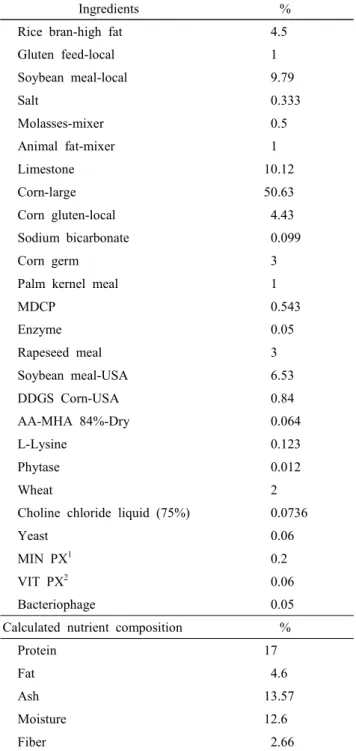
tion. Feed and water were provided ad libitum and diets were prepared in mash form. The composition of the experimental diets is shown in Table 1. Experimental treatments were: 1) CON (basal diet), 2) T1 (1 cc of Salicornia extract per liter drinking water), and 3) T2 (5 cc of Salicornia extract per liter drinking water). Diets were formulated to meet or exceed the nutrient requirements of laying hens (NRC, 1994).
2. Sampling and Measurements
Egg production was recorded on a daily basis. In addition, a total of 30 eggs were randomly collected at 17:00 h from each treatment (n=30, three per replicate) on days 0, 21, and 35 and were used to determine the egg quality. Eggshell brea- king strength was evaluated using a model II egg shell force gauge (Robotmation Co., Ltd., Japan). Egg shell thickness was measured on the large end, equatorial region, and small end using a dial pipe gauge (Ozaki MFG. Co., Ltd., Japan). Finally, the egg weight, egg yolk color, and Haugh units were evalu- ated using an egg multi-tester (Touhoku Rhythm Co. Ltd., Japan).
3. Blood Sampling and Assay
Blood samples were collected from the wing vein into a sterile syringe and stored at —4℃. Samples for serum analysis were then centrifuged at 3,000×g for 15 min, after which the serum was separated. Blood cell counts [white blood cells (WBC), red blood cells (RBC), and lymphocytes] in the whole blood were analyzed using an automatic blood analyzer (ADVIA 120, Bayer, NY).
4. Statistical Analysis
Data were statistically analyzed by ANOVA using the GLM procedure of the SAS (SAS, 1996) for a randomized complete block design. Differences among all treatments were analyzed by Duncan’s multiple range tests. Mean values and standard error of means (SE) are reported. Probability values of less than 0.05 were considered statistically significant.
RESULTS AND DISCUSSION
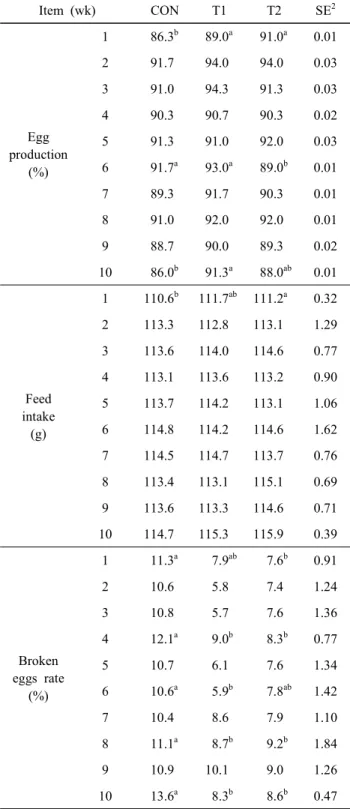
Table 2 shows the influence of Salicornia extract on egg production, feed intake, and broken egg rate. Adding Salicor-
Table 1. Experimental diet ingredients and calculated nutrient composition
Ingredients %
Rice bran-high fat 4.5
Gluten feed-local 1
Soybean meal-local 9.79
Salt 0.333
Molasses-mixer 0.5
Animal fat-mixer 1
Limestone 10.12
Corn-large 50.63
Corn gluten-local 4.43
Sodium bicarbonate 0.099
Corn germ 3
Palm kernel meal 1
MDCP 0.543
Enzyme 0.05
Rapeseed meal 3
Soybean meal-USA 6.53
DDGS Corn-USA 0.84
AA-MHA 84%-Dry 0.064
L-Lysine 0.123
Phytase 0.012
Wheat 2
Choline chloride liquid (75%) 0.0736
Yeast 0.06
MIN PX1 0.2
VIT PX2 0.06
Bacteriophage 0.05
Calculated nutrient composition %
Protein 17
Fat 4.6
Ash 13.57
Moisture 12.6
Fiber 2.66
1 Provided per kilogram of diet: all-trans-retinyl acetate, 2∼0 mg; cholecalciferol, 0∼25 mg; all-rac-tocopherol acetate, 1∼75 mg; menadione (menadione sodium bisulphate), 1∼9 mg;
riboflavin, 7 mg; thiamine (thiamine mono-nitrate), 2∼1 mg;
pyridoxine, 3∼2 mg; niacin, 55 mg; capantothenate, 15 mg;
cobalamin, 0∼4 mg; folic acid, 0∼85 mg; D-biotin, 0∼1 mg.
2 Provided per kg of diet: 8 mg Mn; 60 mg Zn; 5 mg Cu; 40 mg Fe; 0∼3 mg Co; 1∼5 mg I, and 0∼15 mg Se.
Table 2. The effects of Salicornia extract on production perfor- mance and feed intake in laying hens1
Item (wk) CON T1 T2 SE2
Egg production
(%)
1 86.3b 89.0a 91.0a 0.01 2 91.7 94.0 94.0 0.03 3 91.0 94.3 91.3 0.03 4 90.3 90.7 90.3 0.02 5 91.3 91.0 92.0 0.03 6 91.7a 93.0a 89.0b 0.01 7 89.3 91.7 90.3 0.01 8 91.0 92.0 92.0 0.01 9 88.7 90.0 89.3 0.02 10 86.0b 91.3a 88.0ab 0.01
Feed intake
(g)
1 110.6b 111.7ab 111.2a 0.32
2 113.3 112.8 113.1 1.29
3 113.6 114.0 114.6 0.77
4 113.1 113.6 113.2 0.90
5 113.7 114.2 113.1 1.06
6 114.8 114.2 114.6 1.62
7 114.5 114.7 113.7 0.76
8 113.4 113.1 115.1 0.69
9 113.6 113.3 114.6 0.71
10 114.7 115.3 115.9 0.39
Broken eggs rate
(%)
1 11.3a 7.9ab 7.6b 0.91 2 10.6 5.8 7.4 1.24 3 10.8 5.7 7.6 1.36 4 12.1a 9.0b 8.3b 0.77 5 10.7 6.1 7.6 1.34 6 10.6a 5.9b 7.8ab 1.42 7 10.4 8.6 7.9 1.10 8 11.1a 8.7b 9.2b 1.84 9 10.9 10.1 9.0 1.26 10 13.6a 8.3b 8.6b 0.47
1 Abbreviation: CON, basal diet; T1, Salicornia extract 1 cc; T2, Salicornia extract 5 cc.
2 Standard error.
a,b Means in the same row with different superscripts differ (P<
0.05).
nia extract to the drinking water of experimental laying hens did not have any significant effects on egg production from the 1
stweek up to the 9
thweek, but at the 10
thweek, a remark- able difference (P<0.05) was observed between experimental treatments and CON treatment (Table 2). It seems that with aging, the mineral resources of the body are utilized for laying and birds need to have access to higher levels of dietary minerals. Therefore, egg production in T1 and T2 was signifi- cantly higher than that in CON. Previously, other researchers have reported that feeding broiler chickens and laying hens with the diets supplemented with herbal extracts improved the performance without affecting their feed intake (Botsoglou et al., 2002; Lee et al., 2003; Hernández et al., 2004; Shanmu- gavelu et al., 2004; Jang et al., 2007, Franz et al., 2010). Some evidences show that feeding the birds with supplemental herbal extracts led to an improvement in FCR. In agreement with the results of previously performed experiments, this experi- ment also showed that the feed intake was not affected by Salicornia extract, and during the whole experimental period, significant difference was not observed between experimental treatments (Table 2). This study showed that adding Salicornia extract to the drinking water did not have any negative effect on the feed intake, but it can help to improve the FCR by increasing egg production.
One of the main concerns is a decrease in eggshell quality as the hen ages, due to an increase in egg weight without an increase in the amount of calcium carbonate deposited in the shells. For this reason, the incidence of cracked eggs could even exceed 20% at the end of the laying period (Nys, 2001).
The results of this study indicate that Salicornia extract had a remarkable effect (P<0.05) on egg shell quality (Table 1).
Nutritional analysis showed that S. bigelovii contained high vitamins and minerals, which made it an ideal nutritional and diet supplement. It seems that excessive access to minerals can be beneficial in reducing the rate of broken eggs. The results of this study showed a significant decrease in the bro- ken egg rate.
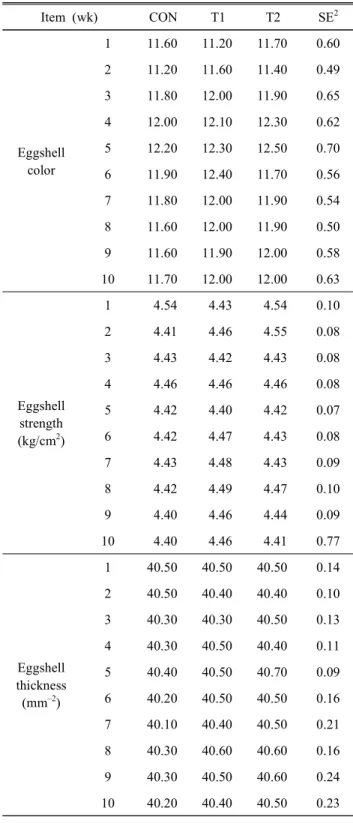
Table 3 shows the effects of Salicornia extract on eggshell
quality in laying hens. The supplementation of Salicornia
extract to the diet of laying hens had no significant effects on
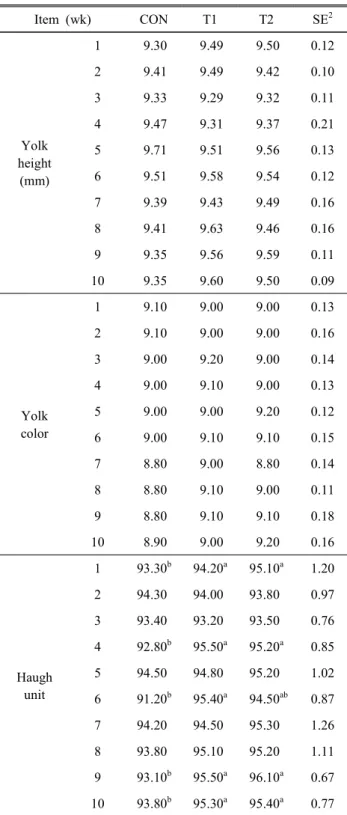
eggshell color, eggshell strength, and eggshell thickness. The
data presented in Table 4 show no significant impact on yolk
Table 3. The effects of Salicornia extract on eggshell quality in laying hens1
Item (wk) CON T1 T2 SE2
Eggshell color
1 11.60 11.20 11.70 0.60
2 11.20 11.60 11.40 0.49
3 11.80 12.00 11.90 0.65
4 12.00 12.10 12.30 0.62
5 12.20 12.30 12.50 0.70
6 11.90 12.40 11.70 0.56
7 11.80 12.00 11.90 0.54
8 11.60 12.00 11.90 0.50
9 11.60 11.90 12.00 0.58
10 11.70 12.00 12.00 0.63
Eggshell strength (kg/cm2)
1 4.54 4.43 4.54 0.10
2 4.41 4.46 4.55 0.08
3 4.43 4.42 4.43 0.08
4 4.46 4.46 4.46 0.08
5 4.42 4.40 4.42 0.07
6 4.42 4.47 4.43 0.08
7 4.43 4.48 4.43 0.09
8 4.42 4.49 4.47 0.10
9 4.40 4.46 4.44 0.09
10 4.40 4.46 4.41 0.77
Eggshell thickness (mm–2)
1 40.50 40.50 40.50 0.14
2 40.50 40.40 40.40 0.10
3 40.30 40.30 40.50 0.13
4 40.30 40.50 40.40 0.11
5 40.40 40.50 40.70 0.09
6 40.20 40.50 40.50 0.16
7 40.10 40.40 40.50 0.21
8 40.30 40.60 40.60 0.16
9 40.30 40.50 40.60 0.24
10 40.20 40.40 40.50 0.23
1 Abbreviation: CON, basal diet; T1, Salicornia extract 1 cc; T2, Salicornia extract 5 cc.
2 Standard error.
a,b Means in the same row with different superscripts differ (P<
0.05).
color and yolk height. By supplementing the diets with Sali- cornia extract, Haugh unit was remarkably (P<0.05) increased at weeks 1, 4, 6, 9, and 10 in the birds (Table 4). The results also showed that addition of Salicornia extract had a positive effect (P<0.05) on egg weight at weeks 1, 7, and 8 (P<0.05).
Lu et al. (2010) reported that fresh Salicornia bigelovii contains 0.62 g/kg of Ca. The level of Ca in Salicornia extract was 300 mg/L which is a proper source of calcium for the birds and improved the egg shell quality and led to a decrease in the egg breaking rate.
The effects of Salicornia extract supplementation on blood profile are presented in Table 4. Red blood cells, white blood cells, and lymphocytes were not affected by the dietary treat- ments. These results indicated that supplementation of Salicor- nia extract to the diet did not affect the health status of the birds.
SUMMARY
The results of the current research demonstrated that addi- tion of Salicornia extract to the drinking water of laying hens improved egg production, without any negative effect on egg
Table 4. The effects of Salicornia extract on egg weight in lay- ing hens1
Item (wk) CON T1 T2 SE2
1 62.2b 64.5a 64.4a 0.99
2 63.5 63.7 63.1 0.68
3 64.1 63.9 63.8 0.71
4 63.1 63.2 63.4 0.88
5 64.1 63.8 64.0 0.76
6 63.4 64.1 64.0 0.56
7 63.4b 65.2a 65.6a 0.53
8 63.9b 65.3a 65.4a 0.27
9 63.3 64.8 64.7 0.42
10 63.6 64.1 64.3 0.65
1 Abbreviation: CON, basal diet; T1, Salicornia extract 1 cc; T2, Salicornia extract 5 cc.
2 Standard error.
a,b Means in the same row with different superscripts differ (P<
0.05).
Table 5. The effects of Salicornia extract on yolk height, yolk color and Haugh unit in laying hens1
Item (wk) CON T1 T2 SE2
Yolk height
(mm)
1 9.30 9.49 9.50 0.12
2 9.41 9.49 9.42 0.10
3 9.33 9.29 9.32 0.11
4 9.47 9.31 9.37 0.21
5 9.71 9.51 9.56 0.13
6 9.51 9.58 9.54 0.12
7 9.39 9.43 9.49 0.16
8 9.41 9.63 9.46 0.16
9 9.35 9.56 9.59 0.11
10 9.35 9.60 9.50 0.09
Yolk color
1 9.10 9.00 9.00 0.13
2 9.10 9.00 9.00 0.16
3 9.00 9.20 9.00 0.14
4 9.00 9.10 9.00 0.13
5 9.00 9.00 9.20 0.12
6 9.00 9.10 9.10 0.15
7 8.80 9.00 8.80 0.14
8 8.80 9.10 9.00 0.11
9 8.80 9.10 9.10 0.18
10 8.90 9.00 9.20 0.16
Haugh unit
1 93.30b 94.20a 95.10a 1.20
2 94.30 94.00 93.80 0.97
3 93.40 93.20 93.50 0.76
4 92.80b 95.50a 95.20a 0.85
5 94.50 94.80 95.20 1.02
6 91.20b 95.40a 94.50ab 0.87
7 94.20 94.50 95.30 1.26
8 93.80 95.10 95.20 1.11
9 93.10b 95.50a 96.10a 0.67 10 93.80b 95.30a 95.40a 0.77
1 Abbreviation: CON, basal diet; T1, Salicornia extract 1 cc; T2, Salicornia extract 5 cc.
2 Standard error.
a,b Means in the same row with different superscripts differ (P<
0.05).
Table 6. The effects of Salicornia extract on blood profile in laying hens1
Item CON T1 T2 SE2
WBC (106/μL) 281.30 266.10 282.10 16.49 RBC (106/μL) 1.88 1.86 1.89 0.13 Lymphocyte (%) 83.00 84.00 84.30 1.70
1 Abbreviation: CON, basal diet; T1, Salicornia extract 1 cc; T2, Salicornia extract 5 cc.
2 Standard error.