Effects of Graded Levels of Rice Bran Oil on Laying Performance, Blood Parameters and Egg Yolk Cholesterol in Hy-Line Laying Hens
Chan Ho Kim, Seong Bok Park and Hwan Ku Kang
†Poultry Science Division, National Institute of Animal Science, RDA, Cheonan 331-801, Republic of Korea
ABSTRACT This study aimed to determine the effect of different dietary level of rice bran extract (RBO) on the laying performance, egg quality, blood parameter, cholesterol, and fatty acids in yolk of Hy-Line Laying hens. In all, 144 Hy-Line Brown laying hens (29 weeks old) were randomly allocated to one of 4 dietary treatments, with 4 replicates per treatment.
A commercial basal diet was used and three additional diets were prepared by supplementing 2.5, 5.0 or 10.0 g/kg of RBO to the basal diet. The experimental diets were fed on an ad libitum basis to the bird during 8 weeks. Hen-day egg production increased (quadratic, p<0.05) with inclusion level of RBO, but feed intake, egg weight, and egg mass were not influenced by inclusion of level of RBO in diet. However, the supplementation of RBO did not have an effect on eggshell strength, eggshell thickness, egg yolk color, and HU during the feeding trial. There were no significant differences in the level of leukocyte. However, heterophil and lymphocytes decreased (quadratic, p<0.01) with inclusion level of RBO. H:L ratio tended to decrease (linear p=0.08) with inclusion level of RBO. As expected, increasing inclusion level of RBO in diets decreased (linear, p<0.01) the concentrations of total cholesterol in plasma. AST, ALT, glucose, and albumin were not affected by inclusion of RBO in diets. Egg yolk cholesterol increased (linear and quadratic, p<0.05) with inclusion level of RBO in diet.
The results of this study indicate that dietary supplementation of RBO improves laying performance and decreased total cholesterol and egg yolk cholesterol levels in laying hens. Therefore, dietary RBO is considered a valuable functional ingredient to improve the performance of birds.
(Key words: laying hens, laying performance, rice bran oil, egg yolk cholesterol, total cholesterol)
†
To whom correspondence should be addressed : [email protected]
INTRODUCTION
Interest in rice bran oil (RBO) has been growing from the health and nutritional aspects as well as its wide application as industrial oil. RBO as its natural state contains several constituents which would potentially provide benefits to health (Raghueam and Rukmini, 1995). The oil contains 4.2%
unsaponifiable matter, which includes antioxidants and micro- nutrients, whereas all other oils have an unsapnifiable content of less than 1∼2%. The RBO is rich in tocopherols and to- cotrienols, γ-oryzanol, phytosterols, polyphenols and squalene (Sayre et al., 1987; Kahlon et al., 1996; Sugano and Tsuji, 1997).
Oryzanol is an antioxidant compound and is associated with decreasing plasma cholesterol (Yoshino et al., 1989), lowering cholesterol, decreasing cholesterol absorption (Ger- hardt and Gallo, 1989) and decreasing platelet aggregation (Seetharamaiah et al., 1990). The beneficial effects of RBO have been recently been reported. The hypolipidemic effect
RBO is not entirely explained by its fatty acid composition.
RBO has a greater content of unsaponifiables (Sugano et al., 1997), which also lower cholesterol compared with most vegetable oils (Wilson et al., 2005). Moreover, RBO has a very good balance in its fatty acid composition i.e., mono- unsaturates to poly-unsaturates/saturates (Ghosh, 2007).
Previous studies on dietary supplementation of RBO in
broilers have shown to improve growth performance (Anitha
et al., 2006; Purushorthaman et al., 2006; Kang and Kim,
2016) and decreased cholesterol concentrations (Berger et al.,
2005; Kang and Kim, 2016). Dietary supplementation of rice
bran or RBO in mice or broilers has shown to enhance
improved immune response (Henderson et al., 2012; Kang
and Kim, 2016). However, data pertaining to the effects of
dietary supplementation of RBO on the laying performance,
egg quality, and egg yolk cholesterol of laying hens are
limited. Therefore, the objective of the present study was to
investigate the effect of dietary supplementation of RBO on
the laying performance, egg quality, blood parameter, and
egg yolk cholesterol of laying hens.
MATERIALS AND METHODS
The protocol for this experiment was reviewed and app- roved by the Institutional Animal Care and Welfare Committee of the National Institute of Animal Science, Rural Development Administration, Republic of Korea.
1. Preparation of Rice Bran Extract
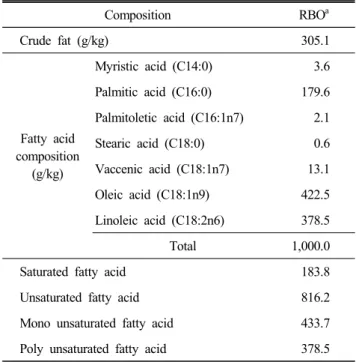
Rice bran harvested in 2015 was obtained from a rice pro- cessing complex (Seonghwan-eup, South Korea). RBO was extracted as described previously (Kang and Kim, 2016). The nutrient composition of RBO was analyzed in duplicate for crude fat (AOAC, 1990). The results are presented in Table 1.
2. Birds and Experimental Design
A total 144, 29-week-old Hy-Line Brown laying hens were randomly allotted to 1 of 4 dietary treatments. Each treatment has 4 replicates and 3 adjacent cages, 3 hen per cage, consi- dered a replicate (36 cm × 40 cm × 42 cm = width × length
Table 1. Analyzed fatty acids composition of RBO used in this experiment (as is basis)
Composition RBO
aCrude fat (g/kg) 305.1
Fatty acid composition
(g/kg)
Myristic acid (C14:0) 3.6 Palmitic acid (C16:0) 179.6 Palmitoletic acid (C16:1n7) 2.1 Stearic acid (C18:0) 0.6 Vaccenic acid (C18:1n7) 13.1
Oleic acid (C18:1n9) 422.5
Linoleic acid (C18:2n6) 378.5
Total 1,000.0
Saturated fatty acid 183.8
Unsaturated fatty acid 816.2
Mono unsaturated fatty acid 433.7
Poly unsaturated fatty acid 378.5
a
Nutrient composition was analyzed for crude fat (AOAC, 1990).
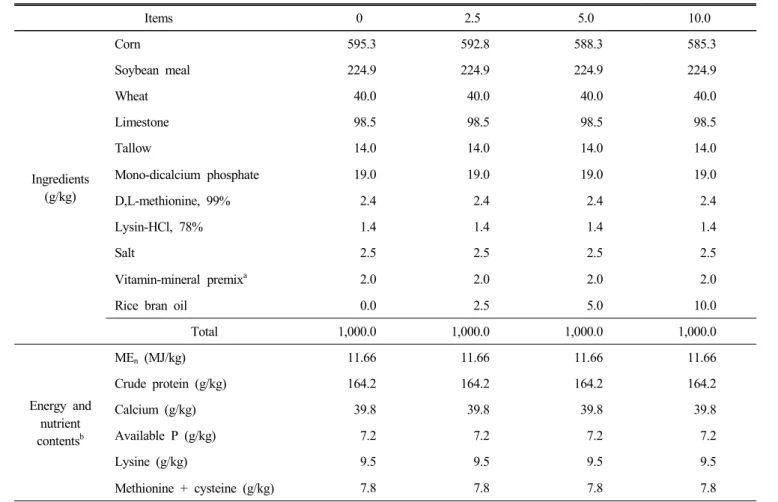
× height). A commercial type basal diet was formulated to meet or exceed nutrient recommendations of the National Re- search Council (NRC, 1994) for laying hens (Table 2). Three additional diets were prepared by supplementing 2.5, 5.0 or 10.0 g/kg of RBO to the basal diet at the expense of corn.
The experimental period lasted 8 weeks. During the experi- ment, hens were provided with feed and water ad libitum and were exposed to a 16h:8h light:dark lighting schedule. The temperature and humidity of the laying house was maintained at 18±3℃ and 65∼70%, respectively, during the experiment.
3. Laying Performance
Hen-day egg production rate and egg weight were recorded daily. Feed intake (FI) and feed conversion ratio (FCR) were recorded weekly. Egg mass (EM) was calculated as follows (Hayat et al., 2009).
Egg mass = (Weekly number of eggs in replicate × Average egg weight)
4. Determination of Egg Quality Parameter Ten eggs per replicate were randomly collected at the end of the each week. Eggshell strength, eggshell thickness, egg yolk colour, and Haugh units (HU) were measured. Eggshell strength was measured by the Texture Systems Compression Test Cell (model T2100C, Food Technology Co., Ltd., Rock- ville, MD, USA) and expressed as units of compression force exposed to units of eggshell surface area (kg/cm
2). Eggshell thickness is defined as the mean value of measurements at 3 different locations on the egg (aircell, equator, and sharpend) and was measured with a dial pipe gauge (model 7360, Mi- tutoyo Co. Ltd., Kawasaki, Japan) and calculated using the following formula (Yannakopouls and Tserveni-Gousi, 1986).
Egg yolk colour was evaluated by the Roche Yolk Color Fan (Hoffman-La Roche Ltd., Basel, Switzerland; 15 = dark orange; 1 = light pale). Hough unit values were calculated using a micrometer (model S-8400, Ames, Walthman, MA, USA) with the following formula described by Eisen et al.
(1962):
HU = 100 log (H — 1.7W
0.37+7.6),
Table 2. Composition and nutrient content of experimental diet (as-fed basis)
Items 0 2.5 5.0 10.0
Ingredients (g/kg)
Corn 595.3 592.8 588.3 585.3
Soybean meal 224.9 224.9 224.9 224.9
Wheat 40.0 40.0 40.0 40.0
Limestone 98.5 98.5 98.5 98.5
Tallow 14.0 14.0 14.0 14.0
Mono-dicalcium phosphate 19.0 19.0 19.0 19.0
D,L-methionine, 99% 2.4 2.4 2.4 2.4
Lysin-HCl, 78% 1.4 1.4 1.4 1.4
Salt 2.5 2.5 2.5 2.5
Vitamin-mineral premix
a2.0 2.0 2.0 2.0
Rice bran oil 0.0 2.5 5.0 10.0
Total 1,000.0 1,000.0 1,000.0 1,000.0
Energy and nutrient contents
bME
n(MJ/kg) 11.66 11.66 11.66 11.66
Crude protein (g/kg) 164.2 164.2 164.2 164.2
Calcium (g/kg) 39.8 39.8 39.8 39.8
Available P (g/kg) 7.2 7.2 7.2 7.2
Lysine (g/kg) 9.5 9.5 9.5 9.5
Methionine + cysteine (g/kg) 7.8 7.8 7.8 7.8
a
Provided per kilogram of the complete diet: vitamin A (from vitamin A acetate), 12,500 IU; vitamin D
3, 2,500 IU; vitamin E (from DL-α-tocopheryl acetate), 20 IU; vitamin K
3, 2 mg; vitamin B
2, 5 mg; vitamin B
6, 3 mg; vitamin B
12, 18 μg; calcium pantothenate, 8 mg; folic acid, 1 mg; biotin, 50 μg; niacin, 24 mg; Zn (as ZnO), 60 mg; Mn (as MnSO
2․H
2O), 50 mg; Fe (as FeSO
4․7H
2O), 50 mg; Cu (as CuSO
4․5H
2O), 6 mg; Co (as CoCO
3), 250 μg; I [as Ca (IO
3)
2․H
2O], 1 mg; Se (as Na
2SeO
3), 150 μg.
b
Nutrient contents in all diet were calculated.
where W is egg weight, and H is albumen height.
5. Haematological Analysis
At the end of the 8 week feeding trial, 8 birds/treatments with a body weight close to the average were selected to be euthanized by cervical dislocation. Immediately after death, a 5-mL blood sample was collected from jugular vein of each bird using EDTA-treated vacutainer tubes and non EDTA- treated vacutainer tubes (Becton Dickinson, Franklin Lakes, NJ, USA). The whole blood samples were kept on ice and provided for immediate analysis of hematology. Leukocytes (white blood cells, heterophils, lymphocytes, monocytes, eois- nophils, and basophils) of blood samples were analyzed using Hemavet Multispecies Hematology Systems (Drew Scientific
Inc., Oxford, CT). The H:L ratios were determined by dividing the number of heterophils by that of lymphocytes. Serum samples obtained by centrifuging the samples for 20 min at 25,000 × g and 4℃, were stored at —15℃. Total cholesterol, triglyceride, aspirate aminotransperase (AST), alanine amino- transperase (ALT), and calcium in the serum were quantified using an ADVIA 1650 chemistry system (Bayer Diagnostic, Putraux, France).
6. Determination of Egg Yolk Cholesterol Level
Egg yolk cholesterol level was performed by using 40 eggs
(10 eggs from each treatment) collected in the last week of
the experiment. A sample of 2 ∼3 eggs from each replicate
was used for cholesterol quantification. Egg yolks were com-
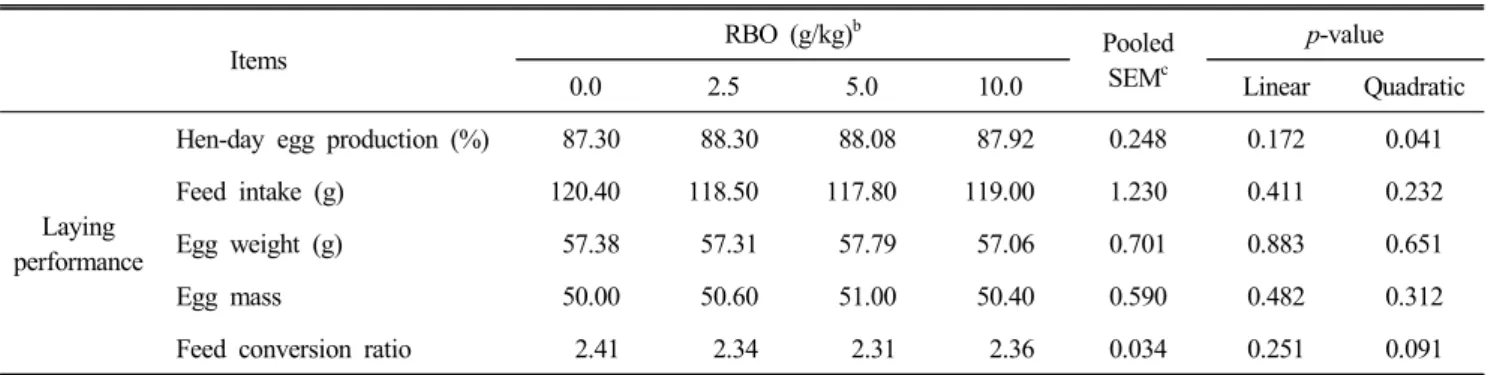
Table 3. Laying performance of laying hens fed the diet containing RBO
aItems
RBO (g/kg)
bPooled
SEM
cp-value
0.0 2.5 5.0 10.0 Linear Quadratic
Laying performance
Hen-day egg production (%) 87.30 88.30 88.08 87.92 0.248 0.172 0.041
Feed intake (g) 120.40 118.50 117.80 119.00 1.230 0.411 0.232
Egg weight (g) 57.38 57.31 57.79 57.06 0.701 0.883 0.651
Egg mass 50.00 50.60 51.00 50.40 0.590 0.482 0.312
Feed conversion ratio 2.41 2.34 2.31 2.36 0.034 0.251 0.091
a
Data are least squares means of 4 observations per treatment.
b
Basal diet was supplemented with RBO at 2.5, 5.0 or 10.0 g/kg.
c
Pooled standard error of the mean.
pletely separated from the albumen, adhering white and chalazae; then weighted, pooled and mixed. The cholesterol content of egg yolk was determined following colorimetric method based on Liebermann-Burchard color reaction as de- scribed by Huang et al. (1961). Briefly, chloroform:methanol (2:1 v/v) solvent was used to extract total lipids from egg yolk. The harvested extracts, which contain free cholesterol and cholesterol esters, were allowed to react with acetic anhydride and concentrated sulfuric acid, resulting in the for- mation of a blue-green complex. Egg yolk cholesterol content was quantified by comparing the color absorbance at 550 nm resulting from the Libermann-Buchard reactions in egg yolk lipid extracts with cholesterol standards (Cholesterol reagent, Gainland Chemical Company, UK). All the reading were blanked against a chloroform:methanol.
7. Statistical Analysis
All data were analyzed by ANOVA according to com- pletely randomized design using the PROC MIXED procedure of SAS (SAS Institute Inc., Cary, NC). Outlier data were identified according to Steel et al. (1997) using the UNIVA- RIATE procedure of SAS, but no outliers was detected. The battery cage was an experimental unit for growth performance data, whereas the individual bird was an experimental unit for blood parameter, serum enzyme activities and immune response data. Dietary treatment was fixed effect in all statistical models. The LSMEANS procedure was used to calculate mean values. The orthogonal polynomial contrast test was performed to determine linear and quadratic effects of increasing inclu-
sion level of RBO in diets on each measurement. Significance and tendency for statistical tests were set at P<0.05 and 0.05
≤P≤0.10, respectively.
RESULTS AND DISCUSSION
Hen-day egg production increased (quadratic, p<0.05) with inclusion level of RBO, but feed intake, egg weight, and egg mass were not influenced by inclusion of level of RBO in diet (Table 3). Dietary supplementation of rice bran or RBO has been reported to improve BW gain in broiler chickens and hen-day egg production in laying hens (Murugesan, 1997;
Purshothaman et al., 2000; Kang and Kim et al., 2016). It is suggested that positive effects of dietary RBO on bird’s per- formance may result from its high concentrations of oryzanols, tocopherols, vitamin E, ferulic acid, phytic acid, lecithin, and inositol (Sharma and Rukmini, 1986; Jo and Choi, 2010).
Resulted best performance in RBO may be associated with
synergistic effects of fatty acids contents of this oil (Rahimi
et al., 2011; Baiao and Lara, 2005). Addition of oils in broiler
diet may result in not only improvement in absorption and
digestion of lipoproteins and essential fatty acids and less heat
increment compared to carbohydrates and proteins (Grobas et
al., 2001; Bhonzack et al., 2002). In addition to the advantages
of the use of oils in broiler diets, reduction in passage rate
of the digesta through the gastrointestinal tract may also be
contributed to the better nutrient absorption and utilization as
well (Lastshaw, 2008), which allow more efficient use of
nutrient from diets. RBO is rich in linoleic acid and tocophe-
Table 4. Egg quality of laying hens fed the diet containing RBO
aItems
RBO (g/kg)
bPooled
SEM
cp-value
0.0 2.5 5.0 10.0 Linear Quadratic
Egg quality
Eggshell strength (kg/cm
2) 4.42 4.12 4.14 4.10 19.372 0.322 0.370
Eggshell thickness (µm) 408.00 403.00 403.00 414.00 6.710 0.551 0.182
Egg yolk color 6.40 6.60 6.60 6.40 0.230 0.852 0.494
Haugh unit 92.90 91.50 91.50 90.90 1.670 0.422 0.831
a
Data are least squares means of 40 observations per treatment.
b
Basal diet was supplemented with RBO at 2.5, 5.0 or 10.0 g/kg.
c
Pooled standard error of the mean.
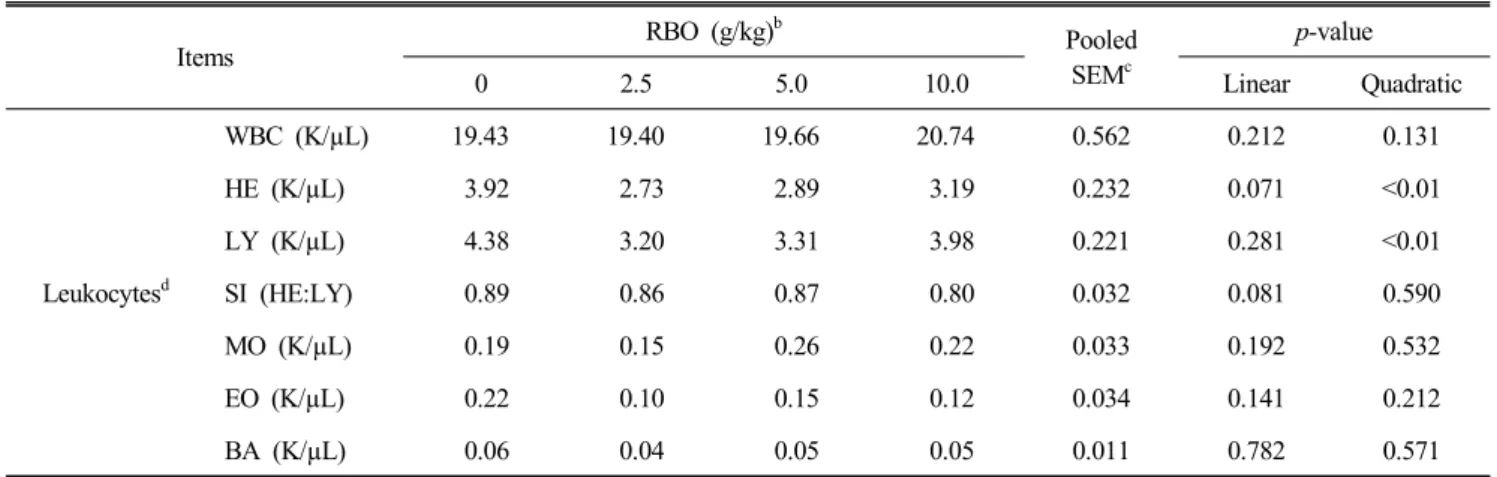
Table 5. Blood parameter of laying hens fed the diet containing RBO
aItems
RBO (g/kg)
bPooled
SEM
cp-value
0 2.5 5.0 10.0 Linear Quadratic
Leukocytes
dWBC (K/µL) 19.43 19.40 19.66 20.74 0.562 0.212 0.131
HE (K/µL) 3.92 2.73 2.89 3.19 0.232 0.071 <0.01
LY (K/µL) 4.38 3.20 3.31 3.98 0.221 0.281 <0.01
SI (HE:LY) 0.89 0.86 0.87 0.80 0.032 0.081 0.590
MO (K/µL) 0.19 0.15 0.26 0.22 0.033 0.192 0.532
EO (K/µL) 0.22 0.10 0.15 0.12 0.034 0.141 0.212
BA (K/µL) 0.06 0.04 0.05 0.05 0.011 0.782 0.571
a
Data are least squares means of 6 observations per treatment.
b
Basal diet was supplemented with RBO at 2.5, 5.0, or 10.0 g/kg.
c
Pooled standard error of the mean.
d
Leukocytes: WBC = white blood cells; HE = heterophils; LY = lymphocytes; SI = heterophil : lymphocytes; MO = monocytes; EO
= eosinophils; BA = basophils.
rols. The beneficial effects of essential fatty acid on egg weight and egg production have been documented (March, 1990). Due to limited experiments on RBO in laying hens, further studies are needed to be conducted.
However, the supplementation of RBO did not have an effect on eggshell strength, eggshell thickness, egg yolk color, and HU during the feeding trial (Table 4). The lack of ade- quate data on the influence of inclusion level of RBO of laying hens in egg quality in poultry requires further research.
Table 5 presents the concentrations of leukocytes in the whole blood. There were no significant differences in the level of leukocyte. However, heterophil and lymphocytes de- creased (quadratic, p<0.01) with inclusion level of RBO. H:L ratio tended to decrease (linear p=0.08) with inclusion level
of RBO. For example, leukocytes are known to increase sharply when infection occurs, as they are one of the first lines of defence of the body (Ganong, 1999; Alzawqari et al., 2011; Masoudi et al., 2011). Leukocyte counts also have been used as a measure of immune function in birds (Johnson and Zuk, 1998). Many factors such as exposure to various microbes and chemicals can cause changes in both granu- locytic white blood cells (Lucas and Jamroz, 1961). The lack of adequate data on the influence of dietary inclusion level of RBO of laying hens in altering blood parameters in poultry requires further research.
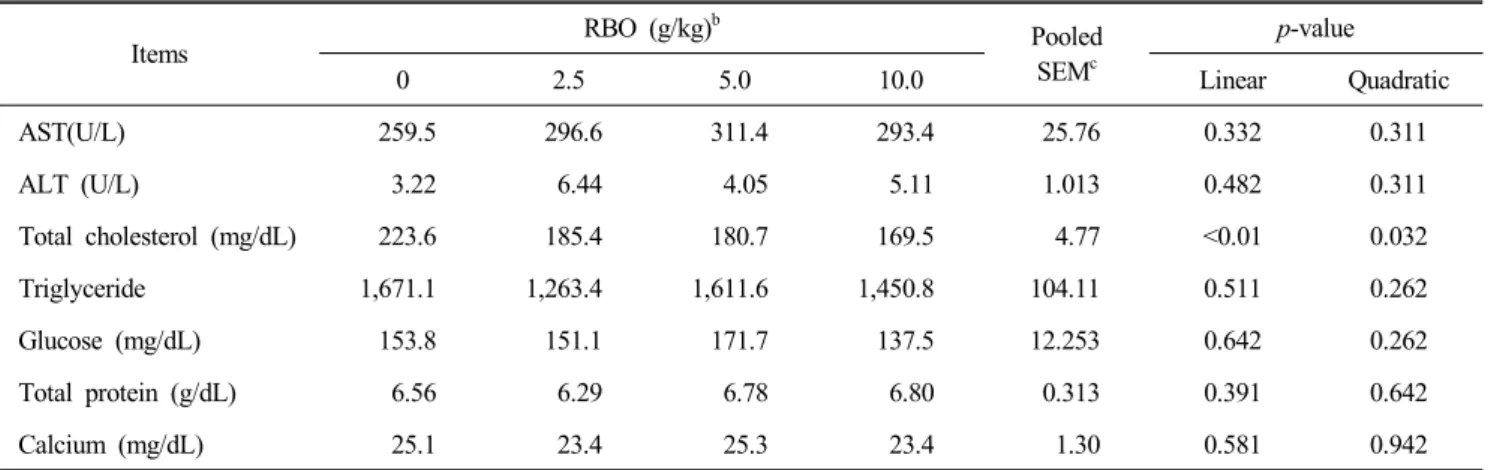
As expected, increasing inclusion level of RBO in diets
decreased (linear, p<0.01) the concentrations of total choles-
terol in plasma (Table 6). AST, ALT, glucose, and albumin
Table 6. Serum enzyme activities of laying hens fed the diet containing RBO
aItems
RBO (g/kg)
bPooled
SEM
cp-value
0 2.5 5.0 10.0 Linear Quadratic
AST(U/L) 259.5 296.6 311.4 293.4 25.76 0.332 0.311
ALT (U/L) 3.22 6.44 4.05 5.11 1.013 0.482 0.311
Total cholesterol (mg/dL) 223.6 185.4 180.7 169.5 4.77 <0.01 0.032
Triglyceride 1,671.1 1,263.4 1,611.6 1,450.8 104.11 0.511 0.262
Glucose (mg/dL) 153.8 151.1 171.7 137.5 12.253 0.642 0.262
Total protein (g/dL) 6.56 6.29 6.78 6.80 0.313 0.391 0.642
Calcium (mg/dL) 25.1 23.4 25.3 23.4 1.30 0.581 0.942
a
Data are least squares means of 6 observations per treatment.
b
Basal diet was supplemented with RBO at 2.5, 5.0, or 10.0 g/kg.
c
Pooled standard error of the mean.
Table 7. Cholesterol in egg yolk of laying hens fed the diet containing RBO
aItems
RBO (g/kg)
bPooled
SEM
cp-value
0 2.5 5.0 10.0 Linear Quadratic
Egg yolk cholesterol (mg/dL) 13.89 13.30 13.57 10.78 0.358 <0.01 0.042
a
Data are least squares means of 6 observations per treatments.
b
Basal diet was supplemented with RBO at 2.5, 5.0, or 10.0 g/kg.
c