• 검색 결과가 없습니다.

The taxonomic status of Angelica purpuraefolia and its allies in Korea : Inferences based on ITS molecular phylogenetic analyses

N/A
N/A
Protected

Academic year: 2021

Share "The taxonomic status of Angelica purpuraefolia and its allies in Korea : Inferences based on ITS molecular phylogenetic analyses"

Copied!
6
0
0

로드 중.... (전체 텍스트 보기)

전체 글

(1)

The taxonomic status of Angelica purpuraefolia and its allies in Korea : Inferences based on ITS molecular phylogenetic analyses

Byoung Yoon Lee

1,2

*, Myounghai Kwak

1

, Jeong Eun Han

1,3

and Se-Jung Kim

1,4

1

Wildlife Genetic Resources Center, National Institute of Biological Resources, Incheon 404-170, Korea

2

Division of Microorganism, National Institute of Biological Resources, Incheon 404-170, Korea

3

Department of Biology, Inha University, Incheon 402-751, Korea

4

Genome analyses center, National Instrumentation Center for Environmental Management, Seoul 151-921, Korea (Received 29 August 2011; Revised 08 September 2011; Accepted 13 September 2011)

ABSTRACT: The taxonomy of the umbelliferous species Angelica amurensis and its allies was reviewed on the basis of molecular phylogenies derived from sequences of nuclear ribosomal DNA internal transcribed spacer (ITS) regions. Strict consensus of six minimal length 119-step trees derived from equally weighted maximum parsimony analysis of combined nuclear rDNA ITS1 and ITS2 sequences from 29 accessions of Angelica and outgroups indicated that Angelica purpuraefolia, known to be endemic to Korea, is the same species as A. amurensis.

Comparisons of sequence pairs across both spacer regions revealed identity or 1-2 bp differences between A.

purpuraefolia and A. amurensis. These results indicated that the two taxa are not distinguished taxonomically.

Also, nuclear rDNA ITS regions are discussed as potential barcoding loci for identifying Korean Angelica.

Keywords: Apiaceae, Angelica purpuraefolia, Angelica amurensis, DNA barcode

The Korean endemic Angelica purpuraefolia Chung grows in mountainous areas in Gangwondo, Gyeongsangbugdo, and Chungcheongbugdo (Lee, W. 1996; Park et al., 1997). A.

purpuraefolia is characterized by three to four times ternate leaves, obsolete calyx teeth, non-ciliated margins of bracts and bracteoles, and densely hispidulous rachis, peduncles, rays, and pedicels. The species can be also distinguished from other congeners by the presence of purple colors at the base of leaf petioles. Angelica species, including A. purpuraefolia, have attracted considerable attention as they have been used as traditional medicine in northeastern Asian countries, including Korea, Japan, and China. Roots of A. purpuraefolia are used in Oriental medicine to relieve pain, fever, perspiration, and anemia (Choi and Park, 1995; Pan and Watson, 2005). Chemical analyses of Angelica components have revealed diverse compounds such as coumarines, sesquiterpenes, and polyacetylenes (An et al., 2005; reviewed in Min, 2006). Chi (1967) isolated the coumarine derivative trans-khellactone from A. purpuraefolia roots, and more recently, Min (2006) isolated four coumarines (isoscopoletin, oxypeucedanin hydrate, arnottinin, and isokhellactone) and one polyacetylene through repeated column chromatography from A. purpuraefolia roots. Also, A.

purpuraefolia derivatives and compounds containing anticancer

bioactivities have been protected by Korean patent law (Lee et al., 2005). However, the taxonomic identity and classification of A. purpuraefolia are unclear because its taxonomic nomenclature is nomen nudum. A. purpuraefolia was first reported by Chung (1956) without a Latin description and type specimens. Following Chung ’ s (1956) treatment of the species, several floras and studies have used this nomenclature to describe A. purpuraefolia (Tou, 1970, 1971; Choi and Park, 1995; Lee, Y. 1996; Park et al., 1997; Feng et al., 2009). In this paper, to taxonomically identify A. purpuraefolia, we present results of a molecular systematic study of A. purpuraefolia and its allies based on nuclear ribosomal DNA (nrDNA) internal transcribed spacer (ITS) sequences. Our goal was to ascertain the taxonomic status and position of the species and to evaluate the utility of the ITS sequences as DNA barcodes for the identification of several Angelica species in Korea.

Materials and Methods

Plant materials

Samples of Angelica and Peucedanum species were obtained through field investigations conducted by the staff of the Korean National Institute of Biological Resources (NIBR) from August 2009 to October 2010. Samples of Angelica polymorpha showing diverse morphological variation of leaf shapes and sheaths

*Author for correspondence: [email protected]

(2)

were collected from five different localities. Five accessions of A. purpuraefolia were sampled from the Inje and Pyeongchang areas of Gangwon-do and Jirisan of Gyeongsangnam-do province, Korea, respectively. Other species of Angelica were collected nationwide in two or three accessions. Herbarium voucher specimens examined in this study were deposited at the herbarium of the NIBR. To compare and align sequences from the Angelica species investigated in this study, nrDNA ITS sequences of two Angelica accessions, A. genuflexa and A.

amurensis, were obtained from GenBank. In total, 29 accessions were used for molecular phylogenetic analyses including three accessions of the genus Peucedanum as outgroups (Table 1).

Experimental strategies

Total genomic DNA was extracted from fresh leaves and herbarium preserved tissues using a DNeasy Plant Mini Kit (Qiagen, Hilden, Germany) according to the manufacturer ’ s instructions. Double-stranded DNA of the complete ITS regions in each genomic DNA were polymerase chain reaction (PCR)- amplified using primers “ ITS 5 ” and “ ITS 4 ’ (White et al., 1990).

Details of the amplification reactions, purification, and alignment are as described in Lee (1998). Pairwise nucleotide differences of unambiguously aligned positions were determined from the distance matrix option in Phylogenetic Analysis Using Parsimony (PAUP*; Swofford, 2000). Phylogenetic analyses of the ITS sequence data were carried out using the heuristic search strategies

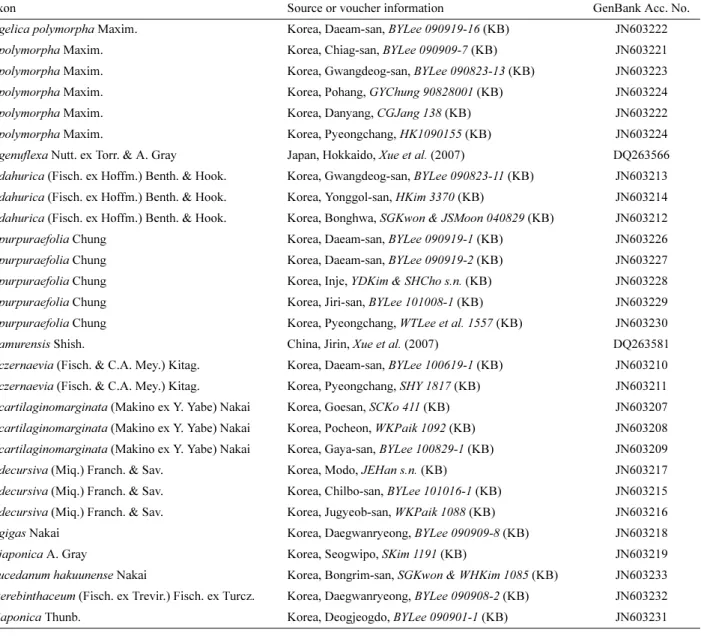
Table 1. The 29 accessions of the genus Angelica and outgroups examined for nuclear ribosomal DNA internal transcribed spacer sequence variation. Accession numbers of newly investigated sequences start with the letter J. Herbarium acronyms: KB = Korean National Institute of Biological Resources, Incheon.

Taxon Source or voucher information GenBank Acc. No.

Angelica polymorpha Maxim. Korea, Daeam-san, BYLee 090919-16 (KB) JN603222

A. polymorpha Maxim. Korea, Chiag-san, BYLee 090909-7 (KB) JN603221

A. polymorpha Maxim. Korea, Gwangdeog-san, BYLee 090823-13 (KB) JN603223

A. polymorpha Maxim. Korea, Pohang, GYChung 90828001 (KB) JN603224

A. polymorpha Maxim. Korea, Danyang, CGJang 138 (KB) JN603222

A. polymorpha Maxim. Korea, Pyeongchang, HK1090155 (KB) JN603224

A. genuflexa Nutt. ex Torr. & A. Gray Japan, Hokkaido, Xue et al. (2007) DQ263566 A. dahurica (Fisch. ex Hoffm.) Benth. & Hook. Korea, Gwangdeog-san, BYLee 090823-11 (KB) JN603213 A. dahurica (Fisch. ex Hoffm.) Benth. & Hook. Korea, Yonggol-san, HKim 3370 (KB) JN603214 A. dahurica (Fisch. ex Hoffm.) Benth. & Hook. Korea, Bonghwa, SGKwon & JSMoon 040829 (KB) JN603212

A. purpuraefolia Chung Korea, Daeam-san, BYLee 090919-1 (KB) JN603226

A. purpuraefolia Chung Korea, Daeam-san, BYLee 090919-2 (KB) JN603227

A. purpuraefolia Chung Korea, Inje, YDKim & SHCho s.n. (KB) JN603228

A. purpuraefolia Chung Korea, Jiri-san, BYLee 101008-1 (KB) JN603229

A. purpuraefolia Chung Korea, Pyeongchang, WTLee et al. 1557 (KB) JN603230

A. amurensis Shish. China, Jirin, Xue et al. (2007) DQ263581

A. czernaevia (Fisch. & C.A. Mey.) Kitag. Korea, Daeam-san, BYLee 100619-1 (KB) JN603210 A. czernaevia (Fisch. & C.A. Mey.) Kitag. Korea, Pyeongchang, SHY 1817 (KB) JN603211 A. cartilaginomarginata (Makino ex Y. Yabe) Nakai Korea, Goesan, SCKo 411 (KB) JN603207 A. cartilaginomarginata (Makino ex Y. Yabe) Nakai Korea, Pocheon, WKPaik 1092 (KB) JN603208 A. cartilaginomarginata (Makino ex Y. Yabe) Nakai Korea, Gaya-san, BYLee 100829-1 (KB) JN603209

A. decursiva (Miq.) Franch. & Sav. Korea, Modo, JEHan s.n. (KB) JN603217

A. decursiva (Miq.) Franch. & Sav. Korea, Chilbo-san, BYLee 101016-1 (KB) JN603215 A. decursiva (Miq.) Franch. & Sav. Korea, Jugyeob-san, WKPaik 1088 (KB) JN603216

A. gigas Nakai Korea, Daegwanryeong, BYLee 090909-8 (KB) JN603218

A. japonica A. Gray Korea, Seogwipo, SKim 1191 (KB) JN603219

Peucedanum hakuunense Nakai Korea, Bongrim-san, SGKwon & WHKim 1085 (KB) JN603233 P. terebinthaceum (Fisch. ex Trevir.) Fisch. ex Turcz. Korea, Daegwanryeong, BYLee 090908-2 (KB) JN603232

P. japonica Thunb. Korea, Deogjeogdo, BYLee 090901-1 (KB) JN603231

(3)

of PAUP*. All searches were conducted with 100 random-addition replicates using tree bisection-reconnection (TBR) branch swapping.

To identify weakly supported nodes, decay analyses (Bremer, 1988) were conducted until tree storage memory was exhausted. A bootstrap analysis was performed using 100 resampled data sets. All trees were rooted with three accessions of the genus Peucedanum, the most closely related taxa to the genus Angelica.

Results

ITS sequence analysis

Alignment of all 29 complete ITS 1 and ITS 2 sequences of Angelica and its outgroups resulted in a matrix of 441 characters. On average, the ITS 1 region was shorter than ITS 2. The length of ITS 1 in all of the Angelica taxa surveyed was 216 bp, except in A. czernaevia collected at Daeam-san (215 bp). The length of the ITS 2 region ranged from 219 bp in A. czernaevia collected at Daeam-san to 222 bp in A. japonica (mean : 220.9 bp). Overall length variation of both spacer regions across all 26 accessions of Angelica ranged from 434 bp to 438 bp. These sizes are comparable to values reported for other Apiaceae (Downie et al., 1998; Lee and Downie, 1999; Lee et al., 2010). Of the 441 initial alignment positions, 70 (15.9%) were potentially parsimony-informative, 351 (79.6%) were constant, and 20 (4.5%) were autapomorphic. Both spacers contributed comparable numbers of informative nucleotide substitutions to the phylogenetic analysis. The ITS sequence divergence values among Angelica species ranged from 0.2%

(between A. purpuraefolia at Daeam-san and Jiri-san and A.

amurensis) to 7.3% (between A. japonica and A. dahurica, and A. decursiva and A. dahurica). Intraspecific nucleotide differences were also detected in several species of Angelica. ITS sequence divergence among accessions of A. amurensis ranged from identity to 0.2% between materials collected in the Ussurie area and three other sites in Korea. Other differences of 0.2% were detected among accessions of A. cartilagomarginata. The 5.8S subunits of 23 Angelica taxa were constant in their length (162 bp), but those of three accessions of A. cartilaginomarginata were 163 bp in length. Sequence differences of the 5.8S subunits among Angelica taxa ranged from identity to 3 bp. Intraspecific nucleotide differences of 1 bp were found among A. amurensis accessions (0.6%), while interspecific differences of the 5.8S subunit were not observed among A. polymorpha, A. decursiva, A. gigas, A. czernaevia, A. japonica, and A. cartilaginomarginata.

Phylogenetic analyses and resolution

Results of the analyses of the combined ITS 1 and ITS 2 nucleotide data sets are presented in Fig. 1; separate analyses

of each spacer region alone were not conducted. Parsimony analysis of the 29 combined ITS sequences using equally weighted character states resulted in six maximally parsimonious trees, and the consensus of these six trees with accompanying bootstrap and decay values is presented in Fig. 1. The consensus tree had a length of 119 steps, consistency index (CI) of 0.85 and 0.82, with and without uninformative characters, respectively, and a retention index (RI) of 0.93. In each of the six parsimonious trees, three major groups of taxa were discernable, each without polytomy. The first group included A. polymorpha, A.

genuflexa, A. dahurica, A. amurensis, A. czernaevia, and A.

cartilaginomarginata. The second group included A. decursiva and A. gigas, and the third group comprising only A. japonica was a sister taxon to the clade including the first and second groups.

Discussion

Taxonomic treatment of Angelica purpuraefolia based on ITS sequence-based phylogeny

The major objective of this study was to ascertain the taxonomic status and position of A. purpuraefolia, which is endemic to Korea. A. purpuraefolia was first recognized as an independent taxon based on the presence of purple colors at the base of leaf petioles, and can be identified by the foul smell of the root (Chung, 1956). However, the species name should be treated as a nomen nudum because no written description in Latin and no designation of type specimens exist. Furthermore, A. purpuraefolia has often been confused with A. anomala.

However, A. anomala is clearly distinguished from other Korean species of Angelica by the presence of a pubescent or spinulose leaf sheath (Pan and Watson, 2005). On the basis of the ITS- derived phylogeny, A. purpuraefolia was not distinguished from A. amurensis. As shown in Fig. 1, the phylogeny did not support the monophyly of A. purpuraefolia, revealing no synapomorphic characters. None of the six parsimonious trees supported separation of A. purpuraefolia from A. amurensis. This result was consistent with Feng et al. (2009) molecular systematics investigation of Angelica and allied genera from the Hengduan Mountains of China based on nrDNA ITS sequences. Their strict consensus tree derived from maximum parsimony analyses showed polytomous relationships among A. amurensis, A. cincta, A. sachalinensis, and A. purpuraefolia (Feng et al., 2009).

Comparisons of sequence pairs across both spacer regions in the present study resulted in divergence values and revealed identity between A. amurensis and A. purpuraefolia at Mt.

Daeamsan and Mt. Jirisan. Although some variation of sequence

divergence between A. amurensis and the other two accessions

of A. purpuraefolia was shown, from 0.23% to 0.46%, the

(4)

sequence differences between these two species were quite low compared to species level divergence of other taxa belonging to Apiaceae. Among species of Agrocharis and Lisaea, pairwise nucleotide divergences ranged from 0.3% to 0.5% and 0.8%

to 1.0%, respectively (Lee and Downie, 1999). However, species ’ delimitations in these two genera are based on fruit secondary

spines that show a high degree of morphological variation. Thus, these characters are only of limited value for delimiting species ’ boundaries within these genera. The larger and more variable shapes of the secondary spines are considered to have evolved independently in these spiny-fruited umbelliferous plants as an adaptation to locally changing environmental conditions for fruit Fig. 1. The strict consensus of six minimal length 119-step trees derived from equally weighted maximum parsimony analysis of 29 combined nuclear rDNA ITS1 and ITS2 sequences from the genus Angelica and outgroups (CIs with and without uninformative characters = 0.85 and 0.82, respectively; RI = 0.93). Numbers above nodes indicate the number of times a monophyletic group occurred in 100 bootstrap replicates;

decay values are presented below.

(5)

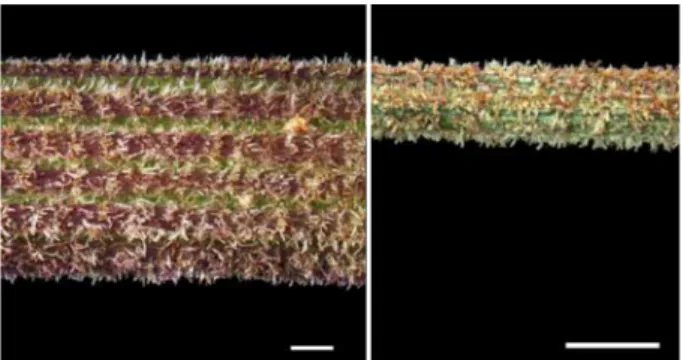
dispersal (Lee, 2002). With the exception of the above genera, pairwise nucleotide divergence of infrageneric species within the umbel family varied in 2.3~5.9% of Orlaya, 0.8~6.9% of Torilis, and 2.3~6.9% of Sium (Lee and Downie, 1999; Lee, 2002; Lee et al., 2010). Genetic divergence among Angelica species in Korea, with the exception of A. purpuraefolia, ranged from 2.7% to 7.3%. Therefore, A. purpuraefolia, described as a new species by Chung (1956), might be identical to A. amurensis because the sequence divergence between their ITS regions ranged from 0 to 0.46%. Morphological characters also indicated that these two taxa were identical. Densely distributed hispidulous hairs on both rays and pedicels that were characters in identifying A. amurensis (Shishkin, 1951) were also found in A. purpuraefolia (Fig. 2). From these molecular and morphological characters, A. purpuraefolia Chung should be treated as a synonym of A. amurensis Shishkin.

Nuclear rDNA ITS regions as potential barcoding loci for identifying Korean Angelica

Another objective of this study was to assess the potential for using ITS sequences as DNA barcodes for identifying species levels of Korean Angelica. Barcode sequence regions should meet three criteria: universality, sequence quality, and discriminatory power (CBOL Plant Working Group, 2009).

Therefore, barcode sequences should be relatively easy to amplify using one pair of universal primers. The DNA barcode should also be good at species delimitation. Thus, barcode regions should possess higher interspecific than intraspecific divergence. Recently, the CBOL Plant Working Group recommended the combined sequences of both rbcL and matK as standard barcodes for vascular plants. However, previous studies have suggested that nuclear rDNA ITS regions exhibit higher interspecific divergence than chloroplast DNA regions in many groups of vascular plants (Chase et al., 2005; Kress et al., 2005; Sass et al., 2007; Chen

et al., 2010). These studies suggested that ITS regions were excellent for species identification, but might be rejected as universal barcodes due to their low efficiency of PCR amplification.

Although universal primers for ITS have not been successfully identified for broad taxonomic groups covering all vascular plants, algae, and fungi, ITS regions should be one of the best candidates for barcodes in identifying species within vascular plant families.

Previous studies have suggested the value of ITS regions in identifying species of the medicinal plant groups of the family Apiaceae (Downie et al., 1998; Lee and Downie, 1999; Lee, 2002; Spalik and Downie, 2006; Feng et al., 2009), and the present study has also demonstrated the utility of ITS sequences as DNA barcodes for distinguishing among species of the genus Angelica. To assess the utility of ITS regions in separating Korean species of Angelica, we analyzed multiple accessions of A.

polymorpha, A. dahurica, A. purpuraefolia, A. czernaevia, A.

cartilaginomarginata, and A. decursiva collected in diverse areas. Lower sequence divergence or identity among multiple accessions of the same species of the Korean Angelica and phylogenetic reconstruction (Fig. 1) demonstrated that the ITS regions were suitable markers for taxonomic discrimination among the species. This suggests that Angelica species in Korea may be easily identified by informative variation of sequences in their ITS regions. The results of these analyses, in conjunction with those obtained from a concurrent DNA barcoding study (Lee et al., unpubl. data) using chloroplast DNA regions, will be used to revise the taxonomy of the Korean Angelica and its allies.

Acknowledgments

This research was supported by a grant from the Korean National Institute of Biological Resources titled ‘A DNA Barcode System for Biodiversity Management in Korea.’ The authors thank J. Jun for her coordination of the project and J.-H. An for taking microscopic photographs of rays and pedicels of A.

amurensis. Finally, we deeply appreciate the contributions of two anonymous reviewers for correcting an earlier draft of this manuscript.

Literature Cited

An, R. B., B. Y. Park, J. H. Kim, O. K. Kwon, J. K., Lee, B. S.

Min, K. S. Ahn, S. R. Oh and H. K. Lee. 2005. Coumarines and chromones from Angelica genuflexa. Natural Products Sciences 11: 79-84.

Bremer, K. 1998. The limits of amino acid sequence data in angiosperm phylogenetic reconstruction. Evolution 42: 795-803.

Fig. 2. Densely distributed hispidulous hairs on a ray (left) and

pedicel (right) that were characters in identifying A. amurensis (a

sample collected at Daeamsan). Lines are 1 mm long. Photo taken

by J.-H. An.

(6)

CBOL Plant Working Group. 2009. A DNA barcode for land plants. Proc. Natl. Acad. Sci. USA. 106: 12794-12797.

Chase M. W., N. Salamin, M. Wilkinson, J. M. Dunwell and R. P.

Kesanakurthi. 2005. Land plants and DNA barcodes: short-term and long-term goals. Philos. Trans. R. Soc. Lond. B Biol. Sci.

360: 1889-1895.

Chen, S., H. Yao, J. Han, C. Liu, J. Song, L. Shi, Y. Zhu, X. Ma, T.

Gao, X. Pang, K. Luo, Y. Li, X. Li, X. Jia, Y. Lin and C. Leon.

2010. Validation of the ITS2 region as a novel DNA barcode for identifying medicinal plant species. PLoS ONE 5(1): e8613.

Chi, H. J. 1967. Coumarin derivatives of the root of Angelica pur- puraefolia Chung. J. Pharmaceut. Soc. Korea 11: 36-38.

Choi, E. G. and H. B. Park. 1995. High frequency somatic embryo- genesis and plant regeneration from cultured immature seeds of Ostericum koreanum Kitagawa and Angelica purpuraefolia Chung. Korean J. Plant Tissue Culture. 22(5): 299-305.

Chung, T. H. 1956. Korean Flora I. Schinzisa, Seoul (in Korean).

Downie, S. R., S. Ramanath, D. S. Katz-Downie and E. Llanas.

1998. Molecular systematics of Apiaceae subfamily Apioideae:

phylogenetic analysis of nuclear ribosomal DNA internal tran- scribed spacer and plastid rpoC1 intron sequences. Am. J. Bot.

85: 563-591.

Feng, T., S. R. Downie, Y. Yu, X. Zhang, W. Chen, X. He and S. Liu.

2009. Molecular systematics of Angelica and allied genera (Apiaceae) from the Hengduan mountains of China based on nrDNA ITS sequences: phylogenetic affinities and biogeographic implications. J. Plant Res. 122: 403-414.

Kress W. J., K. J. Wurdack, E. A. Zimmer, L. A. Weigt and D. H.

Janzen. 2005. Use of DNA barcodes to identify flowering plants.

Proc. Natl. Acad. Sci. USA. 102: 8369-8374.

Lee, B. Y. 1998. A phylogenetic study of Apiaceae tribe Caucalideae.

Ph.D. dissertation. University of Illinois at Urbana-Champaign.

Lee, B. Y. 2002. Taxonomic review on the African umbelliferous genus Agrocharis: inferences based on molecular data. Israel Journal of Plant Sciences 50: 211-216.

Lee, B. Y. and S. R. Downie. 1999. A molecular phylogeny of Apiaceae tribe Caucalideae and related taxa: inferences based on ITS sequence data. Syst. Bot. 24: 461-479.

Lee, B. Y. and S. C. Ko. 2009. Sium ternifolium (Apiaceae), a new species from Korea. Korean J. Pl. Taxon. 39(3): 130-134.

Lee, B. Y. J. Lee and S. C. Ko. 2010. Taxonomic review of the umbelliferous genus Sium L. in Korea; Infarences based on Molecular data. Korean J. Pl. Taxon. 40(4): 234-239.

Lee, H. G., B. S. Min, J. G. Lee, H. I. Moon, D. Y. Kim and T. J. Kim.

2005. Composition comprising the extract of Angelica purpuraefo- lia Chung having potent activity. The patent registration number of 10-051909-0000.

Lee, W. T. 1996. Lineamenta Florae Koreae. Academy Publisher, Seoul (in Korean).

Lee, Y. N. 1996. Flora of Korea. Kyo-Hak Publishing Co., Seoul (in Korean).

Min, B.-S. 2006. Coumarines and a polyacetylene from the roots of Angelica purpuraefolia. Natural Products Sciences 12(3):

129-133.

Pan, Z. and M. F. Watson. 2005. Angelica L. In Flora of China.

Vol. 14. She, M.-L. et al. (ed.), Science Press and Missouri Botanical Garden, Beijing, and Missouri. Pp. 158-169.

Park, W. G., W. K. Paik, W. T. Lee and S. -D. Ahn. 1997. Flora and vegetation of resources plants in the mt. Mandukbong (Kang- won-do). Korean. J. Plant Res. 10(1): 64-85.

Sass, C., D. P. Little, D. W. Stevenson and C. D. Specht. 2007.

DNA barcoding in the Cycadales: testing the potential of proposed barcoding markers for species identification of cycads. PLos ONE 2(11): e1154.

Shishkin, B. K. 1951. Flora SSSR. Appendix XVI: 352.

Spalik, K. and S. R. Downie. 2006. The evolutionary history of Sium sensu lato (Apiaceae): dispersal, vicariance, and domestication as inferred from ITS rDNA phylogeny. Am. J. Bot. 93(5): 747-761.

Swofford, D. L. 2000. PAUP*. Phylogenetic analysis using parsimony.

Version 4, beta 4a. Sinauer Associates, Sunderland, MA.

Tou, C. A. 1970. Cytotaxonomic studies on the Umbelliferae plants.

cytological study on some species of Angelica. Kor. J. Phrmacog.

1(1): 19-24.

Tou, C. A. 1971. Cytotaxonomic studies on the Umbelliferae plants. cytological study and fertility of pollen in Umbelliferae.

Kor. J. Phrmacog. 2(1): 29-34.

White, T. J., T. Bruns, S. Lee and J. Taylor. 1990. Amplification and direct sequencing of fungal ribosomal RNA genes for phylogenetics. In PCR protocols: a guide to methods and applications. Innis, M. A., D. H. Gelfand, J. J. Sninsky and T.

J. White (eds.), Academic Press, San Diego, Pp. 315-322.

Xue, H. J., M. H. Yan, C. M. Lu, N. H. Wang and G. R. Wu. 2007.

Taxonomic study of Angelica from East Asia: inferences from ITS sequences of nuclear ribosomal DNA. Acta Phytotax. Sin.

45: 783-795.

수치

Table 1. The 29 accessions of the genus Angelica and outgroups examined for nuclear ribosomal DNA internal transcribed spacer sequence variation
Fig. 2. Densely distributed hispidulous hairs on a ray (left) and pedicel (right) that were characters in identifying A

참조

관련 문서

• 이명의 치료에 대한 매커니즘과 디지털 음향 기술에 대한 상업적으로의 급속한 발전으로 인해 치료 옵션은 증가했 지만, 선택 가이드 라인은 거의 없음.. •

The proposal of the cell theory as the birth of contemporary cell biology Microscopic studies of plant tissues by Schleiden and of animal tissues by Microscopic studies of

It considers the energy use of the different components that are involved in the distribution and viewing of video content: data centres and content delivery networks

After first field tests, we expect electric passenger drones or eVTOL aircraft (short for electric vertical take-off and landing) to start providing commercial mobility

1 John Owen, Justification by Faith Alone, in The Works of John Owen, ed. John Bolt, trans. Scott Clark, "Do This and Live: Christ's Active Obedience as the

On his part, CEO of Express Roads Authority, Saud Al-Naqqi said that the heavy rains of the previous day led to clogging parts of the express

Kuwait will celebrate on Sunday the fourth anniversary of the UN honoring and proclamation of His Highness the Amir, Sheikh Sabah Al-Ahmad Al-Jaber Al-Sabah as

Qureshi, “Genetic Programming- Computers Using “Natural Selection” to Generate Programs,” Genetic Programming and Data Structures, The Springer International