Print ISSN: 2288-4637 / Online ISSN 2288-4645 doi:10.13106/jafeb.2020.vol7.no10.651
The Roles of Organizational Learning Capability and Firm Innovation in the Relationship between Entrepreneurial Orientation and Firm
Performance
Ploychompoo KITTIKUNCHOTIWUT
1Received: July 9, 2020 Revised: September 06, 2020 Accepted: September 10, 2020
Abstract
This research aims to examine the relationships among entrepreneurial orientation, organizational learning capability, firm innovation, and firm performance. To achieve a data collection, a mail survey procedure via questionnaire was implemented by using executives or managers of gems & jewelry industries, textile and clothing industries, leather and accessories, fashion apparel industries in Thailand as the key informants. Of the surveys completed and returned, 388 were usable. Hence, a model with a structural equation was used to evaluate the data survey of 388 respondents. The results reveal that, in terms of the mediating effect, organizational learning capacity and firm innovation can complement each other in order to improve entrepreneurial orientation. Findings show that entrepreneurial orientation improves firm innovation, which in turn improves firm efficiency. Firm innovation acts as a variable mediating between enterprise orientation and firm performance. Our findings contribute to the current emergence of organizational learning capacity that mediated the relationship between entrepreneurial orientation and firm performance. Entrepreneurial orientation is normally a firm performance that enterprises develop which can have use the information available and make an impact. It can be considered through the mediation of organizational learning capability, and firm innovation variable and as stated in previous literature, it can influence firm performance.
Keywords: Entrepreneurial Orientation, Organizational Learning Capability, Firm Innovation, Firm Performance JEL Classification Code: L25, O26, O31
the concept of entrepreneurial orientation evolved (Edmond
& Wiklund, 2010) and before then, a lot many revisions have been evoked (Wales, 2016). Entrepreneurial orientation is found to represent closely the actual actions of a business firm (Stambaugh et al., 2017) and is usually establish to be certainly linked to firm performance (Wang, 2008).
As Wang (2008), has piercing out, a significant dispatch from the conclusions in the prose on the affiliation between entrepreneurial orientation and performance is that merely examining the through impact of entrepreneurial orientation on firm performance does not offer an ample portrait. Many various mediating and moderating variables have been studied to disentangle the appliance by which entrepreneurial orientation movement’s firm performance (Rauch et al., 2009).
Whereas most work reflects that entrepreneurial orientation has a constructive impact on firm performance (Zahra & Covin, 1995; Lumpkin & Dess, 1996; Wiklund, 1999) this through affiliation does not appear to be empirically definitive (Slater & Narver, 2000). One of
1. Introduction
Innovation in the productions and operations of enterprises has become a significant factor for organizational success despite the increased challenges of fierce competition, economic globalization and technological advancement (Lin et al., 2016; Obeidat et al., 2017). To keep up with the highly changing environment, organizations need to adapt the entrepreneurial orientation behaviors such as innovativeness, proactiveness, and risk taking (Kraus, 2013). In the 1970s
1
First Author and Corresponding Author. Assistant Professor, Mahasarakham Business School, Mahasarakham University, Thailand [Postal Address: Kantarawichai District, Muang City, Maha Sarakham Province, 44150, Thailand]
Email: [email protected]
© Copyright: The Author(s)
This is an Open Access article distributed under the terms of the Creative Commons Attribution Non-Commercial License (https://creativecommons.org/licenses/by-nc/4.0/) which permits unrestricted non-commercial use, distribution, and reproduction in any medium, provided the original work is properly cited.
the aims for this may be that secure success is directly dependent on several variables both internal and external to the company (Thoumrungroje & Tansuhaj, 2005) before that the advantages of entrepreneurial orientation frequently revenue several years to be realized (Zahra & Covin, 1995;
Madsen, 2007). Subsequently, some dependent variables that are more responsive to entrepreneurial orientation should be suggested and certain dependent variable should be considered in command to appreciate the connection between entrepreneurial orientation and firm performance.
On the further influence, and based on Lumpkin and Dess (1996) some relationship between entrepreneurial orientation and performance tends to remain context-specific, i.e. inside or outside impacts effect how high-performance entrepreneurial orientation is configured. They silent support investigation exertions to understand the role of contingency methods in explanation the relationship between entrepreneurial orientation and firm performance, given prior research on these factors. Studies will concentrate on defining the fundamental mechanisms that assess the influence of enterprise-led performance orientation (Zahra et al., 1999). In particular, entrepreneurial operations could be sustained by improving processes of organizational learning and knowledge formation, leading to continuous and constructive enterprise participation and maintainable development (Floyd & Wooldridge 1999).
In adding, organizational learning capability canister be characterized as an organization’s capability to develop, transference and incorporate information and change its actions in order to enhance its performance (Jerez-Gomez, Cespedes- Lorente, & Valle-Cabrera, 2005). Organizational learning capability may remain characterized as the organizational then managerial characteristics or factors that encourage or enable an organization to learn (Goh & Richards, 1997; Chiva et al., 2007). This skill has remained linked completely to variables such as job satisfaction (Chiva & Alegre, 2009) before performance in innovation (Alegre & Chiva, 2008).
The limited amount of inside organizational studies that further explain the relationship between entrepreneurial orientation and firm performance have become a methodical gap in this line of research (Gimenez & Ventura, 2005; Wales et al.,2013). For managers, determining the degree with which their business is entrepreneurial is highly important and recognizing how this is connected to internal business structures, as the organizational learning capacity of these features helps managers to kind their company more commercial.
2. Literature Review
2.1. Entrepreneurial Orientation and Firm Innovation
Anderson and Eshima (2013) claimed that entrepreneurial orientation refers to entrepreneurs’ behavioral tendencies, the
management strategies they have embraced, and their strategic decision-making in the business environment. Entrepreneurial orientation has been established and stressed as imperative for businesses to grow and succeed in the competitive and rapidly evolving market setting, regardless of size (Covin, &
Slevin, 1989). Entrepreneurial orientation was recognized as the primary determinant for the performance, productivity and sustainable growth of the firm.
Additionally, innovativeness means the partiality of an organization to involve and stimulate new concepts, innovation, creativity, and innovative processes which may main to new products, services, or technological procedures, as well as the need for innovative, unique, or new solutions to problems and needs (Covin & Slevin, 1989; Lumpkin
& Dess, 1996; Morris & Jones, 1999). Lumpkin and Dess (1996) reflect that while innovation may differ in its degree of radically, innovation reflects a fundamental willingness to move away since prevailing knowledges or observes and to venture beyond the current state of the art. New innovations also have a great deal to do with entrepreneurship. Risk-taking is described as a readiness to devote substantial resource to opportunities with fair risk of disaster (Covin & Slevin, 1989;
Lumpkin & Dess, 1996; Morris & Jones, 1999). Lumpkin and Dess (1996) find that companies through an entrepreneurial outlook are frequently characterized by excessive risk-taking, such as experiencing weighty liability or making significant resource investments, in the hope of making great revenues by exploiting business opportunities. Proactiveness refers to how a firm relates to market opportunities by seizing initiative and substitute opportunistically to influence trends and, maybe, even create demand (Jogaratnam et al., 1999).
Innovations are implemented as a solution to deviations in inside and outside situations, or as a proactive measure to affect environmental conditions. Innovation is the creation and application of acquaintance in organisations, including knowledge sharing, as well as evidence among workers (Jiménez-Jiménez & Sanz-Valle, 2011). The value in product and firm innovation has been significant in recent years. An invention is characterized as an idea or concept perceived as novel through a person before an activity (Rogers, 1995).
The perceived novelty of the idea decides his or her reaction to it from the point of view of the individual. When the individual’s concept is unique it is an invention (Robertson
& Yu, 2001). An invention is made up of some technological insight of how things can be done better than the existing state of the art (Tyler, 2001).
In fact, for many reasons the firm’s invention of a new
product capability is significant, Innovation technologies
give businesses incentives for growth and expansion into
newer markets, as well as enabling firms to gain competitive
advantage. Innovation is characterized by itself as the making,
adoption and implementation of novel concepts, methods, products or services. The process of creativity involves the creation, dissemination and application of new information (Calantone et al., 2002) and the effective implementation of innovative concepts within an organization (Amabile et al., 1996). Here appears to be broad agreement that learning environment, entrepreneurship and firm innovation are closely linked and several researchers have conducted work to determine how they are linked (Hurley & Hult, 1998; Liu et al, 2002). Entrepreneurial nature focuses on innovation, including innovativeness, risk-taking and proactivity (Baker
& Sinkula, 1999), and can create competitive advantage in dynamic and volatile markets for a company.
2.2. Organizational Learning Capability
Organizational learning capacity container be characterized as an organization’s ability to function, i.e. the capability to develop, obtain, transmission and implement knowledge, and similarly the capacity to adjust conduct to reproduce the new cognitive condition in order to enhance organizational performance (Jerez-Gomez, Cespedes- Lorente, & Valle-Cabrera, 2005). Organizational learning ability serves as a initiator of the organizational learning procedure (Goh & Richards, 1997) understood as tangible and intangible tools of the organization, as abilities that serve as a means of enhancing reasonable advantage and facilitating the organizational learning procedure (Alegre
& Chiva, 2008). For Hsu and Fang (2009), organizational learning capacity is understood as the ability of the company to acquire and transform new information and relate it toward the creation of new products through competitive advantage and great speed of output.
Additionally, Chiva et al. (2007) claim that organizational learning capacity is both an organizational function and an administrative function that occurs in the learning procedure in calculation to promoting the learning procedure within organizations. Camps, Alegre, and Torres (2011) consider this as the nonappearance of constraints or limitations to the cycle of organizational learning. In this context, the organizational learning capability serves as an expediter of organizational learning. Organizations should establish tasks and procedures that encourage or facilitate organizational knowledge-building. Such processes contain socialization, internalization and outsourcing, as well as all activities of management that build an environment favorable to learning (Mbengue & Sané, 2013). The effect of organizational capability and organizational learning on the financial performance (Hindasah & Nuryakin, 2020). Such observes are the core of organizational learning capacity, which can be defined as the collection of management practices that promote the learning process, or as a set of apparatuses that enhance the capability of the organization to sustain and
increase its performance (Alegre & Chiva, 2008; Mbengue
& Sané 2013). Furthermore, capability for organizational learning is generally related to firm innovation (Dodgson, 1993). The process by which firms produce a new product is not coincidental, firm innovation researchers put significant emphasis on the organizational learning capability processes.
Therefore, any technical innovation needs the capacity to learn organizationally (Antonello & Godoy, 2011).
Innovation entails individuals to gain established expertise and share it within the organization, For Hsu & Fang (2009), also suggested that the capacity for organizational learning has a positive influence on firm innovation.
2.3. Entrepreneurial Orientation and Firm Performance Mediated by Organizational Learning Capability
Firm performance is a multidimensional concept.
According to Rivai and Basri (2004), business performance is something that is produced by a company within a certain period with a certain standard. Firm performance is an assessment of the indicators owned. According to Prakosa (2005) (1) Total Sales, (2) Number of New Products, (3) Amount of Profit. Performance (business performance) is at the performance level.
The main role of organizational learning capability is in helping the organization to adapt to changes in its environment by developing and creating new performs and abilities that respond to individuals changes (Berghman et al., 2013). Organizational learning is an active process that allows organizations to adapt rapidly to changes, leading to new behaviors and skills. It is considered the primary method of managing knowledge and enhancing the firm performance (Zhang et al., 2011; Alsabbagh & Alkhalil, 2016). Rendering to Haase et al. (2015) organizational learning allows organizations to improve and change their behaviors, to adjust their morals in line with revolution and to make decisions about various problems. This group of activities and behaviors comprises of knowledge acquisition and distribution of information that potentially improves the culture of the organization (Salarian et al., 2015).
Organizational learning has four dimensions: organizational culture, organizational structure, knowledge sharing and leadership (Haase et al., 2015).
The term competence discusses to funds and abilities.
According to Alikhani et al. (2013) organizational learning
capability raises to an established of skills and concrete and
intangible resources that help the organization to increase
a reasonable advantage. Organizational learning capability
has similarly remained considered as an organization’s
ability to acquire knowledge from its external and internal
environments, to understand, construe and assimilate new
knowledge and to store it in a way that makes it available to employees. In addition, this capability is seen to direct firms toward innovation and firm performance (Wang et al., 2015).
2.4. Entrepreneurial Orientation and Firm Performance Mediated by Firm Innovation Entrepreneurial Orientation has usually been related to firm performance (Zahra & Covin, 1995; Wiklund, 1999;
Jogaratnam et al., 1999; Madsen, 2007). Experiential research suggests that the benefits of entrepreneurial orientation frequently income several years to arise (Zahra & Covin, 1995; Madsen, 2007), and that firm performance be subject to straight on diverse inside and outside organizational contingencies and variables (Thoumrungroje & Tansuhaj, 2005). In order to model the entrepreneurial orientation-firm performance relationship, other dependent variables that are more directly delicate to entrepreneurial orientation are suggested.
Some authors (e.g., Ireland & Webb, 2007; Covin & Miles, 1999; Schumpeter, 1934) debate that entrepreneurial actions have special properties on product, process and managerial innovations. The prose has conventionally considered innovation as an indicator of entrepreneurship (Ireland et al., 2005; Drucker, 1998; Schumpeter, 1934) though no research has empirically analyzed this relationship. As entrepreneurial orientation increases a firm’s proactiveness and willingness to take risks and innovate (Zahra et al., 1999) entrepreneurial orientation and firm innovation may be linked. Entrepreneurial orientation may be measured one of the antecedents of innovation.
Firm innovation is a decisive influence in firm performance as an effect of the development of the competitive environment (Cook, 1992; Bueno & Ordoñez,
2004). The significance of innovation for good long-term business results is now usually acknowledged and has been extensively reported in the literature (Capon et al., 1992;
Lemon & Sahota, 2004; Montalvo, 2006). Consequently, firm performance is considered to have a direct effect on firm innovation (Wheelwright & Clark, 1992; West & Iansiti, 2003; Brockman & Morgan, 2003), and canister be reflected as a more exact dependent variable of entrepreneurial orientation.
3. Research Framework and Hypothesis Development
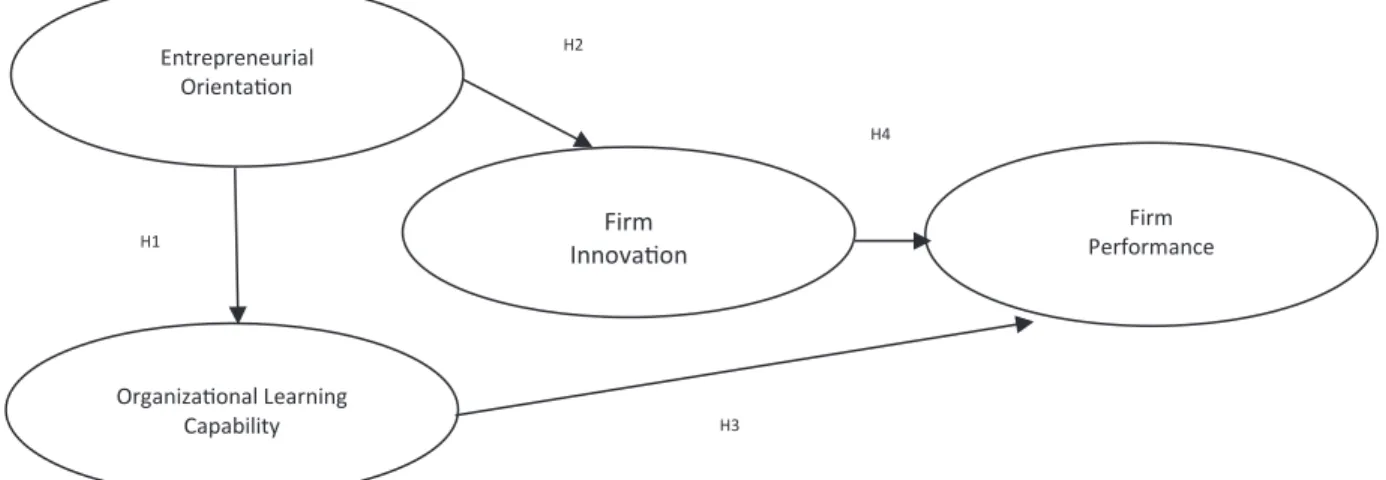
Based on the literature review, the framework of the study is illustrated in Figure 1. The hypothesis is that, the mediating roles of organizational learning capability and firm innovation in the relationship between entrepreneurial orientation and firm performance.
4. Data Methods 4.1. Sample and Data
The empirical investigation of this study was accomplished on a population of gems & jewelry industries, textile and clothing industries, leather and accessories, fashion apparel industries in Thailand. Here, all 673 gems
& jewelry industries, textile and clothing industries, leather and accessories, fashion apparel industries in Thailand from https:// www.thaitextile.org/databaseTh/home/ (2020), Thailand were selected as the samples. To achieve a data collection, a mail survey procedure via questionnaire was implemented by using executives or managers of gems &
jewelry industries, textile and clothing industries, leather
Entrepreneurial Orienta�on
Organiza�onal Learning Capability
Firm Performance Firm
Innova�on
H1
H2
H3
H4